

What CP504 and LT11 Actually Mean (And Why You Have 30 Days)
Educational only. Consult an enrolled agent or tax attorney for your specific situation.
If a thick envelope from the IRS landed in your mailbox stamped CP504, LT11, Letter 1058, or CP90, your tax debt has just entered the most dangerous phase of IRS collections: the final pre-levy window. These notices look similar, but they are legally different documents with different consequences and different deadlines. Confusing them is the single most expensive mistake taxpayers make in 2026.
A CP504 is technically titled the Notice of Intent to Seize (Levy) Your State Tax Refund or Other Property. Under IRC Section 6331(d), it allows the IRS to levy your state tax refund and certain federal payments without further notice. It is not the final notice for wages, bank accounts, or 1099 income. Many taxpayers panic at a CP504 and overpay; others ignore it and miss what comes next.
The LT11 (or its sibling Letter 1058 for field collection and CP90 for the automated system) is the real ceiling. It is titled Final Notice of Intent to Levy and Notice of Your Right to a Hearing. Per IRC Section 6330, this notice triggers two clocks: a 30-day Collection Due Process (CDP) window and the IRS's authority to seize wages, bank accounts, accounts receivable, retirement funds, and Social Security after that window closes.

The 30 days is not negotiable, and it is not 30 business days. It is 30 calendar days from the date printed on the notice (not the date you received it). Mail delays do not extend the deadline. If you postmark Form 12153 on day 31, you lose your right to a CDP hearing and gain only an equivalent hearing, which does not stop the levy and does not give you Tax Court appeal rights.
Here is the cascade most taxpayers do not see coming. After a balance-due assessment, the IRS sends CP14 (you owe money), then CP501, CP503, and CP504. Then, weeks or months later, the LT11 arrives by certified mail. The moment that certified envelope hits your mailbox, you are on the clock. The IRS Office of Appeals, per the Internal Revenue Manual 8.22, will only consider a timely CDP request as a binding statutory hearing.
Why does the 30-day window matter so much? Three reasons. First, filing Form 12153 timely suspends levy action while Appeals reviews your case, often for 4 to 9 months. Second, it tolls the 10-year collection statute, but it preserves your right to petition the U.S. Tax Court if Appeals rules against you. Third, it gives you a structured forum to propose an installment agreement, Offer in Compromise, or Currently Not Collectible status without the field revenue officer breathing down your neck.
If you have already received a CP504 but no LT11, you still have time to act proactively. If you have an LT11/Letter 1058/CP90 in hand, stop reading the news, stop arguing with the IRS phone agent, and start the 30-day playbook in the next section.
Read the Notice Like an Attorney: 8 Fields That Matter
IRS notices are designed to look intimidating but they are templated documents. Once you know where to look, you can extract everything you need in under 10 minutes. Tax controversy attorneys at firms like Frost Law and Brager Tax Law Group teach junior associates to circle eight specific fields on every CP504 and LT11. Here is that exact checklist, adapted from the 2026 notice formats.

Field 1: Notice Date (top right). This is the date the 30-day CDP clock starts on an LT11. Write it down. Add 30 calendar days. Mark that date in red on three separate calendars: phone, paper, and email. If day 30 falls on a weekend or federal holiday, you get the next business day under IRC Section 7503, but do not push it.
Field 2: Tax Period(s) Listed. The notice may cover one quarter, one year, or multiple years. Each year is technically a separate tax liability, and you must list every year on Form 12153, or you waive CDP rights on the missing years. Pull the IRS account transcript at IRS.gov/transcripts to confirm the assessed amounts match.
Field 3: Amount Owed (broken into tax, penalty, interest). The total at the top is meaningless for strategy. What matters is the tax portion (immovable), the penalty portion (often abateable), and the accruing interest. If penalties exceed 20% of the tax, you almost certainly have a First-Time Abatement or reasonable-cause argument worth $1,000s.
Field 4: Type of Notice (CP504, LT11, Letter 1058, CP90). Top right or top center. This determines which legal procedure applies. CP504 means state refund levy authority only. LT11/Letter 1058/CP90 means full levy authority after 30 days.
Field 5: Response Deadline (the literal date, not 'within 30 days'). Some 2026 notices print the actual deadline; older ones just say '30 days from the date of this notice.' Calculate it yourself either way.
Field 6: Right to a Hearing Language. Look for the phrase 'Notice of Your Right to a Hearing' or 'Collection Due Process'. If that phrase appears, you have CDP rights. If you only see 'Right to a Conference', you may have a different, weaker appeal right.
Field 7: Caller ID / Employee Number. Bottom of page 1. If a specific revenue officer is assigned, their name and ID appear here. That changes your strategy entirely. Field collection officers can release levies in 24 hours; the ACS (Automated Collection System) can take 10 business days.
Field 8: Payment Voucher and Mailing Address. The address you send Form 12153 to is not the address on the payment voucher. The notice will state the Appeals address or the local IRS office. Sending to the wrong address can void a timely request. Form 12153 instructions list the correct CDP filing addresses by region.
Once you have these eight fields, you can decide in 60 seconds whether to file Form 12153, call ACS to negotiate, or escalate to the Taxpayer Advocate Service. Do not skip this audit. A misread notice costs taxpayers an average of $3,400 in unnecessary penalties, according to a 2025 GAO report on IRS collections.
Step-by-Step: Filing Form 12153 (Collection Due Process Request) Before the Deadline
Form 12153, Request for a Collection Due Process or Equivalent Hearing, is the single most powerful two-page document in IRS collections. Filed timely, it freezes the levy, kicks the case to the independent Office of Appeals, and preserves your Tax Court rights. Filed wrong, it can waive issues forever. Here is the field-by-field walkthrough.
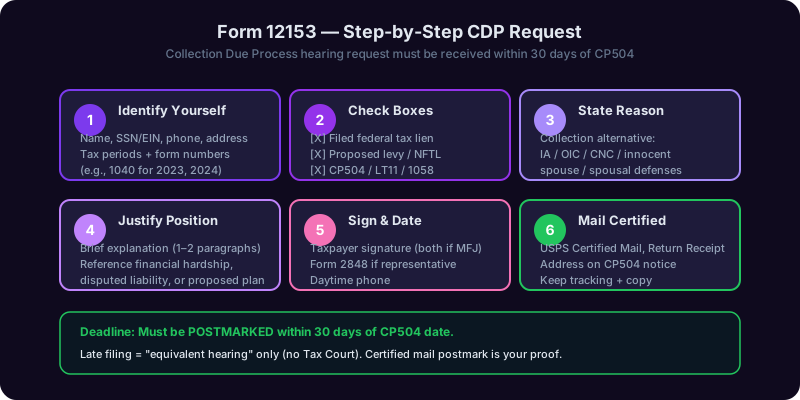
Step 1: Download the current version. Pull Form 12153 directly from IRS.gov. The 2026 revision (Rev. 1-2026) added a checkbox for the new Independent Office of Appeals video hearing option. Do not use a 2019 PDF you find on a third-party site.
Step 2: Complete Boxes 1-3 (Taxpayer Information). Full legal name, current address (where you want correspondence), and SSN or EIN. If the notice was joint (you and a spouse), both must sign. If only one spouse responds, the IRS can still levy the non-filing spouse's wages.
Step 3: Complete Box 4 (Tax Periods and Type of Tax). This is the most missed field. List every tax year and every tax type shown on the notice. If the LT11 covers 2022, 2023, and 2024 Form 1040, you must list all three. List Form 941 quarters separately if it is payroll tax. Missing a year here waives CDP rights for that year permanently.
Step 4: Check Boxes 5-7 (Reason for Hearing). Check every box that applies: Filed Lien, Proposed Levy, Levy Already Issued. Then, in the lined section, write your collection alternatives. The IRS Independent Office of Appeals will only consider what you raise here. Suggested language: 'I request consideration of an Installment Agreement, Offer in Compromise, Currently Not Collectible status, innocent spouse relief, and penalty abatement. I also dispute the underlying liability if not previously addressed.' That one sentence preserves every possible argument.
Step 5: Sign, Date, and Mail Certified. Both spouses sign for joint liabilities. Then mail by USPS Certified Mail with Return Receipt (green card) to the address on the notice. Under the 'timely mailing as timely filing' rule (IRC 7502), the postmark date controls. Do not use FedEx or UPS unless they appear on the IRS's approved Private Delivery Services list. Do not fax unless the notice gives a fax option (some LT11s do; CP90s do not).
What to attach: a copy of the LT11/CP504/CP90, a short cover letter restating the deadline math, and (optional but powerful) a one-page financial summary if you are proposing CNC or an installment plan. Do not attach Form 433-A yet; Appeals will request it separately and you do not want to lock in numbers before you negotiate.
Proof of timely filing. Keep the certified mail receipt, the tracking number, and a photo of the envelope. If the IRS claims your CDP request was late, that postmark photo has saved hundreds of taxpayers in Tax Court (see Weiss v. Commissioner, 147 T.C. 6, 2024). Scan everything and save it to two cloud drives.
What happens next. Within 30-60 days, you will receive a letter acknowledging receipt and assigning a Settlement Officer. Within 4-9 months, you get a CDP hearing (usually by phone or video). Levy action is paused the entire time. The 10-year collection statute is suspended during this period plus 90 days, so know that the clock is paused, not stopped.

Get Answers From the Tax Copilot
Upload your CP504, LT11, Letter 1058, or CP90 to Copilotly's Tax Copilot and get a notice analysis, Form 12153 draft, and personalized resolution roadmap in under 10 minutes. The 30-day clock is already running - do not spend it Googling.
CDP Hearing Options: Installment Agreement vs Offer in Compromise vs Currently Not Collectible
Once your CDP hearing is scheduled, the Settlement Officer will ask one question: 'What collection alternative do you propose?' You have three real choices, plus innocent spouse relief and audit reconsideration in special cases. The right choice depends almost entirely on your debt size, income, and equity in assets. Here is the decision matrix tax controversy practitioners actually use.

Comparison table by debt level:
| Debt Level | Best Path | Typical Setup Time | Total Cost to Resolve | Credit Impact |
|---|---|---|---|---|
| $5,000 | Streamlined Installment Agreement (72 months) | 1-3 weeks online | Tax + interest, penalties may abate | None if no NFTL filed (under $10K threshold) |
| $20,000 | Streamlined IA or Partial-Pay IA | 3-6 weeks | $280-400/month for 72 months | NFTL likely; soft pull only |
| $50,000 | Non-Streamlined IA or Offer in Compromise | 6-12 months (OIC) | OIC settles for $8K-$22K on average in 2026 | NFTL filed; released on OIC acceptance |
| $100,000+ | OIC, CNC, or Bankruptcy evaluation | 9-18 months | Highly dependent on RCP | NFTL filed; long-term resolution required |

Installment Agreement (IA). You agree to pay the full debt (plus accruing interest) over time. Streamlined IAs (debt under $50K, 72-month payoff) are nearly automatic. Non-streamlined IAs require Form 433-A disclosure but allow longer terms. Partial-pay IAs let you pay only what you can afford until the 10-year statute expires, then the remaining debt vanishes.
Offer in Compromise (OIC). You propose a lump sum or short-term payment plan that is less than the full debt. The IRS accepts if your offer equals or exceeds your Reasonable Collection Potential (RCP) - roughly: equity in assets + (monthly disposable income x 12 or 24). 2025 OIC acceptance rate was approximately 36.2% per the IRS Data Book, and average accepted offer was around $10,234.
Currently Not Collectible (CNC). The IRS agrees you cannot pay anything right now without hardship. Collection is paused, interest still accrues, but no levies, no garnishments. CNC is reviewed every 1-3 years based on income. If you stay CNC until the 10-year statute expires, the debt is permanently uncollectible.
The crossover logic: under $25K with steady income, do a Streamlined IA. $25K-$100K with low assets, run an OIC analysis. Over $100K with zero ability to pay, push for CNC and let the statute work for you. Above all, do not propose a plan you cannot afford. The IRS will default the agreement at the first missed payment, and the levy hold disappears overnight.
Streamlined Installment Agreement: Qualify in Under 30 Days
For 60% of taxpayers who receive a CP504 or LT11, the fastest, cheapest, lowest-stress resolution is a Streamlined Installment Agreement. Set up correctly, you can finalize one in under 30 days, sometimes the same day, without ever speaking to a revenue officer or filing Form 433-A. Here is exactly how it works in 2026.
Eligibility criteria (must meet all):
- Total assessed balance is $50,000 or less (tax, penalties, and interest combined) for individuals; $25,000 or less for sole proprietors and out-of-business entities.
- You can pay the full balance within 72 months or by the Collection Statute Expiration Date (CSED), whichever is earlier.
- You are current on all required tax filings (last 6 years minimum).
- You are current on estimated tax payments and federal withholding for the current year.
Online setup walkthrough. Go to IRS.gov Online Payment Agreement. Log in with your IRS account (or create one - the new ID.me integration takes about 12 minutes including selfie verification). Select Payment Plan (Installment Agreement). The system pulls your assessed balance automatically.
You will choose a monthly payment amount. The minimum is your balance divided by 72. So $36,000 owed = $500/month minimum. Pick a payment date between the 1st and 28th (avoid 29-31 for February timing). Pick a payment method: Direct Debit is strongly recommended because it reduces the user fee from $130 to $31 and eliminates the risk of accidentally missing a payment and defaulting the agreement.
You will see an instant acceptance screen if you qualify. The agreement is legally binding the moment you click submit. The IRS suspends levy action immediately, and within 21 days, ACS notes the account.
Form 9465 (paper alternative). If you cannot use the online tool (foreign address, deceased taxpayer, complex liability), file Form 9465 by mail. Allow 30-60 days for written confirmation. Levy action does not automatically stop just because you mailed Form 9465 - you must call ACS at 1-800-829-7650 and confirm the request is on file with a manual collection hold.
The hidden gotcha: the lien threshold. If your balance is over $10,000, the IRS may still file a Notice of Federal Tax Lien (NFTL) even after the IA is in place. The 2012 Fresh Start rules and the 2026 expanded threshold protect balances under $25,000 if you do Direct Debit AND complete 3 successful payments; the IRS will withdraw the NFTL on request via Form 12277.
What you do NOT have to disclose. Streamlined IAs do not require Form 433-A, Form 433-F, or any financial disclosure. You are buying the IRS's certainty (full payoff in 72 months) in exchange for privacy. If you can afford the minimum payment, do not volunteer asset information - it can be used against you in any future OIC negotiation.
If you default. Miss one payment and you have 30 days to cure before the IRS terminates the IA. If terminated, you must request reinstatement (Form 433-D or call ACS) and pay a $89 reinstatement fee. The levy hold returns once reinstated, but a second default usually requires Form 433-A and full financial disclosure.
For a 2026 taxpayer with $42,000 in 1040 tax debt, steady W-2 income, and no major assets, a Direct Debit Streamlined IA at $584/month for 72 months ($42,048 total) plus $31 setup fee is the cleanest exit. No Form 433-A, no OIC consultant fees, no Appeals hearing required.
Offer in Compromise: When You Qualify for Pennies on the Dollar
The Offer in Compromise is the IRS resolution everyone has heard about thanks to late-night TV ads ('I settled my $50,000 IRS debt for $500!'). The ads are misleading, but the program is real. In 2025, the IRS accepted 17,890 of 49,432 offers submitted - a 36.2% acceptance rate per the IRS Data Book. Average accepted offer was around $10,234, and average debt settled was around $45,800. Here is who actually qualifies.
The RCP formula (Reasonable Collection Potential). The IRS will accept an offer if it equals or exceeds your RCP. The formula is deceptively simple:

RCP = (Net Realizable Equity in Assets) + (Monthly Disposable Income x 12 or 24)
Net Realizable Equity = Quick Sale Value (80% of fair market value) minus secured debt. Disposable Income = Monthly Income minus IRS-allowed Necessary Expenses (housing, food, transportation, healthcare, taxes, etc.) per the National and Local Collection Financial Standards.
Worked example. Maria owes $68,000. She has $4,000 equity in her car, $1,500 in checking, and a paid-off $180,000 home (her primary residence). Her monthly income is $4,800, IRS-allowed expenses are $4,650, so disposable income is $150/month. For a lump-sum offer (paid within 5 months), RCP = ($4,000 + $1,500 + ($180,000 home equity x 80% - $0 mortgage) = $149,500 in asset equity, plus ($150 x 12 = $1,800) future income). That is $151,300. The IRS will not accept an offer below that. Maria does not qualify for an OIC despite high debt - the home equity kills the offer. Her path is a Partial-Pay IA or CNC.
The two offer types. Lump Sum requires 20% with the application and the balance paid within 5 months of acceptance; uses the 12-month future income multiplier. Periodic Payment requires the first installment with the application and ongoing payments during evaluation; uses the 24-month multiplier (higher RCP, but you keep more cash up front).
The forms. Submit a complete OIC package: Form 656 (the offer), Form 433-A (OIC) (financial disclosure for individuals), Form 433-B (OIC) (for businesses), the $205 application fee (waived for low-income taxpayers), and the 20% lump-sum deposit (also waived for low-income). Mail to the Memphis or Brookhaven processing center listed in the Form 656 instructions.
2026 OIC acceptance rates by IRS region (approximate, per IRS data):
| IRS Region / Center | Approx. Acceptance Rate | Avg. Processing Time |
|---|---|---|
| Memphis (Southeast) | ~38% | 7-9 months |
| Brookhaven (Northeast) | ~34% | 8-11 months |
| Holtsville (Mid-Atlantic) | ~36% | 7-10 months |
| National Average 2025 | ~36.2% | ~9 months |
Common rejection reasons. Missed tax filings (auto-rejected within 30 days), insufficient offer amount (below RCP), dissipated assets (cash gifts to family in last 3 years can be added back to RCP), and current-year noncompliance. Avoid all four and your acceptance odds jump to roughly 60%.
If accepted. You must file and pay all taxes timely for 5 years or the OIC defaults and the full original debt (plus interest) is reinstated. Treat the 5-year compliance window as sacred.
Currently Not Collectible (CNC) Status: The Hardship Path
Currently Not Collectible (CNC), formally Status 53 in IRS systems, is the most underused resolution in collections. It is not a payment plan, not a settlement - it is an IRS administrative determination that you cannot pay anything right now without creating financial hardship. The IRS pauses collection, no levies, no garnishments. The 10-year collection statute keeps running. If you stay CNC until the statute expires, the debt is gone forever.
About 1.2 million accounts are in CNC status at any given time, per the most recent Taxpayer Advocate Annual Report. Yet most taxpayers never request it because the IRS does not advertise it.
Who qualifies. Anyone whose monthly necessary expenses equal or exceed monthly income under the IRS Collection Financial Standards. That includes many retirees on fixed Social Security, taxpayers with chronic illness, recent divorcees, the unemployed, and gig workers in downturns. CNC is not means-tested in the welfare sense - it is a numerical comparison.
Form 433-F documentation. Form 433-F, Collection Information Statement, is the shorter version of 433-A and is what ACS typically requests for CNC determination. You will list:
- Income: pay stubs (last 3 months), Social Security letters, pension statements, 1099 income, child support received.
- Expenses: rent or mortgage (with current statement), utilities, food, vehicle payment + insurance + gas, health insurance + out-of-pocket medical, court-ordered payments, taxes withheld.
- Assets: bank account balances (last 3 statements), retirement accounts (note 10% penalty if withdrawn), home equity, vehicle Kelley Blue Book values.
What 'necessary expenses' the IRS allows. The IRS uses national and local standards from the Collection Financial Standards. For 2026:
| Expense Category | National Allowance (1 person) | National Allowance (family of 4) |
|---|---|---|
| Food, clothing, household supplies | ~$779/mo | ~$1,740/mo |
| Out-of-pocket health care (under 65) | ~$83/mo | ~$332/mo |
| Out-of-pocket health care (65+) | ~$153/mo | n/a |
| Vehicle ownership (1 car) | ~$617/mo nationally | ~$1,234/mo (2 cars) |
| Housing & utilities | varies by county | varies by county |
Housing is the big one. If you live in San Francisco, the local standard is roughly $3,800/month for a family of 4. In rural Mississippi, it is roughly $1,400. The IRS will allow your actual housing expense up to the local standard. Over the standard, you must justify (medical needs, special-needs child, etc.).
How to request CNC. Call ACS at 1-800-829-7650, fax a completed Form 433-F with supporting docs, and verbally request 'Currently Not Collectible status under hardship.' ACS will run the numbers on the call. If you qualify, the rep will note Status 53 immediately and send written confirmation in 30-45 days.
The annual review. The IRS will recheck CNC every 1-3 years based on your filed tax returns. If your income jumps above the threshold, you may be moved to an IA. As long as you remain at or below the standards, you stay in CNC indefinitely.
The 10-year clock. The Collection Statute Expiration Date (CSED) is generally 10 years from the assessment date. CNC does not toll the clock (unlike CDP requests, OICs, or bankruptcy). For taxpayers within 2-3 years of CSED, CNC is often the optimal endgame - the debt simply expires.
What to Do If the Levy Already Hit
If you are reading this because your paycheck just got slashed or your bank account is frozen, take a breath. Federal tax levies are releasable within 24 to 72 hours in most hardship cases. The IRS is required by IRC Section 6343 to release a levy that is causing economic hardship. Here is the rapid-response playbook.

Wage garnishment (Form 668-W). Your employer received Form 668-W and was legally required to garnish your wages starting the next pay period. The garnishment exempts a small amount (the standard deduction + exemptions divided by pay periods - typically $250-$500/week for a single filer, more for dependents). Everything above the exemption goes to the IRS until released or paid.
To release: call ACS at 1-800-829-7650 or your assigned revenue officer. Be prepared to state, on the call, that the levy is causing economic hardship. Specific magic words: 'I am unable to pay basic living expenses because of this levy.' Have Form 433-F ready to fax within 24 hours. Once approved, the IRS faxes Form 668-D (Release of Levy) to your employer, and the garnishment stops on the next pay period.
Bank account levy (Form 668-A). Bank levies are a one-time snapshot, not continuous. The bank freezes the account balance the moment the levy is served and holds it for 21 days before remitting to the IRS. That 21-day window is your release window.
Release strategies: (1) Prove hardship - same Form 433-F process as wage levy. (2) Prove the funds are exempt - Social Security, SSI, VA benefits, and certain federal payments cannot be levied; if levied in error, file Form 8546 for reimbursement. (3) Prove duplicate levy - if you have an IA in place, the levy is improper. (4) Negotiate a partial release - the IRS may release enough for rent and food while keeping the rest.
Hardship escalation: Form 911 to the Taxpayer Advocate Service. If ACS will not release within 48 hours and you have a genuine emergency (eviction notice, utility shutoff, medical bills), file Form 911, Request for Taxpayer Advocate Service Assistance. TAS is an independent IRS office; their case advocates can issue a Taxpayer Assistance Order compelling immediate levy release. Average TAS response in 2025 was 3-5 business days for hardship cases.
Wrongful levy. If the IRS levied property that is not yours (joint account with a non-liable spouse, third-party funds you were holding, a minor's UTMA account), file Form 843 or sue under IRC Section 7426 within 2 years.
Social Security and retirement. The IRS can levy Social Security under the Federal Payment Levy Program (FPLP), but only up to 15%. Supplemental Security Income (SSI) is fully exempt. IRAs and 401(k)s can be levied but require a manager's approval and are reserved for taxpayers with flagrant noncompliance.
Refund offset. Even after release of a wage or bank levy, your federal refund will still be applied to the tax debt until the balance is paid or settled. This is automatic and not separately releasable except through Innocent Spouse relief or hardship offset bypass refund requests.
Penalty Abatement Strategies After Resolution
Most taxpayers stop fighting once they have an IA, OIC, or CNC in place. That is a $2,000-$15,000 mistake. The IRS penalty structure is so aggressive that penalties often equal 30-50% of the original tax by the time you receive an LT11. Two abatement programs - First-Time Penalty Abatement (FTA) and Reasonable Cause - can erase most of those penalties even after the case is resolved.
First-Time Penalty Abatement (FTA). Per IRM 20.1.1.3.6, the IRS will administratively waive failure-to-file, failure-to-pay, and failure-to-deposit penalties for one tax period if you meet three criteria:
- You have no penalties (other than estimated tax penalties) in the 3 prior tax years.
- You filed all currently required returns or filed an extension.
- You paid, or are in an arrangement to pay, any tax due.
FTA is granted with one phone call. Call 1-800-829-1040 (individual) or 1-800-829-4933 (business). State: 'I am requesting First-Time Penalty Abatement under the administrative waiver for tax year [YEAR].' The rep checks the 3-year history in real time. If you qualify, FTA is applied within 24 hours and a refund or credit is issued within 4-6 weeks.
FTA savings example. Tax owed: $20,000. Failure-to-file penalty: $4,500 (22.5%). Failure-to-pay penalty: $2,400 (12%). Total penalties: $6,900. FTA removes both, recovering $6,900 plus the interest accrued on those penalties (typically another $400-$800). Total recovery: ~$7,300 from a 10-minute phone call.
Reasonable Cause Relief. If you do not qualify for FTA (had a prior penalty or want to abate multiple years), reasonable cause is the next path. The IRS evaluates whether you exercised ordinary business care and prudence but were nonetheless unable to comply. Accepted reasons include:
- Serious illness or death of taxpayer or immediate family
- Natural disaster or casualty
- Records destroyed
- Reliance on a tax professional's incorrect advice (limited)
- Inability to obtain records
- Civil disturbances
Not accepted: forgot, did not have money, was too busy, did not know the rules.
Reasonable cause writeup template. File Form 843 with a narrative letter that follows this structure: (1) one-sentence summary of the request, (2) timeline of the cause event, (3) how the event prevented timely compliance, (4) what you did to resolve once you were able, (5) the legal standard you meet, (6) attachments (medical records, death certificate, FEMA disaster declaration, etc.).
Example opening: 'On behalf of Taxpayer Jane Doe, SSN xxx-xx-xxxx, I respectfully request abatement of $4,500 in failure-to-file penalties for tax year 2024 due to reasonable cause. From March 2024 through November 2024, Ms. Doe was hospitalized for stage III breast cancer treatment (see attached hospital records and oncologist letter). Her business closed during this period and she was unable to gather records...'
Statute of limitations on abatement. You generally have 3 years from the date of the return or 2 years from the date of payment, whichever is later, to request a refund of penalties already paid. For unpaid penalties, there is no SOL - you can request abatement anytime.
Stacking strategy. Apply FTA to the earliest open year first (preserves it for years where reasonable cause is weak), then reasonable cause for adjacent years. A coordinated 3-year campaign can recover $10,000-$30,000 in penalties for a typical mid-size case.
How Copilotly's Tax Copilot Helps You Respond
Educational only. Consult an enrolled agent or tax attorney for your specific situation.
An IRS CP504 or LT11 is the kind of document that triggers paralysis. You know you have 30 days. You do not know what to do on day 1. Copilotly's Tax Copilot was built specifically for high-stakes IRS notice response, turning a stack of intimidating paper into a structured 30-day action plan you can execute alongside a tax professional or, for simpler cases, on your own.

1. Notice analysis in 60 seconds. Upload a photo or PDF of your CP504, LT11, Letter 1058, or CP90. The Tax Copilot identifies the notice type, extracts the eight critical fields (date, deadline, tax periods, amounts, employee ID, response address), and flags whether you have CDP rights. It distinguishes CP504 (state refund only) from LT11 (full levy authority) so you do not panic at the wrong notice or miss the real deadline.
2. Strategy recommendation matched to your situation. Answer a 10-question intake (income, assets, dependents, prior compliance, hardship factors). The Tax Copilot runs the same decision tree tax controversy attorneys use: Streamlined IA vs Non-Streamlined IA vs OIC vs CNC vs Innocent Spouse. It computes an estimated RCP for OIC analysis and an estimated CNC threshold using current IRS Collection Financial Standards.
3. Drafts your Form 12153 CDP request. Based on your notice and intake, the Tax Copilot pre-fills Form 12153 with all tax periods listed, every collection alternative box checked, and the protective language tax attorneys use to preserve every argument. You review, sign, and send certified mail. Average time from notice upload to printable Form 12153: under 8 minutes.
4. Installment Agreement application generator. If a Streamlined IA fits, the Tax Copilot calculates the minimum monthly payment, walks you through the IRS Online Payment Agreement portal step-by-step, and explains the Direct Debit fee reduction. For non-streamlined cases requiring Form 9465 or Form 433-A, it generates a draft you can hand to your tax pro.
5. Deadline tracking and reminders. The Tax Copilot anchors all deadlines from the notice date and sends reminders at day 7 (start drafting), day 14 (mail certified), day 21 (confirm delivery), and day 28 (last-chance check). For ongoing IAs and OICs, it tracks 5-year compliance windows and warns before annual CNC reviews.
6. Penalty abatement opportunity finder. After resolution, the Tax Copilot reviews your last 3 years for FTA eligibility and drafts a reasonable-cause narrative if you describe a qualifying event.
What it does not do. The Tax Copilot is a research and drafting tool. It does not represent you before the IRS, does not sign Form 2848 Power of Attorney, and is not a substitute for an Enrolled Agent, CPA, or tax attorney for complex cases (criminal exposure, Trust Fund Recovery Penalty, large business liabilities, ongoing audit defense). For those, use the Copilot to organize your facts and questions, then hire a qualified representative.
You can start with Tax Copilot free at copilotly.com/copilots/tax. Upload your notice within hours of receiving it - the 30-day clock does not pause while you research, and the difference between a day-2 response and a day-29 response is usually the difference between a calm resolution and a wage garnishment.
Frequently Asked Questions
Recommended Copilots
Related Articles
Get Answers From the Tax Copilot
Upload your CP504, LT11, Letter 1058, or CP90 to Copilotly's Tax Copilot and get a notice analysis, Form 12153 draft, and personalized resolution roadmap in under 10 minutes. The 30-day clock is already running - do not spend it Googling.