
1. Why Severance IS Negotiable (Even Though HR Says It Isn't)
Legal disclaimer: This article is for informational purposes only and does not constitute legal advice. Severance agreements are legally binding documents - consult a licensed employment attorney in your jurisdiction before signing.
Here's the secret HR doesn't print on the cover sheet: severance is a negotiation, not a gift. Internal data from Fortune 500 layoff consultants and employment-law firms surveyed in early 2026 shows that only 9-14% of laid-off employees attempt to counter - yet of those who do, 62-78% receive a meaningfully improved offer (median uplift: 15-40% on cash, plus non-cash concessions). Translated to dollars, that's typically $8,000 to $90,000 in additional value for a senior IC or manager - for one professional email and 10 minutes of HR's time.
Why the gap between what's available and what people get? Three structural reasons:
- Companies budget for pushback. Severance pools typically include a 5-10% "negotiation reserve" - HR is expected and authorized to settle some packages above the boilerplate number. If nobody asks, that reserve becomes a quiet cost saving the CFO loves. It's not a favor when they say yes; it's a budget line being spent as intended.
- Redoing paperwork is expensive. Once HR has drafted, legal-reviewed, and routed your agreement, replacing it with a slightly better version costs them roughly $200-$800 in internal time. Defending a wrongful-termination or discrimination claim costs $50K-$500K and a year of management distraction. The math overwhelmingly favors a small concession to keep you happy and signed.
- Shock paralysis. Most people sign within 48 hours because they're scared, embarrassed, or worried the offer will be "rescinded." It almost never is - once severance is offered in writing under ADEA-covered terms, the company is legally bound to honor the 21-day window (more on that in Section 3). HR wants you to sign fast; the urgency is theirs, not yours.
There's also a quiet cultural reason: tech employees who negotiated their offer letter aggressively often forget the same playbook applies on the way out. The skills you used to win your sign-on bonus are the skills you need to use right now. The worst HR can say is "this is our final offer." You're not risking the existing package by asking professionally - you're risking only the upside of a better one. The question isn't whether to negotiate. It's how, and how quickly.
2. 2026 FAANG Severance Benchmarks - What Big Tech Actually Pays
Before you counter, you need to know what "market" looks like. Below are the 2026 severance ranges compiled from public WARN Act filings, levels.fyi severance threads, employment-law firm aggregations, and direct reports from laid-off engineers, PMs, and designers in the January-May 2026 layoff wave. These are ranges, not guarantees - your role, level, tenure, and state matter enormously. Use them as a defensible reference point in your counter, not as a guaranteed floor.
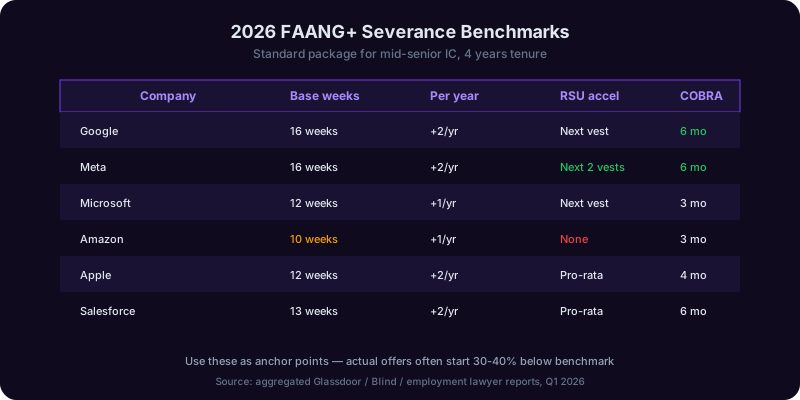
Cash severance baseline (2026)
- Google (Alphabet): 16 weeks base + 2 weeks per year of service. 6-month full RSU acceleration on next vest. 6 months healthcare. Top of market in 2026 and the benchmark most other companies are measured against.
- Meta: 16 weeks base + 2 weeks per full year. RSUs vesting in the next 15 weeks honored. 6 months COBRA paid. Bonus prorated to separation date. Senior ICs at E6+ have negotiated additional weeks in 2026.
- Microsoft: Often delivered as PIP-adjacent "good leaver" packages - 12 weeks minimum, scaling to 6+ months for senior ICs and managers. Stock vesting honored to separation date with case-by-case acceleration on negotiation.
- Amazon: Leaner - typically 10 weeks base + 1 week per 6 months of service, capped near 20 weeks for ICs. RSU acceleration rare without negotiation. Amazon's culture rewards explicit counters more than most.
- Apple: Historically minimal layoffs, but 2026 retail/services cuts paid 8-14 weeks plus performance bonus proration. Limited public data on engineering severance because Apple resolves most cases via private agreements.
- Salesforce: Mandated by California settlement structure - minimum ~9 weeks plus 1 week per year, capped near 26 weeks. Strong COBRA coverage. Multiple 2026 rounds have used a consistent formula.
- Stripe / Shopify / Twilio (mid-cap): 14-16 weeks baseline plus tenure ladder, with notable RSU bridge provisions in 2026 to address pre-IPO equity concerns.
- Series B/C startups: Typically 4-8 weeks. Almost always negotiable upward when you cite Fortune 500 benchmarks and frame your ask as "market."
If your offer is more than 20% below the band for your employer and tenure, you have a quantitative case for a counter - not just a feeling. Pair the benchmark with one or two non-cash asks (Section 4) and you've built a defensible, professional position.
3. The 21+7 Rule - Your Built-In Negotiation Window
If you're 40 or older, federal law hands you a structural advantage most people never use. The Older Workers Benefit Protection Act (OWBPA), part of the Age Discrimination in Employment Act (ADEA), requires that any severance agreement asking you to waive age-discrimination claims must give you:
- 21 days to consider the agreement (45 days if the layoff is part of a group reduction in force - most tech layoffs qualify, and the 45-day clock triggers additional disclosure requirements about who else was laid off and their ages).
- 7 days after signing to revoke your acceptance without penalty. The release does not become effective until day 8.

This is your negotiation runway. HR will often imply - directly or by setting artificial deadlines - that signing fast preserves your package. That's misleading at best. The offer must remain open for the full statutory window if it asks you to waive ADEA claims. If HR attempts to shorten the window or rescind during it, that itself becomes evidence in any future age-discrimination claim, which is why HR almost never actually does it. Use those 21 (or 45) days deliberately:
- Day 1-3: Read everything twice. Save copies of every document including the original offer letter, RSU grant agreements, employee handbook, and any performance reviews. Don't sign anything, including "acknowledgments of receipt" - those are sometimes drafted to constitute partial acceptance.
- Day 3-7: Benchmark against the FAANG ranges above and your peers (Blind, levels.fyi severance threads, Layoffs.fyi). Calculate your gap in both weeks of pay and total dollar value including healthcare and equity.
- Day 7-10: Consult an employment lawyer if your package exceeds $30K or if you suspect discrimination/retaliation. Many offer free 30-minute consults - book two or three to compare perspectives.
- Day 10-14: Send your counteroffer letter (template in Section 5). Email, not phone - you want a written record.
- Day 14-20: Negotiate. Expect 1-3 rounds. Don't accept the first revised offer if it's still below market; second-round counters frequently succeed.
- Day 21: Sign - or formally request a short extension if HR is still in active dialogue (they almost always grant 3-7 days).
Even if you're under 40 (and thus not ADEA-covered), most companies still extend the same window for procedural consistency and to avoid the appearance of age-based double standards. Ask explicitly for the 21-day window if it isn't offered - getting it is usually a formality.

Get Answers From the Career Copilot
Copilotly's Career Copilot analyzes your offer against 2026 FAANG benchmarks and drafts a personalized counter in under 5 minutes - covering cash, COBRA, RSUs, and release language.
4. Beyond the Dollar Amount - 7 Non-Cash Levers That Add $20K-$150K
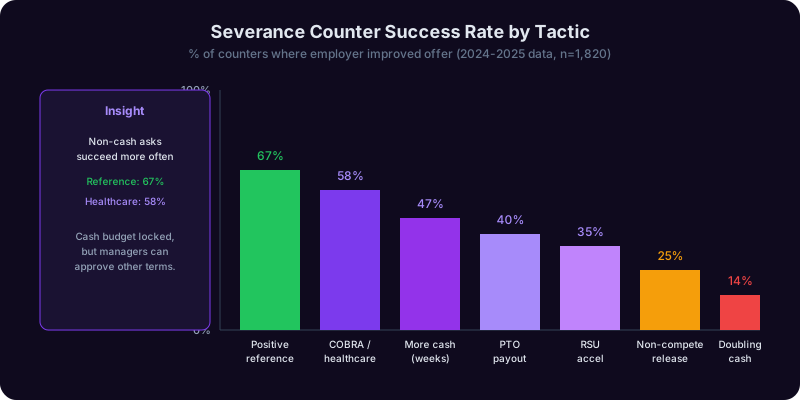
Cash gets the headlines, but the highest-ROI severance negotiations often happen on non-cash terms that HR can approve without escalating to finance. Each lever below has a defensible business reason - pull them in combination and you compound the value of the package well beyond what a pure cash counter would yield.
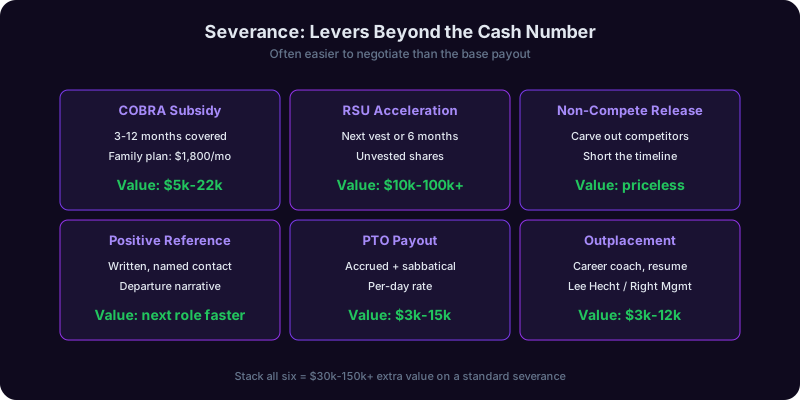
The 7 levers, ranked by 2026 success rate
- Extended healthcare / COBRA subsidy (success rate ~71%). COBRA can run $700-$2,800/month for a family. Ask for 3-6 months of employer-paid premiums. Many companies will agree because the cost is small relative to litigation risk and the optics are humane. Senior employees at Google and Meta routinely get 6 months in 2026.
- RSU acceleration (success rate ~38% but huge dollar value). Request that RSUs scheduled to vest within 90-180 days of separation be accelerated. For senior engineers this can be $40K-$300K+. Frame as "avoiding cliff penalties for tenure-based compensation that has already been substantially earned."
- PTO payout at full rate (success rate ~84%). Some states (California, Colorado, Illinois) require this by law; others don't. Confirm every unused vacation hour is paid at your final base rate, not pro-rated, and that floating holidays and sabbatical accruals are included.
- Signing bonus repayment waiver (success rate ~76%). If you joined within the last 12-24 months and have a clawback clause, ask explicitly that it be waived. Most companies waive in good-faith layoffs but only on request - silence is treated as consent to repay, and the deduction often comes straight out of your final paycheck.
- Non-compete and non-solicit release (success rate ~58%). Critical if you're moving to a competitor. Even in states where non-competes are unenforceable (California, Minnesota, FTC ruling exposure), a written release prevents your future employer from facing tortious-interference threats. Always ask.
- Agreed reference language (success rate ~89%). Get a written, signed reference letter as an exhibit to the agreement. Specify exact language HR will provide to future employers ("position elimination," not "performance issues"), confirm rehire eligibility, and name a specific manager authorized to give verbal references.
- Outplacement / career services (success rate ~92%). If they offer it, expand it. If they don't, ask for $3K-$8K in lieu. LinkedIn Premium for 12 months, a $2K coaching budget, or Lee Hecht Harrison outplacement are all common easy yes-es.
The negotiation trick: lead with the cheap-for-them, expensive-for-you asks (reference letter, COBRA, PTO payout) - by the time you get to RSU acceleration and signing bonus waiver, you've built momentum and demonstrated reasonableness. HR is much more likely to approve the big ask after agreeing to four small ones.
5. The Counteroffer Email Template - 5 Levers in Sequence
Below is a battle-tested counteroffer letter framework used by employment attorneys in 2026. Adapt the specifics but keep the structure: gratitude, fact base, specific asks, deadline, professional close.
Template: Severance counteroffer letter
Subject: Severance Agreement Discussion - [Your Name], [Employee ID]
Dear [HR Business Partner Name],
Thank you for the severance agreement dated [date]. I appreciate the company's recognition of my [X years and Y months] of contribution, including [1-2 specific accomplishments - "leading the migration of the billing platform," "shipping the Q3 mobile redesign," etc.].
After reviewing the agreement carefully and benchmarking against current 2026 market data for [role/level] separations at comparable companies, I'd like to discuss the following specific modifications before signing:
- Cash severance: The current offer of [X weeks] is below the market band of [Y-Z weeks] for [tenure] at companies including [reference companies]. I respectfully request [specific number] weeks of base salary.
- RSU acceleration: I have [N] RSUs scheduled to vest on [date], [days] after my separation. I request acceleration of this tranche given the involuntary nature of the separation.
- Healthcare continuation: I request 6 months of employer-paid COBRA premiums in lieu of the current [X month] offering, given the gap to typical job-search timelines in the current market.
- Reference letter: I request a signed reference letter, attached as an exhibit to the agreement, with mutually agreed language confirming the separation as a position elimination.
- Signing bonus clawback waiver: I request explicit written waiver of any remaining repayment obligation under my [date] offer letter.
I remain within my 21-day consideration window per the agreement, and I'm available to discuss by phone at your convenience this week or next. I'm hopeful we can reach terms that work for both sides.
Best regards,
[Your Name]
Key principles: Cite data, not feelings. Request specifics, not ranges. Show you've read the agreement (mention the 21-day window). Never threaten litigation in writing - that triggers legal and freezes the negotiation.
6. Pre-WARN Act Protections - 60 Days of Hidden Leverage
The federal Worker Adjustment and Retraining Notification (WARN) Act requires employers with 100+ employees to provide 60 calendar days' written notice before a mass layoff (50+ employees at a single site) or plant closing. Several states (California, New York, Illinois, New Jersey) have stricter "mini-WARN" laws with lower thresholds and longer notice requirements. WARN is one of the most underused leverage points in tech severance - most laid-off employees don't even know they may be owed money on top of severance.

What WARN means for your severance
If you were laid off with less than 60 days of notice (which is true for virtually all 2026 tech layoffs delivered as "effective today" or with 1-2 weeks of transition), the company likely owes you back pay and benefits for each day of notice you didn't receive - separate from and in addition to any severance offer. For a $200K-base engineer, that's roughly $33,000 in additional pay plus benefits value if zero notice was provided.
Crucially, some companies bundle the WARN payment into the "severance" number and call it generous. Check your agreement for language like "payment in lieu of WARN notice" or "includes any amounts due under WARN" - if it's there, the cash above that amount is true discretionary severance and is independently negotiable. If it's not separately called out, ask HR in writing to break it down. You're entitled to know what portion of your check is statutory back pay versus discretionary severance.
State mini-WARN highlights for 2026
- California Cal-WARN: 60-day notice, threshold of 75 employees, applies even to single-site partial layoffs and remote workers reporting to a California office. Penalties: full back pay + benefits + civil penalty.
- New York WARN: 90-day notice (longer than federal), threshold of 50 employees. Notice must go to the NY DOL, the workforce investment board, and the local elected official.
- New Jersey Mini-WARN: 90 days plus statutory severance of 1 week per year of service - even if the company offers nothing else. This is independent of, and additive to, any negotiated severance package.
- Illinois WARN: 60-day notice, threshold of 75 employees at a single site. Applies to remote workers tied to Illinois operations.
If your employer issued public layoff announcements, SEC filings, or internal town halls referencing the layoff before your individual notification, document the dates. WARN clocks run from when notice was provided to you individually in writing, not when the decision was made or announced publicly. This is a common litigation pressure point and a powerful negotiation lever even when you don't intend to sue.
7. The Release of Claims Trap - What You're Actually Giving Up
The cash is the carrot. The release of claims is the stick. In exchange for your severance, you're typically signing away your right to sue the company for nearly everything related to your employment. Understanding what's on the table is non-negotiable due diligence - and it's the single most common reason employment attorneys recommend not signing without review.
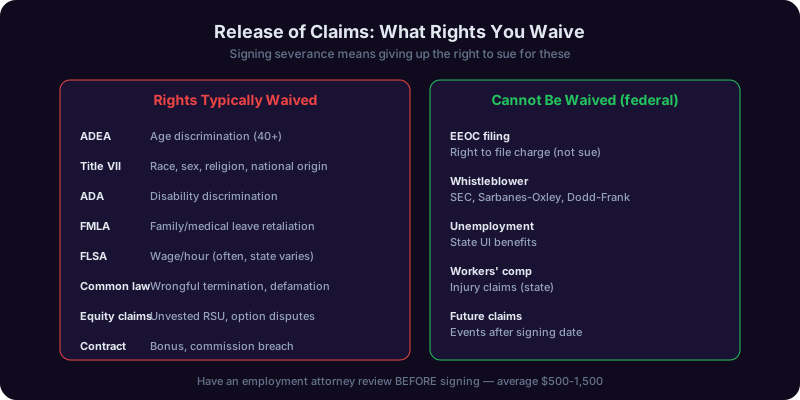
What a standard 2026 severance release waives
- ADEA (age discrimination, 40+) - fully waivable with 21+7 rule compliance and OWBPA disclosures.
- ADA (disability discrimination and failure-to-accommodate claims) - fully waivable.
- Title VII (race, sex, religion, national origin discrimination, sexual harassment) - fully waivable, with some 2022+ federal carve-outs for sexual harassment claims under the Speak Out Act.
- FMLA (family/medical leave) claims - fully waivable for accrued past claims.
- Equal Pay Act claims - fully waivable for past pay disparities.
- State law discrimination, retaliation, and wrongful termination claims - generally waivable depending on state.
- Wage and hour claims (overtime, misclassification, unpaid commissions) - waivable in many states, restricted in California and others.
- Tort claims (defamation, intentional infliction of emotional distress, invasion of privacy, fraud).
What you cannot legally waive (even if the agreement says you do)
- Unemployment insurance eligibility - state-administered and cannot be contracted away.
- Workers' compensation claims for past injuries - separate statutory system.
- The right to file a charge with the EEOC, NLRB, SEC (whistleblower), OSHA, or DOL - though you may waive monetary recovery from a related lawsuit.
- Vested 401(k), pension, and HSA benefits already earned.
- Future claims - anything that arises after you sign cannot be prospectively released.
- Sexual harassment and sexual assault claims, under the federal Speak Out Act (2022) - non-disclosure of these specific claims cannot be required.
Carve-outs to negotiate before signing
If you have a known potential claim - for example, you witnessed discrimination, you have a pending workers' comp issue, you're a participant in an active EEOC investigation, or you have whistleblower information - work with an attorney to insert a specific carve-out preserving that right while still receiving severance. Standard carve-out language: "Notwithstanding the foregoing, this Release does not waive [specific right, e.g., the right to participate in or recover from any pending EEOC proceeding]."
Do not sign a release without understanding which claims you're giving up. If a clause uses the phrase "known and unknown claims" or references California Civil Code Section 1542, that means future-discovered claims too - read carefully and ask questions.
8. When to Involve an Employment Lawyer (and How Copilotly Helps Before You Do)
Legal disclaimer reminder: This article is informational only. Severance and release agreements are legally binding contracts. The recommendations below are general guidance - your specific situation may require professional legal advice.
Hire an employment lawyer if any of these apply
- Your severance offer exceeds $50,000 in total value - the lawyer's $1,500-$5,000 fee is a high-ROI investment.
- You suspect discrimination, retaliation, or wrongful termination (e.g., laid off shortly after disclosing pregnancy, requesting accommodation, reporting harassment, or whistleblowing).
- You're a protected class member in a layoff with statistically skewed demographics - disparate-impact ADEA cases have been particularly active in 2024-2026 tech.
- You have significant unvested equity ($100K+) that the offer doesn't address.
- The agreement contains aggressive non-compete, non-solicit, or non-disparagement clauses beyond standard scope.
- You're being asked to sign on the spot or with less than 21 days - a procedural red flag under ADEA.
Most employment attorneys work on flat fees ($1,500-$5,000) or percentage-of-uplift contingency (25-40% of the increase they negotiate). Many offer free initial consultations. Check your state bar's lawyer referral service or the National Employment Lawyers Association directory.
How Copilotly's Career Copilot fits in
Most laid-off workers don't need a $5K attorney - they need fast, informed analysis and a credible counteroffer letter. That's where Copilotly's Career Copilot comes in:
- Upload your severance offer (PDF or paste text). Copilot analyzes the package against 2026 FAANG and mid-cap benchmarks for your role, level, and tenure.
- Identifies missing levers - flags absent COBRA subsidy, lack of RSU acceleration language, weak reference provisions, overbroad release clauses.
- Drafts your counteroffer letter tailored to your situation, tenure, and target asks - using the framework from Section 5.
- Flags clauses that need a lawyer - if your agreement contains genuinely risky terms (potential discrimination signals, complex equity carve-outs, multi-state non-compete language), Copilot tells you explicitly to escalate.
Think of it as a smart first read - fast enough to use within your 21-day window, sophisticated enough to catch what HR hopes you'll miss. The goal isn't to replace your lawyer. It's to make sure you call the lawyer with the right questions and a strong starting position.
Frequently Asked Questions
Recommended Copilots
Get Answers From the Career Copilot
Copilotly's Career Copilot analyzes your offer against 2026 FAANG benchmarks and drafts a personalized counter in under 5 minutes - covering cash, COBRA, RSUs, and release language.