

Why Most Workers Comp Claims Get Denied (and Why That's a Lie)
Legal Disclaimer: This article is for informational purposes only and does not constitute legal or medical advice. Workers compensation law varies dramatically by state, and individual case outcomes depend on jurisdiction-specific statutes, medical evidence, and timing. Consult a licensed workers compensation attorney in your state before taking action on a denied claim.
If you opened a denial letter from your employer's insurance carrier this week, you are part of a much larger statistic than you realize. According to data aggregated by the International Association of Industrial Accident Boards and Commissions (IAIABC), roughly 1 in 8 workers comp claims is denied at first filing. What the carriers do not advertise: in states with active appeal tracking, between 55% and 65% of those denials are reversed when the injured worker actually files an appeal. The denial, in other words, is frequently a negotiating posture, not a legal conclusion.
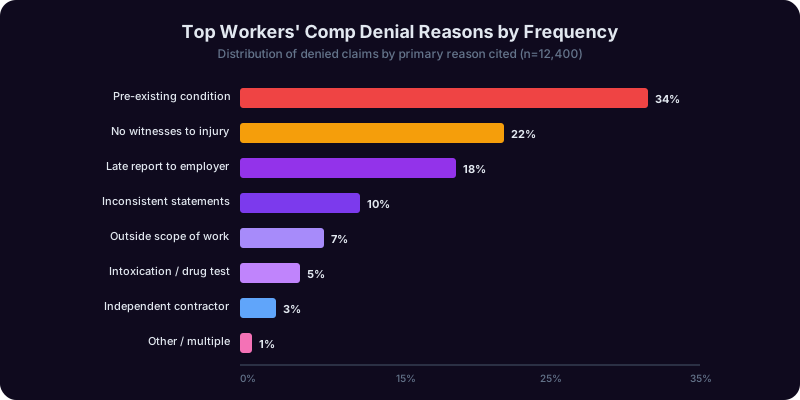
Insurance adjusters lean on a small set of denial reasons because those reasons shift the burden of proof back to you. The most common are:
- Pre-existing condition (cited in ~28% of denials) - The carrier argues your back was already degenerating, so the lift on March 14 did not cause the herniation. This is almost always defeatable with the aggravation doctrine: a workplace injury that aggravates a pre-existing condition is compensable in 47 states.
- No witnesses to the injury (~22%) - Carriers know unwitnessed injuries are harder to prove. But your own testimony, plus contemporaneous text messages, time-clock punches, and ER intake notes, can establish the injury occurred at work.
- Late reporting (~18%) - Most states require notice within 30 days, but many allow exceptions for injuries that worsened gradually (cumulative trauma) or were initially dismissed as minor.
- Intoxication defense (~9%) - The carrier alleges you were impaired. They must prove impairment caused the injury, not merely that a substance was in your system.
- Course and scope (~12%) - They argue you were not performing job duties. Lunch breaks, parking lots, and employer-required travel are frequently litigated gray zones.
- Idiopathic injury (~6%) - A fall caused by your own medical condition (fainting, seizure) rather than a workplace hazard. The increased-risk doctrine can defeat this if work conditions made the consequences worse.
The pattern matters: denials are decisions made by an adjuster reading a one-page incident report, often within 14 days of the injury. They have not seen your MRI. They have not interviewed your foreman. They are gambling that you will not appeal.
The takeaway is simple: a denial letter is the start of your case, not the end. The rest of this playbook walks you through exactly what to do in the first 30 days, how to read the denial letter forensically, and which state-specific forms and deadlines will make or break your appeal.
Read Your Denial Letter: 6 Things to Document
The denial letter is a legal document that triggers strict appeal deadlines. Before you do anything else - before you call a lawyer, before you call your employer, before you post on Reddit - you need to extract six pieces of information from it. Miss any of them and your appeal becomes harder, more expensive, or impossible.
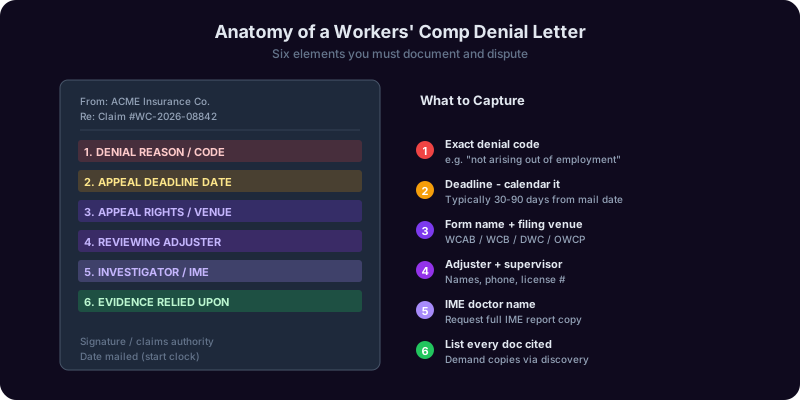
1. The denial reason code. Every carrier uses an internal code (e.g., 'D-04' for pre-existing, 'D-11' for no causal connection). The code may appear in a footer or sidebar. This code tells you exactly what the carrier intends to argue at the hearing - and therefore what evidence you must gather. If the letter cites multiple codes, you must rebut all of them.
2. The appeal deadline. Look for phrases like 'you have 30 days,' 'within 90 days of receipt,' or 'no later than [date].' This is the single most important number on the page. In California, you have 1 year from the injury date to file a claim but only specific windows to challenge utilization review denials. In Texas, you have 20 days to request a Benefit Review Conference after a DWC-21 denial. Miss the deadline and your right to appeal evaporates - permanently.
3. Your stated appeal rights. Carriers are required (in most states) to disclose your appeal options. Look for language like 'you may request reconsideration' or 'you may file with the [state board].' Note whether internal carrier reconsideration is mandatory before external appeal - in some states it is, in others it is optional and a waste of time.
4. The reviewing doctor or 'peer reviewer.' The denial was almost certainly based on a 'paper review' by a doctor who never examined you. The letter must name them (or you can request the name). Look them up. Many peer reviewers work for review companies like Concentra, Genex, or CorVel and have public records of denial rates. A reviewer with a 92% denial rate is a credibility liability for the carrier at hearing.
5. The investigator or adjuster. Identify the adjuster's name, license number, and direct phone. You will be talking to them. Note: in 38 states, adjusters are licensed and subject to unfair claims practices statutes. Document every conversation in writing.
6. The supporting evidence (or lack thereof). The letter should reference specific documents the carrier reviewed. If it cites 'medical records from Dr. Smith dated 2/14/26' but you have never seen Dr. Smith, that is a red flag worth pursuing. If it cites 'witness statement from John Doe' that contradicts your account, you need that statement. Request the entire claim file under your state's discovery rules.
Photograph the letter, save the envelope (the postmark may matter for deadlines), and create a one-page summary with these six items at the top. This document becomes the cover sheet of your appeal binder. The U.S. Department of Labor's OWCP publishes a similar protocol for federal employees that mirrors this state-level best practice.
Step-by-Step: First 30 Days After Denial
The first 30 days after a denial determine 70% of your case outcome. Evidence disappears fast: witnesses forget details, security footage is overwritten on 30-day loops, electronic time-clock data gets purged, and your own medical condition either stabilizes (helping your case) or is mischaracterized in subsequent notes (hurting it). Here is the sequence that experienced workers comp attorneys follow.
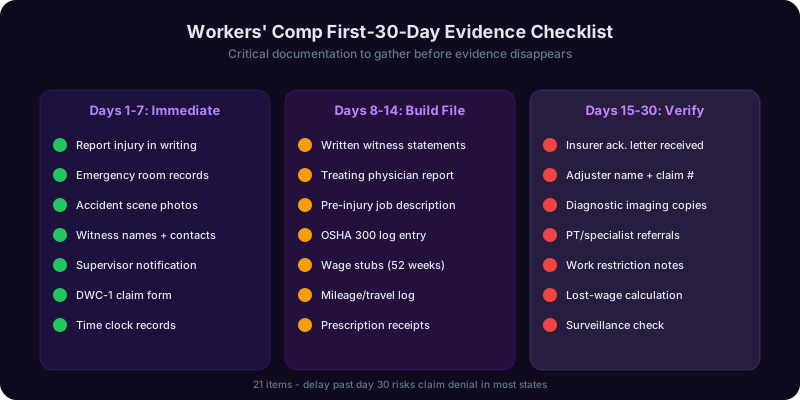
Days 1-3: Lock down the evidence trail. Request your complete medical records from every provider who has seen you for this injury - ER, urgent care, primary care, specialists, physical therapy, chiropractic. Use the formal HIPAA release form (not a verbal request) and ask for the records to be sent both to you and to a secondary address (your attorney or a trusted family member) in case anything 'goes missing.' Costs are capped by state statute, usually $25-50 per provider.
Days 3-7: Identify and contact witnesses. Anyone who saw the injury, anyone who saw you in pain immediately after, and anyone you told within 24 hours. Get written statements while memories are fresh. The format matters: a statement should include the witness's name, address, phone, relationship to you, what they observed (with date and time), and a signature with date. A sworn declaration (notarized) is stronger than an unsworn statement.
Days 5-10: Preserve physical and digital evidence. Photographs of the accident scene, the equipment involved, your injuries (with date-stamped metadata), and any safety conditions (wet floor, missing guardrail, frayed wiring). Request a copy of your time-clock punches for the day of injury - this corroborates that you were at work. If there was security footage, send a written preservation request to your employer's HR and risk management departments immediately. Once you put them on notice, destroying footage becomes spoliation of evidence.
Days 7-14: Request the carrier's claim file. Under most state workers comp procedures, you have a right to a copy of the documents the carrier used to deny your claim. This includes the peer review report, the adjuster's notes, surveillance reports (yes, they probably hired a PI), and the recorded statement you gave (if you gave one - more on that mistake later). The file often contains evidence that contradicts the denial.
Days 14-21: Get a second medical opinion. If the carrier's peer reviewer denied causation, you need a treating physician willing to write a causation opinion. The magic phrase is 'within a reasonable degree of medical certainty, the work injury of [date] is the major contributing cause of [diagnosis].' Without that opinion in writing, you cannot win at hearing.
Days 21-30: File the appeal. Use the correct state form (covered in the next section), include all supporting evidence, and serve copies on the carrier and any required state agency. File before the deadline, not on it - mail delays and electronic filing glitches have killed many appeals filed on the last day.

Get Answers From the Legal Copilot
Copilotly's Legal Copilot analyzes your denial letter, drafts state-specific appeal forms, prepares you for the IME and FCE, and runs settlement math - so you walk into every conference with a complete file and a clear strategy. Free to start.
State-by-State Appeal Timelines and Forms
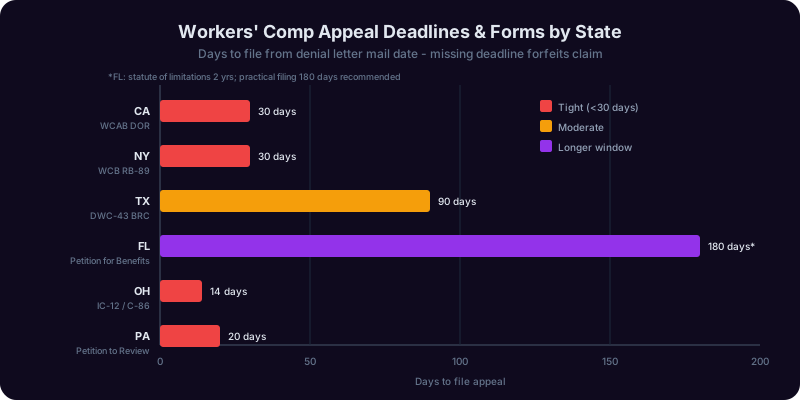
Workers comp is governed by state law - the appeal process in California looks nothing like Texas. Deadlines, forms, and adjudicating bodies vary dramatically; following the wrong process forfeits your claim. The five most populous states have these frameworks for 2026.
| State | Adjudicating Body | Primary Appeal Form | Deadline | First Hearing |
|---|---|---|---|---|
| California | WCAB | Declaration of Readiness (DOR) | 1 year from injury / 5 years for new/further | ~60-90 days |
| New York | WCB | Employee Claim (C-3) + RB-89 review | 30 days from denial | ~45-75 days |
| Texas | DWC | DWC-45 Request for BRC / DWC-43 | 20 days for BRC; 90 days for income | ~40 days (BRC) |
| Florida | OJCC | Petition for Benefits (PFB) | 2 years from injury, 1 year from last benefit | ~90-120 days |
| Ohio | BWC / IC | C-86 Motion / IC-12 Notice of Appeal | 14 days for IC appeal | ~45 days (DHO) |
California (WCAB). The DOR triggers a Mandatory Settlement Conference within 30-60 days. If settlement fails, the case proceeds to trial. California uses Qualified Medical Evaluators (QMEs) selected from a state panel as the cornerstone of medical evidence.
New York (WCB). The C-3 starts the process; to appeal an existing decision file RB-89 within 30 days. NY has aggressive case management - missing a hearing results in dismissal.
Texas (DWC). The Benefit Review Conference is mandatory first - informal mediation with a BRC officer. If unresolved, the case proceeds to a Contested Case Hearing. Texas allows employers to opt out entirely ('nonsubscribers'), changing the calculus significantly.
Florida (OJCC). File a Petition for Benefits with the OJCC. Florida requires mandatory mediation within 130 days. The statute of limitations is brutal: 2 years from injury or 1 year from last benefit payment, whichever is later.
Ohio (BWC/IC). Ohio is monopolistic - BWC is the sole insurer. Denials are appealed via C-86 motion. BWC decisions go to the Industrial Commission with a 14-day Notice of Appeal window through three levels (DHO, SHO, full Commission).
Look up your state board at the IAIABC directory and download current-year forms directly from the state agency - forms change annually.
Independent Medical Examination (IME) Strategy
The Independent Medical Examination is the single most consequential event in your workers comp appeal. It is also, despite the name, almost never independent. The 'IME doctor' is selected by the carrier (or, in panel states like California, drawn from a list) and paid by the carrier. In some studies, IME doctors who consistently find in favor of injured workers stop getting referrals. The economic incentive is unsubtle.
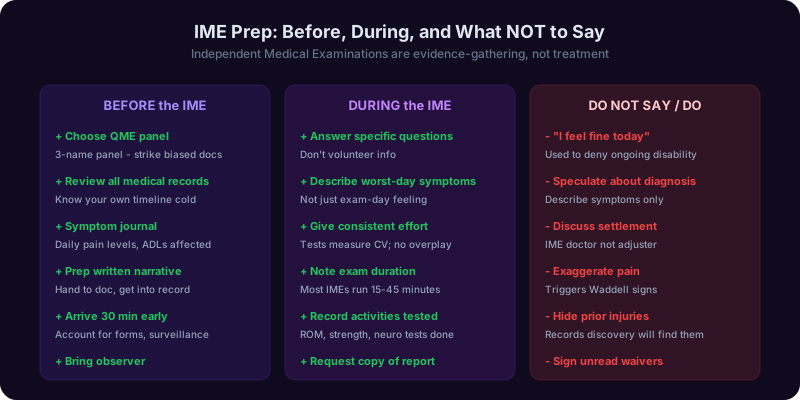
That said, the IME report drives almost every subsequent decision: causation, treatment authorization, impairment rating, return-to-work restrictions, and ultimately settlement value. You cannot skip it (refusing usually forfeits benefits) and you cannot afford to underprepare. Here is the strategy.
Selecting your QME (in panel states). In California, you receive a 'panel' of three QMEs in the specialty you request. Research each one. Search their name plus 'plaintiff' and 'defense' to see which side they typically lean. Check the WCAB en banc decisions for any QME whose reports were rejected as biased. You generally have 10 days to strike one and the carrier strikes one - the remaining QME is yours.
Pre-examination preparation. Review your medical records in chronological order. Know your dates: when did the injury occur, when did you first report it, when did you first seek treatment, when did each symptom appear. Inconsistent dates are weaponized against you. Bring a printed timeline.
What to bring to the exam. A complete list of current medications and dosages. A list of current symptoms (specific - not 'my back hurts' but 'sharp pain at L4-L5 radiating to left posterior thigh, 6/10 at rest, 9/10 with bending'). Imaging discs if you have them. A trusted person to drive you home (you should not drive after a long, stressful exam in pain).
What NOT to say. Do not minimize your symptoms ('it's not that bad today'). Do not exaggerate ('I can't move at all'). Do not discuss settlement, attorneys, or other claims. Do not answer questions about prior injuries unless directly asked, and answer those truthfully and concisely. Do not lie about anything - prior injuries, prior claims, recreational activities - because the IME doctor likely has surveillance footage or social media records and will catch you.
During the physical exam. Give consistent effort. If a maneuver hurts, say so. If it does not hurt, say so. The doctor will perform 'Waddell signs' - tests designed to detect non-organic symptom magnification (more on this in the FCE section). Inconsistencies between subjective complaints and objective findings will appear in the report.
After the exam. Write down everything you remember within 24 hours: what tests were performed, what questions were asked, how long the exam lasted (a 7-minute exam for a complex back injury is a credibility issue for the IME doctor), and any unusual behavior. Request a copy of the report when issued.
If the IME report is unfavorable and demonstrably biased, you can challenge it. In California, an Agreed Medical Evaluator (AME) selected jointly by both parties can supersede a QME report. In other states, you can hire a rebuttal expert. The NCCI publishes data on IME outcome patterns that can support a bias argument.
The Functional Capacity Evaluation (FCE): Don't Sandbag It
The Functional Capacity Evaluation is a 4-6 hour physical testing session that measures your ability to lift, carry, push, pull, bend, stoop, reach, and sit/stand for sustained periods. The results determine your permanent work restrictions and, in many states, are the foundation of your impairment rating. The FCE is the single biggest opportunity for injured workers to inadvertently destroy their own case - because they think they should 'tough it out' or, conversely, 'show how bad it is.'
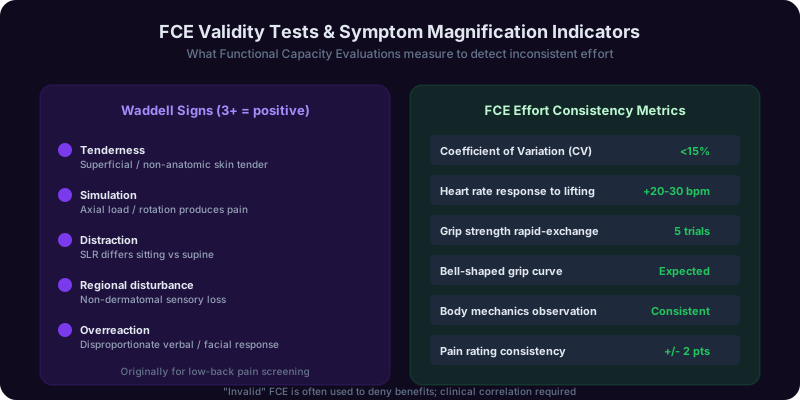
Modern FCEs include sophisticated validity testing - protocols specifically designed to detect 'submaximal effort' (i.e., faking weakness) and 'symptom magnification.' If the validity tests indicate you were not giving full effort, the report will say the results are 'invalid' or that 'effort was suboptimal,' and that single line gives the carrier ammunition to deny your entire claim. Here is what evaluators are watching for.
Waddell signs. Originally developed in 1980 to identify non-organic low back pain, the five Waddell signs are: (1) superficial tenderness (pain from light skin touch), (2) non-anatomical tenderness (pain in regions that do not correspond to nerve distribution), (3) simulation tests (axial loading reproduces back pain - it should not), (4) distraction tests (positive straight-leg raise sitting but negative supine), and (5) overreaction. Three or more positive signs flag the evaluation. Important: positive Waddell signs do not prove malingering, but they are routinely cited against claimants.
Coefficient of Variation (CV) testing. Grip strength tests are repeated 3-5 times. A normal patient produces grip values within 10-15% of each other (low CV). Someone giving variable submaximal effort produces wildly inconsistent values (high CV). A CV above 15% on grip strength is frequently cited as evidence of submaximal effort.
Heart rate response. Genuine maximal exertion produces a predictable heart rate increase. If you claim a lift was at your maximum but your heart rate did not climb appropriately, the evaluator flags it.
Distraction observation. The evaluator watches what you do when you think the test is over - bending to pick up a bag, sitting comfortably in the waiting room, walking briskly to your car. Movement inconsistent with reported limitations is documented.
The correct strategy: give consistent, honest effort. Do not try to fail tests you can do. Do not push past your real limits to 'prove' you are not faking. Do exactly what you would do in a real work task: stop when it actually hurts, lift what you actually can, rest when you need to. The FCE is not a trick - it is a measurement. Trying to game it nearly always backfires because the validity tests catch the gaming.
Document your pain trajectory. Pain typically increases through the FCE as fatigue accumulates. Verbalize this as it happens: 'My pain was 4/10 at the start, it's at 7/10 now.' This creates a record consistent with a real injury rather than a static complaint.
Day after the FCE. Most injured workers have a significant pain flare 24-48 hours after a thorough FCE. See your treating physician within 72 hours and document the flare. This corroborates that the FCE actually measured your functional ceiling rather than a comfortable midpoint.
MMI (Maximum Medical Improvement) and Impairment Rating Disputes
Maximum Medical Improvement, or MMI, is the legal-medical concept that triggers the entire back half of your workers comp case. A patient reaches MMI when, in the treating physician's opinion, further medical treatment will not result in significant improvement. MMI does not mean you are healed - it means you are as healed as you are going to get. From MMI forward, your case shifts from temporary benefits (lost wages, medical treatment) to permanent benefits (impairment rating, vocational rehabilitation, settlement).
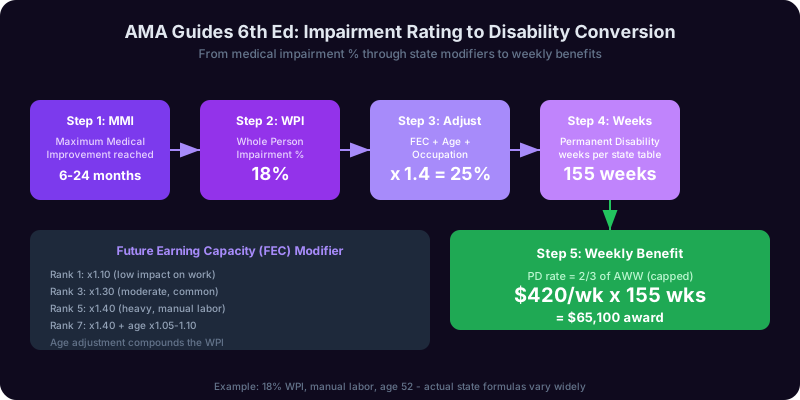
The impairment rating is a percentage figure assigned by a physician using the AMA Guides to the Evaluation of Permanent Impairment. Most states have adopted the 6th Edition (published 2008, with significant amendments), though a handful still use the 5th Edition and a few use state-specific guides. The edition matters enormously: the 6th Edition produced lower impairment ratings on average than the 5th Edition for the same injury, which is exactly why insurance carriers lobbied for its adoption.
How the rating is calculated (6th Edition framework). The rater identifies the diagnosis-based impairment class (0 through IV), then applies functional history, physical examination, and clinical studies grade modifiers to arrive at a 'net adjustment.' For a lumbar disc herniation with residual radiculopathy, a typical 6th Edition rating ranges from 5% to 13% whole-person impairment. Under the 5th Edition, the same injury frequently rated 10-20%.
Whole person vs body part. Some states convert impairment to a 'whole person' figure; others rate the affected body part (a back, an arm, a hand) and use schedules to translate to compensation. A 10% impairment of the arm is not the same as a 10% whole-person impairment - the math diverges dramatically in compensation calculations.
Impairment vs disability. This is the trap that costs injured workers tens of thousands of dollars. Impairment is a medical concept (loss of function). Disability is a legal-vocational concept (loss of earning capacity). A 10% impaired surgeon may be 100% disabled from surgery. A 10% impaired clerk may be 0% disabled. Most state systems compensate based on impairment rating, but some apply a disability multiplier based on age, education, and pre-injury wages.
Apportionment. The rater may 'apportion' some percentage of your impairment to pre-existing conditions or non-industrial causes. If a doctor says your 15% impairment is '40% apportioned to pre-existing degeneration,' your compensable rating drops to 9%. Apportionment is the second-largest battleground in modern workers comp (behind only causation).
Disputing the rating. Most states allow you to obtain a rebuttal rating from a treating physician or independent evaluator. The dispute is then resolved by a hearing officer or judge, sometimes with reference to a tiebreaker rater. Critical: the rebuttal rating must use the same edition of the AMA Guides as the original (otherwise it will be rejected on a technicality), and must show specific arithmetic - not just a different bottom-line percentage.
Settlement implications. Every 1% of impairment translates to a specific dollar amount in your state's compensation schedule. In California, 1% permanent disability for a 40-year-old worker earning the average wage is roughly $1,800-$2,200. A dispute that moves you from 8% to 14% is worth $11,000-$13,000 in additional benefits. The math justifies fighting hard for every percentage point.
Negotiating Lump Sum vs Lifetime Medical
At some point in your case - usually after MMI, often during a Mandatory Settlement Conference - the carrier will offer to settle. The structure of that settlement is one of the most consequential financial decisions of your life, and it is frequently made under pressure, in a hallway outside a courtroom, with an attorney quoting numbers and a deadline. Slow down. Understand the math.
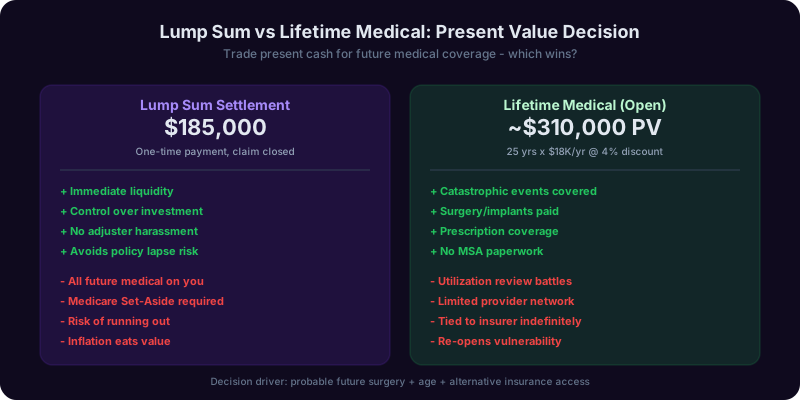
The two basic settlement structures. A Compromise and Release (C&R) settles your entire case for a lump sum: indemnity (lost wages) plus future medical care, in exchange for closing the case forever. A Stipulation with Request for Award settles only the indemnity portion (permanent disability money) and leaves future medical care open - the carrier remains on the hook for treatment of the industrial injury for life.
Present value math for future medical. A C&R for future medical requires the carrier (and you) to estimate every dollar of medical treatment you will need for the rest of your life, then discount it to present value. For a 45-year-old with a serious back injury and a 35-year life expectancy, projected future medical of $300,000 might discount to $180,000 in present value at a 3% discount rate. If the carrier offers $90,000 for future medical, they are offering you 50 cents on the dollar.
The Medicare Set-Aside (MSA). If you are Medicare-eligible (or will be within 30 months) and the settlement exceeds $25,000 (or $250,000 for non-eligible), federal law requires a Medicare Set-Aside - a separate, professionally administered account funded from your settlement specifically for treatment of the industrial injury that Medicare would otherwise pay. The MSA is calculated by a vendor (Gould & Lamb, ISO, MSP) using a CMS-approved methodology. An undersized MSA can be rejected by CMS, and an oversized MSA reduces the cash you actually receive.
When lump sum makes sense. You are young, you have stable medical needs, you have a clear plan for the money (debt payoff, business investment, education), you have other health insurance available, you want closure, and the offer fairly compensates the projected future medical. Lump sum also makes sense if you do not trust the carrier to authorize treatment fairly - C&R cuts the cord.
When lifetime medical makes sense. You have ongoing, complex medical needs (multiple surgeries projected, chronic pain management, neurological complications). You are uninsured outside workers comp. You are at high risk of needing expensive future intervention (spinal cord stimulator, joint replacement). You do not have the financial discipline to manage a lump sum across decades.
The hybrid: structured settlement. Some settlements include an annuity component - guaranteed monthly payments for life or a term of years - alongside a smaller upfront cash payment. Structured settlements provide tax-free income (workers comp settlements are generally non-taxable) and protect against poor financial decisions, but lock in the discount rate at settlement time.
Negotiation leverage. Settlement offers tend to move 30-60% from initial offer to final, depending on case strength and litigation pressure. Filing a hearing date often produces a meaningful jump. Be aware that carriers track 'reserve' amounts - the money they have set aside for your case - and rarely settle for more than 80% of reserve. Knowing approximate reserve can be inferred from medical-only payments, indemnity payments, and the type of injury.
When to Hire an Attorney (and What They Charge)
Roughly 75% of denied workers comp claimants hire an attorney before their final hearing, and the data on outcomes is clear: represented claimants recover significantly more, on average, than unrepresented claimants - even after attorney fees. The question is not whether to consult an attorney (you should, free) but when to hire one and how to structure the relationship.
Free consultations are universal. Workers comp attorneys offer free initial consultations as standard practice. There is no reason not to talk to two or three before deciding. Bring your denial letter, medical records summary, and the six-item document from Section 2. The attorney will give you an honest assessment of the case strength, expected timeline, and likely settlement range. If an attorney refuses to take your case, ask why - the answer is informative.
Contingency fees by state. Workers comp attorneys are paid on contingency (a percentage of your recovery) and the percentages are capped by state statute. As of 2026:
| State | Max Fee % | Notes |
|---|---|---|
| California | 15% | Court-approved; can be reduced for routine matters |
| New York | 15-20% | Tiered by case complexity |
| Texas | 25% | Hourly or contingency; DWC approval required |
| Florida | 20% | Sliding scale by recovery amount |
| Ohio | 33.3% | Capped at $5,000 for IC appeals |
What costs are separate from the fee. Medical records ($200-500), expert witness fees ($2,000-5,000 for a treating physician deposition, $5,000-15,000 for a retained expert), filing fees, deposition costs, and court reporter fees are 'costs' that are typically advanced by the attorney and deducted from your recovery in addition to the fee percentage. Get the cost structure in writing.
What attorneys cannot do. A workers comp attorney cannot file a personal injury lawsuit against your employer for the same injury (the 'exclusive remedy' doctrine bars it in most cases). They can, however, file a third-party claim against a non-employer whose negligence contributed - the manufacturer of defective equipment, the driver of a vehicle that hit you in a delivery, the owner of premises where you were injured. Third-party recoveries are subject to a workers comp lien, and the lien math gets complicated fast.
Red flags in attorney selection. Avoid any attorney who: guarantees a specific outcome, demands payment upfront for case acceptance, refuses to give you copies of documents, will not answer your phone calls or emails within 48 hours, or has unresolved bar disciplinary actions (check your state bar's public records).
When to hire vs go it alone. Hire if: the denial involves causation, you have a serious permanent injury, surgery is likely or has occurred, the carrier is acting in bad faith, you cannot get treatment authorized, or you face a hearing. Consider going alone if: the case is minor, the denial is administrative (paperwork issue), and the carrier seems cooperative. Even in 'easy' cases, a one-hour consultation costs nothing and frequently identifies issues you missed.
How Copilotly's Legal Copilot Builds Your Appeal
Legal Disclaimer: Copilotly's Legal Copilot is an AI-powered research and drafting tool. It does not replace a licensed workers compensation attorney, does not establish an attorney-client relationship, and does not provide legal advice. For matters involving permanent disability, denied medical care, or contested causation, retain a licensed attorney in your state. Use Copilotly for preparation, organization, and first drafts - not for final legal strategy.
Workers comp appeals reward preparation. The injured worker who walks into a Mandatory Settlement Conference with a printed timeline, organized medical records, a one-page case theory, and clear knowledge of their state's specific rules consistently recovers more than the worker who shows up with a folder of papers. Copilotly's Legal Copilot is designed to do exactly that preparation work - the research and organization that an attorney does in hours, done in minutes, before you ever step into a lawyer's office.
Denial letter analysis. Upload your denial letter and Copilotly's Legal Copilot extracts the six critical data points (reason code, deadline, appeal rights, reviewer, adjuster, evidence cited), identifies which state procedural framework applies, and generates a checklist of immediate actions ordered by deadline urgency. The system cross-references the cited denial reason against state-specific defenses - if your letter cites 'pre-existing condition' and you are in California, Copilotly surfaces the aggravation doctrine case law you need.
Appeal letter and form drafting. Based on your jurisdiction, Copilotly generates the correct appeal form (DOR for California, RB-89 for New York, DWC-45 for Texas, PFB for Florida, C-86 for Ohio) and drafts the supporting narrative. The narrative incorporates the medical evidence you have provided, frames the legal arguments specific to the denial reason, and uses the formal language adjudicators expect. You review, edit, and file.
IME and FCE preparation packet. Before your Independent Medical Exam, Copilotly produces a personalized prep packet: a chronological symptom timeline (pulled from your medical records), a list of questions the examiner will likely ask, language to use for symptom description, and warnings about specific traps (Waddell signs, surveillance, recorded statements). For FCEs, the packet includes guidance on validity testing and how to give consistent, honest effort.
Settlement evaluation. When the carrier offers a settlement, Copilotly runs the math: present value of future medical based on your projected treatment needs, Medicare Set-Aside estimation, lump-sum vs structured comparison, and a state-specific comparison of the offer against typical recoveries for similar injuries. The output is a one-page decision document you can use yourself or hand to an attorney for review.
Attorney preparation. If you decide to hire an attorney, Copilotly produces an intake packet that compresses what would otherwise be a two-hour client meeting into a 20-minute review: case summary, timeline, evidence inventory, identified legal issues, and the questions you want answered. Attorneys appreciate organized clients because organized clients win more often. Start a free session with Legal Copilot and bring your denial letter. Twenty minutes of preparation can save you twenty thousand dollars in settlement value - and more importantly, the medical care you actually need to recover.
Frequently Asked Questions
Recommended Copilots
Related Articles
Get Answers From the Legal Copilot
Copilotly's Legal Copilot analyzes your denial letter, drafts state-specific appeal forms, prepares you for the IME and FCE, and runs settlement math - so you walk into every conference with a complete file and a clear strategy. Free to start.