
What Actually Counts as an IRS Hardship in 2026
Financial Disclaimer: This article is for educational purposes only and does not constitute financial, tax, or legal advice. Tax laws change frequently, and individual circumstances vary. Consult a licensed CPA, fiduciary financial advisor, or tax attorney before making any retirement account withdrawal decisions. The penalties for getting this wrong can be permanent.
A 401(k) hardship withdrawal is a distribution from your retirement account that the IRS allows when you face an immediate and heavy financial need. Unlike a 401(k) loan, hardship withdrawals are not repaid - the money is permanently removed from your retirement savings. This is the single most important sentence in this entire guide.
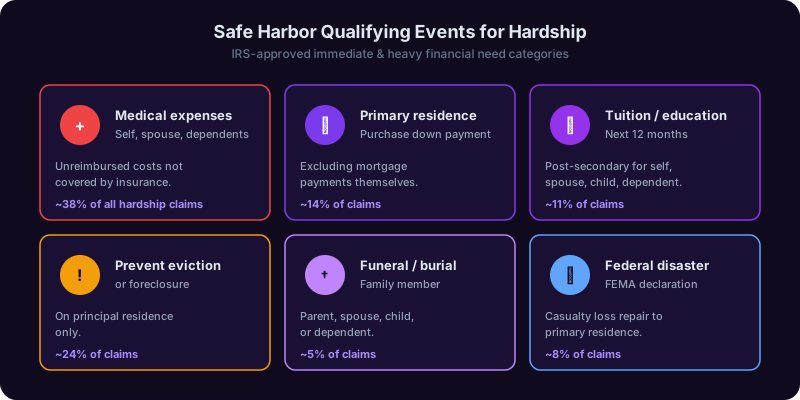
For 2026, the IRS recognizes seven safe harbor hardship categories under Treasury Regulation 1.401(k)-1(d)(3):
- Unreimbursed medical expenses for you, your spouse, dependents, or primary beneficiary (deductible portion under Section 213(d))
- Costs to purchase a principal residence (excluding mortgage payments - only down payment and closing costs)
- Tuition, related educational fees, and room/board for the next 12 months of post-secondary education
- Prevention of eviction or foreclosure on your principal residence
- Burial or funeral expenses for parents, spouse, children, dependents, or primary beneficiary
- Repair of damage to principal residence that qualifies as a casualty loss deduction (no longer requires federally declared disaster as of 2018)
- Federally declared disaster expenses (FEMA-designated areas only)
As of 2026, you no longer need to take a 401(k) loan first before claiming hardship (this rule was eliminated by the Bipartisan Budget Act of 2018). You also do not face a six-month contribution suspension anymore. However, you still must self-certify that the need is immediate and the amount does not exceed what is required.
Critical limit: You can only withdraw the exact amount needed to cover the hardship, plus enough to pay anticipated taxes and penalties on the distribution itself. Your plan administrator must approve the request, and not every 401(k) plan offers hardship withdrawals - check your Summary Plan Description first.
The Real Tax Bite: 10% Penalty Plus Ordinary Income Tax
Here is where most people get blindsided. A hardship withdrawal is not penalty-free unless you qualify for a specific exception (covered in section 4). For everyone else under age 59-1/2, the distribution triggers two separate tax events that can vaporize nearly half the money you withdraw.
Tax Event #1 - The 10% Early Withdrawal Penalty: The IRS imposes a flat 10% additional tax on early distributions from qualified retirement plans under IRC Section 72(t). This is on top of whatever income tax you owe. It is reported on Form 5329 and is not deductible.
Tax Event #2 - Ordinary Income Tax: The full amount you withdraw is added to your taxable income for the year. If you are already in the 22% federal bracket, that hardship money pushes part of your income into 24%, 32%, or higher. Plus state income tax. Plus potentially losing eligibility for credits like the EITC or premium tax credits.
Let's run real 2026 numbers. Assume a married-filing-jointly household earning $90,000 in W-2 wages, taking a hardship withdrawal in California (9.3% marginal state rate):
| Withdrawal Amount | Federal Tax (22-24%) | 10% Penalty | State Tax (9.3%) | Mandatory Withholding | Net Cash Received |
|---|---|---|---|---|---|
| $10,000 | $2,200 | $1,000 | $930 | 20% upfront ($2,000) | ~$5,870 |
| $25,000 | $5,800 | $2,500 | $2,325 | 20% upfront ($5,000) | ~$14,375 |
| $50,000 | $13,200 | $5,000 | $4,650 | 20% upfront ($10,000) | ~$27,150 |
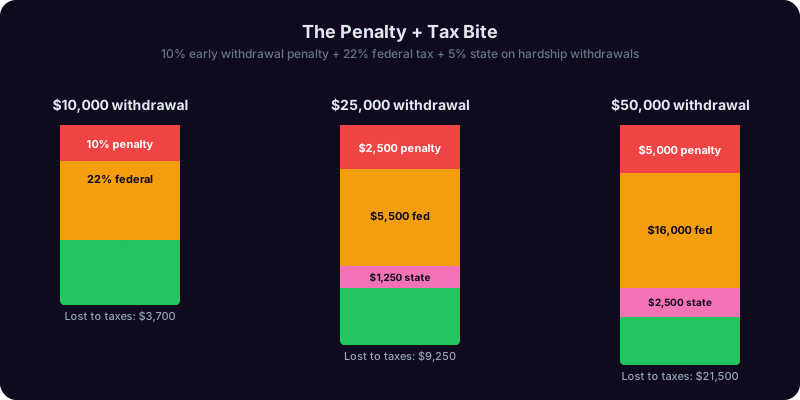
Notice the brutal math: to net $10,000 cash after taxes, you typically need to withdraw roughly $17,000 from your 401(k). That extra $7,000 is gone forever - both as cash and as 30 years of compound growth.
The withholding trap: Unlike 401(k) loans, hardship distributions are subject to a mandatory 20% federal withholding (some plans use 10% for hardships, check yours). If your actual tax bill exceeds this withholding, you owe more at tax time. If it's less, you get a refund - but you've already lost the use of that money for the year.
Hardship Withdrawal vs 401(k) Loan vs 72(t) SEPP: The Decision Matrix
Before pulling the trigger on a hardship withdrawal, you must compare it against two alternative ways to access retirement money. In nearly every case, one of these is mathematically superior.
Option A - 401(k) Loan: Borrow up to 50% of your vested balance or $50,000, whichever is less. You pay yourself back with interest (typically prime + 1%) over 5 years through payroll deduction. No taxes, no penalty, no permanent loss to your retirement. However, if you leave your employer (voluntarily or not), the entire loan balance is typically due within 60-90 days or becomes a deemed distribution subject to taxes and penalties.
Option B - Hardship Withdrawal: Permanent removal. Full income tax. 10% penalty if under 59-1/2 (with limited exceptions). Cannot be repaid. No 60-day rollover option for true hardships (this differs from regular distributions).
Option C - 72(t) SEPP (Substantially Equal Periodic Payments): Under IRC Section 72(t)(2)(A)(iv), you can take penalty-free early withdrawals if you commit to a series of substantially equal periodic payments based on your life expectancy. You must continue these for at least 5 years OR until age 59-1/2, whichever is longer. Breaking the SEPP retroactively triggers all penalties plus interest. Best for early retirees who need ongoing income, not one-time emergencies.
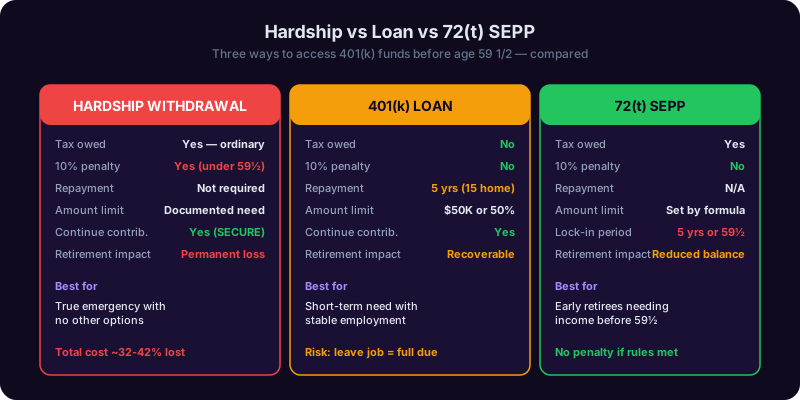
| Feature | 401(k) Loan | Hardship Withdrawal | 72(t) SEPP |
|---|---|---|---|
| Max Amount | $50K or 50% vested | Documented need only | Based on life expectancy formula |
| 10% Penalty | No | Yes (unless exception) | No |
| Income Tax | No (unless defaulted) | Yes, full amount | Yes, on each payment |
| Repayment Required | Yes, 5 years | No (cannot repay) | No (must continue 5 yrs/59.5) |
| Job Loss Risk | Loan accelerates | None | None |
| Best For | Short-term need, stable job | True emergency, no other option | Early retirement income |
For most genuine emergencies under $50,000, a 401(k) loan is dramatically better than a hardship withdrawal. You preserve the principal in your retirement account (the loan balance still exists as your money), avoid penalties, and the interest you pay goes back to yourself. The primary risk is involuntary job loss triggering an acceleration - but even then, you typically have until your tax return due date to roll the unpaid balance to an IRA under the 2017 Tax Cuts and Jobs Act.

Get Answers From the Finance Copilot
Before you tap your 401(k), let Copilotly's Finance Copilot run the real numbers on your specific situation - penalty math, opportunity cost, and alternatives ranked by total cost. Free, private, and built on the latest 2026 SECURE 2.0 rules.
SECURE 2.0 Game-Changers: New 2024-2026 Penalty-Free Exceptions
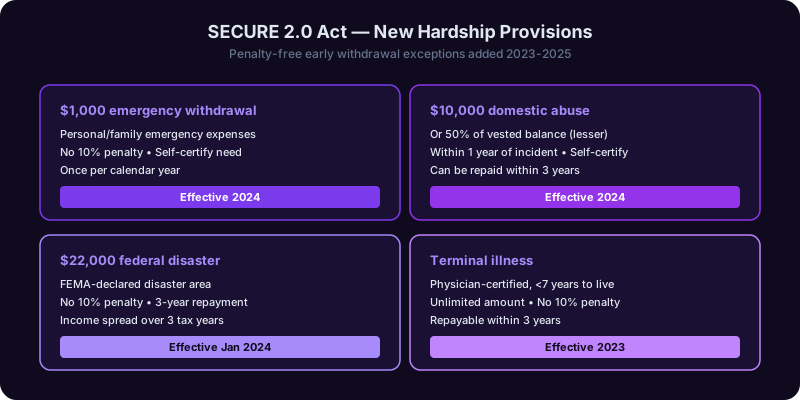
The SECURE 2.0 Act (signed December 2022) created several new penalty-free early withdrawal categories that took effect between 2024 and 2026. These are not traditional hardship withdrawals - they bypass the 10% penalty entirely and offer unique repayment options.
1. Emergency Personal Expense Distribution (effective 2024): Under Section 115 of SECURE 2.0, you can withdraw up to $1,000 once per calendar year for any unforeseeable or immediate financial need. No penalty. No documentation required. You self-certify. You have 3 years to repay it to your 401(k) or IRA. You cannot take another emergency withdrawal during the 3-year repayment window unless you've repaid the prior one or contributed equivalent new money.
2. Domestic Abuse Victim Distribution (effective 2024): Section 314 of SECURE 2.0 allows survivors of domestic abuse to withdraw the lesser of $10,000 or 50% of their account balance within one year of the abuse, penalty-free. The distribution may be repaid within 3 years. Self-certification is permitted; plan administrators may rely on your statement.
3. Terminal Illness Distribution (effective 2023): Section 326 removes the 10% penalty entirely (with no dollar cap) for distributions to individuals certified by a physician as having a terminal illness reasonably expected to result in death within 84 months. Ordinary income tax still applies.
4. Federally Declared Disaster Distribution (made permanent 2024): Up to $22,000 penalty-free per disaster, with the option to spread income tax over 3 years and repay within 3 years.
5. Long-Term Care Insurance Premiums (effective 2026): Up to $2,500 annually penalty-free to pay qualifying long-term care insurance premiums.
6. Public Safety Officer Age 50 Rule (expanded 2024): Qualified public safety officers (firefighters, police, EMTs, corrections officers, air traffic controllers) can take penalty-free distributions from a governmental plan at age 50 (down from 55).
Always check with your plan administrator - not all 401(k) plans have adopted these new provisions yet, even though they are permitted under federal law. Plans have until 2026 to formally amend documents.
The Compounding Catastrophe: What $20K Today Really Costs You
The visible cost of a hardship withdrawal is the immediate 30-40% tax bite. The invisible cost - the one that destroys retirement security - is the lost compound growth over the next 20, 30, or 40 years. This is the number every financial planner wants you to see before you sign the distribution form.
Let's run the math with conservative assumptions: 7% average annual real return (S&P 500 historical average is roughly 10% nominal, 7% real after inflation), reinvested dividends, no additional contributions to the withdrawn portion.
| Withdrawal Age | Amount Withdrawn | Years to Age 65 | Value at 65 if Left Invested | Opportunity Cost |
|---|---|---|---|---|
| 25 | $20,000 | 40 | $299,489 | $279,489 |
| 35 | $20,000 | 30 | $152,245 | $132,245 |
| 45 | $20,000 | 20 | $77,394 | $57,394 |
| 55 | $20,000 | 10 | $39,343 | $19,343 |
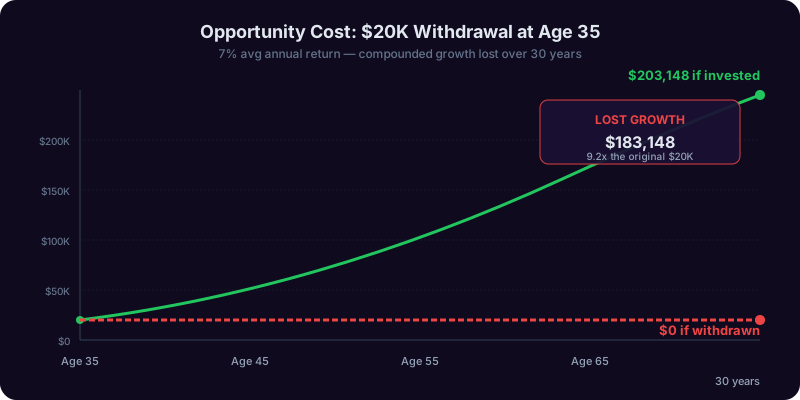
A 35-year-old withdrawing $20,000 to handle a financial crisis is not making a $20,000 decision. They are making a $152,000 decision. Add in the 35-40% immediate tax bite ($7,000-$8,000), and the true cost approaches $160,000 over a working lifetime.
This is also why the Rule of 72 matters here. At 7% returns, money doubles roughly every 10 years. The $20,000 you withdraw at 35 would have become approximately:
- $40,000 by age 45
- $80,000 by age 55
- $160,000 by age 65
To replace that $20,000 withdrawal's future value, you would need to contribute an extra $1,700 per year for the next 30 years - and that assumes you maintain those contributions through every future financial setback, job change, and market downturn. Few people do.
For deeper retirement planning math, read our AI Retirement Planning Step-by-Step Guide for 2026 and the 401(k) vs Roth 401(k) Complete Guide.
Better Alternatives: Seven Options to Try Before Touching Your 401(k)
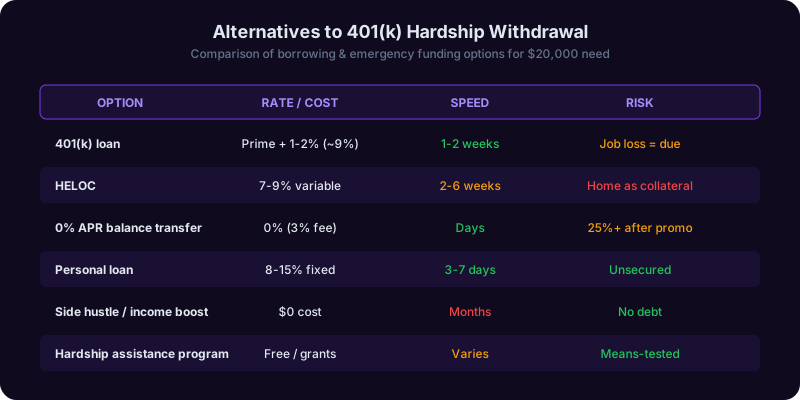
Before you submit that hardship request, exhaust these alternatives. Each one preserves your retirement principal, and most are cheaper than the 30-40% tax-and-penalty bite of a hardship withdrawal.
1. HELOC (Home Equity Line of Credit): If you own a home with equity, a HELOC typically charges prime + 1-3% (currently 8-10% APR in mid-2026) and only accrues interest on what you actually draw. Interest may be tax-deductible if used for home improvements. Compare to your 30%+ hardship cost.
2. 0% APR Credit Card Stacking: For shorter-term needs under $20,000, opening 1-2 cards with 12-21 month 0% introductory APR offers (Chase Slate Edge, Citi Diamond Preferred, Wells Fargo Reflect) provides interest-free runway. Stack a balance transfer offer for additional time. This only works if you have a credible plan to repay before the promotional period ends.
3. Personal Loan from Credit Union: Credit unions often offer unsecured personal loans at 10-15% APR, dramatically cheaper than the 30%+ effective cost of a hardship withdrawal. Navy Federal, PenFed, and Alliant are common low-rate options for qualifying members.
4. Negotiate Directly with Creditors: Medical bills are nearly always negotiable down 30-60%. Hospitals have formal financial hardship programs. Credit card companies offer hardship plans with reduced rates and waived fees. Mortgage servicers offer forbearance under federal CARES-era frameworks. Always call before withdrawing retirement funds.
5. Side Hustle Income Acceleration: Doordash, Instacart, Uber, freelance platforms, and seasonal warehouse work can generate $1,500-$3,000 monthly within weeks. Combined with expense cuts, many true emergencies resolve in 60-90 days without touching retirement.
6. Sell Assets You Do Not Need: Vehicles you can downsize, recreational equipment, collectibles, jewelry, and excess electronics often raise $5,000-$15,000 quickly. Facebook Marketplace and Craigslist move items in days.
7. Emergency Fund Rebuild Strategy: If you have not yet faced the emergency, build your reserves now using the framework in our Emergency Fund Complete Guide. Three to six months of expenses prevents 90% of hardship-withdrawal scenarios.
For an integrated approach to handling debt without depleting retirement, see our Debt Payoff Strategy Guide. The Department of Labor Savings Fitness Guide is also a free resource for prioritizing financial decisions.
Recovery Playbook: How to Bounce Back If You Must Withdraw
Financial Disclaimer: The strategies below are general best practices. Your specific tax situation, plan rules, and state laws affect what is possible. Coordinate any recovery plan with a CPA and your plan administrator before implementing.
If you have exhausted alternatives and must take a hardship withdrawal, your work begins the day the funds arrive. The goal is to compress the recovery timeline and minimize the permanent damage to your retirement trajectory.
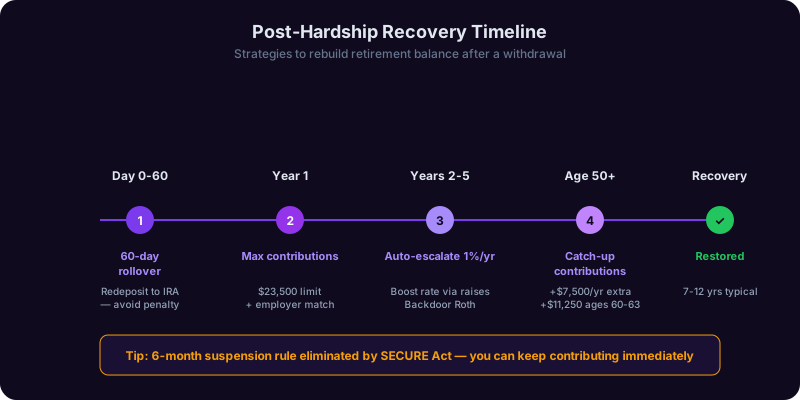
Step 1 - Understand the 60-Day Rollover Rule (Important Distinction): True hardship withdrawals are not eligible for the 60-day rollover treatment that applies to other retirement distributions under IRC Section 402(c). However, if you withdrew funds and your situation resolved (insurance reimbursed the medical bill, the foreclosure was averted), some plans allow you to return funds within a short window. Ask your plan administrator immediately - do not assume.
Step 2 - Adjust Your Tax Withholding Immediately: Update your W-4 with your employer to account for the additional taxable income. Use the IRS Tax Withholding Estimator to avoid an underpayment penalty at tax time. If your withdrawal pushed you into estimated tax territory, set up quarterly payments for Q3/Q4.
Step 3 - Maximize Contributions Going Forward: The 2026 employee 401(k) contribution limit is $23,500 (with $7,500 catch-up at age 50+, and a new $11,250 super catch-up for ages 60-63 under SECURE 2.0). Bumping contributions from 6% to the maximum often recovers the withdrawn amount within 18-30 months while capturing employer match.
Step 4 - Capture Every Dollar of Employer Match: Do not let the hardship cause you to reduce contributions below the employer match threshold. That is an instant 50-100% return you cannot replicate elsewhere.
Step 5 - Use Catch-Up Contributions After Age 50: Once you turn 50, the catch-up contribution adds $7,500 annually to your 401(k) limit. Combined with the standard limit, that is $31,000 per year (or $34,750 at ages 60-63). Aggressive catch-up contributions can largely offset a hardship withdrawal taken in your 40s.
Step 6 - Consider Roth Conversion Strategy: If the hardship withdrawal year was a low-income year for you (job loss, sabbatical, business loss), it may also be a strategic year to convert some traditional 401(k)/IRA dollars to Roth at the lower marginal rate. Read our Roth IRA vs Traditional IRA Complete Guide for the conversion mechanics.
Step 7 - Rebuild the Emergency Fund First: Before resuming aggressive retirement contributions, fund at least one month of expenses in liquid savings. This prevents the cycle of hardship withdrawals every time life events occur.
Recovery is mathematically possible but psychologically difficult. The discipline to redirect lifestyle expenses into accelerated retirement contributions is what separates people who fully recover from those who never do.
Frequently Asked Questions
Recommended Copilots
Related Articles
Get Answers From the Finance Copilot
Before you tap your 401(k), let Copilotly's Finance Copilot run the real numbers on your specific situation - penalty math, opportunity cost, and alternatives ranked by total cost. Free, private, and built on the latest 2026 SECURE 2.0 rules.