
The 2024 DOL 6-Factor Economic Reality Test (Replacing the 2021 Rule)
On March 11, 2024, the U.S. Department of Labor's revised independent contractor rule under the Fair Labor Standards Act took effect, replacing the more employer-friendly 2021 rule. The new regulation restores a totality-of-the-circumstances economic reality test weighing six equal factors. No single factor is dispositive - the analysis asks whether, as a matter of economic reality, the worker is in business for themselves or economically dependent on the employer.
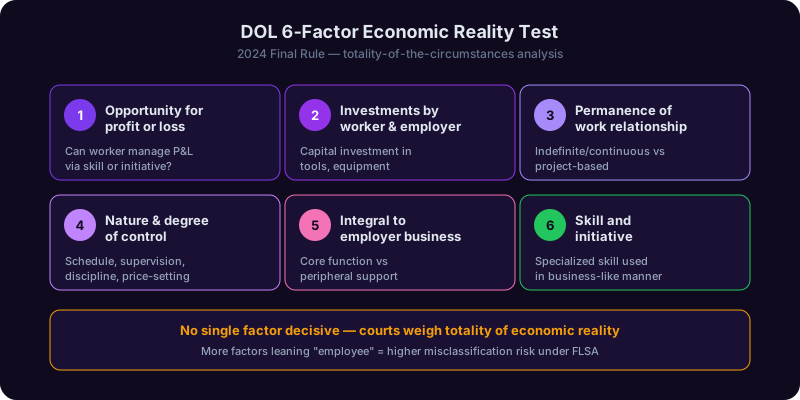
Factor 1: Opportunity for profit or loss depending on managerial skill. Genuine contractors set their own prices, market to customers, negotiate jobs, and can earn more (or lose money) through business decisions. If your "profit" only varies by working more hours at a fixed rate, you look like an employee.
Factor 2: Investments by the worker and the potential employer. Contractors typically make capital investments - buying equipment, software, vehicles, advertising - that support an independent business. Employees use the company's tools. The DOL compares the relative scale and nature of investments, not just absolute dollars.
Factor 3: Degree of permanence of the work relationship. Indefinite, continuous, or exclusive relationships suggest employment. Project-based, sporadic, or non-exclusive work with multiple clients suggests independent contracting. Note: a long-term contractor relationship can still be employment if other factors point that way.
Factor 4: Nature and degree of control. This includes scheduling, supervision, discipline, the ability to work for others, and economic control like setting prices and selecting clients. Reserved (unexercised) control still counts. Compliance with specific legal obligations does not automatically count as control.
Factor 5: Whether the work is integral to the employer's business. If the worker performs the company's core function - a driver for a trucking firm, a coder for a software company - that strongly suggests employment. Peripheral or specialized work (the plumber fixing the office sink) suggests contracting.
Factor 6: Skill and initiative. Specialized skill alone doesn't make someone a contractor - many employees are highly skilled. The DOL looks for whether the worker uses that skill to market themselves as an independent business: building a client base, advertising, holding business licenses, etc.
The 2024 rule rejected the 2021 rule's elevation of "control" and "opportunity for profit" as "core factors" - under current law, all six weigh equally. You can read the full DOL rule and guidance at dol.gov/agencies/whd/flsa/misclassification. The rule has faced legal challenges, so check current status before relying on it.
IRS 20-Factor Test and Form SS-8: Getting an Official Determination
The IRS uses a different framework focused on three categories: behavioral control, financial control, and the type of relationship. These derive from a historical 20-factor common law test that the IRS still references in audits and Form SS-8 determinations. The IRS test matters for tax purposes - payroll taxes, withholding, and self-employment tax liability.
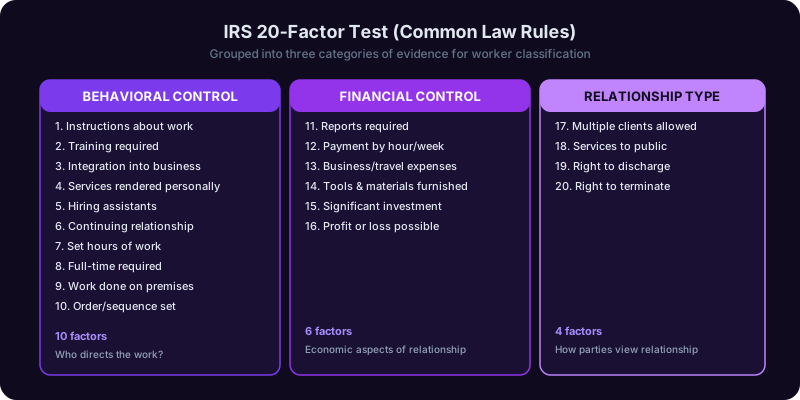
Behavioral Control looks at whether the business has the right to direct and control how the work is performed. Key indicators include: instructions on when, where, and how to work; training provided by the business; required tools or procedures; required reports; and the level of detail in oversight. Even if instructions aren't actually given, the right to instruct can tip the scale toward employment.
Financial Control examines the business aspects of the worker's job. Factors include: significant investment in equipment, unreimbursed business expenses, services available to the relevant market (do you have other clients?), method of payment (hourly/salary vs. flat fee per project), and opportunity for profit or loss. Contractors typically have skin in the game financially.
Type of Relationship looks at how the parties characterize their arrangement. The IRS considers: written contracts describing the relationship (though labels aren't controlling), employee-type benefits (insurance, pension, vacation pay), permanency of the relationship, and whether the services are a key activity of the business.
Form SS-8: Determination of Worker Status. Either you or your employer can file Form SS-8 with the IRS to request an official ruling. You describe the work relationship in detail, the IRS investigates (often contacting the other party), and issues a binding determination - typically taking 6 months to over a year. If the IRS rules you're an employee, you can use that determination to recover overpaid self-employment taxes via Form 8919.
Filing SS-8 has trade-offs. It's free and produces an official ruling, but it tips off your employer that you're questioning the classification - which can lead to retaliation (illegal but real). Many workers file SS-8 only after the working relationship has ended. Download the form at irs.gov/forms-pubs/about-form-ss-8.
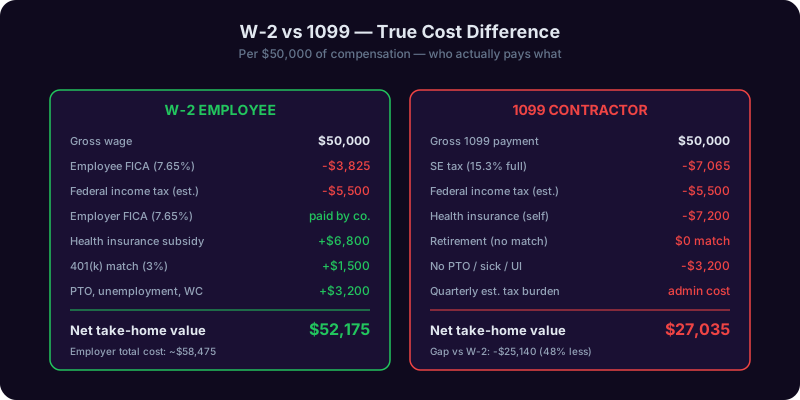
One practical tip: if you receive a 1099 but believe you're actually an employee, file Form 8919 (Uncollected Social Security and Medicare Tax on Wages) with your tax return. This lets you pay only the employee share (7.65%) instead of the full 15.3%, while the IRS pursues the employer for the rest. You must have a reasonable basis for the position - an SS-8 filing, IRS or court determination, or other written confirmation helps.

Get Answers From the Legal Copilot
Copilotly's Legal Copilot analyzes your work arrangement against the 2024 DOL 6-factor test, IRS rules, and state ABC tests in minutes. Upload your contractor agreement, describe your working conditions, and get a clear breakdown of red flags, potential back-wage exposure, and next steps - including draft SS-8 narratives and DOL complaint summaries. Trusted by thousands of workers navigating misclassification disputes in 2026.
State ABC Tests: California AB5, Massachusetts, New Jersey, and Beyond
State laws frequently provide stronger worker protections than federal law. The most worker-friendly framework is the ABC test, which presumes a worker is an employee unless the hiring entity can prove ALL THREE of the following prongs. Failure on any prong means the worker is an employee.
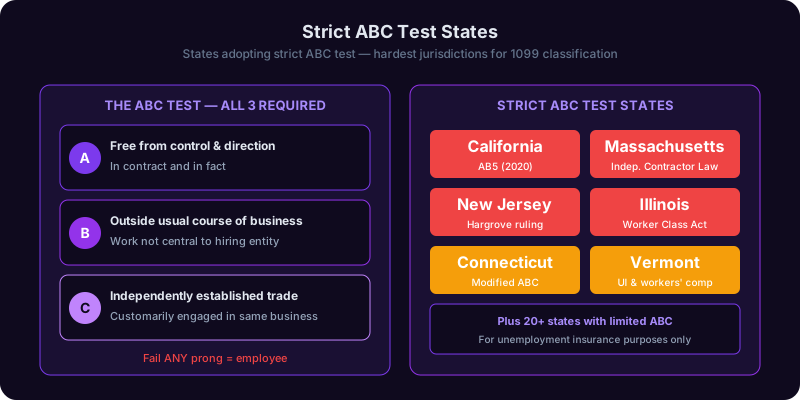
Prong A: Freedom from control and direction in the performance of work, both under contract and in fact. This is similar to the federal control factor but applied as a hard requirement.
Prong B: Work performed outside the usual course of the hiring entity's business. This is the killer prong. A delivery company hiring "contractor" drivers fails B because driving is the core business. A bakery hiring a plumber to fix a leak passes B.
Prong C: Worker customarily engaged in an independently established trade, occupation, or business of the same nature as the work performed. The worker must already operate an independent business - not just be available for one.
California: Dynamex and AB5. In 2018, the California Supreme Court's Dynamex Operations West v. Superior Court decision adopted the ABC test for wage order claims. The legislature codified and expanded it in 2019 via Assembly Bill 5 (AB5), with later amendments adding exemptions for many professions (writers, photographers, lawyers, doctors, accountants, real estate agents, and others, subject to specific conditions). Gig companies later carved out app-based drivers via Proposition 22 in 2020, a separate classification surviving legal challenges through 2023.
Massachusetts has applied an even stricter version of the ABC test under M.G.L. c. 149, sec. 148B since 2004, with very limited exemptions. New Jersey applies the ABC test for unemployment insurance and wage claims under Hargrove v. Sleepy's. Other ABC-test states include Connecticut, Delaware, Illinois, Vermont, Washington, and (variations of) Maryland and Nebraska.
Many other states use modified tests: New York uses a common-law control test with a strong presumption of employment for many industries. Texas and Florida use more employer-friendly common-law tests. Pennsylvania uses different tests for unemployment versus workers' compensation.
Practical implication: even if the federal DOL or IRS would classify you as a contractor, your state may classify you as an employee for state law purposes - unemployment insurance, workers' comp, state wage-and-hour claims, and state anti-discrimination laws. Always check your state's labor department website. For related state-law strategies, see our LLC vs S-Corp tax savings guide.
Industry Hotspots: Where Misclassification Runs Rampant
Misclassification is concentrated in industries with high labor costs, fragmented workforces, and historically weak enforcement. The DOL, IRS, and state agencies have publicly targeted these sectors with enforcement initiatives.
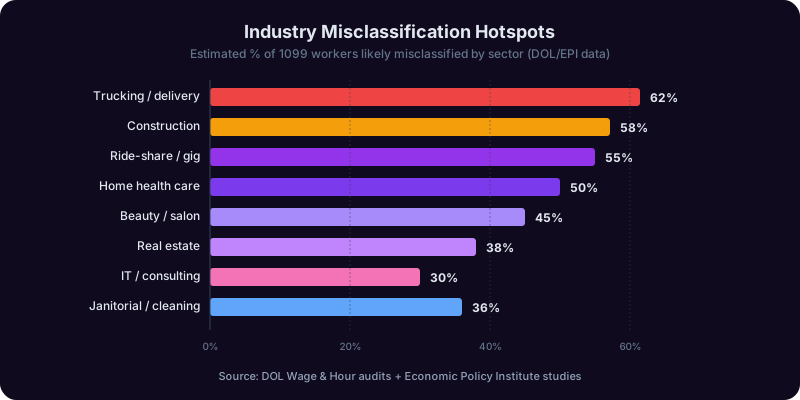
Trucking and Logistics. Port truckers, last-mile delivery drivers, and long-haul drivers are routinely misclassified. The "owner-operator" label often disguises employment relationships where the carrier controls routes, dispatch, equipment financing, and customers. Multiple class actions against FedEx Ground (settled for hundreds of millions) and California port trucking firms have established that drivers are often employees under the ABC test.
Construction. The Center for Construction Research and Training estimates 1.1 to 2.1 million construction workers are misclassified or paid off the books. Subcontractor labeling is rampant, especially in residential and small commercial work. States like New York, New Jersey, and Massachusetts have construction-specific misclassification statutes with stiff penalties.
Rideshare and Delivery (Gig Economy). Uber, Lyft, DoorDash, Instacart, and similar platforms classify workers as contractors. California's Prop 22 created a hybrid "contractor with benefits" status for app drivers, but workers in other states continue to file class actions and seek state-by-state employee status. Massachusetts settled a $175M case with Uber and Lyft in 2024, securing minimum wages and benefits without changing classification.
Home Health and Personal Care. Caregivers, companions, and home health aides - overwhelmingly women, often immigrants - are frequently misclassified as contractors despite working set schedules under agency direction. The DOL extended FLSA protections to most home care workers in 2015.
Beauty and Salon. Hair stylists, nail technicians, and barbers are often labeled "booth renters" or contractors when they actually work under salon control - set hours, required products, salon-set prices. True booth rental requires genuine business independence.
Real Estate. Real estate agents have a statutory safe harbor under IRC sec. 3508 - they're treated as independent contractors for federal tax purposes if compensation is substantially based on sales and a written contract states they're not employees. State law treatment varies; California specifically exempted agents from AB5.
IT Consulting and Tech. Long-term "contractors" sitting in client offices, using client equipment, working under client supervision for years are a Microsoft-era classic. The famous Vizcaino v. Microsoft case (1999) established that perma-temps were employees entitled to 401(k) and stock purchase plan benefits.
Other hotspots: janitorial, landscaping, agriculture, exotic dancers, newspaper carriers, cable installers, and security guards. If your industry is on this list, scrutinize your classification carefully and consider reviewing our freelancer tax deductions guide for legitimate contractor tax planning.
Calculating What You're Owed: Back Wages, Overtime, and Tax Refunds
If you've been misclassified, the damages can be substantial. Recovery typically includes back wages, overtime, payroll tax refunds, the value of lost benefits, and sometimes liquidated damages and attorneys' fees.
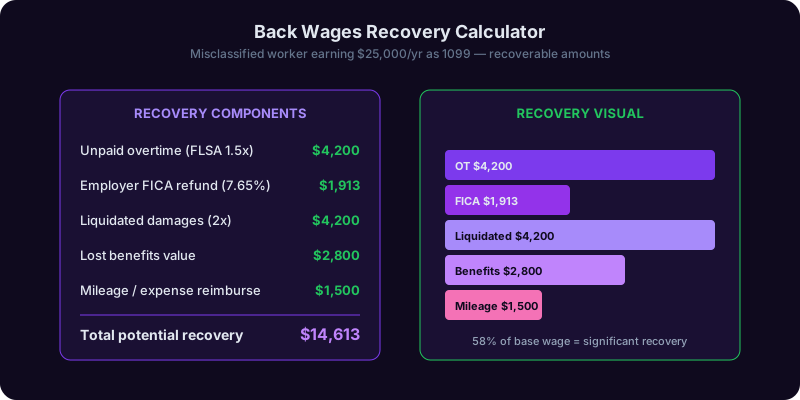
1. Unpaid Overtime (Often the Biggest Item). Under the FLSA, non-exempt employees must receive 1.5x their regular rate for hours over 40 per week. Misclassified workers paid a flat "contractor" rate often worked 50, 60, or 70 hours per week without overtime. Calculate: (Regular hourly rate x 1.5) x (Overtime hours per week) x (Weeks worked). The FLSA statute of limitations is 2 years (3 years if willful). State laws may allow longer recovery periods - California allows 3-4 years for wage claims.
2. Minimum Wage Shortfalls. If your effective hourly rate (total pay divided by actual hours) fell below federal, state, or local minimum wage, recover the difference for every hour worked. Many gig workers see this after expenses are deducted.
3. Employer-Side Payroll Tax Refund. If you paid the full 15.3% self-employment tax, file Form 8919 to recover the employer portion (7.65%) and shift it to the misclassifying employer. On $60,000 of misclassified income over 3 years, that's roughly $13,770 in your pocket.
4. Liquidated Damages. Under the FLSA, courts may award double damages (the unpaid amount plus an equal amount as liquidated damages) unless the employer proves good faith. State laws often allow similar or higher multipliers - California Labor Code sec. 226.8 imposes civil penalties of $5,000 to $25,000 per misclassification.
5. Lost Benefits Value. Health insurance the employer would have contributed to (employer share often $5,000-$15,000/year). Retirement matching (typical 401(k) match is 3-6% of salary). Paid time off. Stock options or RSUs at companies that offer them.
6. Unreimbursed Business Expenses. Under California Labor Code sec. 2802 and similar state laws, employers must reimburse employees for work-related expenses. Misclassified workers who paid for fuel, phones, equipment, supplies, and mileage out of pocket can recover those amounts.
7. Attorneys' Fees and Costs. The FLSA and most state wage laws are fee-shifting statutes: prevailing plaintiffs recover reasonable attorneys' fees from the employer. This is why employment attorneys take strong misclassification cases on contingency - they get paid out of the recovery and fee award.
Example calculation for a misclassified delivery driver earning $45,000/yr over 3 years, working 55 hours/week: overtime owed ~$58,000, payroll tax refund ~$10,300, expense reimbursement ~$18,000, liquidated damages ~$58,000, lost benefits ~$25,000. Total potential recovery: ~$170,000 - and that's before attorneys' fees and statutory penalties.
Filing Options: SS-8, DOL, State Agencies, EEOC, and Private Lawsuits
Misclassified workers have multiple, overlapping enforcement options. You can often pursue them in parallel - an IRS SS-8 ruling doesn't prevent a DOL wage complaint or a private lawsuit. Strategy depends on your facts, goals, and risk tolerance.
1. IRS Form SS-8 (Worker Status Determination). Free, official, binding for tax purposes. Best for resolving payroll tax disputes and obtaining a reasoned IRS determination. Slow (6-18 months). The IRS will contact your employer, so retaliation risk is real if you're still working there. File at irs.gov/forms-pubs/about-form-ss-8.
2. DOL Wage and Hour Division Complaint. The federal DOL investigates FLSA violations - unpaid minimum wage, unpaid overtime, and misclassification underlying those wage claims. Complaints are free and confidential (the DOL won't reveal your identity unless necessary for the investigation). The DOL can recover back wages, liquidated damages, and impose civil penalties. File online at dol.gov/agencies/whd/contact/complaints.
3. State Labor Department. Often faster than federal channels for small claims. California's Labor Commissioner (DLSE), New York Department of Labor, and similar state agencies investigate wage theft and misclassification. Most states allow you to file without an attorney and conduct administrative hearings. State agencies can typically enforce state-law remedies that exceed federal protections.
4. EEOC Charge. The Equal Employment Opportunity Commission enforces Title VII, ADA, ADEA, and other anti-discrimination laws - which generally apply only to employees. If you experienced discrimination or harassment AND were misclassified, file an EEOC charge raising both issues. The EEOC analyzes whether you're an employee for purposes of the statute. File within 180-300 days at eeoc.gov/filing-charge-discrimination. For related EEOC guidance see our wrongful termination and EEOC complaint guide.
5. NLRB Charge. The National Labor Relations Board protects employees' rights to engage in concerted activity, including discussing wages and organizing. If you were misclassified and disciplined for protected activity, file a charge at nlrb.gov. The NLRB has aggressively pursued misclassification as a standalone unfair labor practice.
6. Private Lawsuit (Individual or Class Action). The most powerful option for large damages. FLSA collective actions (opt-in) and Rule 23 class actions (opt-out under state laws) have produced hundreds of millions in recoveries against misclassifying employers. Most plaintiff-side employment lawyers take strong cases on contingency. Pros: full damages, attorneys' fees, larger settlements. Cons: 1-3+ year timeline, public record, possible employer counterclaims.
7. Tax Refund via Form 8919. Even without filing other claims, you can attach Form 8919 to your tax return to pay only the employee share of FICA. You need a reasonable basis - an SS-8 filing, prior IRS or court determination, or written statement from the firm.
Retaliation is illegal. The FLSA, IRS code, state laws, and most agency statutes prohibit retaliation for filing complaints or asserting your rights. If you're fired, demoted, or disciplined after raising classification concerns, you may have a separate retaliation claim with additional damages.
Self-Protection Strategies and How Copilotly's Legal Copilot Can Help
Legal Disclaimer: The strategies below are general best practices, not legal advice. Worker classification turns on specific facts and applicable law. Consult a qualified employment attorney before structuring any work arrangement or filing any claim.
If you genuinely want to work as an independent contractor - or if you want to defend your existing contractor status from reclassification - the following practices strengthen your position. These also help you spot when an arrangement crosses the line into employment.
1. Written Independent Contractor Agreement. A clear contract describing the relationship, project scope, deliverables, payment terms, and the absence of behavioral control isn't dispositive (regulators see through labels), but it's evidence and it sets expectations. Avoid clauses that look like employment: non-competes, set hours, exclusive engagement, training requirements, performance reviews.
2. Multiple Clients. Active relationships with several clients demonstrate an independent business. Even if 80% of your income comes from one client, having 3-5 others materially helps factors B and C of the ABC test and the DOL's "permanence" factor.
3. Your Own Equipment and Workspace. Provide your own laptop, tools, phone, vehicle, and office space. Keep receipts and depreciate as business expenses. This supports the "investment" factor under DOL analysis and behavioral control under IRS analysis.
4. Business Formation and Licenses. Form an LLC or S-Corp, get an EIN, obtain required business licenses, carry your own general liability and professional liability insurance, file a fictitious business name (DBA), maintain separate business bank accounts, and use business cards. These are textbook indicators of an independently established business.
5. Set Your Own Prices and Hours. Quote project-based or value-based fees rather than accepting an hourly rate set by the client. Set your own schedule. Refuse to clock in or report to a manager. Take other projects without seeking permission.
6. Marketing and Sales Activity. Maintain a website, advertise, attend trade shows, send proposals, and actively solicit new clients. Document this activity - it's strong evidence of an independent business.
7. Tax Hygiene. File Schedule C and Schedule SE annually. Pay quarterly estimated taxes. Track and deduct legitimate business expenses (see our side hustle taxes guide). Avoid commingling personal and business funds.
How Copilotly's Legal Copilot Helps: Copilotly's Legal Copilot is an AI-powered legal research assistant trained on federal and state employment law. Upload your contractor agreement, describe your working conditions, and the Legal Copilot will walk you through the 2024 DOL 6-factor test, applicable state tests, IRS factors, and flag specific red flags in your arrangement. It can help you draft an SS-8 narrative, prepare a DOL complaint summary, identify which agencies to contact, estimate potential back-wage exposure, and generate questions for an initial employment lawyer consultation. It does not replace an attorney, but it dramatically reduces the time and expense of figuring out where you stand. Pair it with the Career Copilot to evaluate the financial impact of switching roles or pursuing reclassification.
Final note: classification disputes are fact-intensive and high-stakes. If meaningful money or your job is on the line, hire a licensed employment attorney. Many take contingency cases for free initial consultations. The cost of a one-hour consult is trivial compared to walking away from $50,000+ in back wages.
Frequently Asked Questions
Recommended Copilots
Related Articles
Get Answers From the Legal Copilot
Copilotly's Legal Copilot analyzes your work arrangement against the 2024 DOL 6-factor test, IRS rules, and state ABC tests in minutes. Upload your contractor agreement, describe your working conditions, and get a clear breakdown of red flags, potential back-wage exposure, and next steps - including draft SS-8 narratives and DOL complaint summaries. Trusted by thousands of workers navigating misclassification disputes in 2026.