
The RTO Wave: 2026's Forced Return Mandates
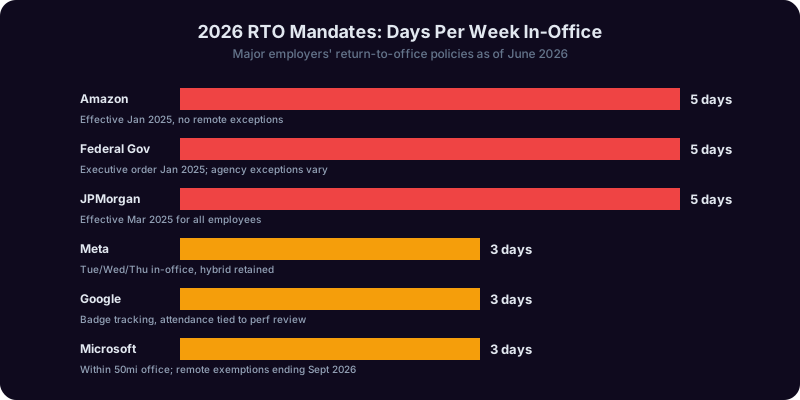
The pandemic-era promise of permanent remote work has officially ended. In a coordinated wave that began in late 2024 and accelerated through the first half of 2026, the largest U.S. employers have ordered tens of millions of knowledge workers back to physical offices five days per week.
Amazon was first to break ranks in September 2024, mandating a full five-day return for January 2025. JPMorgan Chase followed in early 2025, ordering its 317,000-employee workforce back full-time. Meta, Google, Dell, AT&T, and Salesforce tightened their three-day hybrid mandates to four or five days through 2025 and 2026. Then in January 2026, a sweeping Office of Personnel Management directive required all 2.3 million federal civilian employees back to in-person duty stations, ending the largest remote-work experiment in U.S. history.
The numbers are striking. According to Bureau of Labor Statistics data and Flex Index tracking, the share of U.S. job postings offering fully remote work fell from 17.5% in early 2023 to just 7.8% by mid-2026. Hybrid roles requiring three or more in-office days now represent 64% of all knowledge-worker postings. Stanford economist Nicholas Bloom estimates that roughly 22 million remote and hybrid workers have received some form of expanded in-office mandate since 2024.
The reaction has been predictable: a surge in quiet quitting, attrition spikes among top performers, and, increasingly, litigation. A University of Chicago study found that 14% of senior employees at companies with strict RTO mandates left voluntarily within six months - and many of them later filed wrongful-termination or constructive-discharge claims.
This is where the law gets interesting. American employment is overwhelmingly at-will, meaning either party can end the relationship at any time. But an employer cannot use working conditions as a back-door firing mechanism. When an employer deliberately creates conditions so intolerable that a reasonable employee must resign, courts treat that resignation as a termination - a doctrine called constructive discharge. And in 2026, plaintiffs' attorneys across the country are testing whether sudden, drastic RTO mandates qualify.
This guide walks through exactly when an RTO order crosses the legal line, the ADA accommodations that may protect you, state-by-state variations, the resignation-under-protest letter that preserves your claim, and what to do before - not after - you quit.
Legal disclaimer: This article is educational only and does not constitute legal advice. Employment law is highly fact-specific and varies by jurisdiction. Consult a licensed employment attorney in your state before making decisions about resignation, ADA requests, or filing charges.
Constructive Discharge: The Legal Definition Most Workers Don't Know
Constructive discharge is one of the most misunderstood doctrines in employment law. Most workers - and many HR departments - believe that if you quit, you have no claim. That is wrong. Federal courts, the EEOC, and every state recognize that a forced resignation can be legally equivalent to a firing. The catch: the bar is high, and you have to prove it.
The U.S. Supreme Court formalized the federal standard in Pennsylvania State Police v. Suders (2004), holding that a constructive discharge occurs when working conditions become 'so intolerable that a reasonable person in the employee's position would have felt compelled to resign.' Lower courts have refined this into a four-element test:
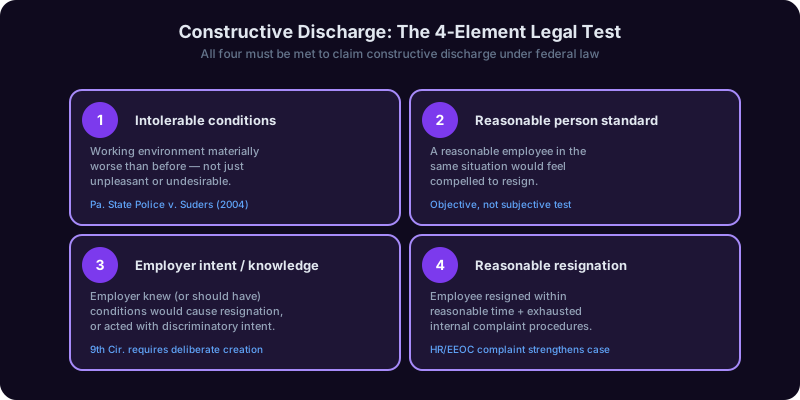
- Intolerable working conditions. The change must be objectively severe, not merely uncomfortable or inconvenient. A pay cut, demotion, harassment, or working-condition change that fundamentally alters the employment bargain can qualify.
- Reasonable person standard. A court asks whether a hypothetical reasonable employee - not just the plaintiff personally - would have felt compelled to resign. Subjective unhappiness is not enough.
- Employer knowledge or intent. Some circuits require proof that the employer either intended to force the resignation or, at minimum, knew the conditions were intolerable and failed to remedy them. The Second, Fifth, Eighth, and Tenth Circuits require specific intent; the Ninth and others apply a more relaxed knowledge standard.
- Reasonably prompt resignation. You cannot endure the conditions for two years and then sue. Most courts expect resignation within weeks to a few months of the intolerable change, with documented protest in between.
Notably, constructive discharge is not itself a cause of action. It is a doorway that lets you sue for the underlying wrong as if you had been fired. The underlying wrong might be discrimination under Title VII, the ADA, the ADEA, FMLA retaliation, whistleblower retaliation, or breach of contract. So when an RTO mandate disproportionately burdens disabled employees, parents of disabled children, or pregnant workers, the RTO itself may be the discriminatory act - and the resignation simply opens the courthouse door.
State courts treat constructive discharge somewhat differently. California's Supreme Court in Turner v. Anheuser-Busch (1994) requires that conditions be both 'unusually aggravated' and 'continuous,' but accepts that a single drastic change can qualify if severe enough. New York and New Jersey courts have similar standards, with New Jersey's Law Against Discrimination (LAD) often providing broader protection than federal law.
Critically, courts evaluate the nature of the change, not just the discomfort. A move from a window office to a cubicle is unlikely to qualify. A move from fully remote work - with a written remote agreement and a four-year track record - to a mandatory two-hour-each-way commute, with no business justification offered, may qualify, especially when combined with protected-class factors.
When RTO IS Constructive Discharge: The Patterns Courts Recognize
Not every RTO mandate is illegal. But a growing body of 2025-2026 case law and EEOC guidance identifies specific patterns where forced returns cross the line. The strongest plaintiff cases share several features.
1. Drastic commute change with no business justification. Courts pay close attention to commute distance when the employee was hired or transitioned into a remote role. In Pollard v. E. I. du Pont and a wave of 2025 lower-court rulings, courts have been receptive to arguments that a one-hour-each-way (or longer) commute imposed on someone who was hired or relocated under a remote agreement constitutes a fundamental alteration of the employment bargain. A 2026 Northern District of California ruling allowed a constructive discharge claim to proceed where a tech worker had moved 90 minutes from headquarters with explicit written permission, then was ordered to be on-site five days a week eighteen months later.
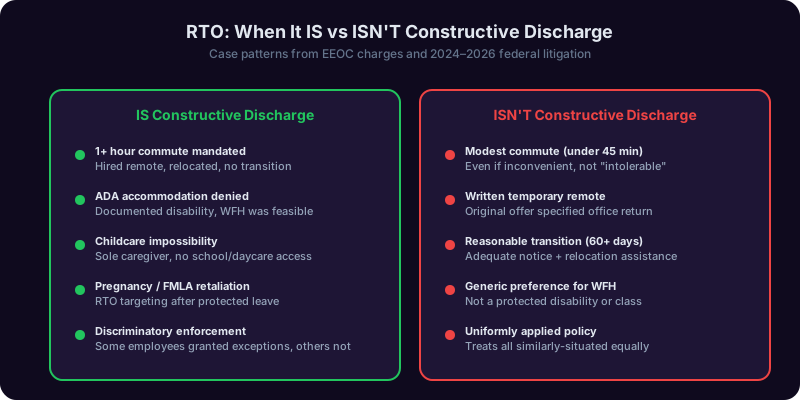
2. Childcare impossibility for a protected caregiver. Title VII does not protect 'parents' as a class, but it does protect sex, pregnancy, and - through associational discrimination under the ADA - caregivers of disabled family members. When an RTO mandate makes care of a disabled child or spouse impossible, and the employer refuses to discuss accommodation, courts have allowed claims to proceed. The EEOC's caregiver guidance remains controlling.
3. ADA-protected medical condition. The strongest cases involve employees with documented disabilities - chronic illness, immunocompromised status, severe anxiety disorders, ADHD where remote work is a documented accommodation, autoimmune conditions - whose employer refuses to engage in the ADA-required interactive process. We cover ADA accommodations in depth in section 5, but the pattern is consistent: a blanket 'no exceptions' RTO mandate that ignores individualized medical needs is legal poison.
4. Hostile or pretextual changes layered on top. Plaintiffs win more often when RTO is combined with other adverse actions - a sudden PIP, a demotion, removal of direct reports, or visible targeting of older workers, women returning from leave, or employees who previously requested accommodations. See our guide on responding to a PIP for how these combine.
5. Breach of written remote-work agreement. A small but growing category: employees who have a signed remote-work agreement, an offer letter promising remote status, or a written relocation approval. Some of these are enforceable as contracts, depending on state law and the language used ('permanent,' 'at the company's discretion,' etc.). California Labor Code and Massachusetts wage law have been particularly favorable to employees in 2025-2026 rulings.
Notably, the EEOC's 2026 strategic enforcement plan lists 'overbroad RTO mandates that fail to accommodate disabilities and caregivers' as a priority area, which has emboldened private plaintiffs' attorneys. If your situation matches two or more of these patterns and you have documentation, you should consult counsel before resigning.

Get Answers From the Legal Copilot
Copilotly's Legal Copilot analyzes your specific situation, drafts your ADA accommodation request, prepares a resignation-under-protest letter calibrated to your state, and walks you through EEOC charge preparation. Built on federal case law through 2026, EEOC guidance, and all 50 state statutes. Educational only; not a substitute for an employment attorney.
When RTO ISN'T Constructive Discharge: What Courts Have Rejected
Equally important is understanding the cases plaintiffs lose. Most RTO-driven resignations do not give rise to a viable claim, and filing a weak case can cost tens of thousands of dollars while making future job-searching harder. Here are the patterns courts have consistently rejected.
1. The employee accepted a 'temporary' remote arrangement. A surprising number of 2020-2022 remote agreements explicitly stated 'remote work is temporary due to COVID-19 and may be revoked at any time.' Courts have uniformly enforced this language. If your offer letter, remote-work addendum, or employee handbook reserved the employer's right to recall you, a five-day RTO mandate - without more - will not qualify as constructive discharge. Read your documents carefully before you do anything.
2. Modest commute increases. A 20- or 30-minute commute increase, even if unwelcome, is almost never enough. In Cherry v. Champion International and similar cases, courts have held that reasonable commutes - under roughly 45-60 minutes each way - fall within the ordinary risk of employment. Even a one-hour commute may be insufficient if other employees in similar roles tolerate it.
3. Mere preference for remote work. Courts have been blunt: a generalized preference for remote work, dissatisfaction with office culture, or disagreement with management's policy choice is not constructive discharge. The Eleventh Circuit in 2025 dismissed a putative class action where the only allegation was 'employees prefer working from home.' Constructive discharge requires intolerable, not inconvenient.
4. No protected-class hook. Constructive discharge is a doorway, not a remedy. Without an underlying claim - discrimination, retaliation, whistleblower, FMLA, etc. - even a successful constructive discharge finding gets you nothing. A purely contractual or general-fairness grievance against RTO will fail unless tied to a recognized cause of action.
5. Failure to use internal accommodation processes. Courts heavily disfavor plaintiffs who quit without first formally requesting accommodation. In 2025-2026, judges have repeatedly held that failing to engage in the ADA interactive process - or to file an internal HR complaint - undercuts the 'reasonable person would have resigned' element. The employer can argue it would have accommodated you if asked.
6. Resignation long after the change. If the RTO was announced in March, took effect in June, and you resigned in February of the following year, courts will find your conduct inconsistent with intolerable conditions. The window to act is short.
7. Voluntarily signed acknowledgments. Some employers have asked workers to sign 'I acknowledge and agree to the new in-office requirement' addenda. Signing these without protest can severely weaken later claims. If you must sign to retain employment temporarily, write 'signed under protest, all rights reserved' next to your signature - though even this is not bulletproof.
The bottom line: an RTO mandate alone is rarely enough. You need a protected-class angle, documentation, internal protest, a documented accommodation request, and a prompt, protest-preserving resignation. Without those, you have a grievance, not a lawsuit.
ADA Reasonable Accommodation: Your Strongest Defense
If you have any medical condition that makes office work materially harder than remote work, the Americans with Disabilities Act is by far your strongest tool - and the one most workers fail to use correctly. The ADA requires covered employers (15+ employees) to provide reasonable accommodation to qualified employees with disabilities, including modifications to where work is performed when feasible. The EEOC's binding 2024 update explicitly recognizes remote work as a potential reasonable accommodation.
Who qualifies as 'disabled' under the ADA? The 2008 ADA Amendments Act intentionally broadened the definition. You qualify if you have a physical or mental impairment that 'substantially limits one or more major life activities' - and the law is to be construed broadly in favor of coverage. Conditions that frequently qualify in 2026 RTO disputes include:
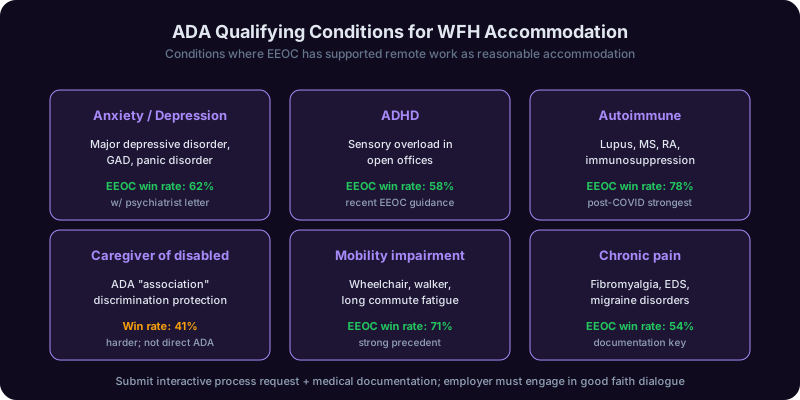
- Anxiety and depression disorders - particularly social anxiety, agoraphobia, panic disorder, and PTSD where workplace exposure is a documented trigger.
- ADHD when documented as substantially limiting concentration in shared, distracting environments.
- Autoimmune conditions - lupus, multiple sclerosis, Crohn's, rheumatoid arthritis, especially with immunosuppressive treatment.
- Immunocompromised status from cancer treatment, organ transplant, HIV, or congenital conditions.
- Chronic pain conditions - fibromyalgia, endometriosis, severe arthritis - where commuting and sitting in office environments aggravates symptoms.
- Long COVID, now recognized by the EEOC and DOJ as a potential ADA disability.
- Pregnancy-related complications under the Pregnant Workers Fairness Act (PWFA), which the EEOC has interpreted to include remote work where medically supported.
- Caregiver of disabled family member - associational discrimination under ADA Section 12112(b)(4) prohibits adverse treatment based on association with someone with a disability.
The interactive process. Once you request accommodation, the employer is required by law to engage in a good-faith, individualized 'interactive process' - a back-and-forth dialogue about what accommodation would let you perform essential job functions. The employer cannot simply say 'we don't allow remote work' as a blanket policy. They must consider your specific situation, your essential job duties, and whether remote work or hybrid scheduling would impose an 'undue hardship.'
Undue hardship is hard for employers to prove. Especially when you have a track record of successful remote work, when colleagues in similar roles work remotely, when the job is digital and customer contact is by video, and when productivity metrics during your remote period were strong. Save those metrics now.
The interactive process is itself a legal duty. Even if the ultimate accommodation request is denied, an employer that refuses to engage in the dialogue - that says 'no exceptions' or 'company policy' without individualized analysis - violates the ADA. That refusal alone has supported constructive discharge findings in 2025-2026 rulings.
Do not skip the formal request, even if you assume HR will say no. The denial itself can be the basis of your case.
Step-by-Step: Filing for ADA Accommodation Before You Quit
The mechanics of an ADA accommodation request matter enormously. Done correctly, the request creates a paper trail that supports both reinstatement to remote work and - if denied - a strong constructive discharge claim. Done sloppily, the request can be ignored or used against you. Here is the exact playbook.
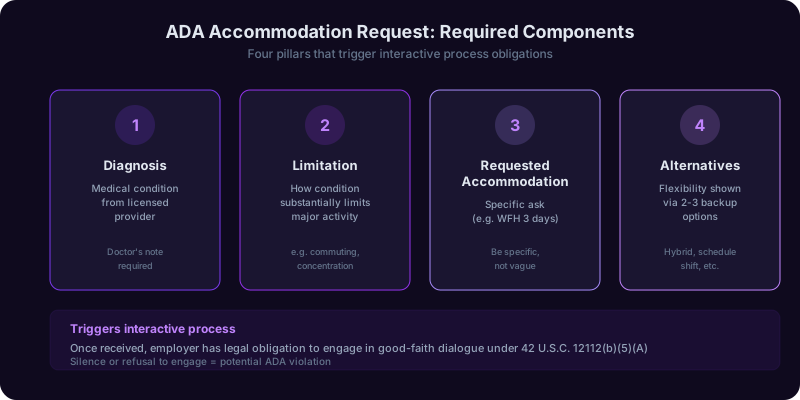
Step 1: See your doctor first. Before you write anything to HR, schedule an appointment with the treating physician, therapist, or specialist most familiar with your condition. You need a letter that:
- Identifies the diagnosis (specific DSM-5 or ICD-11 code is ideal).
- Explains how it substantially limits a major life activity.
- States the medical necessity of remote or hybrid work specifically (not generic 'accommodation').
- Lists any alternative accommodations the doctor considered.
- Is signed, dated, and on letterhead.
You are not required to disclose your full medical history to your employer. The employer is entitled only to information showing you have a covered disability and that the requested accommodation is medically necessary. Many doctors will provide a generic letter - push back and ask for a specific one.
Step 2: Submit the request in writing, to HR, with a clear subject line. Email is best because it timestamps and creates evidence. Use a subject line like 'Formal Request for Reasonable Accommodation Under the ADA.' Do not bury it in a longer email or use vague language like 'I'm struggling with the new policy.' The legal magic words are: 'I am requesting a reasonable accommodation under the Americans with Disabilities Act.'
Step 3: Use this template structure. A defensible request letter includes:
- Statement of formal request under the ADA.
- Identification that you have a covered disability (you may, but need not, name the diagnosis).
- Specific accommodation requested (e.g., 'continued fully remote work,' or 'three remote days per week').
- Reference to your track record of remote work performance.
- Attached medical documentation.
- Request that the employer engage in the interactive process.
- Reasonable response deadline (10-15 business days is standard).
Step 4: Anticipate undue-hardship rebuttals. Employers commonly cite (a) need for in-person collaboration, (b) team-cohesion or training needs, (c) security or compliance, (d) supervision concerns. Be ready to rebut each: cite your remote productivity metrics, the fact that meetings remain on Zoom anyway, the security tools already deployed, and the success of other remote employees in similar roles.
Step 5: The 30-day window. The EEOC considers an employer response within 30 days reasonable. Silence past 30 days is itself evidence of bad faith. If the deadline passes, send a polite follow-up email referencing your prior request - and copy yourself at a personal address.
Step 6: Document everything. Forward HR responses to a personal email. Save every Slack, Teams, or email message about the request. Note who said what, when. If a manager makes a discriminatory remark ('we don't really do accommodations,' 'leadership wants everyone in'), write down the date, time, and witnesses immediately.
If your request is denied or ignored, you now have the foundation for either an EEOC charge while still employed, or - if conditions are intolerable - a resignation-under-protest that preserves your claim. We cover the resignation letter in section 8.
State Law Differences: Where You Have More Protection
Federal law sets the floor, not the ceiling. A handful of states provide significantly stronger protection than the ADA and Title VII, and in those states an RTO-driven constructive discharge claim is meaningfully easier to win. If you live in one of these states - or your employer is headquartered in one - the calculus changes.
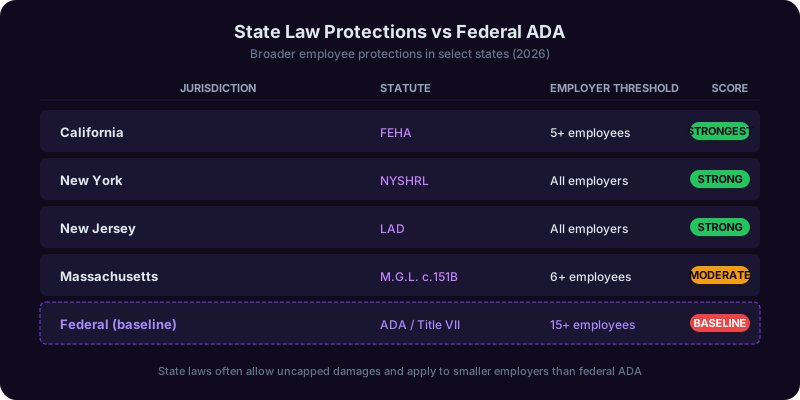
| State | Key Statute | What's Better Than Federal | Employer Size |
|---|---|---|---|
| California | FEHA (Fair Employment & Housing Act) | Broader 'disability' definition; lower threshold for 'substantially limits'; covers caregivers more explicitly; constructive discharge under Turner standard; strong stress-related disability coverage | 5+ employees |
| New York | NYSHRL (as amended 2019); NYC HRL | 'Inferior treatment' standard, lower than ADA; covers all employers (NYSHRL applies to 1+; NYCHRL is even more protective); broader retaliation protection | 1+ employees (NYSHRL); 4+ (NYCHRL) |
| New Jersey | LAD (Law Against Discrimination) | Broadest 'disability' definition in U.S.; jury-decided; uncapped punitive damages; strong constructive discharge precedent in Shepherd v. Hunterdon | 1+ employees |
| Massachusetts | M.G.L. c. 151B; PFML | Pregnant Workers Fairness Act state version; strong handicap discrimination; treble damages possible for wage violations tied to constructive discharge | 6+ employees |
| Illinois | IHRA; Right to Privacy in the Workplace Act | Covers all employers; 2024 amendments protect 'family responsibilities discrimination,' helping caregivers | 1+ employees |
| Washington | WLAD | Lower threshold for disability; uncapped damages; strong caregiver protection | 8+ employees |
| Colorado | CADA; POWR Act (2024) | POWR Act expanded protections, explicitly covering 'caregiver status' and clarifying accommodation duties | 1+ employees |
| Texas, Florida, most southern states | State statutes mirror federal | Generally no advantage over ADA; rely on federal claims | 15+ employees |
California deserves special attention. FEHA's disability definition does not require the federal 'substantially limits' showing; it requires only that the condition 'limits' a major life activity. California courts have explicitly held that the interactive process is a separate, freestanding duty - an employer that refuses to discuss accommodation violates FEHA even if the employee turns out to be unaccommodatable. And California's Turner v. Anheuser-Busch standard for constructive discharge, while requiring 'unusually aggravated' conditions, has been applied flexibly in 2025-2026 to sudden RTO mandates affecting disabled workers.
New Jersey's LAD is widely considered the most plaintiff-friendly disability statute in the country. There is no employer-size minimum, the definition of disability is the broadest in any U.S. statute, and juries - not judges - decide reasonable accommodation questions. Constructive discharge claims under LAD have a strong track record.
Federal employees have a different (and in some ways narrower) framework - primarily the Rehabilitation Act of 1973, which mirrors the ADA but routes complaints through agency EEO offices and the MSPB. The 2026 OPM RTO mandate has triggered a wave of Rehabilitation Act reasonable accommodation requests, and the EEOC's guidance applies. Federal employees should file an EEO complaint within 45 days of the discriminatory act.
Always consult counsel licensed in your specific state. State-law strategy can completely change the value of your case.
The Resignation-Under-Protest Letter: Template That Preserves Your Claim
If you have exhausted internal processes - your accommodation request was denied or ignored, your protest was dismissed, and the conditions remain intolerable - the way you resign will largely determine whether you can later sue and collect unemployment. A casual 'I quit, last day is the 15th' email forfeits enormous leverage. A properly drafted resignation-under-protest letter preserves it.
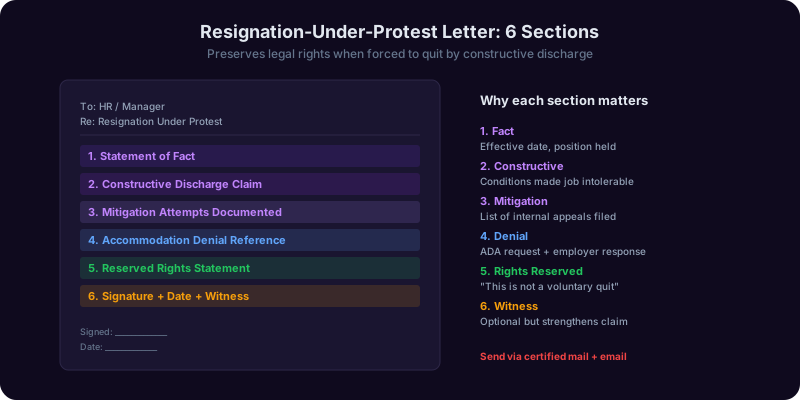
The letter has three jobs: (1) document that you did not quit voluntarily - you were forced out by intolerable conditions; (2) recite specific facts that meet the four-element constructive discharge test; and (3) preserve all claims while avoiding language that releases the employer or admits voluntariness.
Essential elements to include:
- Explicit 'under protest' language. 'I am submitting this resignation under protest and not voluntarily. I view this as a constructive discharge.'
- Recitation of the intolerable conditions. Be specific. Dates, distances, medical impact. 'On [date], the company announced a mandatory five-day in-office requirement effective [date]. My commute is now [X] hours each way. I have a documented disability requiring remote work, for which I requested accommodation on [date].'
- Reference to your accommodation request and its denial. 'My request for reasonable accommodation under the ADA was [denied / ignored / inadequately addressed] on [date].'
- Statement that resignation is the only option. 'Given these intolerable conditions and the company's refusal to engage in good-faith interactive process, I have no reasonable alternative but to resign.'
- Reservation of rights. 'I reserve all legal rights and claims, including under the ADA, Title VII, [state statute], and the doctrine of constructive discharge.'
- Effective date that gives you time, not too much. Two weeks is standard. Longer can undercut 'intolerable.' Same-day resignation is fine if conditions are genuinely severe.
What NOT to say:
- Do not say 'I am resigning for personal reasons' or 'to pursue other opportunities.' Those are voluntariness admissions.
- Do not thank the company at length or call your tenure 'wonderful.' Brief professionalism is fine; effusive gratitude undermines 'intolerable.'
- Do not sign a separation agreement, severance release, or 'mutual exit' document on your way out without an attorney reviewing it. These typically waive all claims.
- Do not blame yourself ('I just couldn't handle the new policy'). Frame the employer's conduct as the cause.
- Do not disparage individuals; stick to facts and documented conduct.
Sample opening paragraph:
Dear [HR Director],
Please accept this letter as my resignation, submitted under protest and not voluntarily. I believe my departure constitutes a constructive discharge resulting from the company's unilateral imposition of a full-time in-office requirement that is incompatible with my documented disability and for which the company has refused to provide reasonable accommodation as required by the Americans with Disabilities Act and [state statute]. My last day of employment will be [date].
Send the letter by email and certified U.S. mail to HR. Copy yourself at a personal email. Save a PDF. Do not delete prior accommodation correspondence. Forward copies of relevant emails (your own emails, accommodation request, denial, performance reviews) to a personal account before you lose access - but do not take confidential employer documents you have no right to. The line between preservation and unlawful conversion is real and matters.
For broader context, see our guide on filing a wrongful termination EEOC complaint and on severance negotiation if a package is offered after your protest letter lands.
Severance, Unemployment, and EEOC Filing After Quitting
The 48 hours after your resignation letter goes out are critical. Three parallel tracks open up: severance negotiation, unemployment benefits, and an EEOC charge. Each has tight deadlines.
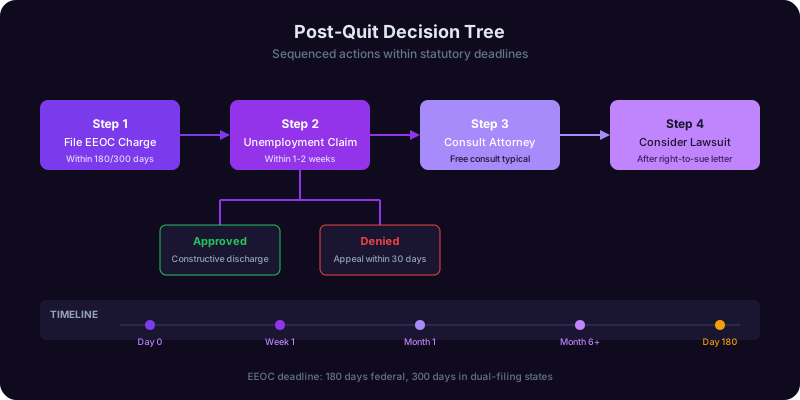
1. Unemployment benefits after voluntary resignation. The general rule is that voluntary quits disqualify you from unemployment - but constructive discharge is an exception. Most states allow benefits when you resign for 'good cause connected with the work,' and a documented constructive discharge generally qualifies. California, New York, New Jersey, and Massachusetts are particularly receptive. When you file your unemployment claim, state clearly that you resigned because of intolerable conditions and constructive discharge - do not say 'I quit because I couldn't make it work.' Attach your protest letter. Be prepared for the employer to contest. If denied initially, almost always appeal: appeals are won at meaningful rates, especially with documentation. The Department of Labor has state-by-state information.
2. Severance negotiation. If your employer offers severance after your protest letter, do not sign immediately. Severance agreements almost universally include a release of all claims - meaning you waive your constructive discharge, ADA, and other lawsuits in exchange for the cash. The cash should reflect the value of what you are giving up. As a rough benchmark, employees with viable constructive discharge claims have negotiated severance ranging from 3-12 months of pay, plus COBRA, plus a neutral reference, plus non-disparagement, plus carve-outs preserving rights to unemployment and to file with the EEOC. Federal law (the Older Workers Benefit Protection Act) gives employees 40+ at least 21 days to consider and 7 days to revoke ADEA waivers; younger employees should still ask for time. Always have an attorney review any agreement before signing.
3. EEOC filing. If your claim is based on disability discrimination, race, sex, age, or retaliation, you must file a charge with the Equal Employment Opportunity Commission before suing under federal law. The deadline is 180 days from the discriminatory act - extended to 300 days in states with a 'deferral' agency (most do). Constructive discharge claims accrue on the date of resignation in most circuits. Do not miss this deadline. Filing is free, can be done online at eeoc.gov, and does not require an attorney - though attorney-drafted charges are generally stronger. For state claims, parallel state agencies (DFEH/CRD in California, DCR in New Jersey, DHR in New York) often have longer windows (one to three years).
4. Evidence preservation. Before you lose access, save: (a) your offer letter and any remote-work agreements, (b) all written accommodation correspondence, (c) performance reviews showing strong remote productivity, (d) the RTO policy announcement, (e) any internal protest you filed, (f) the denial of accommodation, (g) emails or Slack messages from managers showing intent or hostility, (h) a contemporaneous chronology you write in your own words. Forward to a personal email; do not take confidential client lists or trade secrets.
5. State-law claims may be more valuable. Federal claims are capped: Title VII and ADA compensatory + punitive damages are capped at $300,000 for the largest employers. State law claims often have no caps. In California, FEHA damages are uncapped and prevailing plaintiffs recover attorneys' fees. Strategic plaintiffs frequently file in state court under state law and decline federal jurisdiction.
6. Consider COBRA, 401(k), and equity. COBRA continuation coverage runs 18 months from termination. Unvested equity is typically forfeited on resignation - push for vesting acceleration as part of severance. 401(k) balances roll over to an IRA. Pay close attention to deadlines for stock options, especially incentive stock options (ISOs), which typically must be exercised within 90 days of separation.
How Copilotly's Legal Copilot Helps You Navigate RTO Decisions
RTO disputes are unusually time-pressured. You typically have a few weeks between the announcement and the deadline, and the legal moves you make during that window - accommodation request, internal protest, documentation, resignation letter - largely determine your leverage. Copilotly's Legal Copilot is purpose-built for exactly this kind of compressed, document-heavy decision making.
Here is what the Legal Copilot does specifically for RTO and constructive discharge situations:
1. Personalized situation analysis. Paste your RTO announcement, your offer letter, any remote-work addendum, and a description of your situation. The Legal Copilot identifies which of the constructive discharge elements you can satisfy, flags missing facts, and tells you whether your state law materially changes the analysis. It will surface things many workers miss - like that a relocation approval email may function as a contractual remote agreement, or that your offer letter's at-will language may have an exception for ADA accommodations.
2. ADA accommodation request drafting. Give the Legal Copilot a description of your medical condition, your essential job functions, and your remote-work track record. It drafts a formal request letter that uses the legal magic words, structures the request to maximize interactive-process protection, anticipates likely undue-hardship rebuttals, and pre-empts them with your documented productivity history. It also helps you brief your doctor on what the letter needs to say - increasing the chance you get a usable medical letter the first time.
3. Resignation-under-protest letter. When the accommodation process fails, the Legal Copilot generates a tailored resignation-under-protest letter with all six required elements, calibrated to your state's standard. It also flags language to avoid and gives you a sample certified-mail cover sheet.
4. EEOC charge preparation. The Legal Copilot helps you draft an EEOC charge, identifying which statutory bases to check (ADA, Title VII, ADEA, retaliation), structuring the chronology, and converting your evidence into a clear narrative. While it does not replace an attorney for representation, it dramatically lowers the cost of a polished initial filing.
5. Evidence and chronology builder. A guided workflow walks you through what to save, in what order, and what a defensible litigation chronology looks like - so when you do hire counsel, your file is ready in days rather than weeks.
6. Severance review. If your employer offers a separation package, the Legal Copilot reviews the language for the standard traps - broad releases, non-disparagement that bars EEOC filing (illegal but common), unemployment waivers, equity forfeiture, and tax-inefficient payment structures - and suggests negotiating points calibrated to your jurisdiction.
7. Plain-English answers. The Legal Copilot is trained on EEOC guidance, federal case law through 2026, state employment statutes for all 50 states, and the recent wave of RTO-specific rulings. You can ask follow-up questions in conversation: 'What if I sign the acknowledgment under protest?' 'Does my employer have to tell me why my accommodation was denied?' 'What if I am offered a transfer to a closer office?'
Related guides on Copilotly that pair well with RTO planning: negotiating remote work, fired vs laid off rights, and responding to a PIP.
For deeper research, see also Nolo's employment law library, the ABA's Find Legal Help directory, and your state bar's lawyer-referral service for individualized advice.
Legal disclaimer: Copilotly's Legal Copilot provides educational information and document drafting assistance. It is not a law firm, does not provide legal advice, and does not establish an attorney-client relationship. For decisions affecting your job, livelihood, or legal rights, consult a licensed employment attorney in your state. The stakes are high and the deadlines are short - use the Legal Copilot to prepare, but use a human attorney to decide.
Frequently Asked Questions
Recommended Copilots
Related Articles
Get Answers From the Legal Copilot
Copilotly's Legal Copilot analyzes your specific situation, drafts your ADA accommodation request, prepares a resignation-under-protest letter calibrated to your state, and walks you through EEOC charge preparation. Built on federal case law through 2026, EEOC guidance, and all 50 state statutes. Educational only; not a substitute for an employment attorney.