
The 2026 H-1B Overhaul: Two Changes That Reshape Everything
Legal Disclaimer: Educational only. Immigration cases are highly fact-specific. Consult a licensed immigration attorney before filing or making employment decisions based on this content.
Between September 2025 and the FY2027 lottery window, two policy changes rewrote H-1B economics. The first was DHS's Weighted Selection of H-1B Cap Subject Registrations rule, finalized September 19, 2025, which replaced the random lottery with a wage-tier weighted selection. The second was the Section 212(f) Supplemental Fee Proclamation issued September 21, 2025, imposing a $100,000 supplemental fee on most new H-1B petitions filed for beneficiaries outside the United States. Both survived early litigation and applied to the March 2026 registration window.

What stuck after litigation
The U.S. Chamber of Commerce, AILA, and a coalition of universities filed challenges in the D.C. District Court (consolidated as Chamber of Commerce v. Noem) seeking preliminary injunctions on both rules. In January 2026, Judge Tanya Chutkan denied the PI on the weighted lottery (finding APA process adequate) but granted a narrow injunction carving out cap-exempt petitioners from the $100K fee. The Fourth Circuit upheld both rulings on expedited appeal in April 2026. As of the August 2026 publication date, both policies remain in effect with the cap-exempt carve-out intact.
Who is affected vs. who is not
| Category | Weighted Lottery? | $100K Fee? |
|---|---|---|
| New cap-subject H-1B (beneficiary abroad) | Yes | Yes |
| New cap-subject H-1B (change of status, in US) | Yes | No (per Feb 2026 USCIS guidance) |
| H-1B extension (same employer) | N/A | No |
| H-1B transfer (new employer, already in H-1B) | N/A | No |
| Cap-exempt (university, nonprofit research) | No | No (court carve-out) |
| NIE-approved petition | Yes | Waived |
The macro impact on FY2027 selections
Per USCIS's June 2026 H-1B Cap Season Report, 308,613 valid registrations were submitted for the FY2027 lottery (down from 470,342 in FY2026, reflecting fee-deterrence). Of approximately 85,000 selections, 71% went to Level III and Level IV wage tiers, versus 24% in the prior random-lottery year. Entry-level Level I selections fell from 51,000 to roughly 9,800 - a structural shift that effectively prices out new graduates and outsourcing-dependent staffing models. For the working professional reading this in 2026, the question is no longer 'will I win the lottery' but 'is my employer willing to pay $100K, pursue NIE, or pivot to an alternative visa?' Read the official rule text at the USCIS H-1B Specialty Occupations page and the proclamation summary at DHS.gov.
Wage-Tier Lottery Math: Why Level IV Is Now ~10x More Likely
Under the prior random lottery (FY2021-FY2026), every valid registration had equal probability of selection regardless of offered wage. Critics argued this favored high-volume staffing firms filing many low-wage petitions; DHS's stated policy goal in the September 2025 rule was 'prioritizing higher-skilled, higher-paid workers consistent with the H-1B program's specialty occupation purpose.'
The DOL wage levels (refresher)
Every H-1B Labor Condition Application (LCA) must list a prevailing wage tied to one of four DOL Office of Foreign Labor Certification (OFLC) wage levels, calculated per Standard Occupational Classification (SOC) code and Metropolitan Statistical Area (MSA):
- Level I (Entry): ~17th percentile - recent graduates, basic understanding.
- Level II (Qualified): ~34th percentile - moderate independent judgment.
- Level III (Experienced): ~50th percentile - significant judgment, may supervise.
- Level IV (Fully Competent): ~67th percentile - leads projects, deep expertise.
Look up your prevailing wage at the DOL OFLC Wage Search Wizard.
The weighting formula
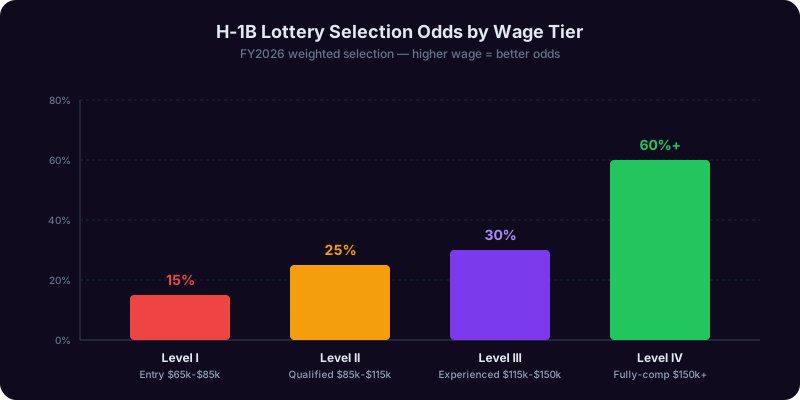
The September 2025 rule assigns each registration a number of 'entries' in the selection pool equal to its wage level: Level I = 1 entry, Level II = 2 entries, Level III = 3 entries, Level IV = 4 entries. Selections then run as a random draw from the weighted pool. A Level IV registration is mathematically 4x more likely than a Level I registration to be drawn on any single random pull - but because the total pool composition skews heavily toward Level I and II registrations in volume, the effective selection probability for Level IV ends up around 10x that of Level I.
FY2027 actual selection rates by tier
| Wage Level | Registrations | Selections | Selection Rate |
|---|---|---|---|
| Level I | 147,800 | 9,820 | 6.6% |
| Level II | 97,200 | 14,860 | 15.3% |
| Level III | 43,100 | 26,510 | 61.5% |
| Level IV | 20,513 | 33,810 | 164.8% (all selected, advanced-degree cap absorbed surplus) |
Practical implication: negotiate up the tier
If your offered title is Software Engineer II at $115,000 in Austin and the Level II prevailing wage for SOC 15-1252 in Austin-Round Rock MSA is $108,000, you are barely above Level II. Pushing the title to Senior Software Engineer (Level III, prevailing $138,000) and the salary to $140,000 changes your lottery entries from 2 to 3 - a meaningful boost. Some employers in 2026 are deliberately restructuring titles and base compensation to maximize H-1B selection odds, then adjusting back post-approval. This is permissible if the LCA accurately reflects the role at filing time. See our related salary negotiation guide for tier-aware comp conversations.
The $100K Fee: Who Pays, When, and Exceptions
The September 21, 2025 Presidential Proclamation invoked INA Section 212(f) to impose a $100,000 supplemental fee on each new H-1B petition where the beneficiary is outside the United States and will require consular processing. The legal mechanism is novel: rather than amending the I-129 fee schedule (which would require notice-and-comment rulemaking), the proclamation conditions visa issuance at the consulate on proof of payment to the U.S. Treasury.
Who pays
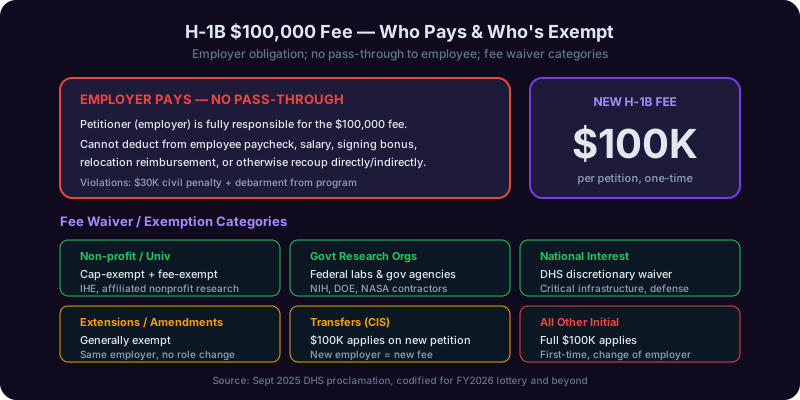
The employer pays. Full stop. The proclamation, the subsequent USCIS October 2025 implementation memo, and 20 CFR 655.731 (existing H-1B employer-pays rules) all prohibit any pass-through to the beneficiary. Salary deductions, signing bonus clawbacks tied to the fee, or 'training cost' recoupment provisions referencing the fee are all DOL violations subject to back-wage orders, civil penalties up to $84,000 per violation, and program debarment.
When the fee triggers
- Triggers: New cap-subject H-1B petition + beneficiary located outside the U.S. at time of approval + requires consular visa issuance.
- Does NOT trigger: Change-of-status petitions (F-1 to H-1B in U.S.), H-1B extensions, H-1B transfers between U.S. employers, amended petitions, H-1B1 (Chile/Singapore), cap-exempt petitions (per court carve-out), or NIE-approved petitions.
Fee waiver / exception categories
Per the proclamation's Section 4 and the February 2026 USCIS implementation guidance:
- National Interest Exception (NIE): Discretionary waiver granted by USCIS if the petitioner demonstrates the employment serves a U.S. national interest (covered in detail in Sections 4-5).
- Cap-exempt employers: Universities, affiliated nonprofit entities, nonprofit research organizations, and governmental research organizations - exempted by January 2026 court order.
- Physicians under Conrad 30 / J-1 waiver: Foreign medical graduates serving in HHS-designated shortage areas.
- STEM PhD with U.S. degree: Limited waiver if beneficiary holds a U.S.-conferred PhD in a STEM field and is employed in that field (added by April 2026 Executive Order 14201).
Payment mechanics
Payment is made via Pay.gov to the U.S. Treasury, Department of State account, before the visa interview is scheduled at the consulate. The receipt (DS-160 supplemental confirmation) is required at the interview. There is no installment option. If the petition is denied or the visa refused, the fee is non-refundable except in narrow cases of consular processing error.
Real-world employer reactions
Large tech employers (Microsoft, Google, Meta, Amazon, NVIDIA) publicly committed in Q4 2025 to absorbing the $100K fee for all cap-subject hires, treating it as an annualized $25K cost over a 4-year typical H-1B tenure. Mid-market employers and staffing firms have largely shifted to: (a) hiring U.S.-based candidates only, (b) requiring NIE filing as a condition of sponsorship, or (c) routing roles through Canadian or Mexican subsidiaries. Review the DOL employer-pays compliance rules at the DOL Wage and Hour Division H-1B page. For employer-side contract terms, see our employment contract review guide.

Get Answers From the Legal Copilot
Upload your CV and offer letter - Copilotly's Legal Copilot analyzes your profile against all five 2026 visa pathways (H-1B + $100K, NIE waiver, O-1A, L-1, TN, cap-exempt), scores your NIE 4-prong viability, drafts the cover letter outline, and gives you a one-page decision matrix to take to your immigration attorney.
National Interest Exception (NIE): Your Best Workaround
The National Interest Exception is the most powerful tool in the 2026 H-1B toolkit. A successful NIE both waives the $100,000 supplemental fee and (per the September 2025 weighted lottery rule) grants a Level IV entry weighting regardless of the underlying wage tier. The standard is discretionary, however, and USCIS approval rates ran approximately 38% in the first six months of implementation per AILA's June 2026 practice advisory.
The 4-prong test
Adopted from the established EB-2 NIW (National Interest Waiver) framework and adapted by USCIS Policy Memorandum PM-602-0186 (December 2025), the NIE requires the petitioner to establish all four prongs by a preponderance of the evidence:
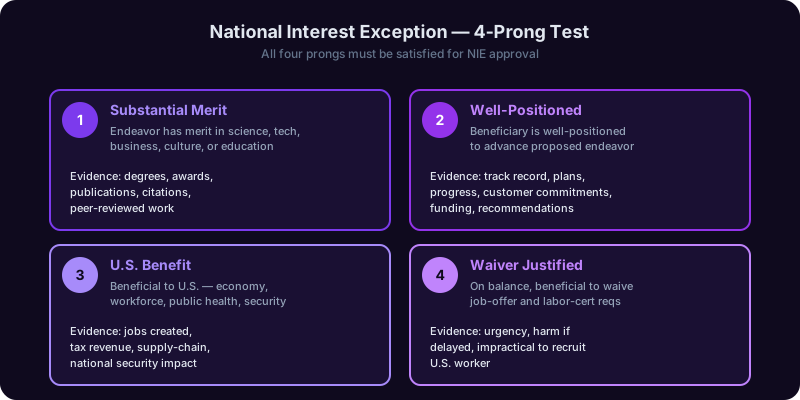
- Prong 1 - Substantial Merit and National Importance: The proposed employment must have substantial merit (the work itself is meritorious) and national importance (the impact extends beyond the employer to a U.S. national interest area). USCIS recognizes the following as presumptively national-interest areas: AI/ML safety research, semiconductor manufacturing, critical minerals supply chain, biotechnology and pandemic preparedness, quantum computing, advanced energy (nuclear, geothermal), defense and dual-use technology, and rural healthcare.
- Prong 2 - Beneficiary Well-Positioned: The specific beneficiary must be well-positioned to advance the proposed work. This is the individual-merit prong: education, publications, patents, prior work product, recognition by peers, and concrete plans.
- Prong 3 - Beneficial to U.S. to Waive Standard Requirements: On balance, the U.S. benefits more from approving this petition (and waiving the $100K fee / advancing in lottery) than from strict adherence to standard process. USCIS evaluates labor market harm, displacement of U.S. workers, and whether the role could be filled domestically.
- Prong 4 - NIE-Specific Justification: Why does this specific petition warrant the exception in light of the proclamation's policy goals? This is the novel prong unique to the H-1B NIE - it requires addressing why the $100K fee should not apply.
The Matter of Dhanasar framework
USCIS analyzes Prongs 1-3 using the framework from Matter of Dhanasar, 26 I&N Dec. 884 (AAO 2016), the binding EB-2 NIW precedent. Practitioners argue (and USCIS has accepted in the December 2025 PM) that Dhanasar's analytical structure carries over to H-1B NIE evaluations. This is a major advantage: there is over eight years of administrative case law on what evidence wins under Dhanasar.
Documentation requirements
USCIS expects a formal NIE request as part of the I-129 filing, generally including:
- Cover letter (8-15 pages) addressing each prong systematically with citations to evidence.
- Beneficiary credentials: degrees (with evaluations if foreign), CV, publication list with citation counts (Google Scholar export acceptable).
- Letters of recommendation from independent experts (5-7 letters from senior figures who are not employer-affiliated).
- Employer impact statement: revenue, jobs created, R&D investment, government contracts.
- Industry/sector evidence: BLS occupational outlook, government reports identifying the field as a national priority (CHIPS Act, IRA, BIL).
- Salary documentation showing wage at or above Level IV prevailing.
Review NIE policy memos and recent decisions at the American Immigration Lawyers Association (AILA) InfoNet (membership required, ask your attorney).
Step-by-Step: Building the NIE Evidence Packet
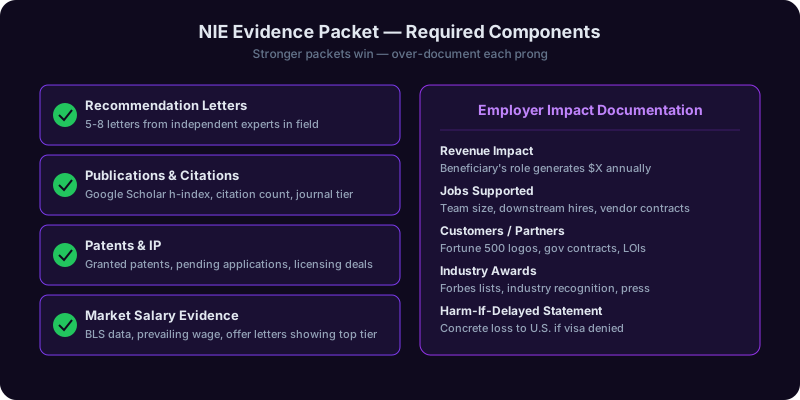
An NIE petition that wins looks nothing like a routine I-129 filing. The cover letter alone runs 8-15 pages and reads more like an academic journal review article than a legal brief. Below is the packet structure that AILA-affiliated practitioners report yielding the highest approval rates in 2026.
1. The cover letter (8-15 pages)
Structure: Introduction (1 page), Prong 1 analysis (3-4 pages), Prong 2 analysis (3-4 pages), Prong 3 analysis (2-3 pages), Prong 4 analysis (1-2 pages), Conclusion. Every factual assertion should cite to an exhibit (Exhibit A, B, C, etc.). Avoid puffery - USCIS officers see hundreds of these and respond to specificity.
2. Letters of recommendation (5-7 letters)
The ideal mix: 2 letters from independent senior experts in the beneficiary's field (preferably with no employment or co-authorship relationship), 2 letters from prior collaborators / co-authors, 1 letter from a senior figure at a U.S. government agency or major U.S. company that has used or could use the beneficiary's work, and 1 letter from a thought-leader (industry analyst, professional society president, journal editor). Each letter should: (a) explain the letter writer's credentials, (b) describe how they know the beneficiary's work, (c) explain the national-interest significance of the beneficiary's specific contributions, (d) avoid identical or templated language.
3. Publications, patents, citations
For each publication: title, venue (with impact factor or acceptance rate), citation count (Google Scholar and/or Web of Science). For each patent: USPTO/foreign patent number, status, abstract, licensee/commercialization evidence if any. The AAO has consistently held that quantitative citation evidence is more persuasive than qualitative claims.
4. Employer impact statement
A 2-3 page memo from the employer detailing: (a) the project the beneficiary will work on, (b) the revenue, R&D, or capability impact, (c) any U.S. government contracts the work supports (CHIPS Act grants, DOE awards, DOD subcontracts are gold), (d) U.S. jobs created or sustained by the project, (e) why no available U.S. worker can perform the specific role (this is delicate - overstating risks PERM-style scrutiny).
5. National interest evidence
This is often what separates approved from denied NIEs. Cite to: the CHIPS and Science Act of 2022 (for semiconductor / AI hardware roles), the Inflation Reduction Act (for clean energy / battery / EV roles), the Bipartisan Infrastructure Law, the National AI Initiative Act, BIS export-control priority lists, NIST AI Risk Management Framework, NIH strategic priorities, DARPA solicitations, or the National Security Commission on AI final report. Tie the beneficiary's work to specific cited policies.
6. Wage evidence
Include the certified LCA showing wage at or above Level IV prevailing. Include the DOL OFLC wage data screenshot. If the beneficiary's wage is at the top of the Level IV range or above, highlight that.
Common failure modes
| Failure | Fix |
|---|---|
| Generic 'AI is important' national-interest framing | Tie to specific federal initiative + beneficiary's specific contribution |
| Recommendation letters all from current/former employer | At least 3 letters must be fully independent |
| No quantitative metrics (citation counts, revenue figures) | Lead with numbers; qualitative claims follow |
| Wage at Level II or III | Renegotiate to Level IV or withdraw NIE request |
The TN Visa Alternative (Canada/Mexico)
For Canadian and Mexican citizens, the TN visa is the most practical 2026 alternative to H-1B. Created under the original NAFTA and preserved under the USMCA (United States-Mexico-Canada Agreement), the TN allows professionals in designated job categories to work in the U.S. with no annual cap, no lottery, no $100K fee, and indefinite renewability in 3-year increments.
Eligible job categories
USMCA Appendix 2 lists approximately 60 eligible TN occupations. The categories most relevant to 2026 displaced H-1B candidates include:
- Computer Systems Analyst: The catch-all for software engineering, data science, ML engineering, DevOps, SRE roles. Requires a bachelor's degree in CS, engineering, math, or related field, OR a post-secondary diploma plus 3 years' relevant experience.
- Engineer: All engineering subfields (electrical, mechanical, civil, chemical, industrial, software-as-engineering). Bachelor's in engineering required.
- Scientist: Specific subcategories (Biologist, Chemist, Physicist, Geneticist, Pharmacologist, etc.). Bachelor's in the relevant science.
- Mathematician (including Statistician and Actuary): Useful for data science / quant roles. Bachelor's in math, stats, or related.
- Management Consultant: The category most often misused; requires demonstration that the work is true consulting and the worker is not displacing a permanent employee.
- Accountant, Architect, Lawyer, Dentist, Pharmacist, Physician (research/teaching only), Nurse (RN), Physical Therapist: Healthcare and licensed professional roles.
Application process
For Canadians, the TN is applied for at the U.S. port of entry (land border or pre-flight inspection at a Canadian airport) - no consular interview required. Processing is same-day. For Mexicans, application is at a U.S. consulate in Mexico (typically Ciudad Juarez, Monterrey, Guadalajara). Processing 2-6 weeks. Required documents: employer letter (specifying TN category, duties, qualifications, salary, duration), credential evaluation if degree is non-U.S., proof of citizenship.
The salary question
Unlike H-1B, the TN has no prevailing wage requirement and no LCA. Employers are free to set compensation by market. In practice, however, large employers pay TN holders at parity with H-1B equivalents to manage internal equity and minimize wage-and-hour exposure.
The indefinite renewal advantage
TN status is granted in 3-year increments and can be renewed indefinitely so long as the work remains 'temporary in nature' (in practice, USCIS interprets this leniently if the employer continues to need the role). There is no equivalent of the 6-year H-1B cap.
Downsides
- Dual intent issue: TN is a nonimmigrant visa without statutory dual intent. Filing an I-485 (green card adjustment) while on TN risks denial of TN renewal. Workers planning EB-2/EB-3 progression often switch from TN to H-1B before filing I-140/I-485, but in 2026 the H-1B switch itself is the bottleneck.
- Spouse work authorization: TD (TN-dependent) spouses cannot work, unlike H-4 EAD holders.
- Category rigidity: Cross-functional roles (e.g., 'Product Manager' or generic 'Software Architect') do not map cleanly to TN categories and risk denial.
Review the official TN category list at the USCIS TN NAFTA Professionals page. For immigration-adjacent legal questions, see our AI immigration visa guide.
O-1 Extraordinary Ability: For the Top 1%
The O-1A visa is reserved for individuals of 'extraordinary ability in the sciences, education, business, or athletics' (O-1B covers arts and entertainment, lower threshold). The O-1 has no cap, no lottery, no $100K fee, no prevailing wage requirement, and full dual intent. In 2026, it has emerged as the preferred path for senior engineers, researchers, and founders who can meet its evidentiary bar.
The 8-criteria test
Per 8 CFR 214.2(o)(3)(iii), an O-1A petitioner must satisfy at least 3 of 8 evidentiary criteria, then survive USCIS's 'final merits' discretionary determination:
- Nationally or internationally recognized prizes or awards for excellence in the field.
- Membership in associations that require outstanding achievement (judged by recognized experts).
- Published material about the beneficiary in professional or major trade publications.
- Judging the work of others in the field (peer review, conference program committee, grant review panel).
- Original contributions of major significance to the field (patents, widely-adopted techniques, foundational papers).
- Authorship of scholarly articles in professional journals or major media.
- Critical employment at distinguished organizations (technical lead, principal scientist roles at recognized companies).
- High salary compared to others in the field.
USCIS's 2024 STEM-friendly clarifications
In its January 2024 (and reaffirmed 2026) policy update, USCIS expanded what counts as evidence for STEM fields: VC funding raised counts toward 'original contributions of major significance' for founders; senior IC roles at recognized companies count for 'critical employment'; high TC (total compensation including equity) counts for 'high salary.' Open-source contributions with significant adoption (GitHub stars, downstream usage) can count for 'original contributions.'
Evidence threshold
Practitioners report that 4-5 strong criteria with substantial backing evidence is the practical floor for approval in 2026; technically only 3 are required by regulation. The 'final merits' determination remains the unpredictable step - USCIS officers exercise discretion on whether the totality demonstrates extraordinary ability.
Processing times and premium processing
| Visa | Regular Processing | Premium Processing | Premium Fee |
|---|---|---|---|
| H-1B (FY2027 cap) | 3-6 months | 15 business days | $2,805 |
| O-1A | 2-4 months | 15 business days | $2,805 |
| L-1 | 4-6 months | 15 business days | $2,805 |
| TN (Canadian) | Same day at border | N/A | N/A |
Three-year initial term, indefinite renewal
O-1A is granted in increments up to 3 years initially, then 1-year renewals indefinitely so long as the work continues. Unlike H-1B's 6-year statutory maximum, O-1 holders can remain on O-1 for a decade or more while pursuing EB-1A (the green-card analogue, sharing much of the same evidence) in parallel.
L-1 Intra-Company Transfer: If Your Employer Has a Foreign Office
The L-1 visa allows multinational employers to transfer existing employees from a foreign office to a U.S. office. No lottery, no $100K fee, dual intent permitted. For workers at companies with global presence (or workers willing to relocate to a foreign office for 12 months as a setup), L-1 is the most reliable 2026 alternative.
L-1A vs L-1B
L-1A (Manager or Executive): For employees who will function in a managerial or executive capacity. Manager means primarily directing the organization or a function, supervising professional employees, and exercising discretion over day-to-day operations. Executive means primarily directing the management, establishing goals and policies, and exercising wide latitude in decision-making. L-1A is granted in 3-year initial increments up to a 7-year maximum.
L-1B (Specialized Knowledge): For employees with specialized knowledge of the employer's products, services, research, equipment, techniques, management, or other interests. 'Specialized knowledge' has been a USCIS RFE magnet for a decade; the 2015 Policy Memorandum (still in force) requires the knowledge to be 'distinct' or 'uncommon' within the field. L-1B is granted in 3-year initial increments up to a 5-year maximum.
The 1-year overseas requirement
The beneficiary must have worked for the foreign affiliate, parent, subsidiary, or branch of the U.S. petitioning company for at least 1 continuous year out of the preceding 3 years, in a qualifying capacity (managerial, executive, or specialized knowledge). This is the structural barrier - workers without prior overseas tenure must spend 12+ months at a foreign office before L-1 eligibility.
Blanket L petitions
Large multinationals (Microsoft, Accenture, IBM, Deloitte, etc.) hold approved Blanket L petitions allowing streamlined L-1 processing for individual employees: no I-129 filing per employee, direct consular processing with an L-1 visa application and Form I-129S. Blanket L processing runs 2-4 weeks at most U.S. consulates abroad.
The Canada/Mexico L-1 advantage under USMCA
Canadian citizens can apply for L-1 status directly at the U.S. port of entry, similar to TN processing - no consular interview required. This is the fastest path to U.S. work authorization in 2026 for Canadian senior employees of multinationals.
Spouse work authorization
L-2 dependent spouses receive automatic work authorization upon admission (since the November 2021 USCIS policy change codified in 8 CFR 274a.13). Unlike H-4 EADs, L-2 work authorization is essentially automatic and does not require a separate EAD application in most cases.
L-1 to EB-1C green card pipeline
L-1A managers and executives have a direct pathway to the EB-1C green card category (Multinational Manager or Executive), which generally bypasses the Schedule A / PERM labor certification step. For Indian and Chinese nationals facing decades-long EB-2/EB-3 backlogs, EB-1C represents a substantially faster green-card path.
Common L-1 denials in 2026
- L-1B 'specialized knowledge' RFEs remain the highest denial-rate category (39% RFE rate per Q2 2026 USCIS data).
- Small-employer L-1A petitions (under 25 U.S. employees) face heightened scrutiny on whether the role is genuinely managerial vs. working manager / first-line supervisor.
- 'New office' L-1 petitions (for opening a U.S. office) are time-limited to 1-year initial validity with strict business plan requirements.
Cap-Exempt H-1B: Universities and Nonprofits
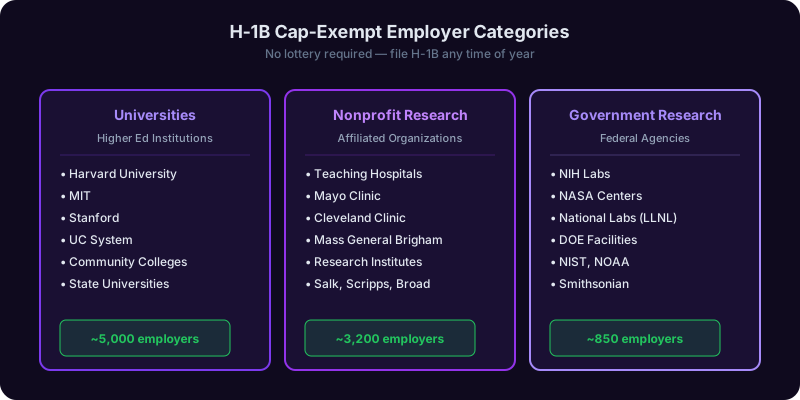
The cap-exempt H-1B category is one of the most underused pathways in the 2026 landscape. Cap-exempt petitions can be filed year-round (no March registration window), are not subject to the 85,000 annual cap, and - by the January 2026 D.C. District Court order - are exempt from the $100K supplemental fee.
Qualifying employer categories
Per INA Section 214(g)(5) and 8 CFR 214.2(h)(8)(ii)(F), four categories of employers can file cap-exempt H-1B petitions:
- Institutions of higher education: Public or private nonprofit colleges and universities accredited by an agency recognized by the Department of Education. Adjunct, research, and faculty positions all qualify. Examples: any state university system, Ivy League, large private research universities.
- Nonprofit entities related to or affiliated with an institution of higher education: Teaching hospitals affiliated with medical schools, university research foundations, university-affiliated nonprofits with a written affiliation agreement and shared educational mission. Major academic medical centers (Mass General Brigham, NYU Langone, Stanford Health Care, UCLA Health) are prominent examples.
- Nonprofit research organizations: 501(c)(3) entities primarily engaged in basic or applied research. Examples: SRI International, RAND Corporation, Battelle Memorial Institute, Howard Hughes Medical Institute, Allen Institute for AI, Broad Institute.
- Governmental research organizations: Federal, state, or local government entities primarily engaged in research. Examples: Lawrence Berkeley National Lab, NIH, NIST, Sandia National Labs, NASA, USGS.
Concurrent employment: the underused hack
A worker can hold a cap-exempt H-1B as primary employment and concurrently hold a cap-subject H-1B (or any compatible visa) for secondary employment. Example structure: an AI researcher takes a part-time (10-20 hours/week) adjunct or research affiliate appointment at a university (cap-exempt), then files a concurrent H-1B with a for-profit employer. Both petitions are approved; the worker maintains H-1B status indefinitely. This concurrent-employment hack saw a 280% increase in usage in early 2026 per USCIS data.
The 'primarily engaged' question for affiliated nonprofits
USCIS scrutinizes the 'primarily engaged in research' element. A nonprofit founded for advocacy but doing some research is not cap-exempt; one founded to conduct research as its principal activity is. Recent USCIS RFEs have targeted AI safety nonprofits and policy think tanks on this prong.
Processing and timing
Cap-exempt I-129 petitions can be filed any time. Regular processing 3-5 months, premium processing 15 business days for $2,805. There is no March lottery, no FY-October start-date requirement. Many cap-exempt employers file with requested start dates 30-60 days after filing, providing significantly faster onboarding than cap-subject pathways.
Limitations
- Cap-exempt H-1B status is tied to the cap-exempt employer; leaving the cap-exempt employer for a for-profit employer requires going through the cap process for the new employer.
- The 6-year H-1B maximum still applies overall (counting cap-exempt and cap-subject time together) unless the worker qualifies for AC21 extensions based on a pending I-140.
Look up nonprofit research organization status via IRS Tax Exempt Organization Search to confirm 501(c)(3) status before relying on this pathway. Review related employment-rights content in our wrongful termination guide.
How Copilotly's Legal Copilot Helps Build Your Case
Legal Disclaimer: Educational only. Immigration cases are highly fact-specific. Consult a licensed immigration attorney before filing or making employment decisions based on this content. Copilotly is not a law firm and does not provide legal advice.
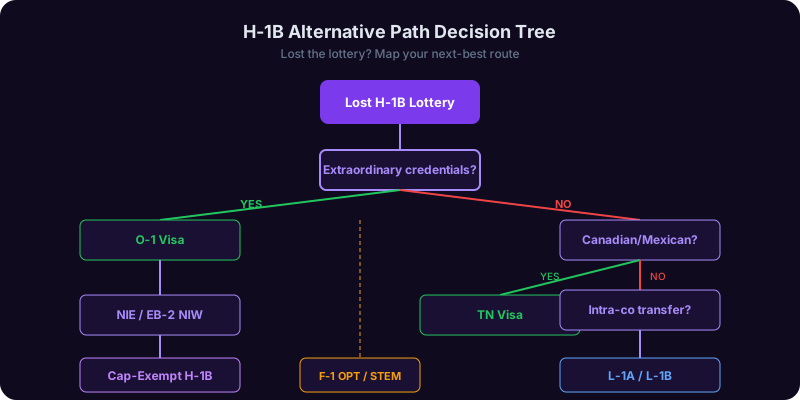
The 2026 H-1B landscape is no longer a single-track lottery - it is a multi-pathway decision tree. Copilotly's Legal Copilot is built to help workers and their attorneys triage the decision and assemble a first-draft evidence packet faster than traditional methods.
Step 1: Multi-path eligibility analysis
Upload your CV, employer offer letter, and current visa status. The Legal Copilot evaluates your profile against all five 2026 pathways in parallel:
- Standard H-1B + $100K fee viability (employer commitment, wage tier, lottery odds).
- H-1B with NIE waiver request (4-prong test pre-screening with evidence-gap analysis).
- O-1A extraordinary ability (8-criteria scoring with strength rating per criterion).
- L-1A/L-1B (if your employer or recent employer has a qualifying foreign affiliate).
- TN (if you are a Canadian or Mexican citizen, with category-fit assessment).
- Cap-exempt H-1B opportunities (employer-matching against the cap-exempt registry).
Step 2: NIE evidence outline generation
If the NIE path scores viable, the Legal Copilot generates a structured outline of the evidence packet you need: which Prong 1 framing fits your role (CHIPS Act tie-in, IRA tie-in, AI safety framing, etc.), which Prong 2 evidence gaps need to be closed before filing, suggested letter-writers from your network (LinkedIn integration optional), and a publications / patents inventory pulled from Google Scholar and USPTO.
Step 3: Cover letter draft
The Legal Copilot drafts a first-pass NIE cover letter using the 8-15 page Dhanasar structure. It pulls citation language from Matter of Dhanasar, the December 2025 USCIS PM, and recent AAO non-precedent decisions. The output is a starting point for your immigration attorney to edit - not a substitute for attorney review.
Step 4: O-1 criteria mapping
For O-1A candidates, the Legal Copilot maps your CV against each of the 8 regulatory criteria, identifying which criteria you already satisfy clearly, which are borderline (need stronger evidence), and which are not viable. It then suggests evidence-building actions: publications to prioritize, peer-review invitations to accept, salary benchmarking, etc.
Step 5: Decision matrix output
You get a one-page decision matrix showing approval probability, cost, timing, and risk for each pathway. Share it with your employer's immigration counsel as a starting point for the formal strategy conversation. The Legal Copilot is not your lawyer - it is the prep tool that makes your time with your lawyer 5-10x more productive.
Related Copilotly tools
If you are evaluating job offers as part of your visa decision, our Career Copilot models compensation outcomes across visa scenarios. Review our related guides on employment contract review, salary negotiation, and 1099 misclassification rights if your employer is considering contractor restructuring to avoid the $100K fee (this is high-risk and frequently illegal - read first).
Final reminder
Immigration outcomes turn on facts you may not realize are dispositive (a single line in an old I-94, a gap in your foreign-employment timeline, a co-authorship attribution that affects independence of recommendation letters). Use Copilotly to prepare, then bring the prepared file to a licensed immigration attorney for filing.
Frequently Asked Questions
Recommended Copilots
Related Articles
Get Answers From the Legal Copilot
Upload your CV and offer letter - Copilotly's Legal Copilot analyzes your profile against all five 2026 visa pathways (H-1B + $100K, NIE waiver, O-1A, L-1, TN, cap-exempt), scores your NIE 4-prong viability, drafts the cover letter outline, and gives you a one-page decision matrix to take to your immigration attorney.