

How VA Disability Ratings Actually Work
Legal Disclaimer: This article is for informational purposes only and does not constitute legal advice. VA claims involve complex regulations and your situation is unique. Consider consulting an accredited VSO (Veterans Service Organization), VA-accredited attorney, or claims agent before filing. Copilotly's Legal Copilot can help organize your case, but it does not replace professional representation.
Your VA disability rating is a percentage from 0% to 100% (in 10% increments) that reflects how much a service-connected condition impairs your ability to function. It's governed by 38 CFR Part 4, the Schedule for Rating Disabilities, which assigns specific percentages to thousands of conditions based on severity criteria called diagnostic codes.
The Combined Rating Math (Why 50% + 30% Does NOT Equal 80%)
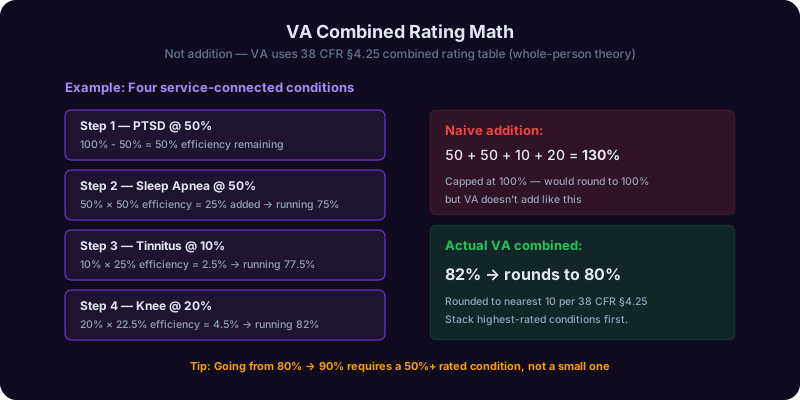
VA does not simply add percentages. Instead, it uses the combined ratings table in 38 CFR § 4.25, which applies a 'whole person' theory: each disability reduces your remaining healthy percentage.
Example: A veteran with a 50% and a 30% rating:
- Start with 100% healthy
- 50% disability leaves 50% healthy
- 30% of remaining 50% = 15% additional disability
- Combined: 50 + 15 = 65%, rounded to nearest 10% = 70%
The Bilateral Factor
If you have disabilities affecting both arms, both legs, or paired skeletal muscles (knees, hips, shoulders), VA adds an extra 10% of the combined value of those bilateral disabilities before combining with other ratings. Many veterans miss this multiplier entirely.
Why 10% Increments Matter
Rounding happens only at the final step. A combined 64% rounds DOWN to 60%, but 65% rounds UP to 70%. Pushing yourself from 64 to 65 by adding even a 10% secondary condition can mean an extra $300+ per month for life.
2026 VA Monthly Compensation Amounts (Full Table)
The VA adjusted compensation rates with a 2.5% COLA increase for 2026. Rates are tax-free and paid monthly for life (as long as your rating remains).
2026 Monthly Compensation by Rating (Veteran Only)
- 10%: $175.51/mo ($2,106/year)
- 20%: $346.95/mo ($4,163/year)
- 30%: $537.42/mo ($6,449/year)
- 40%: $774.16/mo ($9,290/year)
- 50%: $1,102.04/mo ($13,224/year)
- 60%: $1,395.93/mo ($16,751/year)
- 70%: $1,759.19/mo ($21,110/year)
- 80%: $2,044.89/mo ($24,539/year)
- 90%: $2,297.96/mo ($27,576/year)
- 100%: $3,831.30/mo ($45,976/year)
With Spouse (No Children) - additional amounts at 30%+:
- 30% with spouse: $600.42/mo
- 50% with spouse: $1,208.04/mo
- 70% with spouse: $1,908.19/mo
- 100% with spouse: $4,044.91/mo
With Spouse and One Child (30%+ adds child amount):
- 30%: $647.42/mo
- 50%: $1,272.04/mo
- 70%: $1,988.19/mo
- 100%: $4,201.35/mo
Additional Dependents (added to above)
- Each additional child under 18: ~$30 (at 30%) to ~$108 (at 100%)
- Each school-age child 18-23: ~$97 (30%) to ~$351 (100%)
- Dependent parent (one): ~$48 (30%) to ~$175 (100%)
- Aid & Attendance for spouse: ~$56 (30%) to ~$200+ (100%)

The 100% vs 90% Cliff
Notice the massive jump from 90% ($2,297) to 100% ($3,831) - over $1,500/month difference. This is why TDIU (Total Disability based on Individual Unemployability) is so valuable: it pays at the 100% rate even if your schedular rating is lower.
Why Your Rating May Be Lower Than It Should Be
Many veterans accept their initial rating without question, not realizing the VA frequently under-rates conditions due to incomplete evidence, rushed C&P exams, or rater error. Here are the most common reasons your rating is too low:
1. Missed Secondary Conditions
A secondary condition is a disability caused or aggravated by an existing service-connected condition. Example: service-connected PTSD causes sleep apnea (well-established medical nexus), which causes hypertension, which causes erectile dysfunction. That's four ratings from one primary condition - but most veterans only claim the first.
2. Outdated or Inadequate C&P Exam
VA examiners often spend only 15-30 minutes evaluating you. If you were having a 'good day,' downplayed symptoms, or the examiner didn't ask the right questions, your rating reflects an inaccurate snapshot. You can request a new exam if your condition has worsened.
3. Critical Evidence Missing from File
Private medical records, mental health treatment notes, sleep studies, MRIs, and prescription history often never make it into your VA claims file. Anything not in the file does not exist to the rater.
4. Condition Has Worsened Since Last Rating
Many conditions progress over time - degenerative disc disease, PTSD, diabetes, hearing loss. If your symptoms today are worse than when you were last rated, you qualify for an increase.
5. Lay Evidence Was Never Submitted
Buddy statements from family, fellow veterans, and coworkers describing how your condition affects daily life carry significant weight - but most veterans never submit them.
6. Wrong Diagnostic Code Applied
Sometimes a rater applies an incorrect diagnostic code that has lower maximum ratings. Reading your rating decision carefully and comparing it to 38 CFR Part 4 can reveal these errors.

Get Answers From the Legal Copilot
Copilotly's Legal Copilot helps veterans draft personal statements, organize medical evidence, prepare for C&P exams, and identify missed secondary conditions that could increase your rating.
The Most Commonly Under-Rated VA Conditions
Based on community data from veterans organizations, these conditions are most frequently rated lower than they should be:
PTSD (Often Rated 30% - Should Be 70%+)
The PTSD rating schedule (38 CFR § 4.130) ranges from 0% to 100%. Key thresholds:
- 30%: Occupational/social impairment with occasional decrease in work efficiency
- 50%: Reduced reliability and productivity
- 70%: Deficiencies in most areas (work, family, judgment, mood)
- 100%: Total occupational and social impairment
If you have suicidal ideation, near-continuous panic/depression, impaired impulse control, or difficulty maintaining relationships, you likely qualify for 70%, not 30%.
Sleep Apnea (50% if CPAP Required)
If you use a CPAP machine, you automatically qualify for 50% under diagnostic code 6847. Service connection is often secondary to PTSD, depression, sinusitis, or weight gain from another service-connected condition.
Tinnitus (10% Standalone, But Connects Other Claims)
Tinnitus maxes at 10% - but it's a gateway. If you have tinnitus, you almost certainly have some level of hearing loss, vertigo, headaches, and sleep disturbance that can be claimed.
Migraines (Up to 50%)
Under diagnostic code 8100, prostrating migraines averaging once a month over the last several months = 30%. Very frequent completely prostrating attacks producing severe economic inadaptability = 50%. Most veterans with migraines are rated 0% or 10%.
Back, Knee, Shoulder (Range of Motion + Flare-Ups)
VA must consider flare-ups per the DeLuca and Mitchell precedents. If you can bend further on a good day but lose 30 degrees during flare-ups, the rating should reflect the worst.
TBI Residuals (Up to 100%)
Traumatic Brain Injury residuals affect memory, executive function, behavior, motor activity, vision, headaches, and more. Each facet can contribute to a high rating under diagnostic code 8045.

The Increase Claim Filing Process Step-by-Step
Filing an increase claim is your right at any time - there is no cap on how often you can request one. Here is the exact process:
Step 1: Gather Evidence BEFORE Filing
- Recent medical records (VA + private) showing symptom worsening
- Treatment notes, imaging (MRI, X-ray, sleep study)
- Prescription medication list
- Buddy statements from family/coworkers
- Personal statement describing daily impact (the 'lay evidence')
- Any specialist evaluations
Step 2: Choose the Right Form
- VA Form 21-526EZ - Fully Developed Claim for new conditions or increases
- VA Form 20-0995 - Supplemental Claim (if filing after a denial, with new evidence)
- VA Form 20-0996 - Higher-Level Review (no new evidence, just argue VA got it wrong)
- VA Form 21-8940 - TDIU application
Step 3: File via VA.gov, eBenefits, or Mail
Online filing at VA.gov is fastest and gives you a digital tracking record. The 'effective date' (when back-pay starts) is the date VA receives your claim, so file as soon as you have evidence.
Step 4: Attend the C&P Exam
VA will schedule a Compensation & Pension exam, usually within 30-90 days. Never skip this exam. Missing it = automatic denial.
Step 5: Wait for the Rating Decision
Average wait time in 2026 is 130-160 days. You can check status on VA.gov.
When to File an Increase
- After at least 12 months at current rating (avoids 're-evaluation' issues)
- Anytime symptoms have measurably worsened
- After a new diagnosis that could be a secondary condition
- After PACT Act expanded eligibility (no waiting period required)
Risk: Rating Reduction
Filing an increase opens your case for review. If your condition has actually improved, VA could reduce your rating. Protected ratings (held 5+ years for 'stabilized' rating, 10+ years for service connection, 20+ years for the rating itself) have stronger protection.
C&P Exam Strategy: How to Articulate Your Symptoms
The Compensation & Pension exam is the single most important moment in your claim. A 20-minute exam can determine $50,000+/year in benefits. Here is how to do it right:
The 'Worst Day' Approach
VA examiners often ask 'How are you today?' or 'How is your back right now?' - but they're supposed to rate based on your worst symptoms, including flare-ups. Always answer in terms of:
- Your worst day in the past 30 days
- Frequency of flare-ups (how many days per month)
- Duration of flare-ups (hours/days)
- What you cannot do during flare-ups
Specific Language That Helps
- For pain: 'On bad days, my pain reaches 8/10 and I cannot bend forward more than 30 degrees'
- For PTSD: 'I have suicidal thoughts about ___ times per month. I cannot maintain relationships because ___. I have not worked since ___.'
- For migraines: 'I have prostrating migraines that force me into a dark room for ___ hours, occurring ___ times per month'
What NOT to Do
- Don't minimize. Veterans are trained to 'suck it up.' That mindset costs ratings. Be brutally honest.
- Don't exaggerate either. Examiners spot embellishment and it destroys credibility.
- Don't say 'I'm fine.' Even reflexively.
- Don't skip the exam - automatic denial.
- Don't argue with the examiner. If they're rude or dismissive, document it and file a complaint after.
Bring Supporting Materials
- List of medications with dosages
- Symptom diary covering 30-60 days
- Buddy statements (if not already submitted)
- Recent imaging or specialist notes

After the Exam
Request a copy of the DBQ (Disability Benefits Questionnaire) the examiner filled out. If it contains errors or omissions, you can submit a rebuttal before the rater issues a decision.
PACT Act 2022: Presumptive Conditions for Gulf War, Iraq, and Afghanistan Vets
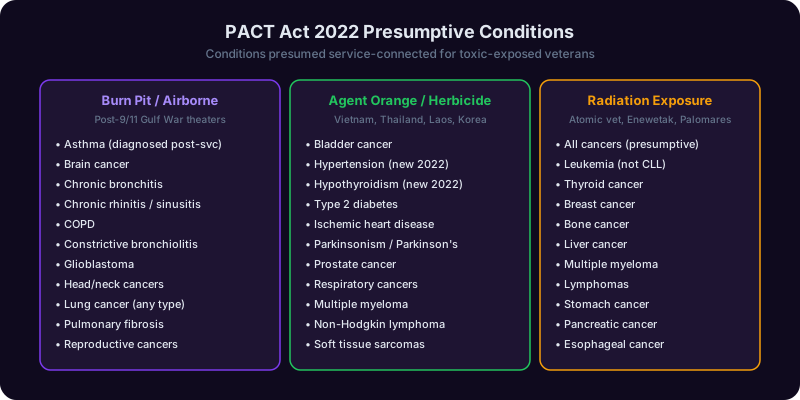
The PACT Act (Promise to Address Comprehensive Toxics Act), signed in August 2022, is the largest expansion of VA benefits in 30 years. It added presumptive service connection for over 20 conditions linked to burn pit and toxic exposures.
What 'Presumptive' Means
For presumptive conditions, VA assumes your condition is service-connected if you served in a covered location during covered dates. You don't need to prove a medical nexus - eligibility alone qualifies you.
Covered Service Periods & Locations
- Gulf War era (1990-present): Iraq, Kuwait, Saudi Arabia, Bahrain, Oman, Qatar, UAE
- Post-9/11 (2001-present): Afghanistan, Djibouti, Egypt, Jordan, Lebanon, Syria, Uzbekistan, Yemen, Somalia
Presumptive Conditions Under PACT Act
Cancers:
- Brain cancer (including glioblastoma)
- Gastrointestinal cancers (colon, pancreatic, stomach)
- Head and neck cancers
- Kidney cancer
- Lymphoma (any type)
- Melanoma
- Pancreatic cancer
- Reproductive cancers
- Respiratory cancers (lung, larynx, trachea)
Respiratory Conditions:
- Asthma diagnosed after service
- Chronic bronchitis
- Chronic obstructive pulmonary disease (COPD)
- Chronic rhinitis
- Chronic sinusitis
- Constrictive bronchiolitis
- Emphysema
- Granulomatous disease
- Interstitial lung disease
- Pleuritis
- Pulmonary fibrosis
- Sarcoidosis
Vietnam-Era Herbicide (Agent Orange) Additions:
- Hypertension (added 2022) - huge for older vets
- Monoclonal gammopathy of undetermined significance (MGUS)
If You Were Previously Denied
If you were denied for any of these conditions before August 2022, refile your claim under the PACT Act. The presumption did not exist when you were denied - the playing field has changed.
Learn more at the official PACT Act resource page.
TDIU: 100% Pay When You Can't Work But Aren't 100% Schedular
Legal Disclaimer: TDIU is a complex benefit with strict eligibility requirements. The information below is educational. Consult an accredited VSO or VA-accredited attorney before filing. Copilotly's Legal Copilot can help draft your personal statement and organize medical evidence, but cannot represent you before the VA.
What Is TDIU?
Total Disability based on Individual Unemployability (TDIU) pays at the 100% disability rate ($3,831/mo veteran-only in 2026) even if your schedular rating is lower - as long as your service-connected disabilities prevent you from maintaining 'substantially gainful employment.'
Schedular TDIU Eligibility (38 CFR § 4.16(a))
You qualify for schedular TDIU if:
- One disability rated at 60%+ that prevents work, OR
- Two or more disabilities, with one rated 40%+ AND combined rating of 70%+
Extraschedular TDIU (38 CFR § 4.16(b))
If you don't meet the schedular thresholds but still cannot work due to service-connected conditions, you can request extraschedular consideration. This requires the VA Director of Compensation Service to review your case individually.

What 'Substantially Gainful Employment' Means
Earning more than the federal poverty threshold ($15,650 for one person in 2026) generally disqualifies you - unless it's 'marginal employment' (protected work environment, family business, etc.). Working part-time or as a freelancer can still qualify if you earn below the threshold.
Required Forms
- VA Form 21-8940 - Veteran's Application for Increased Compensation Based on Unemployability
- VA Form 21-4192 - Request for Employment Information (employer fills out)
The Personal Statement Is Critical
Your personal statement should clearly explain:
- What jobs you've held and why you can no longer do them
- Specific symptoms that prevent work (concentration, panic, mobility, pain levels)
- Education and training limitations
- Attempts to work and why they failed
- Daily limitations (sleep, hygiene, social interaction)
How Copilotly's Legal Copilot Helps
Copilotly's Legal Copilot can:
- Draft a structured personal statement using your symptom narrative
- Identify potentially missed secondary conditions to claim
- Help organize medical evidence chronologically
- Generate buddy statement templates for family and coworkers
- Cross-reference your symptoms against 38 CFR diagnostic codes
- Prep you for your C&P exam with mock Q&A
It is not a substitute for an accredited VSO or attorney, but it can dramatically improve the quality and completeness of your filing package - often the difference between a 30% rating and a 70% rating.
Frequently Asked Questions
Recommended Copilots
Get Answers From the Legal Copilot
Copilotly's Legal Copilot helps veterans draft personal statements, organize medical evidence, prepare for C&P exams, and identify missed secondary conditions that could increase your rating.