

The default LLC that was costing him real money
Mark Reeves spent fourteen years climbing toward a VP of Strategy seat at a Fortune 500 in downtown Denver. He hit it in 2022, hated it inside of eight months, and walked away in November 2023 with a severance check, a handshake from his old SVP, and a list of seven companies that had already asked whether he would consult for them on the side.
By January 2024 he was a single-member LLC. He did what everyone in his network had done: opened the Colorado Secretary of State portal, paid the $50 filing fee, registered a name (Reeves Strategy Partners LLC), and got an EIN from the IRS that same afternoon. Total elapsed time from "should I do this" to "I have a business": about ninety minutes. He treated the LLC like a checkbox. The actual work was the work - landing the first retainer, then the second, then learning to say no to the third.
The first year was good. Net profit of $62k in 2023 (two months of partial revenue plus year-end engagements), then $128k in 2024, then $174k in 2025. He paid his quarterly estimated taxes through the IRS Direct Pay portal, kept a clean QuickBooks ledger, and let his CPA file a Schedule C every April. Simple. Boring. Working.
What he did not do, in any of those years, was sit down and look at his self-employment tax. He paid it. He saw the line item. He filed it under "the cost of being your own boss" and moved on. By the time his 2026 quarterly projection landed in his inbox in February, that line item had crossed a number he could no longer ignore: $26,160 in projected SE tax on $185,000 of profit. Twenty-six thousand dollars. For the privilege of paying himself.
That was the morning he stopped procrastinating.
This story is about how he used Copilotly's Business Formation Copilot, the LLC vs S-Corp playground tool, and a few hours of focused work to convert his pass-through LLC into an S-Corp election, set a defensible salary, and lock in $8,400 a year in ongoing savings. It is also about why he waited two full years to do something that took him less than ten hours.
The "wait, how much?" moment
February 14th, 2026. Mark was at his kitchen table with a coffee and his Q1 estimated tax worksheet. His CPA had emailed a projection: at the current run rate, federal income tax of about $34k, Colorado state of about $8k, and self-employment tax of $26,160. He read that last number three times.
Self-employment tax is the part of the social safety net that W-2 employees only pay half of - their employer covers the other half. When you are self-employed, you are both employee and employer, which means you owe both halves: 12.4% Social Security on earnings up to the wage base ($168,600 in 2024, indexed annually per the SSA contribution and benefit base table) plus 2.9% Medicare on every dollar, with an additional 0.9% Medicare surtax kicking in at $200k. For a plain LLC reporting on Schedule C, that hits every dollar of net profit.
Mark already knew the theory. Every consultant friend he had ever spoken to had mentioned the S-Corp dance at some point. "You should look at S-Corp election once you cross $80k." "You're leaving money on the table." He had nodded and forgotten.
The reason he forgot was not laziness. It was that nobody had ever shown him the actual number. The actual delta. The math people quoted always lived in vague territory: "you could save a few thousand," "it's worth it once you're profitable enough." Nobody walked him through, line by line, what his savings would be at $185k of net profit with a $98k reasonable salary in Denver versus continuing to file Schedule C.
That afternoon, he opened the LLC vs S-Corp playground tool on Copilotly and typed in three numbers: net profit, state, and a placeholder salary. The tool returned a side-by-side comparison.
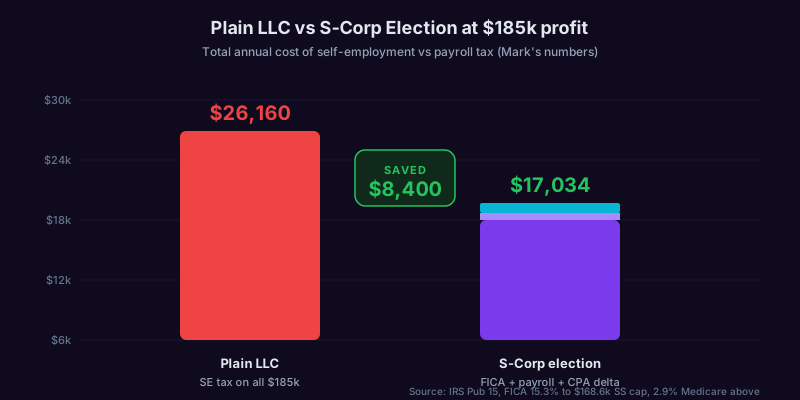
The savings panel read $8,400 a year, net of payroll service and CPA overhead. Mark walked into the living room, told his wife, and then walked back to the kitchen and started reading.
Why two years of procrastination on the election
Before the Copilotly session, Mark had tried twice to figure this out on his own. The first attempt was in mid-2024 when his CPA mentioned offhand that "we should probably talk about S-Corp election next year." Mark spent a Saturday afternoon reading the IRS S-Corporations page and a half-dozen tax blogs. He came away knowing the words "reasonable compensation" and "Form 2553" but no clearer on whether the election was worth it for him personally.
The second attempt was in early 2025. He paid $400 for an hour with a tax attorney who walked him through the theory, said "you'll save somewhere between $4k and $9k a year," and then quoted $2,500 to file the election plus an additional $1,800 a year for the resulting 1120-S preparation. Mark hung up unsure whether the savings would net out positive after fees. The attorney was not selling him math; he was selling him a service. So Mark filed the question under "this year's homework I will get to in Q4," which then became Q1 of 2026, which then became the kitchen table in February.
There were three things that made the DIY research path frustrating. First, every calculator he found online either oversimplified (no payroll overhead, no CPA delta) or required him to enter his Social Security number to sign up. Second, every blog post wanted him to book a consultation. Third, the few good resources, like the SBA entity comparison guide, talked about LLC vs S-Corp at the formation stage. Almost nobody talked about the mid-life conversion - taking an existing LLC and electing S-Corp tax treatment without dissolving anything.
This is exactly the kind of decision where general purpose AI tools start strong and then trail off. ChatGPT will happily explain the difference between an LLC and an S-Corp in three paragraphs. Ask it to run your specific numbers with payroll overhead and CPA fee delta in your state, and it gets vague. Mark had asked. He had gotten the consultant equivalent of a horoscope. (We wrote up a longer version of how Copilotly compares to ChatGPT for this kind of specific financial question if you want the full breakdown.)
The pattern matches what we hear from a lot of solo founders. The activation energy is not the filing. The activation energy is trusting the number.
The Business Formation Copilot picks up the thread
The LLC vs S-Corp tool showed Mark the headline savings number. What the tool could not do was answer the next ten questions: What salary would the IRS accept? Did he need to dissolve and re-form anything? Could he elect S-Corp status mid-year or did he need to wait until 2027? What would his quarterly cadence look like with payroll involved? What happens to his SEP-IRA contributions?
This is where the Business Formation Copilot came in. Mark answered the Business Launch quiz persona in about ninety seconds, which surfaced the Formation, Tax, and Business Finance copilots as his core stack. He started a conversation with Business Formation and pasted in a single paragraph: existing single-member LLC in Colorado, January 2024 formation, projected $185k 2026 profit, looking to elect S-Corp treatment effective for the 2026 tax year.
The first reply was not advice. It was a clarifying question: "Are you currently on payroll anywhere else, or is this LLC your only source of W-2 income?" Mark typed back: only source. The copilot then walked him through the timeline. To elect S-Corp status for the 2026 tax year, he needed to file Form 2553 within 75 days of the start of the tax year, i.e. by March 15, 2026. He was on day 60. He had two weeks.
The copilot also flagged something he had not seen in any of his earlier research: as a continuing LLC that is now electing S-Corp tax treatment, he did not need to dissolve anything or form a new entity. He simply needed to file Form 2553, switch his bookkeeping to reflect owner-employee compensation, set up payroll, and have his CPA file an 1120-S for tax year 2026 instead of a Schedule C. The state-level LLC remained intact; only the federal tax treatment changed.
- Week 1
Ran the LLC vs S-Corp math
Used the LLC vs S-Corp calculator at his projected profit to see savings.
- Week 2
Set reasonable salary
Business Formation Copilot helped him land on $98k as IRS-defensible.
- Week 3
Filed Form 2553
Elected S-Corp tax treatment for the current tax year.
- Week 4
Set up payroll
Onboarded with Gusto to run his own W-2 paychecks.
For the reasonable salary question, the copilot ran a defensibility analysis. It pulled benchmarks from the Bureau of Labor Statistics Occupational Employment Statistics for management analysts (SOC 13-2051), cross-referenced Denver metro wages, and triangulated against published S-Corp reasonable compensation studies. The IRS does not publish a bright-line number. What they look for, per the official guidance on S-Corp compensation, is whether the salary reflects what a third party would pay someone to do that work. For a Denver-based independent strategy consultant with a VP-level background, the defensible range landed between $90k and $110k. Mark chose $98k.
The reasonable salary question and the IRS audit ghost
The piece of this whole exercise that Mark lost the most sleep over was not the math. It was the audit risk. The S-Corp election only saves money because owner-employees pay FICA only on their W-2 salary, not on the K-1 distributions they take from remaining profit. The IRS knows this and they audit. If they decide your "reasonable salary" was unreasonably low, they recharacterize distributions as wages, charge back payroll tax, and add penalties.
Mark wanted to know: at $98k salary on $185k profit, was he in the safe zone, the gray zone, or the danger zone?
The Tax Copilot's answer was structured. First, it walked him through the four-factor framework that courts have used to evaluate reasonable compensation in S-Corp cases - training and experience, duties and responsibilities, time and effort devoted to the business, and comparable salaries paid by similar businesses. Then it applied each factor to Mark's situation. Then it gave him a specific range with a recommended midpoint and an explanation of why the midpoint was defensible.
The midpoint it recommended for Denver was $96k to $102k. The 53% salary-to-profit ratio at $98k landed squarely inside the published norms for solo professional services S-Corps in similar metros. The copilot also generated a one-page memo summarizing the methodology - BLS data sources, comp study citations, the four-factor analysis - that Mark could save in his tax file as contemporaneous documentation. If he ever did face an audit, that memo was the difference between "I picked a number" and "I did my homework."
The other deep-work piece was cash flow. As a Schedule C LLC, Mark had been pulling money from his business account into his personal account whenever he wanted, with quarterly estimated tax payments to cover federal and state. As an S-Corp owner-employee, he needed actual payroll: biweekly or monthly paychecks with federal income tax, FICA, Colorado state tax, and unemployment withheld and remitted. He needed a payroll service.
Business Finance Copilot ran him through the three main options (Gusto, OnPay, ADP) at his transaction volume and use case. Gusto came in at $40/month base plus $6/month per employee, which for a one-person payroll worked out to about $840/year. The copilot also produced a restructured cash flow plan: monthly $98k/12 = $8,167 gross paycheck to himself, quarterly K-1 distributions of remaining profit timed to align with estimated tax payments, and an emergency reserve in the business account equal to two months of operating expenses.
| Plain LLC self-employment tax | $26,160 |
| S-Corp FICA on $98k salary | $14,994 |
| Payroll service annual cost | $840 |
| CPA fee delta (1120-S filing) | $1,200 |
| Net annual savings | $8,400 |
The total time Mark spent across all of this - playground tool, three copilot conversations, reviewing the salary memo, picking Gusto, and physically filing Form 2553 - was about eight hours over two weekends in late February.
What the first six months on S-Corp actually looked like
Form 2553 went in on March 4, 2026, well inside the 75-day window. Gusto onboarding took an afternoon. His first W-2 paycheck cleared on March 31. By June, he had four months of payroll history, a clean general ledger that separated owner salary from distributions, and a quarterly tax payment that finally reflected his real picture.
The headline number held. At his current $185k projection for 2026, net annual savings after Gusto fees and the projected $1,200 in additional CPA work for the Form 1120-S filing works out to $8,400. If his income stays flat over five years (a conservative assumption for an established solo consultant), that compounds to roughly $42k in tax savings - real money that stays in his SEP-IRA and his kids' 529 accounts instead of going to FICA.
There was one unexpected benefit. The discipline of running formal payroll forced Mark to draw a much clearer line between business cash and personal cash. As a Schedule C filer he had paid himself ad hoc - sometimes $5,000 in a great month, sometimes $1,500 in a slow one, always with the silent stress of wondering whether he was leaving enough in the business account. As an S-Corp owner-employee on a monthly $8,167 salary, his personal cash flow finally became predictable. His wife's first comment after the second paycheck cleared: "this is the calmest you've been about money in two years."
If you are early in a similar transition and curious how other founders thought about adjacent decisions, two Copilotly case studies cover related territory: Maya's audit of six years of freelance returns walks through the deduction side of the same equation, and Jordan's solo retainer journey covers the revenue side of going independent.
What he would do differently
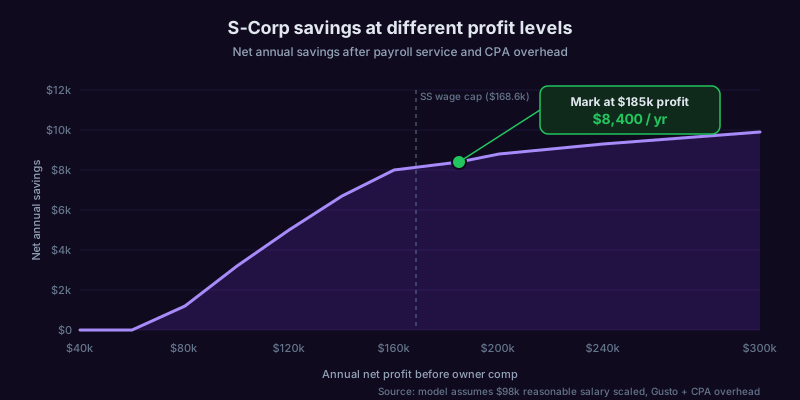
Asked what he would tell his 2024 self, Mark did not say "elect S-Corp from day one." That would have been the wrong move - at $62k of net profit in his first stub year, the FICA savings would not have covered the payroll and CPA overhead, and the SS wage cap rules make the math much weaker below about $80k of profit anyway (the lower-left tail of the savings curve in the chart above tells that story).
What he would tell his 2024 self is this: spend two hours every January running your projected numbers through the LLC vs S-Corp calculator. The moment the projection crosses the threshold where annual savings exceeds your overhead by a comfortable margin (he uses $5,000 as his personal trigger), file the election. Do not wait until the number is undeniable. Do not pay a tax attorney $400 to tell you something a structured tool can show you in fifteen minutes.
The other thing he would change: he would run the tax estimator tool alongside the LLC vs S-Corp playground every quarter, not just at year end. Two of the three years he overpaid SE tax, he also under-projected his quarterly federal estimate and had to scramble in April. A copilot that watches both numbers at once is a small but real source of mental quiet.
The next item on his Copilotly stack is solo 401(k) setup - a structure that lets owner-employees of S-Corps shelter both the employee deferral ($23,500 in 2026) and the employer match on their W-2 wages, plus the employer profit-sharing on top, for a much higher contribution ceiling than the SEP-IRA he was using. The Business Finance and Tax Copilots have already started running those numbers. If you are thinking through a similar set of life-stage business decisions, the Seattle PM offer negotiation case study shows how to think about W-2 versus 1099 tradeoffs in the other direction.
Two years of procrastination. Eight hours of work. $8,400 a year, compounding. The frustrating part, Mark says, was not that the answer existed. It was that nobody had ever shown him the actual number.
Every tool used in this story
What it added up to
Frequently asked questions
Is this a real customer or composite?
At what profit level does S-Corp election start to make sense?
What happens if the IRS audits my reasonable salary determination?
Can I elect S-Corp status mid-year?
Mark did it once.
Now it's your turn.
The same copilots in this story are free to start with, on every device. Open Copilotly and ask the question you have been putting off.
Open Copilotly free