

The freelancer who was tired of starting from zero every month
Jordan Davis left her senior strategist role at a 40-person digital marketing agency in late 2024. She had spent six years there, climbing from coordinator to lead on accounts that billed six figures a quarter. The work was interesting. The politics, the timesheets, and the 11 p.m. Slack pings from a VP three time zones away were not. When a former client offered her a three-month project at a rate that worked out to roughly what the agency billed for her time, she gave notice on a Tuesday and was a freelancer by Friday.
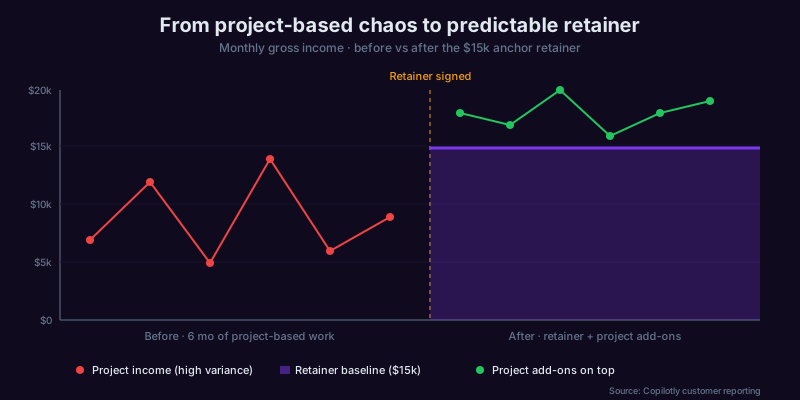
For the first six months it felt like she had cracked a code. She kept the project going, picked up two more from referrals, and by mid-2025 was clearing somewhere between $7,000 and $12,000 a month - more than her agency take-home, with no commute and no quarterly reviews. She moved into a slightly nicer apartment in central Phoenix, started cooking again, and told her parents that going solo was the best decision she had ever made.
Then the variance caught up with her. Her income graph looked less like a salary and more like a heart monitor. One month a launch project would close at $14,000. The next month two clients would push their kickoff and she would scrape together $5,400 from edits and small retainers. Every quarter she had a stretch of two or three weeks where she was the proposal writer, the deliverer, the invoice chaser, and the lead generator all at once - and where any sustained client work effectively stopped because she was selling.
By spring 2026, she had been freelancing for 18 months and had clocked roughly 22 distinct engagements. The work was good. The lifestyle was not. According to Upwork's research center, freelancers in her income band consistently cite revenue predictability - not lead volume or pricing - as their biggest stressor. Jordan was a textbook case. She wanted one anchor: a single retainer paying $10,000 or more a month, signed for at least six months, that would put a floor under the wobble.
The Business Launch quiz persona on Copilotly pointed her at the right starting stack. She had used the Marketing Copilot for one-off campaign briefs before. This time she wanted to use it for something bigger - to design an offer, not just a deck.
The month she billed $5,400 and finally said enough
March 2026 was the breaking point. A client pushed a content sprint into April. Another shrank scope after their own funding round slipped. A third paid invoice #14 thirty-six days late. Jordan billed $5,400 that month - less than rent, utilities, health insurance, and her self-employment tax set-aside combined. She moved $4,200 from her cushion to cover the gap. The cushion had been built across the prior nine months and was now visibly smaller for the first time since she went solo.
What hit harder than the number was the realization that her current setup made March mathematically inevitable on a rolling basis. With two to three active projects and a perpetual one-month sales cycle, any month in which two clients delayed simultaneously was a $5k month. She had built a business that punished her for the exact thing - new business development - that she was supposed to be doing during execution gaps.
The classification dimension was also starting to bother her. She had read the IRS guidance on independent contractor vs. employee status back when she started, and she knew that scope, control, and exclusivity all factored in. A real retainer with a single anchor client could push her toward the gray zone if she was not careful. She wanted recurring revenue without quietly recreating a job.
She did what she had been avoiding for months: she opened a fresh document and wrote down what "success" actually meant in numbers. One anchor client at $10,000+ a month. A six-month minimum so she could plan. Three to four hours per week of focused strategy work, not 35 hours of execution that would make her unable to take other projects. Her partner read the page and said, "okay, so what would it take to land that by July?" She did not have an answer.
That night she opened the Freelance Copilot and asked it to help her sketch the inverse of what she had been doing. Instead of "find me leads," she asked, "look at my last 18 months of clients and tell me which ones could realistically support a $10k+ monthly retainer." It came back with a question she had not thought to ask herself: which clients had renewed work without renegotiation? That list was three names long.
- Week 1
Identified anchor clients
Marketing Copilot helped her shortlist 12 prior clients with retainer potential, then narrowed to 3.
- Week 2
Built the retainer offer
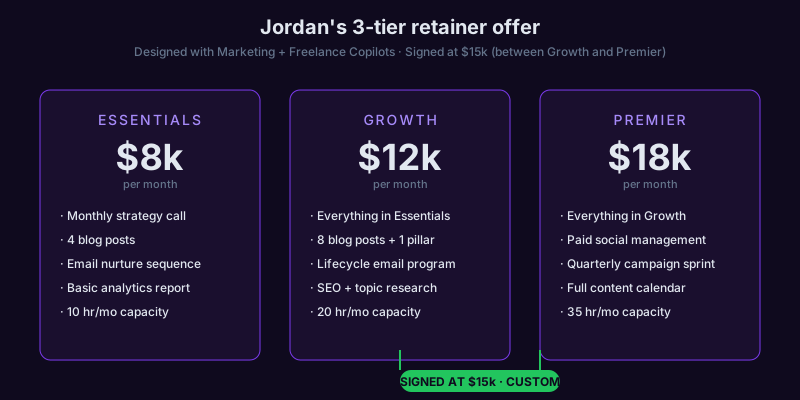
Designed a 3-tier package: Essentials $8k, Growth $12k, Premier $18k. Pitch deck and one-pager drafted with Copywriting Copilot.
- Week 3
Sent the first 3 pitches
Personalized outreach to the three anchor candidates. Candidate #1 passed within 48 hours.
- Week 4
Counter-offer negotiation
Candidate #2 came back interested at $10k. Salary Copilot scripted the counter at $15k with expanded scope.
- Week 5
Leverage and close
Candidate #3 surfaced late interest, used as quiet leverage. Candidate #2 accepted $15k.
- Week 6
Signed $15k/mo retainer
Six-month minimum, then month-to-month. $180k annualized contract value.
Why generic retainer templates failed her three times
This was not Jordan's first attempt at a retainer. She had tried twice in 2025, and both attempts had died quietly. The first time, she had downloaded a "freelance retainer template" from a popular freelance newsletter and emailed it to a client who had previously paid her on a project basis. The template was scoped in hours - "20 hours a month for $4,000" - and the client, sensibly, replied that they had not actually used 20 hours of her time in any prior month and would prefer to continue with project-based work. She had no counter.
The second time, she had read a thread on a freelance forum advising her to anchor high. She quoted $9,500 a month to a B2B SaaS founder who had been paying her roughly $4,000 a month in projects across the prior quarter. He laughed, kindly, and said he could not justify more than doubling his marketing spend without a clear story of what changed. Again, she had no counter. She felt embarrassed enough that she did not re-pitch him for four months.
The pattern in both failures, she realized later, was the same: she had treated retainers as a pricing exercise rather than an offer-design exercise. She had asked "how much can I charge?" rather than "what bundle of outcomes is worth $10k+ a month to a specific kind of buyer?" The first question puts the freelancer at the center. The second puts the client outcome at the center. Resources like the Freelancers Union education library and the Harvard Business Review archive on professional services pricing both make the same point, repeatedly: clients buy clarity and predictability, not effort.
She had also tried ChatGPT in 2025 to draft retainer language and got back the same generic three-tier scaffold that every other freelancer who had ever asked it the same question had also received. The output was not bad. It was just not specific to her - to B2B SaaS marketing in 2026, to her actual past client patterns, to what she could and could not personally deliver in 25 to 30 hours a week. She tried it again for fun mid-process this round and could see the difference immediately versus the Marketing Copilot running on her own historical context.
What she needed was a structured offer that did three things at once: anchored a fair price, made the buyer's outcome legible, and gave her room to negotiate without dropping below her floor. That is what she set out to build over the next six weeks.
Designing a 3-tier offer that priced itself
She started with a single prompt to the Marketing Copilot: design a 3-tier retainer offer for a solo B2B marketing operator selling to seed-to-Series-B SaaS companies with 8 to 40 employees and a marketing budget in the $15k-$60k/mo range. She fed it her actual case study list - what she had delivered for whom, what had moved their numbers, what they had told her after the engagement closed. The first draft came back inside ninety seconds.
The tiers it produced were close to what she eventually used. Essentials at $8k for monthly strategy plus content production. Growth at $12k adding lifecycle email and SEO. Premier at $18k adding paid social management and a quarterly campaign sprint. She iterated on the scope boundaries for two days with the Copilot - the most useful question it kept asking was "what is the buyer giving up if they go one tier lower?" That question forced her to make each tier meaningfully different rather than just bigger.
Then she switched to the Freelance Copilot for the pricing pressure test. It walked her through gross-to-net math at each tier: a $12k/mo retainer with 20 hours of effective delivery time, after self-employment tax and her solo health insurance premium, was roughly equivalent to a $185k W-2 base. She cross-referenced that against the BLS data on marketing services compensation and against marketing-leader benchmarks compiled in the HubSpot marketing statistics report. The number sat at the high end of "senior individual contributor" and well below "VP of marketing." That was the right neighborhood for what she would actually deliver.
The pitch deck came together over a single weekend using the Copywriting Copilot. Twelve slides: one cover, one problem framing, three case studies pulled from her own past work, three tier pages, two on the engagement model and what month one looked like, one FAQ, one ask. The Copilot's most useful contribution was killing every adjective it could find. The deck got shorter and more concrete with each pass.
By the end of week two she had the offer, the deck, a one-page summary, and an outreach sequence drafted for each of her three anchor candidates - all prior clients with whom she had a real relationship. She sent the first emails on a Monday morning.
The hour between sending the counter and receiving the reply
Candidate #1 was a fintech infrastructure company she had run a launch campaign for in summer 2025. They replied within 48 hours: budget had been frozen in their Q2 board cycle, no retainers above $5k were getting approved. Polite, immediate, definitive. She moved on the same day - and added them to a 90-day reminder so she could re-approach after their next planning cycle. That discipline, of treating a no as a "not now" and tracking it, was something she lifted directly from a sequence the Freelance Copilot had drafted for her pipeline.
Candidate #2 was a healthcare SaaS company in their Series A growth phase. She had run a quarterly content sprint for them in late 2025 that had moved their organic traffic 38% month over month. Their head of marketing had been talking about hiring a senior content lead for two quarters. They replied four days after her pitch with the kind of email she had been afraid of for eighteen months: "Love this. We are interested. Realistically we can do $10k a month for the Essentials package - is that doable?"
Her instinct was to say yes. $10k a month was the floor she had told her partner she would accept. It was double her March income. She could be done with the search and signed by Friday. She drafted an acceptance email and let it sit for two hours. Then she opened the Salary Negotiation Copilot.
The reframe took thirty minutes. The Copilot would not let her counter from a defensive posture. It kept asking variants of the same question: "what is the next tier of outcome worth to them, and what does it cost you to deliver?" By the end she had something she would not have written on her own. A counter at $15k/mo that added paid social management and a full content calendar - effectively a custom tier between Growth and Premier. The structure mattered: she was not asking for $5k more for the same scope. She was offering a meaningfully different package at a price that still sat below her Premier tier.
She sent the counter at 11:42 a.m. on a Thursday. The reply came at 1:15 p.m.: "Can we do a call tomorrow to walk through the expanded scope? This looks more aligned with what we are actually trying to do this year." She closed her laptop, walked to the kitchen, and stood there for a minute not really doing anything. The hour and a half between sending and receiving had been the longest hour and a half of the six-week process.
The call ran an hour. They walked her through their Q3 and Q4 plans. By the end she had a verbal yes on $15k/mo, a six-month minimum, then month-to-month, with a 60-day notice clause on either side. Candidate #3 - a B2B vertical SaaS founder she had pitched the same week - had also surfaced late interest. She mentioned it offhand on the call as context, not pressure. The contract draft arrived in her inbox the next Monday.
| Pre-retainer monthly income (range) | $5.4k - $14k |
| Initial 3-tier offer (Essentials) | $8,000/mo |
| Initial 3-tier offer (Growth) | $12,000/mo |
| Initial 3-tier offer (Premier) | $18,000/mo |
| Client counter-offer | $10,000/mo |
| Her counter with expanded scope | $15,000/mo |
| Final signed retainer | $15,000/mo |
| Minimum commitment | 6 months |
| Annualized contract value | $180,000 |
What predictable income actually changed
The contract was executed on a Tuesday in late May. Annualized contract value: $180,000 from a single client, with project work continuing on top from two smaller accounts. Her time investment across the six weeks: roughly 20 hours total, spread across offer design, deck production, three pitches, two negotiation rounds, and the contract review. The math worked out to $9,000 of annualized contract value per hour of pitching time.
What changed first was not the bank balance. It was the calendar. She booked a two-week trip in late June - the first real time off she had taken since going solo. She signed up for a Tuesday-Thursday yoga class without checking whether she had a proposal due. She told her partner they could finally pick a wedding date without first running income projections across three quarterly scenarios.
The retainer itself ran cleanly through month one. She delivered the strategy memo on day three, paid social rollout by week two, the first content calendar review by week three. Her actual time on the account averaged 18 hours per week - well inside her capacity. She still had room for one full project on top, which she filled with a $9k engagement that closed in week three of the retainer.
The tax picture also shifted enough to be worth modeling. With $180k of recurring revenue locked in plus $40k-$80k of projected project work on top, she was looking at gross 2026 income materially above her LLC's prior years. She ran the Copilotly tax estimator at three scenarios and used the LLC vs S-Corp playground to model what an S-Corp election would actually save her in payroll taxes. The numbers pointed the same direction Mark's path had: an S-Corp election starting January 2027 would likely save her between $7,000 and $11,000 a year in self-employment tax at her projected income level, net of the additional payroll administration cost. She is reading Mark's Denver S-Corp case study for the operational details and using the Business Formation Copilot to draft her decision memo.
The other comparison she is reading carefully is Maya's Brooklyn freelance deductions story - same business structure, same kind of solo-operator math, different optimization angle. Together those two cases are giving her something her CPA's twice-a-year check-in never did: a continuous decision framework. The Seattle PM salary negotiation story is what she sent to a friend at her old agency who was negotiating an internal promotion; the framing of "what you are worth to them, not what feels comfortable to you" applied cleanly there too.
What she would do differently and what is next
Three things, if she were starting over. First, she would have built the offer in month six of freelancing, not month eighteen. The hardest part was not the pricing or the pitch - it was the year of variance she absorbed before she gave herself permission to try the retainer structure. The cushion she rebuilt in May would have been a year larger if she had moved sooner.
Second, she would have skipped generic templates entirely. Both her 2025 failures were template-driven. The 2026 win was offer-design-driven. The Marketing Copilot running on her own past client data produced something a generic template could not: tiers that mapped to her actual delivery capacity and to her specific buyer's outcome model. The lesson is not "AI is better than templates." The lesson is that the work of designing an offer cannot be skipped, and a good Copilot makes the work faster, not optional.
Third, she would have practiced the counter-offer conversation out loud, not just in writing. The Salary Negotiation Copilot's scripts were the right words. But the hour and a half between sending and receiving was a body experience, not a writing experience. Next time she pitches a retainer counter, she has told herself, she will record herself reading the counter aloud first - to hear what confident actually sounds like in her own voice before the buyer does.
What is next: a second anchor. Her thesis is that two $10k-$15k retainers plus selective project work is the right shape for her business through 2027. She is in early conversations with one of the candidates from her original outreach who circled back two weeks after candidate #2 signed. She is also planning her S-Corp election for January 2027, which she is mapping with the Business Formation Copilot and the entity comparison playground. The U.S. Chamber small business resources and the SBA business guide are both on her reading list for the operational pieces.
For freelancers reading this who are still in the variance trap: the work is real, but the offer-design step is the one most freelancers skip. The pricing argument cannot win if the offer underneath it does not exist.
Every tool used in this story
What it added up to
Frequently asked questions
Is this a real customer or composite?
Why a 3-tier offer instead of a single price?
Does taking a single $15k/mo anchor create independent contractor classification risk?
What if no prior client is a viable retainer candidate?
Jordan did it once.
Now it's your turn.
The same copilots in this story are free to start with, on every device. Open Copilotly and ask the question you have been putting off.
Open Copilotly free