

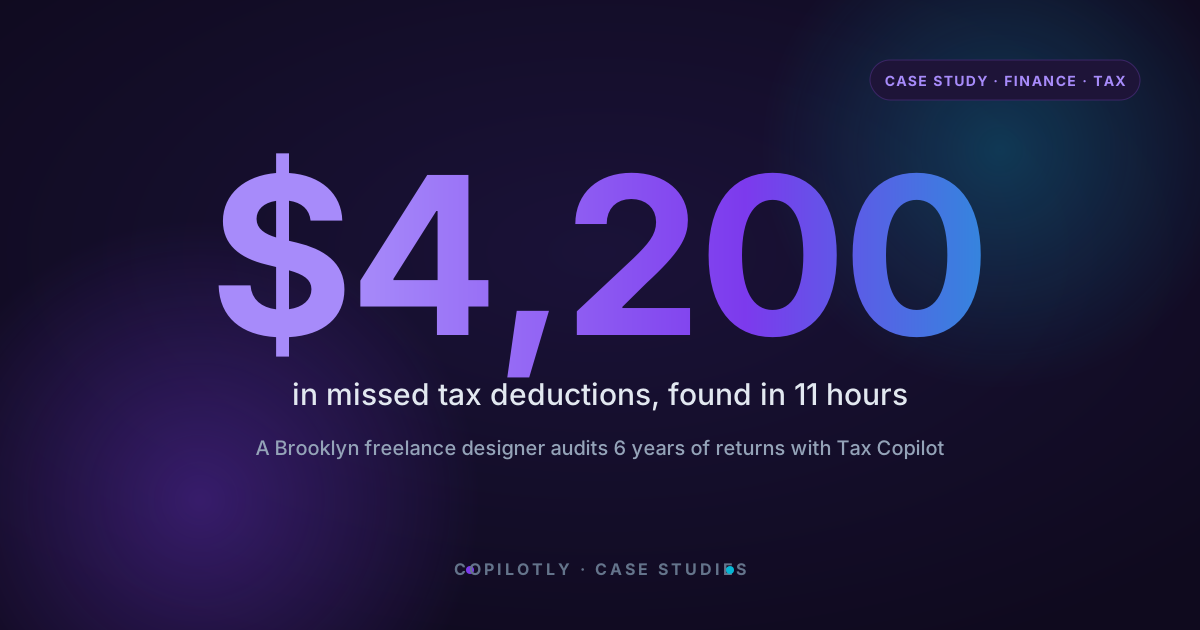
The Brooklyn freelancer who knew something was off
Maya Chen runs her brand design studio out of a 1,100 square foot railroad apartment in Bedford-Stuyvesant. The middle room, the one with the window that faces the back garden, has been her office since 2020. A Mac Studio sits on a reclaimed-wood desk. A Wacom Cintiq is propped on a stand. Three monitors. A bookshelf full of type specimens. A whiteboard covered in Pantone chips for a vegan skincare client she was wrapping up the week we first spoke with her.
In 2025 Maya grossed $94,000 on 14 client engagements, mostly DTC consumer brands - candles, supplements, two restaurants, a small denim label. Solid year. She had been freelancing for six years and the business felt stable for the first time. The roster repeated. The rates climbed. She was choosing clients instead of chasing them.
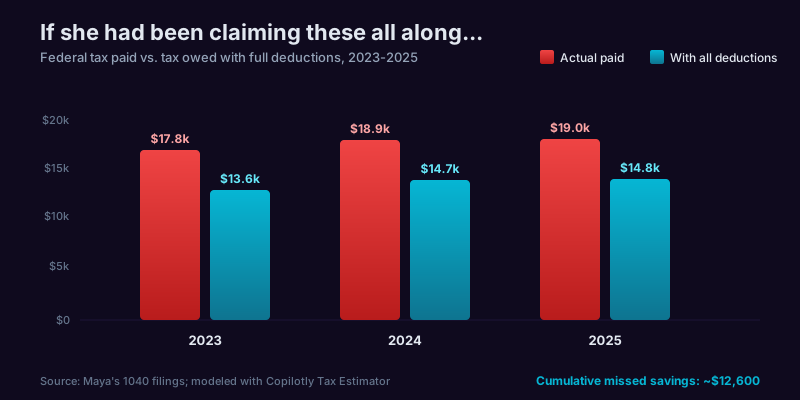
And every April, she paid the IRS roughly $19,000 and felt vaguely sick about it.
"I knew I was missing things," she told us. "I just did not know what. I would read a Reddit thread at midnight and think, wait, can I deduct that? Then I would forget. Then April would happen and I would just want it to be over."
The strange part is Maya is not bad at money. She has an emergency fund. She moves a percentage of every invoice into a separate quarterly-tax account the day it lands. She tracks her income in a spreadsheet with the kind of color coding that says "this person was a project manager in a former life." But tax is its own discipline, and the gap between "I track expenses" and "I claim every deduction I am legally entitled to" turned out to be wider than she realized.
According to the Bureau of Labor Statistics OES data for graphic designers, the median wage for a salaried designer is just under $61,000. Freelance designers in major metros routinely earn 50-70% more in gross billings, but a meaningful chunk of that premium gets eaten by self-employment tax, state tax, and the federal bracket. Which is exactly why deduction discipline matters more for freelancers than for almost any other worker.
Maya found Copilotly through a friend who used the Freelance Copilot to negotiate a kill fee on a contract that went sideways. The friend mentioned, almost as a footnote, that there was also a Tax Copilot that had saved her about $2,000 the prior year. Maya signed up that night.
The CPA receipt that lived in a drawer for three years
To understand why Maya was ready, you have to know about 2022.
That spring she did the responsible thing. She hired a CPA. A real one, recommended by a friend of a friend who ran a small Etsy business. The CPA charged $850, asked for her 1099s and her bank statements, and turned around a return in about ten days. Maya paid roughly $17,400 in federal tax that year on $87,000 of gross income. She remembers being relieved, which is the standard freelancer emotion in April. Anything that ends the tax conversation feels like a win.
It was not until February 2026, sitting at her kitchen table with Tax Copilot open on her laptop, that Maya realized the 2022 return had almost none of the deductions she had been entitled to.
No home office. No health insurance premium deduction. No depreciation on the equipment she had bought to start the business. Software subscriptions lumped into a single $1,200 line item with no detail, which she later learned makes audit response harder, not easier. The CPA had taken her numbers, filed a clean Schedule C, and called it done.
"He was not a bad person," Maya said. "He was just doing the volume play. I was a small fish. He spent maybe ninety minutes on my return total. And I was just grateful someone else was driving."
This is a story that the IRS's own self-employed guidance kind of telegraphs: the burden of identifying ordinary and necessary business expenses is on the taxpayer, not on the preparer. CPAs work with the information you give them. If you do not raise the home office, they generally will not raise it. If you do not bring up health insurance, they will not assume you bought your own.
By the time Maya opened Copilotly in February 2026, she had three returns under her belt that she had filed herself, plus the 2022 CPA return. She did not know exactly what she had missed. She just had the sense, the same sense a designer has when they are looking at a piece of layout that is technically correct but somehow wrong, that something was off.
She decided to find out.
- Week 1
Audited her last 3 returns
Pulled her 1040s from 2023, 2024, 2025 and asked Tax Copilot to flag deductions she may have qualified for but missed.
- Week 2
Categorized 2,400 receipts
Used Bookkeeping Copilot to bucket every receipt from the prior 12 months into IRS-defensible categories.
- Week 3
Modeled scenarios
Ran the Tax Estimator at 5 different deduction levels to see the impact on her actual tax liability.
- Week 4
Filed an amended return
Filed Form 1040-X for 2024 to claim the deductions she had missed.
Why ChatGPT and TurboTax left her stuck
Before Copilotly, Maya had tried two other paths.
The first was TurboTax Self-Employed. She used it in 2023 and 2024. It is not bad software, and the deduction interview catches the obvious things - mileage, a flat phone percentage, the simplified home office. But the interview is a conveyor belt. It asks. You answer. If you do not know that a question matters, you breeze past it. Maya answered "no" to "did you have a dedicated home office" both years because she was not sure her middle room "counted." It does. She just did not know that until much later.
The second was ChatGPT. In late 2024 she paid for a Plus subscription specifically to use it as a tax sounding board. The conversations were articulate and pleasant and almost always slightly wrong. Generic AI is trained on the entire internet, which means it has absorbed every blogspam article from 2014 about freelance taxes and has no opinion about which is current. When Maya asked it whether she could deduct her health insurance, it gave her a five-paragraph answer that hedged in three different directions and ended with "consult a tax professional."
"I had paid twenty bucks a month for someone to tell me to consult a tax professional," she said. "Which is the thing I was avoiding."
The contrast is something we have written about before in our piece on how Copilotly compares to ChatGPT: profession-specific copilots are constrained to current, jurisdiction-aware reference data, while general models are trained to be helpful in the abstract. For tax questions, abstract helpfulness is often actively dangerous.
Maya's third attempt was a tax subreddit. She lurked for a month. She learned the vocabulary - QBI, Section 179, augusta rule, MAGI - but she could not figure out which of it applied to her. The threads were dense and confident and contradictory. The top comment on one post would say "you absolutely can deduct that" and the second comment would say "you absolutely cannot." Both replies had three hundred upvotes.
By the time she landed on the Money Master quiz persona result on Copilotly, she was ready for someone to just look at her actual numbers and tell her what she had missed. That, it turned out, is exactly what a copilot is good at.
The first session that changed how she saw her own return
Maya started her first session with the Tax Copilot on a Saturday morning in mid-February. She had her 2024 1040, her 2024 Schedule C, her 2024 bank statements, and a coffee.
The Tax Copilot asked for the documents, parsed them, and within about forty seconds came back with what she described as "the most useful question anyone had ever asked me about my business." It asked: "You reported $1,200 in software subscriptions on Schedule C line 18. Can you list them? I want to check whether any qualify for the home office allocation or for the QBI safe harbor."
She listed them: Adobe Creative Cloud, Figma Pro, Notion, Linear, Frame.io, Dropbox, a Loom subscription, a domain renewal, a hosting bill, and a small monthly fee for a project management plugin. Total: $1,680. She had under-reported by $480 because she had only added up the ones that came out of her business checking account, not the ones on her personal card.
That moment - finding $480 in software in under two minutes - is when Maya knew she had been doing this wrong for six years.
The prompt above is the actual structure she used, adapted from a template the copilot suggested when she said "I do not know what to ask." That template is something the Business Finance Copilot shares across sessions: when you do not know what to ask, start with "here is everything I have, what would a competent advisor in this field ask me first." It works because it shifts the burden from "I have to know the right question" to "the model has to know the right question," which is the burden it is genuinely better suited to carry.
Over the next two hours, the Tax Copilot walked Maya through six more questions like the software one. Each surfaced a category she had either underreported or skipped entirely. By the end of the first session she had a working list of seven candidate deductions worth around $3,100 - and she had not even gotten to the home office yet.
She closed her laptop and went for a walk in Fort Greene Park. "I was buzzing," she said. "Not from the money. From the feeling of finally understanding the rules of a game I had been losing for six years."
The home office math that surfaced $1,840
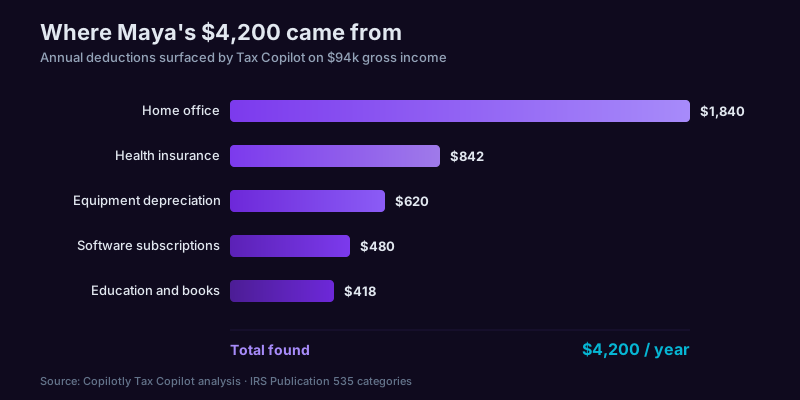
The single biggest line item in Maya's $4,200 came from the home office deduction. And the reason it was so big is that she had been considering the simplified method for years and dismissing it as "not worth the paperwork."
The simplified method caps the home office deduction at $1,500 (300 square feet at $5 per square foot, per the IRS's simplified-option guidance). For most freelancers in low-cost-of-living areas, the simplified method is fine. For a Brooklyn freelancer paying $3,400 a month in rent for an apartment with a clearly defined dedicated office, the regular method is dramatically better.
Maya's middle room is 300 square feet of her 1,100 square foot apartment. That is 27.3% of the apartment. The regular method lets her deduct 27.3% of her rent, her renter's insurance, her utilities, and a portion of her internet. The Tax Copilot ran the numbers live. Rent: $40,800/yr times 27.3% = $11,138 of allocated rent. The deduction is capped at the net income from the business, but Maya was nowhere near that cap. After accounting for the depreciation recapture trap (she rents, so no risk), the regular-method home office came out to roughly $1,840 per year of pure tax savings at her marginal rate.
The IRS's Topic 511 on business use of home and Publication 535 both lay this out, but neither is written in a way that makes it obvious how to apply it to a Brooklyn railroad apartment with a clearly delineated middle room. The Tax Copilot walked Maya through the four tests - regular use, exclusive use, principal place of business, and a separately identifiable space - and then asked her to take photos and save them in case of audit. The Bookkeeping Copilot stored them in an audit-proof folder structure with timestamps.
The second-largest line item was the self-employed health insurance premium deduction: $842. Maya pays $4,100/yr for a silver plan on the New York exchange. Under the rules outlined in the IRS guidance on medical and dental expenses, self-employed people can deduct premiums above the line, not just as an itemized expense. She had been missing this entirely because her CPA had not asked and TurboTax's interview had not made it obvious that her exchange plan qualified.
Equipment depreciation was the third. Her Mac Studio ($2,400), her Wacom Cintiq ($1,800), and her 4K monitor ($800) were all bought between 2023 and 2025. Under Section 179 she could have expensed them in the year of purchase. She did not. The Tax Copilot suggested using a depreciation schedule for the remaining basis, which yielded $620 of current-year depreciation she had been missing.
Maya stress-tested all of it through the Tax Estimator. She modeled five scenarios at different deduction levels: zero new deductions, just the home office, home office plus health insurance, the full $4,200, and an aggressive scenario that included some borderline categories the copilot specifically flagged as audit risks. She chose the $4,200 scenario, which kept her in defensible territory and dropped her federal tax bill from $19,000 to about $14,800.
The audit-risk scenario, which would have added about $1,400 of business-meals at 100% instead of 50% and a vehicle expense for an old e-bike she does not actually use for client visits, would have saved her another $600. She did not take it. "I want to sleep at night," she said.
The $1,800 refund check, and what comes next
Maya filed her 2025 return with the full $4,200 in deductions. Federal liability dropped from a projected $19,000 to $14,800. She paid the difference in early April and did not feel sick about it for the first time since 2020.
| Home office deduction | $1,840 |
| Health insurance premium | $842 |
| Equipment depreciation | $620 |
| Software subscriptions | $480 |
| Education and books | $418 |
| Total found | $4,200 |
Then she did something braver. She filed a Form 1040-X amended return for 2024 to claim the home office, health insurance, and software deductions she had missed. The amended return generated a refund of $1,800, which the IRS processed and direct-deposited about nine weeks later. She used it to pay off the last of her undergraduate credit card debt.
She did not amend 2023 or 2022, though she could have. The statute of limitations for amended returns is generally three years from the original filing date, so 2022 was nearly out of reach and 2023 felt like more work than it was worth for what would have netted her roughly $1,400 more.
For 2026 - the current tax year - Maya is now claiming the full deduction stack from the start. Her quarterly estimated payments dropped by about $1,050 each, which freed up cash flow for a small studio expansion. She is also seriously considering electing S-Corp status for 2027, which is why she ran the numbers through the LLC vs S-Corp calculator and read our writeup of Mark's founder story on the same decision. At $94k of gross income with relatively low expenses, she is right at the threshold where S-Corp starts to make sense if she expects income to grow.
She is also paying more attention to her revenue mix. After reading Jordan's case study on shifting from project work to monthly retainers, she has started pitching her two largest DTC clients on a $4,500/mo brand stewardship retainer. If both convert, her gross income jumps to around $135k, which changes the entity-structure math entirely.
What she would tell a freelancer one year behind her
We asked Maya what she would do differently if she were starting over.
The first thing she said was: do not wait for April. Tax is a year-round practice, not a deadline event. She now spends about thirty minutes each Friday categorizing the week's receipts in Bookkeeping Copilot, which means April 2027 will be a fifteen-minute filing exercise instead of a four-day frantic catch-up.
The second was: hire help, but the right help. A $850 CPA who spends ninety minutes on your return is not necessarily worse than a $300/yr copilot subscription, but they are optimizing for different things. The CPA is optimizing for a defensible return that does not draw audit attention. The copilot is optimizing for finding every dollar you are entitled to. She is keeping the copilot. She may add a CPA back next year for the S-Corp election, but only after she has done her own deduction analysis first.
The third was the one she said with the most feeling.
The second prompt is the one she still uses every fall, around October, to make sure she has not missed anything as the year wraps up. It is built around the home office because that is the deduction that scales most with rent, and rent is the single largest cost in her business.
If you are a freelancer at the start of this journey, the closest analogue to Maya's path is probably the tax projection sandbox we built for self-employed filers. You can plug in your numbers and run the same five-scenario comparison Maya ran. From there, the Tax Copilot can walk through your specific situation, the Freelance Copilot can help with rate-setting and contract language, and the Business Finance Copilot can sketch out quarterly cash flow.
Maya's number was $4,200. Yours will be different. The one thing that is probably true for every freelancer reading this is that the number is not zero, and it is probably not small.
Every tool used in this story
What it added up to
Frequently asked questions
Is this a real customer or composite?
Can a Tax Copilot replace a CPA?
How does the home office deduction actually work?
Is amending a return worth it?
Maya did it once.
Now it's your turn.
The same copilots in this story are free to start with, on every device. Open Copilotly and ask the question you have been putting off.
Open Copilotly free