
What Is Agentic AI, and Why Should You Care?
You have probably heard the term "agentic AI" in the past twelve months. It has appeared in board presentations, vendor pitches, conference keynotes, and an increasing number of LinkedIn posts from people who may or may not understand what it means. If you are a business owner who suspects this is important but cannot quite pin down what it is or why it matters, you are not alone. A PwC 2026 AI Business Survey found that while 78% of executives say agentic AI is a top strategic priority, only 23% can articulate a clear definition of it.
Here is the plain-language version. Agentic AI refers to AI systems that can independently pursue goals, make decisions, take actions, and adjust their approach based on results, with minimal human intervention. Think of the difference between a calculator and an accountant. A calculator waits for you to punch in numbers and press equals. An accountant reviews your financial situation, identifies issues, decides what to investigate further, gathers the information needed, runs the analysis, and comes back with recommendations. Agentic AI is the accountant. Traditional AI, including chatbots like the original ChatGPT interface, is the calculator.
The three capabilities that make AI "agentic."
- Autonomous reasoning. Agentic AI does not just respond to a single prompt. It breaks complex goals into subtasks, determines the right sequence of steps, and executes them without being told how. If you ask an agentic system to "find the best vendor for our new warehouse lease," it will identify the requirements, research available options, compare terms, check references, and present a ranked shortlist, all from a single instruction.
- Tool use and environment interaction. Agentic AI can use external tools: search the web, query databases, send emails, update spreadsheets, book meetings, and interact with other software systems. It does not just generate text. It takes action in the real world through the digital tools your business already uses.
- Self-correction and learning. When an agentic system encounters an obstacle or produces a suboptimal result, it recognizes the problem, adjusts its approach, and tries again. If a search query returns irrelevant results, the agent reformulates the query. If a draft email does not match your company's tone, the agent revises it. This feedback loop is what separates agentic AI from the static prompt-and-response pattern of traditional chatbots.

Why this matters for your business. Every business owner deals with processes that are too complex for simple automation but too routine to justify a full-time employee. Vendor evaluation. Insurance renewal comparison. Contract review. Customer onboarding follow-ups. Compliance monitoring. These tasks sit in a middle ground where they require judgment and multiple steps but follow patterns that an intelligent system can learn. Agentic AI is designed precisely for this middle ground. It handles the multi-step, judgment-requiring work that previously could only be done by humans, freeing your team to focus on the strategic and creative work that actually grows the business.
For a deeper look at how AI is already reshaping professional workflows across industries, see our guide to the best AI tools for every profession in 2026.
Agentic AI vs. Chatbots: Understanding the Difference That Matters
The single most common misconception among business owners is that agentic AI is just a better chatbot. It is not. The difference between a chatbot and an agentic AI system is the difference between a walkie-talkie and a project manager. One communicates. The other plans, executes, coordinates, and delivers results. Understanding this distinction is critical because it determines what you can actually accomplish with AI and how much value it creates for your business.
Generation 1: Rule-based chatbots (2016-2022). The chatbots you encountered on customer service websites over the past decade were decision trees disguised as conversations. They followed pre-programmed scripts: "If customer says X, respond with Y." They could handle simple, predictable interactions, password resets, order tracking, FAQ lookups, but could not reason, learn, or handle anything outside their script. If a customer asked something unexpected, the bot defaulted to "Let me transfer you to a human agent."
Generation 2: Conversational AI and LLM chatbots (2022-2025). ChatGPT and similar large language models transformed what chatbots could do. They could understand natural language, generate human-quality text, answer complex questions, and hold nuanced conversations. But they remained fundamentally reactive. They waited for your prompt, generated a response, and stopped. They could not take action, use external tools, or pursue multi-step goals. Every interaction was a single turn: you ask, it answers, done.
Generation 3: Agentic AI (2025-present). Agentic AI systems combine the language understanding of LLMs with the ability to plan, act, use tools, and iterate. They do not just answer questions. They complete tasks. The distinction is not subtle.
| Capability | Traditional Chatbot | LLM Chatbot (ChatGPT-style) | Agentic AI |
|---|---|---|---|
| Understands natural language | Limited | Yes | Yes |
| Generates human-quality text | No | Yes | Yes |
| Plans multi-step tasks | No | No | Yes |
| Uses external tools (email, CRM, web) | No | Limited (plugins) | Yes |
| Self-corrects when stuck | No | No | Yes |
| Operates autonomously over time | No | No | Yes |
| Learns from results | No | Within session only | Yes, across tasks |
| Coordinates with other systems | No | No | Yes |
A concrete example. Suppose you want to compare three health insurance plans for your 15-person company. With a chatbot, you can ask questions about each plan one at a time and get generic explanations of deductibles and copays. With an LLM chatbot, you can paste in plan documents and get a summary comparison. With an agentic AI system, you describe your team's demographics and coverage needs. The agent reads all three plan documents, builds a comparison matrix across 20 dimensions, models out-of-pocket costs for your specific team composition, checks each plan's provider network against your employees' current doctors, identifies hidden exclusions, and delivers a recommendation with supporting analysis. One instruction. Complete result.
Why this matters financially. Chatbots reduce costs by deflecting simple customer inquiries. LLM chatbots improve productivity by speeding up text-based work. Agentic AI eliminates entire workflows. The economic impact scales accordingly. Gartner estimates that by 2028, agentic AI will autonomously handle 15% of day-to-day work decisions, up from less than 1% in 2024. For a business owner, the question is not whether to adopt agentic AI, but which processes to hand over first.
The $10.8 Billion Market: Why Agentic AI Is Not Hype
Business owners are justifiably skeptical of technology hype. You have lived through the blockchain bubble, the metaverse promises, and multiple AI winters. When someone tells you that agentic AI is different, your first question should be: where is the money? The answer is: everywhere, and at a pace that suggests this is not a speculative trend but a structural market shift.
The hard numbers. The global agentic AI market reached an estimated $5.2 billion in 2025 and is projected to grow to $10.8 billion in 2026, a year-over-year growth rate of approximately 108%. By 2030, market projections from multiple analyst firms converge on a range of $100-150 billion. These are not theoretical projections from enthusiasts. They are consensus estimates from Gartner, McKinsey, and the leading investment banks that track enterprise technology spending.
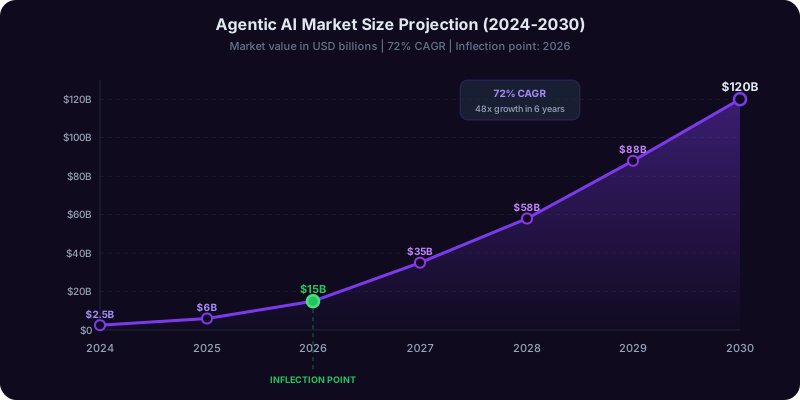
Where the money is going. Enterprise agentic AI spending in 2026 breaks down across five primary categories:
| Category | 2026 Spend (est.) | Growth vs 2025 | Primary Buyers |
|---|---|---|---|
| Customer-facing agents | $3.4B | +95% | Retail, financial services, telecom |
| Internal operations agents | $2.8B | +120% | All industries (HR, finance, IT) |
| Software development agents | $2.1B | +140% | Technology companies |
| Data and analytics agents | $1.5B | +85% | Financial services, healthcare |
| Agentic AI infrastructure | $1.0B | +160% | Cloud providers, platform vendors |
What the big players are doing. The investment signals from major technology companies are unambiguous. Google has embedded agentic capabilities into its Vertex AI platform and launched Agentspace for enterprise workflows. Microsoft's Copilot Studio enables businesses to build custom agents that operate across the Microsoft 365 ecosystem. Salesforce's Agentforce platform reported over 2 billion agentic actions in its first months of availability. Amazon Web Services, IBM, and Oracle have all launched or expanded agentic AI offerings in 2026. When every major technology vendor is investing billions in the same direction simultaneously, it is a strong signal that the market demand is real and sustained.
The venture capital perspective. In the first half of 2026, venture capital firms invested approximately $8.4 billion in agentic AI startups, according to PitchBook data. This represents roughly 22% of all AI-related venture funding, up from 9% in 2024. The investment thesis is clear: agentic AI represents the next platform shift, comparable to mobile in 2008 or cloud in 2010, and early market leaders will capture disproportionate value.
What this means for small and mid-size businesses. You do not need to invest billions. The market growth means that the tools available to you are getting better, cheaper, and easier to implement with each quarter. The agentic AI platforms being built by the major vendors and funded by venture capital will trickle down to small business tools within 12-18 months, just as cloud computing went from an enterprise-only technology to something every small business uses without thinking about it. The business owners who understand agentic AI now will be best positioned to adopt these tools as they become accessible.
The Gartner prediction worth remembering. Gartner named agentic AI its top strategic technology trend and projects that by 2028, at least 33% of enterprise software applications will include agentic AI components, up from less than 1% in 2024. That is not a possibility. It is the baseline expectation from the world's most conservative technology analyst firm.

Get Your Answer Now, Free
Copilotly's specialized copilots bring agentic AI capabilities to your core business functions. Get domain-accurate, multi-step AI assistance for engineering, marketing, legal, and finance workflows, no CTO required.
Real Business Examples: How Companies Are Using Agentic AI Today
Theory is useful. Examples are better. Here are concrete cases of how businesses across different sizes and industries are deploying agentic AI in 2026, with measurable results that matter to business owners: time saved, costs reduced, revenue gained, and errors eliminated.
Example 1: A 40-person accounting firm automates client onboarding. Before agentic AI, onboarding a new business client took an average of 6.5 hours: gathering documents, verifying information, setting up accounts in three different systems, running initial compliance checks, and sending welcome communications. The firm deployed an agentic system that handles the entire workflow. When a new client signs an engagement letter, the agent requests the required documents via email, extracts data from submitted documents using OCR, verifies the information against public records, creates accounts in the firm's practice management, tax preparation, and document management systems, runs an initial risk assessment, and generates a customized welcome packet. The result: onboarding now takes 45 minutes of human oversight instead of 6.5 hours of human labor. The firm onboards 200 clients per year, saving approximately 1,150 hours annually, equivalent to more than half a full-time employee.
Example 2: A regional e-commerce company optimizes its supply chain. A company selling specialty outdoor equipment through its own website and Amazon faced chronic inventory issues: popular items went out of stock during peak demand while slow-moving inventory tied up warehouse space. They implemented an agentic AI system that continuously monitors sales velocity across all channels, tracks supplier lead times, watches weather forecasts and outdoor event calendars that correlate with demand spikes, and automatically generates purchase orders when inventory levels cross calculated reorder points. The system also identifies products that should be marked down before they become stale. In the first six months, stockout events dropped by 62%, inventory carrying costs decreased by 18%, and the company recaptured an estimated $340,000 in previously lost sales from out-of-stock items.
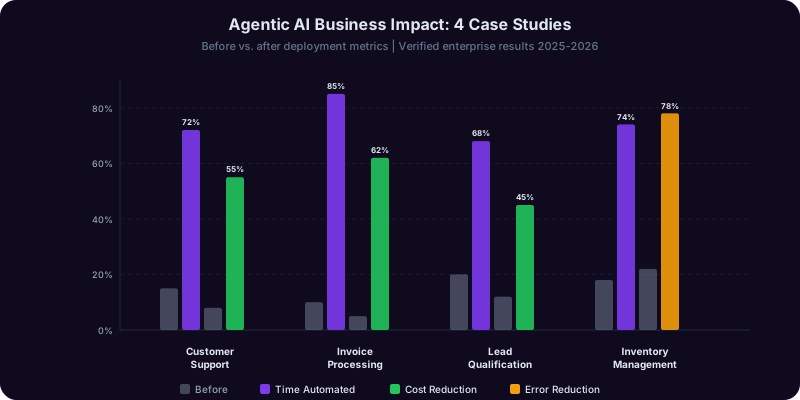
Example 3: A law firm streamlines due diligence for M&A transactions. A mid-size law firm specializing in mergers and acquisitions deployed an agentic AI system for due diligence review. In a typical M&A transaction, the firm reviews 5,000-15,000 documents: contracts, financial statements, regulatory filings, employment agreements, IP registrations, and litigation records. Previously, this required a team of associates working for two to four weeks. The agentic system now ingests the entire document set, classifies each document by type, extracts key terms and provisions, identifies risks and anomalies, cross-references findings across documents, and produces a structured due diligence report with flagged issues ranked by severity. Associates now review and verify the agent's findings rather than reading every document from scratch. Due diligence timelines have been reduced by 60%, and the firm reports that the agent catches cross-document inconsistencies that human reviewers frequently miss, such as a subsidiary contract that contradicts the terms of the parent company's representations.
Example 4: A healthcare practice reduces administrative burden. A multi-physician primary care practice was losing two to three hours per physician per day to documentation, coding, and administrative tasks. They deployed an agentic system that listens to patient encounters (with consent), generates structured clinical notes in the appropriate format, assigns preliminary ICD-10 and CPT codes, identifies required follow-up actions, schedules referrals and follow-up appointments, and sends patient after-visit summaries. Physician documentation time dropped from an average of 2.5 hours per day to 35 minutes. Patient satisfaction scores increased because physicians spent more face-to-face time on actual care rather than typing into an EHR system during the visit.
Example 5: A marketing agency scales personalized campaigns. A 25-person marketing agency managing campaigns for 40 clients used agentic AI to scale its operations without proportionally scaling headcount. The agent monitors campaign performance across Google Ads, Meta, LinkedIn, and email platforms, identifies underperforming ads and audiences, generates A/B test variations, reallocates budget toward high-performing segments, and produces weekly performance reports customized for each client. The agency increased its client capacity by 35% without hiring additional account managers, while average campaign ROAS improved by 22% due to faster optimization cycles.
These examples share a common pattern: the agentic AI system did not replace employees. It eliminated the repetitive, multi-step work that consumed their time, allowing them to focus on higher-value activities that require human judgment, creativity, and relationships.
How to Evaluate Agentic AI Vendors Without a CTO
If you are a business owner without a technical co-founder or a CTO, evaluating AI vendor claims can feel like navigating a foreign country without a map. Every vendor says their product is "agentic," "autonomous," and "intelligent." Most are overselling. Here is a practical framework for separating substance from marketing, written for decision-makers, not engineers.
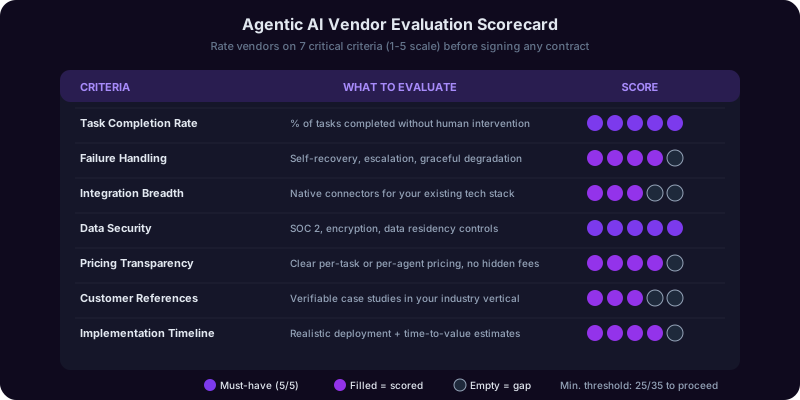
The seven questions every vendor should answer clearly:
- 1. What specific tasks does your agent complete end-to-end? An agentic AI system should be able to describe concrete workflows it handles autonomously. If the vendor can only describe features ("natural language understanding," "advanced reasoning") without naming specific tasks the system completes from start to finish, it is likely a chatbot with better marketing. Ask for a live demonstration of the agent completing a real task relevant to your business, not a polished demo video.
- 2. What happens when the agent encounters something it cannot handle? This is the most revealing question you can ask. Good agentic systems have explicit escalation protocols: they recognize their limitations, stop before causing damage, and route to a human with full context. Bad ones either fail silently (doing the wrong thing without telling you) or crash entirely. Ask to see the escalation path. Ask what the failure rate is. If the vendor cannot answer, they have not tested it rigorously.
- 3. What systems does the agent integrate with? An agentic AI that cannot connect to your existing tools (CRM, accounting software, email, project management) is an island. Integration capability is what separates a genuinely useful agent from a sophisticated chatbot running in a browser tab. Ask for the specific integrations list. Ask how long integration takes. Ask whether integrations require custom development or work out of the box.
- 4. How do you handle our data? This is non-negotiable. Understand where your data is stored, who can access it, whether it is used to train models, and what happens to it if you cancel the service. For any business handling customer data, financial information, or health records, the vendor must provide specific compliance certifications, not vague assurances about taking security seriously.
- 5. What does pricing look like at our scale? Agentic AI pricing models vary widely: per-agent, per-action, per-user, or flat-rate. Some vendors price attractively for pilots but become expensive at production scale. Ask for pricing at your current volume and at three times your current volume. Ask about hidden costs: integration fees, overage charges, premium support tiers. Get the total cost of ownership, not just the sticker price.
- 6. Can you show me results from a business like mine? Case studies from Fortune 500 companies are irrelevant if you run a 30-person services firm. Ask for references from companies of similar size, in similar industries, with similar use cases. Talk to those references directly. Ask them what went wrong during implementation, not just what went right.
- 7. What does implementation actually look like? How long from contract signing to the agent handling real work? What resources are required from your team? Who manages the agent after deployment? What does the first 90 days look like? If the vendor says implementation takes less than two weeks for a complex workflow, they are either oversimplifying or their system handles less than they claim.
Red flags to watch for. Be cautious of vendors who cannot provide a live demo with your actual use case, who require long-term contracts before you can test the product, who emphasize technology over outcomes ("we use the latest GPT-5 architecture" instead of "we reduce your invoice processing time by 70%"), who cannot name specific customers you can contact, or who dismiss your questions about data handling as overly cautious. A vendor who is confident in their product will welcome scrutiny, not deflect it.
The pilot approach. The smartest way to evaluate any agentic AI vendor is a paid pilot with defined success criteria. Choose one specific workflow. Define what success looks like in measurable terms: time saved, errors reduced, throughput increased. Run the pilot for 30-60 days. Measure the results against your criteria. Then decide. Any vendor that resists this approach probably knows their product will not survive a rigorous test. For a broader look at how specialized AI tools compare to general-purpose alternatives, see our analysis of why domain-specific copilots are replacing ChatGPT.
What to Implement First: The Business Owner's Agentic AI Roadmap
The biggest mistake business owners make with agentic AI is trying to transform everything at once. The second biggest mistake is not starting at all. The right approach is deliberate, sequential, and guided by ROI rather than novelty. Here is a practical roadmap designed for businesses with 10-500 employees and no dedicated AI team.
Phase 1 (Months 1-3): Start with one high-volume, rule-based workflow. Choose a process that meets three criteria: it happens frequently (daily or weekly), it follows a mostly predictable pattern, and errors in the process are costly but not catastrophic. Good candidates include accounts payable processing (invoice receipt, data extraction, three-way matching, approval routing, payment scheduling), customer inquiry triage and routing (classifying incoming requests by type, urgency, and required expertise, then routing to the right person with relevant context), employee onboarding workflows (document collection, system account creation, training schedule setup, benefits enrollment initiation), and report generation (pulling data from multiple sources, formatting it consistently, distributing it to stakeholders on schedule).
Why these first? These workflows are high-frequency enough that even modest time savings compound into significant value. They are predictable enough that an agentic system can handle them reliably without extensive customization. And they are low-risk enough that if the system makes an error during the learning period, the consequences are manageable. McKinsey's 2026 State of AI report found that businesses starting with these types of workflows achieve positive ROI within 90 days in 72% of cases, compared to only 31% for businesses that start with complex, judgment-heavy processes.
| Phase | Timeline | Focus | Expected ROI |
|---|---|---|---|
| Phase 1: Single workflow | Months 1-3 | High-volume, rule-based process | 2-5x cost of tool |
| Phase 2: Expand to 3 workflows | Months 4-6 | Cross-department, moderate complexity | 5-10x cost of tools |
| Phase 3: Domain-specific agents | Months 7-12 | Specialized copilots for core functions | 10-25x cost of tools |
| Phase 4: Multi-agent coordination | Year 2 | Agents that work together across functions | Transformative |
Phase 2 (Months 4-6): Expand to cross-department workflows. Once your first agent is running reliably, expand to two or three additional workflows, ideally in different departments. This builds organizational familiarity with agentic AI and identifies internal champions who can drive adoption. Good Phase 2 candidates include sales pipeline management (lead scoring, follow-up scheduling, proposal generation, and CRM updates), contract and vendor management (tracking renewal dates, comparing terms, flagging unfavorable clauses, and managing approval workflows), and financial reporting and analysis (consolidating data from multiple sources, generating variance analyses, and producing board-ready reports).
Phase 3 (Months 7-12): Deploy domain-specific copilots for core business functions. By this phase, your team has experience working with AI agents and you have data on what works. Now invest in specialized copilots for your most important business functions. If you are a professional services firm, deploy a Legal Copilot for contract work and a Finance Copilot for financial analysis. If you run an e-commerce operation, deploy a Marketing Copilot for campaign optimization and customer analytics. The key is choosing copilots that are purpose-built for your domain, not general-purpose tools with domain labels. As we explored in our analysis of alternatives to ChatGPT for professional work, the accuracy difference between general and specialized AI tools is 15-25 percentage points on domain-specific tasks.
Phase 4 (Year 2): Multi-agent coordination. The most advanced stage involves agents that work together. A customer inquiry triggers a support agent that resolves the issue, a quality agent that logs the pattern, and a product agent that recommends a fix to prevent recurrence. This level of orchestration requires the organizational maturity built in Phases 1-3 and is where the most transformative business value emerges.
The budget question. For a business with 50 employees, expect to invest $500-$2,000 per month in Phase 1, $1,500-$5,000 per month in Phase 2, and $3,000-$10,000 per month in Phase 3. These numbers should be evaluated against the time savings, error reduction, and revenue impact each phase delivers. If Phase 1 does not pay for itself within 90 days, reassess before expanding.
Risks, Guardrails, and What Can Go Wrong
Any business owner who has been around long enough knows that every powerful tool comes with risks. Agentic AI is no exception. Being clear-eyed about what can go wrong is not pessimism; it is responsible business management. Here are the real risks and the practical guardrails that mitigate them.
Risk 1: The autonomous action problem. The defining feature of agentic AI, its ability to take action independently, is also its greatest risk. An agent that can send emails can send the wrong email. An agent that can process payments can process the wrong payment. An agent that can update customer records can corrupt them. The guardrail: start with "human-in-the-loop" mode where the agent prepares actions but waits for human approval before executing them. As trust builds and error rates drop, gradually expand the agent's autonomy for low-risk actions while keeping human approval gates on high-risk ones. Never give an agent fully autonomous access to financial transactions, legal commitments, or customer communications without an approval mechanism.
Risk 2: Data security and privacy. Agentic AI systems require access to your business data to be useful. That creates exposure. If the system is compromised, or if the vendor mishandles your data, the consequences can be severe. The guardrail: apply the principle of least privilege. Give each agent access only to the data it needs for its specific task. Require encryption in transit and at rest. Verify the vendor's compliance certifications. Maintain the ability to revoke access instantly. And never connect an agentic system to your most sensitive data stores (payroll, customer payment information, health records) until you have thoroughly vetted the vendor's security practices.
Risk 3: Cascading errors. When agents work in sequence or coordinate with each other, an error in one step can propagate through the entire workflow. If an agent misclassifies an incoming request, the downstream agent that handles it will operate on false assumptions, potentially creating a larger problem than the original error. The guardrail: build checkpoints into multi-step workflows where the system validates its own outputs before proceeding. Implement anomaly detection that flags unusual patterns (an invoice amount that is 10 times larger than normal, a customer email that is sent to 500 people instead of 5). Create rollback capabilities so that actions can be undone when errors are caught.

Risk 4: Vendor lock-in. If your business processes become deeply dependent on a specific vendor's agentic AI platform, switching costs become prohibitive. The vendor gains pricing power, and you lose negotiating leverage. The guardrail: choose vendors that use open standards and APIs rather than proprietary protocols. Ensure your data is portable and can be exported in standard formats. Avoid vendors that require you to rebuild your workflows on their platform rather than integrating with your existing tools. And maintain documentation of your agentic workflows so they can be replicated on a different platform if necessary.
Risk 5: Employee resistance and morale. If employees perceive agentic AI as a threat to their jobs rather than a tool that makes their jobs better, adoption will fail regardless of the technology's capabilities. The guardrail: involve employees in the selection and implementation process from the beginning. Be transparent about which tasks the AI will handle and why. Frame the change as eliminating drudge work, not eliminating people. And back up that framing with action: when agentic AI frees up employee time, invest that time in higher-value work, professional development, and growth opportunities rather than headcount reductions. The companies that get the best results from agentic AI are the ones where employees see it as their assistant, not their replacement.
Risk 6: Regulatory uncertainty. The regulatory landscape for agentic AI is still forming. The EU AI Act, which took effect in 2025, classifies certain autonomous AI applications as high-risk and imposes specific requirements around transparency, human oversight, and risk management. Similar regulations are being developed in the United States, United Kingdom, and other jurisdictions. The guardrail: stay informed about relevant regulations. Build your agentic AI implementations with transparency and human oversight from the start, even where regulations do not yet require it. Choose vendors who are proactively preparing for regulatory requirements rather than waiting to be forced into compliance. Regulatory-ready implementations are easier and cheaper to adjust when rules change than ones that need to be rebuilt from scratch.
The bottom line on risk. Agentic AI risks are real but manageable. They are not fundamentally different from the risks of any powerful business tool: misuse, security exposure, dependency, and change management. The business owners who succeed with agentic AI are the ones who implement it thoughtfully, with clear guardrails, gradual autonomy expansion, and a healthy respect for what can go wrong.
Preparing Your Business for the Agentic AI Era: What to Do Now
If you have read this far, you understand what agentic AI is, why it matters, and how to evaluate and implement it. The question now is: what should you do in the next 30 days to position your business for the agentic AI era? Here is a concrete action plan designed for business owners who want to move forward without moving recklessly.
Action 1: Audit your workflows for agentic AI readiness. Spend one week documenting your business's most time-consuming repetitive workflows. For each one, note how many hours per week it consumes, how many steps it involves, how predictable each step is, and what the cost of an error would be. Rank them by the ratio of time consumed to error risk. The workflows at the top of that list, high time consumption and low error risk, are your best candidates for agentic AI. Most businesses find 5-10 workflows that are strong candidates, and the exercise itself often reveals process inefficiencies that can be fixed immediately, even without AI.
Action 2: Educate your leadership team. Share this article with your leadership team and schedule a 60-minute discussion. The goal is not to make a technology decision but to build shared understanding. Key discussion questions: Which of our processes cause the most frustration for our team? Where do we lose the most time to repetitive multi-step work? What would we do with the time we saved? What concerns do we have about AI in our operations? Aligning your leadership team now prevents the disagreements and resistance that derail implementations later.
Action 3: Start a vendor evaluation. Using the seven-question framework from this article, identify two or three agentic AI vendors relevant to your highest-priority workflow. Request demonstrations. Ask for references from businesses similar to yours. Compare pricing at your actual scale. You do not need to buy anything yet. The goal is to understand what is available, what it costs, and what implementation involves so that when you are ready to move, you can move quickly and confidently.
Action 4: Run a small pilot. Choose your top-priority workflow and one vendor. Run a 30-day paid pilot with clearly defined success metrics. Measure time saved, error rates, employee satisfaction, and total cost. Document everything. If the pilot succeeds, you have a proven business case for expanding. If it does not, you have learned valuable lessons about what your business needs from AI at a minimal cost.
| Action | Time Required | Cost | Outcome |
|---|---|---|---|
| Workflow audit | 5-10 hours | $0 | Prioritized list of AI-ready workflows |
| Leadership alignment | 2-3 hours | $0 | Shared understanding and buy-in |
| Vendor evaluation | 8-15 hours | $0 | Shortlist of vetted vendors |
| 30-day pilot | 10-20 hours oversight | $500-$2,000 | Proven business case with real data |
Action 5: Build your AI literacy. You do not need to become an engineer, but you do need to understand the basics well enough to make informed decisions, evaluate vendor claims, and ask the right questions. Follow the coverage from Google Cloud's AI agent resources, Gartner's AI research, and publications like MIT Technology Review. Subscribe to one AI-focused newsletter. Attend one webinar per month. The goal is steady, low-effort learning that compounds over time rather than a crash course that overwhelms.
What not to do. Do not hire an expensive AI consultancy before you have done the workflow audit yourself. Do not sign a multi-year contract with any vendor before running a pilot. Do not try to build custom agentic AI systems in-house unless you have a dedicated engineering team. Do not delay action because you are waiting for the technology to be "perfect." And do not implement agentic AI without a clear business case. The goal is pragmatic value creation, not technology for its own sake.
The competitive imperative. PwC's 2026 survey found that 64% of businesses that adopted agentic AI in 2025 reported measurable competitive advantages within six months, including faster response times, lower operating costs, and higher customer satisfaction. The businesses that wait until 2028 to start will be competing against companies that have two years of optimization, learning, and workflow refinement behind them. In competitive markets, that gap matters.
Where Copilotly fits. Copilotly's domain-specific copilots represent the Phase 3 opportunity in the roadmap above: specialized AI assistants for core business functions. Whether you need an Engineering Copilot for technical decisions, a Marketing Copilot for campaign strategy, a Legal Copilot for contract analysis, or a Finance Copilot for financial planning, these tools deliver the domain accuracy and structured outputs that general-purpose AI cannot match. They are designed for professionals who need reliable, specialized AI that augments their expertise rather than approximating it.
The agentic AI era is not approaching. It is here. The business owners who understand it, evaluate it clearly, implement it thoughtfully, and scale it deliberately will have a meaningful advantage over those who wait. Your first step is the workflow audit. Your second step is a conversation with your team. Everything else follows from there.
Frequently Asked Questions
Recommended Copilots
Recommended Copilots
Agentic engineering copilot for autonomous code review, architecture analysis, and multi-step debugging workflows
Try Free →Agentic marketing copilot for campaign optimization, audience analysis, and multi-channel strategy execution
Try Free →Agentic legal copilot for contract analysis, compliance monitoring, and due diligence workflows
Try Free →Agentic finance copilot for financial modeling, scenario analysis, and multi-step planning tasks
Try Free →Related Articles
Get Your Answer Now, Free
Copilotly's specialized copilots bring agentic AI capabilities to your core business functions. Get domain-accurate, multi-step AI assistance for engineering, marketing, legal, and finance workflows, no CTO required.