

Why Most Freelancers Underprice
Underpricing is the default for new freelancers, and it creates a trap that is hard to escape. Understanding why it happens is the first step to fixing it.
The employee-rate fallacy. Most freelancers start by dividing their last salary by 2,080 (work hours in a year) and using that as their hourly rate. A $70,000 salary becomes $33.65/hour. But this calculation is catastrophically wrong because it ignores the 30-40% of employer costs that vanished when you went freelance: health insurance ($7,000-$22,000/year), 401k match ($2,000-$6,000), employer's FICA contribution ($5,355 on that $70,000), paid time off ($5,385 for 15 days), equipment, software licenses, and office space.
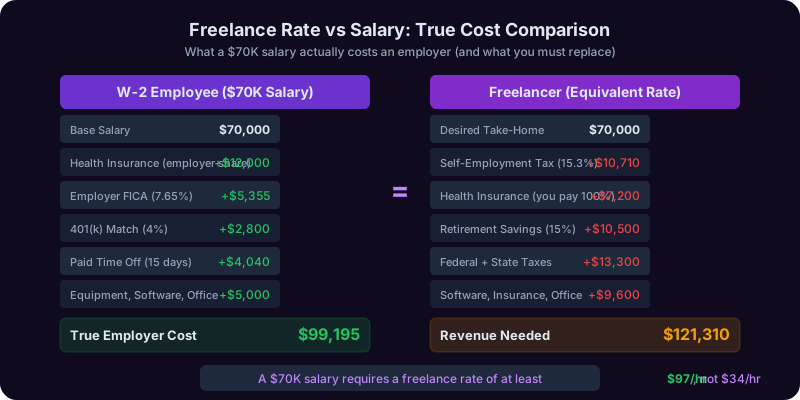
When you add those back, that $70,000 salary actually cost the employer $91,000-$106,000. To replace that total compensation as a freelancer, you need to charge $50-$58/hour at minimum, assuming you work 40 billable hours per week. But you will not work 40 billable hours per week.
The billable hours reality. Freelancers spend significant time on non-billable work: finding clients, writing proposals, invoicing, bookkeeping, professional development, and administrative tasks. The average freelancer bills only 60-70% of their working hours. If you work 40 hours per week but bill 28 of them, your effective hourly rate must be 43% higher than your target take-home rate to compensate. According to a Bureau of Labor Statistics overview of self-employed workers, independent workers face substantially different financial realities than W-2 employees, including bearing all costs for benefits, taxes, and business overhead.
The race-to-the-bottom trap. Many new freelancers undercut the market to win their first clients. This works short-term but creates two problems: you attract price-sensitive clients who will leave the moment they find someone cheaper, and you establish a rate that is difficult to raise. Going from $30/hour to $60/hour requires either firing all your existing clients or having uncomfortable conversations. Starting at $60/hour and occasionally offering a new-client discount is a much better position.
The Freelance Copilot can help you calculate your true minimum viable rate based on your specific expenses, tax obligations, and desired income, so you never accidentally price below your break-even point.
Cost-Based Pricing Method
Cost-based pricing is the foundation. Even if you ultimately price using market or value methods, you need to know your floor: the absolute minimum rate below which you lose money. Here is how to calculate it.
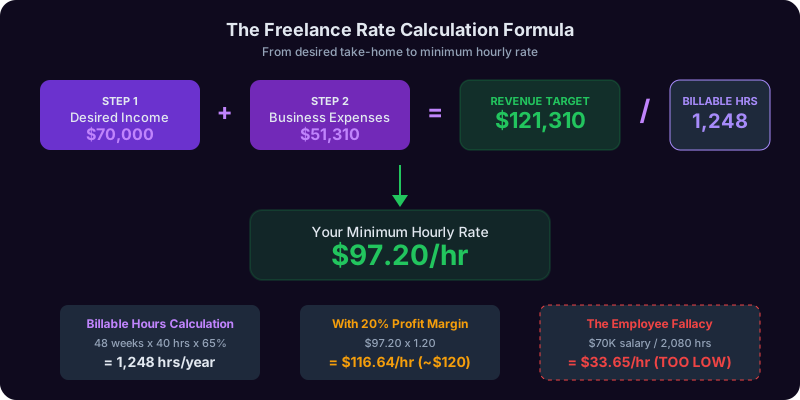
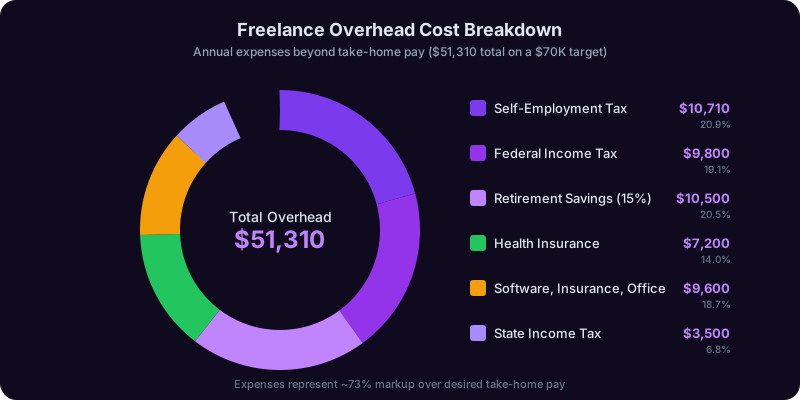
Step 1: Calculate your annual expenses.
| Expense Category | Annual Cost (Example) |
| Health insurance | $7,200 |
| Self-employment tax (15.3%) | $10,710 (on $70,000) |
| Federal income tax (estimated) | $9,800 |
| State income tax (estimated, varies) | $3,500 |
| Retirement savings (15% of income) | $10,500 |
| Software and tools | $2,400 |
| Home office / coworking | $3,000 |
| Professional development | $1,200 |
| Business insurance (E&O/liability) | $1,500 |
| Accounting / legal | $1,500 |
| Total business expenses | $51,310 |
Step 2: Add your desired take-home income. If you want to take home $70,000/year after all business expenses and taxes, your total revenue target is $70,000 + $51,310 = $121,310.
Step 3: Calculate your billable hours. Assume 48 working weeks (4 weeks vacation/sick), 40 hours per week, at 65% billable utilization: 48 x 40 x 0.65 = 1,248 billable hours per year.
Step 4: Divide. $121,310 / 1,248 = $97.20/hour minimum.
That $70,000 salary just became a $97/hour freelance rate. And this is the floor, not the target. This rate assumes full utilization and does not include a profit margin, emergency fund contributions, or income growth.
A more realistic target: Add a 20% profit margin to cover slow months, unexpected expenses, and business growth. $97.20 x 1.20 = $116.64/hour, rounded to $120/hour.
This calculation often surprises freelancers who have been charging $40-$60/hour. The numbers do not lie. If your rate does not cover your expenses, taxes, and desired income, you are subsidizing your clients with your own financial security. Use the Business Finance Copilot to run these numbers with your actual expenses and tax situation.
Market-Based Pricing
Market-based pricing anchors your rate to what other freelancers in your field charge. This method ensures you are competitive while not leaving money on the table.
How to research market rates:
- Freelance platforms: Browse Upwork, Toptal, and Fiverr Pro to see what freelancers with similar experience and skills charge. Filter by top-rated freelancers to avoid the race-to-the-bottom rates.
- Salary data tools: Glassdoor, PayScale, and the Bureau of Labor Statistics Occupational Employment Statistics provide salary data you can convert to freelance rates. Take the median salary, add 40-50% for employer costs, and divide by 1,200-1,400 billable hours.
- Industry surveys: The Freelancers Union annual survey, the Creative Group salary guide, and industry-specific reports (like the Editorial Freelancers Association rate chart) provide direct freelance rate data.
- Peer conversations: Join freelance communities (Slack groups, subreddits, industry forums) and ask about rates. Many experienced freelancers are willing to share ranges.
2026 market rate ranges by experience level:
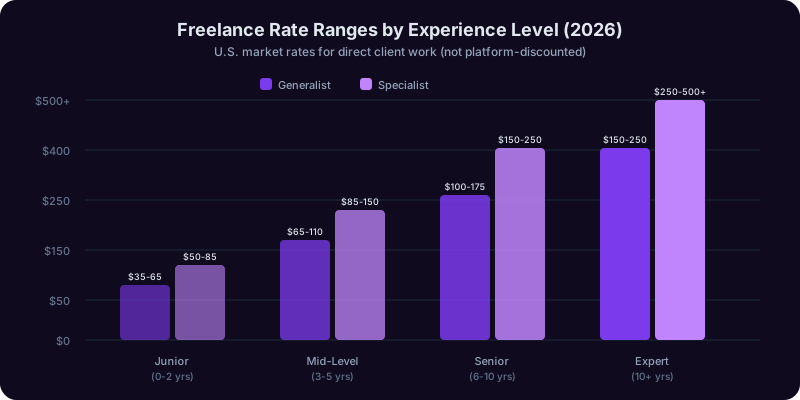
| Experience | Generalist Range | Specialist Range |
| Junior (0-2 years) | $35 - $65/hour | $50 - $85/hour |
| Mid-level (3-5 years) | $65 - $110/hour | $85 - $150/hour |
| Senior (6-10 years) | $100 - $175/hour | $150 - $250/hour |
| Expert (10+ years) | $150 - $250/hour | $250 - $500+/hour |
Where to position yourself: If you are new to freelancing but have several years of industry experience, do not price yourself as a junior freelancer. Your professional experience has value even if your freelancing career is new. A software engineer with 8 years at Google who starts freelancing should price at the senior level, not the junior level.
Geographic considerations: Remote work has flattened rate differences somewhat, but location still matters. Freelancers serving clients in New York, San Francisco, and London can typically charge 30-50% more than those serving clients in smaller markets. Price based on your client's market, not your physical location. If you live in a low-cost area but serve Bay Area startups, charge Bay Area rates.
The key insight with market-based pricing: position yourself in the top third of the market range for your experience level. Clients who hire freelancers in the bottom third are typically the most difficult to work with (scope creep, late payments, constant revisions). Premium clients expect premium rates and are generally better partners.

Get Answers From the Freelance Copilot
Tell the Freelance Copilot your annual income goal, business expenses, desired time off, and industry - get your minimum hourly, project, and retainer rates calculated.
Value-Based Pricing
Value-based pricing is the most profitable approach but requires confidence and business acumen. Instead of charging for your time, you charge based on the value your work creates for the client.
The fundamental shift: A logo design takes you 8 hours. At $100/hour, that is $800. But if that logo is for a company launching a product line expected to generate $2 million in revenue, and the brand identity will be used for the next 10 years across all marketing materials, packaging, and digital presence, is $800 the right price? Value-based pricing says no. The value of that logo to the client is measured in hundreds of thousands of dollars. Charging $5,000-$15,000 is entirely reasonable.
How to implement value-based pricing:
- Understand the client's business outcome. During your discovery call, ask: What is this project meant to achieve? What happens if this does not get done? What would a successful outcome be worth to your business? These questions shift the conversation from cost to value.
- Quantify the impact. If a website redesign is expected to increase conversions by 2%, and the client's current annual revenue through the website is $500,000, that 2% improvement is worth $10,000/year. Charging $8,000 for the redesign is a bargain from the client's perspective because they recoup the cost in less than a year.
- Present your price as an investment. Instead of "this project costs $8,000," say "for an investment of $8,000, you will receive a redesign projected to generate an additional $10,000+ in annual revenue. Most clients see full ROI within 10 months."
- Offer tiered options. Present three packages: Basic ($5,000), Standard ($8,000), and Premium ($12,000). Most clients choose the middle option. The premium option makes the standard look reasonable by comparison (anchoring effect). The basic option ensures you do not lose the project entirely.
As described in a Harvard Business Review analysis of value-based pricing, the key is understanding the customer's willingness to pay based on the perceived benefit, not the cost of production.
When value-based pricing works best:
- The project has a measurable business impact (revenue, cost savings, efficiency gains)
- You have a track record of delivering results (case studies, testimonials)
- The client is a business (not an individual or non-profit with a tight budget)
- The project is unique and custom (not commoditized work)
Value-based pricing does not work for every project. Ongoing retainer work, commoditized tasks, and clients with fixed budgets are often better served by hourly or project rates. The Freelance Copilot can help you determine which pricing model fits each client engagement.
Hourly vs Project vs Retainer Pricing
Each pricing structure has distinct advantages and risks. The best freelancers use all three depending on the engagement.
Hourly pricing charges for time spent. It is the simplest model and works well when scope is uncertain.
| Pros | Cons |
| Fair compensation for scope creep | Penalizes efficiency (faster = less pay) |
| Easy to understand and track | Clients worry about hours being padded |
| Good for ongoing/variable work | Income ceiling limited by hours available |
Best for: consulting, troubleshooting, ongoing development work, projects with unclear scope.
Project pricing charges a flat fee for a defined deliverable. It rewards efficiency and provides predictability for both parties.
| Pros | Cons |
| Rewards efficiency (faster = higher effective rate) | Scope creep risk if boundaries are not clear |
| Clients prefer budget certainty | Underestimation can mean working below your rate |
| Focuses on outcomes, not hours | Requires accurate scope definition upfront |
Best for: website builds, design projects, writing projects, any deliverable with a clear end state. Always define exactly what is included (and what costs extra) in your proposal. A project-priced website build should specify the number of pages, revision rounds, content migration scope, and timeline. For guidance on managing the boundaries of project-based work, see our guide on scope creep at work.
Retainer pricing charges a recurring monthly fee for a set amount of work or availability.
| Pros | Cons |
| Predictable monthly income | Can feel like employment without benefits |
| Deeper client relationships | Clients may expect unlimited availability |
| Reduces sales/marketing time | Opportunity cost if retainer is underpriced |
Best for: ongoing content creation, marketing, development support, and advisory roles. Structure retainers as either a set number of hours per month ("20 hours/month at $120/hour = $2,400/month") or a set deliverable package ("4 blog posts, 12 social media graphics, and 1 newsletter per month for $3,500").
The ideal mix: Most successful freelancers maintain 1-2 retainer clients for baseline income stability and fill remaining capacity with project work at higher effective rates. Hourly work fills gaps. This structure provides both security and upside potential. The Salary Copilot can help you model different pricing structures to find the income mix that meets your financial goals.
Rate Negotiation Scripts
Negotiation is where most freelancers lose money. These scripts handle the most common scenarios. Try our AI salary negotiation guide for step-by-step help.
When a client says "That is too expensive":
"I understand budget is a consideration. Let me ask: what budget range were you working with? If we can adjust the scope to fit your budget, I am happy to explore that. For example, I could [specific reduced scope] for [lower price]. The full package at [original price] includes [specific additional value]. Which approach works better for your needs?"
When a client asks for your rate and you want to anchor high:
"For a project like this, my rate ranges from $X to $Y depending on scope and timeline. Based on what you have described, I would estimate this falls in the $[higher end] range. Once I have a clearer picture of the requirements, I can provide an exact quote. Would it help to schedule a 20-minute call to scope this out?"
When a client wants to negotiate down from your quoted price:
"I appreciate you sharing that. My rate reflects [specific experience, track record, or unique skill]. I can offer a few options: we can reduce the scope to fit a lower budget, we can extend the timeline (which allows me to fit this between other projects), or we can proceed at the quoted rate and I will include [small add-on that costs you little but has perceived value]. Which of those appeals to you?"
When a client asks you to do a "test project" at a reduced rate:
"I am glad you want to ensure we are a good fit. I typically handle that by offering a smaller initial engagement at my standard rate rather than a discounted test. For example, we could start with [one specific deliverable] at $[price]. That gives you a real sample of my work at the quality level you would receive ongoing. If we are both happy, we can discuss a larger engagement from there."
When raising rates with existing clients:
"I wanted to give you advance notice that my rates will be increasing to $[new rate] effective [date 30-60 days out]. This reflects [increased experience, market adjustment, or expanded capabilities]. I value our working relationship and wanted to make sure you have plenty of time to adjust budgets. I am committed to continuing to deliver the quality you expect. Do you have any questions?"
Give existing clients at least 30 days' notice. Most will accept increases of 10-15% without pushback. If you have not raised rates in over a year, you are almost certainly undercharging. Annual rate increases of 5-10% are standard practice for established freelancers.
When to Raise Your Rates
Raising rates is not just about making more money. It is about staying competitive, reflecting your growing expertise, and avoiding burnout from overwork at low margins.
Raise your rates when:
- You are fully booked and turning away work. This is the clearest signal that demand exceeds supply. If every inquiry turns into a project, your rates are too low. You should be closing 30-50% of qualified leads. If you are closing 80-100%, you are underpriced.
- You have not raised rates in 12+ months. Inflation alone (running 3-4% annually in 2025-2026) erodes your purchasing power. A rate that was fair last year is worth less today. Annual increases are standard business practice.
- Your skills have significantly improved. Completing a certification, mastering a new tool, or gaining experience with a high-demand specialty justifies a rate increase. A web developer who learns conversion rate optimization is more valuable than one who only builds websites.
- You feel resentful about your workload. Resentment is a reliable indicator of underpricing. If you dread opening your laptop because the pay does not feel worth the effort, your rate needs to go up.
- Industry rates have increased. Check market rates annually. If the market has moved up 15% and you have stayed flat, you are now priced below your peers for the same quality of work.
How much to raise:
| Scenario | Recommended Increase |
| Annual adjustment (inflation + experience) | 5-10% |
| Fully booked, turning away work | 15-25% |
| New skill or certification | 10-20% |
| Significantly underpriced vs. market | 20-50% (phase in over 2-3 increases) |
| Moving from generalist to specialist | 25-50% |
Strategy for large increases: If you need to raise rates by 40% or more, phase it in. Raise 20% now and another 20% in 6 months. Apply new rates to new clients immediately and phase in increases to existing clients with 30-60 days' notice. Some existing clients will leave, and that is okay. Replacing a $50/hour client with a $70/hour client means you can work fewer hours for the same income, or the same hours for significantly more income.
The portfolio upgrade effect: Higher rates attract better clients, who give you better projects, which improve your portfolio, which attracts even better clients willing to pay even higher rates. This virtuous cycle is the path to a six-figure freelance business.
For guidance on timing and strategy for your specific rate increases, the Business Finance Copilot can model the financial impact and help you plan the transition.
Industry Rate Benchmarks (2026)
These benchmarks represent mid-career freelancers (3-7 years experience) in the United States working with direct clients (not through platforms that take a cut). Platform rates are typically 20-30% lower. Rates vary by specialization, client size, and geographic market.
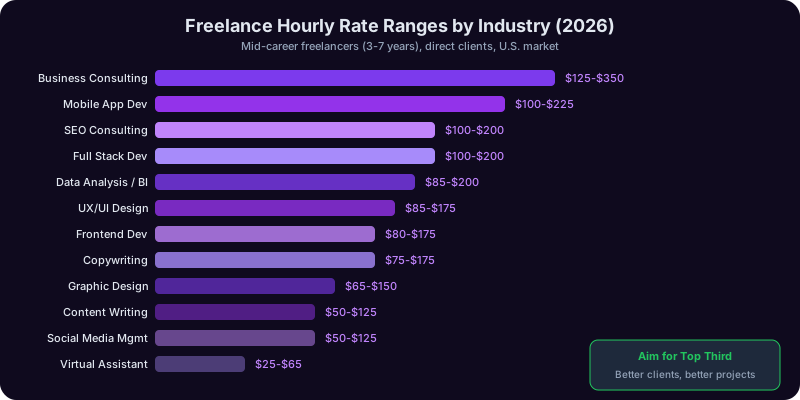
| Industry / Skill | Hourly Range | Project Range (Typical) |
| Web Development (Frontend) | $80 - $175 | $3,000 - $15,000 per site |
| Web Development (Full Stack) | $100 - $200 | $5,000 - $25,000 per site |
| Mobile App Development | $100 - $225 | $10,000 - $50,000 per app |
| Graphic Design | $65 - $150 | $500 - $5,000 per project |
| UX/UI Design | $85 - $175 | $3,000 - $20,000 per project |
| Copywriting | $75 - $175 | $500 - $5,000 per piece |
| Content Writing (Blog/SEO) | $50 - $125 | $200 - $1,500 per article |
| Video Production | $75 - $200 | $1,000 - $10,000 per video |
| Photography | $100 - $300 | $500 - $5,000 per session |
| Social Media Management | $50 - $125 | $1,500 - $5,000/month retainer |
| SEO Consulting | $100 - $200 | $2,000 - $10,000/month retainer |
| Business Consulting | $125 - $350 | $5,000 - $25,000 per engagement |
| Accounting / Bookkeeping | $60 - $150 | $500 - $3,000/month retainer |
| Virtual Assistant | $25 - $65 | $800 - $2,500/month retainer |
| Data Analysis / BI | $85 - $200 | $3,000 - $15,000 per project |
How to use these benchmarks: Find your industry and experience level. If your current rate falls below the range, you are likely undercharging. If you are within the range, your next goal is to move toward the upper end through specialization, better positioning, and case studies that demonstrate results.
Factors that push you toward the top of the range:
- Deep specialization (e.g., "Shopify developer for DTC brands" vs. "web developer")
- Proven ROI and case studies with real numbers
- Strong personal brand and inbound leads
- Enterprise or funded startup client base
- Niche industry expertise (healthcare, fintech, legal)
Factors that keep you at the bottom of the range:
- Generalist positioning with no clear specialty
- Competing primarily on platforms (Upwork, Fiverr) against global talent
- No portfolio, testimonials, or case studies
- Serving small businesses and solopreneurs exclusively
Your rate is not just a number. It is a signal to the market about the quality of work you deliver. The Freelance Copilot can help you identify the right niche and positioning strategy to move toward the top of your industry's rate range.
For more on this topic, read our guide on Fired vs Laid Off vs Let Go: Your Rights and Next Steps Explained.
See our real-world walkthrough: fired without warning.
Frequently Asked Questions
Recommended Copilots
Recommended Copilots
Get a complete freelance rate calculation based on your expenses, goals, and market
Try Free →Benchmark your freelance rate against full-time equivalent compensation
Try Free →Build a financial plan that accounts for freelance income variability
Try Free →Continue Exploring
Related Scenarios
For You
Related Articles
Get Answers From the Freelance Copilot
Tell the Freelance Copilot your annual income goal, business expenses, desired time off, and industry - get your minimum hourly, project, and retainer rates calculated.