
LLC vs S-Corp: They Are Not Even the Same Type of Thing
The single biggest source of confusion in small business tax planning is treating LLC and S-Corp as competing legal structures. They are not. An LLC is a legal entity formed at the state level that gives you liability protection and operational flexibility. An S-Corp is a federal tax election you make with the IRS that changes how your business income is taxed. You do not choose one or the other in the way most people imagine. In almost every realistic scenario, you form an LLC at the state level and then optionally elect S-Corp tax treatment by filing Form 2553 with the IRS.
Tax disclaimer: This article walks through general tax math and rules current as of 2026 to help you understand the trade-offs. Tax situations are deeply personal and state-dependent. Before filing Form 2553 or making any structural change, consult a licensed CPA or tax attorney who can review your specific facts.
How the IRS Sees Each Structure
By default, a single-member LLC is treated as a disregarded entity, meaning the IRS taxes you as if the LLC did not exist. All profit flows to your personal return on Schedule C, and you pay both federal income tax and 15.3% self-employment (SE) tax on every dollar of net profit. A multi-member LLC is taxed as a partnership by default, with similar SE tax exposure on the active members' share of profit.
When you file Form 2553 and your LLC is accepted as an S-Corp, the IRS now treats the business as a pass-through corporation. You become an employee of your own business, the business pays you a W-2 salary, and any remaining profit comes out as a distribution that is not subject to self-employment or payroll taxes. Income tax still applies to both the salary and the distribution, but the FICA/SE layer is removed from the distribution portion. That is the entire mechanism behind S-Corp tax savings.
Disambiguating C-Corp From the Conversation
A C-Corp is a different animal entirely. C-Corps pay a flat 21% corporate income tax on profits, then shareholders pay personal tax on dividends. This is the classic "double taxation" structure. C-Corps make sense for venture-backed startups, businesses that want to retain large amounts of capital inside the company, or owners who want to offer a meaningful equity program. For solo freelancers and most small service businesses, C-Corp is almost always the wrong answer because the double taxation eats any benefit you would get from the 21% rate. This guide focuses on the LLC default vs. S-Corp election decision, which is the choice that actually matters for the 25 million Americans currently running a small business as a sole proprietor or LLC.
What an LLC Gives You Regardless of Tax Election
The legal benefits of the LLC do not change when you elect S-Corp. You keep the personal liability protection, the operating agreement flexibility, the state-level recognition, and the ability to add members later. The S-Corp election is purely a layer on top of the LLC that changes federal tax treatment. This means you do not need to dissolve your LLC and form a new corporation to access S-Corp tax benefits. You simply file Form 2553 and continue operating the same business under the same EIN and same state registration. Many founders we have spoken with delayed their election by a year or two because they thought they needed a major restructuring. They did not.
For the foundational comparison of LLC against operating as a sole proprietor with no entity at all, see our LLC vs sole proprietorship comparison. If you are still in the side hustle phase and have not formed an entity yet, also read our side hustle taxes guide before deciding whether to incorporate.
The Self-Employment Tax Math: Where the Real Savings Come From
To understand S-Corp savings, you have to internalize one number: 15.3%. That is the combined Social Security (12.4% on wages up to the 2026 base of $176,100) and Medicare (2.9% on all wages, plus an additional 0.9% Medicare surtax above $200K single / $250K married) tax that applies to every dollar of self-employment income. For an LLC taxed as a sole proprietorship or partnership, this tax applies to your entire net profit. For an S-Corp, it only applies to the W-2 salary portion you pay yourself. Everything else comes out as a distribution that bypasses SE tax entirely.
Let us run the numbers at three realistic profit levels.
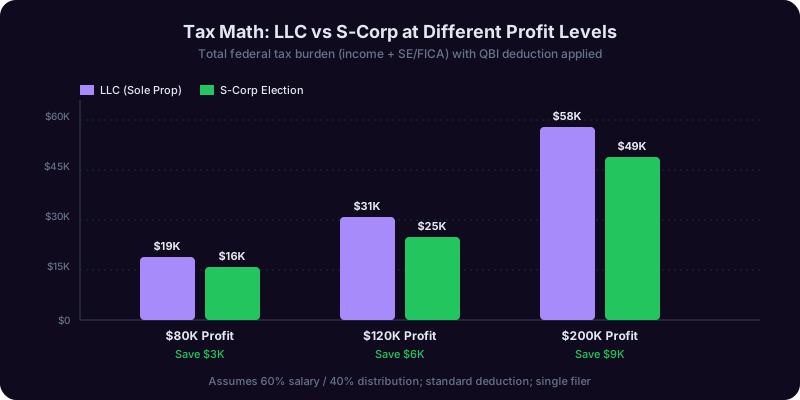
Worked Example: $80,000 Annual Profit
Assume you are a single freelancer with $80,000 in net business profit, no other income, and you operate in a state with average tax burden.
- Default LLC (Schedule C): Your full $80,000 is subject to SE tax. You pay 15.3% on roughly 92.35% of net earnings (the SE tax adjustment), which works out to about $11,304 in SE tax. You also pay federal income tax on roughly $74,348 after the SE tax deduction and standard deduction, landing at roughly $9,200 in federal income tax. Total federal tax burden: ~$20,504.
- S-Corp election: Suppose you pay yourself a $45,000 reasonable salary and take $35,000 as distribution. SE/payroll tax applies only to the $45,000, costing about $6,885 in combined employer and employee FICA. Income tax applies to the full $80,000 (less deductions), landing at roughly $8,800. Total federal tax burden: ~$15,685.
- Savings: ~$4,800 per year, before subtracting S-Corp compliance costs.
Worked Example: $120,000 Annual Profit
- Default LLC: SE tax on $120K profit lands around $16,956. Federal income tax on the remaining base after SE deduction and standard deduction is roughly $17,500. Total federal: ~$34,456.
- S-Corp: Reasonable salary of $65,000, distribution of $55,000. Payroll tax on salary is about $9,945. Federal income tax is roughly $16,800. Total federal: ~$26,745.
- Savings: ~$7,700 per year, before compliance costs.
Worked Example: $200,000 Annual Profit
- Default LLC: SE tax effectively caps the Social Security portion at the wage base ($176,100), so SE tax lands around $26,400 including the uncapped Medicare and surtax components. Federal income tax adds roughly $34,000. Total federal: ~$60,400.
- S-Corp: Reasonable salary of $95,000, distribution of $105,000. Payroll tax is about $14,535. Federal income tax is roughly $33,500. Total federal: ~$48,035.
- Savings: ~$12,300 per year, before compliance costs.
Notice the pattern. The savings scale roughly linearly with the gap between your reasonable salary and your total profit. At $80K, the savings barely cover the compliance costs we will discuss in section 4. At $120K, you are clearly ahead. At $200K, the savings are substantial enough that not electing S-Corp would be a meaningful annual loss.
Why the Distribution Portion Avoids SE Tax
This is not a loophole. It is the explicit design of subchapter S of the tax code. The IRS treats S-Corp shareholders as both employees (paid via W-2) and investors (paid via distributions). FICA applies to the employee portion because that is compensation for labor. Distributions are treated as return on capital, similar to dividends from a public company, and capital returns do not generate Social Security or Medicare obligations. The catch, which we cover in the next section, is that the IRS requires the salary portion to be "reasonable" for the work you actually perform. Pay yourself too little and the IRS can reclassify the distributions as wages, triggering back taxes, interest, and penalties.
The Reasonable Compensation Rule: Where S-Corp Owners Get Audited
The reasonable compensation requirement is the single most important S-Corp rule and the area where the IRS focuses the majority of its S-Corp audit attention. The rule is straightforward in principle: as an owner-employee of an S-Corp, the salary you pay yourself must reflect the fair market value of the services you perform for the business. The temptation, obviously, is to pay yourself a tiny salary and take everything else as distribution to maximize SE tax savings. The IRS knows this temptation exists and has built decades of case law around shutting it down.
How the IRS Defines Reasonable
The IRS does not publish a fixed formula. Instead, it relies on a multi-factor test established through cases like Watson v. Commissioner (2012), where an accountant paying himself $24K on $375K of S-Corp profit was forced to reclassify $67,000 as additional wages. The factors the IRS and courts weigh include:
- Training, experience, and credentials of the owner-employee
- Duties and responsibilities performed
- Time and effort devoted to the business
- What comparable businesses pay for similar services
- The business's gross and net revenues
- Distributions to other shareholders, if any
- Use of a formula for compensation (e.g., industry-standard percentage of revenue)
How to Calculate Your Reasonable Salary
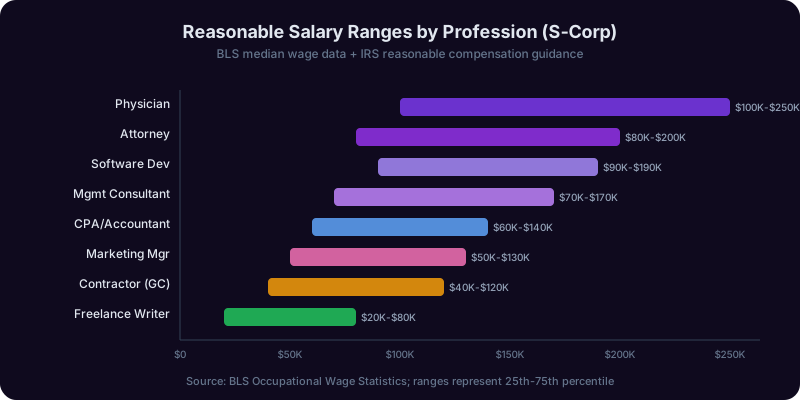
The most defensible approach combines three data sources. First, pull the relevant Standard Occupational Classification (SOC) wage data from the BLS Occupational Employment and Wage Statistics. Find your occupation, look at the median wage for your metro area, and use that as a baseline. Second, cross-reference industry-specific salary surveys (RCReports, Salary.com, Glassdoor, or trade association data) for the same role and experience level. Third, document the percentage of your time spent on the role and any duties you do not perform that a salaried employee would (e.g., if you only spend 50% of your time on billable consulting and 50% on business development, your salary should reflect the blended role).
Typical Salary Ranges by Profession (2026 Estimates)
- Software developer (solo consultant): $95K to $145K depending on metro and specialty
- Marketing consultant: $65K to $110K
- Accountant or bookkeeper: $55K to $95K
- Attorney (solo practice): $90K to $160K
- Real estate agent (high producer): $50K to $90K plus commission structure
- Therapist or licensed counselor: $55K to $85K
- Graphic designer: $50K to $80K
- Personal trainer or coach: $40K to $65K
The 60/40 Heuristic and Why You Should Be Careful With It
You will see many forum posts and even some CPAs suggest a "60% salary, 40% distribution" or "reasonable salary equals 50% of profit" rule of thumb. These heuristics are dangerous if used in isolation. They are defensible when your reasonable salary based on BLS data lands at or below those ratios. They are indefensible when the heuristic produces a salary far below what someone with your credentials and duties would earn in a comparable W-2 role. A surgeon making $600K of S-Corp profit cannot pay themselves $60K and claim 90% as distribution. A surgeon's reasonable salary is several hundred thousand dollars by any defensible benchmark.
What Happens If You Get It Wrong
If the IRS audits and concludes your salary was unreasonably low, the consequences are layered. They reclassify the underpaid portion as wages, you owe the back FICA on the reclassified amount (both employer and employee shares), they assess failure-to-deposit penalties, and they assess interest. In severe cases they can assess additional accuracy-related penalties of 20%. The net effect of getting it wrong is often paying more than you would have saved over the years the underpayment occurred. Document your reasonable compensation analysis annually, ideally with a third-party report from RCReports or your CPA, and keep the documentation with your tax records.

Get Answers From the Tax Copilot
Tell the Tax Copilot your profit, state, and profession and get a personalized LLC vs S-Corp comparison with state-specific tax math, reasonable compensation estimates, QBI deduction modeling, and break-even analysis. Bring the structured output to your CPA for final review.
The Real Costs of Running an S-Corp
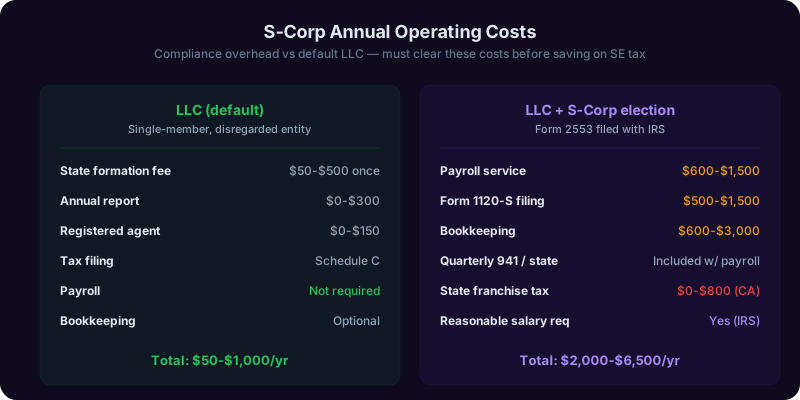
The SE tax savings are real, but so are the compliance costs. Before electing, you need a clear-eyed view of what S-Corp status actually costs you in additional fees, time, and complexity. Many small business owners elect S-Corp too early, then discover the compliance costs eat most or all of the SE tax savings.
1. Payroll Service: $600 to $1,500 per Year
S-Corps must run actual payroll. You cannot just transfer money to yourself and call it salary. You need W-2s, payroll tax deposits (federal income tax withholding, Social Security, Medicare, and state withholding), quarterly Form 941 filings, annual Form 940 (FUTA), state unemployment filings, and a W-2/W-3 issued to yourself at year-end. Running this yourself is legally possible but error-prone. Most S-Corp owners use Gusto ($40/mo for one employee), QuickBooks Payroll ($45-$80/mo), or OnPay ($40/mo plus $6/employee), landing at roughly $600 to $1,000 per year for a single-employee setup. Add a state-specific payroll filing service if your state is complex, and the number can creep to $1,500.
2. Separate Tax Return (Form 1120-S): $800 to $2,500 per Year
S-Corps file Form 1120-S at the federal level (due March 15, not April 15) and a corresponding state corporate return. The corporation issues a Schedule K-1 to each shareholder, which the shareholder reports on their personal Form 1040. The complexity of Form 1120-S is significantly higher than Schedule C, and most owners hire a CPA or enrolled agent to prepare it. Typical fees range from $800 to $1,500 for simple single-shareholder S-Corps, climbing to $2,500+ if you have multiple states, depreciation schedules, accountable plan reimbursements, or anything beyond a clean cash-basis service business.
3. Bookkeeping: $150 to $500 per Month
S-Corps require cleaner books than sole proprietorships because the corporation is a distinct legal entity with its own balance sheet. You need actual accrual-or-cash-basis bookkeeping that produces a balance sheet for the 1120-S Schedule L (required once gross receipts exceed $250K or total assets exceed $250K). Many freelancers operating as Schedule C sole proprietors get away with a spreadsheet and shoebox of receipts. S-Corp owners cannot. Expect to spend $150-$500/month on QuickBooks Online plus either DIY time or a bookkeeper. AI bookkeeping tools have made this dramatically cheaper than it used to be; our AI bookkeeping guide walks through specific tools that can keep your S-Corp books clean for under $100/month if you are comfortable with a hybrid AI-plus-human-review model.
4. State Franchise Taxes and Fees
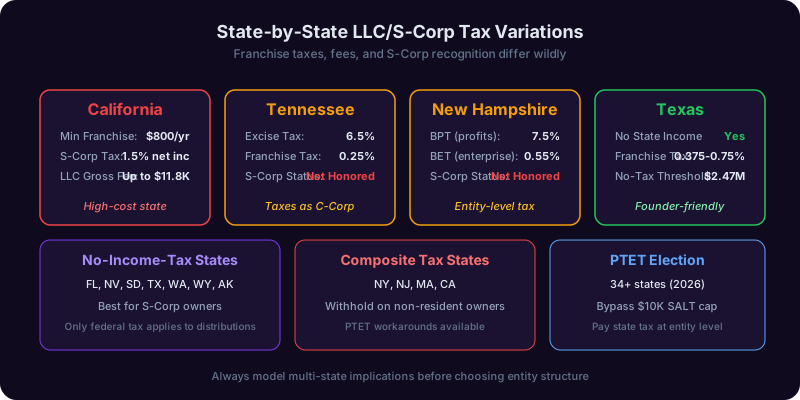
This is the most overlooked cost and the one that surprises people most after election. State treatment of S-Corps varies wildly:
- California: $800 minimum franchise tax annually plus a 1.5% S-Corp tax on net income. A $150K profit S-Corp pays $2,250 just in state-level S-Corp tax that a Schedule C sole prop would not owe.
- New York: Annual MTA filing, NYC general corporation tax for NYC businesses, and state-level S-Corp tax depending on receipts.
- Tennessee: Excise tax of 6.5% of net earnings plus franchise tax of $0.25 per $100 of net worth.
- Texas, Florida, Nevada, Wyoming, South Dakota, Washington: No state income tax, minimal additional burden.
- Illinois: 1.5% personal property replacement tax on S-Corp income.
Before electing, model your state's specific S-Corp treatment. In high-tax states like California, the state-level cost can swallow 30-50% of your federal SE tax savings.
5. Lost Flexibility and Hidden Costs
S-Corp status restricts who can own the business (no foreign owners, no corporate or partnership shareholders, no more than 100 shareholders, only one class of stock). It limits retirement plan choices in some scenarios. It complicates business loan applications because lenders now look at both the corporate and personal returns. It makes future business sales more complex because you cannot easily convert back to a partnership-taxed LLC without triggering tax consequences. None of these are deal-breakers for most freelancers, but they are real constraints to weigh against the savings.
Total Realistic Cost
For a typical solo S-Corp owner outside of high-cost states, plan on $2,000 to $4,500 per year in additional compliance costs beyond what you would spend as a Schedule C filer. For high-tax states, add another $1,000 to $3,000. This is the number you subtract from your SE tax savings to determine the actual benefit.
The Break-Even Threshold: At What Income Does S-Corp Pay Off?
Now we combine the two halves. SE tax savings minus compliance costs equals net benefit. The income level at which net benefit turns positive is your break-even threshold. The honest answer is that it varies by state, profession, and reasonable salary, but we can build a reliable table.
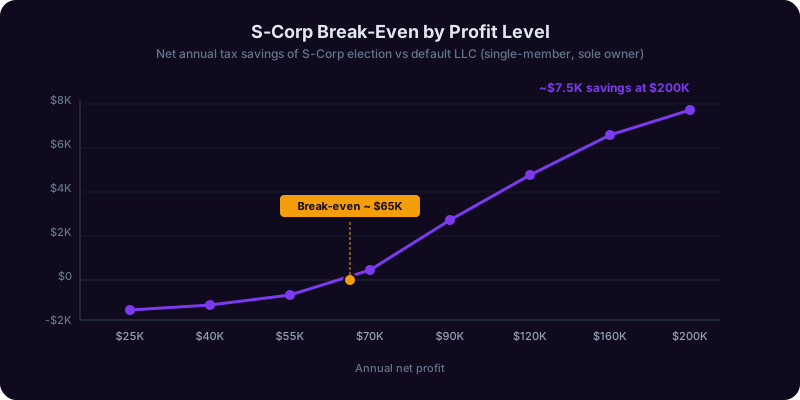
Break-Even Table (2026)
Assumptions: single owner-employee, no other income, reasonable salary set at 50-60% of profit (defensible for most professional service businesses), compliance costs of $3,000/year in low-tax states and $4,500/year in high-tax states.
| Annual Profit | SE Tax Savings (Gross) | Net Benefit (Low-Tax State) | Net Benefit (High-Tax State) |
|---|---|---|---|
| $50,000 | ~$2,300 | -$700 (lose money) | -$2,200 (lose money) |
| $80,000 | ~$4,800 | +$1,800 | +$300 (break even) |
| $120,000 | ~$7,700 | +$4,700 | +$3,200 |
| $200,000 | ~$12,300 | +$9,300 | +$7,800 |
| $350,000 | ~$18,000 | +$15,000 | +$13,500 |
The Practical Break-Even Range
In low-tax states (Texas, Florida, Nevada, Wyoming, Tennessee, Washington, South Dakota), S-Corp election generally turns profitable around $60K-$70K of net business profit. In medium-tax states, the threshold sits around $75K-$85K. In high-tax states like California, the threshold pushes to $85K-$100K because of the 1.5% state S-Corp tax and minimum franchise fee.
Why You Should Build in a Safety Margin
Most CPAs we work with suggest a buffer of about $20K above your calculated break-even before pulling the trigger on S-Corp election. The reasoning is straightforward: business income fluctuates, compliance costs are fixed, and switching back is messy. If your profit is volatile and could drop below break-even in a slow year, you will be locked into paying the compliance costs anyway because you cannot easily revoke S-Corp status mid-year. Many owners who elected during a peak year and then had a slow year ended up paying more in compliance than they saved. Wait until you have at least one full year of profit clearly above break-even and a forecast that suggests it will continue.
The Front-Loading Problem
S-Corp savings also assume you actually pay yourself less than your full profit as salary. If you need every dollar of business profit to cover living expenses, you will likely set salary close to total profit, leaving little distribution to save SE tax on. The S-Corp benefit is largest when your business profit meaningfully exceeds what you need to live on, so distributions can stay inside the corporation or come out as a lower-tax return on capital. Freelancers living paycheck to paycheck off their business often see smaller actual savings than the headline numbers suggest. Our freelancer tax deductions guide covers the deduction strategies that often produce more annual savings than S-Corp election for owners in the $50K-$80K range.
The QBI Deduction and How OBBBA 2026 Changed the Math
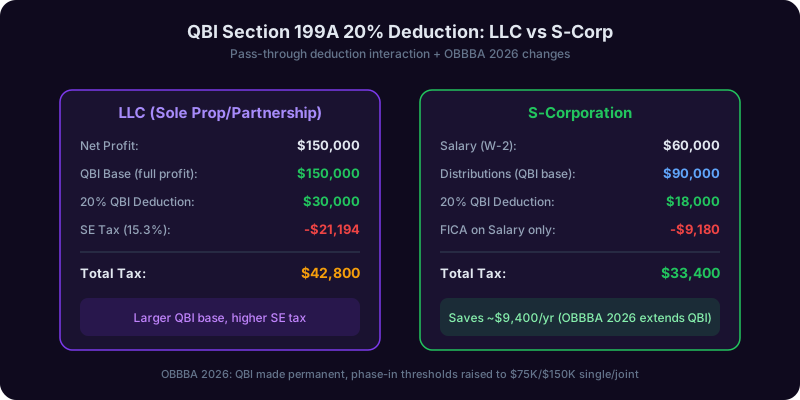
The Section 199A Qualified Business Income (QBI) deduction is the single biggest variable that complicates the LLC vs S-Corp decision. Introduced by the Tax Cuts and Jobs Act of 2017 and made permanent by the One Big Beautiful Bill Act (OBBBA) of 2026, QBI lets eligible pass-through business owners deduct up to 20% of their qualified business income on their personal return. This deduction interacts with S-Corp election in ways that can either amplify or partially offset your SE tax savings.
How QBI Works in the LLC Default Scenario
If you operate as a default LLC (Schedule C or partnership-taxed multi-member), your QBI is your full net business profit, less the deductible portion of your SE tax and self-employed retirement contributions. You then deduct up to 20% of that QBI from your taxable income, subject to the income limits below. For a $120K profit single freelancer, QBI is roughly $111,500 after the SE tax adjustment, producing a deduction of about $22,300. At a 22% marginal rate, that is roughly $4,900 of additional federal tax savings on top of standard deductions.
How QBI Works in the S-Corp Scenario
For an S-Corp, QBI excludes the W-2 wages paid to the owner. So if you take a $65K salary and have $55K of distribution on a $120K profit business, your QBI is only the $55K distribution side (less any 199A adjustments). At 20%, that produces an $11,000 deduction, worth roughly $2,420 at a 22% rate. Compared to the $4,900 you would have gotten as a default LLC, electing S-Corp costs you about $2,480 in lost QBI deduction.
This is the most under-appreciated wrinkle in S-Corp planning. Your SE tax savings need to exceed your lost QBI deduction plus your compliance costs for S-Corp to pay off. At $120K profit, the SE savings of $7,700 minus the lost QBI of $2,480 minus compliance of $3,000 leaves roughly $2,220 of net benefit. That is still positive, but materially smaller than the SE tax savings alone would suggest.
Income Phase-Outs and SSTB Rules
QBI phases out for higher earners in "specified service trades or businesses" (SSTBs), which include law, accounting, health, consulting, athletics, performing arts, financial services, and any trade where the principal asset is the reputation or skill of the owner. For 2026, the QBI deduction begins phasing out at approximately $241,950 taxable income for single filers and $483,900 for joint filers, with full phase-out roughly $50K and $100K above those thresholds respectively. Once you are fully phased out of QBI for SSTB income, the math flips. S-Corp election becomes significantly more attractive because you are not losing a deduction you would not have gotten anyway.
For non-SSTB businesses (e.g., manufacturing, retail, real estate operations, tech product companies), QBI remains available above the SSTB phase-out but is then limited by the greater of 50% of W-2 wages paid or 25% of W-2 wages plus 2.5% of unadjusted basis of qualified property. Counter-intuitively, this wage-based limit means that for high-income non-SSTB businesses, paying yourself a higher W-2 salary through an S-Corp can preserve QBI eligibility that would otherwise be lost. This is a complete reversal of the SE tax incentive and one of the most nuanced areas of small business tax planning.
OBBBA 2026 Changes That Matter
The OBBBA legislation made QBI permanent (it was scheduled to sunset at end of 2025) and adjusted the phase-out thresholds for inflation indexing. It also clarified treatment of certain pass-through entities and tightened anti-abuse rules around "crack-and-pack" structures that artificially split SSTB and non-SSTB activities. For our complete breakdown of how OBBBA affects small business taxes, see our 2026 OBBBA tax changes guide.
The Bottom Line on QBI Plus S-Corp
For most freelancers in the $80K-$240K profit range, QBI partially offsets S-Corp savings but does not eliminate them. For SSTB businesses approaching or above the phase-out thresholds, S-Corp election remains valuable. For non-SSTB businesses above the phase-out, S-Corp can actually increase QBI eligibility through the wage limit. Model both scenarios with your specific numbers before electing.
When NOT to Elect S-Corp Even If the Math Looks Good
There are several situations where S-Corp election is the wrong move even when the SE tax math suggests savings. Recognizing these scenarios up front saves you from a costly mistake.
1. You Live in a Very High-Tax State With Hostile S-Corp Treatment
California's 1.5% S-Corp tax plus $800 minimum franchise fee, Tennessee's excise and franchise taxes, and Illinois's 1.5% personal property replacement tax can all individually swallow 30-60% of your federal SE tax savings. New York City's general corporation tax adds another layer if you operate from NYC. In states where the state-level S-Corp cost is severe, you may need profits well above $150K for the election to net out positive. Always model your state's specific treatment before electing.
2. You Plan to Invest Profits in Real Estate or Hold Appreciating Assets
Real estate held inside an S-Corp creates serious tax problems on the eventual sale or distribution. Unlike partnerships and LLCs taxed as partnerships, S-Corps cannot distribute appreciated property to shareholders without recognizing gain. If you plan to use business profits to buy rental real estate, hold long-term equipment that will appreciate, or eventually distribute property to yourself, S-Corp is the wrong structure. Use a partnership-taxed LLC for the holding entity and only S-Corp the operating side, if anything.
3. You Own Multiple Active Businesses
S-Corp election creates W-2 wage requirements at each business where you are active. If you own three S-Corps and work in all of them, each must pay you reasonable W-2 compensation. This means three payroll systems, three sets of 941 filings, three 1120-S returns, and three separate reasonable compensation analyses. Many multi-business owners find that consolidating into a single LLC holding company with default partnership taxation is dramatically simpler and often cheaper. The exception is when one specific business is highly profitable and the others are small or break-even, in which case selectively electing S-Corp on the high-profit entity makes sense.
4. You Want to Use Passive Activity Losses From the Business
If your business is going to generate losses in early years that you want to deduct against other active or passive income, S-Corp election can complicate or limit your ability to use those losses. S-Corp losses pass through to shareholders only to the extent of basis, and the rules for basis tracking are stricter than partnership basis rules. Default LLC taxation often provides more flexibility for using early-stage losses, especially if you have other taxable income to absorb them.
5. Your Business Is Pre-Profitable or Highly Volatile
If you are not yet consistently profitable, the fixed compliance costs of S-Corp election will eat any savings in lean years. Wait until you have at least one full year clearly above your state's break-even threshold and a reasonable forecast for the next year. The IRS allows revocation of S-Corp status, but you generally cannot re-elect for five years after revoking. This makes the decision more permanent than people realize. Better to wait an extra year than to elect, revoke, and lock yourself out of S-Corp benefits for half a decade.
6. You Plan to Bring in Investors or Add Non-Standard Ownership Soon
S-Corps cannot have foreign owners, more than 100 shareholders, partnership or corporate shareholders, or multiple classes of stock. If your roadmap includes raising from a venture fund (an LLC or LP), bringing in an international co-founder, issuing preferred stock, or stock options with different liquidation preferences, S-Corp will block all of those moves. You would need to convert to a C-Corp or revoke S-Corp status, both of which carry tax consequences. Founders planning a fundraise are usually better off staying in default LLC status (or converting to Delaware C-Corp directly).
7. You Want Maximum Retirement Plan Flexibility
S-Corps allow Solo 401(k)s, SEP-IRAs, and SIMPLE IRAs, but the contribution math is based on W-2 wages rather than total net earnings. For a default LLC, retirement contributions are based on net earnings from self-employment, which often produces a higher contribution ceiling. For high earners specifically focused on maximizing tax-advantaged retirement contributions, the LLC default can outperform S-Corp on this single dimension. Run the retirement contribution numbers as part of your overall comparison.
The Honest Summary
S-Corp election is a powerful tool but it is not a default optimization. It works best for owner-operators of profitable, stable service businesses in moderate-to-low tax states with clear separation between business activity and personal investment plans. If any of the seven scenarios above describe your situation, the conventional S-Corp advice may not apply to you.
How to Make the Election and Model It With AI
If you have run the numbers, accounted for your state, considered QBI, and concluded S-Corp election makes sense, the actual filing process is straightforward. Here is how to make it happen, plus how to use AI to pressure-test your decision before you commit.
Tax disclaimer: The steps below describe the general process for filing Form 2553 and electing S-Corp status. Your specific situation may involve state-level filings, late election relief, or basis tracking issues that this article does not address. Consult a CPA before filing.
The Form 2553 Filing Process
- Confirm eligibility. Your LLC must have a valid EIN, U.S.-based ownership only, no more than 100 shareholders, and only individuals, certain trusts, or estates as owners. All shareholders must consent to the election in writing.
- Choose your effective date. You can elect S-Corp status effective for the current tax year if you file within 2 months and 15 days of the start of the tax year (so by March 15 for a calendar-year business). After that, the election typically takes effect for the following tax year.
- Complete Form 2553. Download the current version from IRS.gov Form 2553. The form requires basic business info, your fiscal year choice (almost always calendar year for new elections), and signatures from all shareholders.
- Mail or fax to the IRS. Form 2553 cannot be e-filed. Mail it to the IRS service center listed in the form instructions for your state, or fax it. Use certified mail with return receipt so you have proof of timely filing.
- Wait for confirmation. The IRS typically responds within 60 days with either acceptance (CP261 notice) or a request for additional information. Keep the acceptance letter permanently with your tax records.
- Set up payroll immediately. Your effective date triggers W-2 obligations. Sign up for a payroll service before your first payroll period to avoid missed deposit penalties.
- File state-level S-Corp election if required. Some states (e.g., New York, New Jersey, Arkansas) require a separate state-level S-Corp election in addition to the federal Form 2553. Others automatically follow the federal election. Check your state's specific rules via SBA.gov or your state's department of revenue.
Late Election Relief
If you miss the March 15 deadline, do not assume you have to wait until next year. Revenue Procedure 2013-30 provides late election relief for entities that intended to be S-Corps from a specific date but failed to file Form 2553 on time. You can request relief by filing Form 2553 with "FILED PURSUANT TO REV. PROC. 2013-30" written across the top, along with a reasonable cause statement explaining the delay. The IRS routinely grants this relief for solo owner-operators, particularly when filed within 3 years and 75 days of the intended effective date.
Using Copilotly's Tax Copilot to Model Your Specific Scenario
Generic articles and calculators only get you so far because your decision depends on at least 12 variables: profit level, state of operation, profession (which drives reasonable compensation), filing status, other household income, retirement contribution plans, real estate plans, business growth trajectory, fluctuation tolerance, and three or four others. Modeling all of these by hand is tedious and error-prone.
The Tax Copilot is built to run this scenario modeling for you. You describe your business in plain English, share your actual or projected profit, and the copilot walks through both the default LLC and S-Corp scenarios with state-specific numbers, reasonable compensation estimates based on your profession and metro area, QBI interaction effects, and a year-over-year sensitivity analysis showing what happens if your profit drops or grows. It is not a replacement for a CPA, but it gets you to a high-confidence decision in 20 minutes rather than three hours, and it gives you a structured document to bring to your CPA for final review.
For broader tax planning beyond the entity decision, see our freelancer tax deductions list, our side hustle taxes guide, and our AI small business bookkeeping guide. The combination of optimal entity structure, full deduction capture, and clean books is what produces the lowest sustainable tax bill year after year.
One Final Caution
The S-Corp election is one of the most discussed and most over-prescribed tax strategies in the freelancer community. It is genuinely valuable when the math works. It is genuinely harmful when applied to businesses that do not meet the criteria. Run the actual numbers for your actual situation, account for your actual state, model the QBI interaction, and have a CPA review your conclusion before filing. The Tax Copilot can do the modeling. The decision should be yours, made with full information.
Frequently Asked Questions
Recommended Copilots
Recommended Copilots
Model your specific LLC vs S-Corp scenario with state-aware tax math, reasonable compensation estimates, and QBI interaction analysis in plain English
Try Free →Plan the broader operational changes that come with S-Corp election including payroll setup, bookkeeping upgrades, and compliance calendar
Try Free →Project how S-Corp savings interact with your retirement contribution strategy, household budget, and long-term financial goals
Try Free →Decide whether to structure your freelance work as a sole proprietor, LLC, or S-Corp based on income trajectory and career plans
Try Free →Related Articles
Get Answers From the Tax Copilot
Tell the Tax Copilot your profit, state, and profession and get a personalized LLC vs S-Corp comparison with state-specific tax math, reasonable compensation estimates, QBI deduction modeling, and break-even analysis. Bring the structured output to your CPA for final review.