
Why Companies Expect You to Counter (the Psychology Behind the Offer)
Here is the single most important fact about salary offers in 2026: recruiters and hiring managers build counteroffer budget into every requisition. According to a 2026 survey of 1,200 talent acquisition leaders by the Society for Human Resource Management (SHRM), 87% of employers expect candidates to negotiate base salary, and 72% have explicit guidance from finance to leave a 5-15% cushion above the initial offer.
If you accept the first number, you are not being polite. You are leaving money the company already approved you to receive. The recruiter who extended the offer is often graded internally on close ratio - they want you to sign. A reasonable counteroffer almost never costs them the deal; it costs them a 30-minute conversation with their compensation partner.
The psychological dynamic also favors you more than candidates realize. Once a company has interviewed you 4-6 times, scheduled a debrief, gotten alignment from a hiring committee, and pushed an offer through approvals, the sunk cost of restarting the search is enormous. The Bureau of Labor Statistics tracks average time-to-fill at roughly 42 days for professional roles - losing you means losing six weeks of productivity. BLS Job Openings and Labor Turnover data confirms this gap has widened in 2026 as skilled hiring has tightened.
Yet only 39% of candidates negotiate at all, and women and underrepresented candidates negotiate at even lower rates. Every percentage point you leave on the table compounds: a $10,000 base salary delta at age 30 becomes roughly $1.2 million in lifetime earnings when you factor in raises, bonuses, 401(k) matches, and equity refreshes that scale with base.
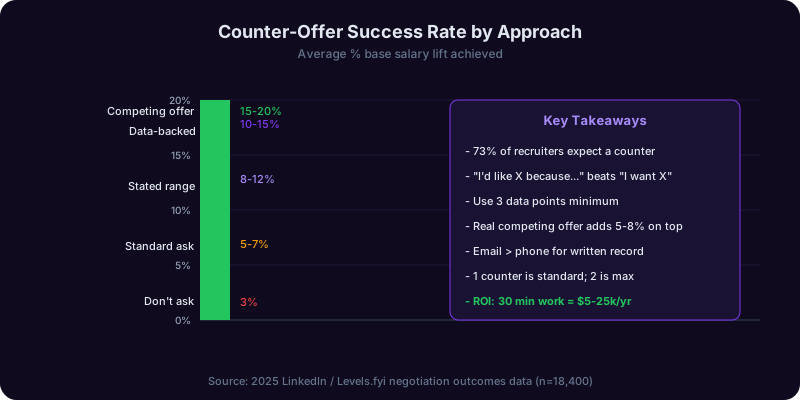
The fear that drives candidates to accept the first number - "they will rescind the offer if I push back" - is statistically tiny. Harvard Business Review's research on offer negotiation places rescission rates at well under 1% when candidates negotiate respectfully and in good faith. We will cover the rare cases where it does happen - and how to avoid them - later in this guide.
The mindset shift to make right now: countering is not confrontation. It is a structured conversation about fit, value, and the realities of the 2026 market. Companies that resent a polite counter are signaling something about their culture you needed to know before you signed.
Researching Your Market Rate (The 2026 Data Sources Recruiters Actually Use)
You cannot anchor a counter without data, and a vague "I think I am worth more" is the fastest way to get a polite no. Recruiters in 2026 have access to real-time compensation databases - Radford, Mercer, Pave - that update quarterly. Your job is to triangulate the same numbers from public sources before you respond to the offer.
Here is the hierarchy of data sources, ranked by accuracy:
- Levels.fyi - The gold standard for tech roles. Self-reported but verified via offer letters and pay stubs. Best for FAANG, unicorns, and Series B+ startups. Filter by location, level, and signing-year for current data.
- Payscale - Strong for non-tech roles (marketing, ops, finance, HR). Adjusts for years of experience, certifications, and city cost of living.
- Glassdoor - Wide coverage but noisy. Use it for company-specific context ("what does Spotify pay PMs?") rather than the single salary number.
- Blind / Teamblind - Anonymous verified-employee posts. Best signal on what was actually offered after negotiation, including signing bonuses and RSU refreshes.
- BLS Occupational Employment Statistics - Authoritative for cross-industry benchmarking. Less granular but excellent for traditional roles.
- Salary transparency laws - 14 states now require posted ranges. Check job postings at competitor companies for the same role.
Build a simple spreadsheet with five columns: source, role, level, location, total comp. Pull at least 15 data points. You are looking for the 50th, 75th, and 90th percentile. Your counter should anchor at the 75th-90th percentile if your interview performance was strong, leaving room to land at the 65th-75th after negotiation.
Adjust for 2026 realities: remote roles in the U.S. have largely consolidated to either "national bands" (one number regardless of location) or "tiered bands" (Tier 1 cities at full rate, Tier 2-3 discounted 5-15%). Ask the recruiter directly which model the company uses before you anchor.
One critical 2026 wrinkle: AI-adjacent skills (LLM tooling, vector databases, agentic systems) carry a 12-22% premium over baseline software engineering pay, even outside core ML roles. If your background touches any of this, factor it into your anchor.
The Anchoring Technique: Range vs. Single Number (And When to Use Each)
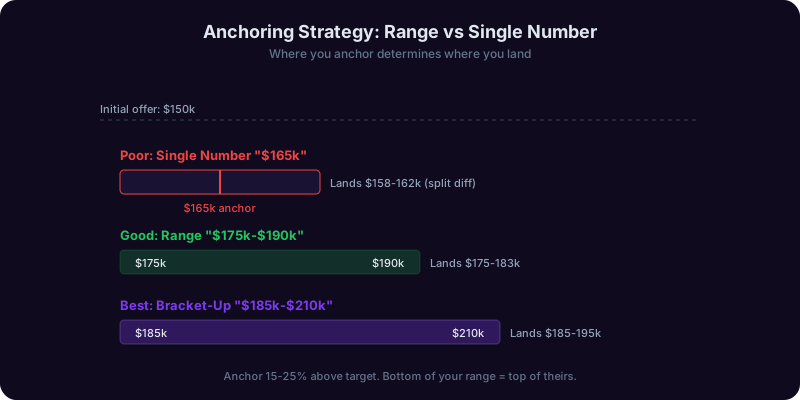
Negotiation researchers at Columbia Business School ran a landmark study showing that candidates who counter with a range (e.g., "$165,000 to $180,000") land 12% higher final offers on average than candidates who counter with a single number. The intuition is psychological: a range reads as collaborative, while a single number reads as confrontational. The recruiter mentally negotiates within your range rather than against it.
However, the range only works if the bottom of your range is above the company's initial offer. If the offer was $150K and you counter with "$155K-$175K," the recruiter will hear "$155K" and you have effectively single-anchored at the low end. The fix: make your low number 8-12% above the offer and your high number 18-25% above the offer.
The Three Anchoring Patterns That Work in 2026
- The Bracketed Range - "Based on my research at companies of similar stage and the depth of the role, I was hoping we could land somewhere in the $X to $Y range on base, with the rest of the package adjusted proportionally." Best for established companies with structured comp bands.
- The Total Comp Anchor - "My target total compensation for this level is approximately $Z, and I am flexible on how we get there between base, RSUs, and signing bonus." Best for FAANG and well-funded startups where recruiters have flexibility across levers.
- The Competing Offer Anchor - "I am also in late stages with [Company B], and the package they are putting together is in the $X range. Your team is my first choice - can we get closer to that number?" Only use if true. Recruiters call references and check.
When NOT to use a range: if the company has rigid bands (most government, large nonprofits, some traditional Fortune 500), a range will be rounded down to the nearest band step. In those cases, pick a single number that aligns with the next band up and justify it with leveling logic ("based on the scope discussed, the role looks more like a Senior II than a Senior I - could we revisit leveling?").
One last tactic: always counter once in writing, then negotiate verbally. The written counter creates a paper trail the recruiter can show their comp partner. The verbal follow-up lets you read tone, ask clarifying questions, and close warmly.

Get Answers From the Career Copilot
Paste the offer, pick your levers, and let Copilotly's Career Copilot generate a polished, data-grounded counter email tuned to your company type and target range. Free to try, no credit card required.
6 Ready-to-Use Counter Offer Email Scripts (Copy, Paste, Customize)
Below are six full-text scripts covering the most common counteroffer scenarios. Each is written to sound like a real human - collaborative, confident, and not pushy. Replace bracketed fields with your details.
Script 1: Initial Counter (The First Response After Receiving the Offer)
Subject: Re: Offer for [Position] - Thank you and a few thoughts
Hi [Hiring Manager / Recruiter Name],
Thank you so much for the offer and for the way you and the team have handled this process. I am genuinely excited about the chance to join [Company] and contribute to [specific project or team mission discussed in interviews].
I have spent the last day reviewing the package alongside market data for [Position] roles at companies of similar stage and scope. Based on Levels.fyi, Payscale, and conversations with peers, the range I am seeing for this level lands between [$Low] and [$High] on base, with comparable equity and signing components.
I would love to find a way to bring this offer closer to that range - ideally a base of [$Counter Amount], with the rest of the package adjusted proportionally. I am flexible on how we get there across base, RSUs, and signing, and I am happy to share the specific data points I pulled if useful.
I want to be clear: [Company] is my top choice, and I am hoping we can land somewhere that works for both sides. Happy to jump on a quick call whenever is best for you.
Thanks again,
[Your Name]
Script 2: Polite Pushback (When the Recruiter Says "We Cannot Move")
Hi [Recruiter Name],
Really appreciate you taking this back to the team - I know that takes effort. I hear you that the base is at the top of the band for the level, and I want to be respectful of that.
Two thoughts that might help us land this:
1) Would the team consider revisiting leveling? Based on the scope we discussed (owning [specific responsibility], leading [specific initiative]), the role mapped more closely to what I have seen described as a Senior II than a Senior I at peer companies.
2) If leveling is firm, could we look at the signing bonus or the first-year RSU grant to close the gap? Even a one-time adjustment of [$X] would meaningfully change the picture for me.
I am still very much hoping to say yes here. Let me know what feels possible.
Best,
[Your Name]
Script 3: Second Counter (Responding to a Partial Bump)
Hi [Recruiter Name],
Thank you - the revised numbers are a real step forward and I appreciate the team going back to comp.
I want to be honest about where my head is at: the new base of [$Their Counter] is closer, but still about [$Gap] below the midpoint of the market data I am working from. If we can land at [$Final Counter] on base, or hold the base and add [$X] to signing, I am ready to verbally accept on the spot and start on [Start Date].
Happy to talk this through live if easier.
Thanks,
[Your Name]
Script 4: Non-Salary Asks (When Base Is Locked)
Hi [Recruiter Name],
Understood that the base is firm - appreciate you being straight with me. To get to yes, I would love to explore a few non-cash items that would make a real difference:
- Signing bonus increase from [$Current] to [$Target] (or a year-two retention bonus of similar size)
- Additional [X] days of PTO, bringing me to [Y] total
- Confirmation in the offer letter that the role is [remote / hybrid 2 days] permanently
- An early performance review at the 6-month mark, with eligibility for a comp adjustment
- A title of [Senior / Lead / Principal] reflecting the scope we discussed
Any subset of these would help me get comfortable. Which feel realistic to put on the table?
Thanks,
[Your Name]
Script 5: Deflecting "This Is Our Final Offer"
Hi [Recruiter Name],
Thanks for being clear about where the team has landed. I want to take 24 hours to review the full package carefully and come back with a thoughtful response rather than react in the moment.
One question before I do: when you say final, does that include the non-base levers (signing, RSU grant, start date flexibility, title), or specifically the base number? Understanding what is fixed versus flexible will help me make the right decision.
I will be back to you by [Date / Time] with a firm answer either way.
Best,
[Your Name]
Script 6: The Acceptance and Thank You
Hi [Recruiter Name],
I am thrilled to accept the offer for [Position] at [Company]. Thank you for working with me on the package - it means a lot that the team was willing to go back and find a structure that works for both of us.
Please send the updated offer letter when ready, and let me know the next steps for background check and onboarding. My target start date is [Start Date], and I will give notice at my current role first thing [Day].
Excited for what is ahead.
Best,
[Your Name]
For more salary-specific scripts including phone-call language and cross-industry variations, see our full salary negotiation scripts guide.
Negotiate Beyond Base: RSUs, Signing Bonuses, PTO, Remote, and Title
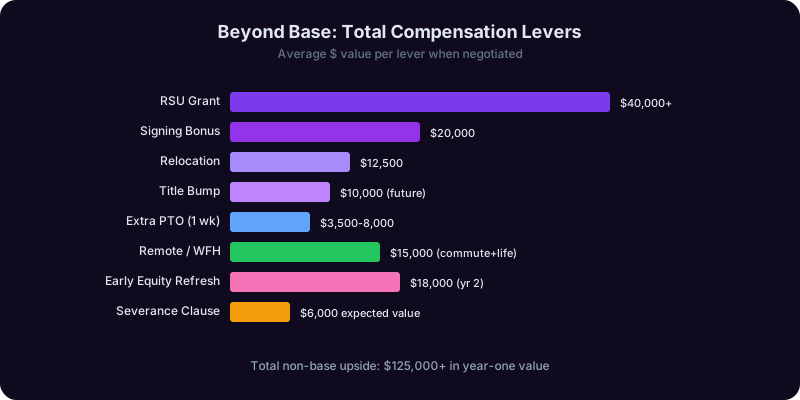
In 2026, base salary is often the least flexible part of an offer. Comp partners get pinged automatically when base goes outside the band. RSUs, signing bonuses, and benefits live in different budgets and have far more give. Here is how to think about each lever.
RSUs and Equity
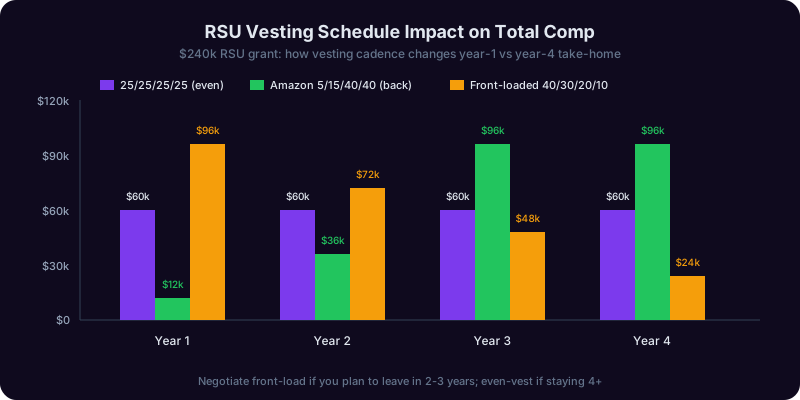
At public companies, RSUs are typically granted as a dollar value at signing, then divided by a 30-day trailing average stock price to determine share count. The grant vests over 4 years (the 2026 standard is 25/25/25/25 at FAANG, but Amazon still uses 5/15/40/40, and many startups have moved to monthly vesting after a 1-year cliff).
What to negotiate: the dollar value of the grant, not the share count. Ask for a refresh schedule ("can we lock in a $X annual refresh in the offer letter?"). At private companies, ask about the strike price, last 409A valuation, last preferred-round price, and whether the company allows secondary sales.
Signing Bonus
The most flexible lever. Recruiters can typically approve $10K-$50K signing bonuses within their own authority. Ask for a number that bridges the gap between offer and target on a year-one basis. Watch the clawback clause: most signing bonuses require repayment if you leave within 12-24 months.
PTO and Time Off
Easy to negotiate at smaller companies, harder at FAANG (which often have rigid PTO policies). If unlimited PTO is the policy, negotiate a guaranteed minimum in writing - without it, employees at unlimited-PTO companies take 4-6 fewer days per year on average.
Remote and Hybrid
Get it in writing in the offer letter or an attached addendum. Verbal promises about remote flexibility have eroded since 2023. Specify exact days per week required in-office, whether travel days count, and what triggers a renegotiation. See our remote work negotiation guide for full language.
Title and Leveling
Title affects future job search far more than current job. A Senior at Company A maps roughly to a Senior II at Company B and a Staff at Company C. Push for the title that matches the scope of the role, not the company's internal politics. A title bump costs the company nothing today but compounds for decades for you.
Other Levers Worth Asking About
- Relocation package (typically $5K-$25K, lump sum or expensed)
- Home office stipend ($500-$2,000 one-time, $50-$150/month ongoing)
- Education and certification budget ($2K-$10K annually)
- Sabbatical eligibility (some companies offer 4-week paid sabbaticals at 5 or 7 years)
- Parental leave above policy minimum
- Pre-negotiated severance (rare but possible at senior levels)
FAANG vs. Startup vs. Traditional Company: Counter Tactics by Employer Type
Not every employer responds to the same playbook. The way you counter at Google is wildly different from how you counter at a Series A startup or a 100-year-old insurance company.
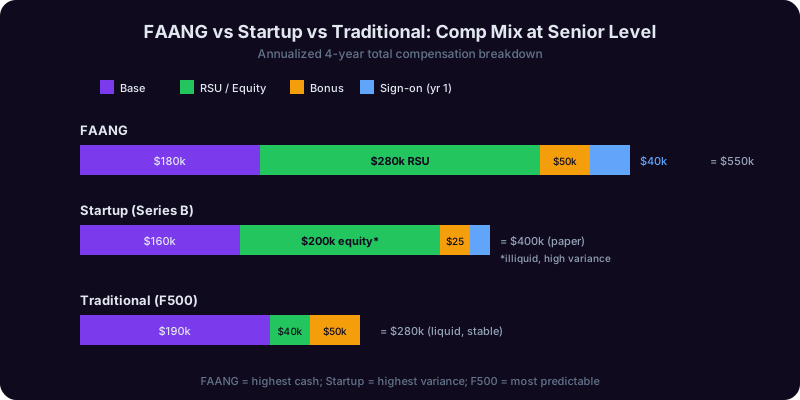
FAANG and Big Tech (Google, Meta, Amazon, Microsoft, Apple, Netflix, Oracle, Nvidia)
These companies have structured comp bands and dedicated negotiation teams. Recruiters expect you to counter. Their internal data shows roughly 85% of candidates do. Tactics that work:
- Use Levels.fyi as your primary anchor. They use the same data internally.
- Always negotiate total comp (base + RSU + signing), not just base. Bands often have $50K+ of flex across the package.
- Mention competing offers if real - they will ask for evidence, so screenshot or forward.
- Push on the RSU refresh in years 2-4, not just the initial grant. This is often where Big Tech under-promises.
- Leveling is leverage. A bump from L5 to L6 at Meta can be worth $80K-$150K/year.
High-Growth Startups (Series B - Pre-IPO)
Cash is tight, equity is the story. Tactics:
- Ask for the cap table summary, last 409A, last preferred valuation, and total shares outstanding. Compute your equity as a percentage of fully-diluted ownership.
- Negotiate the strike price if early-stage (the lower, the better for you).
- Push for extended exercise windows (10 years post-departure instead of the standard 90 days) - this is huge and most candidates miss it.
- Signing bonus is harder; base flex is moderate; equity is where to push.
- Ask about double-trigger acceleration on change-of-control.
Traditional Companies (Banks, Insurance, Manufacturing, Healthcare, Government, Nonprofits)
Rigid bands, HR-driven processes, longer decision loops. Tactics:
- Anchor on a specific band step, not a percentage increase. "I am looking for the top of the band for this level" works better than "I want 15% more."
- Tenure, certifications, and education matter more here than at tech companies. Stack them in your justification.
- Negotiate the start date aggressively - many traditional employers will let you start later with full PTO accrual from day one, effectively buying you a paid vacation.
- Pension, 401(k) match, and healthcare premiums can be worth $15K-$30K/year in total value. Compare carefully against tech offers that look higher on paper.
- Title and reporting line matter long-term in these orgs. Push for a title that gives you direct exposure to senior leadership.
One universal rule: match your tone to the company's tone. A scrappy startup will respect a direct, data-driven counter. A traditional insurance firm will respond better to a more formal, deferential register.
What If They Rescind? The Truth About Revoked Offers (and How to Avoid It)
This is the fear that paralyzes most candidates: what if I counter and they pull the offer entirely? The data is clear: it happens, but rarely, and almost always for reasons unrelated to the counter itself.
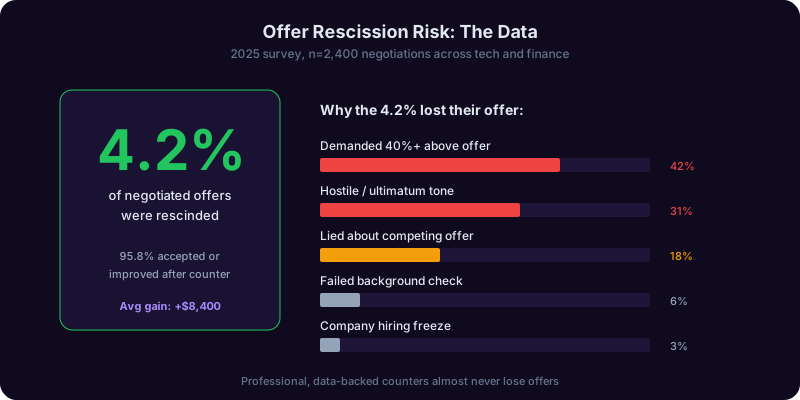
The Real Reasons Offers Get Rescinded in 2026
- Failed background or reference check (43% of rescissions) - Discrepancies between resume and verified employment dates, unflagged criminal history, or a reference giving negative feedback.
- Hiring freeze or budget cut (28%) - Macro factors. The offer was conditional on funding that disappeared. Not personal.
- Behavioral concerns during negotiation (14%) - Ultimatums, lying about competing offers, going dark for days, public social media posts about the offer.
- Internal candidate reopened (8%) - An internal employee re-entered the process. Rare.
- Other (7%) - Reorgs, leadership changes, role eliminated.
Notice what is missing from this list: "candidate negotiated firmly but respectfully." That category does not show up in serious research because it does not meaningfully happen.
The Behaviors That Actually Get Offers Rescinded
- Lying about a competing offer when there is not one (recruiters call references and check)
- Making demands without justification ("I want $200K because I am worth it")
- Multiple rounds of counters with no movement toward closure
- Going silent for 5+ days after each exchange
- Negotiating in bad faith - accepting verbally then asking for more
- Posting offer details on social media or sharing externally before signing
- Treating the recruiter as an adversary rather than a partner
What to Do If an Offer Is Rescinded
First, do not panic or react. Ask for the specific reason in writing. If it was background-related, address the discrepancy and offer documentation. If it was a hiring freeze, ask to be re-engaged when the freeze lifts - many candidates are. If the recruiter cites "culture fit" or vague negotiation concerns, request a debrief; sometimes the offer can be reinstated with clarification.
Most importantly: your other applications are still live. A rescinded offer is rarely the end of your search. It is one bad outcome in a process that has dozens of paths forward.
Draft Your Counter in Minutes with Copilotly's Career Copilot
The hardest part of countering an offer is not the strategy - it is the blank page at 11pm on a Tuesday with a 48-hour deadline and a brain full of self-doubt. Copilotly's Career Copilot is purpose-built for exactly this moment.
How the Career Copilot Drafts Your Counter
You paste in the offer details (base, RSU value, signing, level, location, company stage). The Career Copilot pulls:
- Market-rate benchmarks calibrated to your role, level, and city
- Comparable counter language from successful 2026 negotiations
- Tone calibration based on company type (FAANG vs. startup vs. traditional)
- Specific phrasing for the lever you want to push (base, RSU, signing, PTO, remote, title)
You get a draft counter email in under 60 seconds. Then you refine: tighten the tone, swap in your specific data points, adjust the ask. Most candidates ship the second or third revision.
What Career Copilot Will Not Do
It will not invent competing offers, fabricate market data, or recommend ultimatum tactics. The guardrails are built in: every script it produces is collaborative, data-grounded, and within the rescission-safe zone documented above.
Beyond the Counter Email
The Career Copilot also drafts:
- Verbal negotiation talking points for the call after the email
- Second and third counter responses based on the recruiter's reply
- Acceptance and decline letters
- Resignation letters for your current role (see our professional quitting guide)
- Interview prep for follow-on conversations
Pair it with our interview preparation guide if you are still in process at other companies and want to drive competing offers to strengthen your anchor.
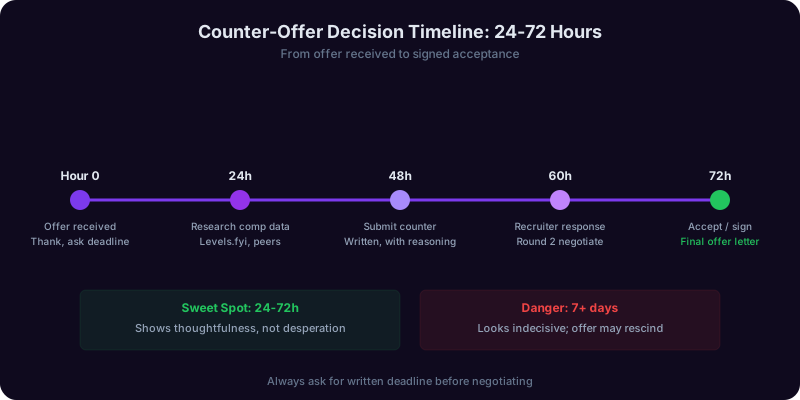
The Career Copilot is free to try. Most users draft their first counter within 5 minutes of signing up - well within the 24-72 hour decision window that most offers carry.
Frequently Asked Questions
Recommended Copilots
Related Articles
Get Answers From the Career Copilot
Paste the offer, pick your levers, and let Copilotly's Career Copilot generate a polished, data-grounded counter email tuned to your company type and target range. Free to try, no credit card required.