
What the Social Security Fairness Act Did: Repealing WEP and GPO
On January 5, 2025, President Biden signed the Social Security Fairness Act into law, ending a 42-year-old policy that had quietly stripped retirement benefits from millions of public servants. The law fully repealed two provisions that had become symbols of unfairness across firehouses, classrooms, and police precincts: the Windfall Elimination Provision (WEP) and the Government Pension Offset (GPO). Crucially, the repeal was made retroactive to January 2024, triggering one of the largest back-pay distributions in Social Security history.
The Social Security Administration (SSA) confirmed in its official Fairness Act portal that approximately 3.2 million beneficiaries would receive adjustments, with total back-pay distributions estimated at $17 billion. The average lump-sum payment landed near $6,710, but individual checks ranged from a few hundred dollars to over $50,000 for surviving spouses who had been entirely zeroed out by GPO.
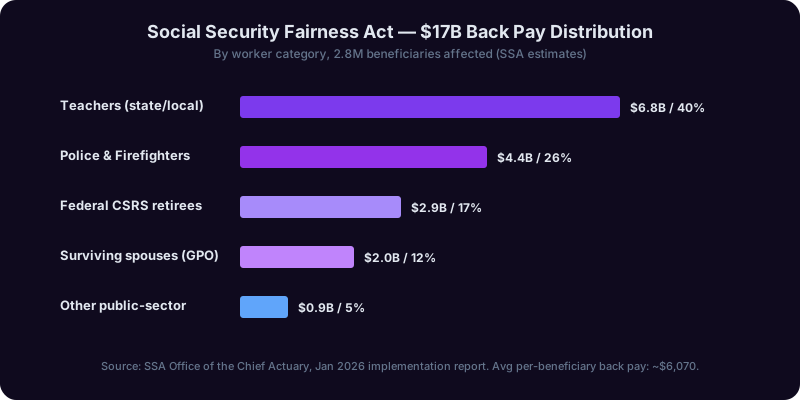
The two provisions worked differently but shared a common target: workers who earned a pension from employment not covered by Social Security (think a Texas teacher, a California police officer, or a federal employee under the old Civil Service Retirement System). WEP reduced the worker's own retirement check. GPO reduced or eliminated benefits a spouse or survivor would otherwise receive on a Social Security-covered partner's record. Together, they left an estimated $200 billion in lifetime benefits unpaid since the original 1983 provisions took effect.
Under the new law, SSA is required to recompute affected benefits and pay back the difference between what was paid and what would have been paid without WEP/GPO from January 2024 forward. Ongoing monthly checks were also adjusted upward, with the average affected retiree seeing a $360 to $1,190 monthly increase depending on category. For some surviving spouses previously blocked by GPO, this is the first Social Security check they have ever received in their life - a financially transformational moment for many widows and widowers in their 70s and 80s.
The law passed with strong bipartisan support - 327-75 in the House and 76-20 in the Senate - reflecting how broadly the unfairness was recognized. Advocacy by the NEA, NARFE, IAFF, and the Fraternal Order of Police was instrumental in getting the bill across the finish line after decades of failed attempts.
Tax disclaimer: This article is educational and does not constitute tax, legal, or financial advice. Back pay is generally taxable in the year received, but the IRS lump-sum election can reduce the bite. Consult a CPA or enrolled agent before filing, especially if your back pay exceeds $10,000 or pushes you into IRMAA territory.
Who Qualifies: The Worker Categories Covered
WEP and GPO applied to anyone receiving a pension from work not covered by Social Security. The repeal therefore benefits a specific (but very large) set of workers. Eligibility for back pay does not require a new application in most cases - SSA is automatically recomputing benefits for people already receiving Social Security. But understanding which category you fall into helps you verify the math and spot errors.
Teachers in 15 Non-Covered States
Roughly 1.2 million public-school teachers worked in states where their districts opted out of Social Security: Alaska, California, Colorado, Connecticut, Georgia (some districts), Illinois, Kentucky (some), Louisiana, Maine, Massachusetts, Missouri, Nevada, Ohio, Rhode Island (some), and Texas. The National Education Association estimates that the average affected teacher will see a $4,800 lump sum plus a $400 monthly increase. For long-tenure teachers who also worked summer or second-career jobs that paid into Social Security, the increase can run substantially higher.
Police Officers and Firefighters
Approximately 700,000 first responders worked under state or municipal pension systems that did not participate in Social Security. Many took private-sector or second jobs (security, contracting, EMS) where they did pay into Social Security, accruing 10+ years of credits - then watched WEP slash their earned benefit by up to 60%. The International Association of Fire Fighters and the Fraternal Order of Police were among the most active advocates for repeal.
Federal Workers Under CSRS
About 500,000 retired federal employees under the old Civil Service Retirement System (CSRS) are affected. CSRS employees hired before 1984 did not pay into Social Security through federal employment. The National Active and Retired Federal Employees Association (NARFE) reports that CSRS retirees see some of the largest individual increases - averaging $7,200 in back pay - because many had substantial second-career Social Security earnings before or after their federal service.
State and Local Government Workers
Beyond the headline categories, the law covers any state, county, or city employee whose pension came from non-covered employment: court clerks, transit workers, sanitation employees, university staff in non-covered systems, and certain railroad workers under specific arrangements. The pattern of non-coverage varies dramatically by state and even within state by district or agency.
Surviving Spouses
This category produced the most dramatic single-case outcomes. Under GPO, two-thirds of a public pension was subtracted from any spousal or survivor Social Security benefit - frequently reducing the check to zero. With GPO repealed, some surviving spouses now collect the full survivor benefit retroactive to January 2024. We dedicate an entire section below to this group because the rules around remarriage, divorce, and proof of marriage produce surprisingly tricky edge cases.
The WEP Reduction Explained: What You Were Losing
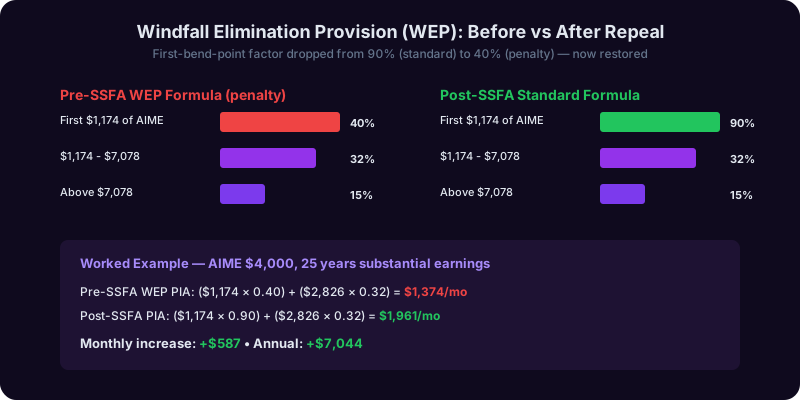
To know what you are owed, you need to understand what was taken. WEP modified the formula SSA uses to calculate your Primary Insurance Amount (PIA) when you had a pension from non-covered work. Normally, SSA applies three replacement percentages to your Average Indexed Monthly Earnings (AIME): 90% on the first segment, 32% on the middle segment, and 15% on the top. WEP slashed that first 90% multiplier - which is where lower earners get most of their replacement - down as low as 40%.
The Standard Bend Points (2026)
| AIME Segment | Normal Multiplier | WEP Multiplier (Max Reduction) |
|---|---|---|
| First $1,226 | 90% | 40% |
| $1,227 to $7,391 | 32% | 32% |
| Above $7,391 | 15% | 15% |
The maximum WEP reduction in 2024 was $613 per month. A worker entitled to a $1,400 PIA could see their actual check cut to $787. Over a 20-year retirement, that is roughly $147,000 in lost benefits - and that is the number SSA is now reconciling (from January 2024 onward, since the repeal is not retroactive prior to that date).
The Years of Substantial Earnings Escape Hatch
WEP eased up for workers who had many years of substantial Social Security-covered earnings. The 40% multiplier increased toward 90% as substantial-earnings years rose:
- 20 or fewer years of substantial earnings: full 40% reduction applied
- 21-29 years: graduated multiplier ranging from 45% to 85%
- 30+ years: WEP did not apply at all
This is why a 25-year teacher with a 12-year summer-job Social Security record was hit harder than a 15-year teacher who pivoted to a 30-year private-sector second career. Substantial earnings thresholds change each year - in 2024 it was $31,275 in covered wages.
How to Estimate What You Lost
Find your monthly check pre-2024, find your post-recomputation check from 2025, and the difference (times the number of months since January 2024) is the lump-sum you should see. SSA also calculates Delayed Retirement Credits and Cost of Living Adjustments (COLAs) on the higher amount, so the back pay typically includes a small COLA top-up of 2.5% (2025) and 3.2% (2026) applied to the months in those years.

Get Answers From the Finance Copilot
Copilotly's Finance Copilot analyzes your work history, calculates your expected back pay, drafts your SSA application, and runs the lump-sum vs spread tax math so you keep more of your money.
The GPO Reduction Explained: Why Many Spouses Got Zero
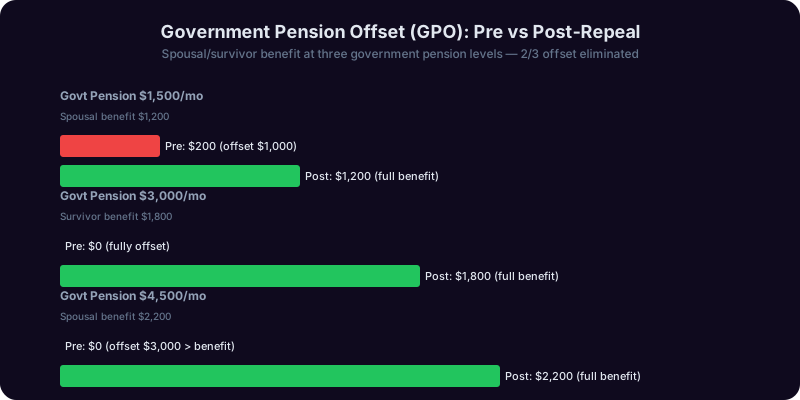
If WEP was the silent tax on retired teachers, the Government Pension Offset (GPO) was the wrecking ball aimed at their spouses. GPO reduced any Social Security spousal or survivor benefit by two-thirds of the recipient's own non-covered pension. The math was brutal: a $3,000 monthly state pension offset $2,000 from any Social Security spousal benefit. Since most spousal benefits run $1,200-$1,800/month, GPO frequently reduced the check to zero.
The Math, With Examples
Consider three real-world scenarios pulled from SSA case studies:
| Scenario | Public Pension | GPO Offset (2/3) | Spousal Benefit | Actual Check |
|---|---|---|---|---|
| Retired teacher, working spouse | $2,400 | $1,600 | $1,200 | $0 |
| Retired police, surviving spouse | $3,600 | $2,400 | $2,200 | $0 |
| Federal CSRS widow | $1,500 | $1,000 | $1,800 | $800 |
The Working-Spouse Benefit Elimination
For couples where one spouse worked in the private sector and the other in non-covered public service, GPO was a marital punishment. If the public-pension spouse outlived the Social Security-covered partner, they often discovered at the most vulnerable moment that they were owed nothing. AARP estimates that 625,000 widows and widowers were zeroed out entirely under GPO, frequently finding out only weeks after burying their spouse.
The Eligible-Survivor Zero Case
Some survivors never applied for benefits at all because their financial planner correctly calculated their GPO offset would exceed any payment. These individuals are now eligible to apply retroactively up to 6 months, plus going forward at the full, un-offset rate. We cover the application path in Section 7. Importantly, the months you would have been entitled to back to January 2024 are also retroactively payable in many cases, depending on when you first became eligible.
The repeal does not change the underlying pension - your state or municipal check stays the same. What changes is that Social Security can no longer treat that pension as a reason to subtract from your spousal or survivor benefit. As of January 2024, you are entitled to both, full stop, with no offset applied.
Step-by-Step: Check Your SSA my Account Status
The fastest way to confirm your status is through my Social Security, the SSA's free online portal. For workers already receiving benefits, SSA has been processing recomputations in waves since February 2025, with the bulk completed by late 2025. If you have not seen your update, this section walks you through verification step by step, including what to do if SSA appears to have skipped your case.
Step 1: Log In or Create an Account
Go to SSA.gov my Account and either sign in or create an account using Login.gov or ID.me. You will need your Social Security number, an email address, and identity-verification documents (a driver's license or passport, plus a credit history that matches Equifax records). Account creation typically takes 10 minutes for most users.
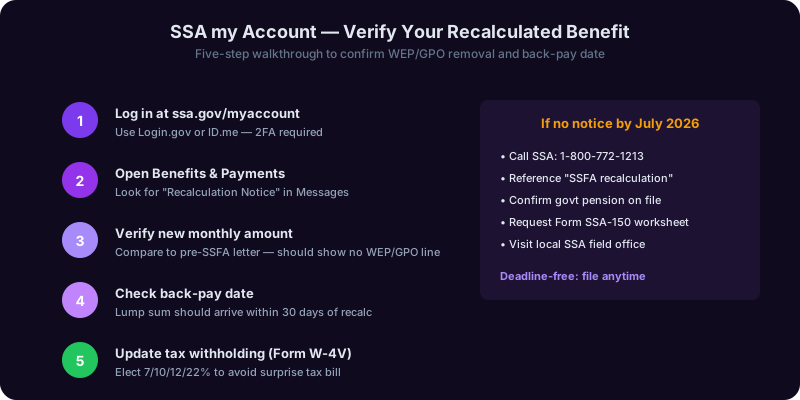
Step 2: Look for the Recalculated Benefit Notice
Once logged in, navigate to Messages. SSA mailed notices titled Notice of Award - Social Security Fairness Act Recalculation to all affected beneficiaries. The notice contains four key numbers:
- Your prior monthly benefit (with WEP/GPO applied)
- Your new monthly benefit (without WEP/GPO)
- The retroactive amount owed (back pay since January 2024)
- The date of the lump-sum deposit
Step 3: Verify the Back-Pay Deposit Date
Most back-pay deposits went out between March and December 2025. Check your bank statement for an SSA deposit labeled SSA TREAS 310 with a memo line referencing FAIRNESS ACT or RECOMP. If you receive paper checks, look for an envelope marked UNITED STATES TREASURY with a non-standard amount that does not match your usual monthly deposit.
Step 4: Verify the Math
Calculate the expected back pay yourself:
- Subtract your old monthly check from your new monthly check.
- Multiply by the number of months from January 2024 through the recomputation date.
- Add an estimated 2.5% COLA adjustment for 2025 and 3.2% for 2026 if relevant.
If your actual deposit is within $200 of your calculation, the math is right. If it is off by $500 or more, file an inquiry through the my Account portal or call SSA at 1-800-772-1213.
Step 5: Confirm Ongoing Monthly Increase
Your monthly benefit should now reflect the higher, un-WEP/GPO amount. If your November 2026 deposit looks identical to your December 2023 deposit, something went wrong - call SSA immediately and ask for a benefit verification letter.
If You Are Not Yet Receiving Benefits
If you delayed claiming because WEP/GPO would have zeroed you out, you are eligible to apply now and can request up to 6 months of retroactive benefits. See Section 6 for the application strategy and timing considerations.
Filing for Benefits You Skipped: The Retroactive Claim
One of the most overlooked aspects of the Fairness Act involves people who never applied for Social Security at all because financial planners correctly predicted WEP or GPO would zero them out. Now that those provisions are gone, this group can finally collect. The process requires an active application - SSA cannot automatically enroll someone who never claimed.
Who Should File a New Application
- Retired teachers, police, firefighters, or federal workers who have never claimed Social Security on their own record despite having 40+ quarters of credits
- Spouses or surviving spouses who were told by SSA in prior years that they would get zero
- Workers who claimed only a reduced (offset) benefit and want to apply for full spousal or survivor benefits
The 6-Month Retroactive Maximum
SSA generally allows up to 6 months of retroactive benefits for retirement claims filed after Full Retirement Age (FRA). If you file in October 2026 at age 68 (past your FRA of 67), you can request benefits backdated to April 2026. Filing earlier captures more months. Important: retroactive benefits before FRA can permanently reduce your monthly check, so this strategy is most useful for those already past FRA.
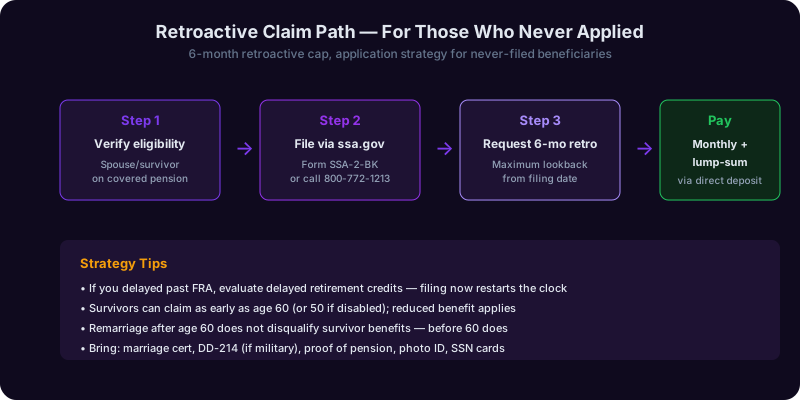
Application Strategy
Use form SSA-1 (Application for Retirement Insurance Benefits) for your own record, or SSA-2 (Application for Wife's or Husband's Insurance Benefits) for spousal benefits. You can file online, by phone (1-800-772-1213), or in person at a local field office. Online is fastest and reduces the chance of clerical error.
Documents You Will Need
- Social Security number
- Birth certificate or proof of birth
- Marriage certificate (for spousal claims)
- W-2s or self-employment tax returns from the past 2 years
- Documentation of your non-covered pension (statement from your pension administrator)
- Bank routing and account numbers for direct deposit
Common Pitfalls to Avoid
First, do not request retroactive benefits before your FRA - the actuarial reduction is permanent. Second, if you are still working, the earnings test may apply for any month before FRA. Third, if you have a pending divorce, surviving-spouse benefits can be complicated; consult an elder-law attorney. Fourth, federal workers under CSRS Offset (different from straight CSRS) have a different calculation - verify your status with NARFE before filing.
Expected Timeline
SSA's published average processing time for retirement applications is 6-8 weeks. Fairness Act-related applications have been running closer to 10-14 weeks due to the surge in volume. File early, track status through my Account, and respond promptly to any document requests.
Surviving Spouse Claims: The Widow/Widower Path
Surviving spouses represent the most financially impacted group under repeal. GPO frequently zeroed out widow/widower benefits entirely, meaning some surviving spouses lived for years or decades with no Social Security income from a deceased partner's lifetime of contributions. With repeal, these survivors are entitled to claim - and the back pay can be substantial.
Who Qualifies as a Surviving Spouse
- Widows or widowers age 60 or older (50 if disabled)
- Widows or widowers caring for the deceased's child under 16
- Surviving divorced spouses, if the marriage lasted at least 10 years
The Remarriage Rule
This catches many off guard. If you remarried before age 60 (or before 50 if disabled), you generally cannot collect survivor benefits on your prior spouse's record while that remarriage is intact. If you remarried after age 60, the remarriage does not affect your eligibility. If you divorced or were widowed from the second marriage, eligibility on the first spouse's record is restored.
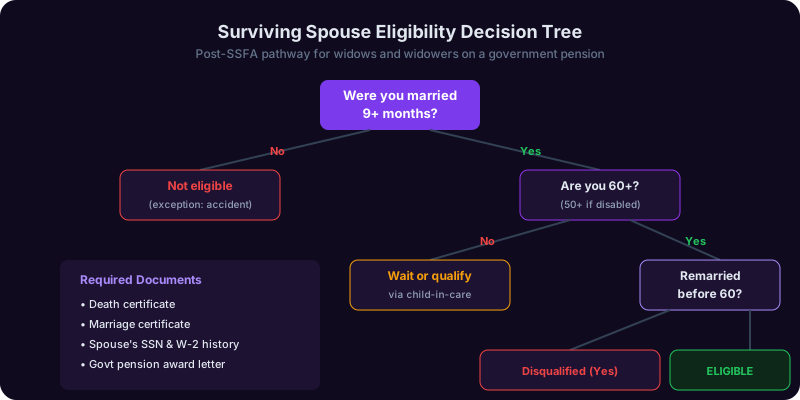
Proof-of-Marriage Documentation
You need a certified copy of the marriage certificate from the issuing jurisdiction. For older marriages where the original document is lost, an SSA field office can accept secondary evidence: a church record, an insurance application listing the spouse, a tax return filed jointly, or affidavits from family members. The more documentation, the smoother the process.
If Your Spouse Was Also a Public Worker
When both spouses worked in non-covered employment, the math gets interesting. Survivor benefits are based on the deceased's earnings record. If the deceased had Social Security credits (from a second job, for example), there may be a benefit even if their primary career was non-covered. SSA will calculate the highest benefit you are entitled to.
Filing Form SSA-10
Use SSA-10 (Application for Widow's or Widower's Insurance Benefits). You generally cannot file this online - it must be done by phone or in person. Schedule an appointment at your local field office through the SSA online appointment system. Bring originals of all documents; the clerk will photocopy and return them.
Back Pay for Already-Eligible But Not-Applied Survivors
If you became eligible (turned 60, or your spouse died after January 2024) but did not apply because GPO would have zeroed you out, you can request retroactive benefits back to the later of: (a) the month you became eligible, or (b) January 2024. This can mean 12-18+ months of retroactive payments in a single lump sum.
The Combined Family Maximum
Survivor benefits are capped by a family maximum (typically 150-180% of the deceased's PIA). If multiple survivors claim on the same record - say a surviving spouse and a minor child - the benefits may be prorated. This rarely affects single-survivor cases but matters for blended families.
Tax Impact of Back Pay: Lump-Sum vs Spread Election
Receiving a $15,000 lump sum in 2025 feels like Christmas. Receiving the tax bill in April 2026 can feel like a bait-and-switch. Social Security back pay is generally taxable in the year received, which means a multi-year lump sum can push you into a higher bracket, increase the taxable portion of your other Social Security, and trigger downstream consequences (including IRMAA, covered in the next section).
The Default Rule: Taxable When Received
Up to 85% of Social Security benefits can be taxable depending on your combined income (adjusted gross income + tax-exempt interest + 1/2 of Social Security). For single filers, taxation starts at $25,000 of combined income (85% threshold at $34,000). For joint filers, $32,000 / $44,000. A back-pay windfall easily blows past these thresholds.
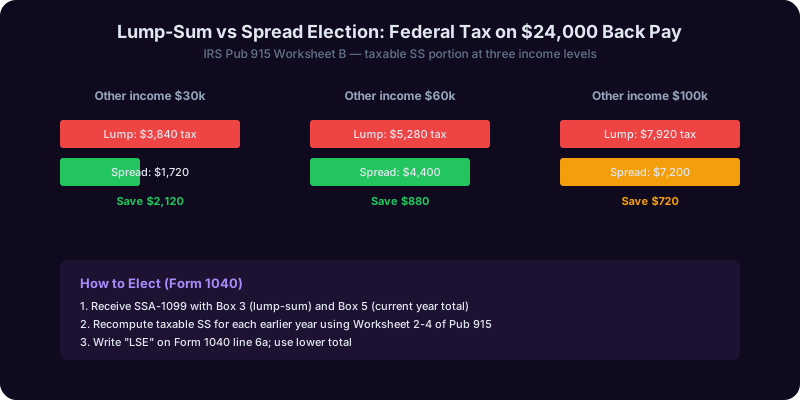
The Lump-Sum Election (IRS Publication 915)
The IRS offers a relief mechanism called the lump-sum election method, detailed in IRS Publication 915 and Worksheets 2-4. The election lets you calculate the tax on each year's portion of the back pay using that year's income, then sum the results. You report all the back pay in the current year for income purposes, but you compute the taxable amount as if you had received it in the original year.
Worked Example
| Method | Taxable SS Amount | Additional Tax |
|---|---|---|
| Lump in current year (default) | $12,750 (85% of $15,000) | $2,805 at 22% bracket |
| Lump-sum election (spread) | $8,500 (effective) | $1,870 at 22% bracket |
| Savings | $4,250 | $935 |
When the Election Helps Most
The lump-sum election produces the biggest savings when:
- Your back pay covers 2+ years (e.g., January 2024 through late 2025)
- You had lower income in the back-pay years than in the current year
- Your current combined income is below the 85% threshold without the lump but above it with the lump
When the Election Does Not Help
If your income was higher in 2024 than in 2025 (uncommon for retirees), the default method may produce a lower bill. Also, the lump-sum election cannot be combined with certain other elections - run both calculations.
State Tax Considerations
Most states either do not tax Social Security or tax it the same way as federal. The notable exceptions where back pay can sting: West Virginia (phasing out), Minnesota, Vermont, Connecticut, Rhode Island, and Montana. Check your state's 2026 rules before filing.
Tax disclaimer: The lump-sum election is computed via Worksheets 2, 3, and 4 in IRS Publication 915 and requires SSA Form SSA-1099 plus the box-3 description of back-pay amounts by year. Consider hiring a CPA for the year of the lump sum - the $300-$500 fee often pays for itself in savings.
Medicare Premium and IRMAA Implications
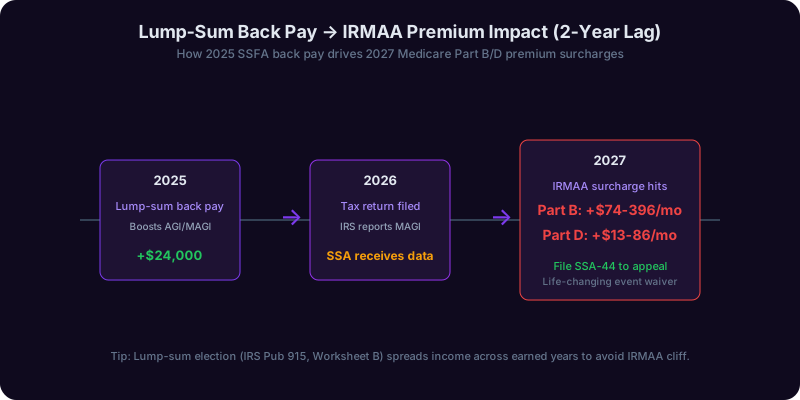
One of the most painful surprises of a Social Security back-pay windfall is not the income tax - it is the Income-Related Monthly Adjustment Amount (IRMAA) on Medicare Part B and Part D. IRMAA is a surcharge added to standard Medicare premiums when your Modified Adjusted Gross Income (MAGI) exceeds certain thresholds. The surcharge can run from $77/month to $443/month for Part B, plus an additional $13-$85/month for Part D.
The 2-Year Lookback
IRMAA uses a 2-year lookback. Your 2026 Medicare premiums are based on your 2024 tax return. Your 2027 premiums are based on your 2025 tax return. This means a lump sum received in 2025 hits your Medicare bill in 2027, not immediately.
2026 IRMAA Brackets (Based on 2024 MAGI)
| Single MAGI | Joint MAGI | Part B Surcharge | Part D Surcharge |
|---|---|---|---|
| Up to $106,000 | Up to $212,000 | $0 | $0 |
| $106,001-$133,000 | $212,001-$266,000 | $77/mo | $13.70/mo |
| $133,001-$167,000 | $266,001-$334,000 | $194/mo | $35.30/mo |
| $167,001-$200,000 | $334,001-$400,000 | $311/mo | $57/mo |
| Above $200,000 | Above $400,000 | $443/mo | $85/mo |
The SSA-44 Life-Changing Event Appeal
Here is the lifeline: IRMAA allows an appeal for a life-changing event, filed on Form SSA-44. While the Fairness Act lump sum is not explicitly on the list of qualifying events (which includes marriage, divorce, work stoppage, work reduction, and pension loss), SSA has been accepting 'work stoppage' or 'pension loss' appeals for retirees whose income spike is a one-time anomaly.
Filing SSA-44 Successfully
- Download Form SSA-44 from SSA.gov.
- Check the box for the qualifying event that best describes your situation (most retirees check 'work stoppage' if they retired recently, or 'pension loss' for the Fairness Act argument).
- Attach documentation: SSA notice of recomputed benefits, the back-pay deposit confirmation, and a statement explaining that the 2024 MAGI is a one-time anomaly.
- Project your expected MAGI for the current and future year (without the lump sum).
- Mail or hand-deliver to your local SSA field office.
Hold-Harmless Provision
If Social Security increases do not cover your Part B increase, the hold-harmless rule may protect you - but it does not apply to IRMAA surcharges or to higher-income beneficiaries. Plan around IRMAA rather than relying on hold-harmless.
Strategic Planning
If you have flexibility, time other income events (Roth conversions, IRA withdrawals, asset sales) to avoid stacking them on top of a back-pay year. A Roth conversion ladder planned for 2024 should be reconsidered if back pay is also landing that year.
How Copilotly's Finance Copilot Helps You Claim
The Social Security Fairness Act is the largest single-event benefits adjustment in Social Security history, and the volume of recomputations, retroactive applications, and tax filings has overwhelmed both SSA field offices and the typical CPA. Copilotly's Finance Copilot was built to help individual workers navigate this complexity without paying for a full retirement-planning consultant.
What the Finance Copilot Actually Does
The Finance Copilot is an AI assistant trained on SSA publications, IRS guidance, Treasury rules, and the actual operational workflows used by Social Security retirement-claims representatives. When you bring it your situation, it does five things:
- Analyzes your work history. Upload your Social Security statement (downloadable as a PDF from my Account) and a copy of your public-pension award letter. The Copilot identifies whether WEP, GPO, or both applied to you, and at what magnitude.
- Estimates your back pay. Using historical WEP/GPO formulas and your earnings record, the Copilot computes the difference between what SSA paid you and what should have been paid since January 2024, including COLA adjustments.
- Drafts your retroactive application. If you never applied for benefits, the Copilot generates a pre-filled SSA-1, SSA-2, or SSA-10 application with your specific information, ready to submit.
- Runs the lump-sum vs spread tax math. The Copilot performs both the default and lump-sum-election calculations using your historical tax returns (which you upload as PDFs), producing a comparison and a recommendation.
- Builds your SSA-44 IRMAA appeal. If your back pay risks triggering IRMAA surcharges 2 years out, the Copilot drafts your Form SSA-44 with the strongest available justification and attaches the required documentation.
Sample Workflow
A retired California teacher uploads her SSA-1099, public-pension statement, and 2023-2025 tax returns. The Copilot identifies she was hit with the full WEP reduction ($613/month), confirms the SSA's recomputation matches her earnings record, and finds that her 2024 lump sum will spike her MAGI past the IRMAA threshold for 2026. It generates an SSA-44 with a 'pension loss' justification - and provides a script for the field-office conversation.
What It Will Not Do (and What to Get a Human For)
The Copilot is excellent at calculation, document drafting, and procedural navigation. It is not a substitute for a CPA or enrolled agent when complex multi-state tax situations apply, for an attorney when a divorce or contested marriage affects survivor benefits, or for a financial planner when integrating the back pay into a broader retirement income strategy.
Related Planning Topics
The Fairness Act intersects with many other retirement decisions. If you are still in the planning phase, our AI retirement planning guide covers the broader framework. For Roth conversion strategy in the same year as back pay, see our Roth IRA conversion ladder guide. For 401(k) and Roth 401(k) decisions for second-career public workers, see our 401(k) vs Roth 401(k) guide. For broader tax-law changes affecting 2026 filings, see our 2026 tax changes explainer. If you also have a disability that affected your work history, our SSDI application guide may apply.
Tax disclaimer: Copilotly's Finance Copilot provides calculations and draft documents as informational support. It does not file your taxes or your SSA claim on your behalf and does not constitute tax, legal, or financial advice. Always have a licensed professional review high-stakes filings, particularly when back pay exceeds $10,000 or when IRMAA, multi-state tax, or survivor disputes are involved.
Frequently Asked Questions
Recommended Copilots
Related Articles
Get Answers From the Finance Copilot
Copilotly's Finance Copilot analyzes your work history, calculates your expected back pay, drafts your SSA application, and runs the lump-sum vs spread tax math so you keep more of your money.