

What a Hardship Letter Is (and the 5 Most Common Use Cases)
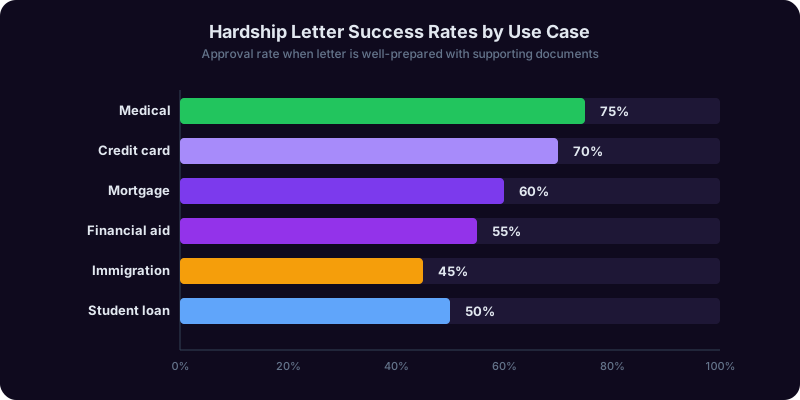
A hardship letter is a formal written statement explaining why you cannot meet a financial, legal, or contractual obligation and requesting specific relief. It is a persuasive document, but the persuasion comes from facts, not feelings. Lenders, hospitals, government agencies, and schools receive thousands of these letters each month, and the ones that succeed share a common DNA: clear cause, documented impact, reasonable ask.
The five highest-volume use cases in 2026:
- Mortgage modification or short sale - Submitted to loan servicers under Fannie Mae Flex Modification, FHA-HAMP, VA Affordable Modification, or private workout programs to reduce payments or avoid foreclosure.
- Medical bill charity care - Sent to nonprofit hospital billing departments to qualify for free or discounted care under IRS Section 501(r) financial assistance policies (FAPs).
- Immigration I-601A / I-601 extreme hardship waivers - Filed with USCIS to demonstrate that a U.S. citizen or lawful permanent resident qualifying relative would suffer extreme hardship if the applicant is denied admission.
- College financial aid appeals - Submitted to university financial aid offices to request reconsideration of a Student Aid Index based on special circumstances.
- Credit card or personal loan hardship programs - Used to qualify for reduced APR, paused payments, or settlement.
Each recipient has a different decision framework. A loan servicer wants to see that the borrower can resume payments after modification. A nonprofit hospital wants to see income below a Federal Poverty Level multiplier. USCIS wants to see hardship that exceeds what any family would normally face during separation. Writing the same letter for all three is the most common reason hardship letters fail.
Legal disclaimer: This article is educational information, not legal, financial, or immigration advice. Hardship letters used in regulated processes - particularly I-601A waivers, foreclosure mediation, and tax debt settlements - should be reviewed by a licensed attorney before submission. Decisions in these areas can have permanent consequences, and the standards described here vary by lender, hospital, jurisdiction, and adjudicator.
The Anatomy: 6 Required Elements of Every Effective Hardship Letter
Regardless of the recipient, every hardship letter that succeeds contains six elements. Missing one is the most common reason a letter is set aside without a substantive response.
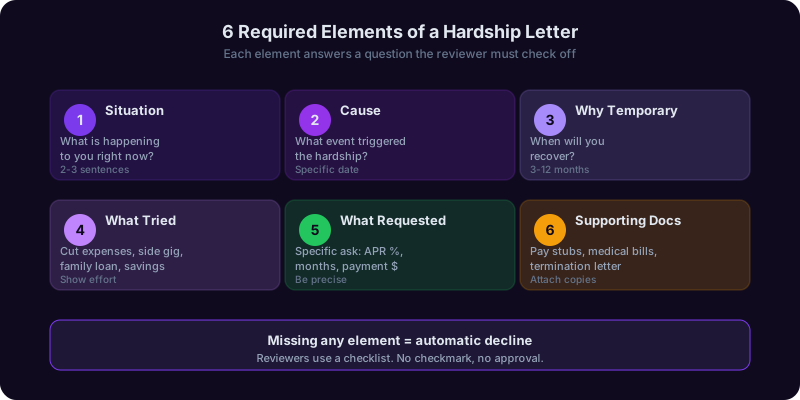
- Current situation (the facts at a glance) - Account number or case number, your full legal name, the property address or relative's A-number, the obligation amount, and the relief you cannot currently provide. This is a paragraph, not a page.
- Cause of hardship (the precipitating event) - Specific, dated, and verifiable. "Job loss" is weak. "Layoff from Acme Logistics on April 14, 2026 after 11 years; severance exhausted June 30" is strong. Identify whether the cause is medical, employment, divorce, death, disability, military deployment, natural disaster, or business failure.
- Why it is temporary or permanent - Decision-makers calibrate relief differently. Temporary hardship (medical recovery, between jobs) supports forbearance or modification. Permanent hardship (disability, terminal illness) supports settlement, short sale, or full charity care. Be honest about which category you are in.
- What you have already tried - Liquidated savings, applied for jobs, sold the second vehicle, moved to a smaller apartment, enrolled in retraining. This single paragraph distinguishes responsible petitioners from people seeking a discount.
- The specific ask - One number, one timeline. "Reduce my monthly principal and interest payment to $1,820 for 60 months" beats "please help me however you can." Vague asks force the recipient to invent a counter-offer, which they rarely do in your favor.
- Supporting documents (the evidence packet) - Pay stubs, termination letter, medical bills, bank statements, tax transcripts, doctor's letters, death certificate, lease agreement. List them at the end of the letter; attach them as labeled exhibits.
A hardship letter without exhibits is a sob story. A hardship letter with a labeled exhibit list is a case file. The same content, packaged the second way, is read with substantially more weight.
Mortgage Hardship Letter - Full Template and What Servicers Look For
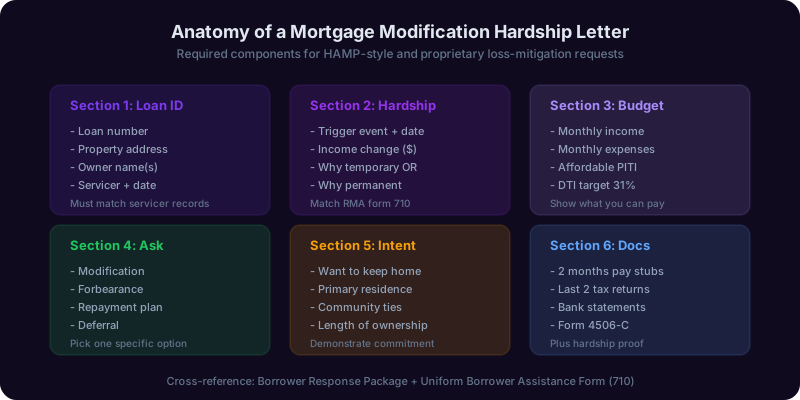
Mortgage servicers evaluate hardship letters against the specific workout option you are requesting. Under the post-HAMP framework, the dominant programs in 2026 are Fannie Mae Flex Modification, Freddie Mac Flex Modification, FHA-HAMP, VA Affordable Modification, and private investor workouts. Each requires Form 710 (Uniform Borrower Assistance Form), but the hardship letter is the narrative that ties your financial package together.
Template:
[Date]
[Servicer Name], Loss Mitigation Department
Loan Number: [#]
Property Address: [Address]
Borrowers: [Names]To Whom It May Concern:
I am writing to request a loan modification on the above-referenced loan due to a financial hardship that has reduced my household income and made my current monthly payment of $[amount] unsustainable.
Cause of hardship: On [date], I was [laid off / diagnosed / divorced / etc.]. Documentation is attached as Exhibit A. As a result, my gross monthly household income fell from $[prior] to $[current], a reduction of [%].
Duration: This hardship is [temporary / permanent] because [explanation]. I expect my income to [stabilize at $X / remain at current level] beginning [date or indefinitely].
Mitigation steps: I have liquidated $[amount] in savings, reduced discretionary spending by $[amount]/month, [sold vehicle / taken in roommate / etc.]. My remaining monthly residual income after essential expenses is $[amount].
Request: I respectfully request a Flex Modification that re-amortizes the unpaid principal balance over 480 months at the prevailing modification interest rate, targeting a P&I payment of approximately $[amount], which represents 31% of my current gross monthly income.
Enclosed: Form 710, two most recent pay stubs, two months bank statements, signed 4506-C, hardship documentation (Exhibit A), 2024 and 2025 tax returns, utility bill (occupancy).
Respectfully,
[Signature]
What servicers actually want to see: (1) the 31% housing-expense-to-income target post-modification, (2) verifiable hardship that is not borrower-induced, (3) occupancy of the property as a primary residence (for most programs), and (4) evidence that the modified payment is sustainable for at least 36 months. The CFPB loss mitigation rules and HUD's foreclosure prevention resources describe the dual-tracking protections and timing rights that apply once a complete loss mitigation application is submitted.

Get Answers From the Legal Copilot
Copilotly's Legal Copilot tailors your hardship letter to the exact recipient - loan servicer, hospital billing office, or USCIS adjudicator - using the standards each one actually applies.
Medical Bill Charity Care Hardship Letter - IRS 501(r) Rules and Template
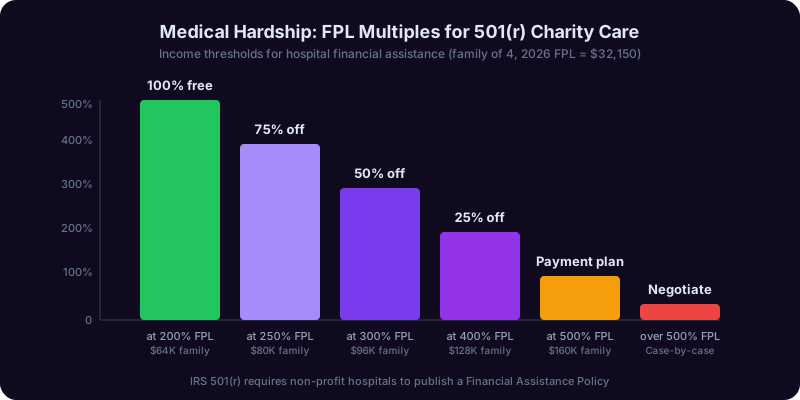
Every nonprofit hospital in the United States is required by IRS Section 501(r) to maintain a written Financial Assistance Policy (FAP). Most hospitals offer free care to patients below 200% of the Federal Poverty Level (FPL) and discounted care up to 400%-600% FPL, but the exact thresholds vary by hospital and state. The IRS 501(r) requirements page describes the FAP, billing limitation, and emergency care obligations that every charitable hospital must meet.
Template:
[Date]
[Hospital Name] - Financial Assistance / Patient Financial Services
Patient: [Name], DOB [date]
Account/MRN: [#]
Dates of Service: [range]
Total Charges: $[amount]To the Financial Assistance Office:
I am requesting financial assistance under [Hospital]'s Financial Assistance Policy pursuant to IRS Section 501(r). My household meets the eligibility criteria as documented below.
Household size: [#] (self, spouse, [#] dependents)
Household gross annual income: $[amount]
As percentage of 2026 Federal Poverty Level: [%]Hardship narrative: [Brief, factual description of the medical event, current employment status, and any complicating circumstances such as disability, caregiving responsibilities, or loss of insurance.]
Requested relief: Based on income below [200% / 400%] FPL, I request [100% charity care write-off / sliding-scale discount per FAP / payment plan at $X/month with no interest].
Enclosed: completed Financial Assistance Application, two most recent pay stubs or unemployment award letter, prior-year tax return or non-filer statement, bank statements (last 60 days), proof of household size, itemized hospital bill.
I also request that collection activity be suspended on this account during the application review period as required under 501(r)-6.
Sincerely,
[Signature]
Key tactical points: (1) Hospitals are prohibited from charging FAP-eligible patients more than "Amounts Generally Billed" (AGB) to insured patients - request the AGB recalculation if you were billed gross chargemaster rates. (2) The 240-day notification period from first post-discharge billing statement gates extraordinary collection actions. (3) Most hospitals look back 12 months on income; recent job loss or disability onset dramatically improves eligibility even if your prior-year W-2 was higher.
Immigration I-601A Waiver Hardship Letter - The 7 USCIS Factors
The I-601A provisional unlawful presence waiver requires the applicant to demonstrate that denial would cause extreme hardship to a U.S. citizen or lawful permanent resident qualifying relative (spouse or parent - children do not qualify for the I-601A standard, though they do for some related waivers). "Extreme hardship" is a legal term of art: it means hardship that exceeds the ordinary hardship a relative would experience from family separation. USCIS's I-601A page and the Policy Manual Volume 9, Part B describe the framework in detail.
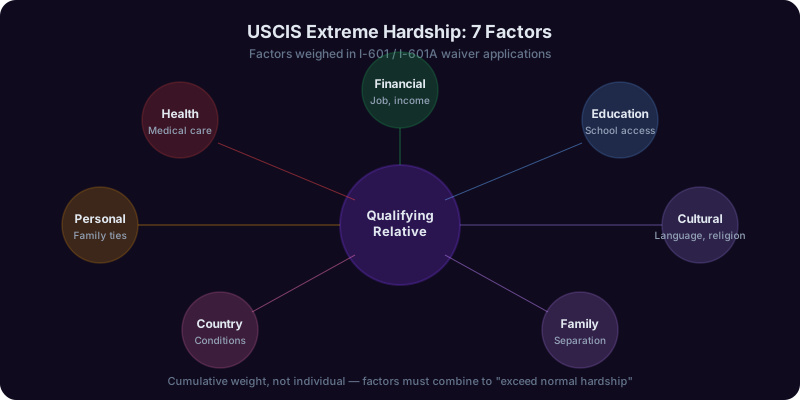
The 7 USCIS extreme hardship factors:
- Family ties - to the United States and to the country of relocation.
- Social and cultural impact - language barriers, religious freedom, integration ability.
- Economic impact - loss of employment, inability to sell home, currency or wage differentials.
- Health conditions and care - availability and quality of treatment for chronic or serious conditions in the country of relocation.
- Country conditions - Department of State travel warnings, violence, persecution risk.
- Educational opportunities - disruption to children's schooling, professional credentialing.
- Personal considerations - caregiving for elderly U.S. relatives, military service obligations, prior trauma.
The hardship letter is written by the qualifying relative, not the applicant, and describes the hardship the qualifying relative would suffer under both scenarios USCIS evaluates: (a) relocating abroad with the applicant, and (b) remaining in the U.S. without the applicant. Both scenarios must show extreme hardship; demonstrating only one is a common, fatal error.
Qualifying relative declaration excerpt:
I, [Name], a United States citizen, am the spouse of [Applicant Name] and the qualifying relative for the I-601A waiver application filed on [date]. I make this declaration under penalty of perjury under 28 U.S.C. § 1746.
Hardship if I remain in the U.S. without my spouse: I am the primary caregiver for my mother, [Name], age [#], diagnosed with [condition] (Exhibit C). I work as a [profession] earning $[amount] annually, which barely covers our mortgage of $[amount] (Exhibit D) and my mother's uncovered medication costs of $[amount]/month (Exhibit E). Without my spouse's income of $[amount], we would face foreclosure within [#] months per the attached budget (Exhibit F).
Hardship if I relocate to [country]: The Department of State Travel Advisory for [country] is Level [#] due to [reason] (Exhibit G). My medical condition, [condition], requires [treatment] which is unavailable outside major urban centers in [country] per [source] (Exhibit H). I do not speak [language] and would be unable to maintain my professional license (Exhibit I).
Critical: I-601A waivers should be prepared with an immigration attorney. A poorly written waiver can prejudice future applications, and country-conditions evidence must be current and properly sourced.
The Tone: Factual, Not Emotional - and Why It Matters
The single biggest mistake in self-written hardship letters is treating the document like a letter to a sympathetic friend. The reader is a loss mitigation specialist with 80 files on her desk, a billing supervisor working a queue, or a USCIS officer with 30 minutes per case. Emotional appeals do not improve outcomes - specificity does.
Tone rules that work:
- Use specific dollar amounts and dates. "I lost my job" is weaker than "Acme Logistics terminated my position on April 14, 2026, reducing household income from $7,200/month to $2,400/month (unemployment)."
- Show, do not tell. Instead of "this has been incredibly stressful," attach the doctor's letter documenting stress-induced hypertension and let the reader draw the conclusion.
- Demonstrate hardship is beyond your control. Job loss, medical emergency, death of co-borrower, divorce, military deployment, natural disaster - these are external causes. Overspending, business failure, and bad investments are harder to position, though not impossible if you can show market or systemic factors.
- Avoid excuse-only narratives. Every paragraph that complains about the lender, the hospital, or the system without offering a path forward weakens your position. Acknowledge the obligation. Then explain what you can do.
- Eliminate qualifiers. Cut "I think," "I feel," "hopefully," "maybe." Replace with declarative statements supported by exhibits.
- Stay in your lane. Do not threaten legal action in a hardship letter (that is what a separate demand letter or attorney engagement is for). Do not argue the law - argue the facts.
A useful self-edit: read the letter aloud. If any sentence sounds like it belongs in a personal journal, rewrite it as a fact statement with an exhibit reference. If the letter contains the phrases "please understand" or "I am desperate," delete those sentences entirely - they do not add information, and they signal weakness to a professional reader.
Common Mistakes That Sink Hardship Letters
After reviewing thousands of hardship letters across mortgage, medical, and immigration contexts, the failure patterns repeat. Avoiding these six pitfalls puts your letter in the top quartile of what decision-makers see.
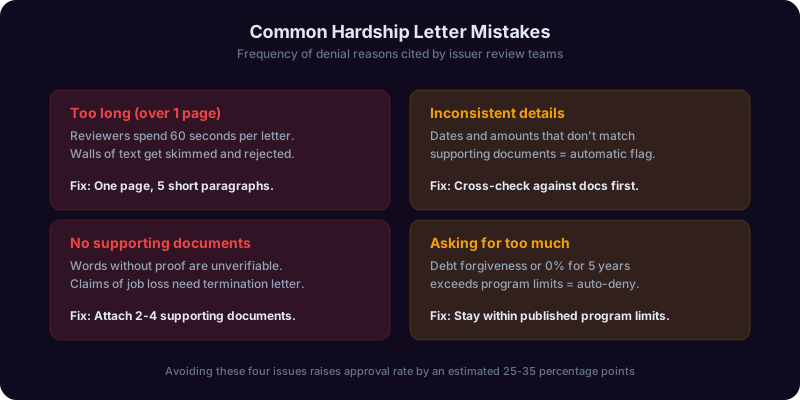
- Too long. One page for mortgage and medical. Two pages maximum for immigration declarations. Anything longer is skimmed. Cut adjectives, combine paragraphs, move detail into labeled exhibits.
- Inconsistent timelines. If the letter says you lost your job in March but the pay stubs show employment through June, the file is flagged for verification - and verification rarely resolves in the borrower's favor. Build a timeline document for yourself before writing, and cross-check every date against attached evidence.
- Omitting supporting documents. A letter that references "my medical bills" without attaching itemized statements is incomplete. Servicers and adjudicators do not request missing documents - they deny or set aside the request and move on.
- Asking for too much. Requesting 0% interest, principal forgiveness, AND a 480-month re-amortization in a single mortgage letter signals that you do not understand the program. Request what the program offers, calibrated to your numbers.
- Submitting to the wrong department. Mortgage hardship letters go to Loss Mitigation, not customer service. Medical letters go to Financial Assistance or Patient Financial Services, not the general billing line. Immigration declarations go to the USCIS lockbox or via attorney filing, not the local field office.
- Generic templates without customization. Recipients see thousands of letters. Copy-paste templates from the internet are recognized instantly. Specificity - your numbers, your timeline, your exhibits - is what differentiates a fileable application from a filler letter.
A useful pre-submission checklist: account or case number on every page, named recipient department, signed and dated, exhibit list, and a one-sentence specific ask. If any of these is missing, do not send the letter.
After Sending: Follow-Up, Escalation, and How Copilotly Customizes Your Letter
Sending the hardship letter is the beginning of the process, not the end. Each recipient type has a distinct follow-up cadence and escalation path.
Mortgage follow-up: Under CFPB Regulation X, servicers must acknowledge receipt of a loss mitigation application within 5 business days and complete review within 30 days of a complete application. Track the date of submission, request written confirmation that the application is complete, and document every phone call (name, date, time, employee ID). If denied, you have 14 days to appeal a Flex Modification denial. Escalation paths: state attorney general, CFPB complaint portal, and HUD-approved housing counselor.
Medical follow-up: Under 501(r)-6, the hospital must suspend extraordinary collection actions during application review and notify you in writing of the determination. If denied, request the written denial explanation and the appeal procedure (every FAP must have one). Escalation paths: state attorney general's consumer protection division, state hospital association complaint mechanism, and - for billing errors - the No Surprises Act IDR portal where applicable.
Immigration follow-up: I-601A processing times in 2026 range from 36 to 50 months at most service centers; check your case status weekly via the USCIS online portal and respond immediately to any RFE (Request for Evidence). An RFE is not a denial - it is an opportunity to strengthen the record, and most attorneys consider it a positive signal.
How Copilotly customizes hardship letters per recipient type: Generic templates fail because each recipient applies different standards. Copilotly's Legal Copilot takes your specific situation - loan type, hospital name, qualifying relative relationship, dollar amounts, hardship cause - and generates a letter calibrated to the exact framework that recipient applies (Flex Mod, FAP, I-601A factors). It produces the exhibit list, the cover letter, and the follow-up correspondence as a single packet. For most users, that turns a multi-week drafting effort into a focused review session of 30 to 60 minutes - without giving up the legal review step.
Legal disclaimer (repeated): Hardship letters used in regulated processes can have permanent consequences. For I-601A waivers, foreclosure mediation, tax settlements, and any matter where rights may be waived or admitted, consult a licensed attorney in your jurisdiction before submission. This guide is educational and does not establish an attorney-client relationship.
Frequently Asked Questions
Recommended Copilots
Get Answers From the Legal Copilot
Copilotly's Legal Copilot tailors your hardship letter to the exact recipient - loan servicer, hospital billing office, or USCIS adjudicator - using the standards each one actually applies.