
What Each Structure Means
Before comparing them, you need to understand what each business structure actually is and what it does (and does not) provide.
Sole proprietorship. This is the default. If you earn money from a side business and do nothing to formalize it, you are a sole proprietor. There is no formation process, no state filing, and no legal separation between you and your business. You report business income on Schedule C of your personal tax return. You can operate under your own name or file a DBA ("doing business as") to use a business name, which typically costs $10-$50 at the county level.
A sole proprietorship is not a legal entity. It is simply you, doing business. Your Social Security number is your business tax ID (though you can get a free EIN from the IRS if you prefer not to share your SSN with clients). You own all the assets, receive all the profits, and bear all the liabilities. There is no legal separation between your personal and business finances.
Limited Liability Company (LLC). An LLC is a separate legal entity created by filing formation documents with your state. It provides a legal wall between your personal assets and business liabilities. If someone sues your LLC, they can generally only go after the business assets, not your personal savings, home, or car (with important exceptions discussed below).
An LLC can have one owner (single-member LLC) or multiple owners (multi-member LLC). A single-member LLC is taxed as a sole proprietorship by default (the IRS treats it as a "disregarded entity"), meaning the tax filing is identical to a sole proprietorship. The key difference is liability protection, not tax treatment.
Many side business owners are confused by this: forming an LLC does not automatically change how you are taxed. You still file Schedule C. The LLC's value is the legal protection, not a tax advantage (unless you elect S-Corp taxation, covered later in this guide).
For related guidance on pricing your services as a sole proprietor or LLC, see our freelance rate calculator guide. The Business Formation Copilot can walk you through whether an LLC makes sense for your specific side business based on your revenue, risk profile, and state.
Liability Protection Comparison
Liability protection is the primary reason to form an LLC. Here is what it actually protects against and where the protection has limits.
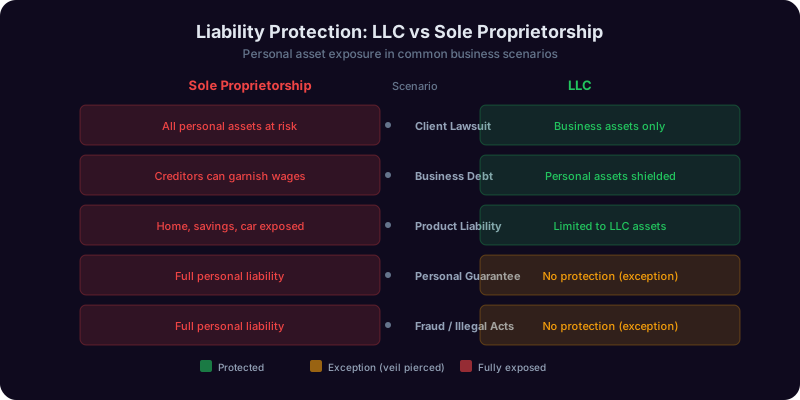
Sole proprietorship liability: You are personally liable for everything. If a client sues your business for breach of contract and wins a $50,000 judgment, they can collect from your personal bank accounts, garnish your wages from your day job, and in some states, place a lien on your home. If your business takes on debt and cannot pay, creditors come after your personal assets. There is zero legal separation.
LLC liability protection: An LLC creates a legal shield. Business debts and lawsuits are generally limited to LLC assets. If your LLC is sued and the judgment exceeds your business assets, your personal savings, home equity, retirement accounts, and other personal property are typically protected.
When LLC protection fails ("piercing the corporate veil"):
- Commingling funds. If you mix personal and business money (using your business account for personal expenses or vice versa), a court can disregard your LLC's protection. This is the most common reason LLCs fail to protect their owners.
- Personal guarantees. If you personally guarantee a business loan or lease (common for small businesses), the LLC does not protect you from that specific obligation.
- Fraud or illegal activity. An LLC does not protect you from personal liability for your own fraudulent or criminal actions.
- Inadequate capitalization. If your LLC has no real assets or insurance and was formed primarily to avoid liability rather than operate as a real business, courts may disregard it.
- Failure to maintain formalities. Not keeping LLC records, skipping annual filings, or not maintaining a registered agent can weaken your protection.
Practical risk assessment. Ask yourself: What is the realistic worst-case scenario for my side business? A freelance writer's worst case might be a client dispute over a $2,000 invoice. A freelance contractor who works on people's homes faces potential lawsuits for property damage or personal injury worth hundreds of thousands. The higher the potential liability, the more valuable LLC protection becomes.
| Business Type | Liability Risk | LLC Recommendation |
| Freelance writing, design, consulting | Low | Optional (professional liability insurance may suffice) |
| E-commerce (physical products) | Moderate | Recommended |
| Services involving physical presence (cleaning, repair, training) | High | Strongly recommended |
| Professional services (legal, medical, financial advice) | High | Required in most states (PLLC) |
Tax Implications (With Real Numbers)
This is where most side business owners get confused. Here is the truth: a single-member LLC and a sole proprietorship are taxed identically by default. The IRS ignores the LLC structure and taxes the income as self-employment income on your personal return. So forming an LLC alone does not save you taxes.
How self-employment taxes work (both structures). All net business income is subject to self-employment tax (Social Security 12.4% + Medicare 2.9% = 15.3%) on the first $168,600 of net earnings (2026 limit). Above that, only the 2.9% Medicare tax applies (plus 0.9% Additional Medicare Tax above $200,000 for single filers).
Real numbers example:
| Scenario | Sole Proprietorship | Single-Member LLC (default) |
| Gross revenue | $80,000 | $80,000 |
| Business expenses | -$15,000 | -$15,000 |
| Net business income | $65,000 | $65,000 |
| Self-employment tax (15.3%) | $9,195 | $9,195 |
| Deductible half of SE tax | -$4,598 | -$4,598 |
| QBI deduction (20% of $60,402) | -$12,080 | -$12,080 |
| Taxable income (business only) | $48,322 | $48,322 |
| Federal income tax (est., 22% bracket) | $6,635 | $6,635 |
| Total federal tax | $15,830 | $15,830 |
Notice: the numbers are identical. The LLC provides no tax benefit in its default configuration.
When taxes do differ: state-level. Some states impose additional taxes on LLCs that sole proprietors do not pay. California charges an $800 annual franchise tax on all LLCs regardless of income (this alone makes an LLC costly for very small side businesses). Texas has a franchise tax for LLCs with revenue above $2.47 million. Other states (Wyoming, New Mexico, most others) have no additional LLC taxes beyond the filing fee.
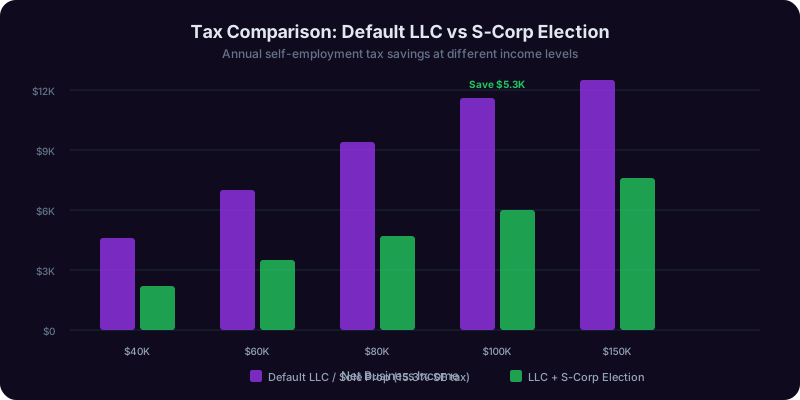
The real tax advantage: S-Corp election. An LLC can elect to be taxed as an S-Corp (covered in detail later), which can save significant self-employment taxes at higher income levels. This is the only structural tax advantage an LLC provides, and it only makes sense once your net business income exceeds roughly $50,000-$60,000 per year.
The Tax Copilot can run your specific numbers to show the actual tax impact of each structure based on your income, state, and filing status.
See our real-world walkthrough: first freelance tax season.

Get Answers From the Business Formation Copilot
Tell the Business Formation Copilot your income, state, risk level, and goals - get a recommendation on LLC vs sole proprietorship with state-specific filing steps.
Formation Costs by State
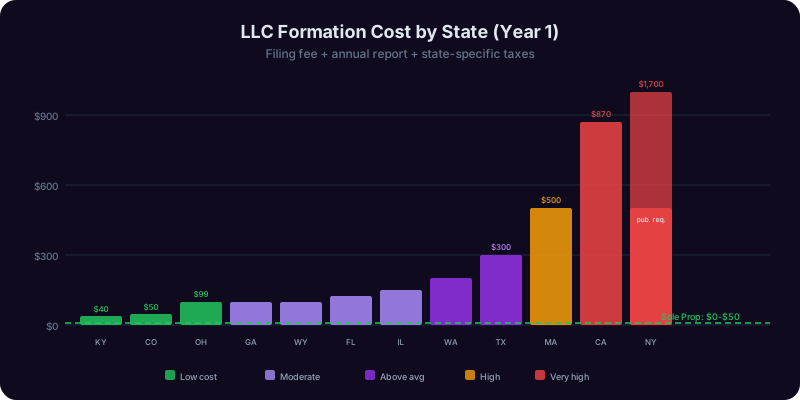
LLC formation costs vary dramatically by state. Here are the actual filing fees and ongoing costs for the most popular states as of 2026.
Initial LLC formation fees (state filing only):
| State | Filing Fee | Annual/Biennial Report | Additional Taxes | Total Year 1 Cost |
| Alabama | $200 | None (but $100 business privilege tax) | Business privilege tax | $300 |
| California | $70 | $20 (biennial) | $800 franchise tax | $870 |
| Colorado | $50 | $10/year | None | $50 |
| Delaware | $90 | $300/year | None | $90 |
| Florida | $125 | $138.75/year | None | $125 |
| Georgia | $100 | $50/year | None | $100 |
| Illinois | $150 | $75/year | None | $150 |
| Kentucky | $40 | $15/year | None | $40 |
| Massachusetts | $500 | $500/year | None | $500 |
| Michigan | $50 | $25/year | None | $50 |
| New York | $200 | $9 (biennial) | Publication requirement ($300-$1,500+) | $500-$1,700 |
| North Carolina | $125 | $200/year | None | $125 |
| Ohio | $99 | None | None | $99 |
| Pennsylvania | $125 | $70 (decennial) | None | $125 |
| Texas | $300 | $0 (franchise tax report, free if under $2.47M) | Franchise tax if applicable | $300 |
| Virginia | $100 | $50/year | None | $100 |
| Washington | $200 | $60/year | None | $200 |
| Wyoming | $100 | $60/year (minimum) | None | $100 |
Additional costs to budget for:
- Registered agent service: $50-$300/year (required in all states; you can be your own registered agent in your home state, but a service provides privacy and reliability)
- Operating agreement: $0 (DIY) to $500-$1,500 (attorney-drafted). Single-member LLCs can use a simple template. Multi-member LLCs should invest in an attorney-drafted agreement.
- EIN: Free from the IRS (irs.gov). Never pay a third-party service for this. You can apply directly at irs.gov.
- Business bank account: Free to $25/month depending on the bank. Essential for maintaining liability protection.
- LLC formation services: $0 (file yourself) to $50-$500 (LegalZoom, ZenBusiness, Northwest Registered Agent). Filing yourself is straightforward in most states.
For a sole proprietorship, the formation cost is $0 (or $10-$50 for a DBA if you want a business name). This cost difference matters most for very early-stage side businesses generating minimal revenue. The Freelance Copilot can help you determine whether the LLC cost is justified at your current revenue level.
Ongoing Compliance Requirements
An LLC comes with ongoing administrative requirements that a sole proprietorship does not. Understanding these before forming an LLC helps you decide whether the overhead is worth the protection.
Sole proprietorship compliance:
- File Schedule C with your personal tax return (annually)
- Pay quarterly estimated taxes if you expect to owe $1,000+ (4 times per year)
- Renew business licenses and permits (varies by locality, typically annually)
- Renew DBA if applicable (varies, typically every 5 years)
That is essentially it. Sole proprietorships have minimal administrative overhead, which is one of their biggest advantages.
LLC compliance:
- Everything above (the tax filing is the same for a default single-member LLC)
- Annual or biennial report. Most states require LLCs to file an annual report (sometimes called a statement of information). This is typically a one-page form confirming your business address, registered agent, and member/manager information. Fees range from $0 to $500 depending on the state. Missing this deadline can result in your LLC being administratively dissolved, which eliminates your liability protection.
- Maintain a registered agent. Your LLC must have a registered agent with a physical address in the state of formation. If you use a service, this is a recurring annual fee ($50-$300).
- Keep records. While single-member LLCs have fewer formality requirements than corporations, you should maintain an operating agreement, records of major business decisions, and separate financial records. This is not legally required in all states but is essential for maintaining the liability protection.
- Separate bank account. Not legally required in all states, but practically essential. Commingling personal and business funds is the fastest way to lose your LLC's liability protection. Open a dedicated business checking account and run all business transactions through it.
- State-specific requirements. Some states have unique requirements. California requires an annual $800 franchise tax minimum. New York requires publication in two newspapers for 6 weeks after formation ($300-$1,500+ depending on county). Illinois requires an annual report. Check your specific state's requirements before forming.
What happens if you fall behind. If you miss your annual report or fail to maintain your registered agent, your state can administratively dissolve your LLC. This does not close your business, but it does remove your liability protection until you reinstate (which usually involves back fees plus a reinstatement fee of $50-$250). Set calendar reminders for all filing deadlines.
The ongoing compliance takes roughly 2-4 hours per year for a simple single-member LLC. It is not burdensome, but it is not zero, and you need to stay on top of it.
When to Switch From Sole Proprietorship to LLC
You do not need an LLC on day one. In fact, forming too early wastes money (especially in high-fee states like California or Massachusetts). Here are the specific triggers that indicate it is time to make the switch.
Revenue threshold. Once your side business generates consistent revenue of $10,000-$20,000+ per year, the cost of an LLC ($100-$300/year in most states) becomes negligible relative to the protection it provides. Below this level, the filing fees may not be worth it unless your business carries significant liability risk.
Client-facing work with meaningful contracts. If you are signing contracts worth $5,000+ or working with clients who have legal teams, an LLC adds credibility and protection. Some enterprise clients and government agencies require contractors to operate as a formal business entity.
Physical products or services. If you sell physical products, the moment a defective product injures someone, you face potential personal liability. If you provide services where mistakes could cause financial harm (consulting, bookkeeping, marketing), the risk profile increases. An LLC becomes more important as the potential consequences of a mistake grow.
Hiring help. If you bring on employees or even independent contractors, an LLC is strongly recommended. Employment-related lawsuits are among the most common business liabilities, and you want that separation between your business and personal assets.
Real assets to protect. If you own a home, have significant savings, or have other assets a creditor could target, the protection matters more. A 22-year-old renting an apartment with $3,000 in savings has less to protect than a 35-year-old with $200,000 in home equity and $50,000 in retirement savings.
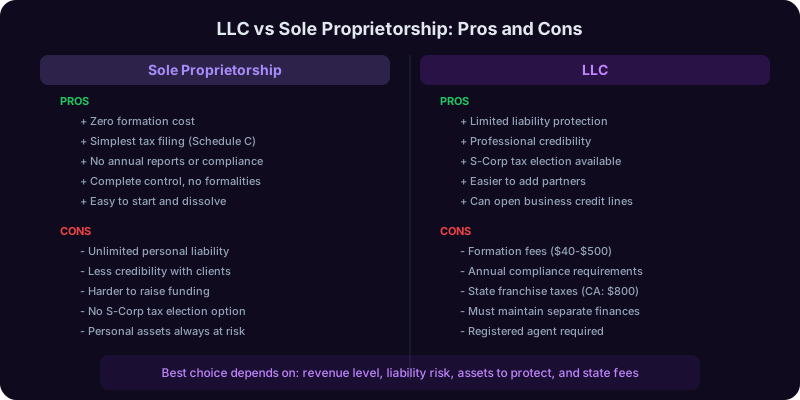
The practical switching process:
- Choose your state (usually your home state for a small business)
- File Articles of Organization with your state ($40-$500 depending on state)
- Get an EIN from the IRS (free, takes 5 minutes online)
- Draft an operating agreement (use a template for single-member)
- Open a business bank account
- Update contracts, invoices, and client communications to reflect your LLC name
- Notify existing clients of the entity change
The entire process takes 1-3 hours of active work plus 1-7 days for state processing. Many states offer expedited processing for an additional $50-$100. The Business Formation Copilot can guide you through the filing process step by step for your specific state.
S-Corp Election Explained
The S-Corp election is where the real tax savings happen for higher-earning side businesses. It is not a separate business structure. It is a tax election that an LLC can make with the IRS, changing how income is taxed.
How it works. Without S-Corp election, all net LLC income is subject to self-employment tax (15.3%). With S-Corp election, you pay yourself a "reasonable salary" (subject to payroll taxes), and the remaining profit passes through as a distribution (not subject to self-employment tax).
Real numbers comparison at $100,000 net income:
| Item | Default LLC (sole prop taxation) | LLC with S-Corp election |
| Net business income | $100,000 | $100,000 |
| Reasonable salary | N/A | $50,000 |
| Distribution (not subject to SE tax) | N/A | $50,000 |
| Self-employment tax (15.3%) | $14,130 | $0 |
| Payroll taxes on salary (15.3%) | $0 | $7,650 |
| Payroll processing costs | $0 | $500-$1,200/year |
| Net SE/payroll tax | $14,130 | $8,150-$8,850 |
| Annual savings | - | $5,280-$5,980 |
At $100,000 net income, the S-Corp election saves roughly $5,000-$6,000 per year in self-employment taxes. The savings increase as income rises (up to the Social Security wage base of $168,600).
When S-Corp election makes sense:
- Net business income consistently exceeds $50,000-$60,000 per year
- The tax savings exceed the additional costs (payroll service, additional tax return, potentially higher accounting fees)
- You are committed to running payroll (you must pay yourself a W-2 salary, which means withholding, quarterly filings, and year-end W-2s)
When it does not make sense:
- Net income below $40,000 (the payroll costs eat the savings)
- Income is highly variable (you must pay a "reasonable salary" even in slow months)
- You want simplicity (S-Corp adds significant administrative complexity)
The "reasonable salary" requirement. The IRS requires your salary to be reasonable for the work you do. You cannot pay yourself $20,000 and take $80,000 as a distribution. The general guideline: your salary should be what you would pay someone to do the same work. For most small business owners, 40-60% of net income as salary is a defensible range. The IRS audits S-Corps that pay unreasonably low salaries.
The Tax Copilot can calculate your exact S-Corp savings based on your income level and help you determine a defensible reasonable salary.
Decision Framework: Which Structure Is Right for You?
Use this framework to make your decision. Answer each question honestly based on your current situation, not where you hope to be in 5 years. You can always form an LLC later when the numbers justify it.
Stay a sole proprietorship if:
- Your side business revenue is under $10,000/year
- Your liability risk is low (digital services, writing, design with no physical product)
- You have minimal personal assets to protect
- You want maximum simplicity and minimum cost
- You are still testing whether this side business is viable
Form an LLC (default taxation) if:
- Revenue exceeds $10,000-$20,000/year consistently
- Your business involves physical products, in-person services, or meaningful liability exposure
- You have personal assets (home, savings, retirement) worth protecting
- You are signing contracts with clients worth $5,000+
- Your state's LLC fees are reasonable (under $300/year total)
Form an LLC with S-Corp election if:
- Net business income consistently exceeds $50,000-$60,000/year
- You are willing to handle payroll administration
- You plan to continue this business long-term
- You are comfortable with additional accounting complexity
The step-by-step decision flowchart:
- Is your side business earning consistent revenue? If no, stay sole prop.
- Does your business have meaningful liability risk? If yes, form an LLC regardless of revenue.
- Is your net income above $20,000/year? If yes, seriously consider an LLC.
- Is your net income above $50,000/year? If yes, evaluate S-Corp election with an accountant.
- Are you in California? Factor in the $800 annual franchise tax. An LLC may not make sense until revenue is well above $20,000.
Common mistakes to avoid:
- Forming an LLC in Delaware or Wyoming for a local business. Unless you have a specific legal reason, form in your home state. Out-of-state LLCs must register as foreign LLCs in states where they do business, doubling your filing fees and compliance requirements.
- Paying $500+ for LLC formation services. Filing directly with your state costs $40-$300. Formation services that charge $500+ are overcharging for a simple filing.
- Skipping the operating agreement. Even for a single-member LLC, an operating agreement establishes your business as a legitimate entity and can strengthen your liability protection.
- Forgetting to maintain separation. The LLC is only as strong as your discipline in keeping personal and business finances separate.
Still unsure? The Business Formation Copilot can walk you through this decision framework with your specific numbers, state, and business type to give you a personalized recommendation.
For more on this topic, read our guide on Freelance Rate Calculator: The Complete Guide to Pricing Your Services.
Frequently Asked Questions
Recommended Copilots
Recommended Copilots
Get personalized guidance on the best business structure for your specific situation
Try Free →Compare the tax implications of LLC vs sole proprietorship for your income level
Try Free →Understand the liability protection differences and state-specific requirements
Try Free →Continue Exploring
Related Scenarios
Related Articles
Get Answers From the Business Formation Copilot
Tell the Business Formation Copilot your income, state, risk level, and goals - get a recommendation on LLC vs sole proprietorship with state-specific filing steps.