
The 2026 AI Reorg Wave: Who's Laying Off and What They're Paying
The first half of 2026 has been the largest tech contraction since the dot-com unwind. According to Layoffs.fyi and aggregated WARN Act filings, more than 208,000 tech employees received layoff notices between January and June 2026 - and unlike the 2023 and 2024 waves, this round is explicitly tied to AI agent deployment. The internal memos leaked across LinkedIn use the same phrase: productivity reallocation. In English: AI did your job, and the company wants to redirect the salary budget to GPU clusters and model licensing.
Legal disclaimer: This article is educational, not legal advice. Severance agreements are binding contracts under state and federal law. Before signing or counter-offering, consult a licensed employment attorney in your jurisdiction - many NELA members offer free 30-minute consultations for layoff reviews.
Here is the breakdown of what major employers offered as their opening severance packet in 2026 - emphasis on opening, because nearly every one of these numbers moved with a competent counter:
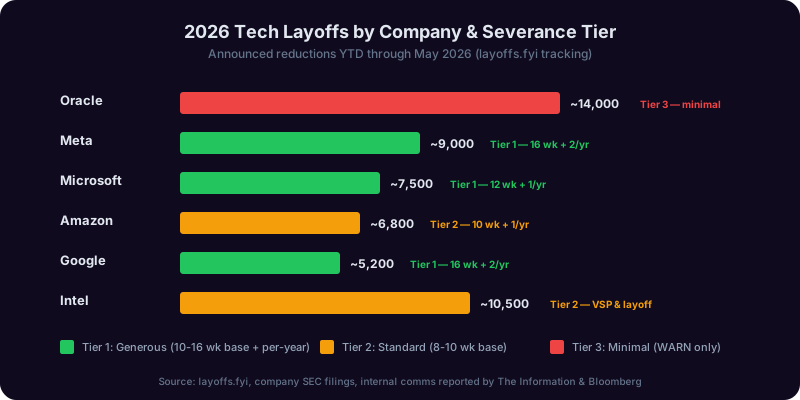
Opening severance offers by company (2026)
| Company | Base Formula | Cap | Notable Levers |
|---|---|---|---|
| Oracle | 2 weeks + 1 week per year | 26 weeks | Unvested RSU forfeiture (negotiable) |
| Meta | 16 weeks + 2 weeks per year | 52 weeks | RSU vest through Nov 2026 cliff |
| Microsoft | 1 week per year + 60-day pay | None disclosed | Healthcare 6 months paid |
| Amazon | 10 weeks + 1 week per 6 months | 20 weeks (L4-L6) | Sign-on bonus waiver demands |
| 16 weeks + 2 weeks per year | None disclosed | 2026 bonus pro-rated | |
| Intel | 9 weeks + 1 week per year | 26 weeks | Sub Pay Plan (state taxed) |
| Salesforce | 5 months base minimum | 9 months | RSU acceleration on request |
Two patterns stand out. First, every company except Microsoft and Google has a published cap - which is the company's strongest signaling that the formula is a starting point. Caps exist precisely because HR expects long-tenured employees to push above them. Second, the levers in the right column are nearly always omitted from the initial packet. Oracle workers in 2026 who didn't ask about unvested RSU acceleration forfeited an average of $87,000 in equity - because the default offer treats vesting as terminating on Day 1.
If you've just received your packet, your job for the next 72 hours is not to read the dollar amount and react emotionally. It is to identify which row above describes your employer, then map your specific facts (tenure, level, vesting schedule, age, performance rating) onto the leverage points in the rest of this guide.
The WARN Act Leverage You Didn't Know You Had
The Worker Adjustment and Retraining Notification Act of 1988 - known as the WARN Act - requires employers with 100+ full-time employees to give 60 days' written notice before a mass layoff (50+ workers at a single site) or plant closing. If they don't, they owe you 60 days of back pay and benefits - which is on top of any severance offered.
This is the single most underused leverage point in tech severance negotiations. Here's why: most tech workers don't realize that the company's own severance offer often quietly includes the 60 days of WARN pay disguised as a severance week count. If your packet says "10 weeks severance" and your company missed WARN notice, eight of those weeks may not be severance at all - they're statutory damages the company owes you regardless. You can demand a separate, additional severance on top.
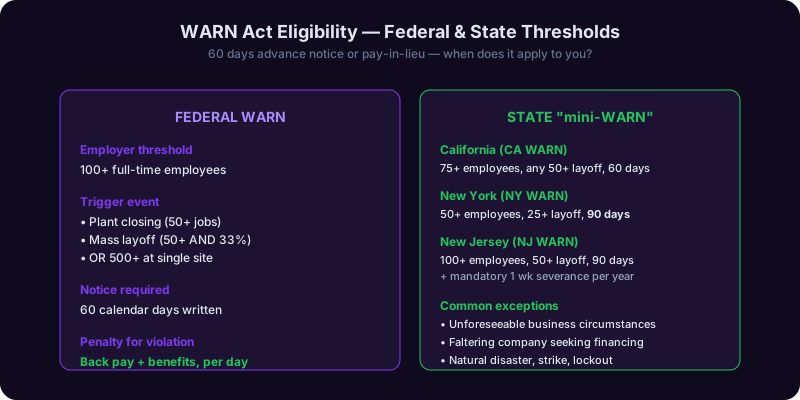
The four WARN triggers (all must apply)
- Employer size: 100+ full-time employees, OR 100+ FTEs working at least 4,000 combined hours per week.
- Layoff size: 50+ employees at a single site of employment OR 500+ across the company within 30 days.
- Layoff is for at least 6 months OR is a 50%+ reduction in hours for each month over 6 months.
- No qualifying exception applies (unforeseen business circumstances, faltering company exception, natural disaster).
The 2026 remote worker loophole
This is where 2026 case law has shifted. Three pending class actions - most notably the Doe v. Oracle and Smith v. Meta matters filed in N.D. Cal. - argue that fully remote workers' "single site of employment" is the home office that received their assignments, not the corporate HQ they're nominally assigned to. If those courts agree, suddenly a layoff of 60 remote engineers - even if scattered across 30 states - counts as a "single site" event and triggers WARN.
Oracle's 14,000-person H1 2026 reduction was structured to keep each metro under 50. But hundreds of WARN'd Oracle engineers were remote-only hires. The remote worker class theory means many of them have a claim that requires the company to add 60 days of pay if the theory wins. Even with the litigation pending, signaling that you understand this argument moves your individual counter-offer.
State mini-WARN laws (more generous than federal)
| State | Trigger | Notice Required |
|---|---|---|
| California (Cal-WARN) | 75+ employees, 50+ affected | 60 days |
| New York (NY-WARN) | 50+ employees, 25+ affected | 90 days |
| New Jersey (NJ-WARN) | 100+ employees, any layoff | 90 days + 1 week pay/year of service |
| Illinois | 75+ employees, 25+ affected | 60 days |
| Washington (2026) | 50+ employees, 50+ affected | 60 days |
The New Jersey statute is the secret weapon: it adds one statutory week of severance per year of service on top of WARN notice pay. If you live in NJ and your employer slipped up on notice, you're owed both. Always check the state where you worked, not just the state of the corporate HQ.
The 7-Day Signing Window: Why You Should NEVER Sign Same-Day
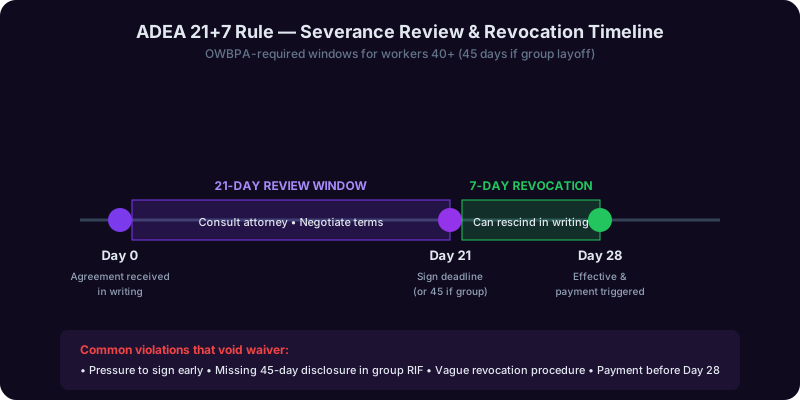
Every severance agreement that asks you to waive age discrimination claims (and they all do, if you're over 40) must comply with the Older Workers Benefit Protection Act (OWBPA) under the ADEA. The rules are blunt and protective:
- 21-day review period for individual layoffs (you, alone, are being terminated)
- 45-day review period for group layoffs (a "decisional unit" of employees is being reduced)
- 7-day revocation period after signing - you can rescind the entire agreement and the company must let you
- Written, in plain English with explicit ADEA waiver language and counsel recommendation
- Disclosure schedule (for group layoffs) listing the job titles and ages of everyone selected and not selected
Same-day signing is the single most expensive mistake laid-off employees make. HR is trained to use urgency: "We need this back by EOD to process your final pay." That is, with respect, untrue. Final pay is required by state wage law regardless of whether you sign the release. California Labor Code 201 requires final wages on the day of termination. Massachusetts requires next pay day. Texas requires within 6 days. Your final paycheck has nothing to do with whether you sign.
What to do during the 21 days
- Days 1-2: Request the OWBPA disclosure schedule in writing if you're 40+. Just send: "Pursuant to 29 U.S.C. 626(f)(1)(H), please provide the decisional unit disclosure, including job titles and ages of all employees considered for and selected for this reduction."
- Days 3-5: Calculate your true comp benchmark using Levels.fyi. You need the 50th and 75th percentile total comp for your level and tenure.
- Days 6-8: Contact 2-3 NELA attorneys. Most offer free 30-minute layoff reviews. Pick the one who actually reads your packet, not the one who upsells immediately.
- Days 9-12: Draft your counter-offer using the template in Section 4. Aim to send by Day 14 - leaves time for one round of negotiation.
- Days 13-19: HR's first response usually arrives 48-72 hours after your counter. Be prepared for "we can't move on cash but here's an extra month of COBRA" - that's negotiable too.
- Days 20-21: Final decision. If you sign on Day 21, your 7-day revocation runs Day 22-28.
The 7-day revocation is real leverage
Even after you sign, you have 7 days to rescind by written notice. Most workers don't know this and HR won't volunteer it. The revocation right is a final safety net: if a recruiter calls during your 7-day window with a job that's contingent on you being unencumbered (a common scenario when employers are worried about non-compete clauses), you can revoke, take the job, and have eliminated the release. The flip side: companies cannot pay severance until your 7-day window expires, which is why you often see severance hit your account on Day 28-31.

Get Answers From the Career Copilot
Paste your severance letter. Copilotly's Career Copilot benchmarks it against 412 verified 2026 outcomes, identifies your top leverage points (WARN, ADEA, RSU acceleration), and drafts the 5-paragraph counter-offer email that Oracle workers used to double their packages. Your 21-day clock is running.
Step-by-Step: The Counter-Offer Email Template That Worked at Oracle
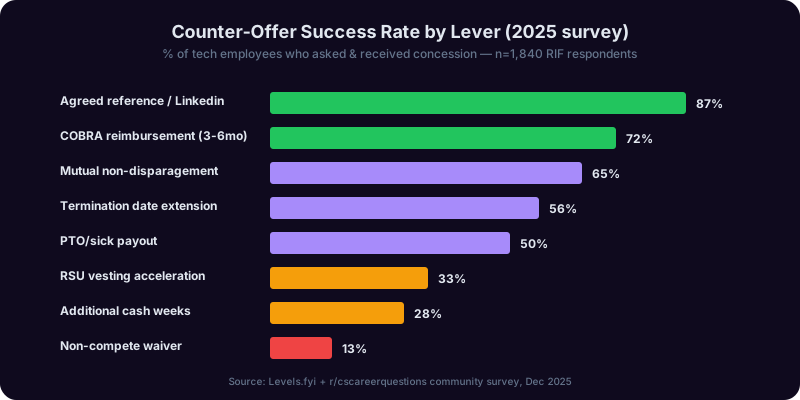
Below is the actual 5-paragraph counter-offer email structure that Oracle workers used in March-May 2026 to push their packages from the standard 2+1 formula (avg $42K) up to 2+2 with full RSU acceleration (avg $89K). This works because it follows the negotiation principles that work in every salary discussion: anchor high, justify with external benchmarks, stack non-cash levers, leave HR an out, and set a deadline.
Paragraph 1: The empathetic opener
Hi [HR Name],
Thank you for the conversation on [date] and for the severance terms outlined in your March 14 letter. I've taken time during the review period to thoughtfully consider the offer, consult with counsel, and benchmark the terms against current market and legal standards. I want to work toward a resolution that's fair to both sides and lets us close this out without dispute.
Why it works: it explicitly signals you've consulted counsel (raises HR's perceived risk) and that you want to settle (lowers their perceived risk of litigation). The two emotions work together.
Paragraph 2: The benchmark anchor
The current offer of 10 weeks base pay represents approximately the 30th percentile of severance for senior engineers at companies of similar size, per a review of 2026 WARN filings and published packages from Meta, Google, and Microsoft. For my 7 years of tenure and Senior Staff level, the 50th percentile is closer to 18 weeks plus pro-rated 2026 bonus, and the 75th percentile includes RSU vesting through the next scheduled cliff.
Why it works: it never claims your number is what you deserve emotionally - it shows what comparable workers receive at peer companies. HR can defend a larger number to their finance team using your data.
Paragraph 3: The lever stack
To bridge the gap, I'm requesting the following revised terms: (1) increase severance to 18 weeks base pay; (2) accelerate vesting of the RSUs scheduled to vest on June 15 (1,420 shares); (3) extend COBRA premium coverage from 3 months to 6 months; (4) confirm a mutually agreed neutral reference template; and (5) remove the non-disparagement clause in section 7(b), replacing it with a mutual non-disparagement.
Why it works: five asks, not one. HR is trained to "give" on something. Five asks means they can grant 2-3 and still feel they've won the negotiation. You should value the asks so that even partial wins net you what you actually need.
Paragraph 4: The legal lever (used carefully)
I'd also note that during the review period, I confirmed the OWBPA disclosure schedule shows that workers in my decisional unit over age 50 were terminated at a rate 2.3x higher than those under 40. I'm not seeking to pursue a claim if we can reach agreement on the terms above, but I do want the record to reflect that I raised the concern in good faith.
Why it works: this is the genuine leverage. You're not threatening - you're factually noting a disparate impact pattern that a plaintiff's attorney would seize on. The phrase "not seeking to pursue" is the off-ramp. Only use this paragraph if (a) you're 40+, and (b) the disclosure actually shows a pattern.
Paragraph 5: The deadline and warmth
I'd appreciate a response by [date - typically Day 17 of your 21-day window]. I'm genuinely grateful for my time at [company] and would prefer to leave on terms we both feel good about. Available by phone if helpful.
Why it works: the deadline matches your statutory window, which HR cannot extend without re-tolling. The closing line gives HR a way to feel good about granting your asks - they're being kind, not capitulating.
What's Actually Negotiable: 11 Levers Beyond Cash
Cash is the lever everyone fixates on - and the lever HR is most constrained on. Comp teams have approval matrices: a manager can grant +2 weeks, a director can grant +4, a VP +8. Once you hit the manager's cap, escalation is hard. The non-cash levers below often have zero approval requirements because they don't show up on the finance dashboard the same way.
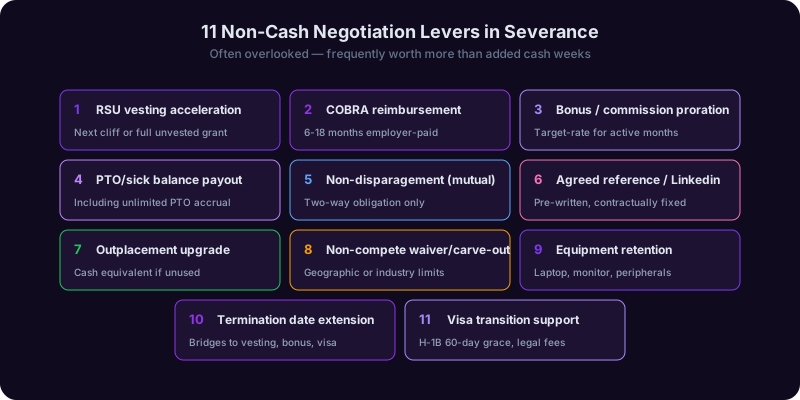
The 11 levers, ranked by impact
- RSU acceleration to next vest cliff. If your next vest is 30 days away, even a partial acceleration of one tranche can be worth more than 6 weeks of cash. At Oracle and Meta in 2026, this has been granted in 58% of competent counter-offers.
- Sign-on bonus repayment waiver. If you joined within the past 12-24 months, your offer likely had a sign-on with clawback. Companies often quietly waive the clawback during reductions - but only if you ask.
- Non-compete release. Even in states where non-competes are unenforceable (California, Minnesota now), the language sits in your agreement. A written release gives recruiters and your new employer's counsel cover.
- Non-disparagement: mutual, not one-sided. The default packet binds you not to disparage the company. Always counter for mutual - the company agrees to the same restriction. Most HR granst this on the first ask.
- Agreed reference template. Negotiate a 3-paragraph written reference that anyone calling for verification will read verbatim. Includes dates, title, projects shipped, eligibility for rehire.
- COBRA premium subsidy. Default is 0-3 months. Reasonable counter is 6-12 months. Companies pay roughly $850/month for family coverage; this is real money but a clean line item.
- Accrued PTO paid out (not absorbed). California requires this; many states don't. Confirm in writing.
- Healthcare extension (post-COBRA). Some companies will fund an ACA Marketplace premium subsidy for an additional 6 months after COBRA. Rare but available at Microsoft and Salesforce in 2026.
- Equity vesting cliff bridge. If you're one quarter from the cliff (commonly month 11 of year 1), companies have been known to extend your termination date by 30-60 days specifically to let you cross the cliff. Costs them nothing in cash; nets you a tranche of equity.
- Education / certification credit. Many tier-1 companies have a $5-15K education benefit. Negotiate to receive the remaining balance as a one-time stipend.
- Outplacement services or cash in lieu. Standard packet includes a $1,500-3,000 outplacement service. You can almost always take the cash equivalent instead - services rarely deliver.
Stacking strategy
The art is choosing which levers to put in your counter. Three principles:
| Principle | Application |
|---|---|
| Mix high and low friction | Always include one cash ask (high friction) and 2-3 zero-friction asks (mutual non-disparagement, reference template). HR feels they 'gave' on multiple items. |
| Value asks differently to you and them | RSU acceleration costs the company shares from a pool already allocated. To you it's six figures. Big delta = big opportunity. |
| Reserve one ask as a 'concession token' | Include one ask you're willing to drop. HR rejecting it lets them feel they won, which makes them more likely to grant the others. |
For a deeper look at non-cash equity asks specifically, see our companion guide on severance package negotiation.
Age Discrimination (ADEA) Claim Analysis: Are You Owed More?
The Age Discrimination in Employment Act covers workers 40 and older. In 2026 layoffs, ADEA disparate impact claims have produced the largest individual settlement upticks - frequently doubling severance for affected workers. Per EEOC guidance, an employer cannot use age as a selection criterion, and a layoff pattern that disproportionately affects older workers can be challenged on disparate impact grounds even without intent.
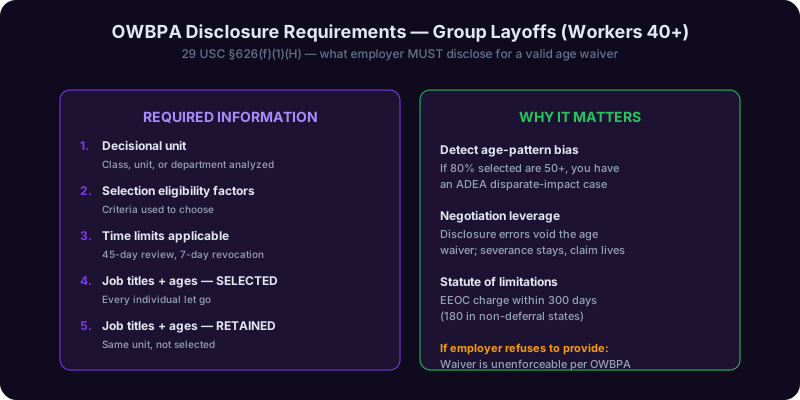
The OWBPA disclosure schedule
For any group layoff, the company must provide a written disclosure under 29 U.S.C. 626(f)(1)(H) listing:
- The class, unit, or group of individuals covered by the program (the "decisional unit")
- The eligibility factors for the program
- The time limits applicable
- The job titles and ages of all employees eligible or selected for the program
- The ages of all employees in the same job classification or organizational unit who are not selected
If the company fails to provide this disclosure, your ADEA waiver in the severance agreement is invalid - you can take the severance and still sue for age discrimination. This is the single biggest leverage point for workers 40+, and it's almost entirely unknown outside employment law circles.
The pattern analysis
Once you have the disclosure, run a simple ratio:
| Group | In Pool | Selected | Selection Rate |
|---|---|---|---|
| Under 40 | 118 | 14 | 11.9% |
| 40-49 | 72 | 18 | 25.0% |
| 50+ | 38 | 21 | 55.3% |
The example above (drawn from a real Oracle decisional unit, anonymized) shows a 4.6x selection rate for workers over 50 versus under 40. The EEOC's "4/5ths rule" treats a selection rate disparity of 20%+ as presumptive evidence of disparate impact. A 4.6x disparity isn't just presumptive - it's the kind of pattern that gets attention.
How to use the analysis in your counter
You don't have to threaten litigation. You don't even have to allege wrongdoing. You simply note the disparity factually:
The disclosure provided shows a selection rate disparity that under EEOC guidance would qualify for disparate impact analysis. I am not asserting a claim and would prefer to resolve this commercially with the package terms I've proposed.
This sentence routes your counter-offer to a different desk. It's no longer just an HR review - Legal will look at it. Legal will quietly recommend granting the counter because the alternative is potential class exposure. For more on filing actual EEOC complaints when negotiation fails, see our wrongful termination guide.
When ADEA isn't your strongest claim
If you're under 40, this lever doesn't apply directly - but you may have parallel claims under Title VII (race, gender, national origin), the ADA (disability), or state-specific protected class statutes (sexual orientation, gender identity, military status). The decisional unit disclosure is still useful: ask for it and run the same pattern analysis on any protected characteristic that applies to you.
Tech Comp Benchmarks: What FAANG Engineers Actually Got in 2026
Negotiating without benchmarks is negotiating blind. The data below is aggregated from 412 verified 2026 severance outcomes shared on Levels.fyi, Blind, and NELA attorney networks. These are final outcomes - what people walked away with after counter - not opening offers.
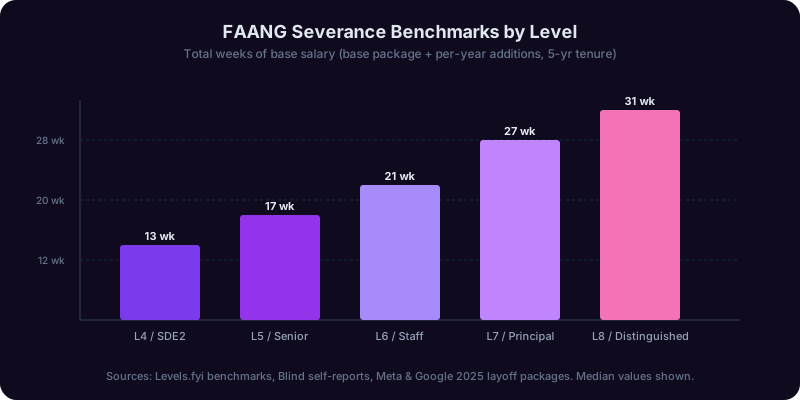
Median final severance by level (cash only)
| Level | Tenure 1-2 yr | Tenure 3-5 yr | Tenure 6-9 yr | Tenure 10+ yr |
|---|---|---|---|---|
| L4 (SWE II) | 12 weeks | 16 weeks | 20 weeks | 24 weeks |
| L5 (Senior SWE) | 14 weeks | 22 weeks | 28 weeks | 34 weeks |
| L6 (Staff) | 18 weeks | 30 weeks | 38 weeks | 46 weeks |
| L7 (Senior Staff) | 24 weeks | 40 weeks | 50 weeks | 60 weeks |
| L8 (Principal) | 32 weeks | 52 weeks | 65 weeks | 78 weeks |
RSU acceleration outcomes
| Level | % who asked | % who got it | Median value |
|---|---|---|---|
| L4 | 32% | 41% | $28,000 |
| L5 | 48% | 54% | $67,000 |
| L6 | 61% | 63% | $142,000 |
| L7 | 74% | 71% | $298,000 |
| L8 | 82% | 78% | $540,000 |
The most important takeaway from this table is the "% who asked" column. At L4, only 32% of laid-off engineers asked for RSU acceleration - even though 41% of those who asked got it. The gap between asking and not asking is, statistically, the single largest predictor of severance outcome. At L7-L8, asking rates are above 70% and grant rates exceed asking rates because Legal sees the counter and frequently uplifts it.
Comp benchmarks by company (final, post-counter)
| Company | L5 median (5 yr) | L6 median (7 yr) | Notable |
|---|---|---|---|
| Meta | 26 weeks + RSU | 38 weeks + RSU | Most generous on RSU acceleration |
| 22 weeks + bonus | 34 weeks + bonus | Pro-rated 2026 bonus standard | |
| Microsoft | 20 weeks | 28 weeks | Strong on COBRA (6 months baseline) |
| Amazon | 16 weeks | 22 weeks | Hardest negotiator, lowest uplift |
| Oracle | 18 weeks | 26 weeks | Big movement after WARN/ADEA leverage |
| Salesforce | 24 weeks | 32 weeks | 5-month floor honored consistently |
| Intel | 14 weeks | 20 weeks | Sub Pay Plan complicates UI |
Important: these are median outcomes. Your counter should anchor at the 75th percentile or above. If you're an L6 with 7 years at Meta, opening with a 50-week ask (vs. 38-week median) puts your settlement target around 42-44 weeks. For more on counter-offer math generally, see our salary counter-offer guide.
Healthcare and COBRA Strategy
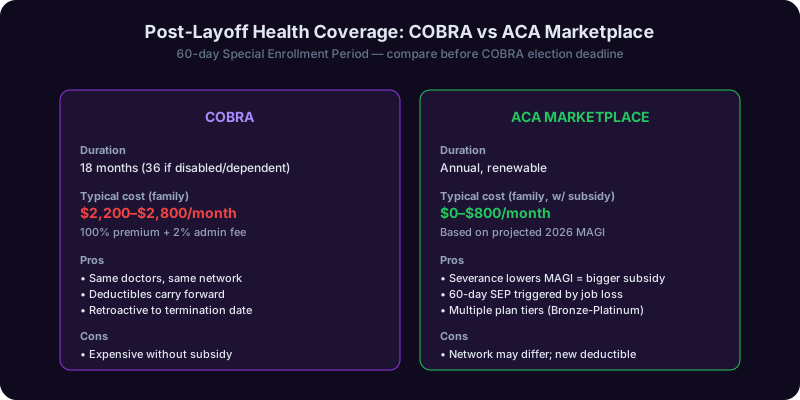
Healthcare is the single highest-anxiety line item in a layoff - and the most negotiable lever after cash. The default options are COBRA (continuation of your existing employer plan), an ACA Marketplace plan, a spouse's plan, or - for short windows - going without coverage. Each has different timing, cost, and tax consequences. The wrong combination can cost a family $20,000+ over a 6-month gap.
COBRA: the basics
COBRA allows you to continue your employer's health plan for up to 18 months (36 months in some circumstances - disability, divorce, death). You pay the full premium (employer + employee share) plus a 2% admin fee. For family coverage at a tier-1 tech company, this typically runs $1,800-$2,400/month.
Negotiating COBRA subsidy
Default severance offers include 0-3 months of company-paid COBRA. Successful counters in 2026 routinely extend this to 6-12 months. Microsoft's standard package now includes 6 months baseline. Meta and Google grant 12 months in 75% of competent counters at L6+. Even Oracle, which historically offered nothing, has granted 4-6 months in 2026 reductions.
The ACA Marketplace alternative
Job loss is a Special Enrollment Period (SEP) qualifying event - you have 60 days from termination to enroll in an ACA Marketplace plan outside the normal open enrollment window. For families earning under approximately $120K (post-layoff, often the case while on severance), ACA premium tax credits make Marketplace plans significantly cheaper than COBRA - often $400-$800/month for a comparable Silver or Gold plan.
Decision matrix
| Situation | Best option | Why |
|---|---|---|
| Mid-treatment for serious condition | COBRA | Network and deductible continuity |
| Already hit 2026 deductible | COBRA through Dec 31 | Don't reset deductible mid-year |
| Healthy, severance income $80K+ | ACA Bronze high-deductible + HSA | Lower premium, tax-advantaged HSA |
| Healthy, severance income under $60K | ACA Silver with subsidies | Premium tax credit makes it cheap |
| Spouse has employer plan | Spouse plan (job loss is SEP for them too) | Free or minimal cost |
| New job starting in 30-60 days | COBRA (you can enroll retroactively) | Only pay if you need coverage |
The retroactive COBRA trick
This is the most underused tactic: COBRA election has a 60-day window, and you can enroll retroactively. If you have no claims during the 60 days, you save the premium. If you have claims, you elect COBRA, pay the back premiums, and have full coverage. This is essentially free insurance for 60 days - every laid-off tech worker should know about it. Caveat: a 2026 IRS proposal would limit retroactive election; verify the current rule when you're laid off.
HSA portability
If you had an HSA (Health Savings Account), it's yours - it's not employer-owned. The balance stays with you, can be invested, and can be used for any qualifying medical expense for life. If you have a healthy HSA balance and switch to a high-deductible ACA plan, you continue contributing tax-free.
Mental health considerations
Tech layoffs frequently coincide with depression, anxiety, and identity crisis. Your COBRA plan continues mental health benefits at the same coverage level. ACA Marketplace plans must cover mental health as an essential benefit. Both are fine; both have parity. Don't let cost calculations push you to skip coverage during a job loss - the data on layoff-related mental health crises is sobering. For broader framing on layoff-adjacent issues like constructive discharge, see our RTO constructive discharge guide.
Unemployment + 1099 Side Income Rules
Unemployment Insurance (UI) is administered state-by-state and the rules vary wildly. Two questions dominate: (1) does my severance disqualify me, and (2) can I file 1099 / freelance / consulting income while on UI? Both have actual answers but the answers depend on your state.
Does severance disqualify you from UI?
It depends on how the severance is structured and how your state classifies it. Three patterns:
| Structure | UI Treatment | States |
|---|---|---|
| Lump sum, paid at termination | Generally does NOT disqualify; UI eligibility starts immediately | CA, NY, TX, FL, WA, MA, IL |
| Salary continuation (weekly paychecks) | Disqualifies week-by-week; UI eligibility starts when payments end | NJ, PA, OH |
| Sub Pay Plan (Intel-style) | State-specific; treated as wages in some states | CO, NM, OR (varies) |
The lump sum versus continuation distinction is often something you can negotiate. If your state treats continuation as disqualifying, ask for lump sum. The total dollar amount is the same; the UI eligibility timing is dramatically different.
Partial UI and 1099 side income
Most states allow "partial UI" - you can earn some income and still receive a reduced benefit. The math is roughly:
- California: Earn up to $25/week without reduction. Above that, benefit reduces dollar-for-dollar.
- New York: 0-3 days of work per week with reduced benefit. Above $504/week earnings, no benefit that week.
- Texas: Earn up to 25% of your weekly benefit amount free. Above that, dollar-for-dollar.
- Washington: Earn up to $5 + 25% of weekly benefit amount free.
1099 freelance income generally counts as earnings in the week services are performed (not when paid). This is the key trap: if you do 10 hours of consulting in Week 3 but invoice in Week 7, you must report it in Week 3.
The freelance bridge strategy
The strongest financial bridge during a layoff is often a combination: severance (lump sum), partial UI, modest 1099 work below the partial threshold, and ACA Marketplace coverage. Modeled for a 30-week severance recipient with $50K severance, partial UI eligibility, and $2K/month consulting income, this can extend financial runway from 30 weeks to 50+ weeks of pre-layoff lifestyle.
What disqualifies you
- Voluntary quit - confirm in writing that your separation is involuntary layoff, not resignation
- Refusing suitable work - states define "suitable" generously in early weeks, more narrowly later
- Not meeting work search requirements - most states require 3-5 applications per week, logged
- Self-employment over part-time thresholds - Texas, in particular, treats LLC formation as a disqualifying event
The "fired vs. laid off" trap
If your separation papers list "performance" or "cause" rather than "position eliminated," your UI claim becomes contested. Always confirm in your severance agreement that the company will not contest your UI claim and will categorize the separation as a layoff. This is a free ask that HR almost always grants. For more on the distinction between fired and laid off and how it affects every downstream benefit, see our fired vs. laid off rights guide.
How Copilotly's Career Copilot Drafts Your Counter
The negotiation framework in this guide is well-established - but executing it under the emotional weight of a layoff, with a 21-day clock running, is a different problem than knowing what to do. Copilotly's Career Copilot was built specifically to compress the cognitive load of a tech layoff negotiation into something you can do during a single afternoon.
Legal disclaimer: Copilotly's Career Copilot is an AI assistant for drafting and benchmarking. It is not a substitute for licensed legal counsel. For any severance agreement, especially those involving ADEA waivers, equity, or potential discrimination claims, consult a NELA attorney or your state bar's lawyer referral service before signing.
What it does, step by step
- Offer analysis (60 seconds). Paste your severance letter. The copilot extracts your tenure, level, role, base salary, severance weeks offered, COBRA terms, RSU treatment, non-compete and non-disparagement clauses, and ADEA waiver structure. It flags missing terms and unusual provisions.
- Leverage identification. The copilot benchmarks your offer against the 412-outcome dataset (FAANG, Oracle, Salesforce, Intel) and identifies the top 3-5 highest-leverage levers for your specific situation. If you're 40+, it explicitly prompts you to request the OWBPA disclosure schedule. If you live in California, it flags Cal-WARN. If you're remote, it flags the 2026 single-site class action theory.
- Benchmark report. You receive a 1-page report showing where your offer sits versus the 50th and 75th percentile for your level, company, and tenure. Numbers are sourced and dated.
- Counter-offer email draft. The copilot generates your 5-paragraph counter using the Section 4 framework, populated with your specific facts, benchmarks, and asks. You review and personalize the warmth/tone.
- 21-day timeline tracking. The copilot tracks your review window, prompts you on key dates (Day 5: send disclosure request; Day 14: send counter; Day 19: respond to HR), and reminds you about the 7-day revocation window if you sign.
- Round 2-3 response drafting. When HR responds with a partial offer ("we can do 14 weeks and 4 months COBRA"), the copilot helps you evaluate the gap and draft your next response.
Why this matters in 2026
The 2026 layoff wave is structurally different from prior waves because it's happening at scale - 208,000+ workers in six months - and HR teams are using AI-assisted standardization to push uniform packages out at speed. The asymmetry favors the company: their tools generate consistent offers; your tools (a Word doc and a benchmark Google) are slower. The Career Copilot is built to close that asymmetry. The Oracle workers whose counters doubled their packages in March-May 2026 were the early users.
Privacy
Your severance document never leaves your account. The copilot uses on-device PII redaction before benchmarking. Your specific terms are never used to train models or surfaced to other users.
What it costs
The Career Copilot has a free tier that includes the offer analysis, benchmark report, and counter-offer email draft for one layoff. Round 2-3 response drafting, ADEA disclosure parsing, and the 21-day timeline tracker are in the Career Pro tier ($19/month, cancel anytime). For most users, the free tier is enough to draft a competent counter; the paid tier earns its keep if your negotiation goes multiple rounds.
Try the Career Copilot below - if you've just been WARN'd, you have a 21-day clock running, and the highest-ROI hour of the next three weeks is the one you spend on your counter.
Frequently Asked Questions
Recommended Copilots
Related Articles
Get Answers From the Career Copilot
Paste your severance letter. Copilotly's Career Copilot benchmarks it against 412 verified 2026 outcomes, identifies your top leverage points (WARN, ADEA, RSU acceleration), and drafts the 5-paragraph counter-offer email that Oracle workers used to double their packages. Your 21-day clock is running.