

SECURE 2.0 Catch-Up Changes: The 2026 Reality
SECURE 2.0 Act, signed into law in late 2022, reshaped the catch-up contribution landscape - and 2026 is the year nearly all of its retirement provisions take full effect. If you are 50 or older, you now navigate three different catch-up regimes instead of one: the long-standing standard 50+ catch-up, the brand-new super catch-up for ages 60-63, and the Roth-mandated catch-up for high earners. Each interacts with your contribution stack differently, and getting them wrong can cost five figures in deferred taxes, missed matches, and 6% excess-contribution penalties.
The standard 50+ catch-up has existed since 2002. In 2026 it sits at $7,500 for 401(k), 403(b), and most 457(b) plans, and $1,000 for IRAs. This is in addition to the base employee deferral limit. Nothing changed structurally - but the new layers stacked on top transform the planning math entirely.
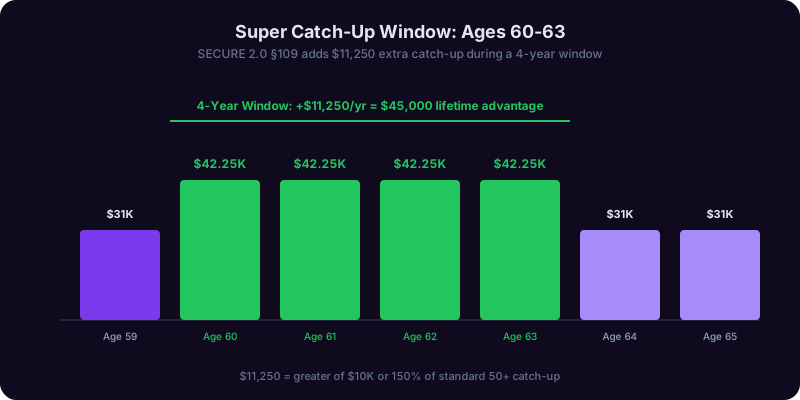
The super catch-up is the headline 2026 change. Created by SECURE 2.0 Section 109, it gives participants who are ages 60, 61, 62, or 63 at any point during the calendar year a higher catch-up: the greater of $10,000 or 150% of the regular catch-up. For 2026 that works out to $11,250 ($7,500 x 1.5). Turn 64 on January 1, 2027? You drop back to the $7,500 standard catch-up. This is a narrow, four-year window - and missing it leaves $15,000 of tax-advantaged room on the table.
The third regime - and the most misunderstood - is the Roth catch-up mandate for high earners. Originally scheduled for 2024, the IRS delayed enforcement until January 1, 2026. Now it is live. If your prior-year FICA wages from your current employer exceeded $145,000 (indexed for inflation, projected around $150,000 for 2026), your catch-up contributions must be made on a Roth (after-tax) basis. You no longer get the pre-tax deduction on those catch-up dollars. Plans without Roth options for catch-ups must either add one or stop accepting catch-ups from high earners entirely.
Why does this matter? A 62-year-old earning $200,000 in 2025 who maxes the super catch-up in 2026 contributes $11,250 of Roth money - taxed at their current 32% bracket - rather than $11,250 of pre-tax money. That is roughly $3,600 of additional 2026 tax liability. The trade-off is tax-free growth and tax-free withdrawals later, which often wins long-term - but only if you plan for the cash-flow hit.
Tax disclaimer: This article provides general educational information about U.S. federal retirement contribution rules. Limits are indexed annually by the IRS and state-level taxation varies. Consult a CPA, CFP, or enrolled agent before making contribution decisions that exceed standard limits or trigger Roth-mandate rules.
2026 Contribution Limits Decoded
Before strategy, master the numbers. The IRS publishes annual cost-of-living adjustments under IRC Section 415, and 2026 brought modest increases across nearly every retirement vehicle. Here is the complete decoded stack - what each limit covers, how they interact, and where the gotchas live.
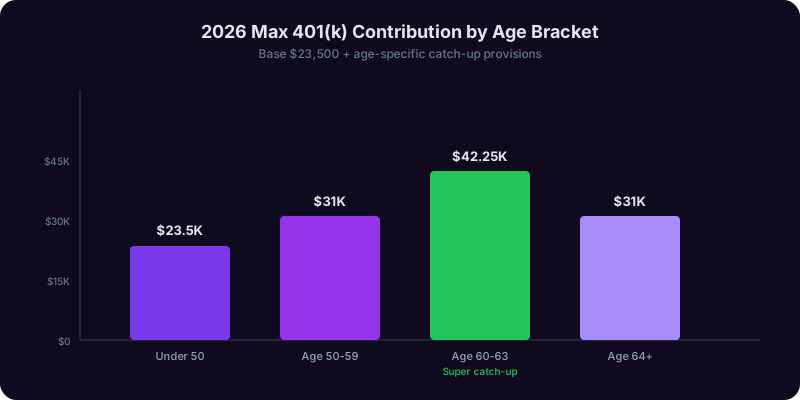
The 401(k), 403(b), and most 457(b) employee deferral limit for 2026 is $23,500. This is the elective deferral cap - what you contribute from your paycheck pre-tax or as designated Roth. Then layered on top:
- Ages under 50: $23,500 employee deferral, no catch-up
- Ages 50-59 and 64+: $23,500 + $7,500 standard catch-up = $31,000
- Ages 60-63: $23,500 + $11,250 super catch-up = $34,750
The IRA limit (Traditional or Roth combined) is $7,000 for 2026, plus a $1,000 catch-up at age 50+. SECURE 2.0 indexed the IRA catch-up for the first time starting in 2024, but it remained at $1,000 for 2026 because the rounding mechanism requires accumulation. IRAs have no super catch-up - that benefit lives only inside employer plans.
| Account | Base Limit | 50+ Catch-Up | 60-63 Super | Max at 60-63 |
|---|---|---|---|---|
| 401(k) / 403(b) | $23,500 | $7,500 | $11,250 | $34,750 |
| 457(b) governmental | $23,500 | $7,500 | $11,250 | $34,750 |
| SIMPLE IRA | $16,500 | $3,500 | $5,250 | $21,750 |
| Traditional/Roth IRA | $7,000 | $1,000 | N/A | $8,000 |
| HSA (self-only) | $4,300 | $1,000 (55+) | N/A | $5,300 |
| HSA (family) | $8,550 | $1,000 (55+) | N/A | $9,550 |
The overall Section 415(c) limit - total annual additions across employee deferrals, employer match, profit-sharing, and after-tax contributions to a defined contribution plan - is $70,000 for 2026 ($77,500 with 50+ catch-up, $81,250 with super catch-up). This is the ceiling that makes the mega backdoor Roth possible: the gap between your employee deferral plus match and the $70K cap can often be filled with after-tax contributions later converted to Roth.
SIMPLE IRAs have separate, lower limits. The 2026 SIMPLE employee deferral is $16,500 with a $3,500 standard catch-up and a $5,250 super catch-up for ages 60-63 (150% of the SIMPLE catch-up). SECURE 2.0 also created an optional 10% higher SIMPLE limit ($18,100 deferral) for employers with 25 or fewer employees, but adoption is sparse - confirm with your plan administrator.
One sneaky 2026 detail: the compensation cap for plan purposes rose to $355,000. If your salary exceeds this, your employer cannot consider income above it when calculating matches or profit-sharing - which can quietly shrink your effective stack.
The Roth Catch-Up Mandate for $145K+ Earners
The Roth catch-up mandate is the most consequential - and most poorly understood - 2026 rule. SECURE 2.0 Section 603 requires that catch-up contributions made by certain high-earning employees be treated as designated Roth contributions, regardless of whether the employee wanted them pre-tax. After IRS Notices 2023-62 and 2024-80 pushed the effective date, enforcement begins January 1, 2026.
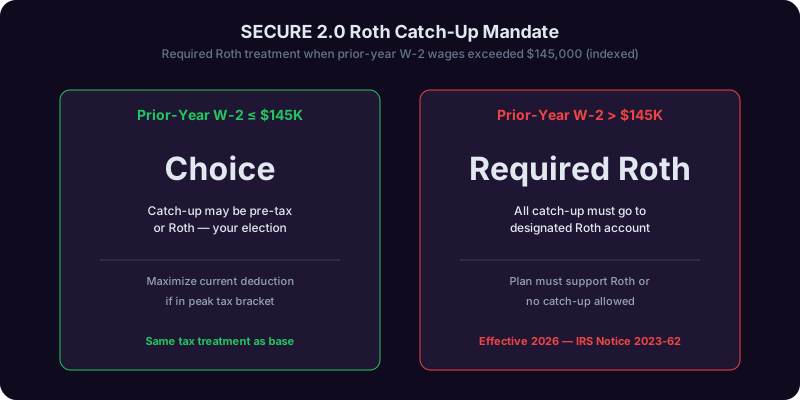
The trigger is precise. The rule applies if your prior calendar year FICA wages (Box 3 of Form W-2) from the same employer sponsoring the plan exceeded $145,000 (indexed; projected at approximately $150,000 for 2026 contributions based on 2025 wages). Critical nuances:
- Same employer rule: Wages from a prior employer do not count toward the threshold at your new employer. A job change in 2025 can reset your status.
- FICA wages, not gross compensation: Box 3 of the W-2, capped at the Social Security wage base ($176,100 for 2025). If you exceeded $145K of FICA-subject wages, the rule applies.
- Self-employment income does not count: Sole proprietors and partners with K-1 self-employment earnings (not W-2 wages) are exempt from the Roth-mandate - a meaningful carve-out for solo 401(k) participants.
- No prior-year wages = no mandate: A first-year employee with no 2025 W-2 from the current employer can take catch-ups pre-tax in 2026 regardless of 2026 salary.
If the mandate applies and your plan does not offer a designated Roth catch-up option, the plan must either add one or stop accepting catch-up contributions from affected employees. The IRS provided a transition framework allowing plans to treat amounts in excess of the regular limit as Roth automatically - a feature known as the "deemed Roth election."
The cash-flow impact is real. Pre-tax catch-ups reduce current-year taxable income; Roth catch-ups do not. A 60-year-old earning $200K who contributes the full $11,250 super catch-up in 2026 loses roughly $3,600 of current-year tax savings (32% federal marginal bracket). That money still grows tax-free and withdraws tax-free - usually a net win over 20+ years - but the budgeting hit is immediate.
| Prior-Year FICA Wages | Catch-Up Type Required | Pre-Tax Option Allowed? |
|---|---|---|
| Under $145,000 (indexed) | Pre-tax or Roth (employee choice) | Yes |
| $145,001+ (indexed) | Roth only | No |
| Self-employed (K-1 / Schedule C) | Pre-tax or Roth | Yes |
| New employee (no prior-year W-2) | Pre-tax or Roth | Yes |
Strategic implication: if you straddle the $145K threshold in 2025, intentionally deferring a year-end bonus into 2026 could keep you below it and preserve pre-tax catch-up eligibility for 2026 contributions. Conversely, a planned 2025 raise that pushes you over the threshold means 2026 catch-ups go Roth - model the multi-year tax impact before assuming Roth is bad. For many in the 24-32% bracket who expect lower retirement brackets, Roth catch-ups are still worse on paper; for those in the 12-22% bracket or expecting higher brackets in retirement, Roth catch-ups can be strictly superior.

Get Answers From the Finance Copilot
Calculate your exact 401(k), IRA, HSA, and mega backdoor Roth targets, check Roth-mandate eligibility, and lock in per-paycheck deferral percentages tailored to your plan and household. Build your 2026 contribution plan in under 10 minutes.
Calculating Your Maximum 2026 Stack
Here is the full stack-by-age math for 2026, accounting for the super catch-up window, IRA additions, HSA contributions, and the Section 415(c) overall limit. The numbers assume a single filer with employer-provided high-deductible health plan (HDHP) coverage and a 401(k) that accepts after-tax contributions for mega backdoor purposes.
| Age Bracket | 401(k) Deferral | IRA | HSA | Total (no after-tax) | Total (with mega backdoor max) |
|---|---|---|---|---|---|
| Under 50 | $23,500 | $7,000 | $4,300 | $34,800 | $81,300 |
| 50-54 | $31,000 | $8,000 | $4,300 | $43,300 | $96,300 |
| 55-59 | $31,000 | $8,000 | $5,300 | $44,300 | $97,300 |
| 60-63 | $34,750 | $8,000 | $5,300 | $48,050 | $101,050 |
| 64+ | $31,000 | $8,000 | $5,300 | $44,300 | $97,300 |
At ages 60-63, the maximum tax-advantaged stack tops $101,000 per year if your plan permits mega backdoor mechanics. Couples can effectively double this through spousal participation in separate employer plans plus dual IRAs. Over the four-year super catch-up window, a high-earning couple can shelter $700,000+ of contributions beyond what was possible before SECURE 2.0.
Income-tier scenarios for a 61-year-old in 2026:
- $80K income, married filing jointly: 22% federal bracket. Pre-tax $34,750 401(k) contribution saves ~$7,645 federal. Deductible Traditional IRA $8,000 saves ~$1,760. Total federal tax savings: ~$9,400.
- $160K income, single: 24% federal bracket. Above the Roth IRA income phaseout ($165K for 2026), so backdoor Roth required for IRA. 401(k) catch-up still pre-tax (under $145K W-2 threshold). Total tax savings: ~$8,340.
- $250K income, single: 35% federal bracket. Roth-mandate triggered - $11,250 super catch-up must be Roth, losing ~$3,940 of current deduction. But base $23,500 still pre-tax saves $8,225. Roth IRA blocked entirely; backdoor required. Total current tax savings: ~$8,225.
- $500K income, single: 35-37% bracket. All catch-ups Roth-mandated. Mega backdoor Roth becomes the lever - fills $35K of after-tax room converted to Roth. Tax savings on base deferral: ~$8,700. Long-term Roth growth: enormous.
The mistake most high earners make in 2026: assuming the Roth-mandate makes catch-ups unattractive and skipping them. The opposite is true. $11,250 of Roth space at age 60 growing at 7% for 25 years until age 85 becomes $61,000 of completely tax-free withdrawal capacity. Skipping it to save $3,600 in current taxes is a deeply negative-NPV decision.
HSA Catch-Up: The Triple Tax Stack at 55+
The Health Savings Account is the only retirement vehicle in U.S. tax code with a triple tax benefit: contributions are deductible (or pre-tax via payroll), growth is tax-deferred, and qualified medical withdrawals are tax-free. At age 55, an additional $1,000 catch-up kicks in - unindexed since 2006, but still valuable. For 2026, the limits are $4,300 self-only / $8,550 family, plus the $1,000 catch-up at 55+.
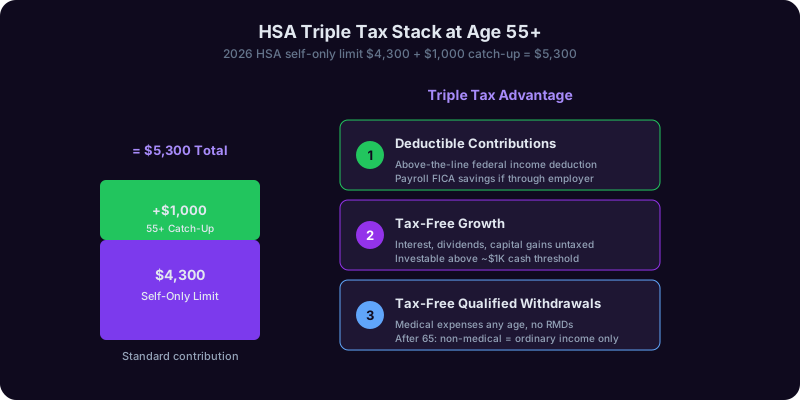
The HSA catch-up has a critical quirk: it must be contributed to each spouse's own HSA account. Two married 55+ spouses cannot pool their $1,000 catch-ups into one account - each needs a separate HSA. Many couples miss this and lose $1,000 of annual space, which compounds to roughly $45,000 over 20 years at 7%.
Eligibility requires HDHP-only coverage with no disqualifying secondary coverage. The most common 2026 trap: Medicare enrollment. The moment you enroll in any part of Medicare (typically at 65), HSA contribution eligibility ends - including the catch-up. If you delay Medicare enrollment past 65 because you remain employed with HDHP coverage, you preserve HSA eligibility. But Social Security beneficiaries are auto-enrolled in Medicare Part A retroactively up to 6 months upon claiming benefits at or after 65. That retroactive enrollment can disqualify HSA contributions for the prior six months, triggering 6% excess-contribution penalties.
Strategic playbook for ages 55-64 with HDHP coverage:
- Stop claiming Social Security if planning to contribute to HSA at 65+. Delay SS until 70, keep HSA eligibility through your last working year.
- Stop HSA contributions 6 months before Medicare enrollment. The retroactive Part A coverage will not penalize you.
- Use the "last-month rule" carefully: If HSA-eligible on December 1, you can contribute the full annual limit for that year - but a 13-month testing period applies, and losing eligibility triggers includable income plus 10% penalty.
- Invest, don't park in cash. Most HSA custodians let you invest balances above a threshold (often $1,000-$2,000) into mutual funds. Treat the HSA as a retirement account.
| Coverage Tier | 2026 Base Limit | 55+ Catch-Up | Total at 55+ |
|---|---|---|---|
| Self-only HDHP | $4,300 | $1,000 | $5,300 |
| Family HDHP | $8,550 | $1,000 each spouse | $10,550 (both 55+) |
After age 65, HSA funds can be withdrawn for any purpose without the 20% penalty - only ordinary income tax applies, just like a Traditional IRA. Qualified medical withdrawals remain tax-free indefinitely. Save medical receipts from any year - even decades old - and reimburse yourself tax-free whenever you choose. This creates an enormously flexible retirement vehicle for ages 65+.
Mega Backdoor Roth + Catch-Up: The $70K+ Annual Capacity
The mega backdoor Roth is the most powerful - and least accessible - tax-advantaged strategy in 2026. It uses the gap between your employee deferral plus employer match and the Section 415(c) overall limit of $70,000 ($77,500 with standard catch-up, $81,250 with super catch-up) to make additional after-tax contributions that immediately convert to Roth.
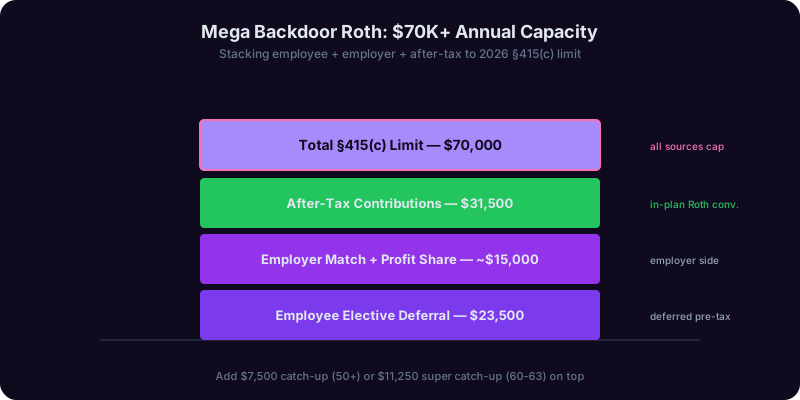
The math for a 61-year-old at a plan supporting both:
- Section 415(c) overall limit with super catch-up: $81,250
- Less: employee deferral + super catch-up ($34,750)
- Less: employer match (assume 5% on $200K salary = $10,000)
- After-tax contribution capacity: $36,500
That $36,500 goes in after-tax (no current deduction). The plan then either performs an in-plan Roth conversion or allows an in-service distribution rolled to a Roth IRA. Either way, the money lands in Roth - growing tax-free forever, with no required minimum distributions during the original owner's lifetime.
Plan eligibility is the chokepoint. Only about 22% of 401(k) plans support after-tax contributions, and an even smaller subset (~15%) supports in-plan conversion or in-service distribution. Check three boxes in your Summary Plan Description:
- After-tax contributions allowed? Separate from Roth elective deferrals. Distinct contribution source.
- In-plan Roth conversion or rollover allowed? Without this, after-tax money grows in a non-Roth bucket and creates pro-rata tax headaches.
- Frequent conversion timing? Best plans convert daily or weekly. Annual-only conversion lets growth accrue in the after-tax bucket, which becomes taxable on conversion.
The pro-rata rule bites if your after-tax contributions sit in the plan and earn growth before conversion. Suppose you contribute $35,000 after-tax in January and it earns $500 by June conversion. The $500 is treated as pre-tax earnings - converting it triggers $500 of current-year ordinary income tax. Daily conversion avoids this entirely.
| Component | Under 50 | 50-59 / 64+ | 60-63 Super |
|---|---|---|---|
| Employee deferral | $23,500 | $31,000 | $34,750 |
| Employer match (5% of $200K) | $10,000 | $10,000 | $10,000 |
| Section 415(c) ceiling | $70,000 | $77,500 | $81,250 |
| Mega backdoor capacity | $36,500 | $36,500 | $36,500 |
| Plus Backdoor Roth IRA | $7,000 | $8,000 | $8,000 |
| Total Roth capacity | $43,500 | $44,500 | $44,500 |
One subtle benefit: mega backdoor Roth contributions are not subject to the high-earner Roth-mandate. The mandate applies only to catch-up contributions. After-tax contributions are a separate source, so the strategy works identically for both low and high earners - assuming the plan supports it.
Spouse Catch-Up Strategies: Doubling Up
Catch-up contribution rules apply per person, not per household. A married couple where both spouses are 60-63 in 2026 can stack $69,500 of combined 401(k) deferrals+catch-ups ($34,750 each), plus $16,000 of IRA contributions, plus dual HSA catch-ups. The total household tax-advantaged stack reaches $96,000+ even without mega backdoor mechanics.
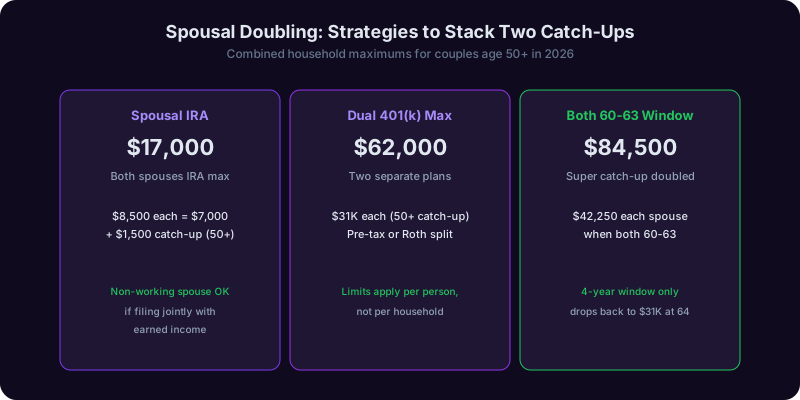
The spousal IRA rule is the underused lever. A non-working or low-earning spouse can contribute to their own Traditional or Roth IRA based on the working spouse's earned income. For 2026, that means a couple filing jointly with one income of $150K can fully fund two IRAs at $8,000 each (with 50+ catch-up) for a household IRA stack of $16,000. Without the spousal rule, the non-earner could not contribute at all.
Roth IRA income phaseouts for 2026 married filing jointly: contribution capacity phases out between $240,000 and $250,000 MAGI. Above $250K, both spouses use the backdoor Roth - contribute $8,000 each to a Traditional IRA (non-deductible), then immediately convert to Roth IRA. The pro-rata rule applies separately to each spouse's IRAs, so one spouse with a large pre-tax IRA can use the backdoor while the other cannot - but the working spouse can sometimes roll a pre-tax IRA into their 401(k) first to clear the pro-rata denominator.
Household optimization checklist:
- Both spouses contribute to their own employer plans up to at least the match. Free money is non-negotiable.
- Identify which spouse triggers the $145K Roth-mandate. The other spouse can take catch-ups pre-tax.
- If one spouse has a mega backdoor plan, prioritize that plan for after-tax dollars. The other spouse's plan may not need maxing.
- Run joint vs. separate filing math. MFS rarely wins, but Roth IRA phaseouts are $0-$10K for MFS - almost always blocks Roth IRA. Backdoor required.
- Coordinate HSA strategy. If both have HDHP family coverage through one spouse, only that spouse contributes to the family HSA limit. Each 55+ spouse needs their own HSA for the $1,000 catch-up.
| Scenario | One Spouse 60-63 | Both Spouses 60-63 |
|---|---|---|
| 401(k) deferrals | $34,750 + $31,000 = $65,750 | $34,750 + $34,750 = $69,500 |
| IRA (Traditional or backdoor Roth) | $16,000 | $16,000 |
| HSA family + both 55+ catch-ups | $10,550 | $10,550 |
| Household total | $92,300 | $96,050 |
One stealth play for early-retired couples: if one spouse retires at 60 while the other continues working, the retired spouse can still contribute to an IRA based on the working spouse's earned income (the spousal IRA), and can take penalty-free 401(k) withdrawals from any plan they separated from in or after the year they turned 55 (the rule of 55). This creates a tax-efficient bridge to age 59.5 with full IRA contribution flexibility.
Catch-Up Timing: Front-Load vs Spread Throughout Year
Timing your contributions across the calendar year sounds trivial - but two plan features can cost you thousands if you ignore them: employer match true-up and the per-paycheck match cap. The interaction between these and catch-up dollars makes timing strategic, not cosmetic.
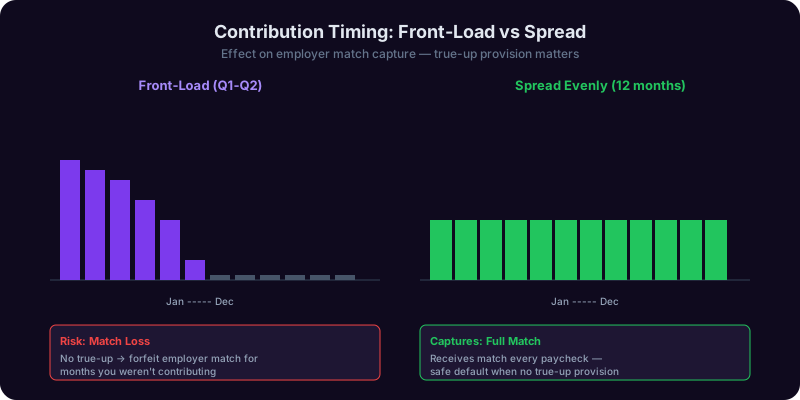
The standard employer match is typically expressed as "100% on the first 3% of compensation, 50% on the next 2%" - paid each pay period. If you front-load your $34,750 max by July, you stop contributing for the rest of the year. Without a true-up provision, the employer match also stops because you have no qualifying contributions in those later paychecks. You can forfeit half your annual match by front-loading too aggressively.
The fix is a true-up provision: at year-end, the employer recalculates the match as if contributions were spread evenly across the year and pays the difference. Roughly 45% of plans offer true-up - confirm in your Summary Plan Description. If your plan does not have true-up, the optimal strategy is to spread contributions so you hit the annual limit on the last paycheck of the year, not earlier.
The math for a 61-year-old earning $200,000 with a 50% match on first 6% (max employer match $6,000/yr):
- Front-loaded (no true-up): Maxes out July 1 at $34,750. Match earned on contributions through July = ~$3,000. Lost match: $3,000.
- Spread evenly: $1,336 per biweekly paycheck for 26 paychecks. Full $6,000 match earned. No lost match.
- Spread with mid-year raise/bonus: Need to recalculate per-paycheck deferral percentage to land exactly on $34,750 at year-end.
The 30% rule of thumb: if your plan has a true-up, front-load aggressively - getting money invested earlier captures more compound growth. On average, contributions made in January earn ~7% more for the year than December contributions. Across the $34,750 maximum, front-loading captures roughly $1,200 of additional first-year growth. Over 25 years that compounds to ~$6,500.
| Strategy | Plan Has True-Up? | Best For |
|---|---|---|
| Front-load (max in 6 months) | Yes | High earners wanting maximum compounding |
| Spread evenly across paychecks | No | Anyone whose plan does not true up |
| Back-load (max in Q4) | Either | Variable income, commission-based |
| Bonus-loaded | Either, with election flexibility | Big year-end bonus earners |
For self-employed and solo 401(k) participants, timing is even more flexible - employer contributions can be made up to the tax filing deadline plus extensions (October 15, 2027 for 2026 contributions). This allows tax-deadline-driven decisions based on actual final-year income.
A practical sequencing recommendation for 2026: front-load Roth-mandated catch-up dollars early in the year while cash flow is fresh, then spread regular pre-tax deferrals across remaining paychecks to maintain match eligibility. This separates the two contribution sources cleanly and minimizes year-end administrative scramble.
Withdrawing Catch-Up Contributions Early: Penalties and Exceptions
Catch-up dollars are not separately accounted for - they merge into your overall plan balance. Withdrawal rules apply uniformly: a 10% early-withdrawal penalty under IRC Section 72(t) on amounts taken before age 59.5, plus ordinary income tax on pre-tax portions. SECURE 2.0 expanded penalty exceptions significantly - and 2026 has the full menu live.
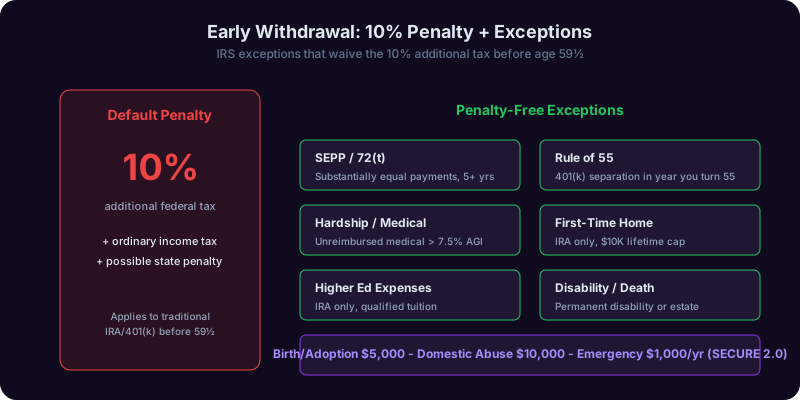
The Section 72(t) exceptions that avoid the 10% penalty (but still owe income tax on pre-tax amounts):
- Age 59.5+: Universal - no penalty after this birthday.
- Rule of 55 (401(k) only): Penalty-free withdrawals from a 401(k) of an employer you separated from in or after the year you turn 55. Does not apply to IRAs.
- Substantially Equal Periodic Payments (SEPP / 72(t)): Calculated annual distributions for at least 5 years or until age 59.5, whichever is longer. Three IRS-approved methods (RMD, amortization, annuitization). Modifying the schedule retroactively triggers penalty on all prior distributions.
- Disability: Total and permanent disability per IRC Section 72(m)(7).
- Death: Beneficiaries withdraw penalty-free.
- Medical expenses exceeding 7.5% of AGI: Penalty-free up to the excess.
- Birth or adoption ($5,000 per child): SECURE Act 2019 provision, may be repaid within 3 years.
- Federally declared disaster ($22,000): SECURE 2.0 - repayable within 3 years.
- Terminal illness: SECURE 2.0 - physician-certified prognosis under 84 months.
- Domestic abuse ($10,000 or 50% of account): SECURE 2.0, starting 2024.
- Long-term care insurance premiums ($2,500/year): SECURE 2.0, effective 2026 for retirement plan distributions.
- Emergency personal expense ($1,000/year): SECURE 2.0, starting 2024 - one withdrawal per year, repayable.
Hardship withdrawals from a 401(k) require demonstrated immediate and heavy financial need - medical, funeral, primary residence purchase/repair, tuition, eviction prevention. They are not automatically penalty-exempt; the 10% applies unless another exception fits. They do, however, exempt from the requirement to first take a loan in many plans (SECURE 2.0 eliminated that requirement).
| Withdrawal Reason | Penalty Exempt? | Income Tax Owed? |
|---|---|---|
| Age 59.5+ | Yes | Yes (on pre-tax) |
| Rule of 55 (separated employer) | Yes (401(k) only) | Yes |
| SEPP / 72(t) | Yes (if rules followed) | Yes |
| Roth contributions only | Yes | No |
| Roth conversions (5-year aged) | Yes | No |
| Hardship withdrawal | Usually no | Yes |
| Birth/adoption ($5K/child) | Yes | Yes (unless repaid) |
For Roth catch-up contributions (mandated for high earners), the 5-year rule applies: contributions can always be withdrawn tax- and penalty-free, but earnings on Roth contributions require both age 59.5 AND a 5-year holding period from your first Roth contribution. For Roth conversions, each conversion has its own 5-year clock - withdrawing the converted principal before 5 years and before 59.5 triggers the 10% penalty on the converted amount even though no income tax is owed.
How Copilotly's Finance Copilot Maximizes Your Catch-Up
Catch-up contribution optimization in 2026 has gone from a one-decision exercise to a multi-variable problem: standard vs super, pre-tax vs Roth-mandated, plan true-up vs no true-up, mega backdoor eligible vs not, spouse coordination, HSA timing, Medicare interactions. Copilotly's Finance Copilot turns this matrix into a single dashboard tailored to your specific employer plan, wages, and household.
What the Finance Copilot does in 2026:
- Roth-mandate detection. Connects to your prior-year W-2 (or payroll integration) and flags whether your 2026 catch-ups must be Roth. Tracks the indexed threshold annually so you do not miss bracket creep.
- Maximum stack calculator. Inputs: age, salary, employer plan rules, HDHP status, spouse income/plan. Outputs: precise dollar targets for each contribution bucket (401(k) base, catch-up, super catch-up, IRA, backdoor Roth, mega backdoor Roth, HSA family + catch-up).
- Per-paycheck deferral percentage. Computes the exact contribution rate to hit your annual target on the last paycheck of the year, preserving full employer match without true-up reliance.
- Plan feature scanner. Parses your Summary Plan Description PDF and identifies: true-up provision, after-tax contribution acceptance, in-plan Roth conversion, in-service distribution, automatic enrollment defaults, vesting schedule, and rule-of-55 separation date implications.
- Cross-account coordination. Models the trade-off between maxing a partial-match 401(k) versus prioritizing a spouse's full-match plan, or using HSA over Roth IRA given your projected retirement medical costs.
- Medicare and HSA timing alerts. Warns when delaying Social Security past 65 preserves HSA eligibility, and computes the 6-month HSA contribution stop-date before Medicare enrollment.
- Multi-year tax projection. Simulates 2026-2030 with the super catch-up window, showing cumulative pre-tax savings, Roth growth, and total household tax-advantaged accumulation.
- Re-optimization on income changes. When a bonus, raise, or job change crosses the $145K Roth-mandate threshold, the Copilot recalculates and adjusts per-paycheck elections automatically.
Practical workflow:
- Upload your most recent W-2 and your spouse's W-2 (if applicable).
- Connect or upload your 401(k) plan's Summary Plan Description.
- Enter HDHP status and current HSA balance.
- Review the recommended contribution stack with per-paycheck dollar targets.
- Export your contribution change instructions for your HR/payroll system.
- Set quarterly check-in reminders - the Copilot watches for IRS limit changes and mid-year salary shifts.
The Copilot does not just compute - it explains the why behind each recommendation in plain English, with citations to the underlying IRS publications and your plan documents. This is especially valuable for the Roth-mandate decision, which is counterintuitive enough that many high earners abandon catch-ups entirely rather than understand the trade-off.
Try the Finance Copilot free, build your 2026 contribution plan in under 10 minutes, and never leave catch-up dollars on the table again.
Tax disclaimer: Copilotly's Finance Copilot provides general educational planning support and is not a substitute for personalized tax, legal, or investment advice. Catch-up contribution rules, indexed thresholds, and plan-specific provisions vary; consult a qualified CPA, CFP, or enrolled agent before making contribution decisions. Always verify final figures against IRS Notices (e.g., IRS COLA limits), IRS Publication 590-A, and IRS SECURE 2.0 guidance. Brokerages such as Fidelity's catch-up resources can supplement plan-specific questions.
Frequently Asked Questions
Recommended Copilots
Related Articles
Get Answers From the Finance Copilot
Calculate your exact 401(k), IRA, HSA, and mega backdoor Roth targets, check Roth-mandate eligibility, and lock in per-paycheck deferral percentages tailored to your plan and household. Build your 2026 contribution plan in under 10 minutes.