The Career Coaching Landscape Has Fundamentally Changed in 2026
Career coaching used to be simple. You paid a professional $150-300 per hour, sat across a desk or on a video call, and received guidance on your resume, interview skills, or career direction. The coach brought experience, accountability, and a human perspective that was impossible to replicate with technology. That dynamic held for decades.
Then AI coaching tools arrived -- not as toys or novelties, but as genuinely capable systems that can parse a resume against 10 million job postings in seconds, simulate interview conversations with adaptive follow-up questions, and generate salary negotiation strategies grounded in real-time market data. By 2026, AI career coaching has matured from a curiosity into a legitimate alternative that millions of professionals use daily.
The question is no longer whether AI career coaching works. It does. The question is where it works better than a human coach, where it falls short, and how to make the smartest investment of your career development budget.
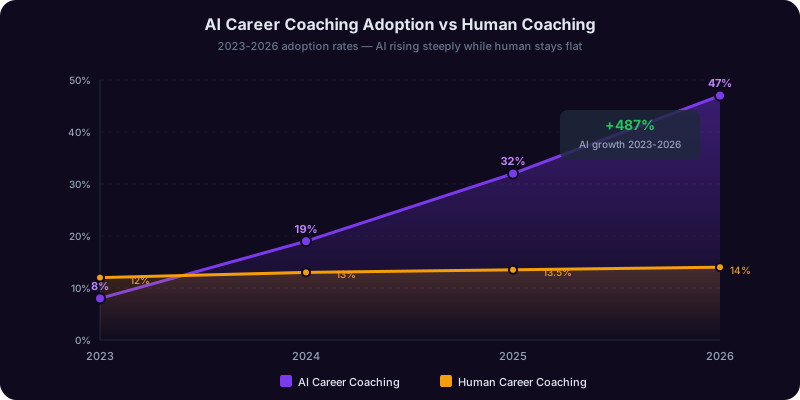
The data tells an interesting story. According to the Bureau of Labor Statistics, demand for human career counselors and coaches grew just 4% between 2024 and 2026. Meanwhile, AI career coaching platforms saw user growth of over 300% in the same period. But -- and this is critical -- the professionals who use both AI and human coaching report the highest satisfaction rates and the fastest career advancement.
What this guide covers:
- Cost analysis: A transparent breakdown of what you actually pay for human coaching versus AI coaching, including hidden costs most comparisons ignore
- Resume optimization: Where AI dominates on speed and ATS compliance, and where humans catch what algorithms miss
- Interview preparation: How AI mock interviews compare to human-led practice sessions across different interview formats
- Salary negotiation: The data on negotiation outcomes when using AI research tools versus human coaching strategies
- Job search strategy: How each approach handles networking, positioning, and opportunity identification
- Career transitions: The hardest test for any coaching approach -- helping someone change industries or roles entirely
- The hybrid model: How to combine both approaches for maximum impact at minimum cost
This is not a promotional piece for AI tools or a defense of traditional coaching. It is an honest, data-grounded comparison that helps you allocate your career development budget where it will generate the highest return. If you have $200 per month for career development, this guide shows you exactly how to spend it.
For context on how AI is reshaping professional advisory services more broadly, see our analysis of how solopreneurs are building AI-powered virtual teams.
The Real Cost Comparison: What You Actually Pay for Each Approach
Every comparison of AI versus human coaching starts with cost, and most of them get it wrong. They quote the sticker price of a coaching session without accounting for what you actually receive per dollar spent. Let us fix that.
Human Career Coaching Costs in 2026
The International Coaching Federation (ICF) 2025 Global Coaching Study reports that certified career coaches in North America charge the following rates:
| Coach Level | Per Session (60 min) | Typical Package | Annual Cost (Monthly Sessions) |
| Entry-level / newly certified | $75 - $125 | 4 sessions for $350 - $450 | $900 - $1,500 |
| Mid-career / 5+ years experience | $150 - $225 | 6 sessions for $800 - $1,200 | $1,800 - $2,700 |
| Senior / executive-level | $250 - $400 | 8 sessions for $1,800 - $3,000 | $3,000 - $4,800 |
| Elite / published / media presence | $400 - $1,000+ | Custom engagements | $5,000 - $12,000+ |
What that session fee actually includes: Most coaches offer a 60-minute session with 15-30 minutes of pre-session preparation (reviewing your materials) and limited between-session support via email. Some package deals include resume reviews, LinkedIn profile audits, or mock interviews, but these are typically billed as separate line items or included only in premium packages.
Hidden costs of human coaching:
- Scheduling friction: Most coaches book 1-2 weeks in advance. If you receive a job offer on Tuesday and need negotiation strategy by Thursday, your coach may not be available.
- Geographic limitation: While video coaching has expanded access, the best coaches in your specific industry may not be in your time zone, limiting scheduling options further.
- Ramp-up time: A new coach needs 1-2 sessions just to understand your background, goals, and constraints before delivering actionable guidance. That is $150-$400 spent on context-building.
- Inconsistent quality: The coaching industry is largely unregulated. ICF certification requires just 60 hours of training for the entry-level credential. The difference between a $150/hour coach and a $300/hour coach is not always proportional to value delivered.
AI Career Coaching Costs in 2026
| Tier | Monthly Cost | Annual Cost | What You Get |
| Free tier (most platforms) | $0 | $0 | Basic resume feedback, limited mock interviews, general career advice |
| Mid-tier subscription | $8 - $15 | $96 - $180 | Unlimited resume optimization, full mock interviews, salary data, job matching |
| Premium / bundled AI suite | $20 - $40 | $240 - $480 | Advanced analytics, industry-specific coaching, multi-copilot access |
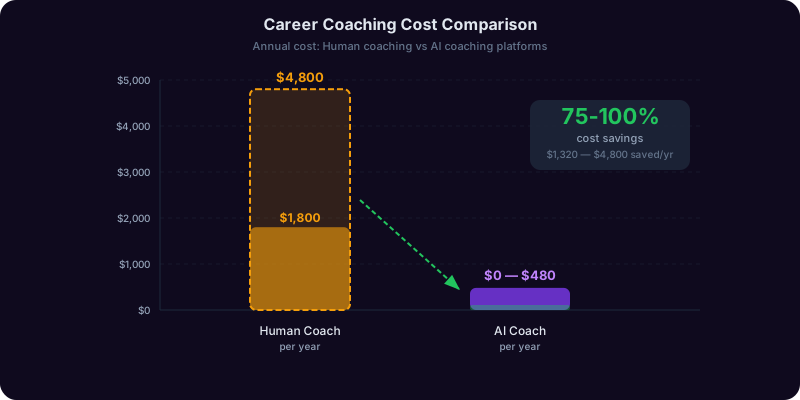
The cost-per-interaction gap is staggering. A single human coaching session costs $150-$300 and lasts 60 minutes. For the same price, you could subscribe to an AI career coaching platform for 10-30 months. During those months, you would have access to unlimited resume reviews, unlimited mock interviews, unlimited salary research, and 24/7 availability. The raw volume of interactions is not even comparable.
But cost per interaction is the wrong metric if the interactions are not equally valuable. A 60-minute session with an experienced human coach who has placed candidates at your target company is worth more than 100 generic AI resume scans. The real question -- which we address in the following sections -- is which specific career tasks justify the premium of human coaching and which are better served by AI tools. For a deeper look at how AI pricing compares across professional services, see our guide to getting a professional second opinion.
Resume Optimization: Where AI Has a Clear Technical Advantage
Resume optimization is where AI career coaching delivers the most unambiguous advantage over human coaches. The reason is structural: modern hiring runs through Applicant Tracking Systems (ATS), and ATS compliance is fundamentally a pattern-matching problem that machines handle better than humans.
What AI Does Better with Resumes
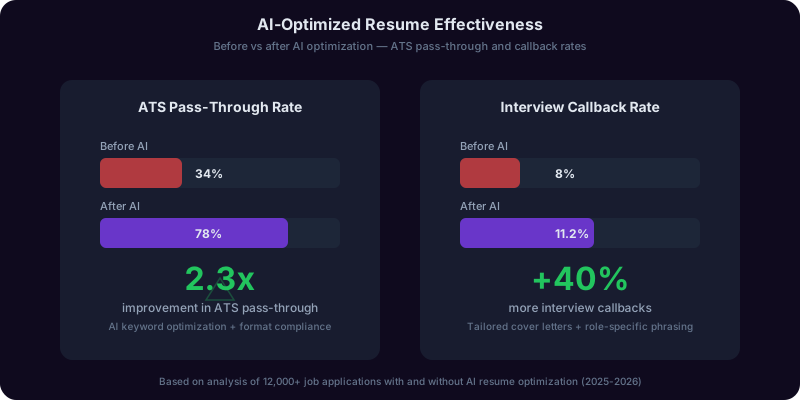
ATS optimization at scale. Over 97% of Fortune 500 companies and 75% of mid-size employers use ATS software to filter resumes before a human recruiter ever sees them. According to LinkedIn's 2025 talent research, approximately 75% of resumes are rejected by ATS before reaching a human reviewer. An AI career coach can parse your resume against a specific job description and identify keyword gaps, formatting issues, and structural problems that would cause ATS rejection -- in under 30 seconds.
A human coach, no matter how experienced, cannot match this speed or precision. They can review formatting and suggest improvements based on their knowledge of common ATS platforms, but they cannot replicate the systematic keyword-matching analysis that an AI performs. A human coach reviewing a resume against a job description might catch 60-70% of keyword gaps. An AI tool catches 95-99%.
Specific AI resume capabilities that outperform human coaching:
- Keyword density analysis: Identifies exact terms from the job description that are missing from your resume, ranked by importance
- Formatting compliance: Flags headers, tables, graphics, columns, and fonts that specific ATS platforms cannot parse correctly
- Quantification prompts: Identifies bullet points that lack measurable outcomes and suggests frameworks for adding metrics
- Tailoring at scale: Generates role-specific resume versions in minutes, so a job seeker applying to 20 positions gets 20 tailored resumes
- Section ordering: Recommends optimal section placement based on experience level and target role
What Human Coaches Do Better with Resumes
AI excels at the technical layer of resume optimization. Human coaches excel at the strategic layer.
Narrative positioning. A human coach can look at your career trajectory and identify a compelling story that connects seemingly unrelated experiences. If you spent three years in nonprofit management, two years in tech sales, and are now targeting product management, a human coach can craft a narrative thread that an AI would not generate because it requires understanding the subjective perception of hiring managers in your target field.
Industry-specific conventions. Some industries have resume norms that deviate from standard best practices. In academia, CVs follow completely different rules than corporate resumes. In creative fields, portfolio presentation matters more than bullet points. A human coach with industry-specific experience knows these conventions intuitively.
Honest feedback on positioning. An AI tool will optimize whatever you give it. A human coach will tell you that your resume undersells your biggest accomplishment, that your job title does not reflect your actual scope, or that you should lead with a different experience entirely. This editorial judgment is something AI struggles with because it optimizes within the frame you provide rather than questioning the frame itself.
The Verdict on Resumes
| Task | Winner | Why |
| ATS keyword optimization | AI | Systematic pattern matching at scale |
| Formatting compliance | AI | Knows exact requirements of major ATS platforms |
| Tailoring to specific job postings | AI | Generates role-specific versions in minutes |
| Career narrative and positioning | Human | Requires subjective judgment about perception |
| Industry-specific conventions | Human | Nuanced knowledge of field-specific norms |
| Identifying what to emphasize | Human | Editorial judgment about strategic positioning |
Best practice: Use an AI tool for every resume you send out (ATS optimization and tailoring), and invest in one human coaching session early in your search to nail your positioning and narrative. That combination gives you both technical precision and strategic clarity.

Get Answers From the Career Copilot
Get an instant resume review, mock interview session, or salary market analysis. No scheduling, no hourly fees. See how AI career coaching compares to traditional coaching for your specific situation.
Interview Preparation: AI Mock Interviews vs Human Practice Sessions
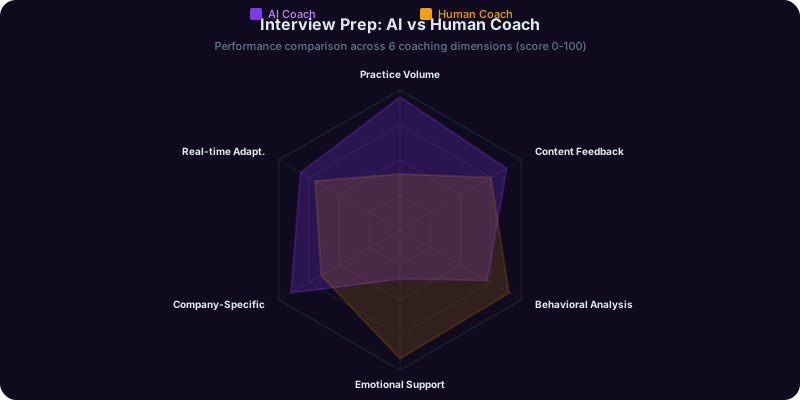
Interview preparation is where the comparison gets more nuanced. Both AI and human coaches deliver genuine value, but they address different aspects of interview readiness. Understanding which aspects matter most for your situation determines where to invest.
AI Interview Prep: Unlimited Practice with Adaptive Feedback
AI mock interview tools in 2026 have advanced well beyond scripted Q&A. Modern systems use voice recognition, natural language processing, and behavioral analysis to simulate realistic interview conversations.
Volume and repetition. The single most effective way to improve interview performance is practice. A human coach gives you one session of practice per $150-300 payment. An AI tool gives you unlimited practice for $0-15 per month. You can run 20 mock interviews for the same company, refining your answers until they feel natural. Research on deliberate practice consistently shows that repetition with feedback is the primary driver of skill improvement.
Real-time content feedback. AI tools analyze the content of your answers and flag common problems: answers that are too long (the optimal behavioral answer is 90-120 seconds), responses that lack specific examples, failure to use the STAR method for behavioral questions, and missed opportunities to connect your experience to the role. For a comprehensive breakdown of interview strategies, see our complete interview preparation guide.
Company-specific preparation. AI tools can ingest data about your target company -- earnings calls, Glassdoor reviews, LinkedIn employee profiles, press releases -- and generate questions likely to come up based on the company's current priorities.
What AI mock interviews measure effectively:
- Answer completeness (did you address all parts of the question?)
- Specificity (did you use concrete examples with numbers?)
- Structure (did you follow a logical framework?)
- Relevance (did your answer connect to the job requirements?)
- Length and pacing (were you concise or rambling?)
Human Interview Coaching: What No Algorithm Can Replicate
Non-verbal feedback. A human coach watches your body language, eye contact, posture, facial expressions, and nervous habits -- and tells you things you cannot see yourself. "You break eye contact every time you talk about your weakness." "Your energy drops when you talk about your last manager." AI tools with video analysis can detect some of these signals, but the interpretation requires human social intelligence.
Emotional calibration. Interview anxiety is real. A human coach recognizes when you are overthinking, when your confidence is artificially low, or when you are performing well but do not believe it. "You nailed that answer. You looked like you were about to apologize for it. Stop doing that." This kind of intervention changes behavior in ways that AI feedback does not.
Insider knowledge. A human coach who has worked in recruiting at your target company can share things no AI knows: "This company always asks a product sense question in the final round." "The VP values conciseness above all else." This insider intelligence comes from human networks and cannot be scraped from public data.
Accountability and stakes. Practicing with a human creates social accountability that AI cannot replicate. The pressure of performing for another person more closely simulates a real interview. This stress inoculation is one of the most valuable aspects of human coaching.
The Verdict on Interview Prep
| Task | Winner | Why |
| Answer content and structure | AI | Unlimited practice with systematic content analysis |
| Company research and question prediction | AI | Processes vastly more company data |
| Behavioral and non-verbal feedback | Human | Requires social intelligence and interpretation |
| Emotional support and confidence | Human | Empathy and real-time emotional calibration |
| Technical interview practice | Tie | AI better for reps; humans better for system design |
| Stress inoculation | Human | Social pressure of performing for another person |
Best practice: Use AI mock interviews for volume -- run 10-15 practice sessions to refine content and structure. Then invest in 1-2 human coaching sessions focused on behavioral feedback, non-verbal cues, and the emotional dimension. This sequence is more effective and 70-80% cheaper than human coaching alone.
Salary Negotiation: Data-Driven AI vs Experience-Driven Human Coaching
Salary negotiation is arguably the highest-ROI career activity you can invest in. A single successful negotiation adds $5,000-$15,000 to your starting salary, which compounds over your career into $500,000 or more in lifetime earnings. Both AI and human coaches can help, but they approach the problem from fundamentally different angles.
Where AI Excels in Salary Negotiation
Market data aggregation. The foundation of any negotiation is knowing your market rate. AI tools can cross-reference salary data from the Bureau of Labor Statistics Occupational Employment Statistics, Glassdoor, Levels.fyi, Payscale, and LinkedIn Salary Insights to give you a precise range for your role, location, and experience level. A human coach might check one or two sources. An AI tool checks all sources simultaneously and identifies where the data converges. For our complete negotiation scripts and templates, see the salary negotiation scripts guide.
Total compensation modeling. Modern compensation packages include base salary, annual bonus, equity, signing bonuses, and benefits. AI tools model the total dollar value of complex packages and compare them side by side. "Company A offers $160,000 base with $40,000 RSUs over 4 years. Company B offers $145,000 base with a $20,000 signing bonus and 15% annual bonus target. Which is worth more over 3 years?" An AI calculates this instantly, accounting for vesting schedules and bonus payout probabilities.
Scenario planning. AI tools model multiple negotiation scenarios: What if they counter at $155,000? What if they cannot move on base but offer a signing bonus? Each scenario is modeled with specific dollar implications so you walk into the negotiation with pre-planned responses for every likely outcome.
Where Human Coaches Outperform AI in Negotiation
Tactical conversation coaching. Knowing your market rate is necessary but not sufficient. Negotiation is a conversation between two people, and the dynamics of that conversation -- tone, timing, pacing, reading signals -- are where human coaches shine. A great coach will role-play the negotiation with you and coach you on when to pause, when to create silence, and when to move to a different part of the package.
Emotional management. Negotiation triggers anxiety, imposter syndrome, and conflict avoidance. A human coach recognizes when you are about to undersell yourself and intervenes: "You are worth that number. Do not apologize for asking." This psychological support directly translates to better outcomes because confident negotiators consistently achieve higher results.
Relationship intelligence. Human coaches understand that a recruiter saying "this is our final offer" is often testing your resolve. They know that expressing enthusiasm before making your ask increases the likelihood of a positive response. These are social insights from years of observing human behavior in professional contexts.
Cost-Effectiveness for Negotiation
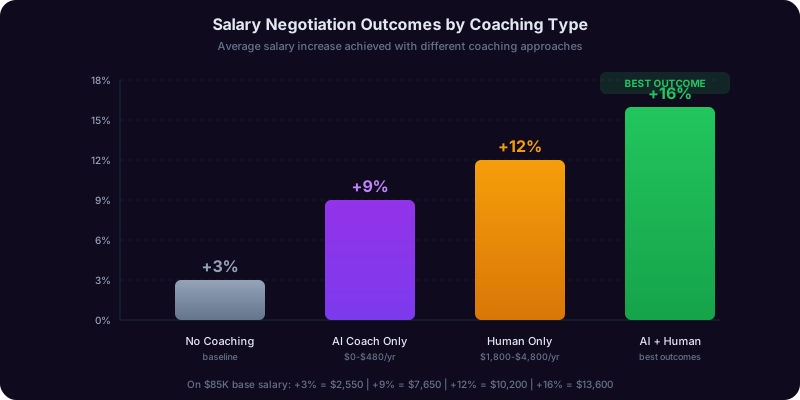
| Approach | Cost | Average Salary Increase | ROI (First Year) |
| No coaching | $0 | $2,500 (3%) | N/A |
| AI coaching only | $0 - $15/month | $7,200 (9%) | $7,200 on $15 |
| Human coaching only | $150 - $300/session | $9,600 (12%) | $9,300 - $9,450 net |
| AI + human combined | $165 - $315 total | $12,800 (16%) | $12,485 - $12,635 net |
The data is clear: the combined approach generates the highest returns. Use AI for data -- market rate research, total compensation modeling, scenario planning. Then invest in a single human coaching session focused on the tactical and emotional dimensions. The $165-315 investment generates an average return of over $12,000 in first-year salary increase alone.
Job Search Strategy and Career Transitions: The Hardest Test for Both Approaches
Resume optimization, interview prep, and salary negotiation are relatively contained problems with measurable inputs and outputs. Job search strategy and career transitions are fundamentally different -- they involve ambiguity, identity, long-term planning, and decisions where the right answer depends on values that no algorithm can fully model.
Job Search Strategy: AI as Research Engine, Human as Strategic Partner
What AI does well in job search:
- Job matching at scale. AI tools scan thousands of postings across platforms and surface the best matches for your skills, experience, and preferences, eliminating hours of scrolling through irrelevant listings.
- Application tracking. AI organizes your pipeline: which companies you applied to, where you are in the process, follow-up deadlines, and response rates.
- Company research. AI synthesizes public data about potential employers -- financial performance, employee reviews, leadership changes, Glassdoor ratings -- and presents a comprehensive profile in minutes.
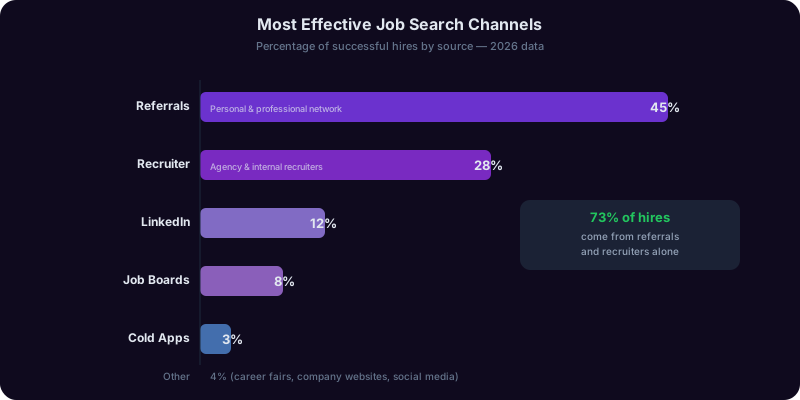
- Networking identification. AI tools analyze your LinkedIn connections and identify second-degree contacts at target companies. The Bureau of Labor Statistics JOLTS report confirms that referrals remain the highest-conversion hiring channel, and AI makes identifying referral paths more efficient.
What human coaches do better in job search:
- Hidden job market access. An estimated 60-70% of positions are filled through networking before they are posted publicly. Human coaches with industry connections can introduce you to decision-makers and vouch for your capabilities.
- Positioning strategy. Should you apply as a senior IC or make the case for a manager title? Target startups or enterprises? Emphasize technical skills or leadership? These strategic decisions require understanding how the market perceives different backgrounds.
- Accountability and momentum. Job searches are emotionally draining. A human coach provides external accountability that keeps you applying even when motivation wanes. According to the ICF coaching effectiveness research, weekly check-ins reduce average job search duration by 20-30%.
Career Transitions: Where Human Coaching Justifies Its Premium
Career transitions -- changing industries, pivoting from IC to management, moving from corporate to entrepreneurship -- represent the most complex coaching challenge. This is where the gap between AI and human coaching is widest.
Why AI struggles with career transitions:
- Identity questions. Career transitions involve questions like "What do I actually want?" and "What am I willing to sacrifice?" These require introspection and values clarification, not optimization. AI can present frameworks, but it cannot sit with you in the discomfort of not having answers.
- Pattern recognition across unconventional paths. A human coach who has guided dozens of transitions recognizes patterns: "I have seen three people make this exact move. Here is what worked." This experiential wisdom is not in any dataset.
- Bridging narratives. The hardest part of a career transition is explaining why you are making the change without raising red flags. A human coach constructs a narrative connecting your past to your target role in a way that feels authentic.
Where AI adds value in career transitions:
- Skills gap analysis: identifying which skills transfer and which you need to develop
- Market demand data: showing which industries and roles are growing and what they pay
- Credential research: identifying certifications or courses that strengthen your candidacy
- Resume repositioning: reframing existing experience to emphasize transferable skills
The verdict: If you are making a significant career transition, invest in a human coach. The strategic guidance, emotional support, and experiential wisdom are genuinely worth the premium. Use AI tools to supplement with data, research, and tactical resume and application execution.
The Complete Head-to-Head Scorecard: AI vs Human Across Every Dimension
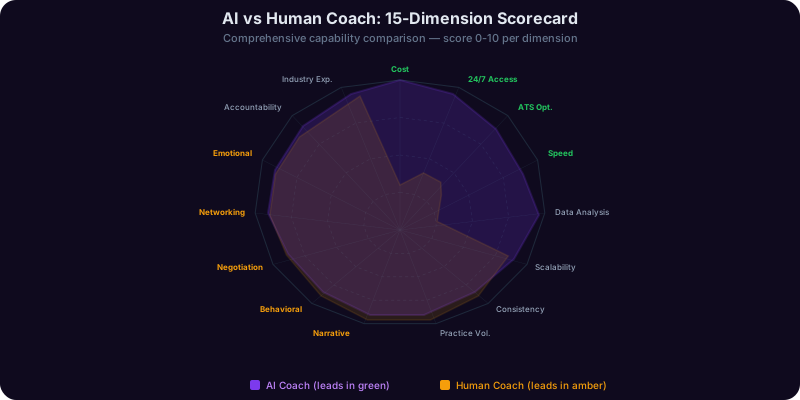
After examining each career coaching function individually, here is the comprehensive comparison. This scorecard rates each approach across 15 dimensions on a scale of 1-5, based on the evidence discussed throughout this guide.
| Dimension | AI Coach (1-5) | Human Coach (1-5) | Notes |
| Cost efficiency | 5 | 2 | AI costs 75-100% less for comparable task volume |
| Availability (24/7 access) | 5 | 1 | AI is instant; humans require scheduling |
| Resume ATS optimization | 5 | 3 | AI handles pattern matching at scale |
| Resume narrative and positioning | 2 | 5 | Requires subjective editorial judgment |
| Interview content practice | 5 | 4 | AI enables unlimited repetitions |
| Interview behavioral feedback | 2 | 5 | Non-verbal cues require human observation |
| Salary market data research | 5 | 3 | AI aggregates more sources faster |
| Negotiation conversation coaching | 2 | 5 | Requires emotional intelligence and role-play |
| Job search efficiency | 5 | 3 | AI scales search across platforms instantly |
| Networking and referral access | 2 | 5 | Humans provide real introductions |
| Career transition guidance | 2 | 5 | Identity and strategy questions need human depth |
| Emotional support | 1 | 5 | Empathy and accountability are human strengths |
| Consistency of quality | 4 | 3 | AI delivers reliably; human quality varies |
| Personalization depth | 3 | 5 | Humans understand context that AI misses |
| Speed of response | 5 | 2 | AI responds in seconds; humans in days |
AI total: 53/75 | Human total: 56/75
The scores are remarkably close, which reflects reality. Neither approach is categorically better. Each dominates in specific domains. The professional who understands these differences and allocates resources accordingly outperforms those who rely exclusively on either approach.
Who Should Choose AI Coaching Only
- Budget-constrained job seekers: If you cannot afford $150-300 per session, AI coaching provides 80% of the value at 5% of the cost.
- Lateral moves within your industry: If you are applying for a similar role at a different company, the tactical tools of AI coaching cover most of what you need.
- High-volume job searchers: If you are sending 50+ applications, AI's ability to tailor resumes and prepare for multiple interviews is more valuable than the depth of human coaching.
- Technical professionals: If career advancement depends primarily on demonstrating technical skills, AI tools for skills assessment and technical interview prep may be sufficient.
Who Should Invest in Human Coaching
- Career changers: Transitioning industries, functions, or levels requires strategic guidance that AI cannot provide at sufficient depth.
- Executives and senior leaders: Career moves at the executive level involve board dynamics, organizational politics, and complex equity structures that require nuanced human judgment.
- Professionals with gaps or non-linear paths: If your resume tells a complicated story, a human coach helps construct a narrative that turns liabilities into assets.
- People who need accountability: If your job search stalls because of motivation rather than tactical issues, the accountability of a human coaching relationship is worth the investment.
The Hybrid Model: How to Get Maximum Value from Both Approaches
The data consistently shows that combining AI and human coaching produces the best outcomes. The hybrid approach uses each tool where it delivers the highest return and avoids the waste of using either where it is weak.
The Optimal Hybrid Budget
| Monthly Budget | AI Allocation | Human Allocation | What You Get |
| $50/month | $15/month AI platform | 1 human session every 3 months | Unlimited AI tools plus quarterly strategic check-ins |
| $100/month | $15/month AI platform | 1 human session every 6-8 weeks | Full AI access plus regular human guidance on strategy |
| $200/month | $15/month AI platform | 1 human session per month | Comprehensive coverage for active job searches |
| $300+/month | $15/month AI platform | 2 human sessions per month | Intensive program for major transitions or executive moves |
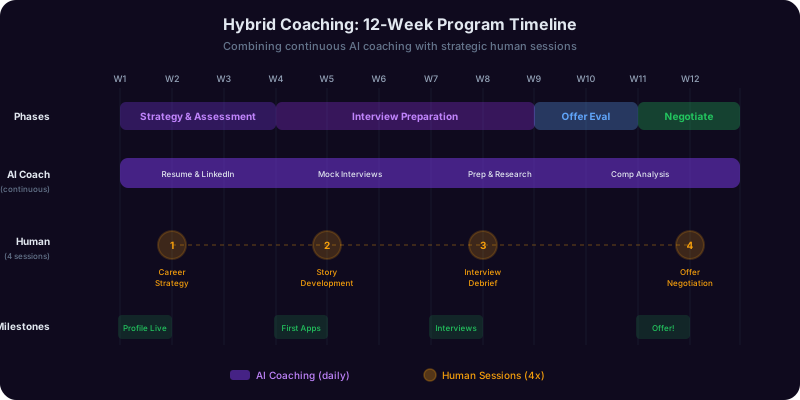
The Hybrid Workflow: Week by Week
Week 1: Foundation (AI-led). Use your AI career coach to audit your resume against 10-15 target job descriptions. Identify keyword gaps, formatting issues, and positioning weaknesses. Generate 3-5 tailored resume versions. Run a salary market analysis for your target roles. The Career Copilot handles this entire phase, giving you a data foundation that would take a human coach 3-4 sessions to build.
Week 2: Strategic session (Human-led). Bring your AI-generated data to a human coaching session. Share your resume audit results, salary research, and target company list. The human coach refines your positioning narrative, identifies networking paths, challenges assumptions about your target roles, and provides feedback on how the market will perceive your background. One focused session with data already in hand is worth more than three sessions spent gathering that data together.
Weeks 3-4: Execution (AI-led). Apply to positions using AI-optimized resumes. Use AI mock interviews to prepare for callbacks. Track applications and follow up on deadlines. Research companies before interviews. Draft networking outreach messages. All high-volume, repetitive work that AI handles more efficiently.
Week 5: Check-in (Human-led, if needed). If you have interviews coming up, book a human session focused on behavioral preparation and non-verbal feedback. If your search is progressing well, save the budget for negotiation coaching when an offer arrives.
When to Escalate from AI to Human
Use AI as your default coaching tool, and escalate to a human coach in these situations:
- You receive an offer and need negotiation coaching. The ROI of a single human session ($150-300 investment, $5,000-15,000 average return) is the highest-return investment in this entire guide.
- You are stuck. If your search has stalled for 4-6 weeks with no interviews despite active applications, a human coach can diagnose positioning issues or targeting mistakes.
- You are making a major career decision. Accept this offer or keep looking? Stay or make a move? These trade-offs benefit from human perspective. For a framework on using AI for important decisions, see our second opinion guide.
- You need emotional support. If rejection is affecting your confidence or mental health, a human coach provides empathetic support that AI cannot.
- You need introductions. When you need a warm introduction to a hiring manager, only a human can do that. The Second Opinion Copilot can help evaluate your options, but it cannot make a phone call on your behalf.
The Bottom Line
A purely AI-driven approach costs $0-180 per year and delivers strong results for straightforward job searches, resume optimization, interview practice, and salary research. A purely human-driven approach costs $1,800-4,800 per year and delivers superior results for career transitions, negotiation coaching, networking, and emotional support. The hybrid model costs $500-2,400 per year and delivers the best results across all dimensions by allocating each dollar where it generates the highest return.
The professionals who will advance fastest in 2026 are not choosing between AI and human coaching. They are using both -- strategically, deliberately, and with a clear understanding of where each approach creates the most value for their specific situation.
Frequently Asked Questions
Recommended Copilots
Recommended Copilots
Get instant AI career coaching for resume reviews, job search strategy, and career transition planning
Try Free →Use as a sounding board for major career decisions like accepting offers or changing industries
Try Free →Build your personal brand and professional positioning with AI-powered marketing guidance
Try Free →Related Articles
Get Answers From the Career Copilot
Get an instant resume review, mock interview session, or salary market analysis. No scheduling, no hourly fees. See how AI career coaching compares to traditional coaching for your specific situation.