

How Property Tax Assessments Work and Why They Are Often Wrong
Every property owner in the United States pays property taxes based on an assessed value assigned by a county or municipal assessor. This value is supposed to reflect the fair market value of your property, but the system that produces it is far less precise than most homeowners realize. Understanding how assessments work is the first step toward identifying whether yours is wrong and worth challenging.
The Assessment Process
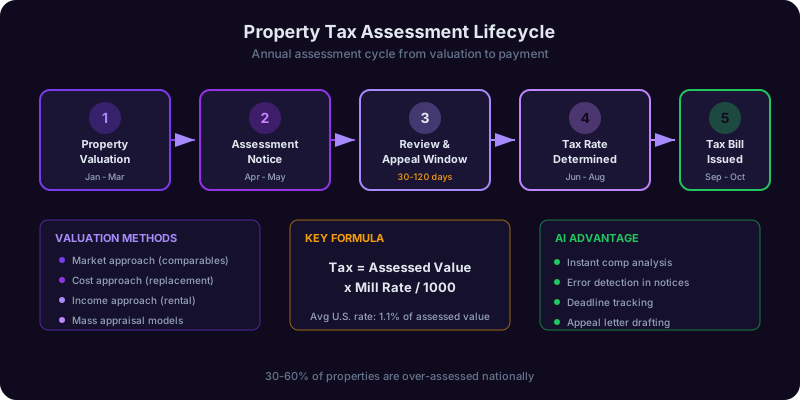
County assessors are responsible for valuing every parcel of land and every structure in their jurisdiction. In most counties, this means a small team of assessors is responsible for tens or hundreds of thousands of properties. The sheer volume makes individual accuracy impossible. Assessors rely on three valuation methods:
- Sales comparison approach: The assessor looks at recent sales of comparable properties in your area and adjusts for differences in size, condition, lot size, and features. This is the most common method for residential properties.
- Cost approach: The assessor estimates how much it would cost to rebuild your home from scratch, minus depreciation, plus the land value. This method is used for newer or unique properties where comparable sales are limited.
- Income approach: Used primarily for commercial and rental properties, this method estimates value based on the income the property generates.
Where Errors Creep In
The International Association of Assessing Officers (IAAO) sets standards for assessment accuracy, recommending that the coefficient of dispersion (a measure of assessment uniformity) stay below 15% for residential properties. Many jurisdictions exceed this threshold. Common sources of error include:
- Outdated data: Many counties reassess properties only every 3-5 years. Your assessment may reflect 2023 market conditions while your neighborhood has declined since then.
- Incorrect property records: The assessor's office may have the wrong square footage, bedroom count, bathroom count, lot size, or year built. One study by the National Taxpayers United of Illinois found that 40% of assessment records contained at least one factual error.
- Mass appraisal limitations: Assessors use computer-assisted mass appraisal (CAMA) models that apply neighborhood-wide adjustments. These models cannot account for property-specific factors like a busy road behind your house, a neighboring commercial property, or deferred maintenance.
- Unequal assessment: Your home may be assessed at a higher percentage of market value than comparable homes on your street. This is a separate legal basis for appeal in many states.
The result is that a significant percentage of properties carry assessments that do not accurately reflect their market value. The Lincoln Institute of Land Policy tracks assessment practices across all 50 states and confirms wide variation in accuracy and frequency of reassessment.
How Your Tax Bill Is Calculated
Your property tax bill is not simply your assessed value multiplied by a tax rate. Most jurisdictions apply an assessment ratio (also called a classification rate) that reduces the assessed value to a taxable value. For example, if your home is assessed at $400,000 and your state applies a 33% assessment ratio, your taxable value is $132,000. The tax rate (expressed in mills, where 1 mill equals $1 per $1,000 of taxable value) is then applied to the taxable value. At a rate of 80 mills, your annual tax would be $10,560. Understanding this math matters because a successful appeal that reduces your assessed value by $50,000 does not reduce your tax bill by $50,000. It reduces your taxable value by $50,000 multiplied by the assessment ratio, and your tax bill by that amount multiplied by the mill rate.
Seven Signs Your Property Is Over-Assessed
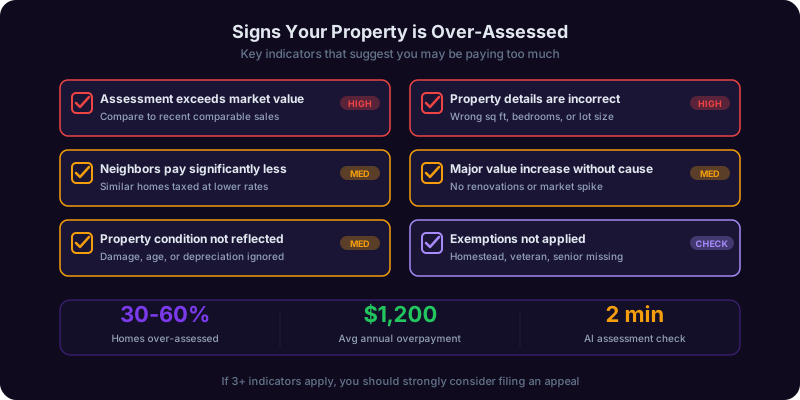
Before you invest time in an appeal, you need to determine whether your property's assessed value is actually too high. Not every assessment is worth challenging. Here are seven concrete indicators that your assessment may be inflated, along with how to verify each one.
1. Your Assessed Value Exceeds Recent Sale Prices of Similar Homes
This is the strongest indicator. If comparable homes in your neighborhood (similar size, age, condition, and lot) have sold for less than your assessed value, your assessment is likely too high. Check recent sales on Zillow or Redfin for homes within a half-mile radius that sold in the past 6-12 months. If three or more comparable sales are 10% or more below your assessed value, you have a strong case.
2. Your Assessment Increased Dramatically in One Year
If your assessed value jumped 20% or more in a single reassessment cycle while comparable properties saw smaller increases, the assessor may have applied incorrect adjustments. Large single-year jumps are especially suspect in states that limit annual assessment increases (like California's Proposition 13 at 2% per year) because they may indicate a data error rather than a legitimate market adjustment.
3. Your Property Record Contains Errors
Pull your property record card from the county assessor's website. Verify every detail: square footage, number of bedrooms and bathrooms, lot size, year built, basement status (finished vs. unfinished), garage size, and any noted improvements. A property recorded as having 2,400 square feet when it actually has 2,100 square feet is being taxed on 300 phantom square feet. At an average assessed value of $150-$250 per square foot, that error alone inflates your assessment by $45,000-$75,000.
4. Your Home Has Condition Issues the Assessor Does Not Know About
Assessors typically do not enter homes during mass appraisal. If your property has significant deferred maintenance, an aging roof, outdated systems, foundation issues, or other condition problems that reduce its market value, the assessor's record likely reflects a higher condition rating than reality. Document these issues with photographs and repair estimates.
5. There Are Negative Externalities Affecting Your Property
Your home's value is affected by factors beyond its walls. Proximity to a highway, railroad tracks, commercial property, cell tower, power lines, landfill, or flood zone can reduce market value by 5-15% compared to otherwise similar homes without those drawbacks. If the assessor's model does not account for these factors, your assessment may be inflated relative to your true market value.
6. Your Neighbors Pay Less on Similar Properties
Many county assessor websites allow you to search property records by address or parcel number. Compare your assessment to homes on your street and in your immediate area that are similar in size, age, and features. If your home is assessed significantly higher than comparable neighbors, you may have a case for unequal assessment, which is a separate legal basis for appeal in most jurisdictions. This argument does not require proving your assessment exceeds market value; it only requires showing that it is higher than comparable properties relative to their actual values.
7. You Recently Made a Failed Attempt to Sell
If you listed your home for sale and received offers below your assessed value, or if it sat on the market without selling at a price below the assessed value, that is direct market evidence that the assessment is too high. Listing history, days on market, and final sale price (or lack of sale) are powerful evidence in an appeal. Real estate agents familiar with your neighborhood can provide a broker's price opinion that may carry weight with the appeals board.
If two or more of these indicators apply to your property, an appeal is worth pursuing. The average successful appeal reduces assessed value by 10-25%, which translates to annual tax savings of $500-$3,000 or more depending on your jurisdiction's tax rate. The Real Estate Copilot can help you analyze whether your assessment is out of line with local market data and comparable properties.
Gathering Comparable Properties With AI: The Core of Your Appeal
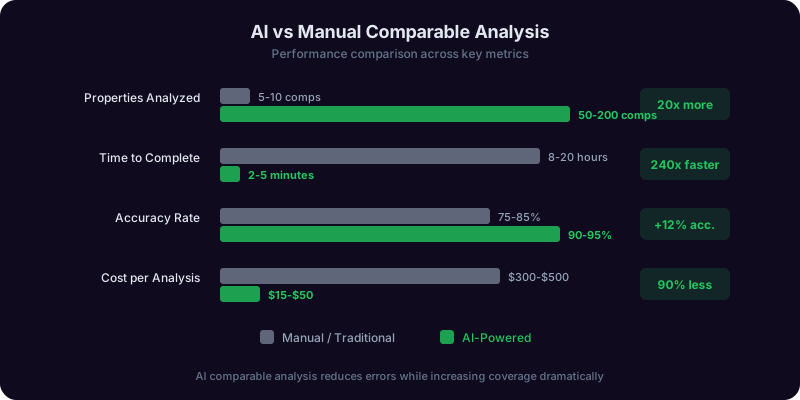
The strength of any property tax appeal rests on one thing: comparable sales data. You need to show the assessor or appeals board that similar properties have sold for less than your assessed value. Traditionally, this required hiring an appraiser ($300-$500) or spending hours manually searching public records and real estate databases. AI tools have fundamentally changed this process, making professional-quality comp analysis accessible to any homeowner.
What Makes a Good Comparable
Before using any tool, you need to understand what assessors and appeals boards consider a valid comparable property. The IAAO and most assessment review boards apply these criteria:
- Location: Same neighborhood or school district, ideally within 0.5-1 mile of your property. The closer, the stronger the comp.
- Sale date: Within the past 6-12 months. More recent sales carry more weight. Some boards accept up to 18 months in slow-turnover neighborhoods.
- Size: Within 10-20% of your home's square footage. A 2,000 sq ft home compared to a 3,500 sq ft home is not a valid comp regardless of proximity.
- Age and style: Similar construction era and architectural style. A 1960s ranch compared to a 2020 new build is not meaningful.
- Condition: Comparable level of updates and maintenance. A fully renovated home versus one with original 1970s finishes are not true comparables.
- Lot size: Within 20-30% of your lot acreage, especially in areas where land value is a significant component.
How AI Automates Comp Selection
AI-powered property analysis tools like Smart Appeal AI, Zillow's Zestimate, and Redfin's market analysis use machine learning models trained on millions of property transactions to identify the most statistically relevant comparables. Here is what they do that manual search cannot match:
- Multi-variable matching: Instead of filtering by one criterion at a time (location, then size, then age), AI evaluates all criteria simultaneously to find the best overall matches. A property that is slightly farther away but nearly identical in size, age, and condition may be a better comp than a closer property with significant differences.
- Adjustment calculations: Professional appraisers adjust comparable sale prices to account for differences. If a comp has a finished basement and your home does not, the appraiser deducts the value of that basement from the comp's sale price. AI tools apply these adjustments automatically using local market data for feature values.
- Market trend analysis: AI factors in whether your local market is appreciating, flat, or declining, adjusting comp values for time between the sale date and your assessment date.
- Outlier detection: AI identifies and flags distressed sales (foreclosures, short sales, estate sales) that may skew your analysis. These sales are often excluded or given less weight by appeals boards.
Step-by-Step AI Comp Analysis
- Enter your property details: Address, square footage, bedrooms, bathrooms, lot size, year built, and any notable features or deficiencies.
- Set search parameters: Most AI tools let you define the radius, date range, and similarity thresholds. Start with 0.5 miles and 6 months, then expand if needed.
- Review AI-selected comps: The tool will return 5-15 potential comparables ranked by similarity score. Focus on the top 5-7.
- Verify and adjust: Cross-reference AI selections against your local knowledge. Exclude any comps that have unusual circumstances the AI may not detect (estate sales, related-party transactions, properties with known issues).
- Generate adjusted values: The AI calculates what each comp would have sold for if it were identical to your property. The average of these adjusted values is your estimated market value.
If your estimated market value is 10% or more below your assessed value, you have a strong appeal case. Between 5-10%, the case is moderate and depends on the strength of your comps. Below 5%, the appeal may not be worth the effort unless your tax rate is very high. For a broader look at how AI is transforming real estate decisions, see our complete guide to AI for real estate agents.

Get Answers From the Real Estate Copilot
Copilotly's Real Estate and Tax Copilots help you analyze comparable property values, identify assessment errors, calculate potential savings, and prepare appeal documentation so you can challenge an over-assessment with confidence.
Building Your Appeal Case: Evidence, Documentation, and AI-Generated Reports
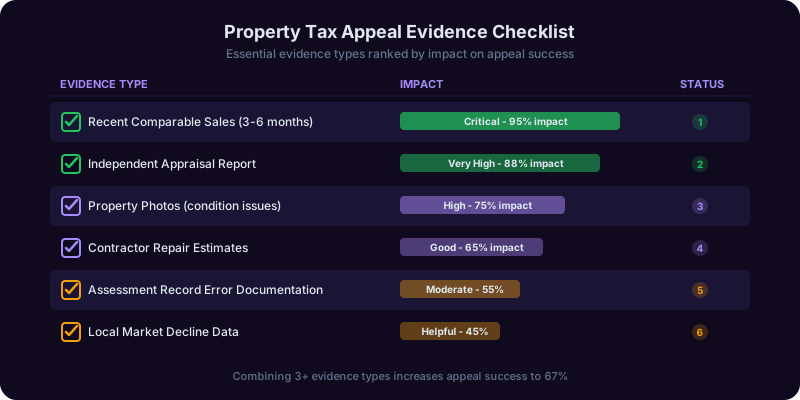
A property tax appeal is a quasi-legal proceeding. You are making an argument, supported by evidence, to a government body. The quality of your evidence package directly determines your success rate. Here is how to assemble a compelling case, and how AI tools accelerate each step.
The Five Categories of Appeal Evidence
1. Comparable sales analysis. This is your primary evidence. Present 3-5 comparable sales showing adjusted values below your assessment. For each comp, include: address, sale date, sale price, key property characteristics, adjustments applied, and adjusted sale price. AI tools generate this analysis as a formatted report. The average of your adjusted comp values establishes your proposed assessed value.
2. Property condition documentation. Photograph any condition issues that reduce your home's value compared to the assessor's assumed condition. This includes: aging roof (with estimated remaining lifespan), outdated kitchen or bathrooms, deferred maintenance, foundation cracks, drainage problems, aging HVAC or electrical systems, and any structural issues. Include repair cost estimates from contractors if available. Even informal estimates add credibility.
3. Property record corrections. If the assessor's records contain errors (wrong square footage, incorrect bedroom or bathroom count, non-existent improvements), document the correct information. Bring your original building plans, a recent appraisal, or measurements. This is the easiest type of appeal to win because the error is factual and verifiable.
4. Market data and trends. If your local market has declined since the assessment date, provide evidence. Median sale prices over time, days on market trends, and inventory levels all demonstrate market direction. AI tools pull this data automatically and present it as charts that appeals boards understand at a glance.
5. Independent appraisal or broker's price opinion. A formal appraisal ($300-$500) from a licensed appraiser carries the most weight with appeals boards. A broker's price opinion (BPO) from a local real estate agent ($50-$150 or sometimes free) is less authoritative but still useful as supporting evidence. If your potential tax savings exceed $1,500 per year, the cost of an appraisal pays for itself within one year.
How AI Generates Your Appeal Package
Modern AI property tax tools can generate a near-complete appeal package in 15-30 minutes. Smart Appeal AI and similar platforms produce:
- Comparable sales report with adjusted values and similarity scores
- Market trend analysis showing local appreciation or depreciation rates
- Assessment equity analysis comparing your assessment ratio to neighborhood averages
- Summary of findings with a recommended assessed value and estimated tax savings
- Appeal letter draft tailored to your jurisdiction's requirements
These AI-generated reports are not a substitute for reviewing and customizing the output. Check every comparable for accuracy, verify that adjustments are reasonable, and add property-specific details the AI cannot know (like the highway noise or the neighbor's junkyard). The Finance Copilot can help you calculate whether the potential savings justify the time and any costs involved in your appeal.
Common Mistakes That Weaken Your Case
- Using comps that are too different. A 4-bedroom colonial is not comparable to a 2-bedroom ranch, regardless of proximity. Stick to properties that a reasonable buyer would consider alternatives to yours.
- Cherry-picking only the lowest sales. Appeals boards notice when you select only distressed sales or outliers. Include a representative range and let the average make your case.
- Arguing about your tax bill instead of your assessed value. The appeals board controls assessed values, not tax rates. Focus your argument on value.
- Being emotional or adversarial. Treat the hearing as a professional presentation of evidence. The board members are doing their job. Respectful, data-driven presentations win far more often than angry complaints.
- Missing the deadline. This is the most common reason appeals never happen. Deadlines are strict and non-negotiable in most jurisdictions.
Property Tax Appeal Deadlines by State: A Filing Calendar
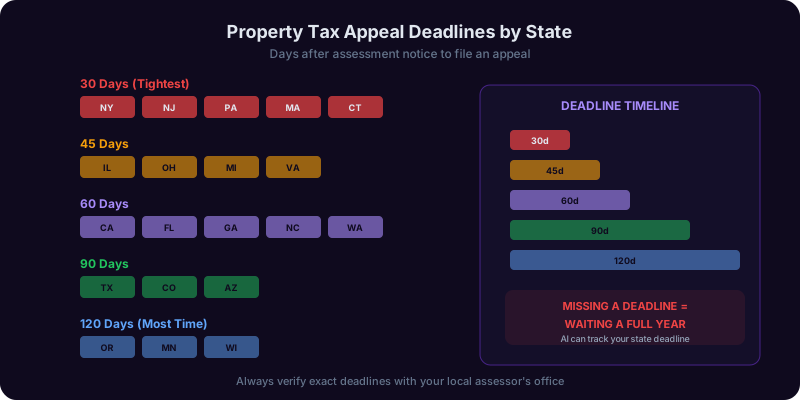
Missing the appeal deadline is the number one reason homeowners fail to challenge their assessments. Deadlines vary dramatically by state, and in some cases by county within the same state. Most deadlines fall within 30-120 days of receiving your assessment notice or tax bill. There is no universal federal deadline because property taxes are administered entirely at the state and local level.
Key Deadlines by State (2026)
The following table covers the most populous states. For your specific jurisdiction, always verify with your county assessor's office or state property tax board, as deadlines can change and some counties have different windows than the state default.
| State | Appeal Window | Where to File | Notes |
|---|---|---|---|
| California | July 2 - November 30 | County Assessment Appeals Board | File Application for Changed Assessment (Form BOE-305-AH). Free to file. |
| Texas | May 15 or 30 days after notice | County Appraisal Review Board (ARB) | File Form 50-132. Late filings accepted through August for good cause. |
| Florida | 25 days after TRIM notice (August) | County Value Adjustment Board (VAB) | File petition with county clerk. Filing fee $15. |
| New York | Varies by municipality (typically March-May) | Local Board of Assessment Review, then SCAR | NYC: January 15 for Class 1 residential. Upstate varies widely. |
| Illinois | 30 days after publication of assessment | County Board of Review | Cook County has separate procedures and deadlines. Check ccao.org. |
| Pennsylvania | Varies by county (typically August 1) | County Board of Assessment Appeals | Some counties allow appeals year-round. No statewide standard. |
| Ohio | January 1 - March 31 (revaluation years) | County Board of Revision | File Form DTE 1. Can also file complaints in non-revaluation years. |
| Georgia | 45 days after assessment notice | County Board of Tax Assessors, then Board of Equalization | File appeal in writing to county assessor. |
| New Jersey | By April 1 (or May 1 in some counties) | County Board of Taxation, then NJ Tax Court | File Form A-1 petition. Assessment date is October 1 of prior year. |
| Michigan | March Board of Review meeting | Local Board of Review, then Michigan Tax Tribunal | Attend Board of Review in person during March hearings. |
How to Track Your Deadline
Assessment notices arrive at different times depending on your jurisdiction. Some arrive in January, others in May or August. The appeal clock typically starts when the notice is mailed, not when you receive it. Take these steps:
- Check your county assessor's website for the current year's assessment calendar and appeal deadlines.
- Set a calendar reminder for the date your assessment notice typically arrives, plus a second reminder 14 days later as a backup.
- Note whether your state allows online filing. Many jurisdictions now accept electronic appeals, which eliminates postal delay risk.
- Confirm the filing fee. Most jurisdictions charge $0-$50 to file an appeal. Some refund the fee if you win.
What Happens If You Miss the Deadline
In most states, missing the deadline means you cannot appeal that assessment year and must wait until the next reassessment cycle (which could be 1-5 years depending on your state). Some states offer limited exceptions for good cause, clerical errors by the assessor's office, or newly discovered evidence. A few states, like Pennsylvania and some Ohio counties, allow appeals to be filed at any time during the tax year. But the general rule is: if you think your assessment is wrong, act within the first two weeks of receiving the notice. AI tools that generate appeal packages in under an hour eliminate the most common excuse for missing deadlines, which is not having enough time to prepare the documentation. Your Tax Copilot can help you understand how a successful appeal would affect your overall tax picture and whether the savings compound with any exemptions you may qualify for.
Informal vs. Formal Hearings: Choosing the Right Appeal Path
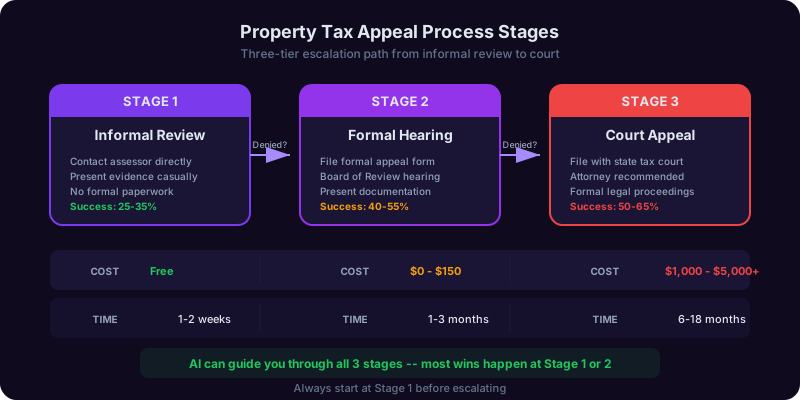
Most jurisdictions offer a two-tier appeal process: an informal review followed by a formal hearing if the informal review does not resolve the dispute. Understanding the differences between these paths helps you allocate your time and resources effectively.
The Informal Review
An informal review is a meeting or phone call with a representative from the assessor's office. It is less structured than a formal hearing and is designed to resolve straightforward disputes without the time and cost of a board hearing. Here is what to expect:
- Format: Typically a 15-30 minute conversation, either in person or by phone. Some counties now offer video conferences.
- Who you meet with: A staff appraiser or reviewer from the assessor's office. This is not the chief assessor but someone authorized to negotiate adjustments.
- What to bring: Your comparable sales analysis, property condition photos, and any documentation of record errors. AI-generated appeal reports work well at this stage.
- Resolution rate: Many jurisdictions report that 50-70% of appeals are resolved at the informal stage, often because the homeowner presents evidence the assessor did not have.
- Outcome options: The reviewer may agree to reduce your assessment, offer a partial reduction as a compromise, or uphold the current assessment. You are not obligated to accept a partial reduction; you can proceed to the formal hearing.
The Formal Hearing
If the informal review does not resolve your appeal, you proceed to a formal hearing before an assessment review board (the name varies by jurisdiction: Board of Equalization, Board of Assessment Appeals, Value Adjustment Board, Appraisal Review Board, etc.). This is a quasi-judicial proceeding:
- Format: A structured hearing before a panel of board members. You present your case, the assessor's office presents theirs, and the board makes a decision. Hearings typically last 15-45 minutes for residential properties.
- Rules of evidence: While less formal than a courtroom, the board expects organized, evidence-based presentations. Hearsay and opinion carry little weight. Data and documentation win cases.
- Presentation tips: Lead with your strongest evidence. If you have a clear property record error, present it first because it is unchallengeable. Follow with your comparable sales analysis. End with property condition evidence.
- The assessor's defense: The assessor's office will present their own comparable sales that support the current assessment. Be prepared to explain why your comps are more relevant than theirs (closer proximity, more similar characteristics, more recent sale dates).
- Decision timeline: Most boards issue decisions within 30-90 days. Some announce the decision at the hearing.
When to Hire a Property Tax Attorney or Consultant
For most residential appeals under $500,000 in assessed value, self-representation is practical and cost-effective, especially with AI tools handling the analytical work. Consider hiring a professional when:
- The assessment involves more than $5,000 per year in taxes: The stakes justify professional representation. Property tax attorneys and consultants typically charge either a flat fee ($500-$2,000) or a contingency fee (25-40% of the first year's tax savings).
- The property is commercial or multi-family: Commercial assessments involve income capitalization and market approaches that require specialized knowledge.
- You are filing a state tax court appeal: If the local board upholds the assessment and you want to appeal further, state tax court proceedings require legal representation in most states.
- Your jurisdiction has a complex appeals process: Some areas, notably Cook County, Illinois, have notoriously complex assessment systems where professional help significantly improves outcomes.
Contingency-fee arrangements are common and attractive because you pay nothing if the appeal fails. However, read the contract carefully. Some firms lock you into multi-year agreements and take a percentage of savings for 2-3 years. For straightforward residential appeals, the combination of AI tools and self-representation often produces results comparable to professional representation at a fraction of the cost. If you want help reviewing the terms of a professional engagement, the Contract Review Copilot can analyze fee agreements and highlight unfavorable terms.
Property Tax Appeal Letter Templates and AI-Assisted Drafting
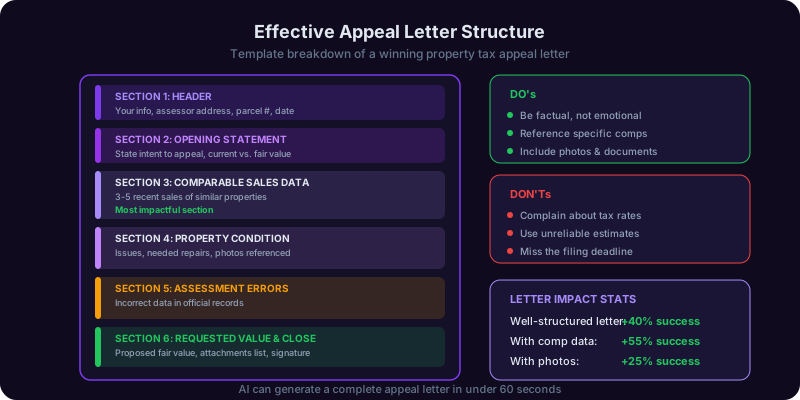
The appeal letter is the document that formally initiates your challenge and presents your argument in writing. Some jurisdictions require a specific form; others accept a letter. Either way, the quality of your written argument matters, especially if the board reviews your case on paper before or instead of holding an in-person hearing.
What an Effective Appeal Letter Includes
A strong appeal letter follows a clear structure. Here is each section with guidance on what to include and what to avoid.
Section 1: Identification and filing information. Include your name, property address, parcel number, current assessed value, and the assessment year you are challenging. Reference the appeal form number if your jurisdiction requires one. State whether this is an informal or formal appeal. Keep this section factual and brief.
Section 2: Statement of the issue. Clearly state what is wrong with your assessment and on what basis you are appealing. The three most common bases are: (a) assessed value exceeds fair market value, (b) the assessment is unequal compared to similar properties, and (c) the property record contains factual errors. You can argue multiple bases in the same appeal.
Section 3: Evidence summary. Present your comparable sales analysis, property condition documentation, and any record corrections. For each comparable sale, include the address, sale date, sale price, key characteristics, adjustments, and adjusted sale price. Summarize the data in a table for readability. Reference attached exhibits by number.
Section 4: Requested relief. State the assessed value you are requesting and the basis for that number. Typically this is the average of your adjusted comparable sale prices, rounded to the nearest $1,000. Be specific: "Based on the comparable sales analysis presented, I respectfully request that the assessed value be reduced from $385,000 to $340,000."
Section 5: Closing. Thank the board for their consideration. Note your willingness to provide additional information or appear at a hearing. Include your contact information and signature.
How AI Drafts Your Appeal Letter
AI tools can generate a first draft of your appeal letter in under five minutes based on your property data, comparable sales analysis, and the specific grounds for your appeal. Here is how to use AI effectively for this task:
- Input your property details and assessment information into the AI tool along with the comparable sales data you have gathered.
- Specify your jurisdiction. Different states and counties have different procedural requirements and legal standards. AI tools trained on property tax appeals adjust the language and format accordingly.
- Review the output critically. AI generates well-structured, professional prose, but it may include generic language that does not apply to your specific case. Remove any unsupported claims and add property-specific details the AI does not know.
- Verify all numbers. Cross-check every assessed value, sale price, square footage, and calculation in the AI-generated letter against your source data. AI can make arithmetic errors or transpose numbers.
- Customize the tone. AI tends toward formal but sometimes overly aggressive language. The most effective appeal letters are respectful, factual, and direct. Remove any language that sounds confrontational.
What to Avoid in Your Appeal Letter
- Do not argue about your tax rate or tax bill. The appeals board controls assessed values, not tax rates. Saying "my taxes are too high" is not a valid legal argument.
- Do not compare to properties in other towns or counties. Your assessment must be evaluated against properties within the same jurisdiction.
- Do not include irrelevant personal circumstances. While sympathetic, financial hardship, medical bills, or retirement status are not grounds for reducing assessed value. Some jurisdictions offer separate hardship exemptions; those are a different process.
- Do not overstate your case. Claiming your $385,000 assessed home is worth $250,000 when your own comps suggest $340,000 undermines your credibility. Be realistic and let the evidence speak.
The Legal Copilot can help you review your appeal letter for clarity, completeness, and persuasiveness before you submit it.
Success Rates, Expected Savings, and Whether an Appeal Is Worth Your Time
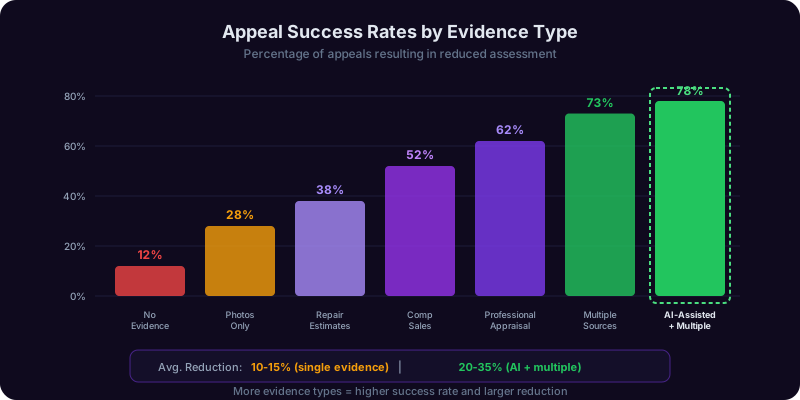
The data on property tax appeal outcomes is surprisingly favorable for homeowners. Understanding the numbers helps you make a rational decision about whether to invest your time.
National Success Rates
Across the United States, homeowners who file property tax appeals win or receive a reduction 40-60% of the time, depending on the jurisdiction and the quality of the evidence presented. Some states report even higher rates:
| Jurisdiction | Approximate Success Rate | Average Reduction | Notes |
|---|---|---|---|
| Texas (statewide) | 65-70% | $20,000-$30,000 in assessed value | Appraisal Review Boards are homeowner-friendly |
| Cook County, IL | 35-45% | $15,000-$25,000 in assessed value | Complex system favors professional representation |
| California | 50-60% | $25,000-$50,000 in assessed value | Prop 13 base year value appeals common after market declines |
| Florida | 50-55% | $15,000-$30,000 in assessed value | Value Adjustment Boards hear residential and commercial appeals |
| New Jersey | 55-65% | $20,000-$40,000 in assessed value | One of the highest property tax states; strong incentive to appeal |
| New York (NYC) | 40-50% | $10,000-$25,000 in assessed value | Class 1 residential appeals through NYC Tax Commission |
What a Successful Appeal Saves You
The dollar savings depend on two factors: how much your assessed value is reduced and your local tax rate. Here is the math for a typical successful appeal:
- Current assessed value: $400,000
- Reduced assessed value after appeal: $350,000 (a $50,000 reduction, or 12.5%)
- Local effective tax rate: 1.5%
- Annual tax savings: $50,000 x 1.5% = $750 per year
In higher-tax states, the same reduction saves significantly more:
- New Jersey (effective rate 2.2%): $50,000 x 2.2% = $1,100 per year
- Texas (effective rate 1.7%): $50,000 x 1.7% = $850 per year
- Illinois (effective rate 2.1%): $50,000 x 2.1% = $1,050 per year
Over 5 years (assuming the reduced value holds until the next reassessment), that $50,000 reduction saves $3,750-$5,500. Over 10 years: $7,500-$11,000. This is why even modest reductions are worth pursuing.
Cost-Benefit Analysis: Is It Worth Your Time?
Here is a realistic breakdown of the time and money involved in a self-filed appeal using AI tools:
| Item | Cost | Time |
|---|---|---|
| AI comp analysis tool | $0-$50 | 30 minutes |
| Property condition documentation | $0 (your phone camera) | 1 hour |
| Appeal letter drafting (AI-assisted) | $0 | 30 minutes |
| Filing the appeal | $0-$50 filing fee | 30 minutes |
| Informal hearing attendance | $0 | 1-2 hours |
| Formal hearing (if needed) | $0 | 2-4 hours |
| Total | $0-$100 | 4-8 hours |
If your potential annual savings exceed $500, the return on your time is at least $60-$125 per hour. With AI handling the analytical heavy lifting, the time investment is lower than ever before. For perspective on maximizing all your financial opportunities, our guide on first-time home buyer mistakes covers the property tax reassessment trap that catches new buyers off guard. And if you are looking at the broader picture of housing costs, our rent negotiation guide provides similar savings strategies for renters.
When Not to Appeal
Not every assessment is worth challenging. Skip the appeal if:
- Your assessment is within 5% of market value. The margin of error in mass appraisal means a 5% variance is within acceptable range, and appeals boards are unlikely to grant a reduction.
- Your local market is appreciating rapidly. If comparable sales support or exceed your assessed value, you do not have a case regardless of how your taxes feel.
- You recently purchased the property near the assessed value. Your own purchase price is the strongest market evidence, and if it aligns with the assessment, an appeal will not succeed.
- You made significant improvements. If you added a bedroom, renovated the kitchen, or finished the basement, increased assessment is justified and expected.
For help analyzing whether your specific situation warrants an appeal, the Tax Copilot can model the financial impact and help you decide whether the potential savings justify the effort.
Frequently Asked Questions
Recommended Copilots
Recommended Copilots
Analyze comparable property values, market trends, and neighborhood data to build your appeal case
Try Free →Calculate the financial impact of a successful appeal and model long-term tax savings scenarios
Try Free →Understand how property tax reductions interact with your overall tax situation and available exemptions
Try Free →Review appeal letters for completeness and understand the procedural requirements in your jurisdiction
Try Free →Analyze fee agreements if hiring a property tax consultant or attorney on a contingency basis
Try Free →Related Articles
Get Answers From the Real Estate Copilot
Copilotly's Real Estate and Tax Copilots help you analyze comparable property values, identify assessment errors, calculate potential savings, and prepare appeal documentation so you can challenge an over-assessment with confidence.