
The Non-Compete Landscape in 2026: Where Things Stand
Non-compete agreements are in the middle of the biggest legal shakeup in decades. If you signed one five years ago, the rules may have already changed under your feet. If you are being asked to sign one today, you have more leverage than you probably realize.
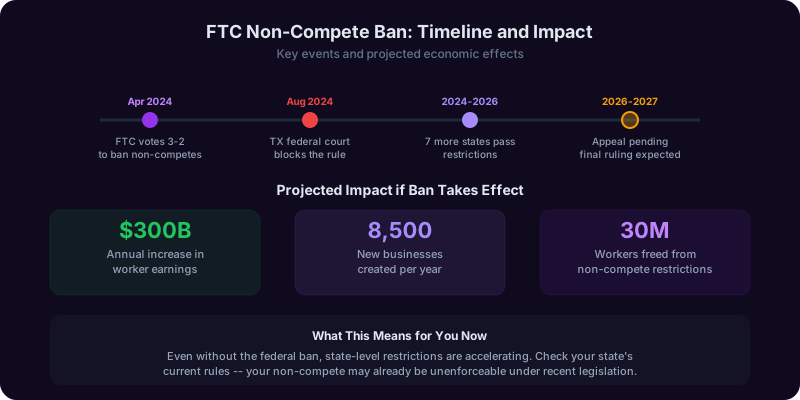
Here is what happened: In April 2024, the Federal Trade Commission voted 3-2 to ban nearly all non-compete agreements nationwide, calling them an "unfair method of competition." The rule was set to take effect in September 2024. Then a federal judge in Texas blocked it. The FTC appealed, and as of early 2026, the legal battle continues in the courts with no final resolution.
But the FTC's action set off a chain reaction at the state level. Between 2024 and 2026, seven additional states passed laws banning or severely restricting non-competes, bringing the total number of states with meaningful restrictions to over twenty. The trend is unmistakable: non-competes are becoming harder to enforce almost everywhere.
The Numbers Tell the Story
The economic stakes are enormous:
- 30 million workers in the United States are currently bound by non-compete agreements, roughly 18% of the entire workforce.
- The Economic Policy Institute estimates that restricted worker mobility costs the U.S. economy approximately $1 trillion per year in lost wages and reduced innovation.
- Workers subject to non-competes earn an average of 4-8% less than comparable workers without them, according to a 2025 study by the Treasury Department.
- 40% of workers who sign non-competes say they did so without consulting a lawyer, and nearly half report that they were presented with the agreement on their first day of work or after they had already accepted the offer.
- Only about 0.5% of non-compete disputes ever result in a court-issued injunction actually blocking someone from working. Employers win full enforcement in fewer than one-third of the cases they bring.
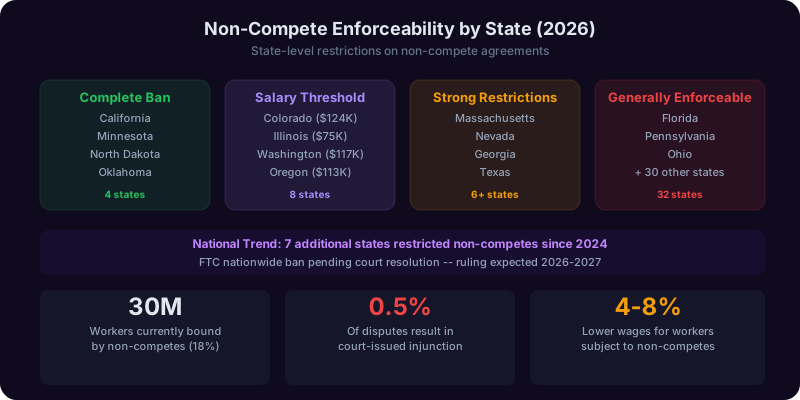 That last statistic is critical. Employers rely heavily on the chilling effect of non-competes: most workers comply out of fear, never testing whether the agreement would actually hold up in court. Understanding the real enforceability landscape changes the calculus entirely.
Disclaimer: This guide provides general legal information, not legal advice. Non-compete enforceability varies by state and by specific contract language. If you are bound by a non-compete and considering changing jobs, consult an attorney licensed in your state about your specific situation.
What Makes a Non-Compete Enforceable: The 4 Tests Courts Apply
When a non-compete dispute reaches a courtroom, judges do not simply ask "did you sign it?" They apply a multi-factor analysis to determine whether the agreement is reasonable. In most states, a non-compete must pass all four tests to be enforced. Fail any one of them, and the agreement may be thrown out entirely or narrowed significantly.
Test 1: Legitimate Business Interest
The employer must prove they have a genuine business interest worth protecting. Courts recognize several categories:
- Trade secrets and proprietary information: Customer lists, formulas, algorithms, manufacturing processes, pricing strategies. This is the strongest basis for enforcement.
- Client relationships: If you built deep relationships with clients on behalf of the company and could take those clients with you, courts may find a protectable interest. But this has limits: knowing a client exists is not the same as having a protectable relationship.
- Specialized training: If the employer invested heavily in training you with proprietary knowledge (not general industry skills), this can support enforcement. However, courts increasingly distinguish between "we taught you our secret process" and "we taught you skills you could have learned anywhere."
What courts have rejected as legitimate interests: preventing ordinary competition, keeping wages low, punishing employees for leaving, and protecting against employees who were in low-level positions with no access to sensitive information. A warehouse worker, a janitor, or a fast-food employee with a non-compete will almost never see it enforced.
Test 2: Reasonable Duration
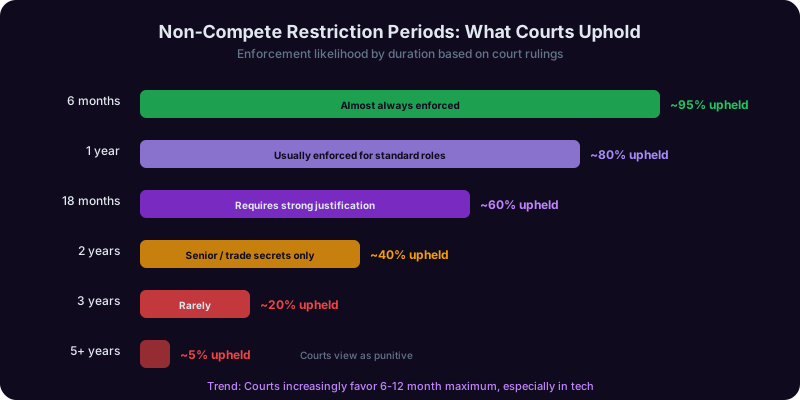
The time restriction must be proportional to the business interest. Here is what courts have generally upheld and rejected:
| Duration | Court Outcome | Typical Context |
|---|---|---|
| 6 months | Almost always upheld | Standard for most roles |
| 1 year | Usually upheld | Sales, management, technical roles |
| 2 years | Upheld with strong justification | Senior executives, trade secrets |
| 3 years | Frequently struck down | Must have exceptional business interest |
| 5+ years | Almost always struck down | Courts view as punitive |
The trend is toward shorter periods. Several recent appellate decisions have noted that in fast-moving industries like technology, even 12 months may be unreasonable because the competitive landscape changes so quickly that the protected information loses its value.
Test 3: Reasonable Geographic Scope
The geographic restriction must match the employer's actual competitive footprint. A local plumbing company cannot enforce a nationwide non-compete. A company that only operates in three states cannot restrict you from working in states where they have no presence.
What courts have upheld: a 50-mile radius for a medical practice, statewide restriction for a company operating across that state, and a regional restriction matching the employer's actual service area.
What courts have struck down: nationwide restrictions for local businesses, global restrictions for companies operating only in the U.S., and restrictions covering areas where the employer has no customers, offices, or competitive interest.
One important development: courts are increasingly skeptical of geographic restrictions for remote workers. If you worked from home in Texas for a company headquartered in New York, the argument for a New York geographic restriction becomes weaker.
Test 4: Adequate Consideration
You must have received something of value in exchange for signing the non-compete. What counts as adequate consideration varies significantly by state:
- At signing of initial employment: In most states, the job itself is sufficient consideration. You got a job; they got a non-compete. This is the easiest scenario for employers.
- After employment has already started: This is where it gets interesting. In many states (including Illinois, Texas, and several others), asking an existing employee to sign a non-compete requires new, independent consideration: a raise, a bonus, a promotion, additional stock options, or continued employment for a specified period (typically at least two years). Simply continuing your existing job may not be enough.
- Inadequate consideration examples: "Sign this or you're fired" with no additional compensation. A token payment of $100 for a two-year restriction. A vague promise of future benefits that never materialized.
If your employer handed you a non-compete after you were already working there and gave you nothing additional in return, you may have a strong argument that the agreement lacks consideration and is therefore void. The Contract Review Copilot can help you analyze whether your specific agreement meets the consideration requirement in your state.
See our real-world walkthrough: fired without warning.
States That Ban or Severely Restrict Non-Competes
The state-by-state landscape is evolving fast. As of May 2026, here is where every major state stands on non-compete enforcement. If you live or work in one of these states, the law may already be on your side.
States with Complete or Near-Complete Bans
| State | Status | Key Details |
|---|---|---|
| California | Complete ban | Non-competes are void and unenforceable regardless of salary. Employers cannot even require employees to sign them. AB 1076 (2024) added penalties for employers who present non-competes to California-based workers. |
| Minnesota | Complete ban | Effective July 1, 2023. Applies to all employees and independent contractors. Employers who require non-competes face potential liability. |
| North Dakota | Complete ban | Long-standing statutory prohibition. Non-competes are void as against public policy. Limited exception for sale of a business. |
| Oklahoma | Near-complete ban | Non-competes generally unenforceable. Narrow exception for sale of a business and dissolution of partnership. |
States with Salary-Threshold Bans
These states ban non-competes for workers earning below a specified amount, updated annually in most cases:
| State | Salary Threshold (2026) | Key Details |
|---|---|---|
| Colorado | $123,750/year | Non-competes void for workers below threshold. Employers must notify workers in a separate document. Penalties of $5,000 per violation. |
| Illinois | $75,000/year | Non-competes unenforceable for workers earning below threshold. Non-solicitation agreements banned below $45,000/year. Requires 14-day review period and attorney consultation advice. |
| Washington State | $116,594/year | Threshold adjusted annually for inflation. Independent contractors: $291,485/year. Non-competes must be disclosed before acceptance of employment offer. |
| Oregon | $113,241/year | Non-competes limited to 12 months maximum. Must be presented at time of offer or supported by advancement. Employer must provide a signed copy within 30 days. |
| Maine | Ban for all hourly workers | Salaried workers must earn at least 400% of the federal poverty level. One-year waiting period before non-compete takes effect for new hires. |
| Maryland | $19.88/hour ($41,350/year) | Non-competes void for workers earning at or below this threshold. Applies broadly to most employment relationships. |
| Virginia | $73,320/year (approx.) | Low-wage workers are exempt. Definition tied to average weekly wage. Non-competes for low-wage workers are void and unenforceable. |
| New Hampshire | Ban for hourly, non-exempt workers | Employers must disclose non-compete before offer acceptance. Must provide copy at least 7 business days before signing. |
States with Strong Restrictions (But Not Full Bans)
| State | Key Restrictions |
|---|---|
| Massachusetts | Non-competes limited to 12 months. Requires garden leave pay (at least 50% of highest salary in last 2 years) OR other mutually agreed consideration. Banned for non-exempt, hourly, and certain other workers. |
| Nevada | Cannot restrict former employee from providing services to a customer if employee was primarily responsible for that customer relationship. Employer must pay during non-compete period if employee was fired. |
| Indiana | Courts apply strict reasonableness test. Must be narrowly tailored. Physician non-competes subject to additional buyout requirements. |
| Georgia | Constitutional amendment in 2010 made non-competes enforceable but with strict requirements: must be reasonable in time (generally 2 years max), geography, and scope of restricted activity. |
| Texas | Must be ancillary to an otherwise enforceable agreement. Requires consideration beyond at-will employment. Courts can reform (rewrite) overbroad agreements rather than voiding them entirely. |
| New York | As of 2026, strong judicial trend toward strict scrutiny. Governor vetoed a complete ban in 2023 but signaled support for salary-threshold legislation. Expect further legislative action. |
If you are uncertain about your state's current rules, the Employment Law Copilot can provide a quick overview of the non-compete laws that apply to your specific situation.

Get Answers From the Employment Law Copilot
Upload your non-compete and get an instant breakdown of enforceability, state-specific rules, and your strongest options for negotiation or challenge - without the $400/hr attorney consultation.
How Courts Actually Rule on Non-Competes: Real Cases and Patterns
Legal theory is one thing. What actually happens in courtrooms is another. Here are patterns from recent non-compete cases that reveal how judges think about these disputes.
The Doctor Who Won: Overbroad Geographic Scope
A cardiologist in Ohio signed a non-compete prohibiting her from practicing within 30 miles of any of the health system's 15 locations across three counties. When she left to join a competing practice 12 miles from one location but 40 miles from the location where she actually worked, the health system sought an injunction. The court denied it, ruling that the restriction was unreasonable because it covered areas where the doctor had never treated patients and the health system had no competitive interest. The court emphasized that a non-compete must protect the employer's actual competitive position, not establish a general competitive moat. The doctor was free to practice immediately.
The Software Engineer Who Lost: Genuine Trade Secrets
A senior software engineer at a cybersecurity firm had detailed knowledge of proprietary detection algorithms, client vulnerability assessments, and the company's product roadmap for the next two years. He left to join a direct competitor in the same product space. The court granted a 10-month injunction, finding that the engineer had signed a clear 12-month non-compete at the time of hire (adequate consideration), the geographic scope was limited to the same product vertical rather than all software engineering (reasonable scope), and the company demonstrated specific trade secrets at risk. The court reduced the duration from 12 to 10 months because the engineer had already been out for two months by the time the ruling came down.
Key takeaway: courts take trade secrets seriously. If you genuinely have access to information that could harm your employer's competitive position, and the non-compete is otherwise reasonable, courts are more likely to enforce it.
The Sales Executive Who Negotiated: Leverage After Termination
A regional sales director earning $185,000 was laid off during a restructuring. Her employment agreement included a 12-month non-compete covering the entire Eastern United States. Rather than challenging the non-compete in court, she hired an attorney who sent a letter pointing out: (1) she was terminated without cause, which weakened the company's equitable argument for enforcement, (2) the geographic scope was arguably overbroad given she only managed accounts in four states, and (3) enforcement would leave her unable to work in her field for a year without any compensation. The company agreed to narrow the restriction to the four states where she had active accounts and reduced the duration to six months, in exchange for her signing a non-solicitation agreement covering her specific client contacts.
This outcome is far more common than a courtroom showdown. The vast majority of non-compete disputes are resolved through negotiation, not litigation. Try our AI salary negotiation guide for step-by-step help.
What Judges Look At Beyond the Contract Language
Courts consider several factors that go beyond the four corners of the agreement:
- Hardship to the employee: If enforcing the non-compete would leave someone unable to earn a living, courts factor that in. A brain surgeon restricted from all neurosurgery faces a greater hardship than a marketing manager restricted from one niche industry.
- Circumstances of departure: Were you fired? Laid off? Did you quit? Courts in many states are more skeptical of enforcement when the employer terminated the relationship, especially without cause.
- Did the employer behave badly? If the employer breached the employment contract first (failed to pay commissions, violated wage laws, created a hostile work environment), courts may decline to enforce the non-compete under the doctrine of unclean hands.
- Industry norms: In industries where non-competes are unusual, courts may view enforcement more skeptically. In industries where they are standard (certain financial services, broadcasting), courts give them more deference.
Blue Pencil Doctrine vs. Strict Enforcement
A critical question is what happens when a court finds that a non-compete is partially unreasonable. States fall into two camps:
- Blue pencil states (Texas, Georgia, Ohio, and others): The court can rewrite the non-compete to make it reasonable. If the geographic scope is too broad, the court narrows it. If the duration is too long, the court shortens it. This is called "reformation." It means that even an overbroad non-compete may still be partially enforced.
- All-or-nothing states (Virginia, Wisconsin, Nebraska, and others): If any part of the non-compete is unreasonable, the entire agreement is void. Courts will not rewrite it. This gives employees in these states a significant advantage: if the employer overreached on any dimension, the whole agreement falls apart.
Knowing which approach your state takes is essential to your strategy. In a blue pencil state, you need to challenge every element of reasonableness, because the court will simply trim what it finds excessive. In an all-or-nothing state, you only need to prove that one element is unreasonable to void the entire agreement.
7 Strategies to Get Out of Your Non-Compete
If you are bound by a non-compete and want to move to a new opportunity, here are seven concrete strategies ranked roughly from least to most aggressive.
Strategy 1: Just Ask for a Release (It Works More Often Than You Think)
Before assuming you are in a fight, try a direct conversation. Send a written request to your former employer asking them to release you from the non-compete. Frame it in terms of goodwill and practical reality:
- "I have valued my time at [Company] and want to maintain a positive relationship. I am pursuing an opportunity that I believe does not compete with your core business. Would you be willing to provide a written release from the non-compete?"
- Offer something in return: a longer notice period, a transition plan, a commitment not to solicit specific clients, or an agreement to keep proprietary information confidential.
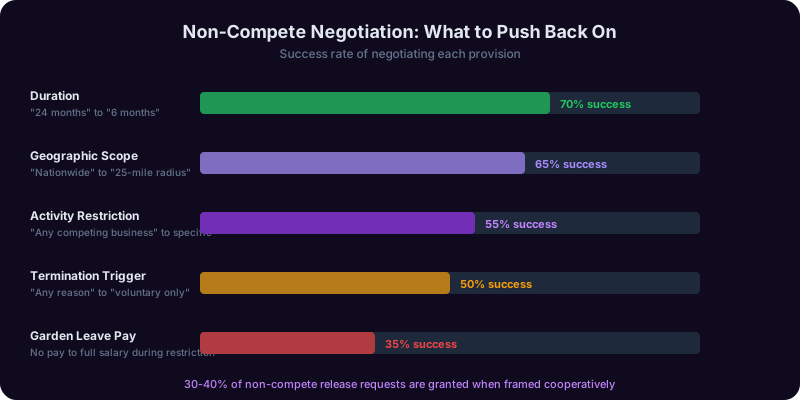
According to employment attorneys, approximately 30-40% of non-compete release requests are granted, especially when the departing employee is not going to a direct competitor and the request is framed cooperatively. Companies often decide that the legal cost and management distraction of enforcement are not worth it.
Strategy 2: Prove the Scope Is Unreasonable
Analyze your non-compete against the four enforceability tests described above. Common weaknesses include:
- The geographic scope covers areas where your employer does not operate or where you never worked
- The activity restriction is so broad it prevents you from working in your entire field, not just competing directly
- The duration exceeds what courts in your state typically uphold
- The definition of "competitor" is vague or overly inclusive
If you can identify specific unreasonable provisions, have an attorney send a letter laying out the analysis. Many employers will negotiate rather than risk having a court void or narrow their standard non-compete language, which could affect their ability to enforce it against other employees.
Strategy 3: Argue Lack of Consideration
This is one of the most effective defenses, particularly in states that require independent consideration for non-competes signed after employment begins. Ask yourself:
- When did you sign the non-compete? At the time of your initial offer, or after you had already started working?
- If after employment started, did you receive anything in return? A raise, a promotion, a bonus, stock options, or a guaranteed period of continued employment?
- Was the consideration meaningful? A $500 "signing bonus" for a two-year restriction affecting a $150,000 salary may be deemed inadequate.
In states like Illinois, Texas, Pennsylvania, and Ohio, courts have voided non-competes where the employee was told to sign or be fired and received nothing additional in return. If this happened to you, document the circumstances and discuss them with an attorney.
Strategy 4: Prove the Employer Breached First
If your employer violated the employment contract or applicable law, you may be able to argue that their breach releases you from your obligations, including the non-compete. Common employer breaches include:
- Failure to pay: Unpaid commissions, bonuses, or wages owed
- Violation of employment law: Discrimination, harassment, retaliation, wage-and-hour violations
- Failure to provide agreed-upon conditions: Changed your role, reduced your territory, eliminated the position you were hired for
- Constructive termination: Making conditions so intolerable that you had no choice but to leave
Courts generally hold that a party who breaches a contract cannot enforce the other party's obligations under that same contract. If you were fired or laid off in circumstances that violated the agreement, the non-compete may fall with it.
Strategy 5: Move to a Ban State
If you relocate to California, Minnesota, North Dakota, or Oklahoma, your non-compete is almost certainly unenforceable regardless of where you signed it or where your former employer is located. California courts routinely refuse to enforce out-of-state non-competes against California residents, even when the agreement contains a choice-of-law clause specifying another state's law.
This is not a loophole; it is established law. California Business and Professions Code Section 16600 voids any agreement restraining someone from engaging in a lawful profession, trade, or business. Courts have consistently held that this statute reflects a fundamental public policy that overrides contractual choice-of-law provisions.
Practical considerations: the move must be genuine. If you "move" to California but continue working remotely for clients in your former state, the analysis becomes more complicated. The relocation needs to be real, with actual residency, state tax filing, and a genuine connection to the new state.
Strategy 6: Wait It Out with a Plan
If your non-compete is 12 months or less and you have financial reserves, sometimes the simplest strategy is to wait. Use the restricted period strategically:
- Build skills: Get certifications, learn new technologies, or develop expertise in an adjacent area not covered by the non-compete
- Network in non-restricted areas: Attend conferences, join professional associations, build relationships that will be valuable when the restriction expires
- Consult or freelance in non-competing areas: Most non-competes restrict you from working for competitors, not from working at all. Identify work that falls outside the restriction
- Negotiate severance: If you are leaving by mutual agreement, negotiate severance payments that cover the non-compete period. Many employers will agree to continue a portion of your salary during the restricted period, sometimes called a "garden leave" arrangement
Calculate the financial impact: if you earn $120,000 and the non-compete is 12 months, the maximum cost of compliance is $120,000 (minus whatever you earn from non-competing work during that period). Compare that to the $50,000-$150,000+ cost of litigation if you violate the agreement and the employer sues.
Strategy 7: Challenge in Court (When the Economics Justify It)
If the stakes are high enough and your case is strong, filing a declaratory judgment action can resolve the issue definitively. In this approach, you file suit asking the court to declare the non-compete unenforceable, rather than waiting for your employer to sue you.
Advantages of going on offense:
- You choose the timing and the jurisdiction
- It demonstrates confidence in your legal position
- Some states allow recovery of attorney fees if the non-compete is found unenforceable
- It forces the employer to respond rather than holding the threat over your head indefinitely
Cost reality: expect to spend $15,000-$50,000 in attorney fees for a non-compete challenge that goes through preliminary injunction. If it goes to full trial, costs can exceed $100,000. This strategy makes sense when the new opportunity is worth significantly more than the litigation cost, or when the non-compete is clearly unenforceable and you can likely recover fees.
The Legal Copilot can help you do a preliminary analysis of your non-compete's enforceability before committing to the cost of hiring an attorney.
What to Do If You Are Asked to Sign a Non-Compete Now
Prevention is always cheaper than cure. If you are currently being asked to sign a non-compete, whether as part of a new job offer or as a condition of continued employment, here is how to protect yourself.
Step 1: Never Sign on the Spot
You have the right to take time to review any employment agreement. In states like Illinois and Oregon, employers are legally required (per SHRM state law updates) to give you a minimum review period (14 days in Illinois, the time between offer and start date in Oregon). Even in states without such requirements, any employer who insists you sign immediately is showing you something about how they treat employees. Ask for at least one week to review the agreement.
Step 2: Redline Specific Provisions
Non-competes are negotiable. Here are the specific items to push back on, with suggested redline language:
| Provision | Original Language (Typical) | Your Counter |
|---|---|---|
| Duration | "24 months following termination" | "6 months following voluntary resignation" (carve out termination without cause) |
| Geography | "Anywhere in the United States" | "Within 25 miles of employer's [specific office] location" or limit to states where you actively worked |
| Activity scope | "Any business that competes with any product or service offered by Employer" | "Any business that directly competes with the [specific product line] on which Employee worked" |
| Trigger | "Upon termination for any reason" | "Upon voluntary resignation only" or "Does not apply if Employee is terminated without cause" |
| Consideration | None stated beyond employment | "In exchange for a signing bonus of $[X]" or "garden leave pay equal to 100% of base salary during the restricted period" |
Step 3: Propose Alternatives to a Non-Compete
Many employers will accept less restrictive protections that still address their legitimate concerns:
- Non-solicitation agreement: You agree not to solicit the employer's specific clients or employees for a defined period. This protects the employer's relationships without preventing you from working in your field.
- Non-disclosure agreement (NDA): You agree not to disclose or use confidential information. This protects trade secrets without restricting your employment.
- Garden leave clause: The employer agrees to pay your full salary during the non-compete period. This makes the restriction fair: if they want to keep you out of the market, they pay for the privilege. In Massachusetts, garden leave pay is legally required for non-competes.
- Intellectual property assignment: You agree that work product created during employment belongs to the employer. This protects their innovations without limiting your future career.
Step 4: Get Paid for It
If the employer insists on a non-compete and you are willing to accept one, make sure you are compensated appropriately. Consider it a form of insurance premium that the employer should pay for the coverage they want:
- Signing bonus: Request $5,000-$25,000+ depending on the scope and duration of the restriction
- Higher base salary: A 5-10% salary premium is reasonable given the career restriction you are accepting
- Accelerated vesting: If you have equity, request faster vesting to compensate for the exit restriction
- Garden leave guarantee: Full salary continuation during the restricted period if you leave or are let go
A Salary Copilot session can help you calculate the right premium to request based on the non-compete's scope and how it might affect your future earning potential.
Step 5: Document Everything
Whatever you negotiate, get it in writing as part of the signed agreement. Verbal promises ("do not worry, we would never enforce that") are worthless in court. If the employer modifies the non-compete based on your negotiations, make sure the final version you sign reflects all agreed-upon changes. Keep a signed copy of the agreement in a personal (not work) location.
Non-Competes and Job Loss: Fired, Laid Off, or Forced Out
How you leave a job significantly affects whether your non-compete will be enforced. This is one of the most misunderstood areas of non-compete law, and it can work strongly in your favor.
Fired Without Cause
If you were terminated without cause (the company eliminated your position, restructured, downsized, or simply decided to let you go), courts in many states are much less likely to enforce a non-compete. The reasoning is straightforward: it is inequitable for an employer to fire you and then prevent you from earning a living elsewhere.
States where termination without cause weakens or voids a non-compete:
- Massachusetts: Non-competes are unenforceable if the employee is terminated without cause or laid off, unless the employer provides garden leave compensation.
- Oregon: Non-competes are void if the employee is fired within the first year of employment.
- Nevada: If an employee is fired, the employer must pay the employee during the non-compete period to enforce it.
- Washington State: Courts apply heightened scrutiny to non-competes when the employee was terminated without cause.
- Many other states: Even in states without specific statutes, courts apply equitable principles that disfavor enforcement against involuntarily terminated employees.
Laid Off vs. Fired: Does It Matter?
In most states, a layoff (reduction in force, position elimination) is treated similarly to termination without cause for non-compete purposes. The key distinction is between:
- Involuntary departure (layoff or termination without cause): Strongest argument against enforcement
- Termination for cause (misconduct, policy violation): Weaker argument against enforcement, but courts still consider whether the "cause" was legitimate
- Voluntary resignation: Weakest argument against enforcement, since you chose to leave
If you are being fired or laid off, understanding this distinction matters for your negotiation strategy.
Severance Negotiation When a Non-Compete Exists
A job loss is actually one of your best leverage points for negotiating changes to a non-compete. Here is why: the employer wants a clean separation, and you have something they want (your agreement not to compete or sue). Use that leverage strategically.
What to negotiate in your severance package:
| Item | What to Ask For | Why It Works |
|---|---|---|
| Non-compete release | Full written release from the non-compete | Employers often agree rather than pay severance AND face potential litigation over enforcement |
| Scope reduction | Narrow the geography, duration, or activity restriction | A compromise that lets the employer feel their interests are protected while giving you more freedom |
| Garden leave pay | 100% of base salary for the duration of the restricted period | If they want you out of the market, they should pay for it. Average garden leave negotiated: 50-100% of base salary. |
| Extended severance | Severance covering the full non-compete duration | Typical: 1-2 weeks per year of service. Push for severance equal to the restriction period. |
| Outplacement services | Career coaching, resume services, job placement | Low cost to employer, high value to you during the restricted period |
| Benefits continuation | Extended health insurance, equity vesting | COBRA costs $600-$2,200/month for a family. Extended employer-paid coverage reduces your financial pressure. |
Critical timing: negotiate before you sign the severance agreement. Once you sign, you have accepted the terms. Most severance agreements include a non-compete reaffirmation clause, so read every word before signing. If the severance agreement does not address the non-compete, raise it explicitly.
The Career Copilot can help you develop a negotiation strategy for your severance package, including specific language to propose for non-compete modifications.
How AI Can Help You Navigate Non-Compete Issues
Non-compete disputes sit at the intersection of contract law, employment law, and state-specific regulations. Historically, getting clear answers required expensive attorney consultations. AI tools are changing that equation significantly.
Where AI Can Help Right Now
Modern AI copilots can provide meaningful assistance at several stages of a non-compete issue:
- Contract analysis: Upload your non-compete agreement and get an instant breakdown of the key provisions, potential weaknesses, and how they compare to what courts in your state typically enforce. The Contract Review Copilot can identify overbroad language, missing consideration clauses, and provisions that courts in your jurisdiction have struck down.
- State law research: Non-compete law changes frequently. The Employment Law Copilot can tell you your state's current rules on salary thresholds, required consideration, enforceability after termination, and recent legislative changes that may affect your situation.
- Negotiation preparation: Before negotiating a non-compete release or severance modification, AI can help you draft a proposal, identify your strongest arguments, and anticipate your employer's counterarguments.
- Cost-benefit analysis: Should you fight, negotiate, comply, or wait? AI can help you model the financial scenarios, factoring in potential legal costs, lost income during the restricted period, and the value of the new opportunity.
What AI Cannot Replace
AI is a research and preparation tool, not a substitute for legal representation in high-stakes situations. You still need an attorney if:
- Your employer has filed or threatened to file a lawsuit
- You need to file a declaratory judgment action
- The financial stakes exceed $50,000
- You need someone to negotiate directly with your employer's legal counsel
- You are in a state with complex or rapidly changing non-compete law
The smart approach is to use AI for initial research, analysis, and preparation, and then bring an attorney into the conversation when you are ready to take action. This typically saves $1,000-$3,000 in attorney fees because you arrive at the consultation already understanding your situation, your state's law, and your options.
Getting Started
If you are dealing with a non-compete issue right now, here is a practical first step: gather your non-compete agreement, your offer letter, any amendments to your employment terms, and your most recent pay stub (to determine whether you fall above or below your state's salary threshold). Then use the Employment Law Copilot to get an initial assessment of your situation.
If you are thinking about starting your own business and are worried about how your non-compete might affect that plan, the Business Formation Copilot can help you explore options that fall outside the scope of your restriction. Many non-competes restrict you from working for a competitor, but do not prohibit you from starting a business in an adjacent or non-competing space.
For understanding the broader terms in your employment agreement beyond just the non-compete, including NDAs, arbitration clauses, and intellectual property provisions, the cease and desist guide and our scope creep guide cover related topics that may affect your transition strategy.
Frequently Asked Questions
Recommended Copilots
Recommended Copilots
Get state-specific guidance on non-compete enforceability and your rights after termination
Try Free →Upload your non-compete for instant analysis of key provisions and potential weaknesses
Try Free →Preliminary enforceability analysis before committing to attorney fees
Try Free →Develop a career transition strategy that accounts for your non-compete restrictions
Try Free →Calculate the right salary premium or signing bonus to negotiate for accepting a non-compete
Try Free →Explore business structures and ventures that fall outside your non-compete's scope
Try Free →Related Articles
Get Answers From the Employment Law Copilot
Upload your non-compete and get an instant breakdown of enforceability, state-specific rules, and your strongest options for negotiation or challenge - without the $400/hr attorney consultation.