

What a PIP Really Is: Signal vs Genuine Improvement Plan
A Performance Improvement Plan, or PIP, is a formal document issued by an employer that identifies specific performance deficiencies, sets goals to address them, and establishes a timeframe -- usually 30, 60, or 90 days -- in which the employee must demonstrate improvement. On paper, a PIP sounds like a coaching tool: a structured opportunity to course-correct with management support. In practice, the picture is far more complicated, and understanding the gap between the formal definition and the operational reality is the single most important thing you can do in the first hours after being placed on one.
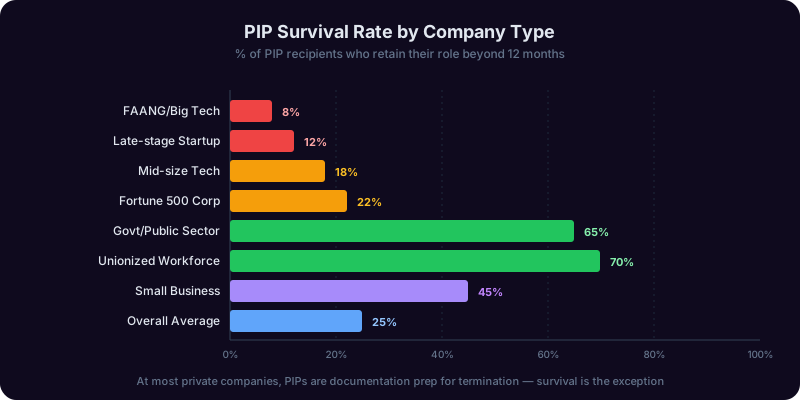
The hard truth most managers will not tell you: in a meaningful percentage of cases, a PIP is not designed to improve your performance. It is designed to create a paper trail that justifies your termination, reduces the company's legal exposure when it lets you go, and forces you to either resign on your own or accept reduced severance because you were dismissed "for cause." According to multiple HR industry surveys aggregated by the Society for Human Resource Management (SHRM), only a small percentage of employees placed on a formal PIP remain at the company long-term after completing it. Many companies use PIPs as the final administrative step before termination rather than as a genuine development intervention.
The typical PIP structure looks like this:
- Day 1: A meeting (often with your manager and an HR representative) where you are presented with the PIP document. You are asked to read it, often pressured to sign immediately, and informed that failure to meet the goals will result in termination.
- Days 1-30: The first review period. You are usually required to meet weekly with your manager to discuss progress. Documentation increases dramatically; everything is in writing.
- Days 30-60: A mid-point review where the company decides whether to continue the PIP, extend it, or escalate to termination.
- Days 60-90: The final period, ending in a formal decision: pass (rare), extend (sometimes), or terminate (most common).
Why most people fail PIPs even when technically "passing" them: Even employees who hit every metric on the PIP often find themselves managed out within six months. The reasons are structural. By the time a PIP is issued, the relationship with your manager has usually deteriorated past the point of repair. Your peers may know -- HR's confidentiality assurances notwithstanding -- which damages your professional reputation. Future opportunities for promotion, high-visibility projects, and bonus calibration tend to evaporate. You have effectively been moved to a "do not invest in this person" list inside the organization, and the PIP is the formal expression of that decision rather than its cause.
This is why the framing of the next 24-72 hours matters so much. You are not just deciding whether you can meet the metrics. You are deciding whether you want to spend three months fighting for a position whose long-term value has already been impaired, or whether to leverage the moment to negotiate a clean exit with terms that protect your career and finances.
Legal disclaimer: This article provides general career strategy information based on publicly available sources and is not legal advice. Employment law varies significantly by state, country, and individual circumstance. If you are facing a PIP, particularly one involving protected status, retaliation concerns, or significant severance implications, consult a licensed employment attorney in your jurisdiction before taking action.
For related context on the legal landscape of separation, see our guides to filing a wrongful termination EEOC complaint and your rights when fired versus laid off.
The First 24 Hours: Do Not Sign, Do Not Commit, Do Not Argue
The PIP meeting is engineered to be emotionally overwhelming. Your manager and an HR representative present a multi-page document that catalogs your shortcomings, sets goals you are seeing for the first time, and informs you that your job is on the line. The natural human response is to defend yourself, agree to everything to demonstrate willingness, or sign the document just to end the meeting. Every one of these instincts works against you.
What to do in the meeting itself:
- Stay calm and quiet. Take notes. Ask clarifying questions about the document's contents but do not argue the underlying premises in real time. Anything you say will be remembered and may be added to the record.
- Do not sign the document on the spot. Signing a PIP usually does not waive your legal rights, but it signals acceptance of the characterization of your performance. Say something neutral such as: "I want to take this seriously and review it carefully. I will respond by [date 1-2 days later]."
- Do not make verbal commitments. Statements like "I will absolutely hit these targets" or "I agree that I have been underperforming" become evidence later. Stay procedural: "I appreciate you walking me through this. I want to read it carefully before responding."
- Request a copy. You are entitled to a written copy of the PIP document. Take it with you.
- Ask about confidentiality. Confirm in writing who else knows about the PIP and what will be communicated to your team.
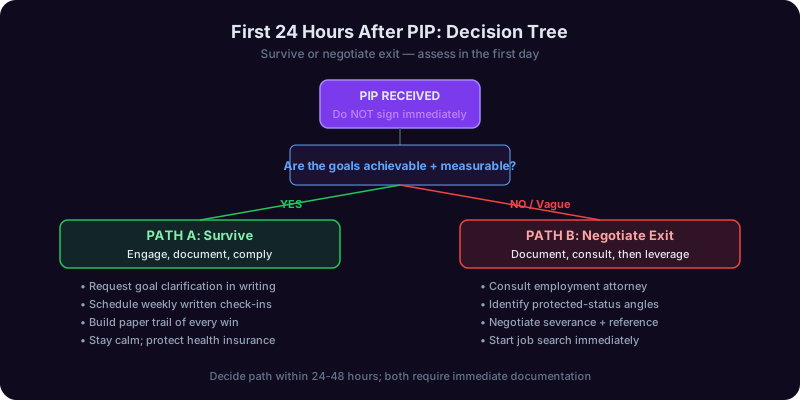
What to do in the 24-48 hours after the meeting:
- Document everything. Write down what was said in the meeting while it is fresh, including who attended, what claims were made, and any inconsistencies with prior feedback you received. This contemporaneous record is invaluable if the situation escalates.
- Pull your records. Gather your last two performance reviews, recent positive emails from managers or stakeholders, project deliverables, and any peer recognition. Compare the PIP's claims against the written record. Inconsistencies are critical.
- Forward key emails to a personal account. Within the bounds of your company policy and any applicable law, ensure you retain evidence of positive feedback, achievements, and any communications relevant to the issues raised. Do not take confidential business information or trade secrets -- focus on documentation about your own performance.
- Consult an employment attorney. Many offer free or low-cost initial consultations. If your situation involves any protected status (age, race, gender, pregnancy, disability, medical leave, or recent complaints about harassment or wage issues), the attorney conversation should happen before you respond to the PIP. The EEOC employee resources page outlines what counts as protected activity.
- Assess your financial runway. Calculate how many months of expenses you have saved. This number determines how much leverage you have. With 6+ months of runway, you can negotiate aggressively. With less than 2 months, you may need to play the survive strategy more carefully while quietly searching.
- Do not tell colleagues. Even friends at work. The information will spread, and it will hurt you both inside the company and in references later.
The response you send back to HR within 1-2 days: Keep it professional, neutral, and non-committal. Acknowledge receipt, ask any clarifying questions about goals or measurement, and confirm next steps. Do not admit fault, do not promise outcomes, and do not waive any rights. A simple template: "Thank you for sharing the performance improvement plan on [date]. I have reviewed the document and want to ensure I understand the success criteria correctly. Could you clarify how progress will be measured for goal #2 and goal #4? I look forward to our first check-in on [date]." That is enough. The shorter your written response, the better.
Decode the PIP Document: SMART Goals vs Designed-to-Fail Traps
The PIP document itself is the most important diagnostic tool you have for deciding whether you can pass it. A PIP designed for genuine improvement looks fundamentally different from a PIP designed to manufacture a termination. Learning to read the difference is what separates strategic responders from people who walk into a 90-day trap.
What a Good-Faith PIP Looks Like
A legitimate, good-faith PIP follows the SMART framework: Specific, Measurable, Achievable, Relevant, and Time-bound. Each goal references concrete deliverables, has objective success criteria, falls within the scope of your role, and can be accomplished in the time provided. A good-faith PIP also includes clear support: weekly meetings, training resources, access to senior team members, and a designated point of contact for questions.
Examples of good-faith PIP goals:
- "Reduce ticket response time from average of 8 hours to under 4 hours by end of Day 60, measured by Zendesk reporting dashboard."
- "Complete certification in [specific platform] by Day 45, with company-paid training time allocated."
- "Deliver project X milestones according to the timeline shared on [date], with weekly check-ins to remove blockers."
What a Designed-to-Fail PIP Looks Like
A designed-to-fail PIP uses vague language, subjective measurement, unachievable timelines, or goals that depend on factors outside your control. The goals shift, the success criteria are open to interpretation, and the resources required to meet them are conspicuously absent. The document is structured so that any disagreement about whether you met the bar will be resolved against you.
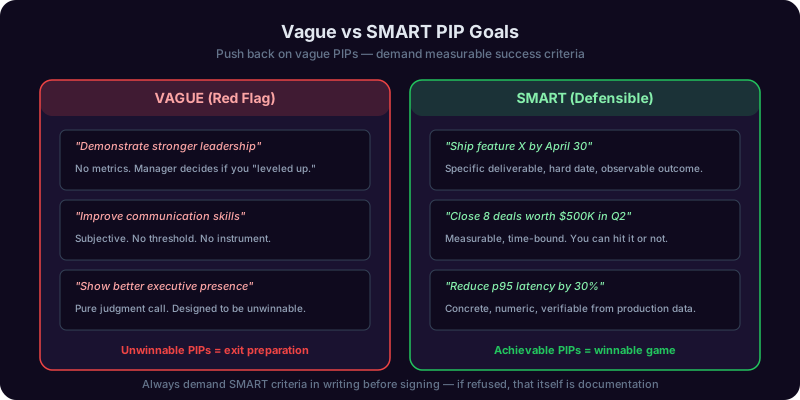
Examples of designed-to-fail PIP goals:
- "Improve collaboration and communication with the team" (no measurement criteria, entirely subjective)
- "Demonstrate leadership in cross-functional projects" (no defined projects, no scope, no measurable outcome)
- "Increase quality of deliverables to expected standard" ("expected standard" is undefined and can be redefined later)
- "Build stronger relationships with stakeholders" (judged entirely by the same people whose feedback caused the PIP)
- "Take ownership of complex initiatives" (no specific initiative, no resources, no timeline)
Identifying Retaliation Signals
Retaliation is a particularly important signal because it is legally actionable in many jurisdictions. The EEOC's retaliation guidance defines retaliation as an adverse employment action taken because of protected activity. A PIP can constitute retaliation if it follows certain triggers.
Common retaliation triggers that precede a PIP:
- Recent return from FMLA, parental, or medical leave
- Recent disclosure of a pregnancy, disability, or medical condition
- Recent internal complaint about discrimination, harassment, or wage issues
- Recent participation in an investigation, including as a witness
- Recent refusal to perform an action you reasonably believed to be illegal
- Recent request for a workplace accommodation
- Recent age-related comments by management, particularly around team "refresh" or "new energy"
If your PIP arrived within 30-90 days of any of these events, the timing alone may support a retaliation or discrimination claim, which significantly increases your leverage in negotiation. This is the single most important reason to consult an employment attorney before responding.
The Three Diagnostic Questions
After reading your PIP carefully, answer these three questions honestly:
- Are the goals specific and measurable? If yes, the company may be acting in good faith. If they are vague, you should assume the document is engineered for a predetermined outcome.
- Are the goals achievable in the timeline given my current resources? Not whether they are achievable in principle -- whether you can do them with the people, time, and tools available. If no, the PIP is likely designed to fail.
- Has anything in my work environment changed in the last 90 days? A new manager, a reorganization, a complaint you raised, a leave you took, an accommodation you requested? Pattern-match the timing.
Your answers determine which of the two strategic paths in the next section makes sense for you.

Get Answers From the Career Copilot
Whether you are surviving the PIP or negotiating your exit, Copilotly's Career Copilot drafts your weekly status emails, decodes vague goals, prepares calibration meeting agendas, and writes the interview narrative for your next role. The Legal Copilot helps you prepare for attorney conversations and analyze separation agreements.
Two Strategic Paths: Survive the PIP or Negotiate Your Exit
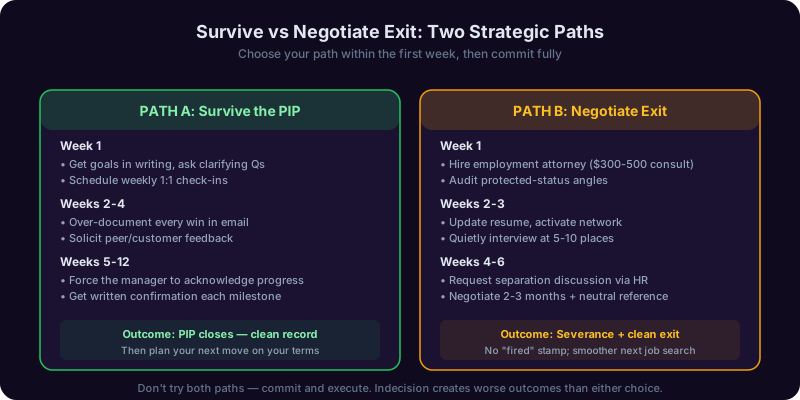
Once you have decoded the PIP, you face a strategic decision. There are essentially two paths forward, and each has distinct tactics. Choosing the wrong path -- particularly trying to survive a PIP that is designed to fail -- wastes your energy and weakens your leverage when reality forces you to switch tactics later.
Path A: Survive the PIP
Choose this path when the PIP is reasonably good-faith, the goals are achievable, you still want the job, and you have a credible chance of demonstrating improvement. Surviving requires meticulous documentation, proactive communication, and treating the next 30-90 days as the most important performance window of your career.
Indicators that the survive path is viable:
- The PIP goals are specific, measurable, and within your control
- Your manager is not actively hostile in 1:1s
- You have allies elsewhere in the organization who can vouch for your work
- The underlying issues are skill or process gaps, not relationship gaps
- You genuinely want to stay and believe in the company's direction
- The PIP was not preceded by any of the retaliation triggers listed above
Path B: Negotiate Your Exit
Choose this path when the PIP appears designed to fail, when your relationship with management is past the point of repair, or when the strategic value of leveraging the moment exceeds the value of staying. Many professionals find that this path actually produces better financial and career outcomes than surviving the PIP, because companies will often pay significantly more in severance to avoid the risk of a wrongful termination claim or to avoid the disruption of a contested separation.
Indicators that the exit path is more strategic:
- The PIP goals are vague, subjective, or measurably unreasonable
- Your manager has stopped giving you challenging work or visibility
- The PIP followed any of the retaliation triggers (leave, complaint, accommodation request, etc.)
- You have 3+ months of financial runway and can absorb a job search
- You were already considering leaving
- Other warning signs are present: team members have been pushed out, the company is reducing headcount, your role is being de-scoped
The Tactical Differences Between the Two Paths
| Dimension | Survive Path | Exit Path |
| Tone with management | Engaged, collaborative, focused on goals | Professional, neutral, document-oriented |
| Job search | Begin quietly as insurance, do not prioritize | Aggressive, full-time priority |
| Documentation focus | Daily wins, deliverables completed, blockers removed | Goal ambiguity, unequal treatment, pre-PIP feedback |
| Use of HR | Partner for support and clarity | Formal channel for documenting concerns |
| Attorney involvement | Consultative, on standby | Active, often visible to the company |
| Goal | Pass the PIP and rebuild standing | Maximize severance, references, and clean exit |
| Timeline | Full PIP duration plus 6-12 months | 2-6 weeks to negotiated agreement |
The hybrid strategy: Many professionals begin with the survive path while building exit leverage in parallel. They document genuinely, hit goals where possible, and quietly begin a job search. If at the 30-day mark the survive path looks unwinnable, they pivot to exit negotiation with substantial documentation already in hand. This hybrid approach is generally the safest because it preserves optionality and prevents you from committing to a single path before you have enough information.
For deeper context on the negotiation mechanics of the exit path, see our companion guide on severance package negotiation in a tech layoff. The tactics overlap substantially.
Survive Path Tactics: Weekly Status Emails, Calibration, and HR Partnership
If you choose to survive the PIP, your goal is not just to hit the metrics. Your goal is to make it impossible for the company to terminate you without a clear, documented, defensible record showing you met every goal. The strategy rests on three pillars: paper trail, visibility, and stakeholder support.
Pillar 1: The Weekly Status Email
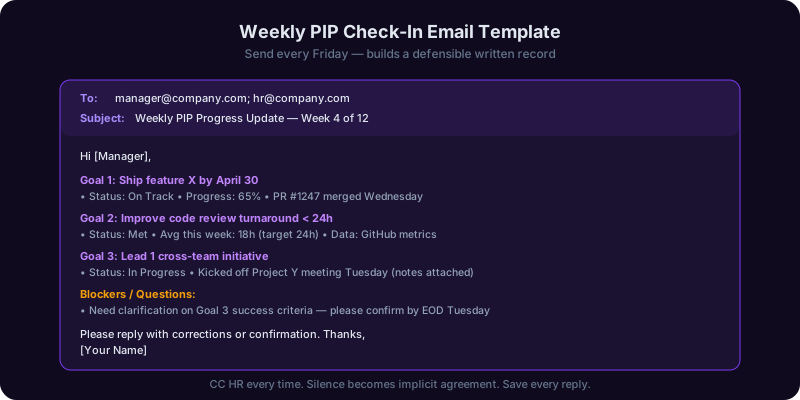
The single most important tactic for surviving a PIP is the weekly written status email. At the end of every week, send your manager (with HR copied or BCC'd, depending on context) a structured email that documents the week's progress. This email serves three purposes: it forces you to track your wins, it creates a contemporaneous written record that cannot be revised later, and it signals to your manager that you are taking the PIP seriously.
Template for the weekly PIP status email:
- Subject line: "PIP Weekly Update - Week [X] of [Y] - [Your Name]"
- Goal 1 progress: What you committed to, what you delivered, evidence (link to documents, ticket IDs, metrics)
- Goal 2 progress: Same structure
- Blockers: Anything that slowed progress, with your proposed solutions. Be explicit about whether you need help from your manager.
- Next week's commitments: Specific, measurable deliverables for the coming week
- Closing line: "Please let me know if any of this is inconsistent with your understanding so we can align before our next 1:1."
That closing line is critical. It invites correction in writing, which means if your manager later claims you did not meet a goal, you have a paper trail showing they had the opportunity to flag concerns and did not.
Pillar 2: Screenshot and Save Every Win
Praise from stakeholders, completed deliverables, positive customer feedback, peer recognition in Slack, ticket resolutions, code merged, deals closed -- save everything. Take screenshots of complimentary messages immediately, because Slack messages can be deleted by senders and emails can be lost in archives. Create a folder (personal device, not company device) and add to it daily.
When the 30-day or 60-day review meeting comes and your manager characterizes your performance vaguely, you walk in with a binder of specific evidence. This shifts the conversation from "my opinion of your performance" to "the documented record of your performance," which is harder to argue with and creates legal risk for the company if they ignore it.
Pillar 3: The Weekly 1:1 Agenda
If your PIP requires weekly check-ins -- and most do -- show up with a written agenda. Send the agenda to your manager 24 hours in advance. The agenda should cover progress on each goal, blockers, and any questions about goal interpretation. Take notes during the meeting and email a brief recap afterward: "Based on our conversation today, the action items are X, Y, Z. The agreed clarification on Goal 2 is [X]. Please correct me if any of this is inaccurate." Again, you are creating a paper trail of agreements that cannot be disputed later.
Pillar 4: Partner with HR Strategically
HR is not your advocate -- their role is to protect the company -- but they can be a useful channel when used carefully. Request a meeting with HR early in the PIP to clarify the success criteria in writing. Ask explicitly: "What does success look like at the end of the 60 days? What is the path to exit the PIP successfully?" Get answers in writing if possible.
If you have concerns about the fairness of the PIP, escalate them through HR formally and in writing -- even if you do not expect them to be resolved in your favor. Documented concerns create the foundation for a retaliation or wrongful termination claim if you are subsequently terminated despite meeting the goals.
Pillar 5: Calibration Meetings and Stakeholder Visibility
Throughout the PIP, deliberately increase your visibility with stakeholders outside your direct management chain. Volunteer for cross-functional projects. Send updates to broader audiences. Request brief calibration conversations with senior people who can vouch for your work. The more people who can speak positively about your contributions, the harder it becomes for your manager to push through a termination on subjective grounds.
The bottom line on the survive path: You are running two parallel tracks. Track one is doing the actual work well. Track two is documenting that you did the work well in a form that cannot be revised, ignored, or disputed. Both tracks are essential. Doing only track one (the work) without track two (the documentation) is how strong performers still fail PIPs.
Exit Path Tactics: The Package Conversation, RSU Acceleration, and Reference Language
If you have decided that the PIP is designed to fail, or that staying is not worth the cost, the exit path becomes a negotiation. The premise is straightforward: the company would prefer to manage your departure smoothly rather than risk a contested termination, especially if there is any chance of a discrimination or retaliation claim. You have more leverage than you think, particularly in the first week of the PIP when the company has not yet invested significant management time in the process.
The Package Conversation: How to Request a Separation Discussion
Approach the conversation with neutrality and professionalism. You are not threatening, accusing, or making demands. You are proposing a mutually beneficial path that avoids the time and risk of the PIP for both parties.
Sample script to your manager or HR:
"I have spent the past few days reflecting on the performance plan, and I want to have a direct conversation. I am not certain that continuing in this role is the best outcome for either of us. I would like to explore whether we can reach a mutual separation arrangement that allows for a smooth transition rather than going through the PIP process. Could we set up a conversation -- perhaps including HR -- to discuss what that might look like?"
This framing accomplishes several things. It signals that you are not going to contest the characterization (which reduces the company's motivation to push you out aggressively). It opens the door to a separation negotiation without committing to anything. And it positions you as someone making a thoughtful, professional decision rather than reacting emotionally.
What to Negotiate For
The components of a strong exit package extend well beyond severance pay. A weak exit accepts the company's first offer. A strong exit negotiates each of the following separately.
1. Enhanced severance. Standard severance is often 1-2 weeks per year of service. PIP-exit severance is negotiable above standard, especially if you have leverage (protected status, recent complaints, ambiguous PIP goals, tenure, role criticality). Target 2-3 weeks per year of service as a starting point, with executive levels negotiating months.
2. No PIP on your record. Critical. Request that the PIP be rescinded as part of the separation, with the company characterizing your departure as a mutual decision or resignation. This eliminates the PIP from any future reference conversation.
3. Agreed reference language. Request specific reference language in writing as part of the agreement. The company commits to confirming dates of employment, role, and a brief positive description in response to reference checks. A neutral reference is dramatically better than a hostile one, and an agreed-language reference is better than "neutral."
4. RSU acceleration. If you have unvested RSUs or equity, negotiate for acceleration of vesting through the next cliff or the next vesting date. Companies will sometimes accelerate 3-12 months of equity as part of a separation, particularly if the alternative is a fight. For a deeper dive into tech equity negotiation in separation, see our severance negotiation guide.
5. Bonus payout. If you are mid-cycle on annual or performance bonus, negotiate prorated payment. Companies frequently agree to this because the legal cost of withholding earned bonus is significant.
6. COBRA subsidy or extended health insurance. Request that the company pay COBRA premiums for 3-6 months after separation. This is a high-value, low-cost ask for most employers (the cost is a small fraction of severance dollars).
7. Outplacement services. Many companies have existing relationships with outplacement firms. Adding outplacement to your package is often free for the company but worth several thousand dollars to you.
8. Non-disparagement (mutual). Most companies will request a non-disparagement clause from you. Insist on a mutual clause -- they cannot disparage you either. This protects you against negative reference conversations later.
9. Extended job search time. Negotiate for a longer notice period or for severance to begin after a defined transition period, giving you more weeks of paid runway.
The Leverage Calculation
Your leverage in this negotiation depends on factors the company is calculating quietly: how strong your potential discrimination or retaliation claim is, how disruptive your departure would be operationally, how senior you are, how much institutional knowledge you hold, how visible your departure would be externally, and how cooperative you appear in the conversation. The cooperative-but-firm posture maximizes leverage. The aggressive or threatening posture often reduces it because it removes the company's incentive to be generous in exchange for a smooth process.
Important: Any separation agreement will include a release of legal claims against the company. Do not sign without an employment attorney reviewing the document. State and federal law mandate certain disclosures and consideration periods (the Department of Labor's guidance on severance and the Older Workers Benefit Protection Act, in particular, give employees over 40 a minimum 21-day review period and 7-day revocation window for age-related releases). Use that time.
PIP and the Law: ADA, ADEA, FMLA, and Protected Status
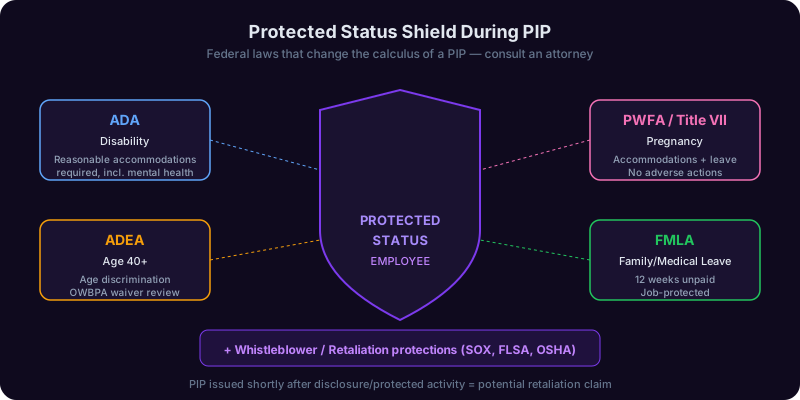
Employment law in the United States does not generally protect employees from being placed on a PIP for legitimate performance reasons. At-will employment means an employer can terminate, demote, or restructure most employees for any reason that is not specifically prohibited by law. But the specifically prohibited reasons are broad and important, and a PIP that is motivated by a prohibited reason can give rise to significant legal claims.
Americans with Disabilities Act (ADA)
The ADA prohibits discrimination against qualified individuals with disabilities and requires employers to provide reasonable accommodations. If you have disclosed a disability or requested an accommodation, and the PIP followed within a reasonably close time window, the timing alone may support a discrimination or retaliation claim. The company's obligation is to provide reasonable accommodations that allow you to perform the essential functions of the job. If the PIP goals require you to perform without the accommodations to which you are entitled, the PIP itself may be discriminatory.
Action items if ADA may apply:
- Document the dates of any disability disclosures or accommodation requests
- Compare those dates to the date of the PIP
- Document any accommodations that have been denied, delayed, or only partially provided
- Consult an employment attorney with ADA experience before responding to the PIP
Age Discrimination in Employment Act (ADEA)
The ADEA protects employees 40 and older from discrimination based on age. PIPs are a common vehicle for age discrimination because they appear neutral on the surface but can be selectively applied to older workers. Patterns that may indicate age discrimination include: PIPs concentrated among older workers in your team or department, recent comments about wanting "new energy" or "fresh perspectives," younger workers being promoted past you despite weaker performance, and recent reorganizations that affected older workers disproportionately.
The ADEA also affects severance negotiations: if you are 40 or older, any release of age-related claims requires a specific written notice with a 21-day review period (45 days for group layoffs) and a 7-day revocation period. Do not sign a separation agreement that purports to release ADEA claims without an attorney's review.
Pregnancy Discrimination Act and Title VII
Title VII prohibits employment discrimination based on race, color, religion, sex (including pregnancy), and national origin. The Pregnancy Discrimination Act (PDA), an amendment to Title VII, specifically prohibits adverse action based on pregnancy, childbirth, or related medical conditions. If you have recently disclosed a pregnancy or returned from maternity leave and find yourself on a PIP, the timing may support a discrimination claim.
Family and Medical Leave Act (FMLA)
The FMLA entitles eligible employees of covered employers to take up to 12 weeks of unpaid, job-protected leave per year for specified family and medical reasons. Crucially, the FMLA prohibits employers from retaliating against employees for taking FMLA leave. A PIP issued shortly after FMLA leave is a classic retaliation pattern. Courts have repeatedly found that close temporal proximity between FMLA leave and an adverse employment action supports a retaliation claim.
State-Level Protections
Many states extend protections beyond federal law. California, New York, Illinois, Washington, and several other states have stronger anti-discrimination, anti-retaliation, and notice requirements than federal law. State law may also extend whistleblower protections, wage complaint protections, and protections against retaliation for reporting safety issues. The state-level differences are why consulting an attorney licensed in your jurisdiction is essential.
What Triggers a Strong Legal Position
- Temporal proximity: The PIP arrived within 30-90 days of a protected event (leave, complaint, accommodation request)
- Disparate treatment: Similarly situated employees outside your protected class are not being PIP'd for similar issues
- Inconsistency with prior reviews: Your last formal performance review was positive, but the PIP characterizes you as a chronic underperformer
- Procedural irregularities: The company is not following its own documented PIP process
- Documented bias: Comments from management referencing age, gender, pregnancy, accommodation, or leave
Even a single one of these factors can give an experienced employment attorney significant leverage in negotiating a settlement. Many strong PIP-exit packages are driven not by litigation but by the credible threat of a discrimination claim that the company would rather settle quietly.
For a complete breakdown of the EEOC complaint process if litigation becomes necessary, see our wrongful termination EEOC filing guide.
After the PIP: What to Tell Future Employers, Unemployment, and Moving Forward
However the PIP ends -- passed, failed, or resolved through a negotiated exit -- the period afterward shapes your career trajectory for years. The decisions you make about how to talk about the experience, what to claim for unemployment, and how to position yourself for the next opportunity matter as much as the tactical decisions during the PIP itself.
Scenario 1: You Passed the PIP
Congratulations -- you are in the smaller percentage of employees who navigated the process successfully. But the work is not done. The PIP changes your standing in the organization, and rebuilding takes deliberate effort.
- Continue the documentation discipline. The weekly status emails should continue for at least 6 months. Your manager will remain alert for any sign of regression. Make the strong performance permanent and undeniable.
- Begin a quiet job search anyway. Even if you want to stay, having a competitive external option is the strongest form of insurance. If the relationship with management continues to be tense, you can leave on your own terms.
- Request a documented PIP closure. Get it in writing that the PIP has been successfully completed and is closed. This document matters if you are PIP'd again, if you are laid off, or if it ever comes up in a reference check.
- Watch for second-PIP risk. A significant portion of employees who pass a PIP are PIP'd again within 6-12 months. This is sometimes called the "managed-out PIP cycle." Be alert.
Scenario 2: You Were Terminated After the PIP
If you were terminated despite making good-faith efforts to meet the PIP goals, you have several immediate priorities.
- Apply for unemployment immediately. In most states, termination for poor performance (as opposed to misconduct) does not disqualify you from unemployment benefits. The PIP framing actually helps your case because it documents that the issue was performance, not misconduct. Apply within days of termination -- there is no benefit to waiting.
- Consult an attorney about wrongful termination. Even after termination, you have legal options. The statute of limitations for EEOC complaints is typically 180-300 days depending on jurisdiction. Do not wait.
- Negotiate severance even after termination. Companies will sometimes offer post-termination severance if you raise the possibility of a discrimination or wrongful termination claim. Have your attorney handle this conversation.
- Manage COBRA carefully. Health insurance continuation under COBRA is expensive but critical. ACA marketplace coverage may be cheaper.
Scenario 3: You Negotiated a Mutual Exit
This is often the best of the three outcomes. You leave on agreed terms, with severance, with an agreed reference, and without a PIP on your record. The next priority is execution.
What to Tell Future Employers
How you talk about your departure in interviews can make or break your candidacy for the next role. The narrative needs to be honest, brief, and forward-looking. The key principles:
- Never disparage your previous employer. Hiring managers interpret negativity about a previous employer as a future risk -- you might do the same to them.
- Keep the explanation short. 30-60 seconds maximum. The longer your explanation, the more you sound defensive.
- Frame around fit, not failure. "The role evolved in a direction that no longer matched my strengths" or "There was a mismatch between what the role required and what I do best."
- Pivot to what you are looking for. The transition out of the story is into a forward-looking statement about what you are seeking now.
Sample script: "I spent four years at [Company] where I [accomplishment]. In the last year, the role shifted in a direction that no longer played to my core strengths, and we mutually decided that a transition made sense. What I am looking for now is [specific role attributes], which is why this opportunity at [Company] caught my attention."
If you signed a separation agreement, your reference language is contractually defined. Make sure your story aligns with what the company will confirm in reference checks.
How Copilotly Helps During and After a PIP
The administrative load of a PIP -- weekly status emails, documentation, calibration meetings, drafting responses to HR, preparing for difficult conversations -- is exactly the kind of work where AI copilots provide meaningful leverage. The Career Copilot drafts weekly PIP status emails based on your inputs, generates calibration meeting agendas, helps you decode vague PIP goals into measurable interpretations to confirm with management in writing, and prepares interview narratives for explaining your departure to future employers. The Legal Copilot helps you analyze separation agreement language, identify clauses that warrant attorney review, and prepare questions for an employment attorney consultation. For complementary tactics, see our guides on quitting a job professionally and using a salary counteroffer script for your next role.
Legal disclaimer: This guide provides general career strategy information based on publicly available sources from SHRM, EEOC, DOL, and major employment law publications. It is not legal advice. Employment law varies significantly by state, country, and individual circumstance. Statutes of limitations are short, and the strength of a legal claim depends on facts that require professional evaluation. If you are facing a PIP, particularly one that may involve protected status, retaliation, or significant severance, consult a licensed employment attorney in your jurisdiction. The Career Copilot and Legal Copilot are productivity tools to help you prepare for those conversations -- not substitutes for them.
The bottom line: A PIP is not the end of your career. It is a moment of significant strategic optionality that most people fail to recognize because the emotional impact obscures the tactical opportunity. The professionals who navigate PIPs best are the ones who treat the document as a strategic problem to solve rather than a moral verdict on their work, who choose the survive or exit path based on data rather than emotion, and who document, document, document until the outcome -- whichever path they chose -- protects their financial position and their long-term career.
Frequently Asked Questions
Recommended Copilots
Get Answers From the Career Copilot
Whether you are surviving the PIP or negotiating your exit, Copilotly's Career Copilot drafts your weekly status emails, decodes vague goals, prepares calibration meeting agendas, and writes the interview narrative for your next role. The Legal Copilot helps you prepare for attorney conversations and analyze separation agreements.