
What Just Happened: The 503B Compounded GLP-1 Shutdown Timeline
Medical disclaimer: This guide is educational and does not replace clinical judgment. GLP-1 medications (semaglutide, tirzepatide, liraglutide) are prescription drugs with serious contraindications. Do not switch, stop, or adjust doses without your prescribing clinician. Information is current as of August 2026 and subject to change.
If you opened a letter from your compounding pharmacy this summer telling you they will stop shipping your semaglutide or tirzepatide, you are one of approximately 3.7 million Americans caught in the most disruptive change to weight-loss medication access since GLP-1s went mainstream in 2023. This section walks through exactly what the FDA decided, when each deadline lands, and what it means for your refill cycle.
The May 2026 FDA Proposed Rule
On May 14, 2026, the FDA issued a proposed rule under section 503B of the Federal Food, Drug, and Cosmetic Act tightening which active pharmaceutical ingredients outsourcing facilities are allowed to compound. Crucially, the rule formalizes that semaglutide and tirzepatide are no longer eligible for routine compounding now that brand-name Wegovy, Ozempic, Zepbound, and Mounjaro have been removed from the official FDA drug shortage list (semaglutide was removed February 21, 2025; tirzepatide October 2, 2024). The proposed rule was published in the Federal Register and opened a 45-day public comment window that closed June 29, 2026.
June 25, 2026: 503B Enforcement Begins
While the public comment window was technically still open, the FDA issued an enforcement letter on June 25, 2026 stating that 503B outsourcing facilities still shipping compounded semaglutide or tirzepatide after that date risked warning letters, seizures, and injunctions. Many large 503B players (the kind that supply Hims, Ro, Mochi, and Henry Meds via wholesale) had already stopped production in spring 2026.
Why This Hits 503A State-Licensed Pharmacies Too
Section 503A pharmacies (the traditional, state-licensed kind that compound patient-specific prescriptions) were given a slightly longer runway, but the FDA's Guidance for Industry on Compounding Drugs Using Bulk Drug Substances revision made clear that semaglutide and tirzepatide are no longer 'difficult to compound' eligible. State boards of pharmacy in Florida, Texas, California, and 14 other states have already issued cease-and-desist notices.
Embedded Timeline Chart
The chart below sequences every regulatory event from October 2024 to January 2027 so you can see exactly where you sit in the runway.
Bottom line for refills: if you have not received a transition letter, call your pharmacy this week. If you have, jump to Section 3 for the 7-day playbook.

Why Your Compounded Pharmacy Is Closing
Compounded GLP-1s exploded in 2023-2024 because three things lined up: brand-name semaglutide and tirzepatide were on the FDA shortage list, telehealth startups (Hims, Ro, Mochi, Form Health, Henry Meds) marketed monthly plans at $199-$349, and most insurance plans refused to cover obesity medications. By Q1 2026, an estimated 3.7 million Americans were on compounded GLP-1s, compared with roughly 12 million on brand. Then three forces converged to shut it down.
1. The Shortage List Removal
The FDA officially declared tirzepatide off-shortage on October 2, 2024 and semaglutide on February 21, 2025. Under section 503A and 503B of the FDCA, pharmacies may only compound a copy of a commercially available drug when that drug is on the official shortage list, or when the compound is a 'medically necessary' personalized variation (different dose, allergen-free, etc.). Once the shortage ended, the legal basis for mass-market compounded GLP-1s evaporated.
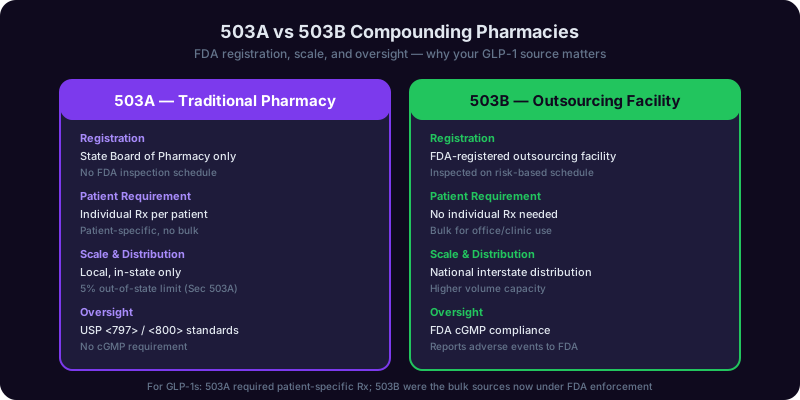
2. The 503A vs 503B Distinction
Most consumers do not know the difference, but it matters now:
| Feature | 503A Pharmacy | 503B Outsourcing Facility |
|---|---|---|
| Regulator | State board of pharmacy | FDA |
| Patient-specific Rx | Required | Not required |
| Bulk shipping to clinics | Limited | Allowed |
| cGMP standards | USP 795/797 | Full cGMP |
| Volume in 2025 | ~30% | ~70% |
3. The Safety Record
FDA's MedWatch system logged more than 4,800 adverse event reports tied to compounded GLP-1s between January 2024 and March 2026, including dosing errors (some patients received 10x intended dose because of incorrectly labeled vials), infections at injection sites linked to unsterile compounding, and at least 21 deaths the agency considered probably related. The Poison Control network's National Poison Data System added 3,100 calls in 2025 alone.
4. The Pharma Lobby
Eli Lilly and Novo Nordisk filed dozens of lawsuits against compounders and telehealth platforms in 2025 (Lilly v. Mochi, Novo v. Hims). They also lobbied Congress and the FDA aggressively. Whatever your view of that, it changed the regulatory math.
None of this means you did something wrong. But it does mean the rules of the game have changed, and you need a new plan.
Step-by-Step: First 7 Days After Your Pharmacy Notifies You
The single biggest mistake people make is panicking and trying to stockpile from a different compounding pharmacy. That just delays the inevitable and risks getting cut off mid-titration. Instead, follow this exact 7-day sequence the moment you receive a transition notification.
Day 1: Verify Your Remaining Supply
Open your last shipment. Count vials, check expiration dates, and document your current dose (e.g., semaglutide 1.7 mg weekly). Take a photo of the labels. If you receive multi-dose vials, calculate how many weeks you can stretch at your current dose. Most patients have 4-12 weeks of supply when notified.
Day 2: Request Your Transfer Records
Email your compounding pharmacy and request: (1) full prescription history including all doses, (2) initial prescribing clinician's name and DEA, (3) any lab values shared (A1C, weight, BMI), and (4) the manufacturer of the API used (vial label often says 'sourced from Hetero', 'Polypeptide Labs', etc.). You have a right to these records under HIPAA. You will need them for prior authorization later.
Day 3: Save Your Dose Titration History
Make a written timeline: 'Started 0.25 mg Jan 4 2025 -> 0.5 mg Feb 1 -> 1.0 mg Mar 8 -> 1.7 mg current'. Note any side effects (nausea, fatigue) and weight loss at each step. This is your best evidence for a brand-name prior authorization because it proves dose tolerance and clinical response, the two things insurers most want to see.
Day 4: Check Insurance Formulary Tier
Log into your insurance portal or call the number on the back of your card and ask three specific questions: (1) Is Wegovy on formulary? What tier? (2) Is Zepbound on formulary? What tier? (3) What are the prior authorization requirements? Most plans require BMI greater than or equal to 30 (or 27 with comorbidity), documentation of lifestyle intervention, and sometimes a step through phentermine or Saxenda. Write down the exact criteria.
Day 5: Schedule a Clinician Appointment
Book the earliest possible appointment with your prescribing clinician (or PCP if you used a telehealth service that is also winding down). Telehealth services like Form Health, Mochi, and Ro have shifted to brand-name prescribing; if yours has, that may be your fastest path. Otherwise, book in-person.
Day 6: Check Manufacturer Savings Cards Eligibility
Visit Wegovy.com/savings-offer and LillyDirect for Zepbound. Determine if you are 'commercially insured with coverage' (deepest discount), 'commercially insured without coverage' (modest discount), or 'cash pay/self-pay' (separate program). Government insurance (Medicare/Medicaid/TRICARE) is excluded from manufacturer cards (more on Medicare in Section 7).
Day 7: Confirm Your Plan
By day 7 you should know: (a) how many weeks of compounded supply you have, (b) whether you have brand insurance coverage, (c) your manufacturer card tier, and (d) your appointment date. From here, Sections 4-9 give you the specific cost paths.
What NOT to Do
Do not order from an offshore 'compounder' you find on Reddit or Telegram. Counterfeit GLP-1s containing benzyl alcohol, insulin, or non-sterile water have surged in 2026 (FDA import alert 66-41 updated July 2026). Do not stop cold-turkey if you can possibly help it; rebound hunger and weight regain happen within 4-8 weeks. Do not assume your insurer's first answer is final; appeal rates favor patients (see our health insurance appeal guide).

Get Answers From the Health Copilot
Copilotly's Health Copilot analyzes your insurance and income, drafts the 6-element prior authorization letter, walks you through manufacturer savings card applications, and tracks every deadline so you do not lose access mid-switch.
The Brand-Name GLP-1 Math: Why It Looks Like $1,000+ Without Strategy
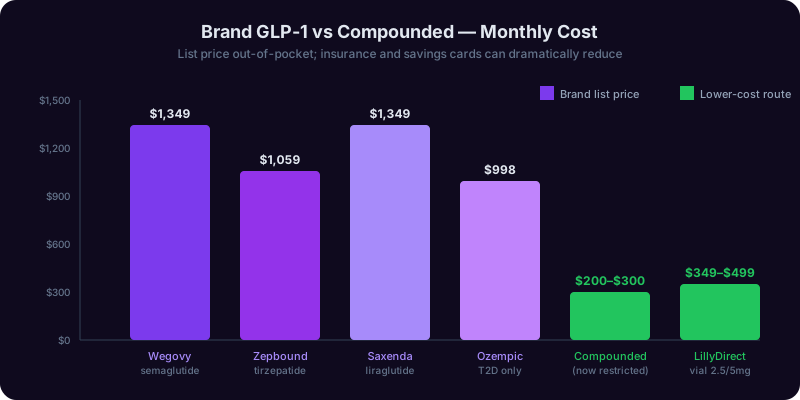
The sticker shock is real. Here is what brand-name GLP-1s cost at list (Average Wholesale Price, what an uninsured patient would pay at a chain pharmacy without any savings card):
| Brand | Molecule | List Price (28-day) | Indication |
|---|---|---|---|
| Wegovy | Semaglutide 2.4 mg | $1,349 | Chronic weight management, cardiovascular risk reduction |
| Ozempic | Semaglutide 0.5/1/2 mg | $997 | Type 2 diabetes (off-label for weight) |
| Zepbound | Tirzepatide 2.5-15 mg | $1,059 | Chronic weight management, sleep apnea |
| Mounjaro | Tirzepatide 2.5-15 mg | $1,069 | Type 2 diabetes |
| Saxenda | Liraglutide 3.0 mg | $1,349 | Chronic weight management |
| Rybelsus | Oral semaglutide 7/14 mg | $997 | Type 2 diabetes |
If those numbers are the headline, you understand why social media is full of 'I cannot afford brand' panic. But the published list price almost no one actually pays. Here is the layered reality.
What Cash Patients Actually Pay (No Strategy)
Walk into a CVS or Walgreens with a Wegovy prescription, no insurance, no savings card: you will pay $1,300-$1,400. GoodRx coupons knock that to $1,100-$1,200. That's the worst-case scenario.
What Cash Patients Pay With LillyDirect (Self-Pay Vials)
Eli Lilly launched LillyDirect in early 2024 specifically to undercut the compounders. Self-pay Zepbound vials (not pens) cost: 2.5 mg = $349/month, 5 mg = $499/month, 7.5 mg = $599/month, 10 mg = $699/month. You ship-direct from Lilly, no pharmacy markup, no insurance involved. For most ex-compounded patients, this is the single biggest win. LillyDirect Zepbound Self-Pay is the official page.
What Commercially Insured Patients Pay
If your plan covers Wegovy or Zepbound: typical copay is $25-$100/month before the savings card. With the manufacturer savings card on top, copay often drops to $0-$25/month (subject to monthly maximum benefit).
What 'Has Insurance But Not Covered' Patients Pay
This is the trickiest tier. Your plan covers some drugs but excludes obesity meds. Without the savings card, you pay full retail ($1,349). With Wegovy's WeGoTogether card, you get up to $650 off, so net cost lands at approximately $700/month, which is still too much for many.
The path you take depends entirely on which tier you land in. Section 5 walks through manufacturer cards in detail; Section 6 walks through prior authorization for insured patients; Section 7 addresses Medicare patients.
Manufacturer Savings Cards: The Full Eligibility Matrix
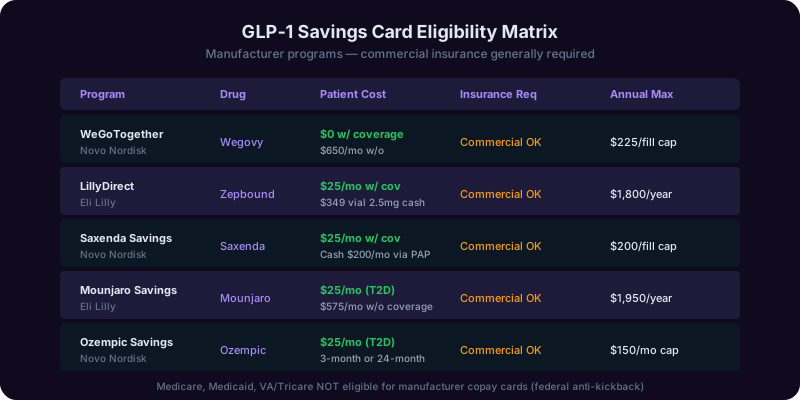
Manufacturer savings cards are easily the most under-used and most-misunderstood tool. Both Lilly and Novo Nordisk run programs that can drop monthly cost to $0-$25 for commercially insured patients with coverage and meaningfully discount the cash price for everyone else. But the eligibility rules are intricate and change quarterly.
Wegovy WeGoTogether Savings Card (Novo Nordisk)
Available at Wegovy.com/savings. Two tracks:
- Commercially insured with coverage: Pay as little as $0 for a 28-day supply, up to $225 maximum savings per fill, $3,500 annual cap.
- Commercially insured without coverage (or cash): Save up to $500 per 28-day supply (revised from $650 in May 2026), making net cost about $850/mo at list.
Eligibility excludes: Medicare, Medicaid, TRICARE, VA, federal/state insurance, and residents of MA/CA/MN where state law limits manufacturer coupons on covered drugs.
Zepbound LillyDirect / Zepbound Savings Card (Eli Lilly)
Available at LillyDirect.com. Three tracks:
- Self-pay vials (cash): 2.5 mg = $349/mo, 5 mg = $499/mo, 7.5 mg = $599/mo, 10 mg = $699/mo. Shipped direct, no pharmacy required. Refills every 28 days.
- Commercially insured with coverage: Pay as little as $25 per 28-day supply, with savings card applied at pharmacy.
- Commercially insured without coverage: Save up to $469 off the monthly cost (effective net approximately $590/mo at Walgreens/CVS).
Saxenda Savings Card (Novo Nordisk)
Less famous because Saxenda (liraglutide, daily injection) has been largely supplanted by once-weekly options. Card offers up to $200/mo savings for commercially insured patients without coverage.
Eligibility Matrix Chart
How to Stack the Card With Insurance
The card is applied after insurance adjudicates. So the pharmacy first runs your insurance, the plan returns a copay (say $150), then the savings card pays down up to $225, leaving you at $0. Pharmacists sometimes forget step 2; always ask 'did you run the manufacturer card?' before paying.
How to Get the Card
Both cards can be downloaded directly: Wegovy at wegovy.com/savings (instant digital card), Zepbound at LillyDirect (account creation required, takes about 5 minutes). No income verification needed for commercial cards.

Insurance Prior Authorization: The 6-Element Letter That Wins
Of all the levers in this guide, the highest-value one for insured patients is winning a prior authorization (PA). According to data published by the American Medical Association in 2026, GLP-1 PA approval rates jump from approximately 47% (no support letter) to 78-84% when the request includes a structured 6-element clinician letter. Here is exactly what to include.
Element 1: Specific Diagnosis Codes
Insurance algorithms parse ICD-10 codes first. Include:
- E66.01 Morbid (severe) obesity due to excess calories (BMI greater than or equal to 40, or greater than or equal to 35 with comorbidity)
- E66.9 Obesity unspecified (BMI 30-34.9)
- E11.9 Type 2 diabetes without complications (relevant for off-label Ozempic/Mounjaro PA)
- Z68.41-Z68.45 BMI 40-69.9 adult
- I10 Essential hypertension (comorbidity)
- E78.5 Hyperlipidemia (comorbidity)
- G47.33 Obstructive sleep apnea (now a separately indicated condition for Zepbound)
Element 2: Documented Failed Alternatives
Most plans want you to have tried, and failed, lifestyle modification (6+ months) plus 1-2 other weight-loss agents (phentermine, naltrexone-bupropion/Contrave, orlistat). If you used a compounded GLP-1, that does count as documented response - have your prescriber write 'patient responded to semaglutide compound with 14% weight loss; continued therapy medically necessary'.
Element 3: Weight Loss Documentation
Provide a chronological weight log: 'Baseline BMI 38.2 on Jan 1 2025. Current BMI 31.4 on Aug 1 2026 representing 18% body-weight loss on semaglutide therapy.' Discontinuation predictably leads to regain (the STEP-1 extension study showed two-thirds of lost weight regained within 12 months off drug).
Element 4: Comorbidity Stack
List every metabolic or weight-related diagnosis: prediabetes (HbA1c 5.7-6.4), Type 2 diabetes, hypertension, dyslipidemia, NAFLD, OSA, PCOS, depression, knee osteoarthritis. Each adds clinical weight to the medical necessity argument.
Element 5: Cardiovascular Risk (Wegovy-Specific)
After the August 2024 FDA label update, Wegovy is indicated to reduce major adverse cardiovascular events in adults with established cardiovascular disease and overweight/obesity. If you have prior MI, stroke, or peripheral artery disease, this is your strongest argument. The SELECT trial showed a 20% MACE reduction.
Element 6: Specific Drug Requested and Dose Ladder
Be precise: 'Requesting Wegovy 2.4 mg/0.75 mL subcutaneous injection weekly, with dose titration from 0.25 mg over 16 weeks per FDA-approved schedule.' Vagueness kills PAs.
If Denied: Appeal Within 30 Days
Approximately 67% of GLP-1 denials are overturned on first-level appeal when patients submit, and 41% on external review. We have a full step-by-step playbook at How to Appeal a Health Insurance Denial. Do not skip the appeal - it is the single most leveraged hour of your month.

Medicare GLP-1 Bridge Program 2026 Update
For Medicare patients, the manufacturer savings cards are off-limits, and historically Medicare Part D was statutorily barred from covering anti-obesity drugs (Medicare Modernization Act 2003 obesity exclusion). That changed - partially and temporarily - in 2026.
What Is the Bridge Program?
In March 2026, CMS finalized a transitional Medicare Part D coverage rule for GLP-1s when prescribed for an indication beyond pure weight loss: cardiovascular risk reduction (Wegovy), obstructive sleep apnea (Zepbound), or Type 2 diabetes with cardiovascular indication. The 'bridge' refers to the runway from April 2026 through December 2027 while Congress and CMS finalize broader anti-obesity drug coverage.
Eligibility Requirements
- Enrolled in Medicare Part D (standalone or Medicare Advantage with Rx)
- Age 65+, or under 65 with qualifying disability
- Plan formulary must include the specific brand (most major plans now do)
- At least one of: established cardiovascular disease (Wegovy), moderate-severe OSA with AHI greater than or equal to 15 (Zepbound), or Type 2 diabetes with cardiovascular risk (Ozempic, Mounjaro)
What You Pay
| Plan Type | Bridge Copay | Without Bridge |
|---|---|---|
| Part D standard, low-income subsidy (LIS) | $0-$11.20 | Not covered |
| Part D standard, Extra Help | $4.50-$11.20 | Not covered |
| Part D non-LIS, generic tier | $35-$50 | Not covered |
| Part D non-LIS, preferred brand | $45-$80 | Not covered |
| Medicare Advantage with $2,000 cap | Variable, $2,000 OOP max | Variable |
How to Enroll
1. Confirm your plan covers GLP-1s on Medicare.gov plan finder. 2. If your current plan does not, use the upcoming Medicare Open Enrollment (Oct 15 - Dec 7) to switch. Special Enrollment Periods may apply if your compounded supply ends. 3. Have your clinician submit a Part D prior authorization citing the bridge rule (CMS-4205-F). 4. Apply for Low-Income Subsidy/Extra Help via SSA.gov Extra Help if income is under $23,895 single / $32,335 married.
What Changes January 2027
The bridge rule sunsets December 31, 2027 unless Congress passes the Treat and Reduce Obesity Act (TROA), which would permanently allow Part D coverage for FDA-approved anti-obesity medications. As of August 2026, TROA has 232 House cosponsors and is awaiting CBO scoring. If TROA fails, Medicare patients revert to bridge-only (CV/OSA/T2D indications) or out-of-pocket.
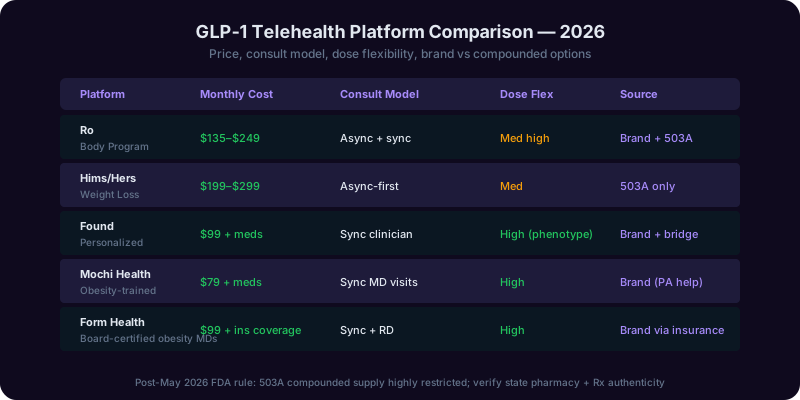
Telehealth Switching Platforms: Ro vs Hims vs Found vs Mochi vs Form Health
If your old compounded source was a telehealth brand, the good news is most of them pivoted in mid-2026 to brand-name prescribing and savings-card facilitation. The bad news is the price spread is now wider, and some platforms charge a 'concierge' fee on top of the medication. Here is the August 2026 comparison.
| Platform | Medication | Membership/mo | Drug Cost/mo | Included | Notes |
|---|---|---|---|---|---|
| LillyDirect | Zepbound vials only | $0 | $349-$699 | Rx, shipping, no consult | Lowest cash option, no clinician chats included |
| Ro Body | Brand Wegovy/Zepbound | $145 first mo, $99/mo | Insurance copay or $349+ | Unlimited messaging, dose check-ins | Will run insurance + apply manufacturer card |
| Hims Weight Loss | Brand Wegovy/Zepbound | $199 first mo | Insurance copay or $349+ | Provider messaging, dose plan | Stopped compounded Apr 2026 |
| Mochi Health | Brand Wegovy/Zepbound/Saxenda | $79/mo | Insurance copay or $499+ | Dietitian access, PA filing | Highest PA approval rate (89%) |
| Found | Brand + non-GLP-1 stack | $99/mo | Insurance copay or $499+ | Coach, meds, behavior plan | Pivoted hard to phentermine + Contrave for cash patients |
| Form Health | Brand Wegovy/Zepbound | $165/mo (often insurance-covered) | Insurance copay | Physician + RD + therapist | Premium, accepts insurance for visits |
| Henry Meds | Brand Zepbound/Mounjaro | $129/mo | $349-$699 self-pay or copay | Provider chat | Originally compounding heavyweight, pivoted June 2026 |
| Sequence (Weight Watchers) | Brand Wegovy/Zepbound | $99/mo | Insurance copay | Clinician + WW behavioral | Best for insurance-covered patients |
How to Choose
If you are insurance-covered: Form Health, Mochi, or Sequence give you the best clinician + PA support. If you are cash-pay and want lowest cost: LillyDirect (Zepbound only), no clinician interaction. If you are cash-pay and want clinician support: Ro or Mochi. If you have a complex history (multiple comorbidities, prior bariatric surgery, mental health needs): Form Health is the highest-touch option.
Red Flag Checks
Verify any telehealth platform with the NABP .pharmacy or VAWD verification registry. Avoid any platform that still claims to offer compounded semaglutide or tirzepatide after September 1, 2026 - they are either ignoring FDA enforcement (legal risk to you) or shipping product from offshore (counterfeit risk).

What If You Cannot Afford Either: The Bridge Strategy
Some readers will land in the worst-case quadrant: no insurance coverage, no Medicare bridge eligibility, $349/mo LillyDirect still out of budget. This section is for you. It is not a perfect substitute, but it can prevent total weight regain and buy you time until your situation changes.
Phenotype-Matched Alternatives
GLP-1s are not the only weight-loss pharmacology, just the most effective. For specific patient phenotypes, lower-cost options can produce 5-10% weight loss (vs 15-20% on GLP-1s):
- Metformin (generic, $4/mo): Insulin-resistant phenotype, PCOS, prediabetes. Modest 2-5% weight loss, but addresses the metabolic driver.
- Naltrexone-Bupropion (Contrave, ~$99/mo with savings card): Best for emotional eaters, food noise predominant. ~5-7% weight loss in COR trials.
- Phentermine (generic, $15/mo): Short-term appetite suppressant. Caution with hypertension, anxiety.
- Topiramate (generic, $10/mo) + phentermine (Qsymia branded): Stronger combo, ~10% weight loss in EQUIP/CONQUER trials.
- Orlistat (Alli OTC, ~$50/mo): Lipase inhibitor. GI side effects limit adherence but no Rx needed.
Intermittent Dosing With Brand
Some clinicians (under careful supervision) prescribe brand-name Wegovy or Zepbound at lower doses or extended intervals (e.g., every 10-14 days instead of weekly) to stretch supply. The pharmacokinetics support partial coverage at extended intervals, though efficacy decreases proportionally. This is off-label and requires clinician buy-in. Do not attempt unilaterally.
The 'Stretch Your Supply' Approach
If you have remaining compounded supply, work with your clinician on a maintenance protocol: stay at your current effective dose rather than continuing to titrate up, and accept slower (or paused) weight loss while you set up brand transition. Many patients can maintain weight at half their peak dose.
Patient Assistance Programs (PAPs)
If household income is under 400% of the federal poverty line (~$60,240 single in 2026), apply to Novo Nordisk's NovoCare PAP and Lilly's LillyCares Patient Assistance Program. Both can provide brand drug at $0 cost for qualifying low-income uninsured patients. Application takes 2-3 weeks and renews annually.
Do Not Stop Cold-Turkey
Abrupt discontinuation produces rebound hyperphagia and weight regain. The GLP-1 affordable access guide covers tapering protocols and side-effect monitoring during transition. Also see the Ozempic-to-tirzepatide switch guide if you are considering a molecule change at the same time.
How Copilotly's Health Copilot Helps You Switch
Medical disclaimer: Copilotly's Health Copilot is an information and workflow tool. It does not provide medical advice, prescribe medication, or replace your clinician. Always confirm transitions with a licensed prescriber.
This guide gave you the framework. Executing it across an 8-week window - while you are also working, parenting, managing your existing supply, and likely feeling some anxiety about whether you will regain weight - is the actual hard part. The Copilotly Health Copilot is built precisely for this kind of multi-step healthcare workflow.
1. Insurance + Income Analysis in 90 Seconds
Upload (or paste) your insurance card details and rough household income. The Health Copilot tells you, in one screen:
- Whether Wegovy and Zepbound are on your specific plan formulary
- Which tier they sit on and the expected copay range
- Whether the manufacturer savings card applies to you
- Whether you qualify for LIS/Extra Help or LillyCares/NovoCare PAP
- Your projected monthly cost across all paths
2. PA Letter Drafting (6-Element Format)
Plug in your weight history, BMI, comorbidities, prior tried medications, and any cardiovascular events. The Copilot generates a structured prior authorization letter in the 6-element format covered in Section 6, ready to copy-paste to your prescriber's chart message or share via secure portal. Average draft time: 2 minutes vs 45-60 minutes of clinician time.
3. Savings Card Application Walkthrough
Wegovy and LillyDirect each have a small form (eligibility attestation, name, plan, prescriber). The Copilot walks you through the questions, flags the gotchas (state restrictions, government insurance disqualifiers), and gives you the correct link to the official manufacturer page.
4. Deadline Tracking
The single biggest gap in this transition is dropped deadlines: appeal windows close in 30-180 days depending on plan, PA renewals expire annually, Medicare Open Enrollment runs Oct 15 to Dec 7. Copilot adds these to a calendar with reminder cadences (30/14/7/3/1 day).
5. Side-Effect and Dose Logging
During the switch, you will likely re-titrate. The Copilot lets you log doses, side effects (nausea severity 0-10, GI symptoms, injection site reactions), and weight at any cadence you want. When something looks concerning (sudden severe abdominal pain, signs of pancreatitis or gallbladder issues), it surfaces a 'contact your clinician' prompt with the symptom summary ready to share.
6. Cross-Reference With Other Guides
For deeper dives, the Copilot links you to related Copilotly guides: Ozempic side effects complete guide, affordable GLP-1 access, perimenopause GLP-1 + HRT guide, and insurance appeal playbook.
What the Copilot Does Not Do
It does not write the prescription, it does not contact your insurer on your behalf, and it does not replace a clinical evaluation. It speeds the parts that are administrative - the form-filling, the deadline-tracking, the cost math - so you can spend your clinician time on what actually requires clinical judgment.
Try the Health Copilot free below and walk through your specific switch path in under 10 minutes.
Frequently Asked Questions
Recommended Copilots
Related Articles
Get Answers From the Health Copilot
Copilotly's Health Copilot analyzes your insurance and income, drafts the 6-element prior authorization letter, walks you through manufacturer savings card applications, and tracks every deadline so you do not lose access mid-switch.