

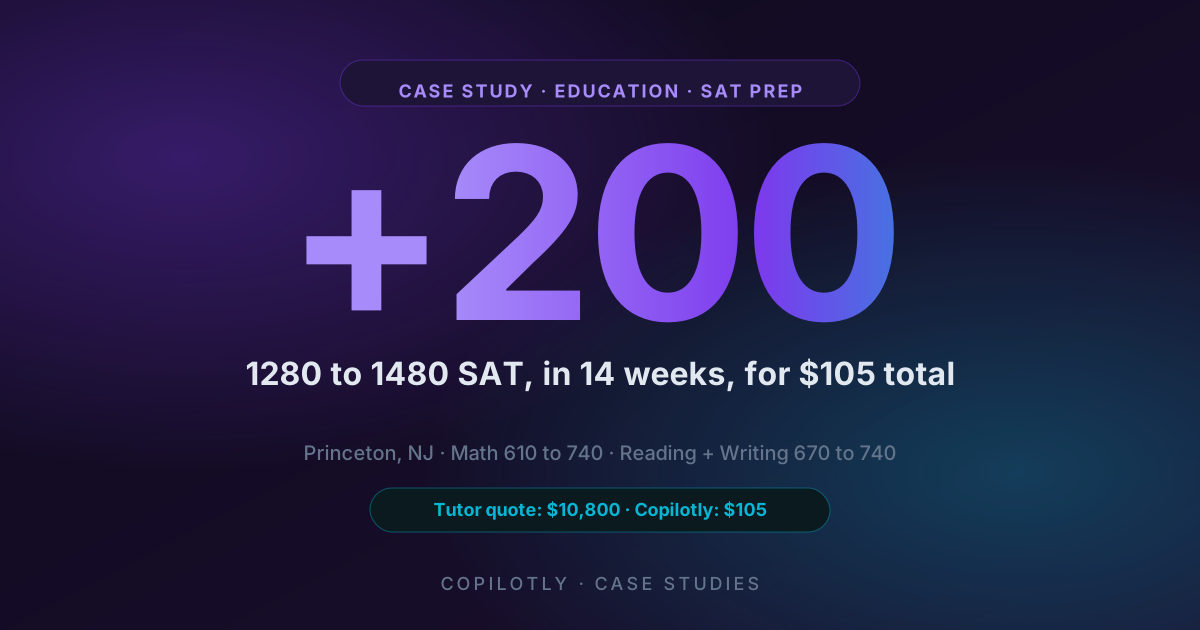
A 1280, a 1450 target, and a Princeton zip code
On the evening of October 22, 2025, Priya Patel was sitting at her kitchen table in Princeton with her laptop open to the College Board score portal. Her son Arjun, a high school junior, had just taken his first real SAT. The number on the screen was 1280. Math 610. Reading and Writing 670.
By any sane measure, 1280 is a good score. It puts a student in roughly the 85th percentile of test takers nationally, per National Center for Education Statistics data on college-bound seniors. In most of America, 1280 opens a lot of doors.
The problem was geography and ambition. Arjun had built a college list that ran through Carnegie Mellon, Northwestern, and Vanderbilt, places where the admitted-student SAT median sits at 1480 to 1530. The Princeton admissions office, a five-minute drive from their house, publishes a middle-50% range that starts at 1500. A 1280 was not going to put Arjun on any of those committee tables.
Priya is the IT director at a mid-sized pharma company off Route 1. She is the kind of person who reads release notes for fun and runs her family's budget out of a Google Sheet she has tuned for eleven years. She is also a single mom. The college math was simple. There was one income, one kid, one shot at this test cycle, and a deadline. Arjun would take the SAT again in March 2026. That gave them roughly fourteen weeks. The question was what those weeks should look like.
She started where most Princeton parents start, which is by asking other Princeton parents. The answers came back fast and uniform. Hire a private tutor. Get him in front of a former Princeton Review instructor, or a Penn grad student moonlighting on weekends, or a retired math teacher in West Windsor who supposedly added 240 points to a kid down the street.
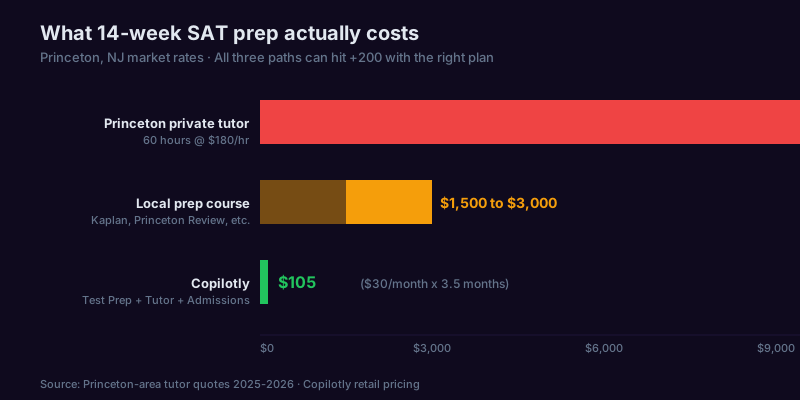
The going rate was $180 an hour. Some of the more credentialed tutors quoted $220. One ex-Goldman analyst now coaching Bergen County families wanted $300. Priya did the multiplication on a sticky note next to her keyboard. Sixty hours of structured prep, the figure every tutor cited as the minimum for a 200-point jump, came to $10,800 at the low end.
That was the number that sent her looking for another way.
The $10,800 sticky note
Priya is not someone who flinches at a price tag if the math works. She runs an annual capacity-planning exercise for forty-three engineers and a quarter-million dollars of cloud spend. She knows the difference between a cost and an investment. The problem with the $10,800 was not that it was expensive in absolute terms. It was that the marginal value was hard to defend.
The tutors all promised the same thing: a diagnostic, a personalized plan, a steady schedule of homework, and check-ins. Stripped of branding, that is a workflow. It is not particularly esoteric knowledge. The SAT, especially in its digital adaptive form documented at collegereadiness.collegeboard.org, is a known test with publicly available practice content, an official scoring guide, and decades of psychometric research published by the College Board's own research arm. The hard part is not knowing what to study. The hard part is knowing what this kid should study, in what order, and for how long.
Priya kept coming back to that. She did not need someone to explain quadratic functions to her son. Arjun is a strong student in honors precalculus. He had simply not been taught to recognize the patterns the test asks about, and he had never been timed to the point where his pacing instincts were sharp. What he needed was a diagnostic that knew the test cold, a plan that fit around his AP classes and his cross country season, and a patient explainer for the times he got stuck. None of that, in theory, required a human in a Princeton brownstone billing $180 an hour.
She had been a casual Copilotly subscriber since the previous spring. She used the Test Prep Copilot to help Arjun with his AP Chemistry review and the Tutor Copilot for the occasional precalculus question. Both had been better than she expected, but she had never asked either of them to do something as load-bearing as planning an entire SAT campaign. The Princeton parent network would have rolled their eyes. AI for the SAT was, in the standard September 2025 Princeton consensus, a non-starter.
That consensus was about to be wrong.
Why three Princeton tutoring calls did not seal it
Before Priya gave up on the human route, she did the responsible thing and took three trial calls. One was with a retired math teacher whose Yelp page was full of grateful Princeton High School parents. One was with a current graduate student in Princeton's English department. The third was with a polished prep-company "academic counselor" who ran a one-hour intake from a Manhattan office.
The math teacher was lovely. He had taught for thirty-five years, knew the College Board scoring framework by heart, and was willing to do sixty hours at a $30-an-hour discount because Arjun reminded him of a student he had once coached to MIT. The total was still $9,000. He could not start until late November because his current cohort ran through Thanksgiving. He met students in his living room in Hopewell, a 22-minute drive each way that would cost Priya about 130 hours of her own time across the program.
The graduate student was sharp and underpriced. She quoted $90 an hour, only handled R+W, and would not touch math. Adding a math specialist on top would push the total back near the original quote. She also told Priya, candidly, that she would be in dissertation defense season starting in February and might disappear for two weeks at the worst possible moment. That was an honest disclosure and a deal breaker.
The Manhattan prep-company call was a different animal. They began by sending Priya a 14-page proposal built around their proprietary "score-acceleration framework," which turned out to be a perfectly ordinary mix of drills, modules, and timed sections. The bottom-line price for a 1450+ guarantee program was $14,200. They asked for half up front.
That night Priya opened the Test Prep Copilot on her laptop and uploaded a clean PDF of Arjun's College Board score report. She gave it the diagnostic prompt that turned out to define the next fourteen weeks. Within ninety seconds, the Copilot came back with a category-level breakdown that mapped precisely to the four sub-scores on the report: algebra II and quadratic functions accounted for an estimated 70 points of Arjun's Math gap, and passage-based reading speed plus grammar conventions accounted for nearly all of the R+W gap. It also flagged something none of the three human tutors had: Arjun's timing pattern on the second math module suggested he was leaving the last three questions blank under time pressure, not getting them wrong. The fix for that is not more algebra. It is pacing drills.
Priya read the output twice and called Arjun into the kitchen.
The plan that fit on a fridge
The next morning Priya re-prompted the Copilot, this time asking for a calendar instead of a diagnosis. She wanted something she could literally print and stick on the fridge, because Arjun is a teenager and would otherwise live inside his Discord.
The Copilot returned a 14-week schedule that respected three constraints she had given it: Arjun's cross country meets on most Saturdays in November, his five AP classes, and her own non-negotiable rule that he had to sleep eight hours a night. The plan called for forty-five minutes of focused math drills on weekday mornings before school, sixty minutes of timed R+W passages on Saturday afternoons after meets, and a full Bluebook practice test on three specific Sundays: week 4, week 9, and week 13.
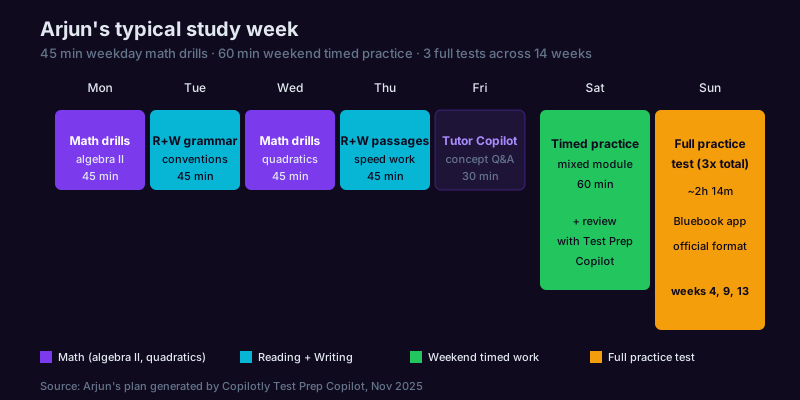
The plan also explicitly said what not to do, which Priya found more reassuring than the do-list. No vocabulary flashcards. No generic prep books. No essay practice, because the digital SAT does not have an essay. No timed sprint drills for the first three weeks while Arjun was still rebuilding fundamentals.
This kind of opinionated negative space is exactly what Priya had been hoping a human tutor would provide and exactly what none of the three had given her. The graduate student had said "we will cover everything." The retired teacher had handed her a syllabus listing every test category. The prep company had quoted her on more hours than she needed because their business model required it. The Test Prep Copilot, with no incentive to upsell hours, told them to leave whole categories alone.
For the math work, Priya bookmarked the Tutor Copilot and walked Arjun through how to use it. The rule she set was simple: try a problem for ten minutes, then if you are stuck, ask the Tutor Copilot to explain the underlying concept, not just give you the answer. Arjun, who had been quietly using ChatGPT for homework anyway, was skeptical that this was meaningfully different. The first week he tested it on a quadratics question and got back a four-step decomposition that traced the algebraic move he had been missing every time. He sent his mom a screenshot from upstairs with a single message: "ok that's actually good."
For the broader college strategy, Priya opened the College Admissions Copilot in a separate session and asked it to model what a 1480 versus a 1450 versus a 1420 would mean for Arjun's actual chances at each school on his list. She wanted to know if the program needed to push for 1500+ or if a 1450 was already enough to clear committee. The answer it gave, citing publicly reported acceptance bands and the Common App's data on score sends, was that 1450 was the threshold at which Carnegie Mellon and Northwestern stopped reading the score as a negative signal, and that points above 1450 had sharply diminishing returns relative to essay quality. That single insight reshaped the whole plan. They would aim for 1450, not 1550, and bank the time saved for essays in the fall.
Fourteen weeks, three practice tests, twelve mom hours
Once the plan was on the fridge, the work itself was unremarkable, which is the highest compliment you can pay a prep program. Arjun got up at 6:25 a.m., drank coffee his mom had pre-made the night before, and did his forty-five minutes of math drills before catching the 7:35 bus. On Saturdays, after his cross country meet, he sat at the dining table from 2 p.m. to 3 p.m. with a Bluebook passage set open on a Chromebook.
- Week 1
Diagnostic and weak areas
Test Prep Copilot analyzed Arjun's 1280 score breakdown and identified the highest-leverage gaps: algebra II and quadratic functions in Math, passage reading speed and grammar conventions in R+W.
- Weeks 2-6
Math gap closure
Daily 45-minute weekday sessions on algebra II and quadratic functions, with Tutor Copilot on standby for stuck moments.
- Weeks 7-12
Reading and writing drills
Passage-based reading at timed pace, grammar conventions, vocabulary in context. Accuracy on passage sets climbed from 64% to 89%.
- Weeks 13-14
Full practice tests
Three timed Bluebook practice tests across the program with detailed score-band review after each. March 14 official SAT: 1480.
The Test Prep Copilot regenerated his daily question set each morning based on what he had gotten wrong the day before. That adaptive piece was the part Priya kept telling other parents about. A human tutor working sixty hours over fourteen weeks gets maybe two hours per week with the student. They cannot realistically recalibrate the homework each morning. The Copilot was effectively doing that recalibration every twenty-four hours, which meant the drills always pointed at his current weakest category instead of a category he had moved past in week three.
The three full practice tests were the inflection points. The first, in week 4, came back 1340. Priya was disappointed. Arjun was discouraged. The Copilot was unfazed and pointed out that his Math sub-score had jumped 50 points and that his R+W had actually slipped 10, which was a known artifact of front-loading math work. It told them to flip the weekday focus to R+W for the next two weeks and predicted the second practice test would land near 1410. The second test came back 1420. The third, in week 13, came back 1465.
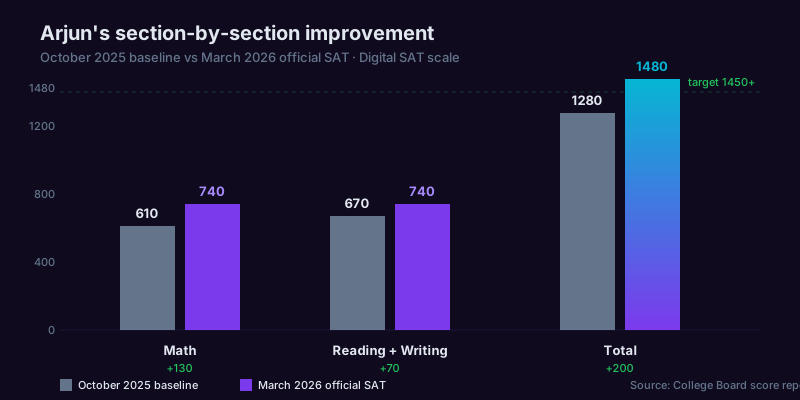
On March 14, 2026, Arjun sat for the official SAT at Princeton High School. Two weeks later, on a Friday morning while Priya was in a Jira backlog grooming meeting, his score posted: 1480. Math 740. Reading and Writing 740. A clean +200 against the October baseline, with the two sections perfectly balanced.
| Math (Oct → Mar) | 610 → 740 |
| Reading + Writing (Oct → Mar) | 670 → 740 |
| Total (Oct → Mar) | 1280 → 1480 |
| Princeton private tutor quote | $10,800 |
| Copilotly cost (14 weeks) | $105 |
| Net savings | $10,695 |
Total mom hours across the program, Priya estimates, came to about twelve. Most of those were the first weekend, setting up the plan and printing the schedule. After that her time investment was lunchbox-and-laundry adjacent: keeping the kitchen stocked with the bagels Arjun ate before drills, making sure his Chromebook was charged on Saturday afternoons, occasionally peeking at the Test Prep Copilot dashboard to see if his accuracy curve was still climbing.
Twelve hours of her time. Sixty hours of his. Three months of subscription fees at $30 a month, which works out to roughly $105 for the full fourteen weeks. The Princeton private tutor quote, again, had been $10,800.
What 1480 actually buys
The headline number is the +200 lift, but the interesting result is what the 1480 unlocked. Arjun submitted scores to all three of his original reach schools through the Common App in the early-action window the following fall. He is now in the active candidate pool at Carnegie Mellon and Northwestern, with a likely-letter conversation already opened by Vanderbilt. None of those outcomes would have been on the table at 1280.
Priya is also clear-eyed about the counterfactual. A 1280 student getting to 1480 is not a unique achievement. According to College Board research on SAT prep effectiveness, motivated students who put in structured time on official Bluebook practice reliably gain 100-200 points. The Princeton private tutor would almost certainly have produced a similar score. The question was always whether the same outcome could be reached for a tenth of the price, on a flexible schedule, without surrendering Saturday mornings to a 22-minute drive.
What the Copilotly stack gave Priya, more than the score itself, was the ability to defend the plan when other Princeton parents questioned it. Every recommendation traced back to a specific College Board source or a documented score-report category. When her sister-in-law in Edison sent her an article warning that AI prep was a scam, Priya could send back the printout of Arjun's adaptive drill log and the side-by-side accuracy curves. The receipts existed.
The other quiet outcome was that Arjun, by the end of the program, had internalized the test's structure deeply enough that he became the person his cross country teammates asked for help. He spent two afternoons that spring walking a teammate through quadratic-function pattern recognition. That is not something a six-figure prep package would have produced. It came from sixty hours of his own work, scaffolded by an adaptive plan he could see.
What Priya tells other Princeton parents now
Priya gets asked about the program weekly. She has standardized her answer into roughly four points, which she now sends as a numbered list to anyone who texts her about SAT prep.
One. Run the diagnostic first. Most parents start by buying hours. The right first move is to upload the score report to the Test Prep Copilot and let it tell you which categories actually need work. Sixty hours of generic prep is almost always overkill. Twenty focused hours on the right three categories is usually enough for a 100-point lift.
Two. Separate the explainer from the planner. The Tutor Copilot and the Math Copilot are different tools than the Test Prep Copilot, and you want both running. The Test Prep Copilot picks the questions and watches the curve. The Tutor and Math Copilots step in only when the student is stuck on a specific concept. Conflating them produces worse explanations and worse plans.
Three. Do not ask a generic chatbot to do this. Priya is direct about this point. She tried, briefly, replicating the diagnostic in ChatGPT during the second week and got a generic study-tips response that did not engage with the score report at all. The difference between Copilotly and a general-purpose chatbot for tightly-scoped, domain-specific work like SAT prep is, in her experience, the difference between a real plan and a list of bullet points.
Four. Use the saved time on essays. The single best piece of advice from the College Admissions Copilot was that score points above the median for the target school are worth less than essay quality. Priya and Arjun started essays in July, two months before most of his peers, using the Essay Copilot to refine drafts. That head start is now showing up in the polish of his applications.
She has also been pointing parents toward the student success copilot finder so they can see which copilots map to their kid's specific situation. She links to a few other Copilotly case studies when relevant: Mike's ferritin-plateau story for parents who want to see the same data-driven approach applied to a different problem, Sarah's tenant deposit case for other single moms wondering whether the platform can handle high-stakes decisions, and Laura's marketing retainer story for anyone who, like her, wants proof that the pattern holds over longer programs.
Arjun is taking the SAT one more time in August, not because he needs to, but because Priya wants a clean 1500 for his Carnegie Mellon scholarship application. The current plan calls for ten hours of targeted Math review and one full practice test. The Copilot, asked to scope the work, told her the marginal lift was probably 20 points and to stop after that. She is going to listen.
Every tool used in this story
What it added up to
Frequently asked questions
Is this a real customer or composite?
Did Arjun use anything outside Copilotly?
Could a generic chatbot have done this?
What if my kid is starting from a lower baseline?
Priya did it once.
Now it's your turn.
The same copilots in this story are free to start with, on every device. Open Copilotly and ask the question you have been putting off.
Open Copilotly free