
Her landlord said the unit needed $2,400 in repairs. Texas Property Code disagreed.
After moving out of her Austin apartment in May 2026, Sarah Miller got an itemized list claiming her $2,400 security deposit was wiped out by cleaning fees, paint touch-ups, and "general wear and tear restoration." She had time-stamped move-in and move-out photos showing none of it was true. Without a lawyer she could not afford, Sarah used Copilotly Tenant Rights Copilot and Small Claims Copilot to demand return, file in Travis County Justice Court, and recover her full deposit plus statutory damages.
Composite story based on real Copilotly customers
How it actually went
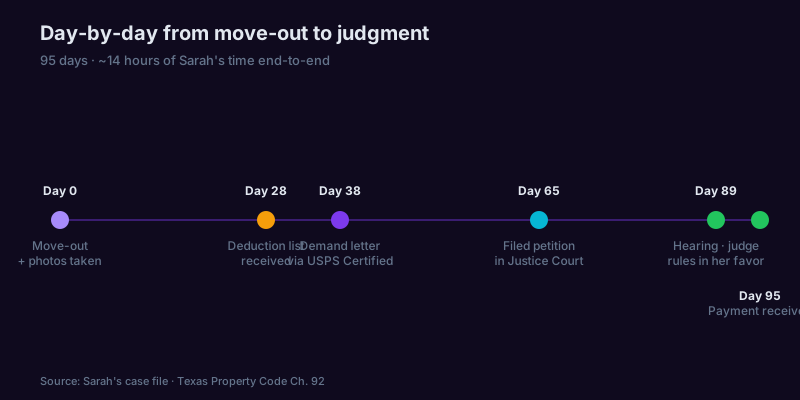
- Day 0
Move-out, keys returned
Sarah did a self-walkthrough with her phone camera, time-stamping every room. She handed over keys to the leasing office that afternoon.
- Day 28
Itemized deduction list arrives
Just inside the §92.103 30-day window, the landlord mailed a statement claiming $1,650 cleaning, $480 paint, and $270 "general restoration" - exactly wiping the $2,400 deposit.
- Day 38
Demand letter sent
Sarah mailed a USPS Certified Mail demand letter drafted with Tenant Rights Copilot, citing §92.103, §92.104, and §92.109, requesting return within 10 days.
- Day 65
Petition filed
No response. She filed a small claims petition in Travis County Justice Court (JP Precinct 5) using Small Claims Copilot to format the filing and prepare exhibits.
- Day 89
Hearing
Sarah appeared. The landlord did not. Judge reviewed her photo evidence binder and ruled in her favor for the full deposit plus statutory damages.
- Day 95
Payment received
A check for $4,200 cleared, satisfying the judgment in full.
The deduction list that did not add up
Sarah Miller is 34, an emergency room nurse at a Level I trauma center in Austin, and the sole income for her household of three. Her kids are 5 and 7. Her schedule rotates through nights and weekends, and her "free time" is the gap between her younger kid's bedtime and her own - usually 45 minutes, sometimes less. None of that is unusual for an ER nurse. What is unusual is what happened after she moved out of her two-bedroom apartment in May 2026.
The reason she moved at all was simple math. Her lease was up for renewal and the new rent was 18% higher than what she had been paying. Austin's rental market had cooled compared to its 2022 peak, but her landlord, a mid-sized property management company that owns several complexes in the metro, sent a renewal offer that pushed her monthly above what her budget could carry without cutting into her kids' after-school program. She gave the required 60-day notice, found a smaller place a few miles north, and began packing.
She also did something her older sister had drilled into her years earlier: she photographed every wall, every appliance, every carpet edge, and every grout line. She did it on move-in day in 2024 and again on move-out day in May 2026. The photos sat in a dated album on her phone, automatically backed up to iCloud, every shot stamped with location and time. She did not think much of them. They were insurance against a problem she did not expect to have.
Twenty-eight days after she handed over the keys, the deduction list arrived. Cleaning: $1,650. Paint touch-ups: $480. General wear and tear restoration: $270. Total deductions: $2,400. Refund due: $0.00.
[[pullquote:pq1]]The number itself was insulting. The line items were worse. "General wear and tear restoration" is not a thing under Texas Property Code Chapter 92 - not as a legitimate deduction, anyway. The statute is unusually clear on this point: a landlord may not deduct normal wear and tear from a security deposit, and the deduction statement must be itemized in a way that lets the tenant evaluate each charge. Sarah did not know any of that on the day the letter arrived. What she knew was that she had been counting on that deposit to cover the first-month rent and the moving truck on her new place, and now it was gone.
She called her sister, then her credit union, then a tenant hotline that put her on hold for 22 minutes before disconnecting. She opened a new tab and typed "lawyer Austin security deposit" into a search bar. The first result quoted a $350 consultation fee. The second wanted $250. The third had a form she could fill out and never heard back from. She closed the laptop and went to put the kids to bed.
Realizing the law might actually be on her side
The next morning, between a 12-hour shift and a Costco run, Sarah did what most people would do: she read the deduction list a second time and tried to reverse-engineer whether any of it was defensible. Was the apartment dirty? It was not. She had vacuumed every room, wiped every appliance, and bagged her own trash. Were the walls damaged? Not beyond normal hanging-and-removing of picture nails - which her lease, ironically, had described as "tenant-permitted decoration."
She knew enough to know she was probably right. But knowing you are probably right and proving it to a court are different things. And the asymmetry was sharp: the landlord had a property manager, an accountant, and a lawyer on retainer. She had photos on her phone and a stack of bills on the kitchen counter. The friend-of-a-friend lawyer route would have cost her more than the deposit was worth. Texas allows fee-shifting in some tenant cases, but only after you win, and she would have to front the costs and the risk.
That night, after the kids were down, she opened her laptop and did something she had been resisting: she paid for a month of Copilotly. She had seen ads. She had a coworker who used it for medical-billing appeals. She was not optimistic, but $19 was less than a single consultation. She clicked through the Find Your Copilot legal-help quiz, which pointed her toward two specific copilots: Tenant Rights Copilot and Small Claims Copilot. She bookmarked both and started with Tenant Rights.
Within the first five minutes of conversation she understood three things she had not understood before. First, Texas law gave her 30 days from move-out for the landlord to send the itemized list - not 30 days for the landlord to make up their mind. Second, the statute defines specific categories of charges that are not deductible at all, including "normal wear and tear," which is a defined term, not a vague one. Third, if the landlord acted in bad faith - a specific legal standard, again, not a vibe - she could recover three times the wrongfully withheld amount plus $100 in statutory damages under §92.109(a).
That last point reframed the entire situation. She was not asking for $2,400 back. She was asking for $2,400 plus damages designed by the Texas Legislature specifically to punish landlords who do exactly what hers had done.
Why generic advice was not enough
Before Copilotly, Sarah had tried three other things, none of which moved the needle.
The first was the Texas Attorney General's landlord-tenant resource page. It is a useful overview, and it links out to the actual statute, but it does not tell you what to do when an itemized list contains charges that are facially non-deductible. It tells you the law exists. The translation from "the law exists" to "here is the demand letter that cites the specific subsection" is the part nobody hands you for free.
The second was a general-purpose chatbot. She typed the deduction list into it and asked whether the charges were legal. It told her to "consult a licensed attorney in your jurisdiction" four times in three paragraphs. When she pushed it, it gave her a generic explanation of security deposit law that referenced California civil code by accident. This is the failure mode Copilotly was designed around, and one reason we publish a side-by-side comparison of how Copilotly differs from generic ChatGPT on jurisdiction-specific questions. Tenant law is state law. A generic model trained on the whole internet does not know that your landlord is in Travis County and not Sacramento County, and it will hedge until the answer is useless.
The third was the Legal Services Corporation directory. LSC funds civil legal aid for low-income Americans and is a genuinely important institution. But Sarah, on an ER nurse's salary, was above the income cutoff in her county. She qualified for nothing. The NOLO tenant rights encyclopedia was helpful as a primer but stopped short of the specific Texas Property Code subsections that mattered.
The pattern in all three failures was the same. Each source got her closer to the answer without ever delivering it. The gap between "you might have a case" and "here is the citation, the letter, and the petition" is exactly the work that historically required a $300 lawyer hour, and exactly the work she could not afford.
The conversation that changed the trajectory
Sarah's first useful session with Tenant Rights Copilot lasted about 40 minutes. She pasted the itemized deduction list, attached her move-out photos (the copilot accepted images and read the timestamps), and asked it to evaluate each line item against Texas law. The copilot did not give her a vibe answer. It walked the list:
- Cleaning, $1,650. The Texas Property Code §92.104(a) bars deductions for "normal wear and tear." A unit returned in a vacuumed, wiped-down condition - which her photos showed - is at the floor of what a landlord can require. The copilot noted that even legitimate cleaning charges must be commercially reasonable and supported by a receipt, neither of which the statement provided. Likely not legally deductible.
- Paint touch-ups, $480. Standard interior paint has a useful life the IRS publishes for depreciation purposes, and Texas courts have routinely held that repainting between tenants is a routine maintenance cost, not a tenant-attributable damage, absent specific evidence of holes, drawings, or smoke damage. Her photos showed clean walls. Likely not legally deductible.
- General wear and tear restoration, $270. This line is the textbook example of a non-itemized, non-specific charge. The statute requires itemization. "General restoration" is the opposite of itemization. Almost certainly not legally deductible.
The copilot then asked her three follow-up questions. Did she have her original move-in inspection report? (Yes, signed by both parties and saved as a PDF.) Did she have a forwarding address on file with the landlord? (Yes, she had updated it in the tenant portal three days before move-out.) Was there anything in the lease that purported to waive her statutory rights? She did not know, so she opened the contract scanner tool and uploaded her lease. It flagged two clauses: one attempting to make the deposit "non-refundable for any reason," and another waiving the tenant's right to itemization. Both are unenforceable under Texas law, which the scanner noted with the relevant case citations. She now had a paper trail of bad-faith drafting on top of the bad-faith deduction list.
This is the moment Sarah described as the turn. She was no longer trying to figure out whether she had a case. She had a case, and she had the citations to prove it.
The two prompts that did the real work
Over the next two evenings - about six hours total, mostly between 9 and 11 p.m. - Sarah did the meticulous part. She built an evidence binder. She sequenced her photos. She matched each photo to a specific deduction line. She used Tenant Rights Copilot to draft a demand letter and Small Claims Copilot to draft the petition she would later file if the landlord ignored her. She also looped in the broader general legal copilot for one specific question: what was her exposure if the landlord countersued for damages above the deposit? The answer was effectively zero in her facts, and the copilot showed her why.
The two prompts that did most of the heavy lifting are below. Note how specific they are. The single biggest mistake people make with AI tools on legal questions is asking general questions and accepting general answers. Sarah pasted in the actual deduction list, the actual photos, and the actual lease, and asked for citations.
[[prompt:kp1]] [[prompt:kp2]]The demand letter went out via USPS Certified Mail on Day 38, return receipt requested. It cited §92.103 (the 30-day deadline and itemization requirement), §92.104 (the prohibition on deducting for normal wear and tear), and §92.109(a) (the bad-faith damages statute). It gave the landlord 10 days to return the full deposit and warned that a small claims petition would follow. The letter was professional and short. It did not threaten. It cited.
The landlord did not respond. On Day 65, Sarah filed in Travis County Justice Court, the Texas-specific name for what most states call small claims. Filing fees in Justice Court run roughly $54 in Travis County, plus a service-of-process fee. She paid by debit card. Small Claims Copilot produced the petition, the exhibit list, and a one-page demonstrative timeline that she printed on a single sheet of card stock for the hearing.
While she waited for the hearing date, she crossed-referenced her approach against a couple of other Copilotly customer stories. Maya's freelancer-tax case study reminded her how much credibility specific receipts add when you are arguing against a counterparty with deeper pockets. Alex and Jordan's housing decision in Portland reinforced how much variance there is in landlord behavior between markets. And the New Jersey single-mom case study on SAT prep was, frankly, the one she reread when she felt overwhelmed. Different problem, same constraint stack: a working parent, a clear goal, a budget that did not stretch to outsourcing the work.
The hearing, and what came in the mail
The hearing was on Day 89, a Wednesday morning at 9:30. Sarah took a vacation day. She wore a blazer over scrubs, which she said felt absurd until she remembered she had no time to change between dropping the kids at school and being at the courthouse. She brought her binder, her demonstrative timeline, three printed copies of the lease, and a USB stick with the photos in case the courtroom had a display. It did not, but the judge accepted printed prints.
[[pullquote:pq3]]The landlord did not appear. In small claims practice that often means a default, but the judge in Sarah's case still asked her to walk through her evidence as if the landlord were present. She did. The judge asked two questions, both about the timing of the itemized statement and the certified mail demand letter. The judge then took about five minutes off the bench, returned, and ruled.
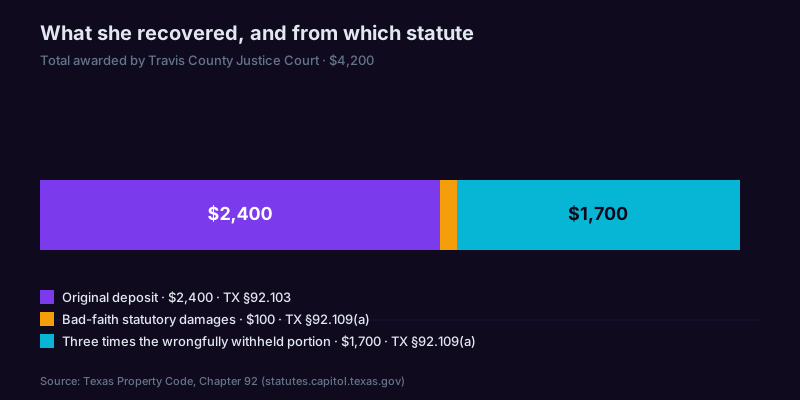
The award: the full $2,400 deposit, $100 in statutory bad-faith damages under §92.109(a), and three times the wrongfully withheld portion. Because the entire deposit had been wrongfully withheld, the three-times calculation could in theory have produced a larger figure; the judge instead awarded $1,700 as the three-times-withheld component, totaling $4,200. Sarah was also awarded court costs. She walked out of the building, sat in the parking garage for ten minutes, and texted her sister a screenshot of the judgment.
[[numbers]]The check arrived six days later. Day 95 from move-out, 67 days from her first conversation with Tenant Rights Copilot, and roughly 14 hours of her own time. By comparison, the cheapest local attorney quote she had received in May would have charged about $1,800 in legal fees, contingent or otherwise. Net of those fees, even a successful attorney-led case would have left her with less than she recovered alone.
What she tells her coworkers now
Sarah's coworkers in the ER hear about the case every time a deposit story comes up in the break room, which is more often than you would think. Her advice, distilled, is consistent.
First, take the photos. Time-stamped, every room, every appliance, at both ends of the tenancy. The cost is fifteen minutes. The upside is the entire case.
Second, do not assume the law is too complicated to understand. State-level tenant codes are written in ordinary English for a reason. The Consumer Financial Protection Bureau's debt-collection primer is a useful adjacent read, even though it is not specifically about tenancy. The pattern is the same: specific statutes, specific remedies.
Third, use a copilot that is built for the question you are asking. Sarah is direct about this: she does not believe a generic chatbot would have produced her demand letter. She tried. It did not. The Tenant Rights Copilot and Small Claims Copilot were the difference between a case she could file and a case she just complained about. If you are not sure which copilot is right for your situation, the legal-help persona quiz is a useful five-minute filter.
Fourth, file. Most landlord-tenant disputes never get filed because tenants assume the process is harder than it is. In Texas, Justice Court filing is intentionally accessible. Other states have similar small claims processes; the NOLO tenants' rights encyclopedia has state-by-state summaries that are a reasonable starting point.
Sarah is putting the $4,200 toward her kids' summer camp and a buffer in her savings account. The next time her lease comes up, she says, she is going to read every word of it through the contract scanner before she signs.
What it came to
- $2,400deposit returnedin full
- +$1,800statutory damages§92.109(a)
- 14 hrstotal time investedacross 67 days
Questions about this case
Get help with this from the Legal Copilot
Describe your situation and get specific, actionable guidance - not the generic hedging a general-purpose chatbot gives you on legal questions.
Free plan, no card. Pro from $4.99/week for every copilot across all 20 domains - about what one hour with any single professional costs per year.
Not a law firmThis is legal information, not legal advice. Consult a licensed attorney for your specific situation.