

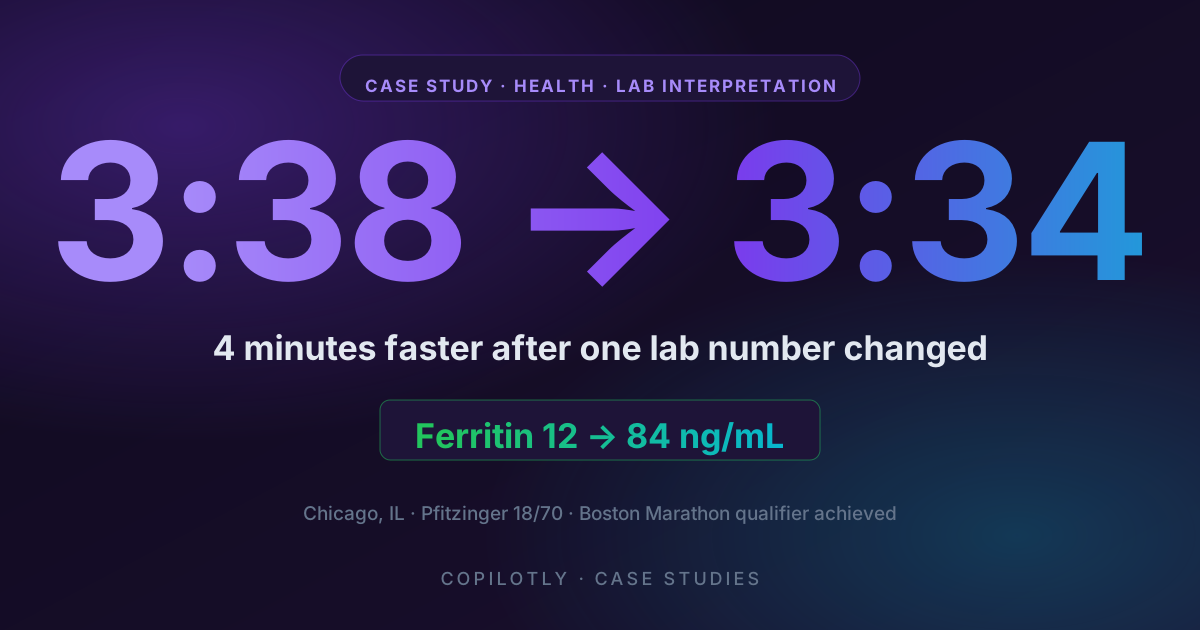
The paces that kept getting slower
Elena Vasquez is 36, lives in Logan Square, and runs the lakefront path most mornings before her first marketing standup. She has finished four marathons. Her PR is 3:42, set at Grandma's Marathon in Duluth in June 2024. For 2026 she had one goal: a Boston qualifier. For her age group (F35-39) that means a finish under 3:35:00.
The plan was a textbook Pfitzinger 18/70 cycle peaking at 70 miles per week, the kind of structured block that has produced thousands of BQs. She had a coach. She tracked everything in a spreadsheet that branched into three tabs: training load, sleep, and what she ate. By April 2026 the long runs were going in, the medium-long runs were going in, and the tempos were getting slower week over week.
Her half marathon split in March, run as a tune-up race in 1:48, suggested a 3:38 marathon on a flat course. That math is well established: a recent half PR is the single best predictor of marathon time for a trained runner. Instead her marathon-pace workouts felt like threshold. Her threshold felt like VO2. Her easy days, the ones that should have been conversational, were leaving her flat on the couch at 7pm.
The first instinct was to blame training. She backed off mileage for ten days. Nothing changed. She added an extra rest day. Nothing changed. She moved her hardest workouts to morning, slept nine hours, ate more carbs. Her Garmin "body battery" reading was fine. Her resting heart rate was 4 beats higher than baseline, but only barely outside normal day-to-day noise.
What she did not yet know, and what her primary care doctor would later wave away, was that her last annual physical contained the answer. The CBC was sitting in MyChart with a hemoglobin reading flagged green - 13.4 g/dL, comfortably inside the 12.0 to 17.0 reference range that the CDC uses for the general adult population. Nothing was red. Nothing was starred. From the system's perspective, Elena Vasquez was a healthy woman.
From an endurance physiology perspective, she was running on a tank that was three-quarters empty and getting emptier every long run.
The doctor said the labs were fine
In late April Elena booked a same-day appointment with her primary care physician. She brought a printed list of symptoms: training paces 15 to 25 seconds per mile slower at the same perceived effort, unusual breathlessness on stair climbs, a cold tolerance that had collapsed (she was wearing a base layer in 60-degree weather), and dark crescents under her eyes that no amount of sleep was fixing.
The appointment lasted nine minutes. Her doctor pulled up the panel from January, scrolled, and said the line she would replay later:
The doctor's reasoning was not unreasonable. Within the framework of population medicine, every number on her panel was either green or boring. Hemoglobin 13.4. Hematocrit 40. White count normal. Platelets normal. Glucose 88. The only suggestion was a sleep study and a referral to behavioral health, on the theory that endurance athletes who feel terrible during a hard training block are often overtrained, underfed, or under-slept.
Elena left the office with a referral she didn't want and a sense that something had been missed. She is, in her marketing job, a person who works with data for a living. She knows the difference between a population mean and an individual signal. The "normal" range that flagged her hemoglobin as fine was built from a NIH-curated reference population that included nursing-home residents and college freshmen. It was not built for a 36-year-old running 65 miles per week.
The breaking point came that Saturday. Her long run was scheduled at 18 miles, 12 at marathon pace (8:11 per mile). She made it 9 miles before her pace fell off a cliff. She walked the final 4 miles back to her apartment. In the kitchen, still in sweaty clothes, she opened her laptop and typed "interpret CBC and iron panel marathon training" into a search engine. The first three results were forum threads. The fourth was a Copilotly page about the Lab Results Copilot.
She uploaded the PDF from her January physical that afternoon.
What didn't work before Copilotly
This was not Elena's first attempt to debug the plateau. By the time she opened Lab Results Copilot she had spent roughly 20 hours over six weeks doing the kind of forensic self-investigation runners are good at and bad at in equal measure.
She had tried the obvious training adjustments first. Cutting mileage by 20 percent. Adding a third rest day. Replacing one quality session with cross-training. None of it moved her tempo paces. She had tried the nutrition lens next, logging every meal for two weeks in a macro tracker and confirming she was eating roughly 2,800 calories with a 55/20/25 split. The numbers were boring and within the recommendations of the American College of Sports Medicine for a runner at her training volume.
She had also dipped into the forums. Letsrun threads. Reddit's r/AdvancedRunning. A handful of triathlon Slack groups. The collective advice was a wall of contradictions: probably overtrained, probably underfueled, probably underslept, possibly RED-S, possibly low ferritin, possibly Lyme, possibly perimenopause. Every diagnosis came with a confident anecdote and zero ability to look at her actual numbers.
Her coach, a 2:38 marathoner who has coached hundreds of recreational runners, suggested an iron panel almost as an aside in a Zoom check-in - "Just in case, given you're female and training hard." Elena added it to her doctor visit list. The doctor agreed to order serum iron, TIBC, and ferritin but cautioned that she did not expect to see anything. The blood was drawn the same day as the dismissive appointment.
The iron panel results came back into MyChart 72 hours later, again with every value either green or unflagged. Serum iron 52 mcg/dL (reference 60 to 170). TIBC 410 mcg/dL (reference 250 to 450). Ferritin 12 ng/mL (reference 30 to 300 for "general adult female"). The portal showed two of three values inside reference ranges and one - the serum iron - mildly low but not flagged for follow-up. Elena's doctor closed the chart without a message.
This is the part of the story that matters most. The data she needed had been collected. It was sitting in a database. What was missing was an interpretation framework that knew the difference between a 36-year-old sedentary woman and a 36-year-old running 65 miles per week.
The first useful output, 90 minutes later
Elena uploaded both lab PDFs to Lab Results Copilot on a Saturday afternoon. The first response, generated in roughly 40 seconds, made her sit up. The Copilot did not just restate her values. It flagged ferritin first, before anything else, and explained why the population reference range was the wrong lens.
The interpretation walked through the iron physiology in plain language. Ferritin is the body's iron storage protein. Hemoglobin reflects the iron currently riding around in red blood cells. You can have technically-adequate hemoglobin while your storage tank is nearly empty, and your body will eat into the storage tank every time you stress it - which, for an endurance athlete in a 70-mile peak week, is roughly every 18 hours. Once storage is gone, hemoglobin starts to fall and you cross into clinical anemia. But before that, you exist in a functional twilight: not anemic on paper, but oxygen-poor in the muscles that need it.
The Copilot cited PubMed-indexed work on ferritin and endurance performance showing that female endurance athletes typically target 50 ng/mL as a floor and 80 ng/mL or higher for peak performance. Elena's 12 was not a borderline reading. It was three to five times below what her training load required.
Two things mattered about this output. First, it gave Elena a falsifiable hypothesis: if low ferritin is causing the plateau, supplementation should reverse it on a known timeline. Second, it cross-referenced her serum iron of 52 (below population normal) and TIBC of 410 (toward the upper end), which is the textbook pattern of early iron deficiency - the body upregulating transferrin to scavenge harder for whatever iron is available.
She spent the next 45 minutes pulling related threads. She fed the same panel into the Lab Range Lookup tool and got the athletic reference range displayed visually next to her value. She opened the Health Copilot and asked what other markers were worth requesting at her follow-up - the answer included reticulocyte count, vitamin B12, vitamin D, and TSH, the standard "fatigue panel" that her primary care had not ordered. She opened the Nutrition Copilot and pulled an iron-rich meal pattern that emphasized heme iron from beef and chicken liver, paired with vitamin C, and timed away from coffee, tea, and dairy.
Total elapsed time: 90 minutes. Total cost: her Copilotly subscription. The output was not a diagnosis - the Copilot was clear about that, and clear that she needed a clinician to write the prescription and re-test. What it gave her was the question to walk back into the clinic with.
Designing the supplementation protocol
The hardest part of the next 12 weeks was not getting iron into her body. It was getting it in correctly. There is a counterintuitive body of research suggesting that everyday iron supplementation in healthy women is actually less effective than every-other-day dosing, because daily doses spike hepcidin, the hormone that suppresses iron absorption, for the next 24 hours.
Elena went back to Lab Results Copilot with a specific request.
The protocol that came out of that thread looked like this. Sixty-five milligrams of elemental iron as ferrous bisglycinate (gentler on the gut than ferrous sulfate), taken every other morning on an empty stomach with 250mg of vitamin C and a small glass of orange juice. No coffee, tea, calcium, or eggs for two hours after dosing - all known absorption inhibitors documented by the NIH Office of Dietary Supplements iron fact sheet. On non-iron days, normal breakfast and full coffee.
The Copilot also flagged the every-other-day evidence with the specific citation - a 2017 Lancet Haematology paper showing that alternate-day dosing produced higher cumulative absorption and fewer GI side effects than daily dosing in women with depleted iron stores. Elena printed the abstract and brought it to her follow-up appointment, where her doctor, to her credit, agreed to the protocol and ordered the supplement.
The other side of the protocol was food. The Nutrition Copilot built a weekly meal pattern with three "iron-loading" dinners per week: a Sunday beef stew with red bell pepper, a Wednesday lentil curry with tomatoes and lemon (non-heme iron with vitamin C), and a Friday chicken thigh roast with broccoli. It removed her habit of yogurt-and-coffee breakfasts on training mornings and replaced them with steel-cut oats topped with strawberries on the days adjacent to long runs.
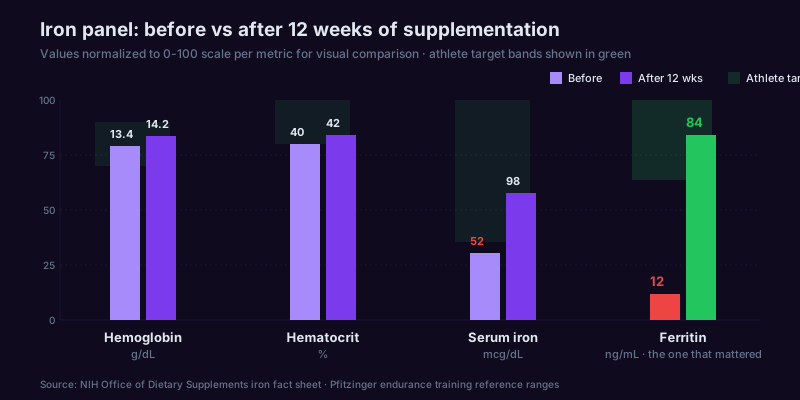
| Hemoglobin (g/dL) | 13.4 → 14.2 |
| Hematocrit (%) | 40 → 42 |
| Serum iron (mcg/dL) | 52 → 98 |
| Ferritin (ng/mL) | 12 → 84 |
| Outcome | 4-min marathon PR |
She tracked compliance in the same training spreadsheet that had been documenting the plateau. By week 6 the easy runs started feeling like easy runs again. By week 8 her tempo paces were back to 7:35 per mile at a heart rate that had been delivering 7:55s in April. By week 10 she ran a 20-mile long run with 14 at marathon pace, the workout that had imploded twice during the plateau, and finished it feeling like she could have done 10 more. The plan said one thing. Her body said another. They were finally agreeing.
- Week 1
Pulled her lab results
Uploaded her annual physical CBC and metabolic panel to Lab Results Copilot.
- Week 2
Asked for the iron panel
Followed up with her doctor to get serum iron, TIBC, and ferritin tested.
- Week 3
Started supplementation
Began ferrous bisglycinate with vitamin C, timed away from coffee.
- 12 weeks later
Retested and ran a PR
Ferritin back in athletic range. Marathon pace dropped 4 minutes.
Chicago, October 2026, mile 22
The retest at 12 weeks told the story in numbers before the marathon told it in seconds. Ferritin had moved from 12 to 84 ng/mL, squarely inside the athletic target band. Serum iron was 98, almost double the baseline. Hemoglobin had climbed from 13.4 to 14.2 g/dL - a modest move in absolute terms but a meaningful one in oxygen-carrying capacity. The doctor, looking at the same patient she had brushed off five months earlier, wrote a single sentence in the chart note: "Iron repletion successful, continue current protocol with quarterly monitoring."
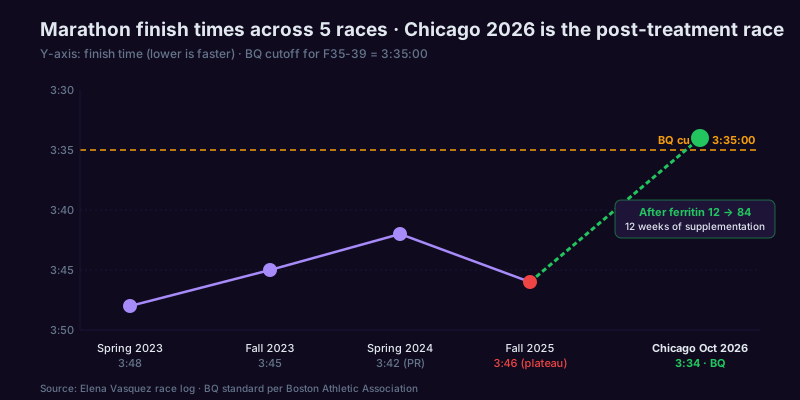
Chicago is a fast course. Net flat, a few gentle rises through the West Loop, the long straight south on State Street and back up Michigan. Elena went out at 8:10 pace through 10K, a touch faster than her goal. She hit the half in 1:46:30, the same effort that had won her a 1:48 in March. At mile 18 her watch said she was on for 3:33 and she didn't believe it. At mile 22, the part of the marathon where the wheels usually come off, the wheels did not come off. She negative-split the second half by 90 seconds.
She crossed the finish line on Columbus Drive in 3:34:11. Twenty-nine seconds under the Boston qualifying standard for her age group. Four minutes faster than the PR she set in better-fed, smarter-trained 2024.
Total time invested in the Copilotly side of the investigation: roughly six hours. Two hours of initial lab interpretation. One hour of protocol design. Two hours across the follow-up Q&A sessions with the Lab Results, Health, and Nutrition Copilots. One hour at the retest interpretation 12 weeks in. The supplement cost was $14 for a 90-day supply of ferrous bisglycinate.
The doctor's bill for the original visit and follow-up testing was $340 after insurance. The retest was another $180. The total medical cost of catching what the system had labeled "normal" was under $550, of which roughly $200 went to lab work she would not have ordered without the Copilot framing.
What she would do differently
Asked a month after the race what she would tell another runner stuck in the same plateau, Elena's first answer was about timing. She would not have waited until the breaking point. The clues had been in the January CBC - the borderline-low hemoglobin, the unusually low MCV that nobody had remarked on - and a Copilot pass on that panel in February would have caught the trajectory before the 11 months of broken training. The annual physical is, for an endurance athlete, an underused data source.
Her second answer was about advocacy. She had walked into the second clinic visit with a printed abstract, a list of specific markers to request, and a willingness to push back politely on "your labs are fine." Her doctor was, in the end, helpful. But she would not have gotten to a helpful conversation without the framework the Copilot gave her. Mayo Clinic's clinician-facing guidance on iron supplementation exists. Most primary care offices simply do not apply it through an athletic lens unless the patient asks.
Her third answer was about the broader pattern. The same interpretive gap - population norms applied to a context they were not built for - shows up in every domain where ordinary people are trying to make decisions with their own data. Elena had read the New Jersey SAT prep case study a month earlier and recognized the structure: a parent looking at test data the school had labeled "fine" and the Copilot finding the diagnostic signal underneath. She had read the Portland rent-vs-buy story and seen the same pattern again. Data exists. Interpretation, applied to your specific situation, is the missing piece.
What is next for Elena is Boston in April 2027. She is two weeks into a build cycle. Her ferritin is being monitored quarterly. She still uses the Nutrition Copilot weekly to plan iron-aware meals on heavy training days and the Fitness Copilot for the rare strength-training question. She took the Health Guide quiz in February and now uses it as a periodic check-in - new symptom, new question, same workflow. She also bookmarked the Lab Range Lookup tool for the next time a friend says their doctor told them their numbers were normal.
She is, she says, faster than she has ever been. She is also, for the first time in two years, not tired.
Every tool used in this story
What it added up to
Frequently asked questions
Is this a real customer or composite?
Did Copilotly diagnose or prescribe anything?
Why is ferritin 12 a problem if it is in the reference range?
Should I just start taking iron if I feel tired?
Elena did it once.
Now it's your turn.
The same copilots in this story are free to start with, on every device. Open Copilotly and ask the question you have been putting off.
Open Copilotly free