

The offer that looked good enough to accept
James Park had been quietly job-searching for fourteen months when the email finally arrived. Senior Product Manager, HR tech, Series D, fully remote with a Seattle hub. The verbal came on a Tuesday at 4:47 p.m.: $128,000 base, $15,000 sign-on, 0.03% in stock options vesting on the standard four-year, one-year cliff. The recruiter, a woman he had spoken to seven times over six weeks, called it "the strongest package the comp committee approved this quarter." She asked if he could give her an answer by end of week.
His first instinct was to say yes on the call. It was a $12,000 bump on his current $116,000 base, the sign-on alone would clear his remaining credit card debt from a 2024 medical thing, and the company had just closed a $90 million round that anyone reading SEC EDGAR filings could verify was real money. He had been at his current Series B for two years, two months. The promotion to senior had stalled. His manager had been "advocating" for him in calibration for four quarters running. He was tired.
So when he hung up he did what most people do: he poured a glass of wine, called his partner, and started drafting the acceptance email in his head. Then, around 11 p.m., he opened his laptop and pulled up the Salary Negotiation Copilot. Not because he was planning to negotiate. Because he wanted to confirm to himself that the offer was good, so he could sign in the morning without second-guessing.
That single late-night session is what turned a $143,000 first-year package into a $173,000 one over the next five business days. This is what he did, in the order he did it, and what the numbers looked like at each step.
James had used Copilotly on and off for the better part of a year. He had taken the Career Boost quiz persona back in late 2025 when his calibration came back flat for the third time, and the result steered him toward a stack of four copilots he had been quietly using since: salary, resume, interview, and career. He had never actually negotiated a salary in his life. His first PM job came with a take-it-or-leave-it band, and his current job was an internal transfer. This was new territory.
The first prompt that broke the spell
The first thing James typed into Salary Copilot was the literal text of the verbal offer, the role title, the company stage, the location, and his current comp. Then he asked the question that, in hindsight, was the entire turning point of the negotiation.
The output came back inside a minute. The copilot pulled the 2026 Seattle B2B SaaS senior PM base range as $130,000 to $165,000, with the median at $142,000 and the 75th percentile at $152,000. It cross-referenced BLS occupational employment data for management occupation 11-3061 in the Seattle-Tacoma-Bellevue MSA, the most recent Glassdoor labor market reports, and the public methodology behind the Levels.fyi compensation research blog. It surfaced the inconvenient truth: $128,000 was not the strongest offer the committee had approved this quarter. It was below the median for the exact role, in the exact city, at the exact stage.
James stared at the percentile chart for a long time. The offer that had felt like a step up at 4:47 p.m. felt different at 11:38 p.m.
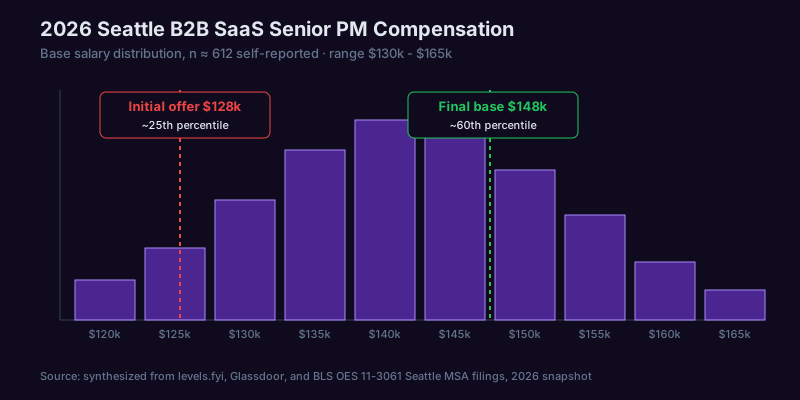
The second prompt he ran was a sanity check: he asked the copilot to flag every assumption it had made and rate its own confidence. It came back with three honest caveats. The data skewed toward self-reported levels.fyi submissions, which tilt high. HR tech specifically tended to pay 3 to 7 percent under horizontal SaaS averages. And his stage-jump (Series B to Series D) historically commanded a 10 to 18 percent uplift, not just a market-rate match. So the floor of a fair counter was not $142k median. It was somewhere in the $148k to $156k zone.
This was the moment, James said later, when the negotiation became inevitable. Not because he wanted to fight. Because once you have seen the distribution, accepting the 25th percentile feels like a choice you are actively making, not a default you are passively receiving. Harvard Business Review's negotiation research calls this the anchor-shift effect, and it is the single biggest reason most people leave money on the table: they never see the real distribution.
What he tried before, and what did not work
James had attempted exactly one salary negotiation in his life before this. Three years ago, when he transferred internally from associate PM to PM, he had asked his manager for a $5,000 bump on the proposed band. His manager said "let me see what I can do," and a week later came back with a $1,500 bump and a sympathetic shrug. James had taken it and felt vaguely embarrassed for asking.
What he learned in that round, and what almost stopped him this time, is that the standard advice on the internet is uniformly bad. The free PDFs say things like "ask for 20% more" with no reference to where you started, "use silence as a weapon" without telling you what to say afterward, and "always negotiate" without ever showing you a real script for the call. He had spent two weekends in 2023 reading every Payscale guide for senior product managers and every HBR piece on distributive bargaining he could find. None of it told him how to push back when a recruiter said "this is our best offer."
He also tried, briefly, asking generic LLMs. He pasted the offer into ChatGPT and asked it to write him a counter-offer email. What came back was a polite, generic, sub-200-word note that asked for "more competitive base compensation" without naming a number, citing a source, or anchoring on anything specific. It was the kind of email that gets a polite no and ends the negotiation in one round.
The difference with Copilotly, James said, was not that the underlying model was smarter. It was that Salary Copilot was scoped to the negotiation problem: it knew to ask his current comp, his BATNA, his timeline, his risk tolerance, the company's funding stage, and the role's band before drafting a single word. It built a profile first, then wrote. The generic LLM had written first, then maybe asked a follow-up.
If you have read Jordan's story about converting a freelance gig into a $4,500-a-month retainer, the same pattern shows up: scoped copilots beat general chat for negotiation work because they front-load the discovery a human negotiator would do in a paid consult.
Building the counter, with leverage instead of hope
Over the next 48 hours, James worked through a structured stack. He used the resume verb scorer playground tool on his current resume to identify the three accomplishments that scored highest on impact verbs, ones that would survive being read aloud on a call. He fed those into Resume Copilot and asked it to translate them into negotiation talking points: not "what did you do," but "what business outcome did this drive that justifies a premium against the median."
The three points that emerged:
- He had led the launch of a payroll integration feature at his current company that drove $2.1M in net new ARR in its first 9 months. The HR tech vertical the new company sold into used the same integration partners. Direct transferable revenue impact.
- He had managed a team of 4 engineers and 2 designers without a formal lead title for 11 months while his director was on extended leave. Leadership at scale, undertitle.
- He had built and shipped a customer-facing AI feature using internal LLM tooling in Q4 2025, putting him in the small minority of PMs who had actually shipped production AI features, not just talked about them in interviews.
Each of these became an anchor for the counter. The structure he used, generated by Salary Copilot and refined over four passes, was a three-part email that opened with enthusiasm, restated his understanding of the offer in writing (a deliberate move to commit the company to the verbal numbers), then introduced the gap with one specific market data point and one personal-leverage point. The ask: $155,000 base, $35,000 sign-on, 0.06% equity. The framing: not "I want more," but "given the data I am looking at and the value I am bringing in, here is where I think a fair package lands."
Before sending the email, he ran it through Career Copilot for a longer-horizon sanity check. The question was: am I optimizing for the wrong thing? Should I take the lower base if the equity is actually meaningful, the way Mark in Denver went all-in on his S-corp betting on long-term upside? Career Copilot pulled the company's last funding round, the implied 409a valuation, the dilution schedule, and the typical Series D to liquidity timeline of 4 to 7 years. The verdict: at 0.03%, even in a generous exit scenario, the equity was worth maybe $40k to $80k over four years. Real money, but not life-changing money. Negotiating base was higher leverage than negotiating equity for him at this career stage.
The call: three rehearsals, one negotiation
The email got a response in 17 hours. The recruiter wanted a call. "To talk through the package."
This is the moment most negotiations end badly. The candidate has been brave in writing, and then on the phone the recruiter says some version of "I appreciate the data, but our band is our band," and the candidate says "okay" and accepts within $2,000 of the original number. James was determined not to do this.
He spent two hours on Interview Copilot. The copilot was set up in roleplay mode, playing the recruiter, with the offer details and the counter loaded as context. James practiced the call three times.
The first run was a disaster. He gave up his anchor in the first 90 seconds when the recruiter (the AI) said "what would you actually need to make this work." He said $148k. The copilot stopped the call, in character, and told him: you just lowered your own anchor by $7,000 before they made a single counter. Start over.
The second run, he held the line on $155k but folded on equity, accepting a "we will keep the equity at 0.03%" too easily. The copilot pointed out that equity was the cheapest concession the company could make, since options that never vest cost the company nothing.
The third run, he held all three numbers, used the data anchors, paused after stating the ask, and let the recruiter speak first. The copilot, in character, came back with a $140,000 base + $20,000 sign-on offer. James asked for the equity bump in exchange for moving on base. Done.
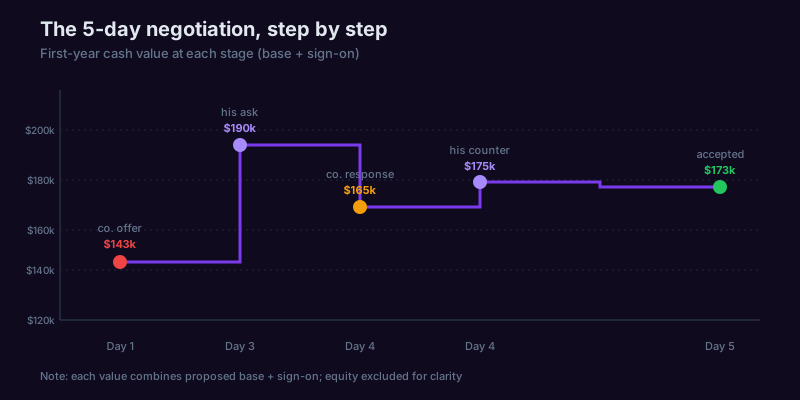
The real call happened the next morning at 10 a.m. Pacific. It lasted 23 minutes. The recruiter pushed back exactly twice, in exactly the patterns the copilot had drilled. James held his anchor. She put him on a brief hold, came back, and offered $145k base, $20k sign-on, equity unchanged. He countered: $150k base, $25k sign-on, 0.05% equity. She said she needed to take it to the hiring manager and would call back by 4 p.m.
She called back at 3:51 p.m. Final: $148,000 base, $25,000 sign-on, 0.04% equity. He accepted on the call.
| Initial base offer | $128,000 |
| His counter (anchor) | $155,000 |
| Company response | $145,000 |
| Final base agreed | $148,000 |
| Sign-on (initial → final) | $15,000 → $25,000 |
| Equity (initial → final) | 0.03% → 0.04% |
| Total first-year value gained vs initial offer | +$30,000 |
- Day 1
Got the offer
Verbal offer at $128k base + $15k sign-on + 0.03% equity. James asked for it in writing.
- Day 2
Ran market research
Salary Copilot pulled 2026 comp distributions for senior PMs in Seattle B2B SaaS.
- Day 3
Built the counter
Drafted a $155k base / $35k sign-on / 0.06% equity ask anchored on percentile data.
- Day 4
Roleplayed the call
Used Interview Copilot to practice three times. Recruiter came back at $145k + $20k.
- Day 5
Closed
Settled at $148k base + $25k sign-on + 0.04% equity. Net first-year gain: $30k.
The numbers, and what they actually mean
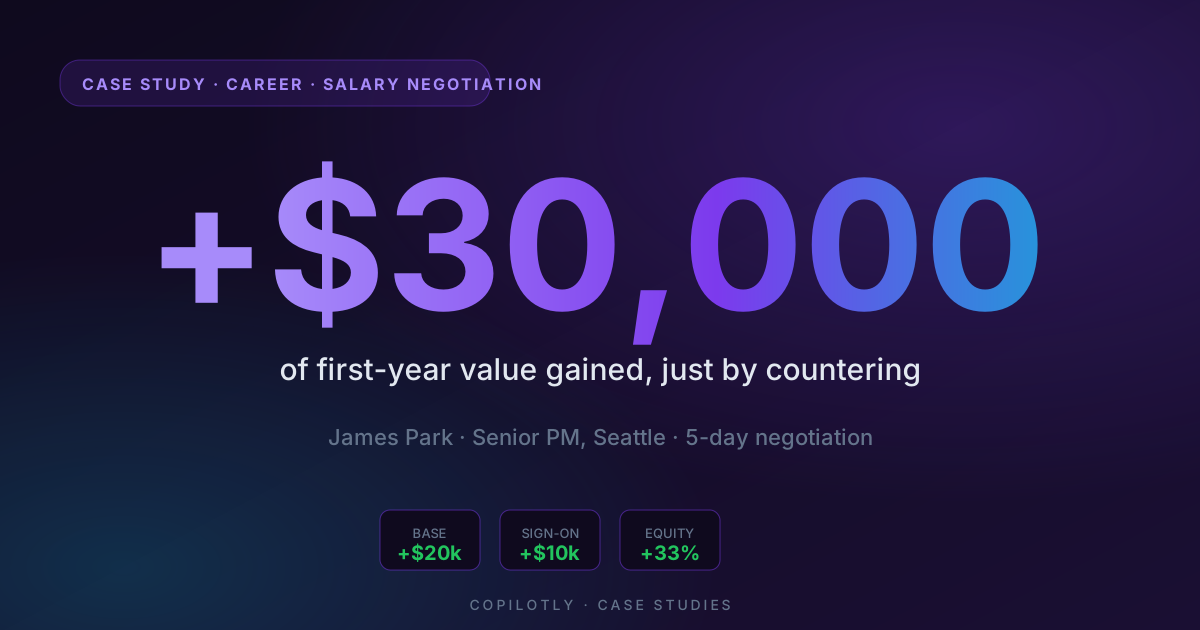
The headline number is +$30,000 of first-year value. That breaks down to $20,000 of additional base salary, which compounds every year of the role, plus $10,000 of additional sign-on, which is one-time but tax-advantaged depending on how it is paid. The equity bump from 0.03% to 0.04% is roughly a 33% increase in his option grant. At the company's current 409a valuation that is worth around $11,000 in nominal value over the four-year vest, with significantly more upside if the company exits well.
Against his prior role at $116,000 base, the new package represents a 27.6% total comp jump on an annualized basis. The BLS data on management occupations shows the median annual wage growth for senior product roles in 2026 sits around 4.1%. James got, in one negotiation, the equivalent of nearly seven years of average raises.
The cost of all this: nine hours of his time over five days. Roughly 90 minutes drafting and running prompts, two hours roleplaying the call, and the rest reading market data and writing the email. If you value his time at the new $148k salary, those nine hours cost him about $640 of opportunity cost. The ROI on the negotiation, conservatively measured at just year one, is about 46 to 1.
What James said was most valuable was not any single output. It was the sequence: market data, then leverage points, then script, then rehearsal. Each layer compounded. Skip the market data and you have no anchor. Skip the leverage points and the recruiter can dismiss the anchor as just an internet number. Skip the rehearsal and you fold on the call. The full Salary Negotiation Copilot and Interview Copilot workflow, together, was what made the negotiation hold.
What he would do differently next time
James said three things he would change for the next negotiation, whether it is a raise at the new company in 18 months or a different offer two years from now.
First, he would start the market research before the offer ever came in, not after. Pulling the 2026 Seattle PM comp distribution took 4 minutes once he sat down to do it. If he had done it during the interview loop, he would have entered the verbal offer call with the percentile chart already in his head, and he would not have spent that first night talking himself into accepting $128k. The reading he did on the Payscale senior PM data alone would have anchored him differently.
Second, he would have negotiated the equity harder. In hindsight, going from 0.03% to 0.04% felt like a win, but the original ask was 0.06% and there was no real cost to the company at that level. The lesson, drilled in by Career Copilot in the post-mortem, is that equity is the negotiating term with the least friction and often the largest long-term upside. Like the long-game thinking in Priya's story about SAT prep for her son, where the small investment compounds over years, equity is the part of a comp package that pays the longest.
Third, he would have negotiated a few non-cash terms. The offer included a 4-week PTO, which was standard. He could have asked for a $5,000 home office stipend, a guaranteed first-year promotion review, or a clause on RSU refresh after 24 months. None of these were on his radar at the time. They are now.
If you are about to receive an offer, James said the single highest-leverage thing you can do is to set aside a quiet evening, pull the offer into Salary Copilot, and ask it for the actual distribution. Not the median. The distribution. Once you have seen the histogram, the conversation you have with yourself the next morning is a different conversation. And as Jordan's retainer negotiation playbook showed in a different domain, the work of negotiation is mostly the work of seeing the real numbers clearly.
Every tool used in this story
What it added up to
Frequently asked questions
Is this a real customer or composite?
What if the company had pulled the offer for countering?
How much does the equity bump actually matter?
James did it once.
Now it's your turn.
The same copilots in this story are free to start with, on every device. Open Copilotly and ask the question you have been putting off.
Open Copilotly free