
Step 1: Assess Your Financial Readiness Before You Start Looking
Before you browse a single listing or talk to a real estate agent, you need an honest assessment of your financial position. The biggest mistake first-time buyers make is falling in love with a house before knowing what they can actually afford. Start with these four numbers that determine everything.
Your Credit Score
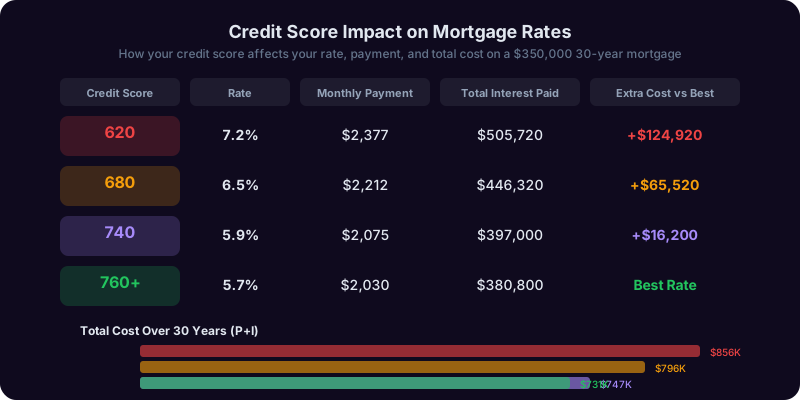
Your credit score is the single most important number in the home buying process. It determines whether you qualify for a mortgage, which loan programs are available to you, and what interest rate you will pay. In 2026, here is what each score range means for home buying:
| FICO Score | Loan Options | Estimated Rate (30-yr Fixed) | Monthly Payment ($350K Home, 10% Down) |
| 760+ | All programs, best terms | 5.65% | $1,822 |
| 720-759 | All programs, competitive terms | 5.90% | $1,870 |
| 700-719 | All programs | 6.15% | $1,918 |
| 680-699 | Most programs | 6.45% | $1,977 |
| 660-679 | Conventional with higher PMI, FHA | 6.80% | $2,047 |
| 620-659 | Limited conventional, FHA | 7.25% | $2,138 |
| 580-619 | FHA only (3.5% down) | 7.50%+ | $2,189+ |
The difference between a 760 and a 620 score on a $315,000 mortgage (the loan amount after 10% down on a $350,000 home) is $316 per month and more than $113,760 in total interest over 30 years. If your score is below 720, spending 3-6 months improving it before applying can save you tens of thousands of dollars. Our complete credit score guide explains exactly how to raise your score quickly.
Your Debt-to-Income Ratio
Lenders use your DTI ratio to determine how much house you can afford. Calculate it by dividing your total monthly debt payments (student loans, car payment, credit card minimums, personal loans) by your gross monthly income. Most lenders want your total DTI (including the new mortgage) under 43%, and under 36% for the best rates.
Example: If you earn $7,500/month gross and have $500 in monthly debt payments, your current DTI is 6.7%. A $2,100 mortgage payment would bring your total DTI to 34.7%, which is within the ideal range. But if you have $1,200 in existing debts, that same mortgage pushes your DTI to 44%, which may trigger a denial or higher rate.
Your Savings Position
You need three separate pools of money to buy a home:
- Down payment: 3-20% of the purchase price ($10,500-$70,000 on a $350,000 home)
- Closing costs: 2-5% of the purchase price ($7,000-$17,500)
- Cash reserves: 2-6 months of mortgage payments in savings after closing ($4,000-$12,600)
Many first-time buyers drain their savings for the down payment and arrive at closing with nothing left. This is dangerous. Homeownership comes with immediate unexpected costs: the water heater fails, the dishwasher leaks, the HVAC needs repair. You need a buffer. The Finance Copilot can help you build a personalized savings plan that accounts for all three pools.
Your Employment Stability
Lenders want to see at least two years of stable employment history. This does not mean you need to stay at the same job for two years, but you need to show consistent income in the same field. Job-hopping with salary increases is fine. Changing careers six months before applying for a mortgage is not. If you are self-employed, you will need two years of tax returns showing consistent or growing income.
Step 2: Choose the Right Mortgage Type for Your Situation
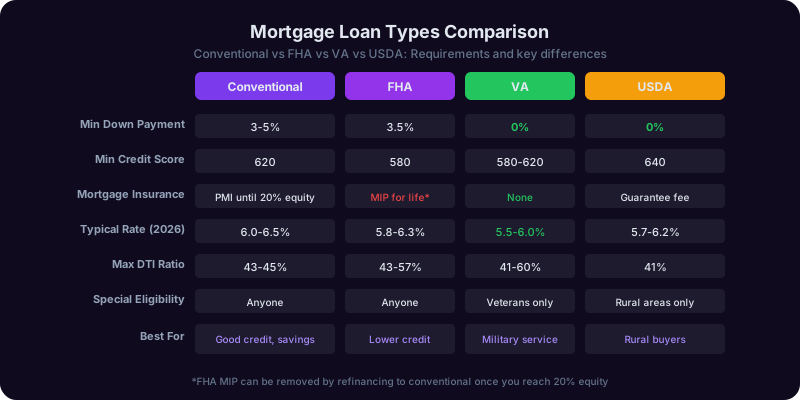
First-time buyers have more loan options than they realize, and choosing the wrong one can cost thousands in unnecessary fees and insurance premiums. Here is an honest comparison of every major mortgage type available in 2026, with real numbers based on a $350,000 home purchase.
Conventional Loans
Conventional loans are not backed by a government agency and are the most common mortgage type. In 2026, they offer:
- Down payment: As low as 3% ($10,500 on a $350,000 home) through Fannie Mae's HomeReady or Freddie Mac's Home Possible programs
- Credit score minimum: 620, but you need 740+ for the best rates
- PMI: Required if you put less than 20% down. Costs 0.3-1.5% of the loan annually ($945-$5,040/year on a $315,000 loan). PMI is removable once you reach 20% equity.
- Average rate (mid-2026): 5.90% for well-qualified borrowers
Conventional loans are best for buyers with credit scores above 700 and at least 5% down. The ability to remove PMI later is a significant advantage over FHA loans.
FHA Loans
FHA loans are insured by the Federal Housing Administration and are designed for buyers with lower credit scores or smaller down payments:
- Down payment: 3.5% with a 580+ credit score ($12,250 on $350,000). 10% with a 500-579 score.
- Credit score minimum: 500 (with 10% down) or 580 (with 3.5% down)
- Mortgage insurance premium (MIP): 1.75% upfront ($5,512 on a $337,750 loan, usually rolled into the loan balance) plus 0.55% annually ($1,858/year). Unlike conventional PMI, FHA MIP never goes away for the life of the loan if you put less than 10% down.
- Average rate (mid-2026): 5.65-6.15%
The permanent MIP is the hidden cost of FHA loans. On a $337,750 loan, you will pay approximately $55,800 in total MIP over 30 years. This makes FHA loans more expensive long-term than conventional loans for buyers who could qualify for either. However, if your credit score is below 680 or you cannot manage more than 3.5% down, FHA may be your best entry point. You can always refinance into a conventional loan once your credit and equity improve.
VA Loans
VA loans are available to veterans, active-duty military, National Guard members, and eligible surviving spouses. They are the best mortgage product available in the United States:
- Down payment: 0% required
- Credit score minimum: No VA-mandated minimum, but most lenders require 620+
- PMI/MIP: None. VA loans do not require any mortgage insurance.
- Funding fee: 1.25-3.3% of the loan amount (can be rolled into the loan). Waived for disabled veterans.
- Average rate (mid-2026): 5.40-5.80%, typically the lowest available rates
If you are eligible for a VA loan, there is almost no scenario where another loan type is better. Zero down, no PMI, and the lowest rates available. Check your eligibility at VA.gov.
USDA Loans
USDA loans are designed for moderate-income buyers in eligible rural and suburban areas. You might be surprised by what qualifies as "rural" -- many suburbs and small cities are eligible:
- Down payment: 0% required
- Credit score minimum: 640 (most lenders)
- Guarantee fee: 1% upfront plus 0.35% annually (much cheaper than FHA MIP)
- Income limits: Cannot exceed 115% of the area median income
- Average rate (mid-2026): 5.65-6.10%
Check property eligibility at the USDA Rural Development website. Many buyers in suburban areas overlook USDA loans and miss out on zero-down financing with low insurance costs.
State and Local First-Time Buyer Programs
Nearly every state offers first-time home buyer assistance programs that provide down payment grants, forgivable loans, or below-market interest rates. These programs are dramatically underused. The HUD website maintains a directory of programs by state. We cover the major ones in a later section of this guide.
Step 3: Get Pre-Approved (Not Just Pre-Qualified)
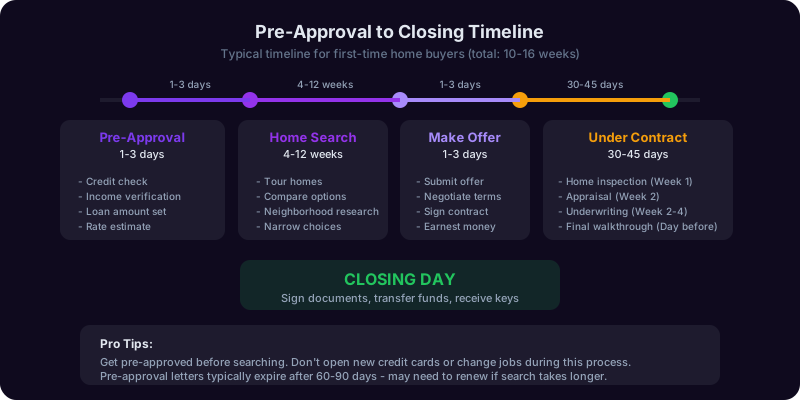
Pre-approval is the most important step you take before house hunting. It tells you exactly how much you can borrow, it signals to sellers that you are a serious buyer, and it uncovers potential problems early enough to fix them. Here is the complete process.
Pre-Qualification vs. Pre-Approval
These are not the same thing, and confusing them is a costly mistake:
| Feature | Pre-Qualification | Pre-Approval |
| Credit check | No (self-reported) | Yes (hard pull) |
| Income verification | No | Yes (pay stubs, W-2s, tax returns) |
| Asset verification | No | Yes (bank statements) |
| Time to complete | 10-30 minutes | 1-3 business days |
| Validity period | N/A | 60-90 days typically |
| Seller confidence | Minimal | High |
| Accuracy of amount | Rough estimate | Lender-committed amount |
A pre-qualification letter in a competitive market is essentially worthless. Sellers with multiple offers will choose the buyer with a verified pre-approval every time. Get pre-approved before you start touring homes.
Documents You Need for Pre-Approval
Gather these before contacting a lender to speed up the process:
- Photo ID (driver's license or passport)
- Social Security number
- Pay stubs from the last 30 days
- W-2 forms from the last two years
- Federal tax returns from the last two years (all schedules)
- Bank statements from the last two to three months (all accounts)
- Investment and retirement account statements
- Proof of additional income (rental income, alimony, child support)
- Gift letters if any of your down payment comes from family
- Landlord contact information for rental verification
Shop Multiple Lenders in a 14-Day Window
This is non-negotiable. The Consumer Financial Protection Bureau found that borrowers who compare five or more lenders save an average of $3,000-$5,000 over the life of the loan. FICO treats all mortgage inquiries within a 14-day window as a single credit pull, so there is zero credit score penalty for shopping aggressively.
Apply to at least these four types of lenders:
- A large national bank (Chase, Bank of America, Wells Fargo)
- A credit union (often the lowest rates and fees)
- An online mortgage lender (Rocket Mortgage, Better, SoFi)
- A local mortgage broker (shops wholesale rates across 20+ lenders)
Within three business days of each application, you will receive a Loan Estimate (a standardized three-page document). Compare these side by side. Focus on the APR (which includes fees, not just the interest rate), origination charges, and third-party fees. The lender with the lowest advertised rate may not have the lowest total cost once fees are included.
What Your Pre-Approval Amount Really Means
Here is something no lender will tell you: the amount you are pre-approved for is almost always more than you should actually spend. Lenders approve based on the maximum DTI ratios they accept (often 43-50%), but financial experts recommend keeping your housing costs below 28% of gross income.
If you earn $90,000/year ($7,500/month gross), a lender might approve you for a $420,000 mortgage. But at 5.9% interest, that payment would be about $2,490 for principal and interest alone. Add taxes, insurance, and PMI, and you are looking at $3,200-$3,500/month, which is 43-47% of your gross income. A more comfortable target is $2,100/month total housing cost (28% of gross), which translates to a purchase price of roughly $300,000-$330,000. The Finance Copilot can help you calculate a purchase budget based on your complete financial picture, not just what a lender will approve.

Get Answers From the Tax Copilot
Ask a specialist AI copilot the question you just read about. Your first conversation needs no signup and no card.
Step 4: House Hunting Strategies That Actually Work in 2026
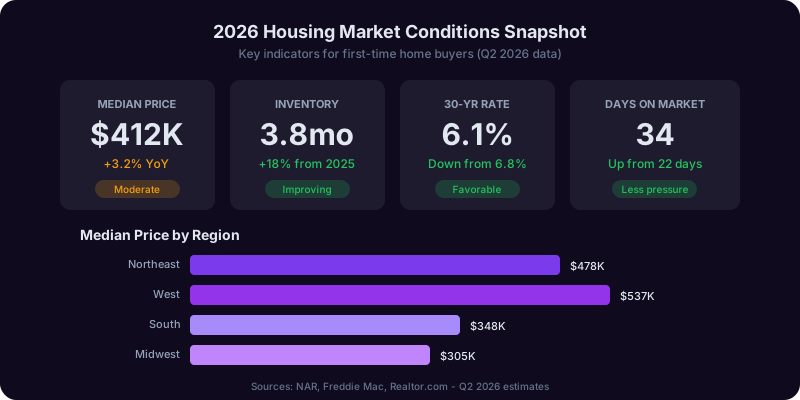
House hunting in 2026 looks different than it did even two years ago. Inventory has improved from the extreme shortages of 2021-2023, with the National Association of Realtors reporting 3.8 months of housing supply nationally as of early 2026, up from 1.6 months at the 2022 low. But desirable homes in good locations still move fast, and you need a strategy beyond scrolling Zillow on your couch.
The 2026 Housing Market Reality
Here is what first-time buyers are facing right now:
- Median home price: $412,000 nationally (up 4.2% year-over-year)
- Average 30-year fixed rate: 5.9% (down from 7.5% peaks in late 2023)
- Days on market (median): 34 days nationally, but as low as 8-14 days in competitive markets
- Inventory: Improving but still below the 5-6 month supply considered a balanced market
- First-time buyer share: 31% of all purchases, slightly below the historical average of 34%
Define Your Must-Haves vs. Nice-to-Haves
Before you tour a single home, create two lists. Your must-haves are non-negotiable: minimum bedroom count, maximum commute time, school district, yard for the dog. Your nice-to-haves are preferences you can compromise on: updated kitchen, garage, specific architectural style, finished basement. First-time buyers who skip this exercise waste weeks touring homes that do not meet their core needs or overpay for features they do not actually need.
Be brutally honest about which list each item belongs on. A lot of buyers say an updated kitchen is a must-have until they realize it costs them $80,000 in purchase price. A functional kitchen you renovate later is a much better financial decision than paying a premium for someone else's design choices.
Location Research Beyond the Listing
A listing tells you about the house. It tells you almost nothing about living there. Research these factors independently:
- Commute times: Drive the actual route during rush hour on a weekday. GPS estimates are optimistic.
- School ratings: Even if you do not have kids, school district quality directly affects resale value. Homes in top-rated districts hold value better in downturns.
- Property tax rates: These vary dramatically even within the same county. A house three blocks over the municipal line may have property taxes that differ by $2,000/year.
- Future development: Check the city's planning department website for zoned developments. That quiet lot behind the house may become a 200-unit apartment complex in two years.
- Crime statistics: Use local police department data, not just neighborhood marketing websites.
- Flood zone status: Check FEMA flood maps. Flood insurance can add $888-$10,000/year to your costs.
Working With a Buyer's Agent
In most markets, the seller pays the buyer's agent commission (typically 2.5-3% of the sale price). This means having professional representation costs you nothing directly. A good buyer's agent provides:
- Access to MLS listings before they hit public websites
- Comparable sales data to inform your offer price
- Negotiation experience with hundreds of transactions
- Contractor, inspector, and lender referrals
- Contract review and deadline management
Interview at least three agents. Ask how many first-time buyers they have worked with in the past year, how many transactions they closed, and what their average list-to-sale price ratio is for buyers. An agent who consistently gets homes at 97-98% of asking price is saving you real money compared to one whose buyers routinely pay 101-103%.
Off-Market and New Construction Options
Not every home is listed on the MLS. Consider these alternatives:
- New construction: Builders often offer incentives to first-time buyers including rate buydowns (the builder pays to reduce your interest rate for the first 1-3 years), closing cost assistance, and upgrade packages. In 2026, many builders are offering 2-1 buydowns that start your rate 2% below market in year one and 1% below in year two.
- FSBO (For Sale By Owner): Roughly 7% of homes sell without an agent. These sellers are often more willing to negotiate because they are saving on commission.
- Off-market networking: Tell everyone you know you are looking. Some of the best deals come from homeowners who have not listed yet but are considering selling.
The Home Copilot can help you evaluate neighborhoods, compare properties, and organize your house hunting process with structured checklists for each viewing.
Step 5: Making a Competitive Offer and Negotiating Effectively
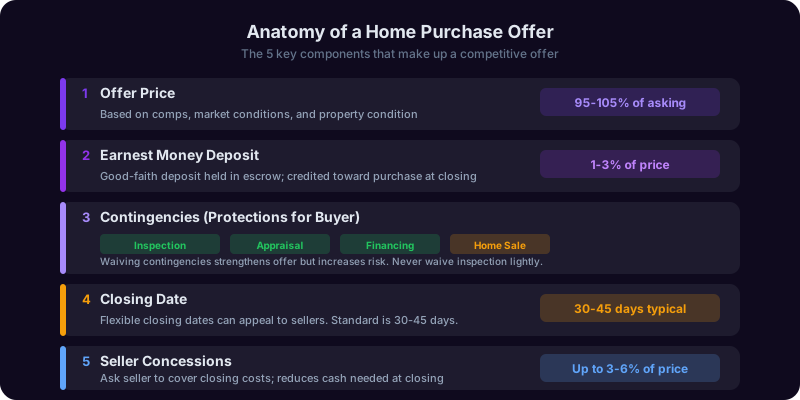
You have found the house. Now you need to structure an offer that wins the deal without overpaying. The offer is not just about price -- it is a package of terms that the seller evaluates holistically. Here is how to build a competitive offer in the 2026 market.
Determine Your Offer Price
Your offer price should be based on data, not emotion. Pull comparable sales (comps) from the last 3-6 months for similar homes in the same neighborhood. Your real estate agent should provide a Comparative Market Analysis (CMA) that includes:
- Homes within 0.5-1 mile with similar square footage (within 10%), bedroom/bathroom count, and lot size
- Days on market for each comp
- List price vs. sale price ratio (tells you whether homes are selling above or below asking)
- Active listings (your competition as a buyer)
If comparable homes sold for $340,000-$360,000 and the home you want is listed at $365,000, offering $355,000-$360,000 is data-supported. Offering $385,000 because you "really love it" is emotional, and emotions are expensive in real estate.
Earnest Money Deposit
Your earnest money deposit (EMD) shows the seller you are serious. It typically ranges from 1-3% of the purchase price ($3,500-$10,500 on a $350,000 home). In competitive markets, a larger EMD strengthens your offer. This money is held in escrow and credited toward your down payment or closing costs at closing. You get it back if the deal falls through under a valid contingency. You lose it if you back out for a reason not covered by your contingencies.
Contingencies: Your Safety Net
Contingencies are conditions that must be met for the sale to proceed. The three standard contingencies are:
| Contingency | What It Protects | Risk of Waiving |
| Inspection | Right to renegotiate or withdraw based on property condition | You inherit every hidden problem: foundation cracks, mold, roof failure, plumbing issues |
| Appraisal | Right to renegotiate if the home appraises below your offer price | You must cover the gap between appraised value and offer price with cash |
| Financing | Protects your EMD if your mortgage falls through | You could lose $3,500-$10,500+ in earnest money if you cannot close |
In the 2026 market, do not waive the inspection contingency. Full stop. If you want to make your offer more competitive, shorten the inspection period to 5-7 days instead of the standard 10-14, or include an "as-is" clause that limits repair requests to issues exceeding a specific dollar threshold (for example, $5,000). This shows flexibility without eliminating your protection.
Seller Concessions: The Cash You Might Be Leaving on the Table
Seller concessions are contributions from the seller toward your closing costs. In a balanced or buyer-friendly market, you can often negotiate 2-6% of the purchase price in concessions depending on your loan type:
- Conventional (less than 10% down): Up to 3% ($10,500 on $350,000)
- Conventional (10-25% down): Up to 6% ($21,000)
- FHA: Up to 6% ($21,000)
- VA: Up to 4% ($14,000)
Instead of negotiating $15,000 off the purchase price, ask for $10,000 in seller concessions. The price reduction saves you approximately $50/month on your mortgage. The concession keeps $10,000 in your bank account right now. For a cash-strapped first-time buyer, the concession is almost always more valuable.
Escalation Clauses
An escalation clause automatically increases your offer by a set amount over competing bids, up to a maximum cap. Example: "I offer $350,000 and will escalate by $2,000 above any verifiable competing offer up to $370,000." This prevents you from overbidding when there is no competition while staying competitive when there is. Set your cap based on comps and your budget, and do not exceed it. The seller must provide proof of the competing offer that triggered the escalation.
Closing Timeline as a Negotiating Tool
Sellers care about timing. A seller who has already purchased their next home wants a fast closing (21-30 days). A seller who has not found their next home may want a longer closing (45-60 days) or a rent-back agreement where they stay in the home for 30-60 days after closing. Matching your timeline to the seller's preference can be more persuasive than adding $5,000 to your offer price. Ask the listing agent what the seller's ideal timeline is before you submit.
Step 6: Inspections, Appraisals, and the Complete Closing Cost Breakdown
Your offer is accepted. Now the clock starts ticking on inspections, appraisals, and the mountain of costs that accumulate between contract signing and closing day. Understanding every cost and deadline prevents surprises that derail deals.
Home Inspection: What to Expect
A standard home inspection costs $400-$600 and takes 2-4 hours depending on the size of the home. The inspector evaluates the roof, foundation, electrical system, plumbing, HVAC, insulation, windows, and visible structural components. However, a standard inspection does not cover sewer lines, radon, mold, pests, or detailed roof condition. Budget an additional $500-$1,500 for specialty inspections based on the property.
After the inspection, you typically have three options:
- Request repairs: Ask the seller to fix specific issues before closing
- Request a credit: Ask for a dollar amount off the price or as a closing credit (usually the better option since you control the quality of repairs)
- Walk away: Exercise your inspection contingency and get your earnest money back
For a deeper dive into inspection red flags, our guide on first-time buyer mistakes covers the specialty inspections that protect you from five-figure repair bills.
The Appraisal: What Happens If the Home Is Worth Less Than Your Offer
Your lender orders an appraisal to verify the home is worth what you are paying. The appraisal costs $400-$700 and is paid by you but ordered by the lender. If the appraisal comes in at or above your offer price, you proceed normally. If it comes in below, you have several options:
- Renegotiate the price down to the appraised value
- Pay the difference in cash (the "appraisal gap")
- Split the difference with the seller
- Request a reconsideration of value with additional comparable sales data
- Walk away under your appraisal contingency
Appraisal gaps are common in competitive markets where buyers bid above asking. If you offered $365,000 and the appraisal comes in at $350,000, your lender will only lend based on the $350,000 value. You would need an additional $15,000 in cash to proceed at the original price.
Complete Closing Cost Breakdown
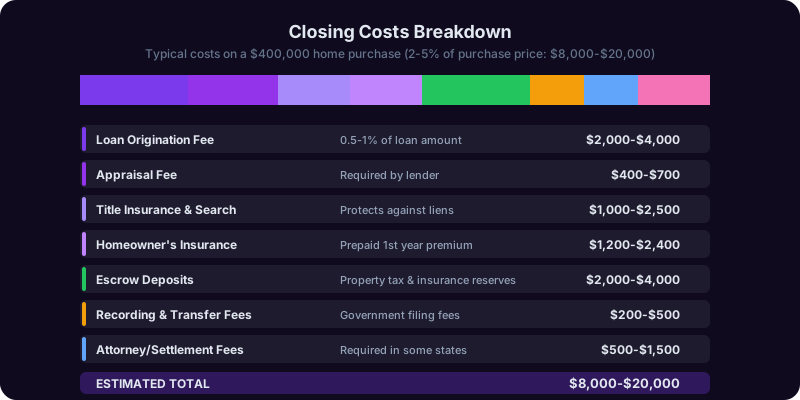
Closing costs on a $350,000 home typically range from $10,500-$17,500 (3-5% of purchase price). Here is where every dollar goes:
| Fee Category | Typical Cost | Negotiable? |
| Loan origination fee | $1,575-$3,150 (0.5-1% of loan) | Yes -- shop lenders |
| Appraisal | $400-$700 | No |
| Credit report | $30-$50 | No |
| Title search and insurance | $1,500-$3,500 | Partially -- shop title companies |
| Attorney fees (required in some states) | $500-$1,500 | Yes -- shop attorneys |
| Recording fees | $50-$250 | No -- set by county |
| Transfer taxes | $0-$7,000+ | No -- set by state/county |
| Prepaid interest | $500-$2,000 | No -- but closing at end of month minimizes this |
| Homeowners insurance (1 year prepaid) | $1,200-$3,600 | Yes -- shop insurers |
| Property tax escrow (2-6 months) | $1,000-$4,000 | No |
| Insurance escrow (2-3 months) | $300-$900 | No |
| PMI (first month, if applicable) | $80-$420 | No |
How to Reduce Closing Costs
First-time buyers have several strategies to reduce closing costs:
- Negotiate seller concessions (2-6% depending on loan type)
- Ask about lender credits: Some lenders offer credits toward closing costs in exchange for a slightly higher rate. Worth it if you plan to refinance within 5 years.
- Close at the end of the month: This minimizes prepaid interest charges.
- Shop title insurance: You are not required to use the title company your lender or agent recommends. Get at least two quotes.
- Apply for down payment assistance programs: Many also cover closing costs (covered in the next section).
Step 7: First-Time Buyer Programs and Down Payment Assistance You Might Be Missing
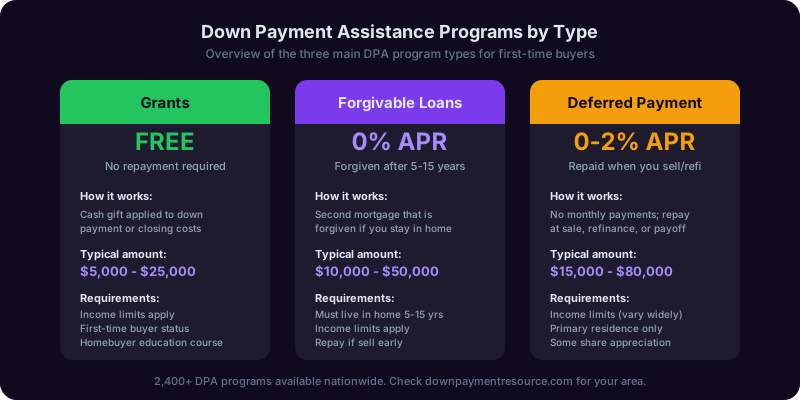
There are over 2,400 down payment assistance (DPA) programs available across the United States, and the vast majority of first-time buyers never apply for any of them. These programs provide grants (free money), forgivable loans (loans that disappear after 5-15 years of living in the home), and below-market interest rates. According to the Fannie Mae National Housing Survey, roughly 40% of first-time buyers who could have qualified for assistance did not even know these programs existed.
Federal Programs
- FHA Loans (3.5% down): Already covered above, but worth repeating: the FHA program is itself a form of first-time buyer assistance by allowing lower down payments and credit scores.
- Good Neighbor Next Door (HUD): Offers 50% off the list price for law enforcement officers, teachers, firefighters, and EMTs purchasing HUD-owned homes in designated revitalization areas. The discount is provided as a "silent second" that requires a 3-year residency commitment.
- HomePath Ready Buyer (Fannie Mae): Provides up to 3% in closing cost assistance on Fannie Mae-owned foreclosed properties. Requires a homebuyer education course.
- National Homebuyers Fund: Offers up to 5% of the loan amount in down payment assistance as a forgivable grant. Works with FHA, VA, USDA, and conventional loans.
State Programs: Highlights by Region
Every state runs its own housing finance agency with first-time buyer programs. Here are some of the strongest programs available in 2026:
| State | Program | Assistance Amount | Type |
| California | CalHFA MyHome | Up to 3.5% of purchase price | Deferred-payment junior loan |
| Texas | My First Texas Home | Up to 5% of loan amount | 30-year deferred forgivable loan |
| Florida | Florida Assist | Up to $10,000 | 0% interest deferred second mortgage |
| New York | SONYMA Down Payment Assistance | Up to $15,000 (or $30,000 in NYC) | Forgivable after 10 years |
| Illinois | IHDA Access Forgivable | Up to $6,000 | Forgivable after 10 years |
| Georgia | Georgia Dream | Up to $10,000 | 0% deferred second mortgage |
| Virginia | VHDA Down Payment Grant | Up to 2-2.5% of purchase price | Grant (no repayment) |
| Colorado | CHFA Down Payment Assistance | Up to 3% of first mortgage | Non-repayable grant |
| Washington | Home Advantage DPA | Up to 4% of loan amount | 0% deferred second mortgage |
| North Carolina | NC Home Advantage | Up to 3% of loan amount | Forgivable after 15 years |
Who Qualifies as a "First-Time Buyer"?
The definition is more generous than you think. For most programs, a first-time buyer is anyone who has not owned a home in the past three years. This means:
- You owned a home 4+ years ago and sold it -- you qualify
- You owned a home with a former spouse but are now divorced -- you may qualify
- You owned a mobile home that was not permanently affixed -- you may qualify
Income Limits and How to Check
Most DPA programs have income limits based on the Area Median Income (AMI) for your county. Common thresholds are 80% AMI for grant programs and 115% AMI for loan programs. In a metropolitan area where the median household income is $85,000, the 115% threshold would be $97,750. A household earning under that amount qualifies. Check your county's limits at the HUD income limits page.
The Mortgage Credit Certificate (MCC)
The MCC is one of the most valuable and least-known first-time buyer benefits. It provides a federal tax credit of 20-50% of your mortgage interest paid each year, up to $2,000 annually, for the life of the loan. On a $315,000 mortgage at 5.9%, you pay roughly $18,500 in interest in year one. A 20% MCC gives you a $2,000 tax credit (not a deduction -- a dollar-for-dollar reduction in taxes owed). Over 10 years, that is $15,000-$20,000 in tax savings. MCCs are issued by state housing finance agencies and must be obtained before closing. Ask your lender and your state's housing agency about MCC availability. The Finance Copilot can help you research which programs you qualify for based on your income, location, and purchase price.
How Copilotly Helps You Through Every Stage of the Home Buying Process
Buying your first home involves dozens of financial decisions, hundreds of pages of documents, and a timeline measured in weeks where a single missed deadline can derail the entire transaction. AI tools are most valuable when applied at specific decision points throughout the process. Here is how Copilotly's AI copilots support each stage.
Financial Preparation and Budgeting
The Finance Copilot helps you assess your readiness before you engage with any lender:
- Affordability analysis: Input your income, debts, savings, and target location. The copilot calculates a comfortable purchase price based on the 28/36 rule rather than the maximum a lender will approve, which is often more than you should borrow.
- Credit improvement planning: Identify the fastest-impact actions to raise your credit score before applying. Whether it is paying down utilization, disputing errors, or becoming an authorized user, the copilot creates a priority-ordered action plan.
- Down payment strategy: Model different down payment amounts to see how each affects your monthly payment, PMI costs, and total interest over the life of the loan. Compare the cost of waiting to save 20% versus buying now with 5% down and PMI.
- Program eligibility screening: The copilot can help you determine which down payment assistance programs, tax credits, and first-time buyer benefits you may qualify for based on your income, location, and employment.
Mortgage Comparison and Rate Analysis
When you have Loan Estimates from multiple lenders, the copilot helps you make an informed decision:
- Total cost comparison: Compare not just interest rates but the complete cost of each loan including origination fees, discount points, PMI, and closing costs over your expected ownership period.
- Rate lock timing: Understand the tradeoffs between locking immediately versus floating based on current market conditions and your risk tolerance.
- Loan type analysis: Determine whether FHA, conventional, VA, or USDA is the best fit for your specific financial profile. The cheapest option is not always the most obvious one.
Document Preparation and Review
The home buying process generates an enormous volume of documents that most first-time buyers find overwhelming:
- Pre-approval documentation: Get a checklist customized to your employment type and income sources so nothing is missing when you apply.
- Inspection report interpretation: Understand which findings in a 40-page inspection report are serious safety or structural concerns versus normal cosmetic issues.
- Contract clause explanation: Understand what each contingency, addendum, and disclosure actually means in plain language before you sign.
- Closing Disclosure review: Compare your Closing Disclosure line by line to the original Loan Estimate to catch discrepancies before you sit down at the closing table.
Ongoing Homeownership Support
The Home Copilot continues to provide value after you close:
- Maintenance scheduling: Build a seasonal maintenance plan to protect your investment and avoid expensive emergency repairs.
- PMI removal tracking: Monitor your equity buildup and know exactly when you can request PMI cancellation, which can save $100-$400/month.
- Refinance analysis: When rates drop, the copilot can model whether refinancing makes sense based on your current rate, remaining balance, and estimated closing costs on a new loan.
- Property tax monitoring: Track your assessed value against market value and identify when a tax appeal may reduce your annual bill.
The Bottom Line
Buying your first home in 2026 is achievable with mortgage rates around 5.9%, down payment assistance programs that can cover your entire down payment, and a market with improving inventory. The key is preparation: know your numbers, get pre-approved with multiple lenders, understand your loan options, and do not rush past inspections or skip contingencies to save a few days. Every step in this guide exists because first-time buyers before you learned these lessons the hard way.
Start with your credit score and savings position. If those numbers are not where they need to be, spend 3-6 months getting them right. The house will still be there, and you will buy it on much better terms.
This guide provides general educational information and is not financial, legal, or real estate advice. Consult qualified professionals for guidance specific to your situation.
Frequently Asked Questions
Recommended Copilots
Related Articles
Get Answers From the Tax Copilot
Ask a specialist AI copilot the question you just read about. Your first conversation needs no signup and no card.