
Money & Finance
How Much Does One Late Payment Hurt Your Credit Score?
A single 30-day late payment can knock 60-110 points off a good credit score and stays on your report for seven years, making payment history, 35% of your FICO score, the factor with the most teeth. This guide breaks down all five factors by real weight, the utilization timing tricks that work fast, and the myths that cost people points.
What Is a Credit Score? FICO vs. VantageScore
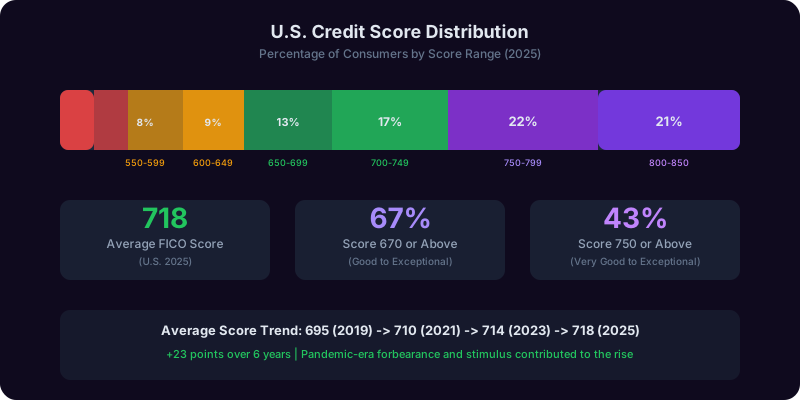
A credit score is a three-digit number that predicts how likely you are to repay borrowed money. Lenders, landlords, insurers, and even some employers use it to make decisions about you. The number ranges from 300 to 850, with higher being better.
There are two major scoring models, and they work differently.
FICO Score
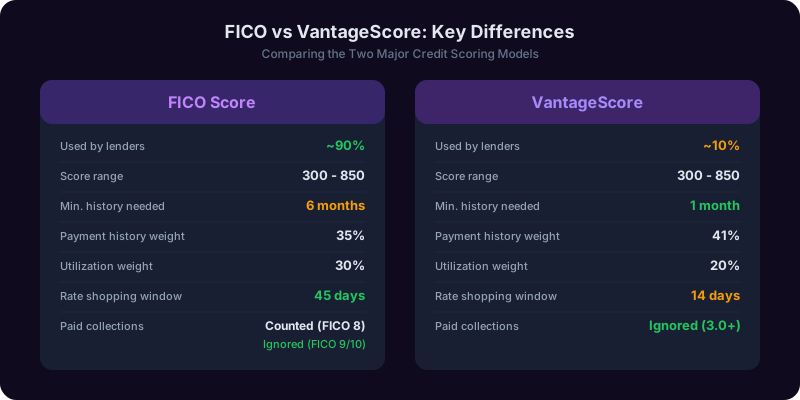
Created by Fair Isaac Corporation, the FICO score is used in approximately 90% of lending decisions in the United States. When a mortgage lender, auto lender, or credit card company checks your score, they are almost certainly looking at a FICO score. There are multiple FICO versions (FICO 8 is the most widely used, but mortgage lenders still use FICO 2, 4, and 5).
FICO score ranges:
| 800-850 | Exceptional |
| 740-799 | Very Good |
| 670-739 | Good |
| 580-669 | Fair |
| 300-579 | Poor |
VantageScore
Created jointly by the three credit bureaus (Equifax, Experian, TransUnion), VantageScore uses the same 300-850 range but weighs factors slightly differently. VantageScore is commonly used by free credit monitoring services (Credit Karma, for example, shows your VantageScore 3.0). It is less commonly used for actual lending decisions.
Why Your Scores Differ
You do not have one credit score. You have dozens. Each scoring model version, applied to each bureau's data, produces a different number. Your Equifax FICO 8 might be 745 while your TransUnion VantageScore 3.0 is 730. This is normal. The differences come from three sources:
- Different data: Not all creditors report to all three bureaus
- Different models: FICO and VantageScore weigh factors differently
- Different timing: Bureaus update at different times during the month
The score you see on Credit Karma or your bank's app may not be the exact score a lender sees, but it is a reliable indicator of your general credit health. A 30-point difference between models is common and not a cause for concern. To learn what constitutes a good score for your specific goals, see our guide on what is a good credit score.
Understanding which score a specific lender uses matters most when you are on the borderline between rate tiers. The Finance Copilot can help you understand which score to focus on based on your specific lending goals.
This is general information, not financial advice. Consult a financial professional for guidance specific to your situation.
See our real-world walkthrough: landlord keeping security deposit.
The 5 Factors and Their Real Weight
FICO publishes the approximate weight of each factor, but how they interact with your specific credit profile matters more than the percentages alone. Here is the breakdown:
| Factor | Weight | What It Measures |
|---|---|---|
| Payment History | 35% | Do you pay on time? |
| Credit Utilization | 30% | How much of your available credit are you using? |
| Length of Credit History | 15% | How old are your accounts? |
| New Credit | 10% | How many new accounts or inquiries recently? |
| Credit Mix | 10% | Do you have different types of credit? |
These percentages are averages. For someone with a short credit history, length of history may carry more weight. For someone with many accounts, utilization becomes more influential. The algorithm adjusts based on what data is available.
The 80/20 Rule of Credit Scores
Here is what matters most in practice: payment history and utilization together account for 65% of your score. If you do nothing else, paying every bill on time and keeping your credit card balances low will get you 80% of the way to a good score. The remaining three factors fine-tune the number but rarely make or break it.
This is why people obsess over the wrong things. Opening a new credit card (10% factor) while carrying a 60% utilization ratio (30% factor) is focusing on the noise instead of the signal.
VantageScore Differences
VantageScore 4.0 uses slightly different categories:
- Payment history: 41% (even more dominant)
- Depth of credit: 20% (combines age and mix)
- Credit utilization: 20%
- Recent credit: 11%
- Balances: 6%
- Available credit: 2%
The takeaway is the same across both models: pay on time, keep balances low, and the rest takes care of itself over time.
Payment History Deep Dive
At 35% of your FICO score, payment history is the single most important factor. It answers one question: do you pay your debts on time?
What Counts as "On Time"
A payment is on time if it is received by the due date. Most creditors report to the credit bureaus monthly, and they only report late payments that are 30 days or more past due. Being a few days late typically results in a late fee but does not appear on your credit report. However, once a payment hits 30 days late, it is reported and stays on your credit report for 7 years.
The Severity Scale
Not all late payments are equal. The damage increases with severity:
- 30 days late: Score drops 60-110 points (more for higher starting scores)
- 60 days late: Additional 10-30 point drop beyond the 30-day impact
- 90 days late: Further damage, and the account may be sent to collections
- 120+ days late / Charge-off: The creditor writes off the debt. Severe damage.
- Collection account: The debt is sold to a collection agency. This is a separate negative mark in addition to the late payments.
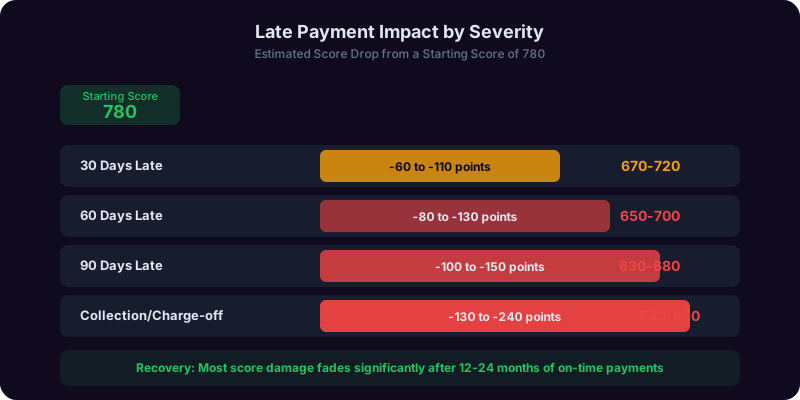
A single 30-day late payment can drop a 780 score to the low 700s. The same late payment on a 650 score might only drop it 30-40 points. Higher scores have more to lose because the algorithm expects consistent behavior from borrowers with strong track records.
How to Protect Your Payment History
- Set up autopay for the minimum payment on every account. This ensures you never miss a payment even if you forget. You can still pay more manually, but autopay is your safety net.
- Set calendar reminders 5 days before due dates as a backup.
- If you miss a payment, pay it before 30 days. Call the creditor and ask them to waive the late fee. If the payment is not yet 30 days late, it will not be reported to the bureaus.
- If a late payment is reported incorrectly, dispute it. File a dispute with the credit bureau (online at each bureau's website) and provide documentation showing the payment was on time.
One strategy if you have a single late payment on an otherwise clean record: call the creditor and request a goodwill adjustment. Explain that you have been a loyal customer, the late payment was a one-time mistake, and ask them to remove it as a courtesy. This works more often than people expect, especially with credit card issuers. The Consumer Financial Protection Bureau provides guidance on communicating with creditors about payment issues. Use the Budgeting Copilot to set up a bill payment system that prevents missed payments in the first place.
Credit Utilization Tricks That Actually Work
Credit utilization is the ratio of your credit card balances to your credit limits. It accounts for 30% of your FICO score and is the fastest factor you can change. Unlike payment history (which takes years to build), utilization resets every month when your issuer reports new balances to the bureaus.
How It Is Calculated
Utilization is measured two ways:
- Per-card utilization: The balance-to-limit ratio on each individual card
- Overall utilization: Total balances across all cards divided by total credit limits
Both matter. Having one card maxed out hurts your score even if your overall utilization is low.
The Utilization Sweet Spots
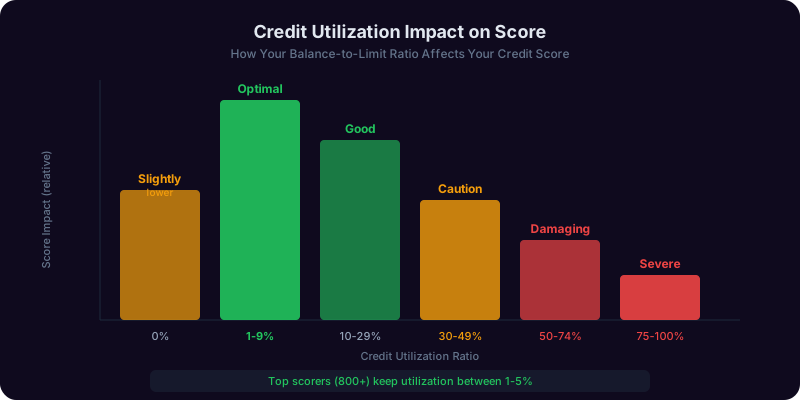
| 0% | Slightly worse than 1-9% (shows no active use) |
| 1-9% | Optimal range for highest scores |
| 10-29% | Good, minimal score impact |
| 30-49% | Noticeable negative impact begins |
| 50-74% | Significant negative impact |
| 75-100% | Severe damage to score |
The often-cited "keep it under 30%" advice is outdated. Data from FICO score analysis shows that the highest scorers maintain utilization under 10%, and the ideal range is 1-5%.
Timing Trick: When Your Balance Is Reported
Most credit card issuers report your balance to the bureaus on your statement closing date, not your payment due date. This means if you charge $2,000 during the month but pay it off before the statement closes, the reported balance (and your utilization) could be near zero.
The strategy: find out your statement closing date (check your last statement or call the issuer) and make a payment a few days before it. This is especially useful before applying for a major loan, when you want your reported utilization as low as possible.
Other Utilization Strategies
- Request credit limit increases. A higher limit with the same spending lowers your utilization percentage. Most issuers allow online requests. Some perform a soft pull (no score impact), others a hard pull (ask first).
- Spread spending across multiple cards instead of concentrating on one. Per-card utilization matters.
- Pay twice a month. Make a mid-cycle payment to keep your running balance low, so the reported balance is lower regardless of when the statement closes.
- Do not close old cards. Closing a card removes its limit from your total available credit, which increases your overall utilization ratio.
If you are preparing for a mortgage or major loan application, the Finance Copilot can help you optimize your utilization across all cards for maximum score impact before the lender pulls your credit.
Length of Credit History
This factor accounts for 15% of your FICO score and measures three things: the age of your oldest account, the age of your newest account, and the average age of all your accounts. Longer history is better because it gives lenders more data to evaluate your behavior.
What Counts as Good History Length
| Under 2 years average | Thin file, limited score potential |
| 2-5 years average | Building, noticeable improvement |
| 5-7 years average | Solid history |
| 7+ years average | Strong contributor to score |
This is the factor you have the least control over because it requires time. You cannot speed up the aging of your accounts. But you can avoid actions that shorten your average age.
Common Mistakes That Hurt History Length
Closing old accounts. When you close a credit card, it eventually falls off your credit report (typically 10 years after closing). While it remains, it still contributes to your average age. But once it falls off, your average age drops. If your oldest card is 15 years old and you close it, you lose that anchor once it ages off your report.
The exception: if an old card charges an annual fee and you do not use it enough to justify the cost, ask the issuer to downgrade it to a no-fee version instead of closing it. This keeps the account open and the history intact.
Opening too many new accounts at once. Each new account has an age of zero, which pulls down your average. Opening five cards in six months (a practice common in the "credit card churning" community) can temporarily drop your average age by years.
Strategies for Building History
- Keep old accounts open, even if you rarely use them. Put a small recurring charge (a subscription) on old cards to keep them active.
- Become an authorized user on a family member's old, well-managed card. Their account history can appear on your report, boosting your average age. Make sure the card has a clean payment history and low utilization.
- Start early. If you have children approaching 18, adding them as authorized users on your oldest card (or helping them get a secured card) gives them a head start on building history.
- Be selective about new accounts. Only open new credit when you genuinely need it, not because you were offered a store discount at checkout.
For young adults or people rebuilding credit, the Budgeting Copilot can help you develop a plan that builds credit history while keeping spending in check. If you are starting from zero, check out our detailed guides on building credit from nothing and building credit from scratch.
New Credit Inquiries: Hard Pull vs. Soft Pull
New credit accounts for 10% of your FICO score. It measures how actively you are seeking new credit, primarily through hard inquiries on your report.
Hard Inquiries
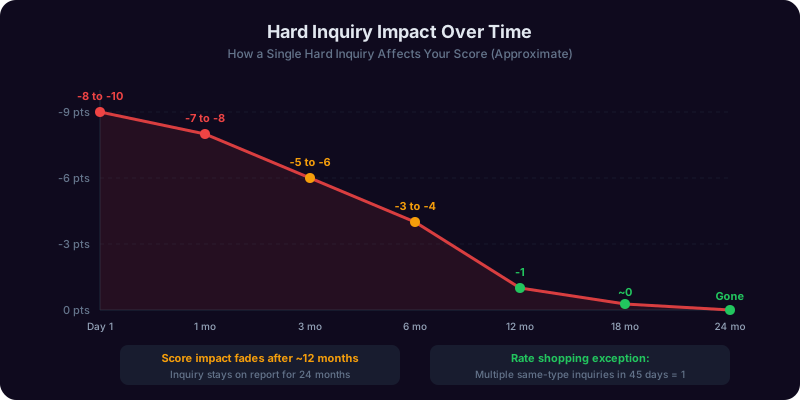
A hard inquiry (hard pull) occurs when a lender checks your credit because you applied for credit. Each hard inquiry can lower your score by 5-10 points and stays on your report for 2 years (though it only affects your score for about 12 months).
Common hard inquiries:
- Credit card applications
- Mortgage applications
- Auto loan applications
- Personal loan applications
- Apartment rental applications (sometimes)
- Student loan applications
Soft Inquiries
A soft inquiry (soft pull) does not affect your score at all. These happen when:
- You check your own credit
- A lender pre-approves you for an offer
- An employer runs a background check
- An existing creditor reviews your account
- Credit monitoring services check your report
The Rate Shopping Window
The scoring models recognize that shopping for the best mortgage or auto loan rate requires multiple applications. To avoid penalizing this responsible behavior, FICO groups multiple inquiries for the same type of loan within a 45-day window as a single inquiry. VantageScore uses a 14-day window.
This means you can apply to five different mortgage lenders within 45 days and it counts as one inquiry on your FICO score. The same applies to auto loans and student loans. Credit card applications do not receive this treatment, since each card application is considered a separate credit product.
When Inquiries Matter Most
If you have a long credit history with many accounts, a single hard inquiry barely registers. If you have a thin credit file with only 2-3 accounts, each inquiry has a proportionally larger impact.
Practical advice:
- Do not avoid applying for credit out of inquiry fear. The impact is small and temporary. Missing a better interest rate to avoid a 5-point inquiry hit is counterproductive.
- Do consolidate rate shopping. If comparing mortgage or auto loan rates, do all applications within a 2-week window to be safe under both FICO and VantageScore rules.
- Space out credit card applications. Wait at least 3-6 months between credit card applications to minimize cumulative inquiry impact.
- Dispute unauthorized inquiries. If you see a hard inquiry you did not authorize, dispute it with the credit bureau. Identity theft often shows up first as unauthorized inquiries. If you suspect identity theft, learn how to freeze your credit at all three bureaus.
Credit Mix and How to Check Your Score for Free
Credit mix is the final factor at 10% of your FICO score. It measures whether you have experience managing different types of credit.
Types of Credit
- Revolving credit: Credit cards, store cards, lines of credit. You borrow up to a limit and repay on a flexible schedule.
- Installment loans: Mortgages, auto loans, student loans, personal loans. Fixed payments over a set period.
- Open credit: Charge cards that must be paid in full each month (like some American Express cards).
Having both revolving and installment accounts demonstrates broader credit management experience. However, this factor is relatively minor. Never take out a loan just to improve your credit mix. Paying interest to improve a 10% factor is a losing proposition.
If you only have credit cards, your credit mix is limited but not catastrophic. If you only have installment loans (student loans, for example) with no revolving credit, opening a credit card can provide a noticeable boost because it adds both revolving credit history and lowers your overall credit usage profile.
How to Check Your Credit Score for Free
You have several free options:
- AnnualCreditReport.com: Free credit reports (not scores) from all three bureaus, as required by the Fair Credit Reporting Act. You are entitled to one free report per bureau per week through the end of 2026. Review these for errors and unauthorized accounts.
- Credit Karma: Free VantageScore 3.0 from TransUnion and Equifax. Updated weekly. Also provides credit monitoring and alerts.
- Bank and credit card apps: Many banks and issuers now provide free FICO scores. Discover offers free FICO to anyone (you do not need a Discover card). Chase, Capital One, Bank of America, and American Express all provide free scores to cardholders.
- Experian: Free FICO 8 score through their website or app
- Credit Sesame: Free VantageScore from TransUnion
How Often to Check
Check your credit report (the detailed document, not just the score) at least once every four months, rotating between bureaus. Check your score monthly through a free app or banking tool. Set up credit monitoring alerts through Credit Karma or your bank to be notified of any changes, new accounts, or inquiries in real time.
The Finance Copilot can help you interpret your credit report, identify factors dragging your score down, and create a targeted improvement plan.
Common Credit Score Myths Debunked
Misinformation about credit scores is everywhere. Here are the myths that cause the most confusion and bad decisions.
Myth: Checking your own credit hurts your score
False. Checking your own credit is a soft inquiry and has zero impact on your score. Check it as often as you want. The confusion comes from hard inquiries, which only happen when you apply for credit through a lender.
Myth: You need to carry a balance to build credit
False. This is the most expensive myth in personal finance. You do not need to pay interest to build credit. Charging a small amount, letting the statement close (so a balance is reported), and then paying in full by the due date builds credit identically to carrying a balance, without costing you a penny in interest.
Myth: Closing a credit card improves your score
Usually false. Closing a card reduces your total available credit (increasing utilization) and eventually removes the account's history from your report (shortening average age). In most cases, closing a card hurts your score. The exception: if a card has an annual fee you cannot justify and the issuer will not downgrade it, closing it may make financial sense despite the score impact.
Myth: Your income affects your credit score
False. Your income, savings, investments, and net worth are not factors in any credit scoring model. A person earning $30,000/year with perfect payment history and low utilization can have a higher score than someone earning $300,000/year with late payments and maxed-out cards.
Myth: Paying off a collection removes it from your report
Partially true, but not automatically. Paying a collection account changes its status to "paid" but does not remove it from your report. It remains for 7 years from the original delinquency date. However, FICO 9 and VantageScore 3.0+ ignore paid collection accounts entirely, so the impact depends on which scoring model the lender uses. You can also negotiate a "pay for delete" agreement where the collector agrees to remove the entry in exchange for payment. Get this in writing before paying.
Myth: All debt is bad for your credit
False. Responsibly managed debt actually helps your score. A mortgage with a perfect payment history, an auto loan paid on time, and credit cards used and paid regularly all contribute positively. The key word is "responsibly managed." Debt becomes a problem when payments are missed or utilization is high.
Myth: You only have one credit score
False. As discussed earlier, you have dozens of scores across different models and bureaus. FICO alone has over 50 different scoring versions tailored for different industries (mortgage, auto, credit card). Do not panic if the number varies across platforms. Focus on the trend over time rather than any single number.
For personalized guidance on improving your specific credit situation, the Business Finance Copilot can analyze your credit profile and recommend targeted actions based on which factors are currently holding your score back.
This is general information, not financial advice. Consult a financial professional for guidance specific to your situation.
For more on this topic, read our guide on Side Hustle Taxes: Everything the IRS Expects From You.
Frequently asked questions
How long does it take to build a credit score from scratch?
Does paying rent build credit?
How much does a late payment hurt my credit score?
Is 700 a good credit score?
Can I improve my credit score by 100 points quickly?
What is the difference between FICO and VantageScore?
How does credit mix affect my score, and do I need every type of credit?
Should I freeze my credit to protect my score?
Get a Personalized Credit Score Improvement Plan
Tell the Finance Copilot your current score and situation, and get a step-by-step plan to raise it - which accounts to pay first, utilization targets, and timeline estimates.
- Finance & Money CopilotGet a personalized credit improvement plan based on your specific situation
Free plan, no card. Pro from $4.99/week for every copilot across all 20 domains - about what one hour with any single professional costs per year.
Not a financial advisorThis is financial information, not financial advice. Consult a licensed financial professional.