
Money & Finance
Is $1,000 Enough for an Emergency Fund? The Right Number by Life Stage
The 3-6 month rule is wrong for a lot of people: a single renter with stable income needs far less than a self-employed parent. This life-stage breakdown shows your real number, where a $20,000 fund earns $850-$950 a year, and how to build it fast on a tight budget.
What Actually Counts as an Emergency?
Before calculating how much to save, you need a clear definition of what an emergency fund is for. Without this clarity, the fund gets raided for things that feel urgent but are actually predictable or optional.
An emergency is an unexpected, necessary expense or loss of income that you could not have reasonably planned for. Here are real emergencies:
- Job loss: You are laid off, fired, or your company shuts down. This is the primary reason emergency funds exist.
- Medical emergencies: An ER visit, surgery, or diagnosis that generates bills beyond your insurance coverage. The average ER visit costs $2,200. A 3-day hospital stay averages $30,000 before insurance.
- Major car repair: Your transmission fails ($3,000-$5,000) and you need the car to get to work. This is different from routine maintenance.
- Home repair that cannot wait: Your furnace dies in January. Your roof starts leaking into the living room. A pipe bursts. These are emergencies. A kitchen remodel is not.
- Emergency travel: A family member's sudden illness or death requires immediate travel you did not budget for.
These are not emergencies (even though they feel like it):
- A sale on something you want
- Holiday gifts you forgot to budget for
- Annual insurance premiums (these are predictable; budget for them)
- Car registration, property taxes, and other recurring bills
- Vet bills for routine care (budget separately for pet expenses)
The distinction matters because many people drain their emergency fund for predictable expenses and then have nothing left when a real crisis hits. The solution is to have separate sinking funds for known irregular expenses (car maintenance, holiday gifts, annual premiums) and keep your emergency fund exclusively for true surprises. The Consumer Financial Protection Bureau recommends keeping emergency savings separate from everyday spending accounts for exactly this reason.
The Budgeting Copilot can help you set up sinking fund categories alongside your emergency fund so each type of expense has its own designated savings.
This is general information, not financial advice. Consult a financial professional for guidance specific to your situation.
See our real-world walkthrough: fired without warning.
The 3-6 Month Rule (and Why It Is Wrong for Some People)
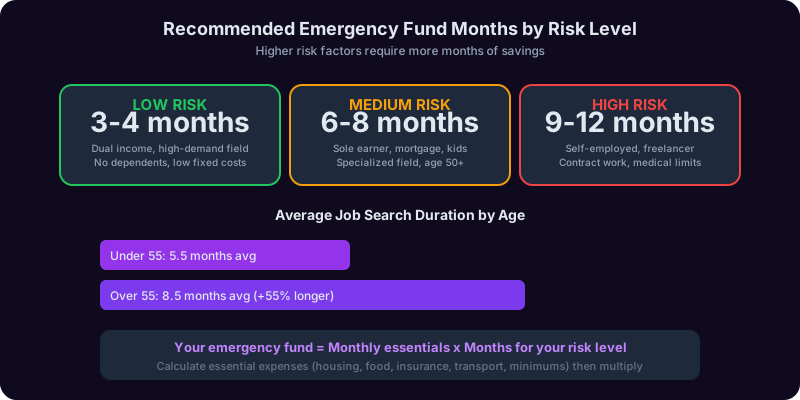
You have heard the standard advice: save 3-6 months of living expenses. This is a reasonable starting point, but it is a one-size-fits-all recommendation that does not account for your actual risk profile.
The real question is: how long would it take you to replace your income if you lost it tomorrow? That depends on several factors:
When 3 Months Is Enough
- You are in a high-demand field with low unemployment (nursing, software engineering, skilled trades)
- You are a dual-income household where one income covers essential expenses
- You have no dependents
- You have additional safety nets (family support, union benefits, strong severance policies)
- You have minimal fixed obligations (renting a modest apartment, no car payment)
When You Need 6 Months or More
- You are the sole income earner for your household
- You work in a volatile industry (tech startups, oil and gas, media, seasonal tourism)
- You are in a specialized field where job searches take longer (executive roles, academia, niche industries)
- You have significant fixed obligations (mortgage, car payments, student loans)
- You have dependents relying on your income
When You Need 9-12 Months
- You are self-employed or a freelancer with irregular income
- You are the sole earner with a mortgage and children
- You work on contract with gaps between engagements
- You have a medical condition that limits your job flexibility
- You are over 50 and in a field where age discrimination is prevalent (the average job search for workers over 55 takes 8.5 months compared to 5.5 months for younger workers, according to the Bureau of Labor Statistics)
The number that matters is your monthly essential expenses, not your total spending. Essential expenses include housing, utilities, groceries, transportation, insurance premiums, minimum debt payments, and any other bills you cannot eliminate. Dining out, subscriptions, and discretionary spending do not count because you would cut those in a real emergency.
Calculate your essential monthly expenses, then multiply by the number of months appropriate for your situation. That is your emergency fund target. If you are also working on building credit from scratch, factor your credit-building costs (secured card deposit, credit builder loan payment) into your monthly essentials.
Emergency Fund Calculator by Life Stage
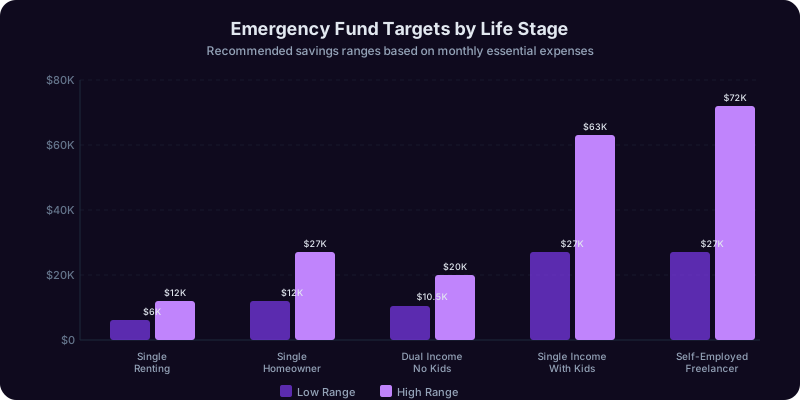
Here are specific targets based on common life situations. Find the one closest to yours and use it as your starting framework.
Single, Renting, No Dependents
| Monthly essentials | $2,000-$3,000 |
| Recommended months | 3-4 |
| Target range | $6,000-$12,000 |
Your risk is lower because your obligations are minimal and you have maximum flexibility. You can downsize apartments, take a temporary job, or relocate for work if needed.
Single, Homeowner, No Dependents
| Monthly essentials | $3,000-$4,500 |
| Recommended months | 4-6 |
| Target range | $12,000-$27,000 |
Homeownership adds fixed costs (mortgage, insurance, property tax, maintenance) that cannot be reduced quickly. A major home repair can easily cost $5,000-$15,000 on top of lost income. If you are a first-time homeowner, review our guide on first-time home buyer mistakes to avoid costly surprises. Try our AI tax filing assistant for step-by-step help.
Married/Partnered, Dual Income, No Kids
| Monthly essentials | $3,500-$5,000 |
| Recommended months | 3-4 |
| Target range | $10,500-$20,000 |
Dual income provides a natural safety net. If one person loses their job, the other's income can cover basics while the job search happens. Your target can be on the lower end.
Married/Partnered, Single Income, With Kids
| Monthly essentials | $4,500-$7,000 |
| Recommended months | 6-9 |
| Target range | $27,000-$63,000 |
This is where the standard advice falls short. With one income, children, and likely a mortgage, losing that income is a genuine crisis. Childcare costs ($1,200-$2,500/month per child) make it difficult for the non-working parent to take a job quickly. A 6-month minimum is essential.
Self-Employed / Freelancer
| Monthly essentials | $3,000-$6,000 |
| Recommended months | 9-12 |
| Target range | $27,000-$72,000 |
Freelancers and self-employed individuals face income volatility that W-2 workers do not. A bad quarter, a lost client, or an industry downturn can cut income dramatically. You also do not qualify for unemployment insurance. A larger fund compensates for this increased risk. The Finance Copilot can help you calculate your specific number based on your actual income patterns and expenses.
Where to Keep Your Emergency Fund (HYSA Comparison)
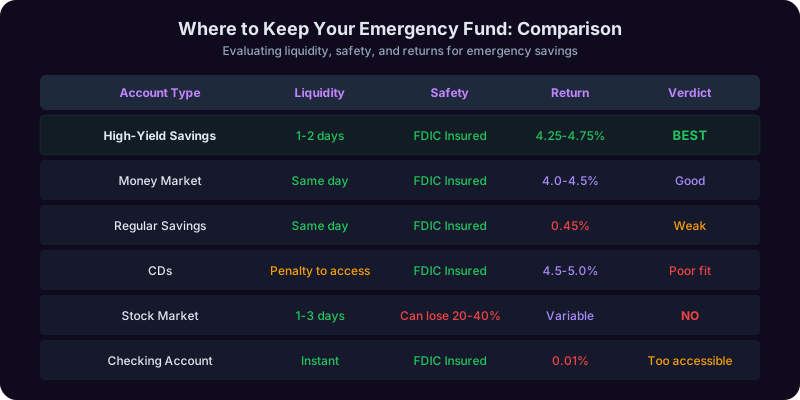
Your emergency fund needs to be liquid (accessible within 1-2 business days), safe (no risk of losing principal), and ideally earning interest. This eliminates stocks, bonds, crypto, and CDs with penalties.
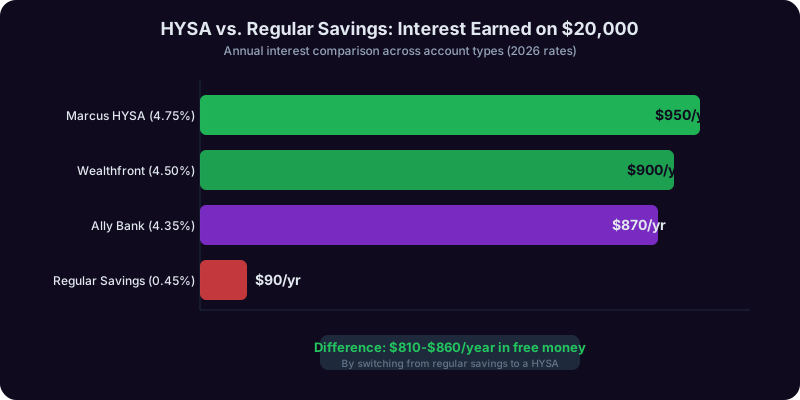
The best option for most people is a High-Yield Savings Account (HYSA). As of mid-2026, the best HYSAs are paying between 4.25% and 4.75% APY, compared to the national average savings rate of 0.45%. On a $20,000 emergency fund, that difference is roughly $800/year in free money. The Federal Reserve publishes selected interest rates weekly for reference.
Top HYSA Options (May 2026)
| Account | APY | Minimum | FDIC Insured |
|---|---|---|---|
| Marcus by Goldman Sachs | 4.50% | $0 | Yes |
| Ally Bank | 4.35% | $0 | Yes |
| Capital One 360 | 4.25% | $0 | Yes |
| Discover Online Savings | 4.30% | $0 | Yes |
| Wealthfront Cash Account | 4.50% | $0 | Yes (via partners) |
Rates change frequently. Verify current rates before opening an account.
Why Not Other Options?
Regular savings account: The 0.45% average rate means you lose purchasing power to inflation. A HYSA takes 5 minutes to open and earns 10x more.
Checking account: Too accessible. Emergency funds sitting in your daily spending account tend to get spent. The psychological separation of a dedicated savings account matters.
Money market account: Similar to HYSAs and perfectly fine. Some offer check-writing privileges, which can be convenient for large emergency payments. Rates are comparable.
CDs: Poor choice for emergency funds because of early withdrawal penalties (typically 3-12 months of interest). The whole point of an emergency fund is immediate access. A CD ladder (splitting your fund across multiple CDs with staggered maturity dates) reduces but does not eliminate this problem.
I-Bonds: Government savings bonds indexed to inflation. Good for long-term savings but not emergencies because they cannot be redeemed in the first 12 months, and redeeming before 5 years forfeits 3 months of interest.
The ideal setup: keep your emergency fund in a HYSA at a different bank from your checking account. This adds a 1-2 day transfer buffer that prevents impulsive withdrawals while keeping the money fully accessible for real emergencies. The Investment Copilot can help you evaluate where to park savings beyond your emergency fund for better long-term returns.
How to Build Your Emergency Fund Fast
Knowing the target is one thing. Actually reaching it is another. Here are proven strategies that work even on a tight budget. Try our AI budget planning tool for step-by-step help.
The Starter Fund: Get to $1,000 First
If you have zero savings, a $20,000 target feels impossible. Ignore the final number for now. Your first goal is $1,000. This covers most minor emergencies (car repair, appliance replacement, urgent medical copay) and breaks the cycle of using credit cards for every surprise.
Ways to get $1,000 fast:
- Sell things you do not use. Most households have $500-$1,000 worth of items that could sell on Facebook Marketplace, eBay, or Craigslist. Electronics, furniture, clothes, sports equipment, tools.
- Redirect one expense. Cancel a subscription or service for 3 months and redirect the money. A $50/month gym membership plus $15 streaming service is $195 in three months.
- Tax refund. The average federal refund is approximately $3,100, according to the IRS. Directing even half of it to your emergency fund makes a massive dent.
- Side income sprint. Two weekends of gig work (rideshare, delivery, yard work, selling baked goods) can generate $300-$600. If you earn side income, be sure to understand the tax implications of side hustles.
Automating the Build
Once you have $1,000, switch to automatic transfers. Set up a recurring transfer from checking to your HYSA on payday. Start with an amount that feels manageable, even if it is just $25 per paycheck. That is $650/year, and it adds up.
The key principle: pay yourself first. The transfer happens before you have a chance to spend the money. Treat it like a bill that is not optional.
Accelerating the Build
- Increase contributions with every raise. If you get a 3% raise, direct half of it (1.5%) to your emergency fund. You never miss money you never had.
- Use windfalls. Birthday money, bonuses, cash back rewards, rebates. Direct at least 50% of unexpected money to the fund.
- Challenge months. Pick one month per quarter and cut discretionary spending aggressively. Cook every meal, skip entertainment purchases, and funnel the savings.
- Round-up savings. Apps and banks that round up purchases to the nearest dollar and save the difference can add $30-$50/month passively.
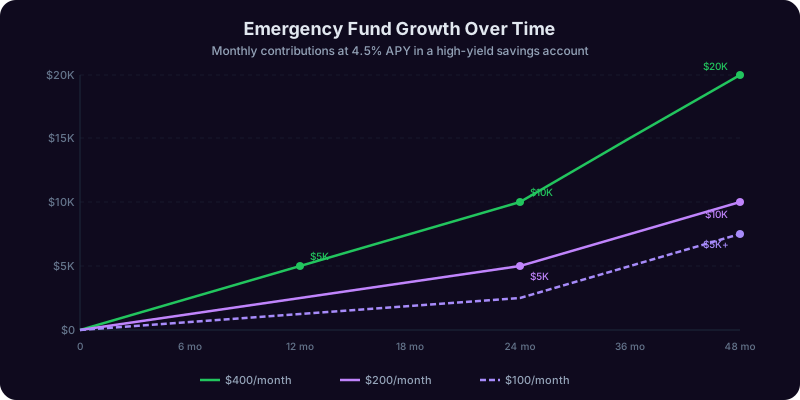
At $200/month in contributions plus a HYSA earning 4.5%, you would reach $10,000 in about 45 months. At $400/month, you hit $10,000 in just over 24 months. Use the Budgeting Copilot to find room in your current spending for emergency fund contributions.
When to Use Your Emergency Fund
Having an emergency fund is pointless if you cannot bring yourself to use it when needed, or if you drain it for non-emergencies. Here is a framework for deciding.
Use Your Emergency Fund When:
The expense is unexpected. You did not know it was coming, and it could not have been reasonably predicted. A car accident qualifies. An oil change does not.
The expense is necessary. Not addressing it would cause significant financial harm, health risk, or safety issues. Fixing a broken furnace in winter is necessary. Upgrading your phone is not.
The expense is urgent. It cannot wait until next month's paycheck or be planned into your regular budget. A burst pipe needs fixing today. New tires can usually wait a week or two and be budgeted.
All three conditions should be true. If an expense is unexpected but not necessary (a flash sale), or necessary but not unexpected (annual insurance premium), it does not qualify.
The Decision Checklist
Before withdrawing from your emergency fund, ask yourself:
- Could I have predicted this expense? (If yes, it should have been in a sinking fund)
- What happens if I do not pay for this right now? (If the answer is "nothing serious," it can wait)
- Can I cover this from my regular budget by cutting something this month? (If yes, do that instead)
- Is there a less expensive alternative that solves the immediate problem? (A used appliance instead of new, for example)
Real-World Examples
| Situation | Use Emergency Fund? |
|---|---|
| Lost your job | Yes, this is exactly what it is for |
| $1,800 ER bill after insurance | Yes |
| Transmission repair, $3,500 | Yes, if you need the car for work |
| Vet emergency surgery, $4,000 | Yes (if pet insurance does not cover it) |
| Friend's destination wedding | No, this is a choice, not an emergency |
| Holiday gifts | No, budget for these annually |
| New tires ($800) | Maybe, if they are bald and unsafe now. Otherwise, budget for it. |
The goal is not to hoard the money forever. The goal is to use it wisely so it is there when you truly need it. If a medical bill is the reason you are dipping into savings, be sure to read our guide on how to dispute a medical bill before paying the full amount.
When and How to Rebuild After Using Your Fund
Using your emergency fund is not a failure. It is the fund doing exactly what it was designed to do. But you need to rebuild it as soon as your situation stabilizes.
Rebuilding After Job Loss
If you used your fund during unemployment, rebuilding is your first financial priority once you start your new job. Before increasing retirement contributions, paying extra on debt, or upgrading your lifestyle, funnel money back into the emergency fund.
A practical approach: allocate 50-70% of disposable income to rebuilding for the first 3-4 months of new employment. This feels aggressive, but the period right after a financial crisis is when you are most motivated and most aware of why the fund matters.
Rebuilding After a Large Expense
If a single large expense ($3,000-$10,000) depleted your fund, calculate how many months it will take to rebuild at your normal savings rate. If the timeline is longer than 6 months, temporarily increase your contributions by cutting discretionary spending or picking up extra income.
The Rebuilding Priority Order
- Restore $1,000 minimum immediately. Get back to a starter fund as fast as possible, even if it means aggressive temporary cuts.
- Resume regular automatic contributions. Turn the autopilot back on.
- Evaluate whether your target needs adjusting. The event that depleted your fund may reveal that your target was too low. If a single car repair wiped out the fund, you probably need a larger buffer.
- Do not overcompensate. Saving 80% of your income to rebuild quickly is not sustainable and can lead to burnout and binge spending.
What If You Cannot Rebuild Right Away?
If you are still recovering financially (paying off medical bills, catching up on payments), focus on stabilizing first. Even $25-$50/month back into the fund is progress. The Budgeting Copilot can help you find room in a tight budget to begin rebuilding without sacrificing essentials.
The most important thing is to start. Do not wait until you can afford large contributions. Small, consistent deposits rebuild the fund over time, and having even a partial fund is dramatically better than having nothing.
Alternatives and Supplements to a Traditional Emergency Fund
A HYSA emergency fund is the foundation, but there are additional tools that can supplement or accelerate your financial safety net.
Roth IRA as a Backup Emergency Fund
You can withdraw your contributions (not earnings) from a Roth IRA at any time, tax-free and penalty-free. This makes a Roth IRA a useful secondary emergency fund. The 2026 contribution limit is $7,000 ($8,000 if 50+). The ideal approach: fund your Roth IRA, invest it for retirement growth, and know that the contributions are accessible if a true catastrophe hits. This is a backup plan, not a replacement for a dedicated emergency fund. For a deeper comparison of retirement account options, see our guide on Roth IRA vs. Traditional IRA.
Home Equity Line of Credit (HELOC)
If you own a home, a HELOC gives you access to a line of credit secured by your home equity. You only pay interest on what you borrow. Having a HELOC in place (even if you never use it) provides a credit safety net. The risk: if you cannot make payments, your home is collateral. Only use this as a last resort and for large, genuine emergencies.
0% APR Credit Cards
A credit card with a 0% introductory APR (typically 12-21 months) can bridge a gap if you have an emergency and your fund is insufficient. The key: have a repayment plan that pays off the balance before the promotional rate expires. After the promo period, rates jump to 20-29%, which turns a manageable expense into a debt trap. Maintaining a strong credit score is essential for qualifying for these offers.
Income Protection Insurance
- Short-term disability insurance: Replaces 60-70% of income for 3-6 months if illness or injury prevents you from working. Many employers offer this as a benefit.
- Long-term disability insurance: Covers longer periods. Critical if you are the primary earner.
- Umbrella insurance: Provides additional liability protection beyond your auto and home insurance limits.
Community and Family Resources
Do not overlook non-financial resources: family members who can help temporarily, community assistance programs, food banks, utility assistance programs (LIHEAP), and employer hardship funds. These are not replacements for savings, but they can reduce the amount you need to withdraw from your fund during a crisis.
The best strategy is layered: a HYSA emergency fund as your primary tool, a Roth IRA as a secondary backstop, appropriate insurance coverage, and awareness of community resources. The Finance Copilot can help you evaluate which combination makes the most sense for your situation and risk profile.
This is general information, not financial advice. Consult a financial professional for guidance specific to your situation.
For more on this topic, read our guide on Side Hustle Taxes: Everything the IRS Expects From You.
Frequently asked questions
Is $1,000 enough for an emergency fund?
Should I pay off debt or build an emergency fund first?
Does my emergency fund need to be in a separate bank?
Should I invest my emergency fund in the stock market?
How do I calculate my monthly essential expenses?
What is the difference between an emergency fund and a sinking fund?
An emergency fund covers unexpected, unpredictable expenses like job loss or medical emergencies. A sinking fund is for known, predictable expenses that do not come monthly, such as annual car insurance, holiday gifts, property taxes, or vacation savings. You should have both. The emergency fund stays untouched until a true crisis hits. Sinking funds prevent you from raiding your emergency fund for expenses you could have planned for.
How much interest will I earn on a $20,000 emergency fund in a HYSA?
At the current top HYSA rates of 4.25-4.75% APY, a $20,000 emergency fund earns approximately $850-$950 per year in interest. By comparison, the same amount in a regular savings account at 0.45% earns only about $90 per year. The difference of roughly $760-$860 annually is essentially free money for keeping your savings in the right account. Rates fluctuate, so check current rates before opening an account.
Can I use a Roth IRA as my emergency fund?
You can withdraw Roth IRA contributions (not earnings) at any time without taxes or penalties, making it a viable backup emergency fund. However, it should not be your primary emergency fund because withdrawals reduce your retirement savings and the money loses its tax-advantaged growth. The ideal strategy is to have a fully funded HYSA emergency fund and treat your Roth IRA contributions as a last-resort safety net for catastrophic situations.
How long does it take to build a full emergency fund?
It depends on your savings rate and target. At $200/month into a HYSA earning 4.5%, you will reach $10,000 in about 45 months and $20,000 in about 82 months. At $400/month, those timelines are roughly 24 and 45 months respectively. The key is to start immediately with whatever amount you can, automate the transfers, and increase contributions whenever your income goes up. Even $50/month builds a meaningful safety net over time.
Should freelancers have a bigger emergency fund than employees?
Yes. Freelancers and self-employed individuals should aim for 9-12 months of essential expenses instead of the standard 3-6 months. The reasons: income is irregular and unpredictable, you do not qualify for unemployment insurance, client losses can happen without warning, and finding replacement income often takes longer than a traditional job search. Additionally, freelancers need to cover their own health insurance, retirement contributions, and business expenses even during dry spells.
Build Your Emergency Fund with a Personalized Plan
Tell the Budgeting Copilot your income, expenses, and life stage, and get a customized savings plan with monthly targets and the best accounts to use.
- Finance & Money CopilotGet a personalized financial health check and savings strategy
Free plan, no card. Pro from $4.99/week for every copilot across all 20 domains - about what one hour with any single professional costs per year.
Not a financial advisorThis is financial information, not financial advice. Consult a licensed financial professional.