
Money & Finance
Medical Bill Wrong or Already in Collections? Scripts to Dispute and Shrink It
Yes, you can still dispute a medical bill after it reaches collections, and the average American overpays $1,300 thanks to duplicate charges and coding errors. This guide gives you the exact call scripts, the itemized-bill request that surfaces errors, fair-price benchmarks, and the financial assistance and settlement paths that shrink what you owe.
Medical Billing Errors Are Shockingly Common
If you have ever stared at a medical bill and thought "this cannot be right," you are probably correct. Multiple independent studies have found that up to 80% of medical bills contain at least one error. That is not a fringe statistic from a consumer advocacy group - it has been confirmed by auditing firms, the American Medical Association, and hospital billing departments themselves.
The average overcharge on a medical bill in the United States is approximately $1,300. For hospital stays, the number is considerably higher - one 2025 analysis from the Healthcare Financial Management Association found that inpatient bills contained an average of $2,400 in errors. Across the entire U.S. healthcare system, billing errors account for an estimated $210 billion annually in unnecessary charges.
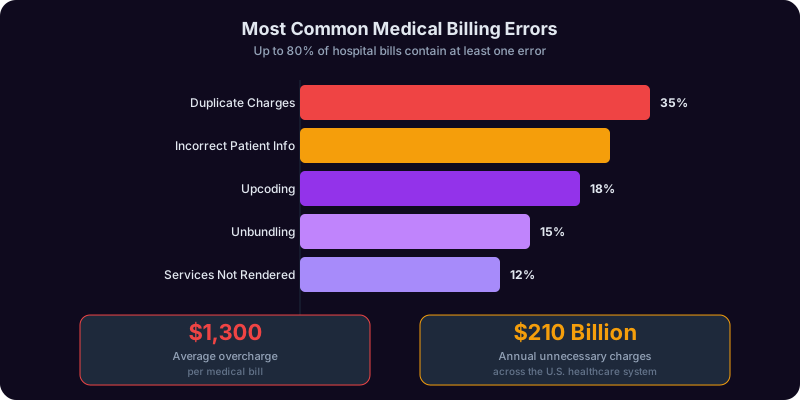
Here are the most common types of medical billing errors you should watch for:
Duplicate Charges
The same procedure, test, or supply is billed more than once. This happens frequently when shifts change during a hospital stay or when both a department and an individual provider submit charges for the same service. Example: You received one blood draw, but your bill shows two separate charges for venipuncture at $45 each.
Upcoding
A provider bills for a more expensive procedure or visit level than what was actually performed. For instance, a 15-minute office visit (CPT code 99213, typically $130-$180) might be billed as a comprehensive visit (CPT code 99215, typically $250-$350). Upcoding is technically fraud, but it happens at enormous scale - often through automated coding systems rather than deliberate deception.
Unbundling
Services that should be billed together under a single bundled code are broken out into separate line items, each at a higher price. A common example: a metabolic panel (CPT 80053, around $35-$100) gets unbundled into 14 separate tests billed individually, totaling $300-$500. The clinical result is identical, but the cost to you multiplies.
Incorrect Patient Information
Wrong insurance ID numbers, incorrect dates of birth, or misspelled names can cause claims to be denied and then billed to you at the full self-pay rate instead of your negotiated insurance rate. This alone accounts for roughly 20% of all billing errors.
Balance Billing (Surprise Billing)
Despite the No Surprises Act (effective January 2022), balance billing still occurs. Out-of-network providers at in-network facilities may still attempt to bill you for the difference between their charge and what your insurance pays. Under current federal law, this is illegal for emergency services and many non-emergency situations at in-network facilities - but enforcement depends on you catching it. The CMS No Surprises Act page explains your federal protections in detail.
Charges for Services Not Rendered
You may see charges for medications you never received, consultations that never happened, or supplies that were opened but never used. During hospital stays, this is especially common with surgical supply charges and pharmaceutical items.
The bottom line: never pay a medical bill without reviewing it carefully. The system is not designed to catch its own mistakes - it is designed to collect payment. You are the only quality control in this process.
Disclaimer: This guide provides general information about medical billing practices and dispute strategies. It is not legal or financial advice. Medical billing rules vary by state, insurer, and facility. Consult with a billing advocate or attorney for guidance on your specific situation.
See our real-world walkthrough: negotiating a raise.
Step 1: Get an Itemized Bill
The first and most important step in disputing any medical bill is requesting an itemized bill - not the summary statement that most hospitals send by default.
A summary statement shows a single total or a handful of broad categories ("Lab Services: $1,840" or "Operating Room: $12,500"). An itemized bill breaks down every single charge with its corresponding CPT (Current Procedural Terminology) code, a description of the service, the date it was performed, and the individual price.
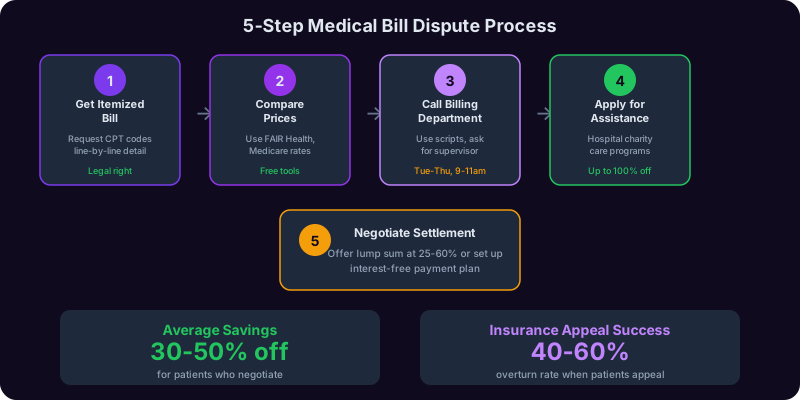
How to Request an Itemized Bill
You have a legal right to an itemized bill under HIPAA and most state laws. Here is exactly how to get one:
- Call the billing department (the number is on your summary statement). Say: "I would like a fully itemized bill showing every individual charge with CPT codes, dates of service, and unit prices."
- Be specific. If they offer to send "a detailed statement," clarify that you want line-by-line charges with procedure codes. Some billing departments will try to send a slightly more detailed summary instead of a true itemized bill.
- Put it in writing. Follow up your call with a written request sent by email or certified mail. Include your name, date of birth, account number, and the specific dates of service.
- Allow 30 days. Most facilities will send the itemized bill within 2-4 weeks. Some states require a response within 30 days of a written request.
What to Look for on Your Itemized Bill
Once you have the itemized bill, go through it line by line. Here is a checklist:
| What to Check | What It Means | Example Red Flag |
|---|---|---|
| Duplicate CPT codes on same date | You may have been billed twice for the same service | Two charges for CPT 36415 (blood draw) on 03/12 |
| CPT codes you do not recognize | Services you may not have received | CPT 99223 (high-level inpatient care) when you were in observation |
| Charges after discharge date | You should not be billed for services after you left | Pharmacy charges dated the day after discharge |
| Operating room time | Facilities charge per minute - verify the actual duration | Billed for 120 minutes of OR time when your procedure took 45 minutes |
| Room charges | Verify the room type matches what you had | Billed for a private room ($4,500/night) when you were in a semi-private ($2,800/night) |
| Medication quantities | Check that quantities match what you actually received | Billed for 10 doses of IV acetaminophen when you received 3 |
A common trick in hospital billing: charging for the entire package of a supply even if only one unit was used. For example, a surgical kit containing 20 gauze pads may be billed at full kit price ($85) even though only 2 pads were used. These charges are negotiable.
The Finance Copilot can help you analyze an itemized medical bill and flag charges that appear duplicated, inflated, or inconsistent with the services you received.
Step 2: Compare Prices and Know What Is Fair
Once you have your itemized bill, the next step is determining whether the prices charged are reasonable. Hospital pricing in the United States is notoriously opaque, but several tools now make comparison shopping possible - even after the fact.
Price Transparency Tools
Here are the most reliable resources for checking whether your charges are in line with market rates:
| Tool | What It Shows | Best For | Cost |
|---|---|---|---|
| FAIR Health Consumer | Usual and customary charges by ZIP code and CPT code | Out-of-network price benchmarking | Free |
| Healthcare Bluebook | Fair price ranges with green/yellow/red ratings | Quick fair-price checks for common procedures | Free |
| Medicare Fee Schedule (CMS) | What Medicare pays for each CPT code | Establishing a baseline minimum | Free |
| Hospital Price Transparency Files | Each hospital's own negotiated rates (required by federal law since 2021) | Seeing what insurers actually pay at your specific hospital | Free |
The FAIR Health Consumer tool is especially useful because it shows you what other providers in your ZIP code charge for the same CPT codes, giving you objective data for negotiation. The CMS Medicare Physician Fee Schedule provides the baseline that all other pricing is measured against.
How to Use Medicare Rates as a Benchmark
Medicare rates represent what the federal government has determined is a fair payment for a medical service. While hospitals routinely charge 2-5x the Medicare rate, Medicare rates give you an objective baseline for negotiation. Here is how the math typically works:
- Medicare rate for a service: $500
- What most insurers negotiate: $750-$1,500 (150-300% of Medicare)
- What hospitals charge the uninsured: $2,000-$4,000 (400-800% of Medicare)
- A reasonable negotiation target: 150-200% of Medicare rate ($750-$1,000)
Real Price Comparisons That Show Why This Matters
The price variation for common medical services in the United States is staggering:
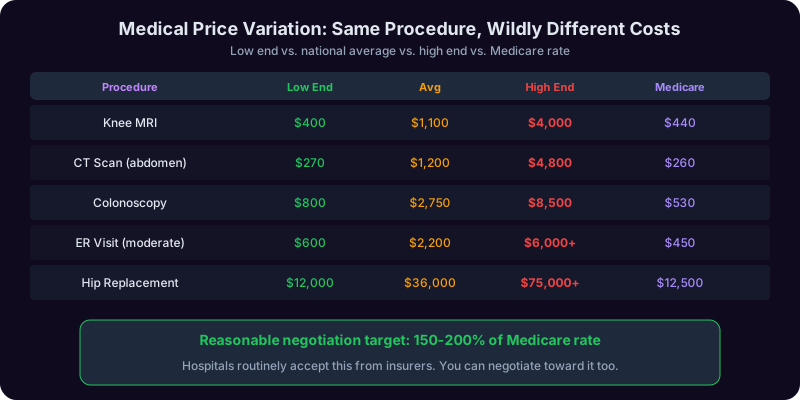
| Service | Low End | National Average | High End | Medicare Rate |
|---|---|---|---|---|
| Knee MRI | $400 | $1,100 | $4,000 | $440 |
| CT Scan (abdomen) | $270 | $1,200 | $4,800 | $260 |
| Colonoscopy | $800 | $2,750 | $8,500 | $530 |
| ER Visit (moderate) | $600 | $2,200 | $6,000+ | $450 |
| Vaginal delivery (uncomplicated) | $5,000 | $14,800 | $30,000+ | $4,200 |
| Hip replacement | $12,000 | $36,000 | $75,000+ | $12,500 |
If your bill is at the high end of these ranges, you have significant room to negotiate. If it exceeds the high end, something is likely wrong with the billing itself.
Using Hospital Price Transparency Files
Since January 2021, all hospitals in the United States are required by federal law to publish their negotiated rates with insurers in machine-readable files. This is a powerful negotiation tool because you can see exactly what Blue Cross or Aetna pays for the same service at the same hospital. To find these files:
- Go to your hospital's website
- Search for "price transparency" or "standard charges"
- Download the machine-readable file (usually a CSV or JSON file)
- Search for the CPT codes from your itemized bill
If your insurance company is paying $1,200 for a knee MRI at your hospital but you are being billed $3,800 as a self-pay patient, you now have documented proof that the hospital accepts $1,200 as full payment from insurers. This is powerful leverage in negotiation.
For help interpreting pricing data and comparing your charges to fair market rates, the Health Copilot can walk you through the analysis for each line item on your bill.
Step 3: Call the Billing Department - Scripts That Work
Armed with your itemized bill and pricing research, you are now ready to contact the billing department. This is where most people fail - not because their case is weak, but because they do not know what to say, who to ask for, or how to escalate. Here is a proven approach.
When to Call
Call Tuesday through Thursday, between 9:00 AM and 11:00 AM in the hospital's local time zone. Mondays are the busiest day for billing departments (weekend backlog). Fridays tend to have reduced staffing. Mid-morning means the morning rush is over but staff are not yet thinking about lunch. Average hold times are shortest during this window.
Who to Ask For
The first person you speak with is typically a collections representative or customer service agent. They have limited authority to adjust bills. Politely ask for:
- A billing supervisor - they can approve adjustments up to a certain threshold (usually $500-$2,000)
- A patient financial counselor - they handle financial assistance applications and can connect you with discount programs
- The revenue cycle manager - for larger disputes ($5,000+), this person has authority to approve significant adjustments
Script 1: Reporting Billing Errors
Use this when you have identified specific errors on your itemized bill.
"Hello, my name is [Name] and my account number is [Number]. I have reviewed my itemized bill for my [date] visit and I have found what appear to be billing errors. Specifically, I see [describe the error - duplicate charge, incorrect code, service not received]. I would like to have these charges reviewed and corrected. Can you connect me with someone who can review itemized charges?"
Script 2: Negotiating a Lower Price
Use this when the charges are technically correct but significantly above fair market rates.
"I have been comparing the charges on my bill to fair market rates using Healthcare Bluebook and the Medicare fee schedule, and several charges appear to be significantly above the usual and customary rate for my area. For example, the [specific service] was billed at [your amount], but the fair market rate for my ZIP code is [fair rate]. I would like to discuss adjusting these charges to a more reasonable level. Is there a supervisor or financial counselor I can speak with about this?"
Script 3: Requesting a Self-Pay Discount
Many hospitals offer automatic discounts of 20-50% for self-pay patients (those without insurance or paying out-of-pocket for non-covered services). Some hospitals offer these proactively, but most do not - you have to ask.
"I understand that many hospitals offer a self-pay or prompt-pay discount. Does your facility have a self-pay discount policy? I am prepared to settle this account, and I would like to know what options are available for reducing the balance for a cash-paying patient."
Script 4: Escalation
If the first person you speak with says they cannot help, do not accept that as the final answer.
"I understand this may be outside your authority to adjust. Could you please connect me with your billing supervisor or patient financial services department? I have documented evidence of pricing discrepancies and I would like to discuss this with someone who has the authority to review and adjust charges."
Key Negotiation Tactics
- Always be polite but persistent. Billing department employees deal with angry callers all day. Being calm and respectful makes them more likely to help you.
- Reference specific numbers. "This charge seems high" is weak. "This charge is $2,800, which is 340% of the Medicare rate and above the 90th percentile for my region" is strong.
- Take notes. Write down the name of every person you speak with, the date and time, and what was said or promised.
- Ask for a reference number for every adjustment or promise made.
- Follow up in writing. After every productive call, send an email or letter summarizing what was discussed and agreed to.
If phone negotiations feel overwhelming, the Consumer Rights Copilot can help you prepare your talking points and draft follow-up correspondence based on your specific bill.
Step 4: Apply for Financial Assistance
Even if your bill is accurate and priced fairly, you may still qualify for significant financial assistance - potentially reducing your bill to zero. This is one of the most underutilized tools in medical billing, and hospitals are not required to tell you about it unless you ask.
Hospital Financial Assistance Programs (Charity Care)
Under the Affordable Care Act (ACA), every nonprofit hospital in the United States is required to have a financial assistance policy. This is not optional - it is a condition of their tax-exempt status under Section 501(r) of the Internal Revenue Code. Approximately 58% of all U.S. hospitals are nonprofit, including most major medical centers and university hospitals.
What this means for you: if you were treated at a nonprofit hospital, there is a formal program to reduce or eliminate your bill based on your income. The hospital must:
- Have a written financial assistance policy
- Make it widely available (on their website, in the billing department, in the ER)
- Process applications within a reasonable time frame
- Not pursue extraordinary collection actions (lawsuits, wage garnishment, credit reporting) before making a reasonable effort to determine if you qualify
Income Thresholds
Each hospital sets its own income thresholds, but typical guidelines look like this:
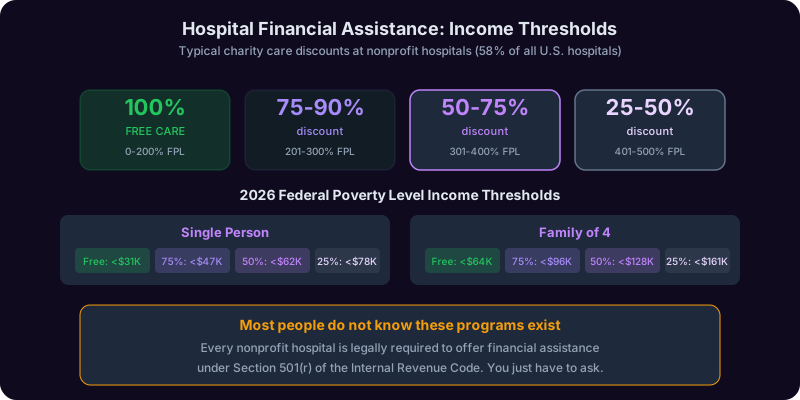
| Household Income (% of Federal Poverty Level) | 2026 FPL for Single Person | 2026 FPL for Family of 4 | Typical Discount |
|---|---|---|---|
| 0-200% FPL | $0-$31,200 | $0-$64,200 | 100% write-off (free care) |
| 201-300% FPL | $31,201-$46,800 | $64,201-$96,300 | 75-90% discount |
| 301-400% FPL | $46,801-$62,400 | $96,301-$128,400 | 50-75% discount |
| 401-500% FPL | $62,401-$78,000 | $128,401-$160,500 | 25-50% discount (some hospitals) |
Note: Federal Poverty Level amounts are approximate for 2026 and vary by state for Alaska and Hawaii. Check your hospital's specific policy for exact thresholds.
How to Apply
- Find the application. Go to the hospital's website and search for "financial assistance" or "charity care." You can also call the billing department and ask them to mail you an application.
- Gather documentation. You will typically need: recent pay stubs (2-3 months), your most recent tax return, bank statements, proof of household size, and documentation of any hardship (job loss, disability, etc.).
- Complete the application thoroughly. Include all requested documents. Incomplete applications are the number one reason for denial.
- Submit and follow up. Send the application by certified mail or hand-deliver it and get a receipt. Follow up by phone every 2 weeks until you receive a decision.
- Appeal if denied. If you are denied, ask for the specific reason in writing. Many denials are due to missing documents, which you can provide and resubmit.
Other Financial Assistance Sources
Beyond hospital charity care, several other programs can help:
- Medicaid: If your income is below 138% of FPL in expansion states, you may qualify for Medicaid - and in many states, Medicaid can be applied retroactively to cover bills from the past 3 months.
- State and county programs: Many states have additional programs for residents who do not qualify for Medicaid but cannot afford medical bills. Search "[your state] medical bill assistance program."
- Disease-specific foundations: Organizations like the HealthWell Foundation, Patient Advocate Foundation, and disease-specific nonprofits (American Cancer Society, National MS Society) offer grants to help pay medical bills.
- Pharmaceutical assistance programs: If a large portion of your bill is medication-related, most major pharmaceutical companies have patient assistance programs that provide medications free or at reduced cost.
For help identifying which financial assistance programs you may qualify for based on your income and situation, the Budgeting Copilot can analyze your financial picture and point you toward the right programs. You can also read our guide on what to do when you cannot afford a doctor for additional resources.
Step 5: Negotiate a Payment Plan or Settlement
If financial assistance does not fully cover your bill and the billing department has not agreed to reduce charges to your satisfaction, it is time to negotiate a payment plan or lump-sum settlement. Hospitals would rather collect something than send your account to collections - and they know it. This gives you leverage.
Lump-Sum Settlement
Offering to pay a lump sum in exchange for a reduced balance is the single most effective negotiation tactic for medical bills. Here are the typical settlement ranges:
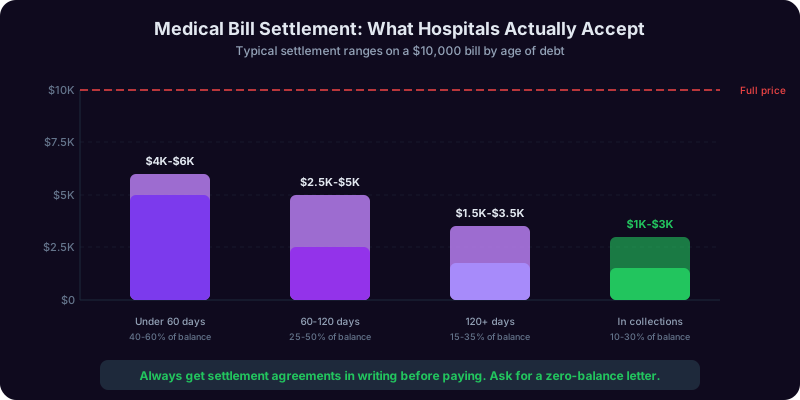
| Situation | Typical Settlement Range | Example on $10,000 Bill |
|---|---|---|
| Bill is less than 60 days old | 40-60% of balance | $4,000-$6,000 |
| Bill is 60-120 days old | 25-50% of balance | $2,500-$5,000 |
| Bill is 120+ days old or in pre-collections | 15-35% of balance | $1,500-$3,500 |
| Bill is with a collection agency | 10-30% of balance | $1,000-$3,000 |
Why do hospitals accept these discounts? Because collecting the full amount costs money - billing staff time, postage, collection agency fees (typically 25-50% of the amount collected), and the risk of collecting nothing if the patient files for bankruptcy or simply never pays.
How to Negotiate a Lump-Sum Settlement
Use this approach:
"I have been reviewing my options for resolving this balance. I am unable to pay the full amount of [total], but I am prepared to make a lump-sum payment of [your offer - start at 25-30% of the balance] to settle this account in full today. Would you be able to accept that as payment in full?"
Key rules for lump-sum negotiations:
- Start low. Your first offer should be 20-30% of the balance. You can always go up; you cannot go down.
- Have the money available. Be ready to pay immediately. "I can pay right now" is a powerful statement.
- Get it in writing before you pay. Never pay a settlement amount without a written agreement that the payment constitutes "payment in full" and that the remaining balance will be written off. This is critical.
- Ask for a zero balance letter after payment is processed, confirming the account is settled and no further amounts are due.
Payment Plans
If you cannot afford a lump sum, most hospitals will offer a payment plan. Here is what you need to know:
- Interest-free plans: Most hospitals offer interest-free payment plans if you ask. The key phrase is: "Do you offer a zero-interest payment plan?" Many hospitals are required to offer interest-free plans under their financial assistance policies.
- Monthly amounts: You can often negotiate the monthly payment amount. A common starting point is $50-$100/month, even on large balances. As long as you are making regular payments, most hospitals will not send the account to collections.
- Duration: Payment plans typically range from 12-60 months. Longer plans mean lower monthly payments, but make sure the plan does not include interest that kicks in after a certain period.
Credit Reporting Protections
Important changes you should know about:
- Since 2023: Medical debt under $500 is no longer reported on credit reports (all three major bureaus).
- Since 2023: Paid medical collections are removed from credit reports (previously they stayed for 7 years even after payment).
- Since 2023: New medical debt does not appear on credit reports until at least 365 days after being sent to collections, giving you a full year to resolve the bill before any credit impact.
- CFPB rule (2025): The Consumer Financial Protection Bureau finalized a rule to remove all medical debt from credit reports. Check the current status, as implementation timelines may have shifted.
This means you have more time and less credit risk than you think. Use this knowledge to negotiate from a position of calm rather than panic. Understanding how medical debt interacts with your overall credit is important - see our guide on understanding your credit score for more context.
Building an emergency fund is one of the best ways to prepare for unexpected medical expenses. Even $1,000 set aside gives you the ability to make a lump-sum offer on a smaller bill. If medical debt is being pursued by collectors, our guide on debt collector rights explains what collectors can and cannot do legally.
When to Hire a Medical Billing Advocate
If your bill is large, complex, or you are getting nowhere on your own, a professional medical billing advocate can be worth the investment. These specialists do nothing but fight medical bills - they know the codes, the pricing, the negotiation tactics, and the regulatory requirements that most patients do not.
What Medical Billing Advocates Do
- Audit your itemized bill line by line for errors, duplicate charges, upcoding, and unbundling
- Compare your charges to fair market rates and Medicare benchmarks
- Negotiate directly with the hospital billing department on your behalf
- File appeals with your insurance company for denied claims
- Apply for financial assistance programs and follow through on the paperwork
- Navigate the No Surprises Act and state balance billing protections
- Represent you in formal billing disputes and grievance processes
Typical Fees
Medical billing advocates typically charge one of two ways:
| Fee Structure | Typical Range | Best For |
|---|---|---|
| Percentage of savings | 25-35% of the amount they save you | Large bills ($5,000+) where savings potential is high |
| Flat fee | $100-$400 per bill | Smaller bills or straightforward error disputes |
| Hourly rate | $75-$200/hour | Complex cases involving multiple providers or insurance appeals |
When It Is Worth It
Consider hiring an advocate when:
- Your bill exceeds $5,000 and you have been unable to negotiate it down yourself
- You have been in the hospital for more than 3 days - longer stays have more billing errors and more room for negotiation
- You had surgery - surgical bills involve multiple providers (surgeon, anesthesiologist, facility, pathology) and are especially prone to errors
- Your insurance denied a claim and you believe the denial is incorrect - advocates have high success rates on insurance appeals (estimated 40-60% overturn rate)
- You are dealing with a billing department that will not cooperate - advocates speak the industry language and know the regulatory pressure points
How to Find a Reputable Advocate
- Alliance of Professional Health Advocates (advoconnection.com) - searchable directory of certified patient advocates
- Patient Advocate Foundation (patientadvocate.org) - offers free case management for patients with chronic or serious conditions
- AdvoConnection - directory of private patient advocates sorted by specialty and location
- Your state's consumer protection office - may have referrals to local billing advocacy resources
Ask any advocate you are considering: How many bills have you negotiated? What is your average savings percentage? Do you have experience with my type of bill (hospital, surgical, ER)? Can you provide references from past clients?
How AI Can Help You Fight Medical Bills
The complexity of medical billing is exactly the kind of problem that AI tools are built to solve. Analyzing an itemized bill with hundreds of line items, comparing CPT code pricing across databases, identifying patterns of upcoding or unbundling, and drafting negotiation letters are all tasks that require attention to detail and access to pricing data - strengths of AI-powered analysis.
How Copilotly Can Help
Copilotly offers several AI copilots that work together to help you navigate medical billing disputes:
- Finance Copilot: Upload your itemized bill and get a line-by-line analysis. The Finance Copilot can flag potential duplicate charges, identify CPT codes that may have been upcoded, and compare your charges against fair market rate databases. It can also help you calculate what a reasonable settlement offer would be based on the age and size of your bill.
- Health Copilot: Not sure what a specific procedure or test on your bill actually is? The Health Copilot can explain medical terminology in plain English, help you understand whether a billed service was clinically appropriate for your condition, and identify services that are commonly unbundled for billing purposes.
- Consumer Rights Copilot: Get help understanding your legal protections under the No Surprises Act, state balance billing laws, and hospital financial assistance requirements. The Consumer Rights Copilot can also help you draft dispute letters and formal complaints if your billing department is unresponsive.
- Insurance Copilot: If your insurance company denied a claim or paid less than expected, the Insurance Copilot can help you understand the denial reason, determine whether an appeal is warranted, and draft an appeal letter with the clinical documentation and regulatory references that insurance companies respond to.
- Budgeting Copilot: Facing a large medical bill you cannot pay in full? The Budgeting Copilot can help you assess what you can realistically afford, evaluate whether a lump-sum settlement or payment plan makes more financial sense, and create a plan to manage the payments without destabilizing your overall budget.
A Practical Workflow
Here is how to use AI tools effectively in your medical bill dispute:
- Start with the Finance Copilot to analyze your itemized bill and identify potential errors and overcharges
- Use the Health Copilot to understand any medical terms or procedures you do not recognize
- Check your rights with the Consumer Rights Copilot before contacting the billing department
- Prepare your negotiation strategy using the pricing comparisons and error analysis
- Draft your dispute letter or prepare your phone script with specific dollar amounts and references
- If your claim was denied, use the Insurance Copilot to prepare an appeal
Medical billing is a system that profits from complexity and patient confusion. AI tools do not replace professional billing advocates for the most complex cases, but for the vast majority of medical bill disputes - catching errors, comparing prices, understanding your rights, and preparing your case - they put you on a much more level playing field with hospital billing departments.
Protecting your financial health is closely tied to understanding your overall financial picture. If your credit score is a concern, addressing medical debt strategically can help protect it.
Frequently asked questions
How long do I have to dispute a medical bill?
There is no universal federal deadline for disputing a medical bill, but timing matters. Most hospitals will not send accounts to collections for at least 90-180 days after the final bill is issued. Once a bill goes to collections, you can still dispute it, but your leverage decreases. For insurance-related disputes, most plans require you to file an appeal within 180 days of the denial notice. The best practice is to request your itemized bill within 30 days of receiving your first statement and begin the dispute process immediately.
Can I dispute a medical bill that has already gone to collections?
Yes. You retain the right to dispute the bill even after it has been sent to a collection agency. Under the Fair Debt Collection Practices Act (FDCPA), if you send a written dispute within 30 days of the collector's first contact, they must stop collection efforts until they verify the debt. You can also still apply for the hospital's financial assistance program - many hospitals will pull the account back from collections if you submit a financial assistance application. Additionally, you can negotiate a settlement directly with the collection agency, often at a steeper discount (10-30% of the original balance) than the hospital would have accepted.
Will disputing a medical bill hurt my credit score?
No. Disputing a bill does not negatively affect your credit score. In fact, medical debt has less credit impact than ever before. Since 2023, medical debt under $500 is not reported on credit reports at all, paid medical collections are removed entirely, and new medical debt does not appear for at least 365 days after being sent to collections. Actively disputing and negotiating your bill is the best way to prevent credit damage because it keeps the bill from going to collections in the first place. As long as you are communicating with the billing department, most hospitals will not escalate to collections.
What if the hospital refuses to give me an itemized bill?
You have a legal right to an itemized bill. Under HIPAA, you are entitled to access your billing records, and many state laws specifically require providers to furnish itemized statements upon request. If the billing department refuses or delays, escalate by: (1) submitting a written request by certified mail referencing your rights under HIPAA and your state's medical billing transparency laws, (2) contacting the hospital's patient advocate or ombudsman, (3) filing a complaint with your state's attorney general consumer protection division, or (4) filing a complaint with the Centers for Medicare and Medicaid Services (CMS) if the hospital receives federal funding. Most hospitals will comply once they realize you know your rights.
Should I pay the bill while I am disputing it?
Generally, you should not pay the full amount while a dispute is active, but you should communicate that you are disputing. Paying in full before the dispute is resolved eliminates your leverage and makes it much harder to get a refund. However, if you are concerned about collections, you can make a small good-faith payment ($25-$50/month) while the dispute is being processed. This demonstrates willingness to pay and typically prevents the account from being sent to collections. Always document that your partial payment is not an acknowledgment that the full amount is correct.
Do I need a lawyer to dispute a medical bill?
In most cases, no. The vast majority of medical billing disputes are resolved through direct communication with the hospital billing department, financial assistance applications, or negotiated settlements. However, you may want to consult an attorney if: the bill exceeds $25,000 and the hospital is threatening legal action, you believe the hospital committed billing fraud (systematic upcoding or charges for services not rendered), the hospital has already obtained a judgment against you, or you are considering bankruptcy due to medical debt. Many consumer attorneys offer free consultations for medical billing disputes, and some work on a contingency basis for billing fraud cases.
What is the No Surprises Act and how does it protect me?
The No Surprises Act, effective January 2022, protects patients from unexpected out-of-network medical bills in specific situations. It covers emergency services at any facility (you cannot be balance-billed by out-of-network ER doctors), non-emergency services at in-network facilities by out-of-network providers you did not choose (such as an anesthesiologist or radiologist), and air ambulance services from out-of-network providers. Under the law, you only owe your in-network cost-sharing amount. If you receive a bill that violates these protections, you can file a complaint at cms.gov/nosurprises or call 1-800-985-3059. The law does not cover ground ambulance services or bills from out-of-network facilities you voluntarily chose.
How much can I realistically expect to reduce my medical bill?
The reduction depends on your situation, but most people who actively negotiate see meaningful results. If billing errors are found, you can expect the incorrect charges to be fully removed (often 10-30% of the total bill). Self-pay discounts typically range from 20-50% off the billed amount. Financial assistance programs at nonprofit hospitals can reduce bills by 50-100% for qualifying patients. Lump-sum settlement offers are commonly accepted at 25-60% of the balance. On average, patients who dispute and negotiate their medical bills save $1,300-$3,000, with savings on larger hospital bills sometimes exceeding $10,000.
Can I negotiate a medical bill if I have insurance?
Yes. Even with insurance, you may be responsible for deductibles, copays, coinsurance, and out-of-network charges that can add up to thousands of dollars. You can negotiate your portion of the bill using the same strategies: request an itemized bill, check for errors, compare prices, and ask for a discount or payment plan. Additionally, if your insurer denied a claim or applied it to your deductible incorrectly, you can appeal the insurance decision. Many insured patients successfully reduce their out-of-pocket costs by 20-40% through negotiation and error correction.
Get AI-Powered Help Disputing Your Medical Bill
Upload your itemized medical bill and get an instant analysis of potential errors, overcharges, and a personalized negotiation strategy - no $200/hour billing advocate required.
- Finance & Money CopilotAnalyze itemized medical bills line by line to identify errors, duplicate charges, and overcharges
- Health & Medical CopilotUnderstand medical terminology, procedures, and whether billed services were clinically appropriate
Free plan, no card. Pro from $4.99/week for every copilot across all 20 domains - about what one hour with any single professional costs per year.
Not a financial advisorThis is financial information, not financial advice. Consult a licensed financial professional.