
Money & Finance
Roth vs Traditional IRA: The Tax Math at Every Income Level
The Roth vs traditional answer flips depending on your bracket: at lower incomes the Roth's tax-free growth usually wins, while high earners often net more from the traditional deduction plus a later conversion. This guide runs the actual math at several income levels, covers the 2026 limits and phase-outs, and walks through the backdoor Roth for those over the cap.
The Fundamental Difference: Tax Now vs. Tax Later
At its core, the Roth IRA vs Traditional IRA decision comes down to one question: do you want to pay taxes on your retirement savings now, or later? Everything else - contribution limits, income thresholds, withdrawal rules - is a variation on that single theme.
The Seed vs. the Harvest Analogy
Imagine a farmer who can choose to pay taxes on seeds or on the harvest. A Traditional IRA is like paying taxes on the harvest. You plant your seeds tax-free (your contributions are tax-deductible), the crop grows tax-free, but when you harvest in retirement, every dollar you withdraw is taxed as ordinary income. A Roth IRA is the opposite. You pay taxes on the seeds (contributions are made with after-tax dollars), the crop grows tax-free, and the entire harvest is yours - withdrawals in retirement are completely tax-free.
The mathematical reality is straightforward: if your tax rate is the same today as it will be in retirement, both accounts produce the exact same after-tax result. Invest $7,000 in a Traditional IRA at a 22% tax rate, and it grows to $54,174 over 30 years at 7% average annual returns. Withdraw it all and pay 22% tax, and you keep $42,256. Invest $5,460 in a Roth IRA (the after-tax equivalent of $7,000 at 22%), and it grows to $42,256 - the same number, with no tax due at withdrawal.
The decision gets interesting - and consequential - when your tax rates differ between now and retirement. If you expect to be in a higher bracket later (because your career is growing, tax rates may rise, or you will have significant other retirement income), the Roth wins. If you are in a higher bracket now than you expect to be in retirement, the Traditional IRA wins.
A Quick Comparison
| Feature | Traditional IRA | Roth IRA |
|---|---|---|
| Tax on contributions | Deductible (pre-tax) | Not deductible (after-tax) |
| Tax on growth | Tax-deferred | Tax-free |
| Tax on withdrawals | Taxed as ordinary income | Tax-free (if qualified) |
| Best when | Current tax rate is higher | Future tax rate will be higher |
Most people dramatically oversimplify this choice. They pick based on a gut feeling or a rule of thumb they read somewhere. But the difference between the right and wrong choice can be tens of thousands of dollars over a career. The Finance Copilot can model both scenarios using your actual income, expected career trajectory, and state tax situation to show you exactly which account puts more money in your pocket at retirement.
This article is general information, not financial or tax advice. Consult a qualified financial advisor or tax professional for guidance specific to your situation.
2026 Contribution Limits and Income Thresholds
The IRS adjusts IRA contribution limits and income thresholds annually for inflation. Here are the numbers that matter for 2026.
Contribution Limits
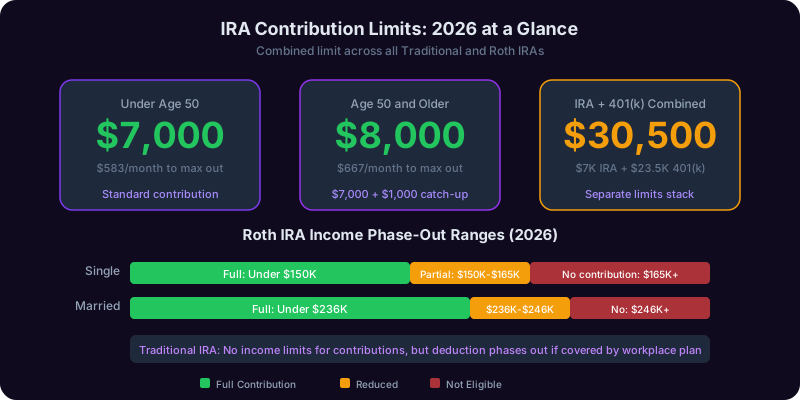
The maximum you can contribute across all your IRAs combined (Traditional and Roth) is:
- Under age 50: $7,000
- Age 50 and older: $8,000 (includes a $1,000 catch-up contribution)
This is a combined limit. If you contribute $4,000 to a Traditional IRA, you can contribute a maximum of $3,000 to a Roth IRA in the same year. You cannot contribute $7,000 to each.
You must have earned income (wages, salaries, self-employment income, or alimony received under pre-2019 agreements) at least equal to your contribution. If you earned $5,000 in 2026, your maximum contribution is $5,000 regardless of the general limit. Investment income, rental income, and Social Security do not count as earned income for IRA purposes.
Roth IRA Income Limits
The Roth IRA has income limits that restrict or eliminate your ability to contribute directly. For 2026:
| Filing Status | Full Contribution | Reduced Contribution | No Contribution |
|---|---|---|---|
| Single / Head of Household | MAGI under $150,000 | MAGI $150,000 - $165,000 | MAGI above $165,000 |
| Married Filing Jointly | MAGI under $236,000 | MAGI $236,000 - $246,000 | MAGI above $246,000 |
| Married Filing Separately | N/A | MAGI $0 - $10,000 | MAGI above $10,000 |
MAGI stands for Modified Adjusted Gross Income. For most people, this is very close to the adjusted gross income (AGI) on your tax return. It includes your salary, freelance income, investment income, and a few add-backs like student loan interest deductions and foreign earned income exclusions. For the latest IRS guidance on IRA contribution limits, see IRS.gov IRA contribution limits. Try our AI tax filing assistant for step-by-step help.
Reduced Contribution Calculation
If your income falls in the phase-out range, here is how to calculate your reduced Roth IRA contribution. For a single filer earning $157,500 in 2026:
- Subtract the lower limit: $157,500 - $150,000 = $7,500
- Divide by the phase-out range: $7,500 / $15,000 = 0.50
- Multiply by the full contribution limit: $7,000 x 0.50 = $3,500
- Subtract from the full limit: $7,000 - $3,500 = $3,500
Your maximum Roth IRA contribution would be $3,500.
Traditional IRA Deduction Limits
Anyone with earned income can contribute to a Traditional IRA regardless of income. However, the tax deduction may be limited if you or your spouse are covered by a workplace retirement plan (401(k), 403(b), etc.):
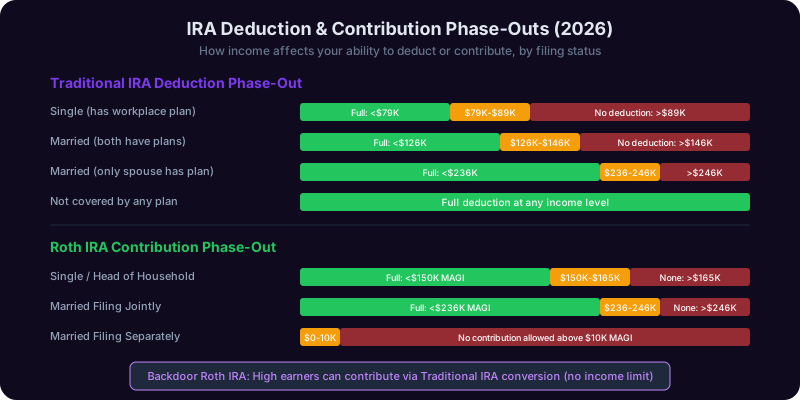
| Situation | Full Deduction | Partial Deduction | No Deduction |
|---|---|---|---|
| Single, covered by workplace plan | MAGI under $79,000 | MAGI $79,000 - $89,000 | MAGI above $89,000 |
| Married (both covered) | MAGI under $126,000 | MAGI $126,000 - $146,000 | MAGI above $146,000 |
| Married (only spouse covered) | MAGI under $236,000 | MAGI $236,000 - $246,000 | MAGI above $246,000 |
| Not covered by any plan | Any income | N/A | N/A |
This is a critical distinction. If you are not covered by a workplace plan and neither is your spouse, you can deduct your full Traditional IRA contribution regardless of income. The Tax Copilot can determine your exact eligibility based on your filing status, income, and workplace plan coverage.
Tax Implications Deep Dive: Deductions, Withdrawals, and RMDs
The tax treatment of each IRA type affects your finances in three distinct phases: when you contribute, while your money grows, and when you withdraw. Understanding all three is essential to making the right choice.
Phase 1: Contributions and Tax Deductions
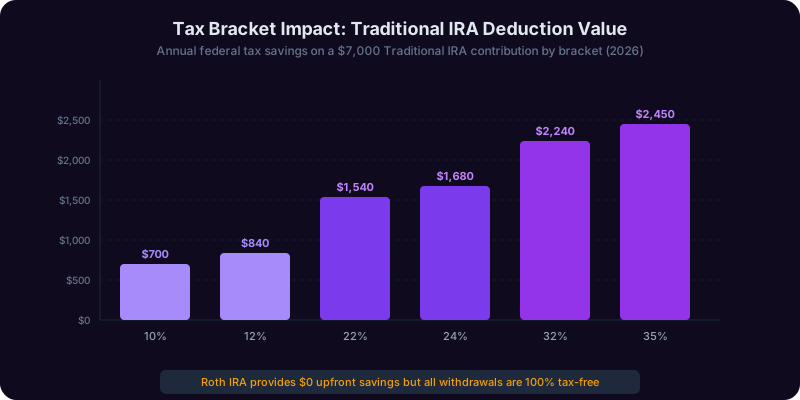
With a Traditional IRA, deductible contributions reduce your taxable income dollar for dollar. If you earn $75,000 and contribute $7,000, your taxable income drops to $68,000. At the 22% federal tax bracket, that saves you $1,540 in federal taxes for 2026. If you also live in a state with income tax (California at 9.3%, New York at 6.85%, etc.), your total tax savings are even larger.
With a Roth IRA, contributions provide zero tax benefit today. You contribute money that has already been taxed. There is no deduction, no credit, and no reduction in your current tax bill. The payoff comes later.
Phase 2: Growth
Both account types grow tax-free while the money remains inside the account. You pay no capital gains tax on stock appreciation, no tax on dividends, and no tax on interest. This is a massive advantage over a taxable brokerage account, where you owe taxes on dividends every year and capital gains when you sell.
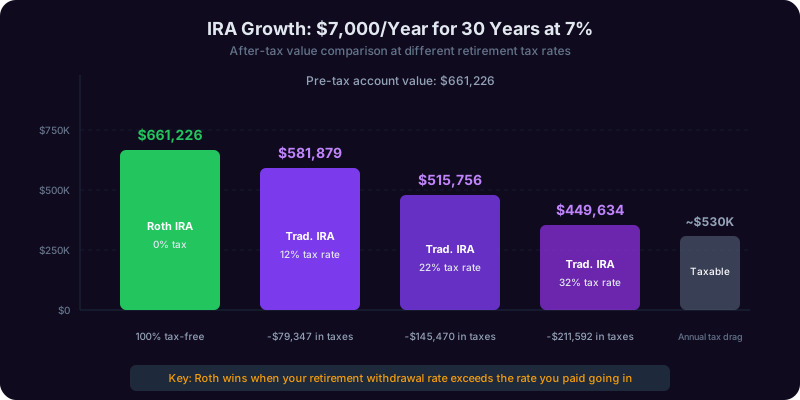
Over 30 years, the tax-free compounding effect is substantial. A $7,000 annual contribution growing at 7% reaches approximately $661,000. In a taxable account with the same returns (assuming 15% capital gains tax on growth and taxes on dividends along the way), the after-tax balance would be closer to $530,000 - roughly $131,000 less. According to research from the Federal Reserve's Survey of Consumer Finances, tax-advantaged retirement accounts remain the primary wealth-building vehicle for American families.
Phase 3: Withdrawals
This is where the two accounts diverge sharply:
Traditional IRA withdrawals are taxed as ordinary income at your marginal tax rate. A $50,000 withdrawal is treated identically to $50,000 in salary for tax purposes. If you are in the 22% bracket, that withdrawal costs you $11,000 in federal taxes. Withdrawals also count toward your provisional income for Social Security taxation and can push you into higher Medicare premium brackets (IRMAA surcharges).
Roth IRA withdrawals are completely tax-free if you meet two conditions: the account has been open for at least 5 years, and you are at least 59 1/2. Qualified Roth withdrawals do not appear on your tax return at all. They do not affect your Social Security taxation, do not trigger IRMAA surcharges, and do not push you into a higher tax bracket.
Required Minimum Distributions (RMDs)
Starting at age 73 (under current law, rising to 75 in 2033), Traditional IRA owners must take Required Minimum Distributions. The amount is calculated by dividing your account balance by a life expectancy factor from IRS tables. At age 73 with a $500,000 Traditional IRA balance, your first RMD is approximately $18,868. You must withdraw and pay taxes on this amount whether you need the money or not.
Roth IRAs have no RMDs during the owner's lifetime. Your money can continue growing tax-free for as long as you live. This makes the Roth IRA a superior tool for estate planning - you can pass the account to heirs who will receive tax-free withdrawals (though non-spouse beneficiaries must empty the account within 10 years under the SECURE Act).
Early Withdrawal Penalties
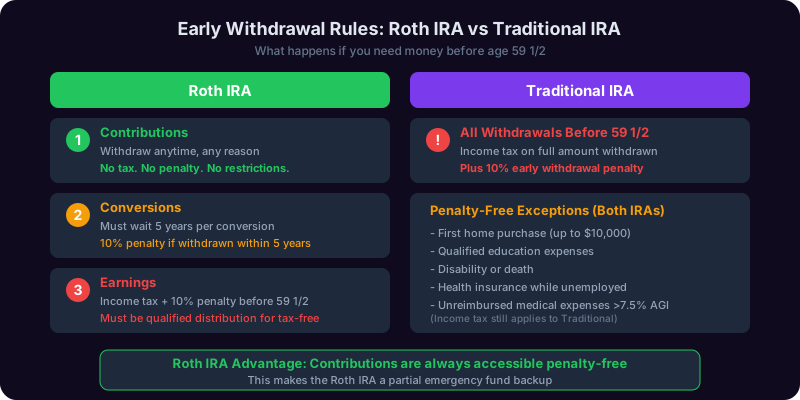
Both accounts impose a 10% early withdrawal penalty on earnings withdrawn before age 59 1/2, with some exceptions (first-time home purchase up to $10,000, qualified education expenses, disability, and others). However, Roth IRA contributions (not earnings) can be withdrawn at any time, for any reason, with no tax and no penalty. This gives the Roth IRA a flexibility advantage that the Traditional IRA cannot match.
Need help modeling how withdrawals from each account type affect your retirement tax bill? The Tax Copilot can project your effective tax rate in retirement and compare the after-tax income from each IRA type based on your expected Social Security benefits, pension income, and other sources.
Roth IRA: Who It Is Best For
The Roth IRA is one of the most powerful wealth-building tools in the tax code, but it is not the right choice for everyone. Here are the situations where a Roth IRA provides the most value.
Young and Early-Career Earners
If you are in your 20s or early 30s earning $40,000 to $60,000, the Roth IRA is almost certainly the better choice. You are likely in the 12% or 22% federal bracket - among the lowest tax rates you will ever pay. The tax deduction from a Traditional IRA saves you $840 to $1,540 on a $7,000 contribution. But if your income doubles or triples over the next 20 years, you could be withdrawing from that Traditional IRA at 24% or 32% - paying far more in tax than you saved.
With a Roth, you pay the low tax rate now and lock in tax-free growth for 30 to 40 years. That is decades of compounding with no tax drag, and no tax on the eventual withdrawal. For a 25-year-old contributing $7,000 annually to a Roth IRA until age 65, with 7% average returns, the account grows to approximately $1,497,000 - all of it tax-free.
People Expecting Higher Future Income
Graduate students, medical residents, early-career professionals in tech, law, or finance - anyone whose income trajectory is sharply upward. A medical resident earning $65,000 today will likely earn $250,000+ within a few years. The Roth lets you contribute now while you still qualify (before income limits phase you out) and pay taxes at a fraction of what your future rate will be.
Tax Diversification Strategists
Even if you are in a moderate bracket now, having a Roth IRA alongside your 401(k) gives you tax diversification in retirement. You can strategically withdraw from your Traditional 401(k) up to the top of a low bracket, then pull additional income from your Roth IRA tax-free. This keeps your effective tax rate low and gives you control over your taxable income year by year.
For example, a retired couple in 2026 can earn approximately $94,050 in ordinary income (including the standard deduction of $30,000) before hitting the 22% bracket. They could withdraw $94,050 from Traditional accounts taxed at 10-12%, then take any additional spending needs from their Roth IRA at 0% tax.
People Who Want Emergency Fund Flexibility
Because Roth IRA contributions can be withdrawn at any time without tax or penalty, the Roth doubles as a last-resort emergency fund. This does not mean you should treat your retirement account as a savings account. But knowing the money is accessible without penalty provides a psychological safety net that the Traditional IRA does not offer. If you withdraw $5,000 in contributions for an emergency, you lose the future tax-free growth on that $5,000 - a real cost - but you do not owe the IRS anything. For dedicated emergency savings strategies, see our complete emergency fund guide.
People Concerned About Future Tax Rate Increases
Federal income tax rates are historically low. The top marginal rate has been as high as 94% (1944) and 70% (1980). Today's top rate is 37%. If you believe tax rates are more likely to rise than fall over the next 20-30 years due to national debt, entitlement spending, or political shifts, the Roth IRA hedges against that risk. You pay today's known rate rather than gambling on an unknown future rate. The Congressional Budget Office's long-term fiscal outlook projects rising federal debt levels that may put pressure on future tax policy. Try our AI budget planning tool for step-by-step help.
Estate Planning
If you want to leave tax-free money to your heirs, the Roth IRA is unmatched. There are no RMDs during your lifetime, so the account can grow untouched for decades. When inherited, beneficiaries receive tax-free withdrawals (though they must empty the account within 10 years under current rules). A $500,000 inherited Traditional IRA might net an heir $350,000 after taxes. A $500,000 inherited Roth IRA is worth the full $500,000.
The Investment Copilot can help you build a portfolio strategy within your Roth IRA that maximizes the benefit of tax-free growth - typically by holding your highest-growth investments in the Roth where gains will never be taxed.
Traditional IRA: Who It Is Best For
The Traditional IRA gets less attention in personal finance media, but for the right person in the right situation, it is the mathematically superior choice. Here is when the Traditional IRA wins.
High Current Earners in Peak Brackets
If you are in the 32% or 35% federal tax bracket (single income above $197,300, or married filing jointly above $394,600 in 2026), a deductible Traditional IRA contribution saves you $2,240 to $2,450 on $7,000. If you expect your retirement income to be lower - drawing Social Security plus modest withdrawals from savings - you might withdraw those same dollars at the 12% or 22% rate. That is a 10 to 23 percentage point spread in your favor.
On $7,000, the tax arbitrage between a 35% deduction today and a 12% withdrawal in retirement is worth $1,610. Over 30 years of contributions, that difference compounds into tens of thousands of dollars.
Workers Nearing Retirement
If you are 55 to 65, the Traditional IRA's immediate tax deduction has a clear advantage. You have limited time for a Roth's tax-free growth to compound, and you get immediate tax relief when you need it most (often your peak earning years). The math favors the Traditional IRA when your investment horizon is under 10-15 years, because the upfront tax savings invested wisely can outpace the Roth's tax-free withdrawal benefit over a shorter period.
State Tax Deduction Benefits
If you live in a high-income-tax state (California, New York, New Jersey, Oregon, Minnesota, Hawaii), the Traditional IRA deduction applies to both federal and state taxes. A $7,000 contribution for someone in the 24% federal bracket and 9.3% California bracket saves $2,331 in combined taxes. If you plan to retire in a no-income-tax state (Florida, Texas, Nevada, Tennessee, Washington, Wyoming, South Dakota), the arbitrage is even larger: you deduct at your state's rate today and withdraw at 0% state tax in retirement.
Self-Employed Workers Managing AGI
Traditional IRA contributions reduce your Adjusted Gross Income (AGI), which affects eligibility for other tax benefits. A lower AGI can help you qualify for the self-employed health insurance deduction premium tax credit on ACA marketplace plans, avoid the Net Investment Income Tax (3.8% surcharge above certain income levels), and reduce or eliminate the phase-out of other deductions and credits.
For example, a freelancer earning $95,000 who contributes $7,000 to a Traditional IRA drops their AGI to $88,000. This could keep them below the threshold for the student loan interest deduction phase-out ($80,000-$95,000 for single filers) and reduce their ACA premium tax credit repayment.
People With No Workplace Retirement Plan
If neither you nor your spouse is covered by an employer-sponsored retirement plan, you can deduct your Traditional IRA contribution at any income level. There is no phase-out. A high earner making $200,000 who is not covered by a 401(k) can fully deduct a Traditional IRA contribution - an option that is not available to most W-2 employees at that income level.
When You Expect Lower Retirement Income
Not everyone's income increases over time. If you are a teacher, government employee, or someone in a stable but flat-salary career, your retirement income (Social Security plus modest savings) may genuinely be lower than your current income. In that case, the Traditional IRA's tax arbitrage works in your favor.
The Finance Copilot can project your retirement income from all sources - Social Security, pension, 401(k), IRA withdrawals, rental income - and determine whether your retirement tax rate is likely to be higher or lower than your current rate.
The Math: Real Scenarios at Different Income Levels
Theory only goes so far. Let us run the numbers for three real-world scenarios, each contributing $7,000 per year for 30 years at 7% average annual returns (approximately $661,000 in total account value at the end).
Scenario 1: Early-Career Earner - $45,000 Salary
Maria is 28, single, earns $45,000, and is in the 12% federal bracket. She lives in Texas (no state income tax).
| Traditional IRA | Roth IRA | |
|---|---|---|
| Annual tax savings | $840 | $0 |
| Account value at 58 | $661,226 | $661,226 |
| Tax on withdrawal (estimated 22%) | $145,470 | $0 |
| After-tax value | $515,756 | $661,226 |
| Tax savings reinvested at 7% | +$79,346 | N/A |
| Net after-tax wealth | $595,102 | $661,226 |
Roth wins by $66,124. Maria pays 12% now but avoids 22% later. Even accounting for the reinvested tax savings from the Traditional IRA, the Roth delivers significantly more after-tax wealth. This is the classic case for a Roth: low bracket today, higher bracket in retirement.
Scenario 2: Mid-Career Professional - $85,000 Salary
James is 35, single, earns $85,000 (before adjustments), and is in the 22% federal bracket. He lives in California (9.3% state tax on this income).
| Traditional IRA | Roth IRA | |
|---|---|---|
| Annual tax savings (federal + state) | $2,191 | $0 |
| Account value at 65 | $661,226 | $661,226 |
| Tax on withdrawal (estimated 22%) | $145,470 | $0 |
| Tax savings reinvested at 7% | +$207,095 | N/A |
| Net after-tax wealth | $722,851 | $661,226 |
Traditional IRA wins by $61,625 - but only if James retires somewhere with no state tax and stays in the 22% bracket or lower. If he retires in California and his combined federal and state rate in retirement is still 31%, the Roth wins. If he moves to Florida? The Traditional IRA wins by an even wider margin. The state tax variable is enormous in this scenario.
Scenario 3: High Earner - $130,000 Salary
Priya is 40, married filing jointly with a combined household income of $130,000. She is in the 22% federal bracket and lives in New York (6.85% state rate at this income). Her spouse has a 401(k) at work.
| Traditional IRA | Roth IRA | |
|---|---|---|
| Can she deduct? | Partial (spouse has 401k, income near phase-out) | Full contribution allowed |
| Annual tax benefit | ~$1,000 (partial deduction) | $0 |
| Account value at 65 | $661,226 | $661,226 |
| Tax on withdrawal (estimated 22%) | $145,470 | $0 |
| Net after-tax wealth | $540,756 | $661,226 |
Roth wins by $120,470. Priya cannot fully deduct the Traditional IRA because her spouse is covered by a workplace plan and their income exceeds the deduction phase-out threshold. A non-deductible Traditional IRA is almost always worse than a Roth IRA - you get no tax break going in, and you pay full ordinary income tax coming out. The Roth is the clear winner here.
Key Takeaways from the Math
- The Roth wins when your current bracket is lower than your expected retirement bracket
- The Traditional wins when your current bracket is higher than your expected retirement bracket, especially with state tax arbitrage
- A non-deductible Traditional IRA almost never makes sense - use a Roth or a backdoor Roth instead
- Reinvesting the tax savings from a Traditional IRA is crucial to making it competitive - most people spend the refund instead
These scenarios use simplified assumptions. Your actual situation involves Social Security timing, other retirement accounts, potential pension income, and changing tax laws. The Finance Copilot can run a personalized projection using your complete financial picture. For understanding how your IRA choice interacts with your workplace retirement plan, see our 401(k) vs Roth 401(k) guide.
Backdoor Roth and Conversion Strategies for High Earners
If your income exceeds the Roth IRA contribution limits ($165,000 for single filers, $246,000 for married filing jointly in 2026), you cannot contribute directly to a Roth IRA. But there is a legal workaround that high earners have used for over a decade: the backdoor Roth IRA.
How the Backdoor Roth IRA Works
The backdoor Roth is a two-step process:
- Contribute $7,000 to a Traditional IRA. Do not take a deduction (you likely cannot deduct it anyway at this income level). This is a non-deductible Traditional IRA contribution.
- Convert the Traditional IRA to a Roth IRA. Because you already paid taxes on the contribution (it was non-deductible), the conversion is tax-free on the contributed amount. Any growth between the contribution and conversion is taxable, which is why most people convert within days.
The result: $7,000 ends up in a Roth IRA, growing tax-free forever, even though your income technically disqualified you from contributing directly.
The Pro-Rata Rule: The Critical Trap
This is where many high earners make a costly mistake. The IRS applies the pro-rata rule to Roth conversions. If you have any pre-tax money in any Traditional IRA (including SEP IRAs and SIMPLE IRAs), the conversion is not just applied to the non-deductible portion. It is applied proportionally across all your Traditional IRA balances.
Example: You have a $93,000 Traditional IRA from old 401(k) rollovers (all pre-tax) and you contribute $7,000 non-deductible for a backdoor Roth. Total Traditional IRA balance: $100,000. Non-deductible portion: $7,000 (7%). When you convert $7,000 to a Roth, only 7% ($490) is tax-free. The other 93% ($6,510) is taxable income. At the 32% bracket, that is an unexpected $2,083 tax bill.
Solutions to the Pro-Rata Problem
- Roll existing Traditional IRA balances into your employer's 401(k). Most 401(k) plans accept incoming rollovers. Once your Traditional IRA balance is $0, the backdoor Roth conversion is clean. This is the most common solution.
- Convert everything to Roth at once. If your Traditional IRA balance is small enough, you can convert the entire balance to Roth, pay the tax, and start fresh. This makes sense if the balance is modest and you have cash to pay the tax bill without dipping into retirement funds.
- Use a Solo 401(k) instead of a SEP IRA if you are self-employed, because Solo 401(k) balances are not subject to the pro-rata rule (only IRA balances count).
Roth Conversion Ladder Strategy
If you have a large Traditional IRA or 401(k) balance, converting everything at once could push you into the 32% or 35% bracket. A Roth conversion ladder spreads the conversions over multiple years to stay within lower brackets.
Example: You have $500,000 in a Traditional IRA and are in the 24% bracket. Instead of converting all $500,000 (which would push much of it into the 32% and 35% brackets), you convert $50,000 per year over 10 years, keeping each conversion within the 24% bracket. Total tax on conversions: approximately $120,000 over 10 years. Converting all at once would cost approximately $160,000 in taxes. The ladder saves roughly $40,000.
This strategy is particularly powerful during gap years, sabbaticals, early retirement before Social Security kicks in, or any period when your income drops temporarily.
Mega Backdoor Roth
If your employer's 401(k) plan allows after-tax contributions and in-service distributions or in-plan Roth conversions, you may be able to contribute up to $70,000 total (the overall 401(k) limit for 2026) and convert the after-tax portion to Roth. This is the "mega backdoor Roth" and can shelter far more than the $7,000 IRA limit. Not all plans offer this - check with your HR department or plan administrator.
For a detailed walkthrough of how Roth conversions interact with your other income and deductions, the Tax Copilot can model the tax impact of different conversion amounts and help you find the optimal annual conversion to minimize your lifetime tax bill. For broader tax strategy around side hustle income, these conversion strategies can work alongside your self-employment tax planning.
See our real-world walkthrough: first freelance tax season.
How to Open and Fund an IRA: Step by Step
Opening an IRA takes about 15 minutes and requires no minimum balance at most major brokerages. Here is exactly how to do it, from choosing a provider to automating your contributions.
Step 1: Choose a Brokerage
The three largest IRA providers for individual investors are Fidelity, Schwab, and Vanguard. All three offer:
- $0 account minimums for IRAs
- $0 commissions on stock and ETF trades
- Broad investment selection: index funds, ETFs, individual stocks, bonds, CDs
- Strong mobile apps and online platforms
The practical differences between them are minimal for most investors. Fidelity has fractional share investing and a slightly more modern interface. Vanguard pioneered low-cost index investing and is structured as investor-owned (no outside shareholders). Schwab offers excellent customer service and recently merged with TD Ameritrade. Any of the three is a solid choice.
Avoid brokerages that charge annual account maintenance fees, require high minimum balances, or push proprietary high-fee funds. If someone at a bank or insurance company is actively selling you an IRA, scrutinize the fee structure carefully.
Step 2: Open the Account
You will need:
- Your Social Security Number
- Your employer's name and address (for IRS reporting)
- A bank account for funding (checking or savings)
- A beneficiary designation (who receives the account if you pass away - you can change this later)
During the application, you will choose between a Traditional IRA or Roth IRA. You can open both types at the same brokerage. The process is entirely online at all major brokerages.
Step 3: Fund the Account
You can fund your IRA via:
- Electronic bank transfer (ACH): Free, takes 1-3 business days. The most common method.
- Wire transfer: Same-day but may incur a $15-$30 fee from your bank.
- Check: Mail a check to the brokerage (slower but works).
- Transfer from another IRA: Called a trustee-to-trustee transfer. No tax consequences.
- Rollover from a 401(k): When leaving a job, you can roll your 401(k) into an IRA. Direct rollover (sent directly between institutions) avoids mandatory withholding.
Step 4: Choose Your Investments
Your IRA is just a container. The money inside needs to be invested. Here are common approaches ranked from simplest to most involved:
Target-date fund (simplest): A single fund that automatically adjusts its stock-to-bond ratio as you approach retirement. Pick the fund closest to your expected retirement year (e.g., Fidelity Freedom Index 2060 or Vanguard Target Retirement 2060). Expense ratios are typically 0.10-0.15%.
Three-fund portfolio (moderate): A classic approach using three low-cost index funds:
- US total stock market index (e.g., VTI or FSKAX) - 60-70%
- International stock index (e.g., VXUS or FTIHX) - 20-30%
- US bond index (e.g., BND or FXNAX) - 0-20% (more bonds as you age)
Individual stock and ETF selection (advanced): Picking individual investments requires more research and carries more risk, but gives you full control. Most financial advisors recommend index funds for IRA accounts, where simplicity and low fees compound over decades. For a complete guide to getting started with investments, see our beginner investing guide.
Step 5: Automate Contributions
Set up automatic monthly contributions from your bank account to your IRA. To max out $7,000 per year, set up a recurring transfer of $583.33 per month (or $666.67 for those 50+ contributing $8,000). This approach, called dollar-cost averaging, removes the temptation to time the market and ensures you contribute consistently.
Most brokerages let you set up automatic investments as well - the money transfers from your bank to your IRA and is immediately invested in a fund of your choice, all without manual intervention.
Step 6: Review Annually
Once a year, check that:
- Your contributions are on track to max out the annual limit
- Your investment allocation still matches your risk tolerance and timeline
- Your beneficiary designations are current (especially after marriage, divorce, or children)
- Your income still qualifies for your chosen IRA type (check Roth income limits and Traditional deduction phase-outs)
If you are not sure which investments to choose inside your IRA, the Investment Copilot can recommend a portfolio allocation based on your age, risk tolerance, and retirement timeline. For understanding how your IRA fits into your broader financial picture - including credit building, emergency savings, and debt payoff - the Finance Copilot can help you prioritize across all your financial goals.
This is general information, not financial advice. Consult a qualified financial advisor for guidance specific to your situation.
Frequently asked questions
Can I contribute to both a Roth IRA and a Traditional IRA in the same year?
What happens if I contribute to a Roth IRA and my income ends up exceeding the limit?
Is a Roth IRA better than a 401(k)?
Can I withdraw from my Roth IRA before retirement without penalty?
I am over 50 and have never opened an IRA. Is it too late to start?
What is the backdoor Roth IRA and is it legal?
How does the spousal IRA work if my spouse does not have earned income?
Should I max out my IRA or pay off student loans first?
Find Your Optimal IRA Strategy
The Finance Copilot models Roth vs Traditional IRA outcomes using your actual income, tax bracket, and retirement timeline to show you exactly which option maximizes your after-tax wealth.
- Finance & Money CopilotModel your retirement income and compare Roth vs Traditional IRA outcomes for your specific situation
Free plan, no card. Pro from $4.99/week for every copilot across all 20 domains - about what one hour with any single professional costs per year.
Not a financial advisorThis is financial information, not financial advice. Consult a licensed financial professional.