
Money & Finance
Got $100 to Invest? Choose Between a Roth IRA, Brokerage, or HSA First
With fractional shares and zero-commission brokers, $100 is genuinely enough to start, but the account you pick first matters more than the fund. This guide settles the Roth IRA vs brokerage vs HSA question, shows how expense ratios eat returns, and lays out 1-fund, 2-fund, and 3-fund starter portfolios you can build today.
Why $100 Is Enough to Start Investing (And Why Waiting Costs You More)
The single biggest myth in personal finance is that you need a lot of money to start investing. You do not. $100 is more than enough to open a brokerage account, buy real investments, and begin building wealth. The financial industry spent decades reinforcing the opposite idea - mutual funds with $3,000 minimums, financial advisors who required $100,000 portfolios, and brokerage accounts that charged $10 per trade. That world is gone.
Today, every major brokerage offers $0 account minimums, $0 commissions, and fractional share investing. You can buy $25 worth of an S&P 500 index fund or $10 worth of Apple stock. The barriers that kept ordinary people out of the market have been demolished.
The Math of Starting Early
What makes $100 powerful is not the amount - it is the time you give it to grow. Compound interest is the engine that turns small, consistent contributions into significant wealth. Here is what happens when you invest $100 per month at a 7% average annual return (roughly the historical inflation-adjusted return of the U.S. stock market, based on data from the U.S. Securities and Exchange Commission):
| Time Horizon | Total Contributed | Portfolio Value | Growth from Returns |
|---|---|---|---|
| 5 years | $6,000 | $7,159 | $1,159 |
| 10 years | $12,000 | $17,308 | $5,308 |
| 20 years | $24,000 | $52,093 | $28,093 |
| 30 years | $36,000 | $121,997 | $85,997 |
| 40 years | $48,000 | $262,481 | $214,481 |
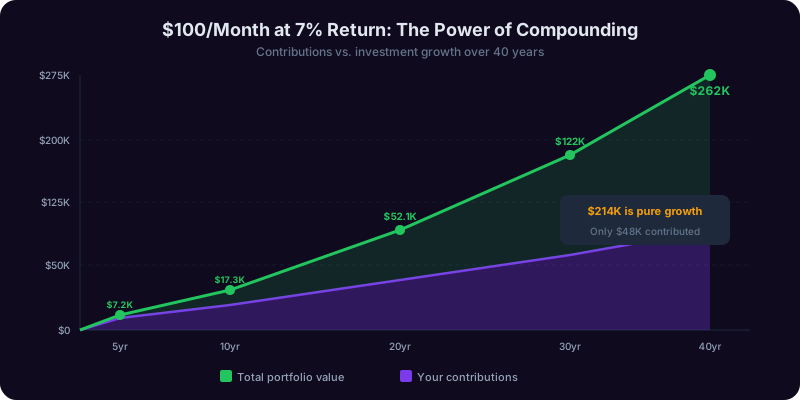
Read that last row carefully. If a 25-year-old invests $100 per month and never increases the amount, they will have over $262,000 by age 65 - and $214,000 of that is pure investment growth, money their money made for them. If they wait until 35 to start, they accumulate $121,997 instead. That ten-year delay costs $140,484. Waiting is the most expensive decision a beginner investor can make.
The Fractional Shares Revolution
Before 2019, if you wanted to buy a share of Amazon stock trading at $1,800, you needed $1,800. If you wanted to buy into the Vanguard Total Stock Market Index Fund (VTSAX), you needed the $3,000 minimum. With $100, your options were limited to a handful of cheap stocks or nothing at all.
Fractional shares changed everything. Every major brokerage now lets you buy a dollar amount of any stock or ETF, regardless of the share price. Want to invest $100 in an S&P 500 ETF trading at $520 per share? You buy 0.192 shares. You own the same investment, earn the same percentage returns, and receive the same proportional dividends as someone who bought 100 full shares. The playing field is level.
This means your $100 can be properly diversified from day one. You are not forced into penny stocks or speculative plays because they are all you can afford. You can buy into the same index funds that billionaires use.
What $100 Actually Buys You
When you invest $100 in a total U.S. stock market index fund, you are buying a tiny slice of over 3,600 companies - Apple, Microsoft, Amazon, Johnson & Johnson, JPMorgan Chase, and thousands of others. You instantly own a piece of the entire American economy. That $100 gives you exposure to technology, healthcare, finance, energy, consumer goods, and every other sector. No research required. No stock picking. No guessing which company will win.
The Investment Copilot can help you understand exactly what you are buying with your first $100 and how it fits into a long-term wealth-building strategy tailored to your age and goals.
This article is for educational purposes and does not constitute financial advice. All investing involves risk, including the potential loss of principal. Past performance does not guarantee future results. Consult a qualified financial advisor before making investment decisions.
Choosing the Right Account: Brokerage vs. Roth IRA vs. HSA
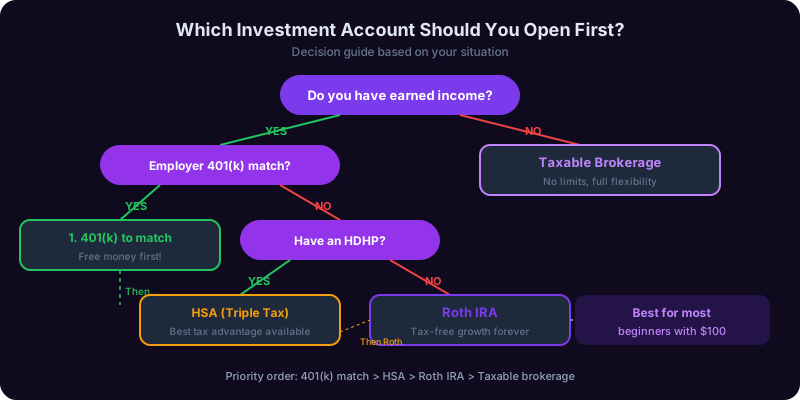
Before you invest your first dollar, you need to decide where to invest it. The type of account you open matters as much as what you buy inside it, because different accounts have different tax advantages, withdrawal rules, and contribution limits. Here are the three best options for a beginner with $100.
Option 1: Roth IRA - The Best Starting Point for Most Beginners
If you have earned income (a job, freelance work, gig economy income) and you are under the income limits, a Roth IRA is the single best account for a beginning investor. Here is why:
- Tax-free growth: Every dollar your investments earn inside a Roth IRA will never be taxed. Not when it grows, not when you withdraw it in retirement. If your $100 grows to $1,000 over 30 years, you keep all $1,000.
- No tax on qualified withdrawals: After age 59 1/2 (and the account has been open 5+ years), every withdrawal is completely tax-free.
- Contribution withdrawal flexibility: You can withdraw your contributions (not earnings) at any time, for any reason, with no tax or penalty. This makes the Roth IRA a partial safety net.
- No required minimum distributions: Unlike a Traditional IRA, you are never forced to withdraw money. It can grow tax-free for your entire life.
The 2026 contribution limit is $7,000 per year ($8,000 if you are 50 or older). Income limits for full contributions are $150,000 for single filers and $236,000 for married filing jointly. For a deep comparison of Roth vs. Traditional IRAs, see our complete Roth IRA vs Traditional IRA guide.
Option 2: Taxable Brokerage Account - Maximum Flexibility
A standard brokerage account has no contribution limits, no income limits, and no withdrawal restrictions. You can invest as much as you want and take money out whenever you need it. The tradeoff is taxes: you owe capital gains tax when you sell investments at a profit, and you owe tax on dividends each year.
A taxable brokerage account makes sense when:
- You have already maxed out your Roth IRA for the year
- You do not have earned income (you are a student living on savings, for example)
- You want to invest for a goal shorter than retirement (5-10 years out)
- You want complete flexibility with no withdrawal restrictions
The tax impact is manageable. Long-term capital gains (on investments held over one year) are taxed at 0%, 15%, or 20% depending on your income - significantly lower than ordinary income tax rates. Most beginning investors in lower brackets will pay 0% or 15% on their gains.
Option 3: HSA - The Triple-Tax-Advantage Account
If you have a High Deductible Health Plan (HDHP), you can contribute to a Health Savings Account. The HSA is the only account in the U.S. tax code with a triple tax advantage:
- Tax-deductible contributions (reduces your taxable income today)
- Tax-free growth (no tax on investment returns)
- Tax-free withdrawals for qualified medical expenses (now or in retirement)
The 2026 HSA contribution limit is $4,300 for individuals and $8,550 for families. After age 65, you can withdraw HSA funds for any purpose (not just medical) and pay only ordinary income tax - making it functionally identical to a Traditional IRA at that point, but with the added benefit of tax-free medical withdrawals.
Which Account Should You Open First?
| Your Situation | Best First Account | Why |
|---|---|---|
| Have earned income, income under $150K | Roth IRA | Tax-free growth is the most powerful long-term advantage |
| Have an HDHP at work | HSA (then Roth IRA) | Triple tax advantage is unmatched; fund both if possible |
| No earned income or need money in <5 years | Taxable brokerage | No income requirement, no withdrawal restrictions |
| Employer offers 401(k) match | 401(k) to match, then Roth IRA | Never leave free money on the table |
One critical point: if your employer offers a 401(k) match, contribute enough to get the full match before opening any other account. A 50% or 100% match is an instant guaranteed return that no other investment can beat. After capturing the match, open a Roth IRA for your next dollars. Learn more about the 401(k) decision in our 401(k) vs Roth 401(k) guide.
The Retirement Copilot can help you determine the optimal order of accounts based on your income, employer benefits, and tax situation. The Tax Copilot can clarify the tax implications of each account type. For broader financial planning around building your emergency fund alongside your investments, the Finance Copilot can create a prioritized plan.
Best Investments for $100: Index Funds, ETFs, and Target-Date Funds
You have opened your account. Now you need to decide what to actually buy with your $100. The good news: the best investments for beginners are also the simplest. You do not need to research individual companies, read earnings reports, or follow market news. You need one to three low-cost index funds.
What Is an Index Fund?
An index fund is a fund that holds every stock (or bond) in a particular market index. Instead of trying to pick the best stocks, it simply buys all of them. An S&P 500 index fund holds all 500 of the largest U.S. companies. A total stock market index fund holds essentially every publicly traded company in the U.S. - over 3,600 stocks.
Index funds beat the majority of professional stock pickers. According to the S&P Dow Jones SPIVA scorecard, over a 20-year period, approximately 90% of actively managed funds underperform their benchmark index after fees. The fund managers who do outperform rarely do so consistently. By buying the index, you are virtually guaranteed to outperform most professional investors over the long run.
ETFs vs. Mutual Funds
| Feature | ETF | Mutual Fund |
|---|---|---|
| Trading | Trades throughout the day like a stock | Trades once per day at market close |
| Minimum investment | Price of one share (or fractional) | Often $1 to $3,000 (varies by fund) |
| Expense ratios | Often slightly lower | Comparable at major brokerages |
| Tax efficiency | Slightly more tax-efficient | Slightly less (in taxable accounts) |
| Automatic investing | Not always supported | Easy to automate at most brokerages |
For a beginner with $100, the practical difference is negligible. At Fidelity, you can buy their mutual funds with no minimum investment. At Schwab and Vanguard, ETFs have no minimums when you use fractional shares. Pick whichever is easier at your brokerage.
The Best Funds for Beginners: Specific Tickers
U.S. Total Stock Market (your core holding):
- VTI - Vanguard Total Stock Market ETF (expense ratio: 0.03%)
- ITOT - iShares Core S&P Total U.S. Stock Market ETF (expense ratio: 0.03%)
- FSKAX - Fidelity Total Market Index Fund (expense ratio: 0.015%, no minimum)
- SWTSX - Schwab Total Stock Market Index Fund (expense ratio: 0.03%)
S&P 500 (large-cap U.S. stocks only):
- VOO - Vanguard S&P 500 ETF (expense ratio: 0.03%)
- IVV - iShares Core S&P 500 ETF (expense ratio: 0.03%)
- FXAIX - Fidelity 500 Index Fund (expense ratio: 0.015%, no minimum)
- SWPPX - Schwab S&P 500 Index Fund (expense ratio: 0.02%)
International Stocks:
- VXUS - Vanguard Total International Stock ETF (expense ratio: 0.07%)
- IXUS - iShares Core MSCI Total International Stock ETF (expense ratio: 0.07%)
- FTIHX - Fidelity Total International Index Fund (expense ratio: 0.06%)
U.S. Bonds:
- BND - Vanguard Total Bond Market ETF (expense ratio: 0.03%)
- AGG - iShares Core U.S. Aggregate Bond ETF (expense ratio: 0.03%)
- FXNAX - Fidelity U.S. Bond Index Fund (expense ratio: 0.025%)
Target-Date Funds (all-in-one, set-it-and-forget-it):
- Fidelity Freedom Index 2060 (FDKLX) - expense ratio: 0.12%
- Vanguard Target Retirement 2060 (VTTSX) - expense ratio: 0.08%
- Schwab Target 2060 Index Fund (SWYNX) - expense ratio: 0.08%
If You Only Buy One Thing
If you want the simplest possible starting point, invest your entire $100 in a total U.S. stock market index fund (VTI, ITOT, FSKAX, or SWTSX). You get instant diversification across the entire U.S. economy at an expense ratio of 0.015% to 0.03%. That means you pay $0.015 to $0.03 per year for every $100 invested. It does not get cheaper or simpler than this.
The Investment Copilot can recommend specific funds based on which brokerage you use and help you understand the differences between similar funds at different providers.
Understanding Fees and Expense Ratios: What Eats Your Returns
Fees are the silent killer of investment returns. They do not appear on a bill or show up as a charge on your bank statement. They are quietly deducted from your fund's returns, day after day, year after year. Understanding fees is one of the most important things a beginner investor can do, because small differences in fees lead to enormous differences in wealth over time.
What Is an Expense Ratio?
An expense ratio is the annual fee a fund charges to manage your money, expressed as a percentage of your investment. A fund with a 0.03% expense ratio charges you $0.30 per year for every $1,000 invested. A fund with a 1.00% expense ratio charges $10.00 per year for every $1,000.
How Fees Compound Against You
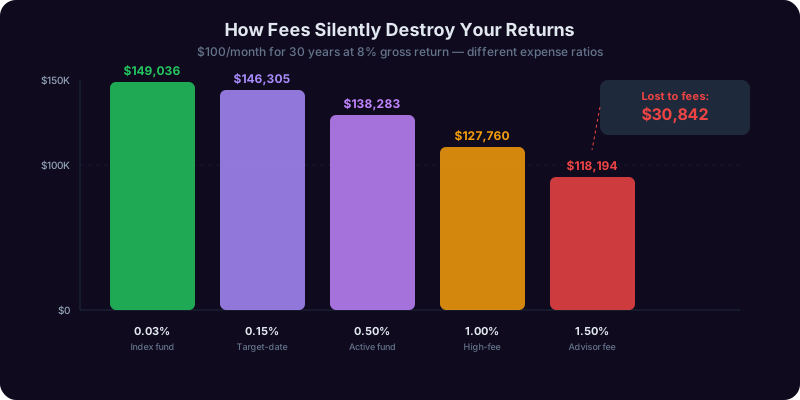
Here is the real cost of fees over time. Assume you invest $100/month for 30 years with an 8% gross market return:
| Expense Ratio | Annual Fee per $10K | Portfolio After 30 Years | Lost to Fees |
|---|---|---|---|
| 0.03% (index fund) | $3 | $149,036 | $1,000 |
| 0.15% (target-date fund) | $15 | $146,305 | $3,731 |
| 0.50% (average active fund) | $50 | $138,283 | $11,753 |
| 1.00% (high-fee active fund) | $100 | $127,760 | $22,276 |
| 1.50% (loaded fund or advisor) | $150 | $118,194 | $31,842 |
The difference between a 0.03% index fund and a 1.50% actively managed fund is $30,842 - on just $100 per month in contributions. That is real money stolen from your retirement by unnecessary fees.
Types of Fees to Watch For
- Trading commissions: All major brokerages (Fidelity, Schwab, Vanguard) charge $0 for stock and ETF trades. If your brokerage charges commissions, switch immediately.
- Account maintenance fees: Some brokerages charge annual fees of $25 to $75 for small accounts. The big three do not.
- Load fees: Some mutual funds charge a "load" - a sales commission of 3% to 5.75% when you buy or sell. Never buy a load fund.
- 12b-1 fees: Marketing fees buried inside a fund's expense ratio. Index funds from Fidelity, Schwab, and Vanguard do not have these.
- Advisory fees: Financial advisors typically charge 0.50% to 1.00% of assets annually, on top of fund expense ratios.
- Account transfer fees: Some brokerages charge $50 to $75 to transfer. Many receiving brokerages will reimburse this fee.
The Fee Comparison Rule
When evaluating any investment, apply this simple test: is there a nearly identical fund with a lower expense ratio? For beginning investors, target an expense ratio of 0.10% or less for stock index funds and 0.15% or less for target-date funds. The Finance Copilot can compare the fee structures of different funds and show you the long-term dollar impact of choosing one over another.
Building a Simple Portfolio: 1-Fund, 2-Fund, and 3-Fund Options
You do not need a complex portfolio to build wealth. In fact, simpler portfolios often outperform complicated ones because they have lower fees, less behavioral temptation to tinker, and broader diversification. Here are three portfolio approaches, from simplest to slightly more involved, all achievable with $100.
The 1-Fund Portfolio: Target-Date Fund
This is the simplest legitimate investment portfolio in existence. You buy one target-date fund and you are done.
Example (Fidelity): 100% in Fidelity Freedom Index 2060 (FDKLX) - expense ratio: 0.12%
Example (Vanguard): 100% in Vanguard Target Retirement 2060 (VTTSX) - expense ratio: 0.08%
The 2-Fund Portfolio: U.S. + International Stocks
| Fund | Ticker (Vanguard ETF) | Allocation | Expense Ratio |
|---|---|---|---|
| U.S. Total Stock Market | VTI | 70% | 0.03% |
| International Stock Market | VXUS | 30% | 0.07% |
With $100: Invest $70 in VTI and $30 in VXUS. Your blended expense ratio is approximately 0.042%.
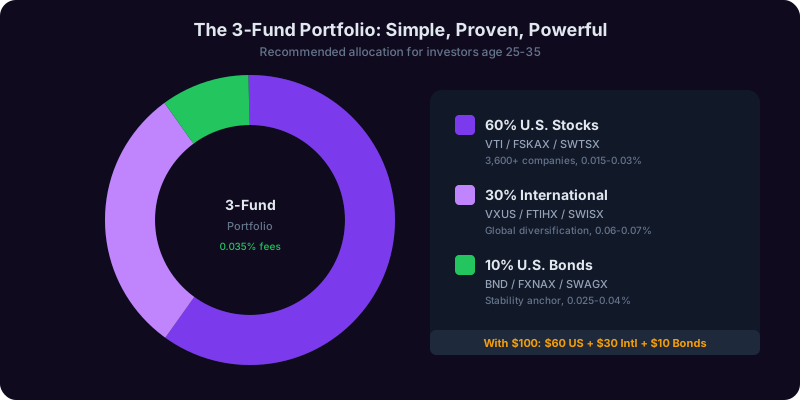
The 3-Fund Portfolio: The Gold Standard
| Asset Class | Fidelity Fund | Vanguard ETF | Schwab Fund | Suggested Allocation (Age 25-35) |
|---|---|---|---|---|
| U.S. Stocks | FSKAX (0.015%) | VTI (0.03%) | SWTSX (0.03%) | 60% |
| International Stocks | FTIHX (0.06%) | VXUS (0.07%) | SWISX (0.06%) | 30% |
| U.S. Bonds | FXNAX (0.025%) | BND (0.03%) | SWAGX (0.04%) | 10% |
With $100: Invest $60 in U.S. stocks, $30 in international stocks, and $10 in bonds. Your blended expense ratio is approximately 0.035%.
Rebalancing: Keeping Your Portfolio on Track
For a beginner with a small portfolio, the easiest way to rebalance is with new contributions. Instead of selling, simply direct your next few months of contributions to the underweight fund until the allocation is back on target. Rebalance once or twice a year.
Which portfolio should you choose? If you are unsure, start with the 1-fund target-date approach. The Investment Copilot can recommend the right allocation based on your age, risk tolerance, income stability, and how hands-on you want to be.
Common Beginner Mistakes That Cost You Money
Starting to invest is the hardest part. But once you have started, the second hardest part is avoiding the mistakes that sabotage your returns. Every mistake on this list is common, psychologically tempting, and expensive.
Mistake 1: Waiting for the "Right Time" to Invest
The research is unequivocal: time in the market beats timing the market. A study by Schwab analyzed investing $2,000 per year over 20 years using five strategies. Terrible timing - investing at the absolute worst moment every single year for 20 years - still vastly outperformed staying in cash.
Mistake 2: Checking Your Portfolio Too Often
The stock market goes down on roughly 46% of all trading days. Set a schedule: check your portfolio once a month at most.
Mistake 3: Picking Individual Stocks Instead of Index Funds
Professional fund managers fail to beat index funds 90% of the time over 20 years. Start with index funds. If you want to pick individual stocks later, limit it to 5-10% of your portfolio.
Mistake 4: Selling During a Market Downturn
The S&P 500 has recovered from every single downturn in its history. Every one.
Mistake 5: Investing Before Building an Emergency Fund
Before investing, build a small emergency buffer of at least $500 to $1,000 in a high-yield savings account. See our emergency fund guide for a complete framework.
Mistake 6: Paying High Fees Without Realizing It
As your portfolio grows to $50,000 and then $500,000, that 1% fee becomes $500 and then $5,000 per year. Review every fee you are paying.
Mistake 7: Following Social Media Investment Advice
Stick to the boring, proven strategy: low-cost index funds, regular contributions, long time horizon.
Mistake 8: Not Investing Because You Think $100 Is Too Little
$100 per month at 7% for 40 years grows to over $262,000. Starting with $100 today is infinitely better than starting with $1,000 next year.
The Budgeting Copilot can help you find $100 (or more) in your monthly budget to redirect toward investing.
When and How to Add More Money: Dollar-Cost Averaging Strategy
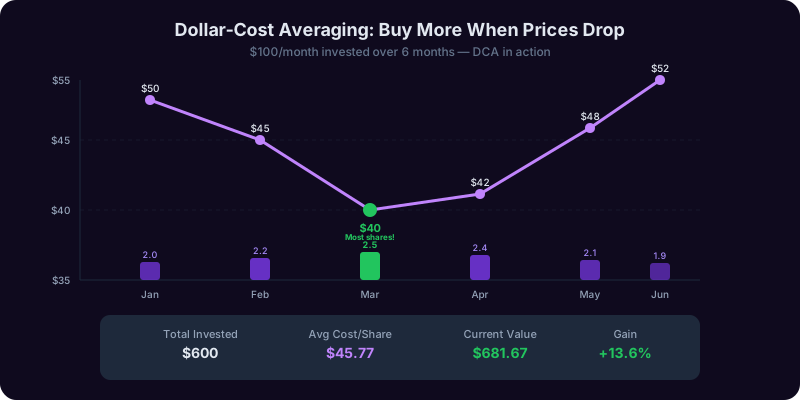
Your initial $100 is just the beginning. The real wealth-building power comes from consistent, ongoing contributions over time. The strategy that makes this work is called dollar-cost averaging (DCA).
What Is Dollar-Cost Averaging?
Dollar-cost averaging means investing a fixed dollar amount at regular intervals, regardless of what the market is doing.
| Month | ETF Price | Amount Invested | Shares Purchased |
|---|---|---|---|
| January | $50.00 | $100 | 2.000 |
| February | $45.00 | $100 | 2.222 |
| March | $40.00 | $100 | 2.500 |
| April | $42.00 | $100 | 2.381 |
| May | $48.00 | $100 | 2.083 |
| June | $52.00 | $100 | 1.923 |
Total invested: $600. Total shares: 13.109. Average cost per share: $45.77. Current value at $52: $681.67.
The Power of Increasing Contributions
| Strategy | Total Contributed | Portfolio Value at Year 30 |
|---|---|---|
| $100/month, never increasing | $36,000 | $121,997 |
| $100/month, increasing by $25/year | $79,500 | $282,640 |
| $100/month, increasing by $50/year | $123,000 | $443,283 |
By adding just $50 more per month each year, you go from $121,997 to $443,283.
Need help finding room in your budget for investments? The Budgeting Copilot can analyze your spending. If you have side hustle income, even small irregular amounts can be invested using the same DCA approach. And if you are starting a side hustle, investing even a portion of that extra income can accelerate your wealth-building significantly.
Apps and Platforms Compared: Where to Open Your Account
Choosing a brokerage is one of the first decisions you will make. The top brokerages are all excellent, all free for basic investing, and all offer the same core index funds.
Head-to-Head Comparison
| Feature | Fidelity | Charles Schwab | Vanguard | Robinhood |
|---|---|---|---|---|
| Account minimum | $0 | $0 | $0 | $0 |
| Stock/ETF commissions | $0 | $0 | $0 | $0 |
| Fractional shares | Yes ($1 min) | Yes ($5 min) | Limited (ETFs only) | Yes ($1 min) |
| Mutual fund minimums | $0 (Fidelity funds) | $0 (Schwab funds) | $1,000-$3,000 | Not available |
| Roth IRA available | Yes | Yes | Yes | Yes |
| HSA available | Yes | Yes | No | No |
| Best for | Overall best for beginners | Customer service + banking | Long-term buy-and-hold | Simple mobile-first |
Our Recommendation
For most beginners investing $100: open a Roth IRA at Fidelity. Invest in FSKAX (total U.S. stock market, 0.015% expense ratio, $0 minimum) or FZROX (total U.S. stock market, 0.00% expense ratio, $0 minimum). Set up automatic monthly contributions. You will have a professionally-structured, ultra-low-cost investment portfolio in 15 minutes.
The Investment Copilot can walk you through the account opening process at any major brokerage. For understanding how investing fits alongside your other financial priorities - from building credit to managing side hustle taxes - explore the full set of tools available in the Finance domain. If you are also considering setting a freelance rate, investing your freelance income wisely can accelerate your wealth building.
This article is for educational purposes and does not constitute financial advice. All investing involves risk, including the potential loss of principal. Past performance does not guarantee future results. Consult a qualified financial advisor before making investment decisions.
Frequently asked questions
Can I really start investing with just $100?
Should I pay off debt before I start investing?
What is the difference between an index fund and an ETF?
How much risk am I taking by investing $100 in the stock market?
Should I invest in a Roth IRA or a regular brokerage account with my $100?
What is dollar-cost averaging and should I use it?
Dollar-cost averaging (DCA) means investing a fixed amount at regular intervals regardless of market conditions. When prices are high, your money buys fewer shares. When prices drop, it buys more. Over time, this averages out your purchase price. Research shows lump-sum investing outperforms DCA about two-thirds of the time, but DCA has a significant behavioral advantage: it reduces the risk of investing all your money right before a downturn and panicking. For most people investing from each paycheck, DCA happens naturally.
Do I need to pay taxes on my investment gains?
It depends on the account type. In a Roth IRA, you pay no taxes on gains or withdrawals in retirement. In a traditional IRA or 401(k), gains grow tax-deferred, but you pay income tax on withdrawals. In a taxable brokerage account, you owe taxes on dividends annually and capital gains when you sell at a profit. Long-term gains (held over one year) are taxed at 0%, 15%, or 20% depending on income - much lower than ordinary income rates.
How do I know which index fund is right for me?
For most beginners, a total U.S. stock market index fund is the best single choice. Funds like VTI (Vanguard), FSKAX (Fidelity), or SWTSX (Schwab) give you exposure to over 3,600 companies. If you want simplicity with automatic rebalancing, a target-date fund matched to your retirement year is ideal. The key factors are: expense ratio (stay under 0.10%), diversification (broad market beats sector bets), and your time horizon. Do not overthink this - the difference between the top index funds is negligible.
Start Your Investment Journey with Confidence
The Investment Copilot helps you choose the right account, pick the best low-cost funds, and build a portfolio matched to your age, goals, and risk tolerance - all in a personalized, step-by-step conversation.
- Finance & Money CopilotBuild a complete financial plan that balances investing with debt payoff, emergency savings, and other priorities
Free plan, no card. Pro from $4.99/week for every copilot across all 20 domains - about what one hour with any single professional costs per year.
Not a financial advisorThis is financial information, not financial advice. Consult a licensed financial professional.