

The 2026 RTO + Disability Accommodation Collision
Legal disclaimer: This article is educational content, not legal advice. Disability and employment law is fact-specific and varies by jurisdiction. Consult a licensed attorney before acting on any information below, especially before filing a formal charge with the EEOC.
Between September 2025 and June 2026, the largest single shift in American workplace policy in a generation collided with the Americans with Disabilities Act. Amazon required five-day in-office attendance for all corporate staff starting January 2026. The federal Office of Personnel Management (OPM) directed all executive-branch agencies to terminate remote-work agreements except where required by accommodation. JPMorgan Chase, Goldman Sachs, AT&T, and Disney followed with strict on-site mandates. By Q2 2026, roughly 73% of S&P 500 companies required four or more in-office days, up from 38% a year earlier, according to Flex Index quarterly tracker data.
The collateral consequence: hundreds of thousands of workers who had been performing essential job functions from home - many of them with documented disabilities, chronic conditions, neurodivergence, or caregiver-linked health needs - were ordered to resume commuting. Many of those workers had never formally requested an ADA accommodation; the pandemic-era remote default made it unnecessary. The RTO mandate revealed an uncomfortable truth: informal flexibility is not a legal right, but a reasonable accommodation under the ADA is.
In April 2025, the U.S. Equal Employment Opportunity Commission updated its long-standing Enforcement Guidance on Reasonable Accommodation and Undue Hardship to clarify that telework - including full-time remote work - can be a reasonable accommodation when an employee has a disability that limits commuting, exposure tolerance, sensory processing, or stamina. The guidance explicitly stated that an employer cannot deny remote work as an accommodation solely because the employer prefers an in-person workforce or has a general RTO policy. The fact that other employees were ordered back is not, by itself, an undue hardship defense.
That guidance produced a measurable surge in filings. EEOC charge intake data through Q1 2026 showed ADA failure-to-accommodate charges up 41% year-over-year, with remote-work-denial fact patterns appearing in roughly one in three new ADA charges. The agency is now the primary battleground for the post-RTO economy, and the 180-day statutory window between a denial and a charge filing has become the single most important deadline in employment law for 2026.
This guide walks through every step of the legal mechanics: the interactive process the ADA requires before any denial is final, the written accommodation request that survives scrutiny, the EEOC Form 5 and its prima facie elements, the 180-day filing window (300 days in deferral states), what the agency does for the eight-month investigation phase, and how a right-to-sue letter unlocks federal court. The goal is not to win at any cost - it is to preserve your legal position while you keep working, keep getting paid, and keep your healthcare. Read on with the dual lens this guide will use throughout: protect the job, protect the case.
The ADA Interactive Process: What Your Employer MUST Do
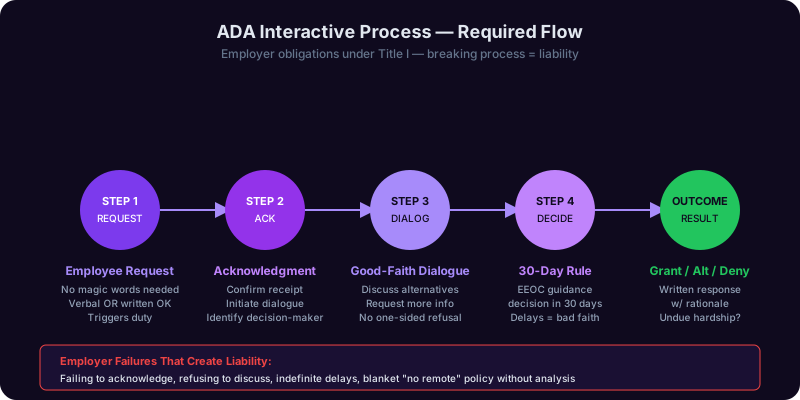
The ADA (42 U.S.C. § 12112) does not give a right to a specific accommodation. It gives a right to a process - the interactive process - where employer and employee work in good faith to identify a reasonable accommodation. Skipping or sabotaging the process is itself an ADA violation, even if the underlying accommodation would have been denied.
The process is triggered the moment an employee - or someone speaking for the employee - gives notice that an adjustment is needed for a medical condition. The notice need not mention “ADA,” “accommodation,” or “disability.” EEOC guidance is explicit: “Plain English suffices.” Telling a manager “I cannot come in because of my Crohn’s flare-ups” starts the clock.
Once triggered, the employer has five EEOC-framework obligations:
- Acknowledge in writing. Best practice (and many state laws) require written acknowledgment within five business days.
- Request only narrow medical documentation. The employer may ask for documentation of the disability and functional limitation, not full records or a specific diagnosis.
- Engage in dialogue. The employer must communicate about limitations and possible accommodations. A one-sided denial without dialogue is evidence of bad faith.
- Consider the preferred accommodation. The employer need not grant the first choice but must consider it and explain in writing why an alternative was selected.
- Conduct individualized undue hardship analysis. Boilerplate (“we need everyone in the office”) is not hardship. The employer must show specific, fact-based cost or disruption.
Federal courts have repeatedly found unreasonable delay during the interactive process is itself an ADA violation. The case-law benchmark is the 30-day rule: more than 30 calendar days between a complete request and a documented response is presumptively unreasonable. Some district courts apply a shorter window for straightforward requests like adjusted start times or remote work for roles where peers already work from home.
| Employer Behavior | Interactive Process Status | Evidence Value for EEOC Charge |
|---|---|---|
| Written acknowledgment within 5 days | Good faith engagement | Low - favors employer |
| No response after 30 days | Presumptive bad faith | High - strong charge evidence |
| Verbal denial, no written reason | Process incomplete | High - request written denial |
| Generalized “policy” denial | No individualized analysis | Very high - Title I violation |
The strategic implication: create a paper trail that proves the process happened (or did not). Follow every conversation with a written summary email. Follow every verbal denial with a polite request for the denial in writing. If your employer refuses to put the denial in writing, that refusal is itself evidence. For deeper coverage of how RTO exits become actionable, see RTO mandates and constructive discharge.
Step-by-Step: Writing the Accommodation Request That Survives Denial
The accommodation request is the most important document you will create. If denied, the EEOC investigator’s first ask will be: “Produce the request and your written response.” A vague request makes cause harder; a precise one narrows the employer’s defense to the merits.
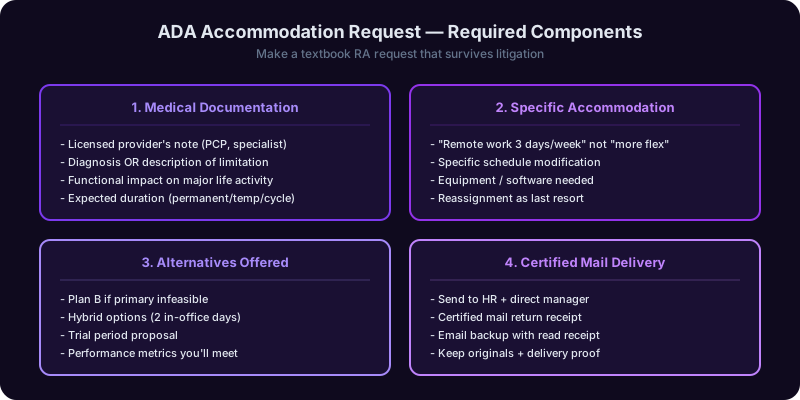
A surviving request has six components. Below: rationale and language patterns recommended by the DOL-funded Job Accommodation Network (JAN).
1. Identify yourself and the trigger
Open with full name, job title, employee ID, and the trigger. Example: “I am submitting this formal request for a reasonable accommodation under the ADA in response to the company’s January 6, 2026 return-to-office policy.” This anchors the request to a date that starts the interactive process clock.
2. Disclose only what is necessary
You need not share your diagnosis - only that (a) you have a covered disability and (b) the functional limitation. Example: “I have a chronic condition that substantially limits my ability to commute and manage sustained sensory environments. My treating physician confirms the condition meets the ADA definition.”
3. Identify the essential job functions
Reference the essential functions from your job description and explain which are affected. This pre-empts the most common defense - that the accommodation prevents performance. Example: “The essential functions of my role are individual contributor software development, code review, and asynchronous coordination. None require in-person presence; I performed all of them remotely from March 2020 through December 2025 with exceeds-expectations reviews.”
4. Propose specific accommodations
State your preferred accommodation, then propose two alternatives. Courts find that alternatives strengthen the good-faith presumption. Examples: full-time remote work, hybrid with two in-office days, modified start time, private workspace with HEPA filtration, or temporary remote work pending modifications.
5. Attach medical documentation
Include a letter from your treating physician that (a) confirms the disability, (b) describes the functional limitation in workplace terms, and (c) recommends accommodations. Omit diagnosis codes or treatment history unless specifically requested through a limited follow-up.
6. Send by certified mail and email
Send the original by USPS Certified Mail with return receipt to HR, and copy your manager and the company’s ADA coordinator by email. The certified receipt is independent proof of the request date - critical if the employer claims non-receipt.
| Common Mistake | Why It Hurts | Fix |
|---|---|---|
| Verbal-only request to manager | No proof of date or content | Email summary same day |
| Disclosing diagnosis upfront | Invites privacy and stigma issues | Functional limitations only |
| Requesting only one accommodation | Allows easy “all or nothing” denial | Propose 2-3 alternatives |
| No medical letter attached | Employer may demand more | Attach minimal physician letter |

Get Answers From the Legal Copilot
From the first accommodation request through the 180-day filing window and the right-to-sue letter, Copilotly’s Legal Copilot maps your conditions to the ADA, drafts every document, generates the EEOC narrative, and tracks every deadline. Free to start, lawyer-ready output.
When Denial Triggers an EEOC Charge
Not every denial is illegal, and not every illegal denial supports a charge. The threshold for a viable charge under ADA Title I (42 U.S.C. § 12112) is the prima facie case - minimum evidence to require an employer response. Four elements:
- You have a disability under the ADA Amendments Act of 2008 (broad construction, includes major life activities and bodily functions).
- You are qualified for the position, meaning you can perform essential job functions with or without reasonable accommodation.
- You requested a reasonable accommodation (or, in a few circuits, your need for one was so obvious that the employer was on notice without a formal request).
- The employer denied the accommodation - either expressly or constructively through delay, sabotaged interactive process, or undue hardship findings without individualized analysis.
What does not trigger a viable charge: denial backed by documented undue hardship; denial of an accommodation that eliminates an essential function; or denial where the employer offered an effective alternative. EEOC guidance: the law guarantees an effective accommodation, not the preferred one.
Constructive discharge vs accommodation denial
A consequential post-RTO decision: resign and claim constructive discharge or stay employed and file a failure-to-accommodate charge. The theories have different thresholds and remedies.
| Factor | Failure to Accommodate | Constructive Discharge |
|---|---|---|
| Required action | None - keep working | Must resign |
| Evidentiary threshold | Denial of request | Conditions so intolerable a reasonable person would quit |
| Back pay clock | Starts at adverse action | Starts at resignation |
| Healthcare during process | Preserved (still employed) | Lost at resignation |
| Filing window | 180/300 days from denial | 180/300 days from resignation |
Most 2026 RTO workers should stay employed and file the charge while still on payroll. Reasons: continued income, continued insurance during the 8-month investigation, and a stronger retaliation claim if the employer acts. The ADA prohibits retaliation; post-filing adverse actions trigger separate claims under 42 U.S.C. § 12203.
Exception: if the in-office requirement is so medically dangerous it would cause irreparable harm (severe immune compromise, for example), FMLA leave, unpaid medical leave, or constructive discharge may be required. Coordinate with a treating physician and lawyer first. For a broader analysis of when an RTO mandate crosses the constructive-discharge line, see the related guide on RTO and constructive discharge, and for related termination-stage filing mechanics, see EEOC wrongful termination filing.
The 180-Day Filing Deadline: Mechanics and Exceptions
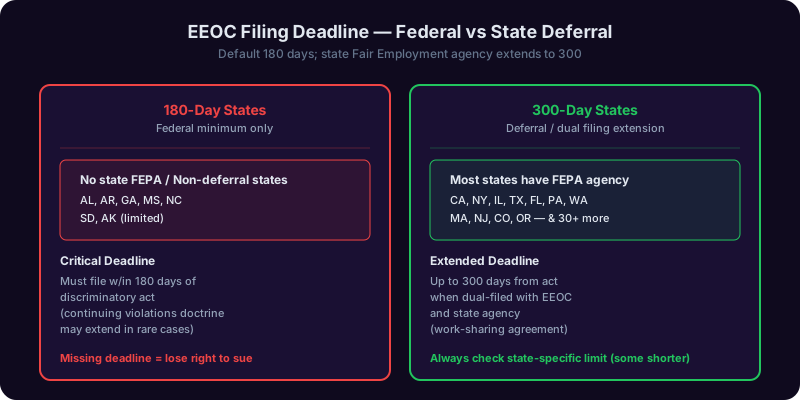
The single most important date in any ADA failure-to-accommodate matter is the deadline for filing an EEOC charge. Under 42 U.S.C. § 2000e-5(e)(1) and 42 U.S.C. § 12117(a), an employee must file with the EEOC within 180 calendar days of the discriminatory act. In states and localities that have their own fair employment practice agencies with work-sharing agreements with the EEOC - the so-called deferral states - the deadline is extended to 300 calendar days.
Almost every populous state is a deferral state, including California, New York, Texas, Florida, Illinois, Pennsylvania, Ohio, Massachusetts, New Jersey, Virginia, Washington, and Michigan. Workers in those states have 300 days. Workers in Alabama, Arkansas, Georgia, Mississippi, and a handful of others have only 180 days. The EEOC maintains a current list at EEOC timeliness rules.
When does the clock start?
The clock starts on the discrete discriminatory act. Courts have differed on what counts:
- Date of formal written denial (the cleanest, most defensible trigger)
- Date of the last interactive process meeting where the employer made the denial clear
- Date the employer’s deadline to respond expired without response (most courts apply 30 days)
- Date of the adverse action triggered by the unaccommodated condition (such as a write-up for non-attendance)
Conservative practice: treat the earliest plausible trigger as the start and file well before expiration. Filing early carries no penalty; filing late is jurisdictionally fatal.
The continuing violation doctrine
One narrow rescue: the continuing violation doctrine. The Supreme Court in National Railroad Passenger Corp. v. Morgan, 536 U.S. 101 (2002), held discrete acts must each be filed within 180/300 days, but hostile-environment claims can include earlier acts if any contributing act falls in the window. Some failure-to-accommodate patterns may qualify - particularly ongoing denial or repeated refusals to revisit. This is high-risk and should not be the primary timing argument.
Tolling
The clock can be tolled (paused) in narrow circumstances: fraudulent concealment by the employer, USERRA military duty, or documented incapacitation. Tolling is fact-specific and rarely granted.
| Event | Date | Days Remaining (180-day) | Days Remaining (300-day) |
|---|---|---|---|
| Written denial issued | February 1, 2026 | 180 | 300 |
| Deadline (180-day jurisdiction) | July 31, 2026 | 0 | 180 |
| Deadline (300-day jurisdiction) | November 28, 2026 | Expired | 0 |
If you are within 30 days of either deadline and have not yet filed, file immediately using the EEOC Public Portal. You can refine, supplement, or amend the charge later; you cannot recover an expired deadline.
What to Include in Your EEOC Charge of Discrimination
The EEOC’s formal charging document is Form 5 (Charge of Discrimination) - two pages, with the narrative section deciding the outcome. The assigned investigator will spend more time on the narrative than any other file document. A strong narrative satisfies the prima facie elements, pre-empts likely defenses, and gives the investigator a roadmap for evidence requests.
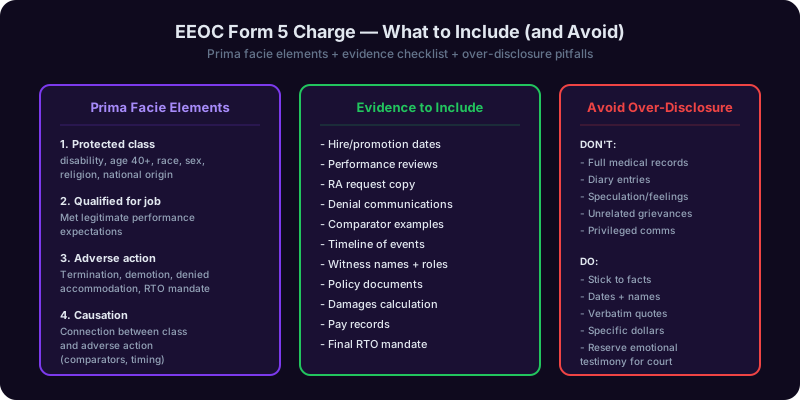
Top of Form 5: bibliographic basics
Name, address, phone, email, DOB, employer name and address, approximate employee count, discrimination types (check “Disability” and “Retaliation” where applicable), and date(s). If ongoing, check the “Continuing Action” box.
The narrative: prima facie elements
Walk through each of the four elements explicitly so the investigator can circle each one. Example structure:
- Element 1 (Disability): “I am a person with a disability within the meaning of the ADA Amendments Act. I have [functional limitation in plain language], which substantially limits the major life activity of [activity].”
- Element 2 (Qualified): “I am qualified for my position of [title]. I have [years] of experience, [most recent performance rating], and I performed all essential job functions remotely from [date] to [date] with no performance concerns.”
- Element 3 (Requested accommodation): “On [date], I submitted a written request for the reasonable accommodation of [accommodation]. The request included medical documentation from [physician].”
- Element 4 (Denial): “On [date], the company denied my request. The written denial stated [reason]. The reason was not supported by any individualized undue hardship analysis.”
Evidence list
Attach an exhibit list: written request, medical letter, denial letter, email chains, performance reviews showing remote success, and comparable accommodations granted to others. Do not attach voluminous medical records - only the physician letter that accompanied the request.
| Include | Why |
|---|---|
| Written accommodation request | Proves notice and date |
| Treating physician letter (functional, not diagnostic) | Establishes disability element |
| Written denial | Establishes adverse action and date |
| Performance reviews showing remote-work success | Establishes qualified element |
| Examples of accommodations granted to others | Undermines undue hardship defense |
Common over-disclosure mistakes
Many self-filed charges fail by saying too much. Avoid diagnosis codes, treatment histories, prescription details, irrelevant mental health information, prior disputes, settlement attempts, or anything that could be characterized as inconsistent. Keep the narrative precise, factual, and limited to the four elements plus retaliation if applicable. For a parallel evidence framework for termination-based charges, see EEOC wrongful termination filing.
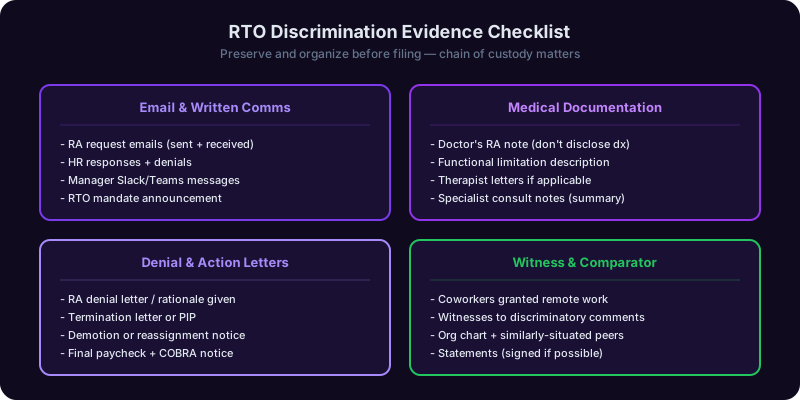
The Pre-Determination Investigation: Mediation, Position Statement, Onsite
Once your charge is filed and assigned a Charge Number, the investigation begins. The EEOC’s FY 2025 average for ADA failure-to-accommodate charges was 248 days - roughly eight months. Systemic-policy denials and strong-documentation cases tend to resolve faster, often through mediation. Full investigations can take 12-18 months.
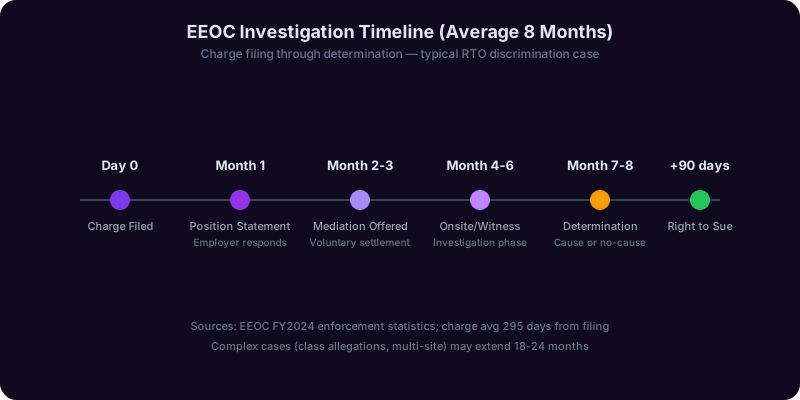
Phase 1: Mediation invitation (Days 1-45)
Within 10 days of filing, the EEOC notifies the employer. Within 30-45 days, the agency offers free mediation; both parties must agree. Mediation is informal, confidential, and non-binding. Roughly 70% of accepted ADA accommodation mediations settle - usually a hybrid accommodation, return-to-work plan, or separation package. It is underused: preserves the relationship, avoids public record, and resolves faster.
Phase 2: Position statement (Days 30-120)
If mediation fails, the employer submits a position statement - typically 10-50 pages including policy documents, interactive process record, undue hardship analysis, comparable accommodations, and legal defenses. Under the EEOC’s 2018 transparency reform, you have the right to a copy and 20 days to submit a written response.
Your response is among the highest-leverage documents in the process - one chance to correct errors, flag missing documents, and steer the investigator. Many self-represented employees skip it. Do not.
Phase 3: Investigation (Days 120-240)
The investigator may request additional employer documents, interview witnesses by phone, or - rarely in 2026 - conduct an on-site visit. Most investigations are by phone and email. Respond promptly and only to the question asked.
Phase 4: Determination (Days 240-300)
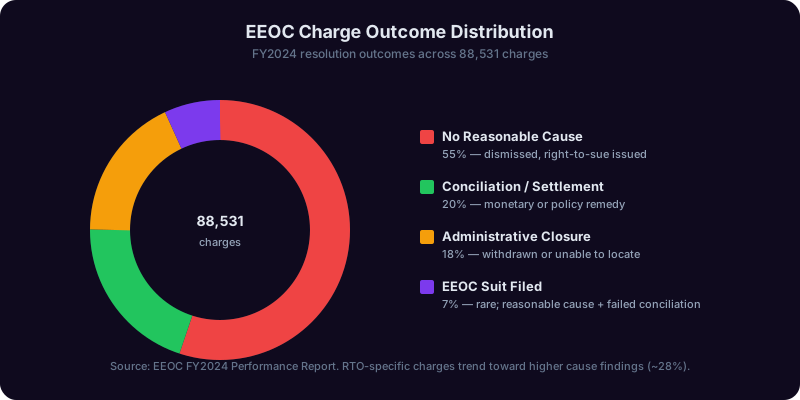
The investigation closes with one of three outcomes:
- Cause finding: The EEOC concludes that reasonable cause exists to believe discrimination occurred. The agency then attempts conciliation (negotiated resolution). If conciliation fails, the EEOC may sue the employer or issue a notice of right to sue. Cause findings are rare - historically about 3-4% of ADA charges - but produce dramatically higher settlement values.
- No cause finding (dismissal): The EEOC concludes that the evidence does not support a finding of discrimination. You receive a Dismissal and Notice of Rights, which is a right-to-sue letter. You can still file your own federal court lawsuit within 90 days.
- Administrative closure: The EEOC closes the case for procedural reasons (no jurisdiction, withdrawn charge, failure to cooperate). Most administrative closures also produce a right-to-sue letter.
| Outcome (FY 2025 ADA Failure to Accommodate) | Share | Right to Sue? |
|---|---|---|
| Mediation settlement | 18% | N/A - resolved |
| Cause finding | 4% | Yes |
| No cause dismissal | 62% | Yes |
| Administrative closure | 11% | Yes |
| Other / withdrawn | 5% | Varies |
Right-to-Sue Letter: When the EEOC Closes Your Case
The right-to-sue letter is a single piece of paper that ends one chapter of your case and begins another. The day you receive it, you have 90 days to file a federal court lawsuit. This deadline is jurisdictional - courts have no power to extend it absent extraordinary tolling. Missing it ends your federal claim permanently.
Two ways to receive a right-to-sue
The EEOC issues a right-to-sue letter in two scenarios. The first is at the conclusion of the agency’s investigation - whether by no-cause dismissal, by failed conciliation following a cause finding, or by administrative closure. The second is on request from the charging party. Under 29 C.F.R. § 1601.28, an employee can request a right-to-sue letter 180 days after filing the charge even if the EEOC has not finished investigating. This is a common strategy when an employee wants to move to federal court without waiting the full eight-month investigation.
Should you request a right-to-sue at 180 days?
For most accommodation denial cases, the answer is no. The EEOC investigation produces sworn statements, document productions, and sometimes cause findings that are extremely valuable in federal court. Litigating without that record means starting from scratch with discovery - which is slow and expensive. The exceptions are: (a) you have private counsel ready to file and the litigation calendar requires it, (b) the employer has signaled aggressive litigation strategy that makes administrative resolution unlikely, or (c) the EEOC has signaled it does not intend to prioritize the case.
What the right-to-sue letter does not do
The right-to-sue letter does not:
- Constitute a determination on the merits (a no-cause dismissal is not the same as a court ruling that you lose)
- Reset the 90-day clock if you missed an earlier deadline
- Cover state-law claims (those have their own deadlines under state agencies)
- Cover claims you did not raise in the charge (under the “scope of the charge” doctrine, federal courts limit claims to what the EEOC investigated)
State agency alternatives
In every deferral state, the state fair employment practices agency offers a parallel forum. Many state laws are broader than federal law: California’s FEHA, New York State Human Rights Law, and New Jersey’s LAD all have lower thresholds for disability, no caps on compensatory damages (unlike Title I’s $300,000 cap for large employers), and longer filing windows. Filing with the EEOC dual-files with the state agency in nearly every deferral state, so you preserve both. Some employees prefer to pursue the state claim first, where remedies are stronger.
| Jurisdiction | Damages Cap | Statute |
|---|---|---|
| Federal ADA Title I (500+ employees) | $300,000 compensatory + punitive combined | 42 U.S.C. § 1981a(b)(3) |
| California FEHA | No cap | Gov. Code § 12940 |
| New York State HRL | No cap | Exec. Law § 296 |
| New Jersey LAD | No cap | N.J.S.A. 10:5-1 et seq. |
Once the right-to-sue letter is in your hand and you have decided to file, consult an employment plaintiffs’ lawyer. The National Employment Lawyers Association maintains a member directory. Many lawyers take ADA cases on contingency.
Retaliation Protection While Your Charge Is Pending
One of the most common questions in any EEOC matter is: “Can my employer fire me, demote me, or punish me for filing?” The legal answer is unequivocal: no. The practical answer is more nuanced - retaliation happens, and the law’s strongest protection lies in creating contemporaneous evidence.
Section 503 of the ADA (42 U.S.C. § 12203) prohibits any “person” - meaning the employer, supervisors acting within their authority, and HR - from discriminating against an individual because the individual has opposed an unlawful practice, made a charge, testified, assisted, or participated in any manner in an investigation, proceeding, or hearing. The prohibition applies even if the underlying accommodation claim ultimately fails. An employee who loses a no-cause dismissal can still win on retaliation, because the legal protection attaches to the act of filing itself.
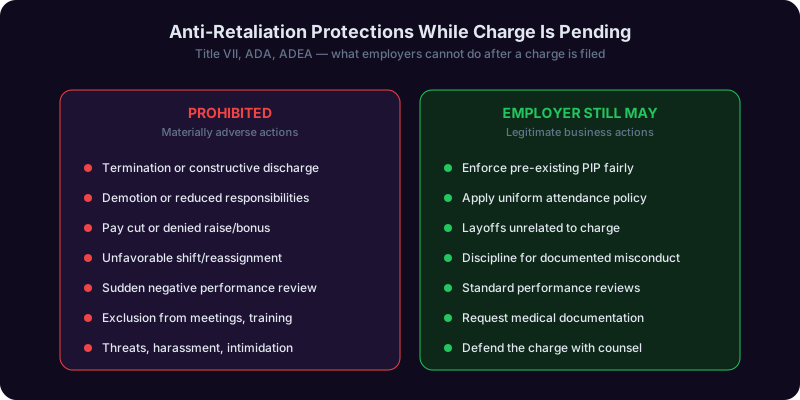
What retaliation looks like in practice
Retaliation is rarely as obvious as “you filed an EEOC charge, so you are fired.” Sophisticated employers use proxies:
- Sudden performance plans (PIPs) for an employee with a clean prior record
- Reassignment to lower-status roles or projects
- Removal from team meetings, mailing lists, or strategic projects
- Denial of promotions or raises that were previously expected
- Heightened monitoring not applied to peers
- Negative references during internal transfers
- Stricter enforcement of policies (attendance, dress code, expense reports) that previously were applied flexibly
Document everything
From the day you submit the accommodation request - not the day you file the charge - start a written log. Keep it on a personal device, not on company systems. Each entry should include date, time, people present, what was said or done, and any witnesses. Save copies of emails to a personal email account. The legal standard for retaliation is the temporal proximity between the protected activity (request or charge) and the adverse action; short proximity is strong circumstantial evidence of retaliation.
The separate retaliation claim
If retaliation occurs after you file, you must file a separate or amended charge for the retaliation. The retaliation claim has its own 180/300-day clock from the date of the retaliatory act. You can amend an existing pending charge to add retaliation, or file a new charge cross-referencing the original. Either way, document the retaliation in the same way you documented the original denial: facts, dates, witnesses, written summaries.
| Adverse Action After Filing | Strength of Retaliation Inference |
|---|---|
| Within 30 days of filing | Very strong (presumptive) |
| 30-90 days | Strong |
| 90-180 days | Moderate (needs corroboration) |
| 180+ days | Weak (needs direct evidence) |
Filing confidentiality
The EEOC notifies the employer 10 days after filing - to HR, not your manager. In practice, however, HR will inform managers in most cases. There is no realistic way to file an EEOC charge in secret. The protection lies not in concealment but in the law’s prohibition on adverse action. For a closely related discussion on negotiating remote-work arrangements before the situation escalates to a charge, see negotiating remote work in 2026.
How Copilotly's Legal Copilot Builds Your Case
Legal disclaimer: Copilotly is a document and research assistant, not a law firm. Copilotly does not provide legal advice and does not establish an attorney-client relationship. Always have material decisions reviewed by a licensed attorney in your jurisdiction, particularly before filing a charge or initiating litigation.
Building a strong EEOC charge takes 20-40 hours of careful work: drafting the accommodation request, organizing medical documentation, mapping the prima facie elements, drafting the Form 5 narrative, and tracking deadlines. Most workers do not have a quiet 40 hours during the most stressful eight months of their employment history. Copilotly’s Legal Copilot compresses that work into a structured, deadline-aware workflow.
Conditions-to-ADA mapping
The first analytic step is determining whether a medical condition meets the ADA’s definition of disability under the broad construction of the ADAAA. The Legal Copilot ingests a redacted summary of your condition, your functional limitations, and your major life activities, then maps each to ADA case law and EEOC guidance. It produces a structured memo that identifies (a) the major life activities affected, (b) the bodily functions implicated, (c) prior EEOC determinations on similar fact patterns, and (d) the likelihood that a court would find the disability element satisfied.
Accommodation request drafting
The Copilot drafts your accommodation request following the six-component framework in Section 3 of this guide. It pulls language from JAN’s accommodation database, EEOC enforcement guidance, and the company’s own job description (uploaded by you), and produces a request that is precise, conservative on disclosure, and aligned with the prima facie elements. The draft is editable and exportable to PDF for certified mail dispatch.
EEOC narrative generation
If your accommodation request is denied, the Copilot drafts the Form 5 narrative by walking through each prima facie element with citations to your uploaded evidence. The narrative is structured for the EEOC investigator’s reading pattern: short paragraphs, clear element labels, evidence references in brackets. The Copilot also generates the exhibit list and flags common over-disclosure mistakes before submission.
Deadline tracking
The Copilot maintains a deadline calendar with three tiers of alerts: 60-day, 30-day, and 7-day reminders for every statutory window - accommodation request acknowledgment, 30-day interactive process benchmark, 180/300-day charge filing, 20-day position statement response, and 90-day right-to-sue lawsuit. Missing any of these deadlines can permanently end a case; the Copilot’s calendar layer is designed to make missing them effectively impossible.
What the Copilot does not do
The Copilot does not file your charge for you; the EEOC Public Portal requires the charging party’s electronic signature. The Copilot does not represent you in mediation, conciliation, or litigation. The Copilot does not give jurisdiction-specific legal advice. For each of these, the Copilot recommends you engage a licensed employment lawyer - and for litigation, the Copilot’s output is structured to be lawyer-ready, reducing your attorney’s preparation time and therefore your legal fees.
For workers facing related decisions - contract review, custody disputes affected by RTO scheduling, or ADHD evaluation for accommodation purposes - Copilotly offers complementary playbooks. See employment contract review with AI and adult ADHD evaluation checklist. Sign up for the free Legal Copilot at copilotly.com/copilots/legal and start the accommodation workflow today.
Frequently Asked Questions
Recommended Copilots
Related Articles
Get Answers From the Legal Copilot
From the first accommodation request through the 180-day filing window and the right-to-sue letter, Copilotly’s Legal Copilot maps your conditions to the ADA, drafts every document, generates the EEOC narrative, and tracks every deadline. Free to start, lawyer-ready output.