
The AI Regulation Landscape in 2026: What Changed and Why It Matters Now
For years, AI regulation was a topic companies could monitor from a distance. There were proposals, draft frameworks, public comment periods, and committee hearings, but very few enforceable requirements. That era is decisively over. In 2026, the regulatory environment for artificial intelligence moved from aspirational principles to binding obligations backed by real penalties.
Three developments converged to make 2026 the year AI compliance became non-optional for businesses of virtually every size.
First, the EU AI Act reaches full enforcement in August 2026. After a phased implementation period that began in 2024, the final provisions of the EU Artificial Intelligence Act take effect on August 2, 2026. This means the complete risk classification system, conformity assessments, transparency obligations, and a penalty framework that can reach up to 35 million euros or 7 percent of global annual turnover are now operational. Any business that serves EU customers, processes EU citizen data, or deploys AI systems whose outputs are used in the EU falls under this regime, regardless of where the company is headquartered.
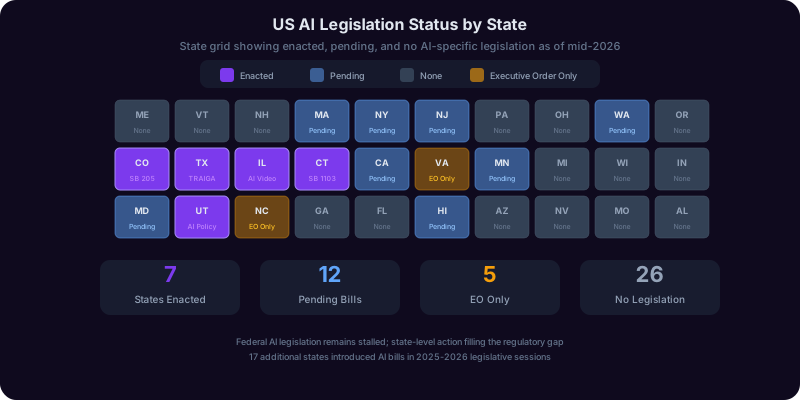
Second, U.S. state-level AI legislation moved from proposal to law. Colorado's SB 21-205 established the first comprehensive state framework for regulating high-risk AI systems, with requirements for impact assessments, bias testing, and consumer notification. Texas followed with the Texas Responsible AI Governance Act (TRAIGA), creating separate but overlapping requirements. More than a dozen other states have introduced AI bills, and several are expected to pass in 2026 or early 2027.
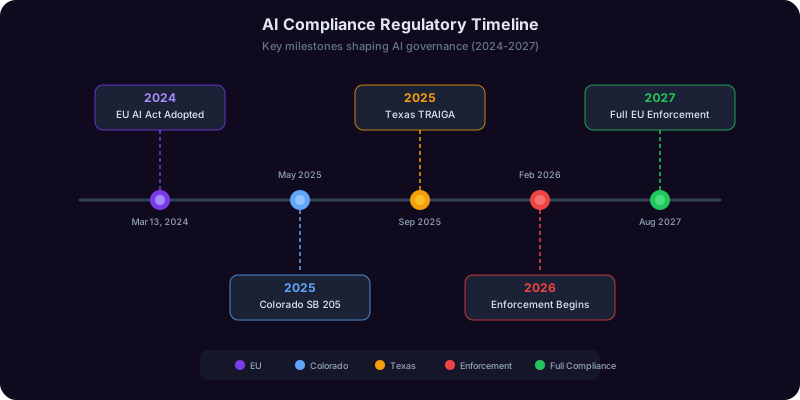
Third, a coalition of state attorneys general began coordinated enforcement actions. In early 2026, attorneys general from seventeen states formed a working group focused on AI-related consumer protection violations. Unlike legislative action, which moves slowly, AG enforcement is immediate and unpredictable. The coalition has already issued civil investigative demands to companies using AI in hiring, insurance underwriting, and consumer lending.
The business implications are concrete. If you use AI for any customer-facing decision, employee screening, content moderation, pricing, risk assessment, or recommendation, you now operate under at least one and likely multiple regulatory frameworks. The question is not whether you need to comply. It is how to comply without paralyzing your business operations or spending more on compliance infrastructure than on the AI systems themselves.
This guide translates each major regulation into plain-language requirements, maps those requirements to specific business actions, and provides checklists you can begin implementing immediately. It is written for business operators, product managers, and technical leaders who need to understand their obligations without wading through hundreds of pages of legislative text.
The EU AI Act: Risk Tiers, Obligations, and What Your Business Must Do by August 2026
The EU AI Act is the most comprehensive AI regulation in the world, and its extraterritorial reach means it affects businesses far beyond Europe. Understanding its structure is the foundation for understanding every other AI regulation, because most state and national frameworks borrow from its risk-based approach.
The Four Risk Tiers
The Act classifies AI systems into four risk categories, each with escalating requirements.
Unacceptable Risk (Banned): These AI applications are prohibited outright. The list includes social scoring systems used by governments, real-time biometric identification in public spaces for law enforcement (with narrow exceptions), AI that manipulates human behavior to circumvent free will, and systems that exploit vulnerabilities of specific groups such as children or persons with disabilities. If your product falls into this category, there is no compliance path -- you must discontinue it.
High Risk: This is where most business compliance obligations concentrate. High-risk AI includes systems used for employment and worker management (resume screening, interview scoring, performance evaluation, promotion decisions), creditworthiness assessment and insurance pricing, educational assessment and admissions, essential private and public services (benefits eligibility, emergency services dispatch), law enforcement and border control, and critical infrastructure management. High-risk systems face mandatory conformity assessments, risk management systems, data governance requirements, technical documentation, record-keeping, transparency and information obligations, human oversight mechanisms, and accuracy, robustness, and cybersecurity standards.
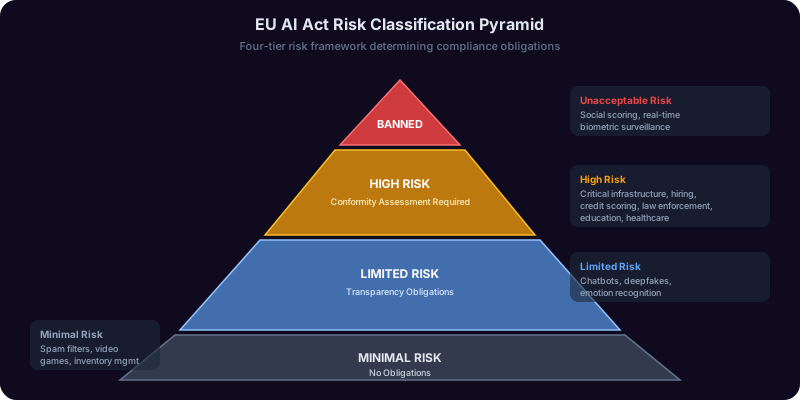
Limited Risk: AI systems that interact directly with humans, generate synthetic content, or are used for emotion recognition or biometric categorization. The primary obligation is transparency: you must inform users they are interacting with AI, label AI-generated content, and disclose the use of emotion recognition or biometric systems. Chatbots, AI writing assistants, and deepfake generators fall here.
Minimal Risk: AI applications like spam filters, AI-powered video games, and inventory management systems face no specific regulatory requirements under the Act, though general consumer protection and data privacy laws still apply.
Penalties for Non-Compliance
The penalty structure is tiered by violation severity. Using a prohibited AI system carries fines of up to 35 million euros or 7 percent of global annual turnover, whichever is higher. Violations of high-risk obligations can result in fines of up to 15 million euros or 3 percent of global annual turnover. Providing incorrect or misleading information to regulators can cost up to 7.5 million euros or 1 percent of turnover. These are maximum figures, but the scale signals that regulators intend the penalties to be meaningful even for large corporations.
Your Compliance Checklist for the EU AI Act
- Inventory every AI system you operate or deploy. Include third-party AI tools, APIs, and embedded models. Many companies undercount their AI footprint.
- Classify each system by risk tier. When in doubt, classify higher rather than lower.
- For high-risk systems, implement a documented risk management system that identifies, analyzes, and mitigates risks throughout the system lifecycle.
- Establish data governance practices for training, validation, and testing datasets, including bias examination.
- Create technical documentation that describes the system's intended purpose, design, development, capabilities, and limitations.
- Implement logging that enables traceability of the AI system's operations for its expected lifetime.
- Provide clear user instructions covering capabilities, limitations, and human oversight requirements.
- Register high-risk systems in the EU public database before deploying them.
For a deeper look at how AI tools can help you navigate legal compliance, see our guide on using AI for contract and legal review.
Colorado SB 205 and Texas TRAIGA: State-Level AI Laws You Cannot Ignore
While federal AI legislation in the United States continues to stall, states have filled the vacuum with their own frameworks. Colorado and Texas are the two most consequential, but they represent a broader trend that will affect businesses operating in any U.S. state within the next two years.
Colorado SB 21-205: The U.S. Pioneer
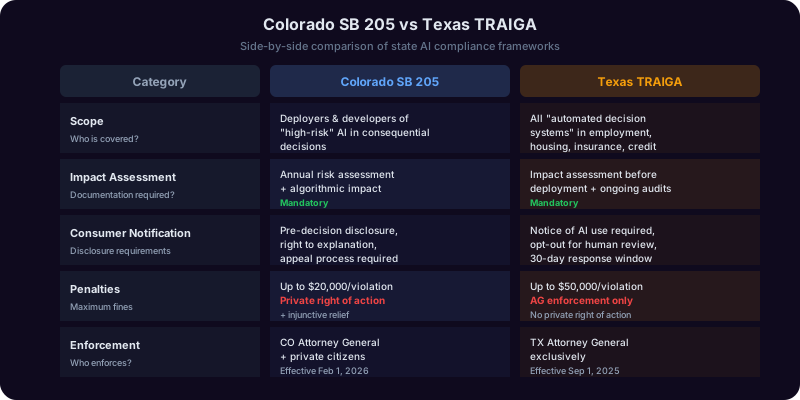
Colorado was the first U.S. state to enact a comprehensive AI governance law. SB 205 (full text available on the Colorado General Assembly website) targets "high-risk AI systems" -- defined as any AI system that makes or substantially contributes to a consequential decision. A consequential decision is one that has a material legal or similarly significant effect on a consumer in areas including employment, education, financial services, healthcare, housing, insurance, and legal services.
Key requirements for deployers (businesses using AI):
- Risk management policy: Implement and maintain a written policy describing how you identify, mitigate, and monitor risks of algorithmic discrimination.
- Impact assessment: Complete an algorithmic impact assessment before deploying any high-risk AI system and update it annually or whenever you make significant modifications.
- Consumer notification: Inform consumers when an AI system is used to make a consequential decision about them, provide an explanation of the decision, and offer a process to appeal or request human review.
- Bias testing: Conduct regular testing for algorithmic discrimination based on protected characteristics including race, ethnicity, sex, religion, disability, sexual orientation, and age.
- Incident reporting: Report known instances of algorithmic discrimination to the Colorado Attorney General within 90 days of discovery.
Texas Responsible AI Governance Act (TRAIGA)
Texas took a different approach, focusing on transparency and accountability rather than prescriptive compliance procedures. TRAIGA applies to "automated decision systems" used by state agencies and large private sector entities operating in Texas.
Key requirements:
- Transparency statement: Publish a plain-language statement describing each AI system used in consequential decisions, including the data inputs, the type of decision, and how to request human review.
- Human oversight: Maintain meaningful human oversight for all AI-assisted decisions that materially affect consumers, defined as a human reviewer with authority to override the AI's recommendation.
- Record retention: Retain records of AI-assisted decisions for a minimum of three years, including the inputs, the AI output, and the final decision.
- Annual reporting: File annual reports with the Texas Department of Information Resources describing AI systems in use, their purposes, and any known incidents of bias or error.
How They Differ and Why It Matters
Colorado emphasizes proactive risk management through mandatory impact assessments and bias testing before deployment. Texas emphasizes reactive transparency through disclosure requirements and record-keeping after deployment. If you operate in both states, you need to satisfy both sets of requirements, which means implementing the more rigorous standard from each.
The practical challenge for multi-state businesses is that these laws define key terms differently. Colorado's "consequential decision" and Texas's "automated decision system" do not perfectly overlap. A system that qualifies as high-risk under Colorado may not trigger TRAIGA obligations, and vice versa. This patchwork creates compliance complexity that will only grow as more states pass their own versions.
What to do now: Map your AI systems against both frameworks. Implement Colorado's impact assessment process as your baseline, since it is the more demanding standard, and layer Texas's transparency and record retention requirements on top. This approach positions you for compliance in additional states as their laws take effect.

Get Answers From the Legal Copilot
Copilotly's Legal Copilot breaks down regulatory requirements for your specific business, helps you classify AI systems by risk tier, and drafts compliance documentation in plain language. Get actionable guidance instead of generic summaries.
The State AG Coalition: Enforcement Without New Laws
While legislatures debate new AI-specific statutes, state attorneys general are not waiting. Using existing consumer protection laws, unfair trade practice statutes, and civil rights frameworks, a coalition of AGs has begun investigating and taking action against AI-related harms. This enforcement approach does not require new legislation, which makes it both faster and less predictable than statutory compliance.
How the Coalition Works
In February 2026, attorneys general from seventeen states -- including California, New York, Illinois, Massachusetts, and Washington -- announced a formal working group on AI consumer protection through the National Association of Attorneys General. The coalition pools investigative resources, shares information about companies and practices under scrutiny, and coordinates enforcement actions to maximize impact. A company that receives a civil investigative demand from one AG may soon receive similar demands from others.
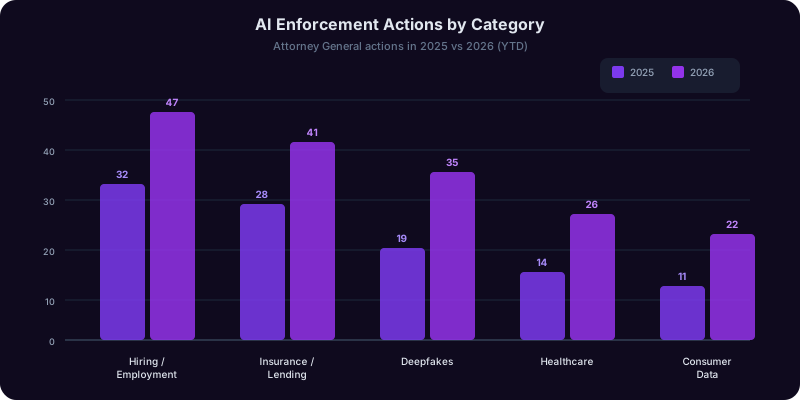
The coalition's early focus has centered on four areas:
- AI in hiring and employment: Resume screening tools that systematically disadvantage protected groups, AI interview scoring systems that penalize accents or disabilities, and automated performance evaluation systems that lack transparency.
- AI in insurance and lending: Algorithmic underwriting that produces discriminatory pricing, AI-driven claims denial patterns, and opaque credit scoring models that incorporate proxy variables for protected characteristics.
- AI-generated content and deepfakes: Synthetic media used for fraud, non-consensual intimate imagery, and commercial deception. Several states have passed standalone deepfake laws that the coalition is actively enforcing.
- AI in healthcare: Clinical decision support systems that perform differently across demographic groups, AI triage tools that deprioritize certain populations, and chatbot-based health advice that fails to disclose its non-human nature.
Why Existing Laws Are Enough
The coalition does not need new AI-specific statutes to act. Most states have robust unfair and deceptive acts and practices (UDAP) laws that prohibit businesses from engaging in conduct that is unfair, deceptive, or causes substantial consumer injury. If an AI system produces discriminatory outcomes, that constitutes an unfair practice. If a company fails to disclose that a decision was made by AI, that can constitute a deceptive practice. If consumers are harmed by inaccurate AI outputs with no recourse, that is a substantial injury.
State civil rights laws add another enforcement layer. When an AI system produces disparate impact outcomes in housing, lending, employment, or public accommodations, existing anti-discrimination statutes apply regardless of whether the discrimination was intentional or algorithmic.
How to Protect Your Business
AG enforcement actions typically begin with a civil investigative demand -- essentially a detailed questionnaire about your AI practices accompanied by a document request. Being unable to answer these questions is itself a problem. To prepare:
- Document every AI system's purpose, data inputs, and decision logic. If you cannot explain how your AI reaches its conclusions, you are vulnerable.
- Conduct and retain disparate impact analyses. Test your AI outputs across protected characteristics and keep the results, even if they reveal problems. Demonstrating that you identified and addressed issues is far better than being unable to show you looked.
- Maintain human review processes. AGs have consistently viewed fully automated consequential decisions more critically than AI-assisted decisions with human oversight.
- Create a consumer complaint channel specifically for AI-related concerns. Unresolved consumer complaints are one of the primary triggers for AG investigations.
The coalition's approach means that even businesses operating in states without AI-specific legislation face enforcement risk. If you use AI in any consumer-facing capacity, existing consumer protection law already governs your conduct. The AG coalition simply makes enforcement more likely and more coordinated.
Classifying Your AI Systems: A Practical Risk Assessment Framework
Every regulation discussed in this guide uses some form of risk classification. Rather than running separate analyses for each framework, you can build a unified risk assessment process that satisfies all of them simultaneously. The NIST AI Risk Management Framework provides an excellent foundation that maps cleanly onto regulatory requirements.
Step 1: Inventory Your AI Systems
Most businesses significantly undercount their AI footprint. Your inventory should include internally developed models and algorithms, third-party AI APIs and services (including those embedded in SaaS platforms), AI features within enterprise software (CRM scoring, ERP demand forecasting, HR screening), customer-facing chatbots and virtual assistants, AI-powered analytics and reporting tools, and automated decision workflows that incorporate any form of machine learning or algorithmic logic.
For each system, document the purpose and use case, the data inputs (what information does it process), the outputs and decisions it influences, the affected population (customers, employees, applicants, patients), the deployment context (fully automated versus human-in-the-loop), and the vendor or developer responsible for the underlying model.
Step 2: Assess Risk Level
Using the information from your inventory, classify each system into one of four risk levels.
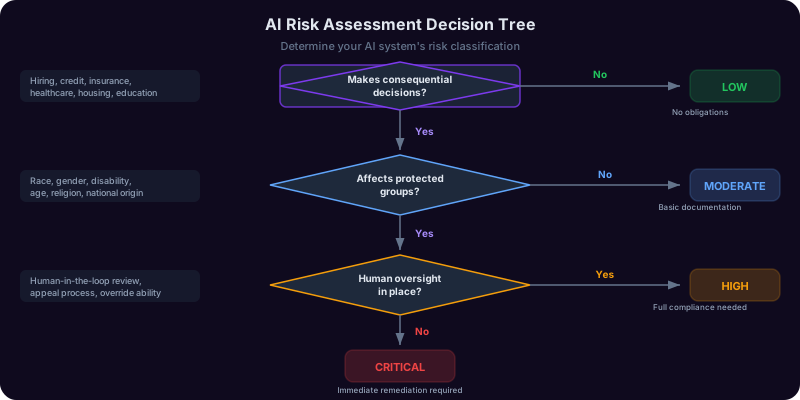
| Risk Level | Criteria | Examples | Required Actions |
|---|---|---|---|
| Critical | Fully automated consequential decisions affecting protected groups with no human override | Automated loan denial, AI-only hiring screening, algorithmic insurance pricing | Full impact assessment, bias audit, human oversight, regulatory registration, ongoing monitoring |
| High | AI substantially influences consequential decisions with some human involvement | Resume ranking with human review, AI-suggested medical diagnoses, credit risk scoring reviewed by underwriter | Impact assessment, bias testing, transparency disclosures, documentation, regular audits |
| Moderate | AI enhances or personalizes user experience without making consequential decisions | Product recommendations, content personalization, customer service routing, demand forecasting | Transparency disclosures, data governance, periodic review |
| Low | AI performs routine operational tasks with no direct consumer impact | Spam filtering, internal document search, code completion, meeting transcription | Basic documentation, standard data security |
Step 3: Map Regulatory Requirements
Once classified, map each system to its applicable regulations. A high-risk system used by EU customers triggers EU AI Act obligations. The same system used in Colorado triggers SB 205 requirements. If it involves employment decisions, it is also subject to AG enforcement under existing employment discrimination law. Build a compliance matrix that lists each AI system, its risk level, every applicable regulation, the specific requirements from each regulation, and the current compliance status.
Step 4: Prioritize and Act
Address critical-risk systems first, then high-risk, then moderate. For each system, ask: does it need a full conformity assessment under the EU AI Act, has an algorithmic impact assessment been completed per Colorado SB 205, does it meet Texas TRAIGA transparency requirements, could existing UDAP or civil rights enforcement reach it, and is there documented human oversight and an appeal process? For guidance on getting expert input on your risk assessment decisions, read our guide on seeking a second opinion on important professional decisions.
Transparency and Disclosure: What You Must Tell Users, Customers, and Regulators
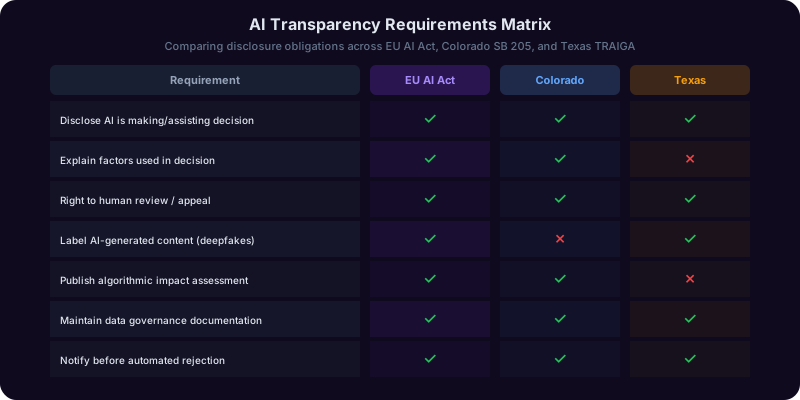
Every AI regulation includes transparency requirements, but the specifics vary. Meeting all of them requires a layered disclosure strategy that addresses three audiences: end users and consumers, regulators and oversight bodies, and internal stakeholders.
Consumer-Facing Transparency
Across all applicable regulations, consumers must know when AI is involved in a decision that affects them, what role the AI played (whether it made the decision or informed a human decision-maker), what data was used, how to request human review or appeal, and how to access a plain-language explanation of the decision logic.
The implementation challenge is doing this without burying users in legalese. Effective transparency uses contextual disclosure: present the relevant information at the moment the AI-influenced decision is delivered, not buried in a terms-of-service document. For example, when a loan application is denied, the denial notice should state that an AI system contributed to the assessment, identify the key factors in the decision, explain how to request human review, and provide contact information for questions or appeals.
Regulatory Disclosure
Different regulators require different documentation. The EU AI Act mandates registration in a public database for high-risk AI systems. This registration must include a description of the intended purpose, the risk classification and the basis for it, the conformity assessment results, the identity and contact information of the provider, and summary results of bias testing and performance evaluation.
Colorado SB 205 requires algorithmic impact assessments to be available upon request by the Attorney General. Texas TRAIGA requires annual reports filed with the Department of Information Resources. In all cases, the underlying documentation must be current, accurate, and sufficiently detailed to allow regulators to evaluate your compliance.
Internal Transparency
Compliance fails when only the legal team understands the obligations. Internal transparency means product teams understand which AI features trigger compliance requirements, engineering teams document model changes that could affect risk classification, customer service teams know how to handle AI-related inquiries and complaints, executive leadership receives regular compliance status updates, and incident response plans cover AI-specific scenarios including bias discovery and system malfunction.
Building a Transparency Program
A practical transparency program includes five components.
- AI system registry: A centralized, current list of every AI system with its risk classification and compliance status.
- Consumer notification templates: Pre-approved language for common AI-influenced decisions, reviewed by legal counsel.
- Impact assessment library: Completed assessments for every high-risk system, with annual update schedules.
- Training program: Regular training for all teams that build, deploy, or support AI systems.
- Audit trail: Logging infrastructure that captures AI inputs, outputs, and human override decisions for the required retention period.
The most common transparency failure is not a lack of effort but a lack of specificity. Vague statements like "we use AI to improve your experience" satisfy no regulatory requirement. Specific statements like "our system used your payment history, account age, and requested amount to generate a risk score, which our underwriting team reviewed before making this decision" satisfy most of them.
For businesses seeking to understand how AI tools can help with legal documentation and compliance language, our AI contract review guide covers similar principles of clear language and thorough analysis.
Your 90-Day Compliance Action Plan: From Audit to Implementation
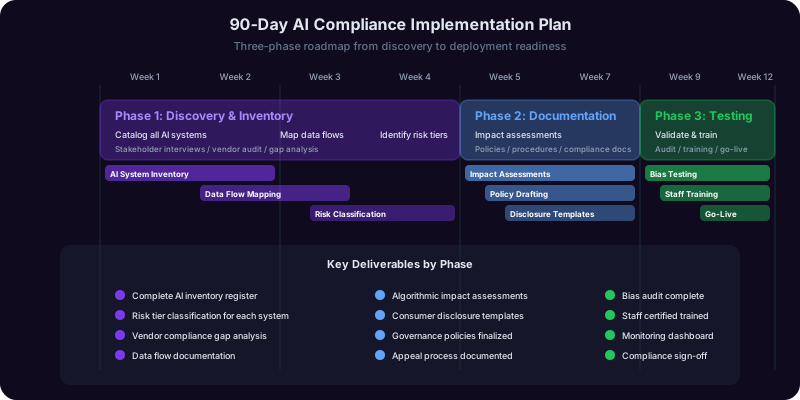
Theory without execution is worthless. Here is a concrete 90-day plan to bring your business into compliance with the regulations discussed in this guide. This plan is structured in three phases, each lasting roughly 30 days, and is designed for businesses with small-to-medium compliance teams.
Phase 1: Discovery and Assessment (Days 1-30)
Week 1-2: AI System Inventory
- Survey every department for AI tool usage, including third-party SaaS with AI features
- Interview product and engineering leads about internally developed AI systems
- Review vendor contracts for AI-related clauses and data processing terms
- Document each system's purpose, data inputs, outputs, and affected populations
Week 3-4: Risk Classification and Gap Analysis
- Classify each system using the four-tier framework from the previous section
- Map each system to applicable regulations (EU AI Act, Colorado SB 205, Texas TRAIGA, state AG exposure)
- Identify gaps between current practices and regulatory requirements
- Prioritize systems by risk level and compliance gap severity
Deliverable: A complete AI system inventory with risk classifications, regulatory mapping, and a prioritized gap analysis.
Phase 2: Documentation and Process Design (Days 31-60)
Week 5-6: Core Documentation
- Draft algorithmic impact assessments for all high-risk and critical-risk systems
- Create technical documentation describing each system's design, capabilities, and limitations
- Develop consumer notification templates for each AI-influenced decision type
- Establish a risk management policy covering identification, mitigation, and monitoring
Week 7-8: Process Implementation
- Implement human oversight workflows for high-risk decisions with documented authority to override
- Set up logging infrastructure for AI inputs, outputs, and final decisions
- Create consumer appeal processes with defined timelines and escalation paths
- Design bias testing protocols with scheduled testing frequencies
Deliverable: Completed impact assessments, technical documentation, consumer notification systems, and documented processes.
Phase 3: Testing, Training, and Activation (Days 61-90)
Week 9-10: Testing and Validation
- Run initial bias tests on all high-risk systems and document results
- Conduct a simulated AG civil investigative demand exercise to test documentation completeness
- Test consumer notification flows end-to-end
- Validate that logging captures all required data points
Week 11-12: Training and Launch
- Train product teams on compliance requirements for new AI features
- Train customer service on handling AI-related complaints and appeal requests
- Brief executive leadership on compliance status and residual risks
- Activate ongoing monitoring dashboards
Deliverable: Test results, trained teams, active monitoring, and a completed compliance posture.
Ongoing Maintenance
Compliance is not a one-time project. After the initial 90 days, schedule quarterly bias tests for all high-risk systems, annual impact assessment updates, monthly review of new AI deployments or significant model changes, quarterly training refreshers for relevant teams, and semi-annual reviews of the regulatory landscape for new requirements. This cadence keeps your compliance program current without consuming disproportionate resources.
What Is Coming Next: Preparing for the 2027 Regulatory Wave
The regulations in effect today are just the beginning. Understanding what is on the horizon helps you build compliance infrastructure that scales rather than rebuilding from scratch every time a new law passes.
Federal Legislation Gaining Momentum
While the U.S. has no comprehensive federal AI law as of mid-2026, several bills have advanced further than any predecessors. The Algorithmic Accountability Act has been reintroduced with bipartisan support, requiring impact assessments for automated decision systems used by large companies. The AI Labeling Act would mandate disclosure of AI-generated content across all media. The Federal AI Risk Management Act would codify the NIST AI Risk Management Framework as a binding standard rather than a voluntary guideline.
Industry consensus is that some form of federal AI legislation will pass before the end of 2027. When it does, businesses with existing compliance programs will adapt quickly. Those starting from zero will face urgent, expensive catch-up projects.
Additional State Activity
Beyond Colorado and Texas, at least twelve states have introduced comprehensive AI governance bills. California's proposed AI Transparency Act would require detailed disclosures for any AI system used in consumer-facing decisions. New York's AI auditing bill would mandate third-party bias audits for employment-related AI systems. Illinois is expanding its existing Biometric Information Privacy Act to cover AI-powered biometric analysis more broadly. The trajectory is clear: within two years, most large states will have some form of AI-specific legislation.
International Developments
Canada's Artificial Intelligence and Data Act (AIDA) is expected to take effect in late 2026 or early 2027, with requirements closely modeled on the EU AI Act. Brazil's AI regulatory framework is advancing through its legislature. The United Kingdom has continued its sector-specific approach, with the Financial Conduct Authority and the Information Commissioner's Office both issuing AI-specific guidance that carries regulatory weight. For businesses operating internationally, the compliance surface is expanding rapidly.
How to Future-Proof Your Compliance Program
The most effective strategy is to build compliance infrastructure based on principles rather than specific statutes. Every current and proposed AI regulation shares common requirements: know what AI systems you operate, understand and document their risks, test for bias and discrimination, maintain human oversight for consequential decisions, be transparent with affected individuals, and keep records that demonstrate compliance.
If your compliance program addresses these six principles comprehensively, you will be able to adapt to new regulations by mapping their specific requirements onto your existing infrastructure rather than building new systems from scratch.
Practical steps for future-proofing:
- Adopt the NIST AI RMF as your internal governance standard, even though it is currently voluntary
- Build your compliance documentation to be jurisdiction-agnostic where possible and jurisdiction-specific where required
- Invest in automated compliance monitoring tools that can be configured for new requirements
- Participate in industry standards bodies and public comment periods to understand regulatory direction
- Allocate compliance budget on a rolling basis rather than as one-time project funding
For businesses exploring how specialized AI tools can assist with compliance and governance tasks, our overview of domain-specific AI copilots explains how purpose-built AI assistants differ from general-purpose tools in regulated environments.
Frequently Asked Questions
Recommended Copilots
Recommended Copilots
Analyzes regulatory text, maps compliance obligations to your specific business context, and drafts impact assessment documentation
Try Free →Assists with implementing technical compliance requirements including logging infrastructure, audit trails, and bias testing pipelines
Try Free →Provides an independent review of your risk classifications and compliance strategy to catch gaps before regulators do
Try Free →Related Articles
Get Answers From the Legal Copilot
Copilotly's Legal Copilot breaks down regulatory requirements for your specific business, helps you classify AI systems by risk tier, and drafts compliance documentation in plain language. Get actionable guidance instead of generic summaries.