

Quitclaim Deed vs Warranty Deed: What You're Actually Transferring
A quitclaim deed is the legal equivalent of saying "whatever interest I have in this property, I give to you, no promises." It transfers ownership without any guarantee that the title is clear, that no liens exist, or even that you actually own the property at all. That is why it is the most misunderstood document in American real estate law.
By contrast, a warranty deed (general or special) comes with legal covenants: the grantor warrants they own the property, that it is free of undisclosed encumbrances, and that they will defend the title against future claims. If a problem surfaces after closing, the grantee can sue the grantor on those covenants. With a quitclaim, that recourse simply does not exist.
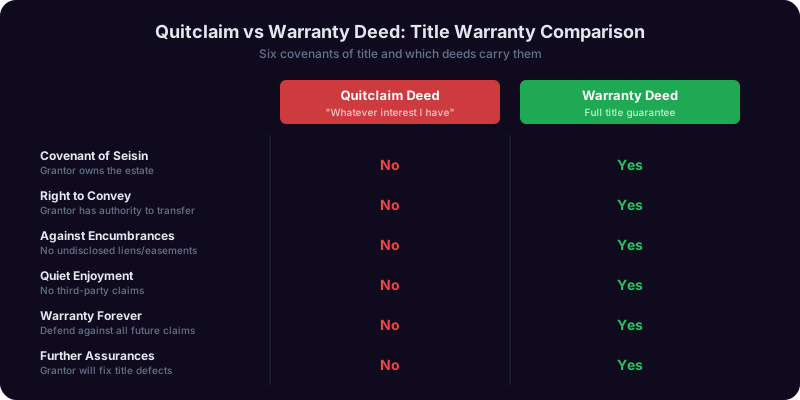
Despite offering zero title protection, quitclaim deeds remain wildly popular for one reason: they are fast, cheap, and require no title search. That makes them ideal for situations where the parties already trust each other and title risk is low or already understood:
- Parent-to-child transfers - Mom adds her adult daughter to the deed, or transfers the family home outright as part of estate planning.
- Divorce property settlements - One spouse quitclaims their interest in the marital home to the other as part of the divorce decree.
- Removing a co-owner - A former partner, ex-fiance, or sibling who inherited a fractional interest is paid out and quitclaims their share.
- Adding a spouse - A homeowner who married after purchase wants their new spouse on title.
- Trust funding - Transferring property from an individual into a revocable living trust they themselves control.
- Clearing clouds on title - A long-lost heir signs a quitclaim to formally relinquish any claim.
Here is what the document does not do, and where most family disputes start:
- It does not extinguish the mortgage. If you quitclaim your interest to your son, you remain personally liable on the loan until it is refinanced or paid off.
- It does not transfer the homeowners insurance policy, which is tied to the named insured.
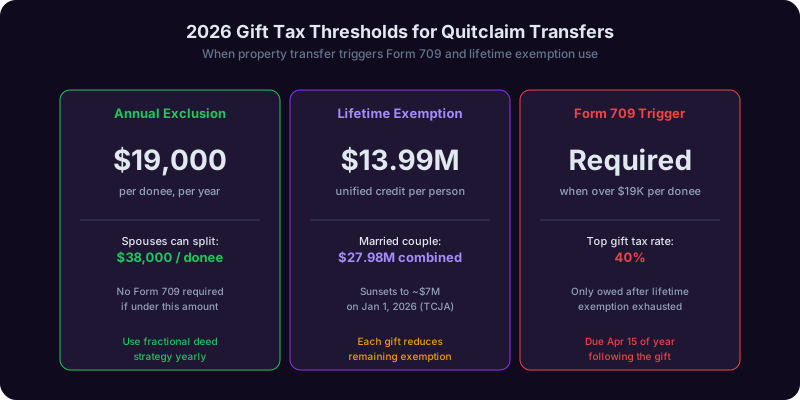
- It does not change the property tax assessment automatically - and in some states (notably California with Proposition 19) the transfer can trigger reassessment.
- It does not protect against unknown liens, easements, or boundary disputes that may exist.
Legal & Tax Disclaimer: This article is educational only and does not constitute legal, tax, or financial advice. Deed law, gift tax thresholds, and Medicaid eligibility rules vary by state and change frequently. Consult a licensed real estate attorney, CPA, and elder law attorney before executing any deed.
The Carryover Basis Disaster: Why a Quitclaim Can Cost Your Kid $80,000 in Taxes
This is the single most expensive mistake families make with quitclaim deeds, and it shows up only when the child later sells the home. The villain is a concept called carryover basis, and it is the reason elder law attorneys cringe when they hear "Mom is just going to deed the house to me now."
When you give property as a gift during your lifetime, the recipient inherits your original cost basis - what you paid for the property plus the cost of capital improvements. When you transfer property at death (through a will, trust, or beneficiary deed), the recipient gets a stepped-up basis equal to the fair market value on the date of death.
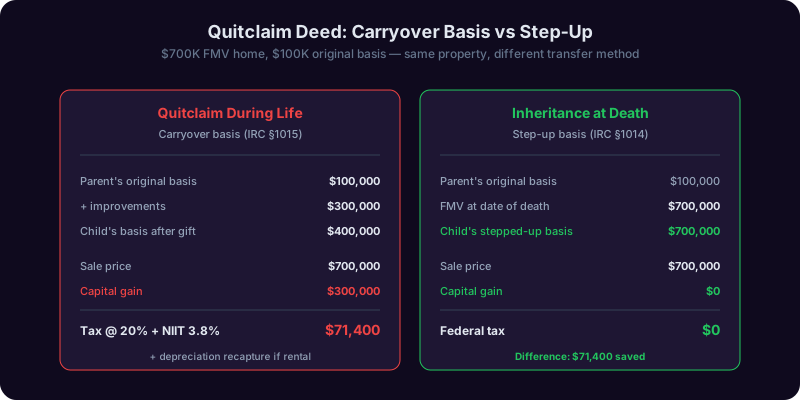
Let us walk through a real-world example that plays out thousands of times a year:
The Setup: Mom bought her home in 1985 for $90,000. She added a $20,000 kitchen renovation in 2002. Her adjusted basis is $110,000. The home is worth $700,000 today. Her son Mark will inherit it eventually.
| Scenario | Mark's Basis | Sale Price | Taxable Gain | Federal Cap Gains Tax (15%) | Net Cost |
|---|---|---|---|---|---|
| Mom quitclaims now (carryover) | $110,000 | $700,000 | $590,000 | $88,500 | Plus state, plus NIIT 3.8% |
| Mark inherits at death (step-up) | $700,000 | $700,000 | $0 | $0 | $0 |
| Mom puts in revocable trust, Mark inherits | $700,000 | $700,000 | $0 | $0 | $0 |
| Ladybird deed (enhanced life estate) | $700,000 | $700,000 | $0 | $0 | $0 (in eligible states) |
The lifetime quitclaim costs Mark roughly $88,500 in federal capital gains tax alone, plus state income tax (potentially another $25,000-$50,000), plus the 3.8% Net Investment Income Tax if his income is high enough. Total damage: easily $120,000+. Inheriting the same house through any of the other methods costs zero.
There are nuances families miss:
- The Section 121 exclusion does not transfer. Mom could have excluded $250,000 of gain as her primary residence ($500,000 if married). Mark gets none of that unless he lives in the home as his primary residence for 2 of the 5 years before selling.
- Improvements you cannot document are lost. If Mom never kept receipts for the kitchen, the IRS can disallow that $20,000 add-back. Carryover basis is only as good as the records.
- Partial gifts get partial step-up. If Mom quitclaims 50% now and dies owning 50%, only the 50% she still owned at death gets a step-up. The other half keeps the carryover basis.
- Joint tenancy is even worse in non-community-property states - only the deceased's half gets a step-up.
The takeaway: for a highly appreciated primary residence, gifting during life via quitclaim is almost always a tax disaster. The exceptions are properties with little appreciation, properties that will not be sold (kept for rental), or properties where Medicaid planning urgency overrides tax optimization.

Get Answers From the Legal Copilot
Copilotly's Legal Copilot analyzes your gift tax exposure, Medicaid lookback risk, and carryover basis impact before generating a state-specific quitclaim deed, Form 709 worksheet, and transfer-tax exemption forms. Catch the traps before you sign - not after the IRS audit or the Medicaid denial.
Medicaid 5-Year Lookback: When Your Quitclaim Disqualifies Mom or Dad
Here is the scenario that breaks more families than any other: Mom quitclaims her home to her daughter to "protect it from the nursing home." Three years later, Mom needs long-term care. The family applies for Medicaid. The state denies coverage and slaps Mom with a penalty period of disqualification. The family has to pay $9,000-$15,000 per month out of pocket for nursing care during the penalty. The daughter often has to sell the house anyway - or worse, refuses, and Mom has nowhere to go.
This is the Medicaid 5-year lookback, and it is the single most consequential rule in elder law.
How it works: When someone applies for long-term care Medicaid (the program that pays for nursing homes), the state reviews every asset transfer made in the 60 months preceding the application. Any transfer for less than fair market value - including a quitclaim deed for $1 - is presumed to be an attempt to qualify for Medicaid and triggers a penalty period.
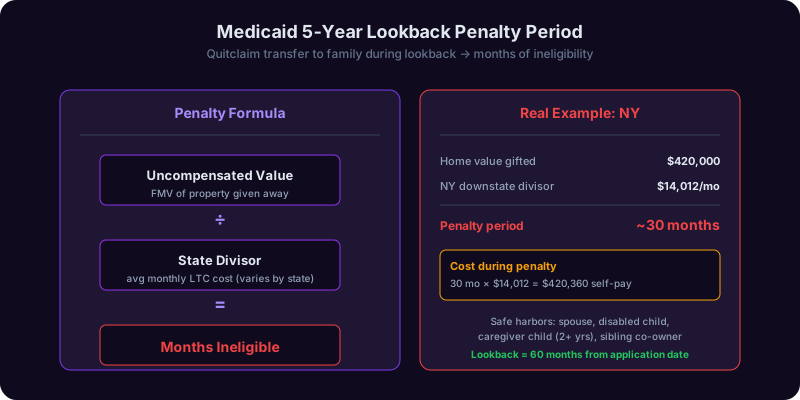
Calculating the penalty: The state takes the value of the transferred asset and divides by the state's monthly penalty divisor - roughly the average private-pay nursing home cost in that state. The result is the number of months the applicant is disqualified, starting on the date they would otherwise have qualified for Medicaid.
| State (2026 est.) | Monthly Divisor | $400K Quitclaim Penalty | Penalty Months |
|---|---|---|---|
| California (skilled nursing) | $13,500 | $400,000 / $13,500 | 29.6 months |
| New York (Upstate) | $13,800 | $400,000 / $13,800 | 28.9 months |
| Florida | $10,809 | $400,000 / $10,809 | 37.0 months |
| Texas | $262.59/day | $400,000 / $7,978 | 50.1 months |
| Ohio | $8,256 | $400,000 / $8,256 | 48.4 months |
Exempt transfers that do NOT trigger penalties:
- Transfer to a spouse (unlimited).
- Transfer to a child who is blind or permanently disabled.
- Transfer to a child under 21.
- Transfer to a caretaker child who lived in the home for at least 2 years and provided care that delayed institutionalization.
- Transfer to a sibling who has an equity interest and lived in the home for at least 1 year.
- Transfer into certain disability trusts or pooled trusts for the applicant's benefit.
The half-loaf strategy: Sophisticated elder law attorneys sometimes use a technique where the applicant gifts half the assets and uses the other half (often via a Medicaid-compliant annuity) to private-pay through the penalty period. This is complex, state-specific, and never something to attempt without an elder law specialist.
The bottom line: If there is any possibility a parent will need Medicaid-funded long-term care within 5 years, do not execute a quitclaim deed without first consulting a certified elder law attorney. The penalty is calculated from the date of Medicaid application, not the date of the deed, so timing matters enormously.
Step-by-Step: How to Properly Execute a Quitclaim Deed
The good news is that executing a valid quitclaim deed is mechanically straightforward. The bad news is that small errors - a missing middle initial, an incorrect parcel number, an unwitnessed signature - can invalidate the transfer or cloud the title for decades. Here is the complete checklist.
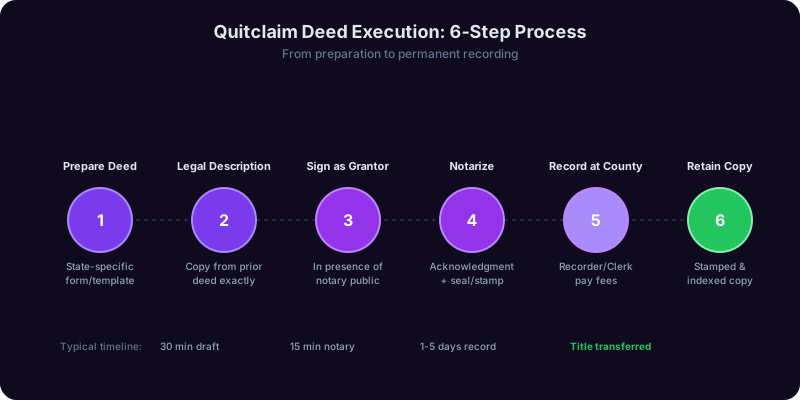
Step 1: Obtain the correct state-specific form. Quitclaim deed requirements are governed by state law. Generic internet forms often miss state-specific language. Use either your county recorder's form, a state bar association form, or a verified template from your state's recorder of deeds website.
Step 2: Pull the current vesting deed. Look up the existing deed at the county recorder. The grantor on your new quitclaim must exactly match the grantee on the most recent deed - including any "as joint tenants," "as trustees," or "a married person as sole and separate property" language.
Step 3: Copy the legal description verbatim. The street address is not enough. The legal description (lot, block, subdivision, or metes and bounds) must be copied character-for-character from the existing deed or a current title report. Even a missing comma can render the deed void for vagueness.
Step 4: State the consideration. Most states require some recital of consideration, even if nominal. Common formulations: "the sum of Ten Dollars ($10.00) and other good and valuable consideration" for an arm's-length transfer, or "love and affection and the sum of One Dollar ($1.00)" for a family gift.
Step 5: Include grantor and grantee details. Full legal names (no nicknames), current mailing addresses, and marital status. For grantees, specify how title will be held: "as joint tenants with right of survivorship," "as tenants in common," "as community property," or "as sole and separate property."
Step 6: Sign before a notary. Every state requires notarization of the grantor's signature. Some states (including Florida, Georgia, Louisiana, South Carolina, and Vermont) also require two witnesses. The grantee does not sign.
Step 7: Spousal consent. In community property states (AZ, CA, ID, LA, NV, NM, TX, WA, WI) and many homestead-protection states (including FL), a non-titled spouse may need to sign even if not on the original deed.
Step 8: Prepare the Preliminary Change of Ownership Report (PCOR) or equivalent. California requires a PCOR. Other states have similar forms - Florida's DR-219, New York's RP-5217, Texas's HCAD form. These determine whether the transfer is reassessed for property tax.
Step 9: Calculate transfer taxes. Most states impose a real estate transfer tax or documentary stamp tax. Many states exempt intra-family transfers, but you must claim the exemption on the recording form. Common exemptions: parent-to-child, spouse-to-spouse, into a revocable trust, divorce decree.
Step 10: Record at the county recorder. An unrecorded deed is valid between the parties but vulnerable to subsequent creditors and bona fide purchasers. Bring the original signed deed, the PCOR/transfer form, the recording fee (typically $15-$150), and any transfer tax payment. The recorder time-stamps it and returns the original.
Step 11: Notify the mortgage holder and insurance carrier. Most mortgages contain a due-on-sale clause that technically allows the lender to accelerate the loan upon transfer. The federal Garn-St. Germain Act exempts most family transfers (spouse, child, joint tenant) but not all. Insurance must be updated to add or substitute the new owner.
Step 12: Update the property tax records. The recorder usually notifies the assessor, but follow up. The new owner needs to file for any applicable homestead exemption in their own name.
State-by-State Recording Requirements: Fees, Transfer Taxes, and Forms
Recording a quitclaim deed is a state and county matter, and the costs and required forms vary wildly. A transfer that costs $25 to record in Ohio can trigger $4,000 in mansion tax in New York. Here is what you need to know in the six most populous states for 2026.
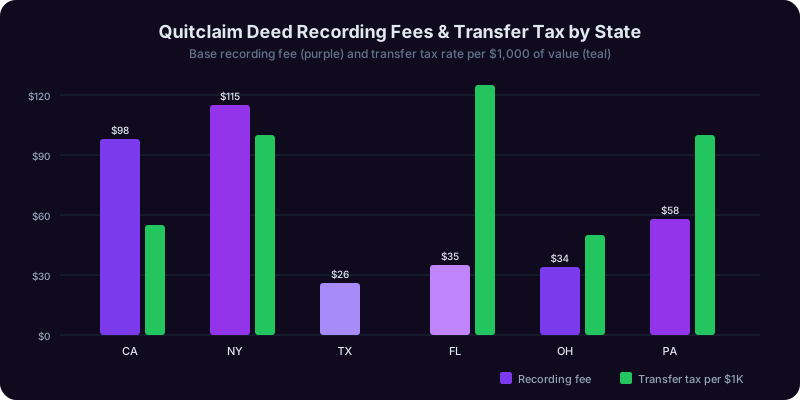
| State | Recording Fee (first page) | Transfer Tax Rate | Family Exemption? | Required Form |
|---|---|---|---|---|
| California | $15-$25 + $75 SB2 fee | $0.55 per $500 (county) + city | Yes - parent/child, spouse | PCOR (BOE-502-A) |
| New York | $45 + $5/page | $2 per $500 state + NYC 1-2.625% | Limited - TP-584 declaration | RP-5217, TP-584 |
| Texas | $26-$30 | None (no state transfer tax) | N/A | Texas Property Code form |
| Florida | $10 first page, $8.50 each add'l | $0.70 per $100 doc stamp ($0.60 Miami-Dade) | No - but minimum tax on quitclaim is $0.70 | DR-219 (if applicable) |
| Ohio | $34 first page, $8 each add'l | $1-$4 per $1,000 (county option) | Yes - DTE 100EX exemption | DTE 100 or DTE 100EX |
| Pennsylvania | $30-$80 county varies | 1% state + 1% local (2% total typical) | Yes - REV-183 family exemption | REV-183, REV-1728 |
California Proposition 19 trap: Since February 2021, parent-to-child transfers of California real estate only retain the parent's property tax basis if the child uses the property as their primary residence and files for the homeowners exemption within one year. The old "$1 million bonus" parent-child exclusion is gone. Quitclaiming a rental property or a vacation home to your kids in California now triggers a full reassessment to current market value - often doubling or tripling the property tax bill.
New York mansion tax: Transfers of residential property valued at $1 million or more trigger an additional 1% buyer-side mansion tax. The NYC mansion tax steps up further for properties above $2M, with a top rate of 3.9% at $25M+. "Quitclaim for love and affection" does not avoid it - NYC assesses based on fair market value.
Florida documentary stamp minimum: Florida is unique in that even a "$1 love and affection" quitclaim to a child triggers a minimum $0.70 documentary stamp tax. If there is a mortgage on the property and the grantee is assuming it, the documentary stamp is calculated on the mortgage balance - which can be thousands of dollars.
Texas advantage: Texas has no state transfer tax, no documentary stamp, and a flat recording fee. It is one of the cheapest states in which to execute a family quitclaim. However, Texas does have unique homestead and community property rules that require spousal joinder.
Pennsylvania quirk: The PA 2% transfer tax applies even to family transfers unless you specifically file the REV-183 claiming the family exemption (parent-child, grandparent-grandchild, spouse, siblings of the same parents). Forget the form and you pay 2% of the assessed value.
Always verify with your specific county recorder before recording - county-level surcharges, e-recording fees, and indexing fees can add another $50-$200 to the cost.
Reverse Quitclaim: When You Need to Undo a Deed Transfer
The phone call usually starts with panic: "My mom quitclaimed her house to me three years ago, but now she needs Medicaid and we are way inside the lookback. Can we just undo it?" Or: "My ex quitclaimed his half to me in the divorce, but the title company is saying the deed is defective. Can he sign a new one?" The answer to both is "maybe, but it is complicated."
A reverse quitclaim - sometimes called a "deed-back" or "corrective deed" - is the process of transferring the property back to the original grantor. The mechanism is exactly the same as the original quitclaim: a new deed naming the current owner as grantor and the original owner as grantee, signed, notarized, and recorded.
When a reverse quitclaim works smoothly:
- Mutual agreement. Both parties cooperate and sign. The deed-back is recorded, and ownership reverts. This is the most common scenario in family contexts.
- Within the same tax year. If the original quitclaim was within the same calendar year and Form 709 has not yet been filed, the IRS may treat the round-trip as if no completed gift occurred - but only if the intent was clearly to undo a mistake, not to manipulate exemptions.
- Scrivener's error. If the original deed had a typographical or clerical error (wrong legal description, misspelled name, missing notary seal), a corrective deed can be recorded that explicitly references and replaces the prior recorded document. Most states allow this without re-triggering transfer tax.
When it gets messy:
- Tax consequences run both directions. A deed-back is itself a gift from the current owner back to the original. If the daughter deeds Mom's house back to Mom, the daughter has potentially used another chunk of her lifetime gift exemption. The IRS does not automatically "undo" the prior gift.
- Medicaid will not be fooled. Federal regulations require Medicaid agencies to look at the substance of transfers, not just current titling. A deed-back made specifically to defeat the lookback can still result in a penalty period - and in some states, lying on a Medicaid application is a criminal offense.
- Disputed cases require litigation. If the grantee refuses to sign the deed-back, the original grantor must sue in state court to set aside the deed. Grounds include undue influence, lack of capacity, fraud, or failure of consideration. These are tough cases, often requiring medical records and witness testimony, and can take 12-24 months to resolve.
- Third-party liens. If the grantee has taken out a mortgage, HELOC, or had a judgment lien recorded against the property, that lien survives the deed-back. The original grantor receives the property subject to whatever the grantee did during their ownership.
- Reassessment risk. A deed-back in California, for example, can be a second reassessment event for property tax purposes if the original transfer broke the parent-child exclusion chain.
The practical takeaway: A deed-back is far more expensive and risky than getting the original deed right. Before executing any family quitclaim, run the "what if we need to undo this?" scenario with an attorney. And if you are already in the position of needing to reverse one, get specialist counsel immediately - there are sometimes time-sensitive elections (such as filing an amended Form 709) that can salvage the situation.
Quitclaim vs Living Trust vs Ladybird Deed: The Smart Alternatives
For most parent-to-child transfer goals - avoiding probate, easing administration, keeping the home in the family - a quitclaim deed is the worst tool in the toolbox. The good news: there are at least three alternatives that achieve the same goals without the tax bomb or Medicaid penalty.
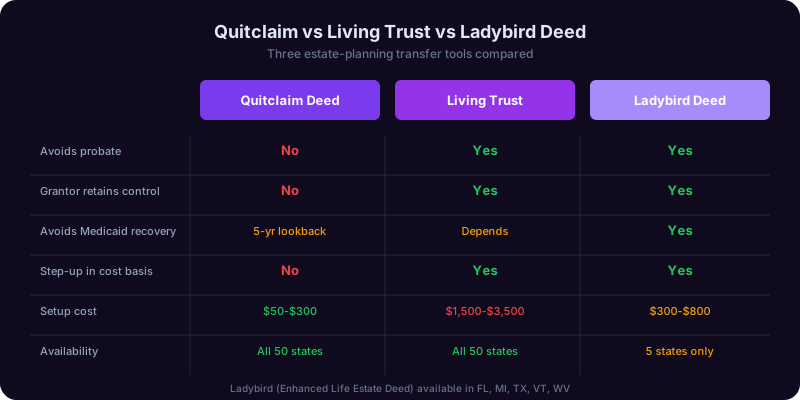
| Mechanism | Avoids Probate? | Step-up in Basis? | Medicaid Safe? | Parent Retains Control? | Cost |
|---|---|---|---|---|---|
| Lifetime Quitclaim | Yes | No - carryover | No - triggers 5-yr lookback | No | $50-$300 |
| Revocable Living Trust | Yes | Yes - full step-up | No - counts as parent's asset | Yes | $1,500-$3,500 |
| Transfer-on-Death (Beneficiary) Deed | Yes | Yes - full step-up | Yes - no transfer until death | Yes | $50-$200 |
| Ladybird (Enhanced Life Estate) Deed | Yes | Yes - full step-up | Yes - no completed gift | Yes - can sell/mortgage | $300-$800 |
| Irrevocable Medicaid Trust | Yes | Yes (if grantor retains POA) | Yes - after 5 years | Limited | $3,500-$8,000 |
The Ladybird Deed (Enhanced Life Estate Deed): This is the elegant solution most families have never heard of. The parent records a deed that conveys the property to the child at the parent's death, while explicitly retaining the right to live in, sell, mortgage, or revoke the transfer during life. Because the parent retains full control, it is not a completed gift for federal tax purposes and not a transfer for Medicaid purposes. At death, the property transfers automatically (no probate) and the child gets a full step-up in basis.
Ladybird deeds are recognized in Florida, Michigan, Texas, Vermont, and West Virginia. In other states, a similar result is achieved with a Transfer-on-Death Deed (TODD) or Beneficiary Deed, now recognized in roughly 30 states under the Uniform Real Property Transfer on Death Act.
The Revocable Living Trust: The parent transfers the property to themselves as trustee of a trust they control. They can revoke, amend, or sell at any time. The trust names the child as a successor beneficiary. At death, the trustee distributes the property without probate, and the child receives a stepped-up basis. The downside: it does not protect the home from Medicaid (the trust is treated as the parent's asset because they can revoke it).
The Irrevocable Medicaid Asset Protection Trust: For families with a long time horizon (more than 5 years), this is the gold standard. The parent transfers the home into an irrevocable trust, naming the children as remainder beneficiaries. After the 5-year lookback period passes, the home is no longer counted as the parent's asset for Medicaid purposes. With careful drafting (retaining a limited power of appointment), the parent can still preserve the step-up in basis at death. The cost is loss of control during the trust term.
Decision framework:
- Parent is healthy, no Medicaid concerns: Revocable living trust or TOD deed.
- Parent in FL/MI/TX/VT/WV, wants Medicaid protection and step-up: Ladybird deed.
- Parent is healthy, 5+ year horizon, wants Medicaid protection: Irrevocable Medicaid Asset Protection Trust.
- Parent is already in nursing home or expected within months: Talk to elder law specialist immediately - crisis planning has its own playbook.
- Property has minimal appreciation: Lifetime quitclaim is actually fine.
Common Quitclaim Mistakes That Cause Title Problems for Decades
Title examiners have a graveyard of horror stories about quitclaim deeds drafted at the kitchen table, signed without proper notarization, or recorded with errors that took thirty years to surface - usually when someone tries to sell or refinance the property and the title company refuses to issue insurance.
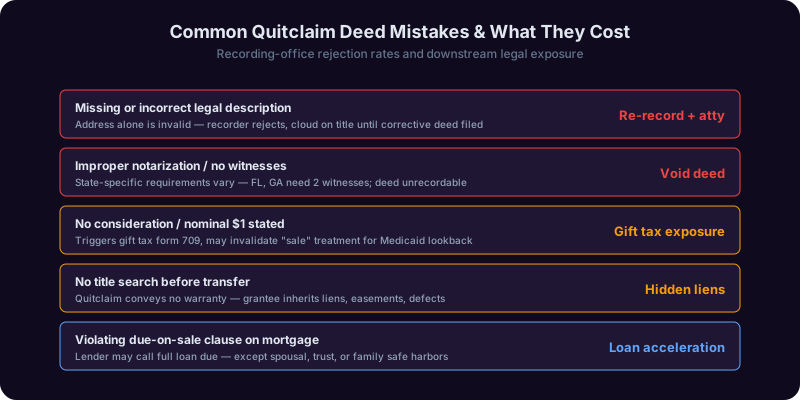
Mistake #1: Missing or defective legal description. The street address is not a legal description. "123 Main Street, Springfield" is meaningless in the chain of title. Every deed needs the lot/block reference, subdivision name, plat book reference, or metes-and-bounds description. A deed with a defective legal description is sometimes void on its face and almost always requires a quiet title action (cost: $3,000-$10,000) to fix.
Mistake #2: No statement of consideration. Most states require some recital of consideration, even nominal. Deeds that say "in consideration of love and affection only" are valid in some states but rejected by recorders in others. Use the universal formulation: "the sum of Ten Dollars ($10.00) and other good and valuable consideration."
Mistake #3: Mismatched grantor names. The grantor on the new quitclaim must match the grantee on the most recent deed exactly. If Mom is on title as "Margaret A. Smith" but signs the quitclaim as "Maggie Smith," you have created a defect that may require an affidavit of identity, or in the worst case, a probate proceeding to resolve.
Mistake #4: Missing spousal signature. In community property states and homestead states, a non-titled spouse often must consent to a transfer of marital property. A Florida homestead conveyed by one spouse without the other's signature is void as to the homestead. The fix requires either the spouse's belated signature or, if the spouse has died, an estate proceeding.
Mistake #5: Untranscribed liens and mortgages. A quitclaim does not extinguish liens. If Mom owes $200,000 on her mortgage and quitclaims to her son, the son takes the property subject to the mortgage. The mortgage is still a lien even if the lender does not invoke the due-on-sale clause. Worse: tax liens, mechanic's liens, and judgment liens survive too. Always pull a current title report before transferring.
Mistake #6: Defective notarization. A notary who fails to verify the signer's identity, misdates the acknowledgment, or omits the seal can render the deed unrecordable. Some states (Florida, Georgia, South Carolina) also require two witnesses in addition to the notary. The deed itself may still be valid between the parties, but it cannot be recorded - and an unrecorded deed is vulnerable to subsequent creditors and bona fide purchasers.
Mistake #7: Wrong vesting language. "To John Smith and Mary Smith" without further qualifier creates a tenancy in common in most states (50/50, no right of survivorship). To create joint tenancy with right of survivorship, you must explicitly say so. To create tenancy by the entirety (available only to married couples in about half of states), specific language is required. The wrong vesting can mean the property goes through probate when one owner dies.
Mistake #8: Failure to record. An unrecorded deed is valid between grantor and grantee but invisible to the world. If the grantor later sells the same property to a bona fide purchaser who records first, the BFP wins in most states. Always record promptly - within days, not months.
Mistake #9: Recording in the wrong county. Deeds must be recorded in the county where the property is located, not where the parties live. This sounds obvious until you handle a property that straddles a county line or has been re-parceled.
Mistake #10: Ignoring transfer tax exemption forms. Even where family transfers are exempt from transfer tax, the exemption is only claimed by filing the proper form at recording. Miss the form, pay the tax. Some states allow refund applications within a year; others do not.
The repair cost for these mistakes ranges from a few hundred dollars (re-signing and re-recording) to tens of thousands (quiet title litigation) to a property no one can sell or insure. The lesson: pay $300-$800 for a real estate attorney to draft and record the deed correctly the first time.
How Copilotly's Legal Copilot Drafts Your Quitclaim Deed and Catches the Tax Traps
The painful truth about quitclaim deeds is that the document itself takes ten minutes to fill out, but the surrounding analysis - gift tax, basis, Medicaid lookback, state-specific exemptions, vesting language, due-on-sale risk - requires expertise most families never access until something goes wrong. That gap is exactly what we built Copilotly's Legal Copilot to close.
Here is how a family transfer flows through Copilotly in 2026:
Step 1: Intake interview. You answer a guided conversation about your situation: state of the property, current owners, intended grantees, relationship, approximate property value, cost basis (if known), mortgage status, parent's age and health, intended purpose of the transfer (estate planning, gift, divorce, trust funding). The intake takes about 8-12 minutes.
Step 2: Risk analysis dashboard. Copilotly generates a personalized analysis showing:
- Estimated gift tax filing requirement (whether Form 709 is needed and how much lifetime exemption you would use).
- Carryover basis projection vs step-up scenario, with a 10-year capital gains forecast at sale.
- Medicaid lookback risk score based on the parent's age and state of residence.
- State-specific transfer tax estimate and applicable family exemptions.
- Due-on-sale clause risk if there is a mortgage, including Garn-St. Germain Act protections.
- Whether a Ladybird Deed, TOD deed, or revocable trust would better serve your goals.
Step 3: Document generation. If you decide to proceed with a quitclaim, the Legal Copilot drafts:
- State-specific quitclaim deed with the correct statutory language, vesting clause, and consideration recital.
- Notary acknowledgment block formatted to your state's requirements (including dual-witness blocks for FL, GA, LA, SC, VT).
- State transfer-tax exemption form (CA PCOR, NY RP-5217/TP-584, FL DR-219, OH DTE-100EX, PA REV-183, etc.).
- IRS Form 709 worksheet pre-populated with the property valuation and donor information.
- Cover letter to your mortgage servicer claiming Garn-St. Germain exemption if applicable.
- Recording instructions for your specific county recorder, including fees and accepted payment methods.
Step 4: Attorney review handoff. Copilotly does not replace your attorney - it makes the attorney visit one hour instead of five. You walk in with a fully analyzed scenario, draft documents, and a checklist of decisions to make. Most attorneys we work with reduce their flat fee by 40-60% when a client arrives with Copilotly-prepared materials.
Step 5: Post-execution tracking. After recording, Copilotly tracks your gift tax filing deadline (April 15 of the following year), reminds you to update homeowners insurance, notifies you when the Medicaid 5-year lookback window closes, and stores your documents in an encrypted vault accessible to your designated beneficiaries.
What Copilotly will not do: We do not give legal advice for your specific situation. We do not handle contested transfers, disputed deeds, or quiet title litigation. We do not replace an elder law attorney for crisis Medicaid planning. We are a software tool that makes the routine 90% of family transfers faster, cheaper, and dramatically less error-prone - and we tell you clearly when you have hit the 10% that needs a human specialist.
Legal & Tax Disclaimer: Copilotly is a legal information and document preparation tool. It is not a law firm and does not provide legal advice. Output is generated based on the information you provide and current rules as of 2026. Tax, deed, and Medicaid rules vary by state and change frequently. You should review Copilotly's analysis and any generated documents with a licensed attorney and qualified tax professional in your state before signing, recording, or filing. References to IRS forms, state agencies, and Medicaid rules are educational. For official guidance, see IRS Form 709 instructions, Medicaid.gov long-term services, and your state recorder of deeds. For general consumer-facing legal information, the NOLO Quitclaim Deed Encyclopedia is a useful starting point.
Frequently Asked Questions
Recommended Copilots
Related Articles
Get Answers From the Legal Copilot
Copilotly's Legal Copilot analyzes your gift tax exposure, Medicaid lookback risk, and carryover basis impact before generating a state-specific quitclaim deed, Form 709 worksheet, and transfer-tax exemption forms. Catch the traps before you sign - not after the IRS audit or the Medicaid denial.