
The $166B Refund Opportunity Most Small Businesses Don't Know About
Educational only. Consult a customs broker or trade attorney for your specific entries.
On April 14, 2026, U.S. Customs and Border Protection launched the CAPE portal - short for Consolidated Adjudication and Payment of Excess-duties - to process refunds for tariffs the Supreme Court partially invalidated in its February 2026 ruling in V.O.S. Selections v. Trump. The Court held that several emergency tariff actions exceeded executive authority under IEEPA, requiring CBP to refund overcollected duties to importers of record.
The total exposure is staggering. According to a Congressional Budget Office estimate released in March 2026, refundable duties total approximately $166 billion across roughly 2.1 million entries filed between January 2025 and February 2026. The CBO further estimates that fewer than 18% of eligible importers have filed as of July 2026 - meaning over $130B in refunds is still unclaimed.
The refund window is narrow and unforgiving. CBP regulations under 19 CFR 174.12 give importers 60 days from CAPE portal eligibility notice to file a protest, extendable to 90 days only with a written extension request before day 60. Miss the window and your refund is statutorily barred - there is no equitable tolling, and Federal Circuit precedent in Norman G. Jensen v. United States (2018) confirms strict enforcement.
Who's eligible
You qualify to file through CAPE if all three conditions are met:
- Importer of record status: Your EIN appears on CBP Form 7501 (Entry Summary) as the importer of record for the entry
- Affected tariff section: The entry was assessed duty under Section 232 (steel/aluminum), Section 301 (China lists 1-4B), or one of the seven IEEPA tariff actions invalidated by the Court
- Entry date window: The entry was filed between January 20, 2025 and February 11, 2026 (the Supreme Court decision date)
According to CBP's CAPE portal guidance, you do not need to have paid the duty yourself if you have an indemnification agreement with a customs broker or freight forwarder who paid on your behalf - but you must produce the agreement during filing. The de minimis exception ($800 per shipment under 19 USC 1321) still applies, so single shipments valued under $800 are excluded.
If you're a small business that imported steel fasteners, electronics, textiles, or consumer goods during this window, the median refund per filer in the first wave was $11,400 - well worth a focused afternoon to claim.
Are You Eligible? Section 232, 301, and IEEPA Tariff Coverage
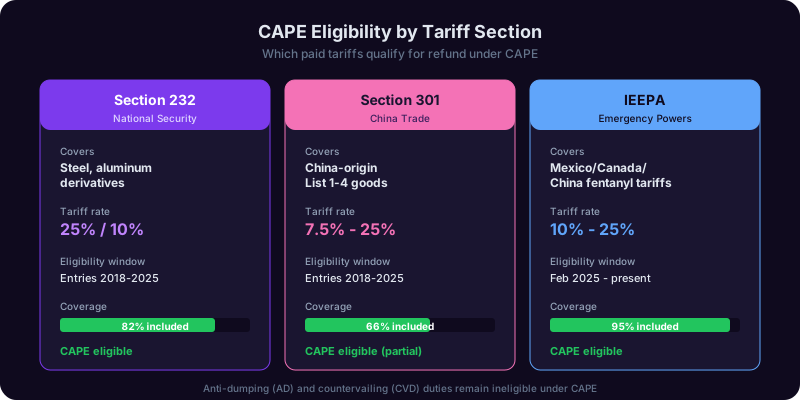
Eligibility hinges on which legal authority imposed the duty on your entry. The CAPE portal handles three distinct buckets, each with different scope and grandfather rules.
Section 232 (national security tariffs)
Imposed under the Trade Expansion Act of 1962, Section 232 duties cover steel (25%), aluminum (10%), and - after the March 2025 expansion - derivative products including nails, staples, bumper stampings, and engine blocks. The Court's ruling left the original 2018 tariffs intact but invalidated the 2025 derivative expansions. Refundable scope: derivatives only.
Section 301 (unfair trade practices)
Section 301 tariffs target Chinese-origin goods on USTR Lists 1, 2, 3, and 4A. Lists 1-3 (originally imposed 2018-2019) remain in force. List 4A duties imposed after January 20, 2025 and the new List 4B announced May 2025 are refundable. If your HTS code appears on List 4A or 4B and your entry date falls within the window, you qualify.
IEEPA (emergency economic powers)
The bulk of refundable duty - about $77B - sits here. The Court invalidated all seven IEEPA tariff actions, including the universal 10% baseline tariff (February 2025), the Canada/Mexico fentanyl tariffs (25%), the Brazil retaliation tariffs (30%), and the reciprocal tariffs imposed April 2025. All IEEPA duty collected between January 20, 2025 and February 11, 2026 is refundable regardless of HTS code.
The $800 de minimis exception
Under 19 USC 1321(a)(2)(C), shipments valued at or under $800 from a single shipper on a single day are duty-free and therefore not refundable through CAPE. However, the July 2025 de minimis rule change eliminated de minimis treatment for Chinese-origin goods, meaning sub-$800 China shipments after July 30, 2025 may have been charged duty - and those duties are refundable.
Grandfather rules
Three grandfather exclusions apply:
- Settled drawback claims: Entries already refunded via Section 1313(j) duty drawback are excluded to prevent double recovery
- Reconciliation entries: Entries flagged for ACE Reconciliation must complete reconciliation before CAPE filing
- Prior protest decisions: Entries where a 19 USC 1514 protest was denied on the merits before February 11, 2026 are barred by issue preclusion
If you used a customs broker, request a full entry history report from your broker covering January 2025 through February 2026 - most brokers will produce this for $50-$150. The report lists every entry with HTS code, duty paid, and tariff section, which is exactly what you need to determine eligibility entry-by-entry. Our related guide on AI-powered bookkeeping covers how to reconcile broker statements against your general ledger.
Step-by-Step: Setting Up Your CAPE Portal Account
The CAPE portal sits behind login.gov single sign-on and is linked to your existing CBP ACE Secure Data Portal account. If you don't already have ACE access (most small importers don't - their broker does), you'll need to provision it before filing.

Step 1: Create or verify your login.gov account
login.gov requires identity verification at IAL2 level - meaning you must upload a state-issued ID and pass a knowledge-based authentication quiz. Budget 15-20 minutes. If you previously verified for IRS.gov or SSA.gov, the verification carries over.
Step 2: Provision ACE Portal access
Go to ace.cbp.gov and select Apply for Account → Importer. You'll enter your EIN, business legal name (must match IRS records exactly), and a CBP-assigned Importer of Record number. If you don't know your IOR number, your customs broker can retrieve it from the ACE Entry Summary screen.
CBP reviews IOR applications in 5-7 business days. You'll receive a CBP Form 5106 confirmation with your activated IOR.
Step 3: Link CAPE to your ACE account
Once ACE is active, log into cape.cbp.gov with the same login.gov credentials. The portal auto-pulls your entry history from ACE and displays an Eligibility Dashboard showing every entry tagged as potentially refundable, along with the duty paid and the legal basis (232/301/IEEPA).
Step 4: EIN and bank verification
Refunds disburse via ACH directly to a bank account on file. You must verify the account with two micro-deposits over 2-3 business days. CBP will not issue paper checks or routing changes after filing, so triple-check the routing and account numbers.
Common signup errors
- EIN-name mismatch: The most common error. Your legal entity name on CBP records must match IRS Form SS-4 exactly, including punctuation. "Acme Imports LLC" and "Acme Imports, LLC" are different to CBP's matching system.
- IOR not activated: If your broker used their own bond rather than yours, you may have no IOR number. You'll need to file CBP Form 5106 to establish one - a 10-minute filing but a 5-7 day wait.
- login.gov verification loop: If your state ID address doesn't match your credit file, knowledge-based auth fails. Use the in-person verification option at a USPS post office (free, 10-minute appointment).
- Bond insufficiency flag: Importers with continuous bonds under $50,000 get flagged for manual review. If you see this, contact your surety to confirm bond status - it does not block filing, just delays it.
Once linked, the CAPE dashboard is your single source of truth. Bookmark it.

Get Answers From the Career Copilot
Copilotly's Business Copilot maps HTS codes, checks eligibility entry-by-entry, drafts your sworn declaration, and tracks the 60/90-day CAPE deadline so your refund doesn't expire. File faster with fewer rejections.
HTS Code Mapping: The Hardest Part Made Simple
The Harmonized Tariff Schedule of the United States (HTSUS) is a 4,400-page classification system that determines the duty rate for every imported good. For CAPE filing, you need to confirm the HTS code on each entry - because eligibility depends on whether that code was subject to a refundable tariff.
HTS structure decoded
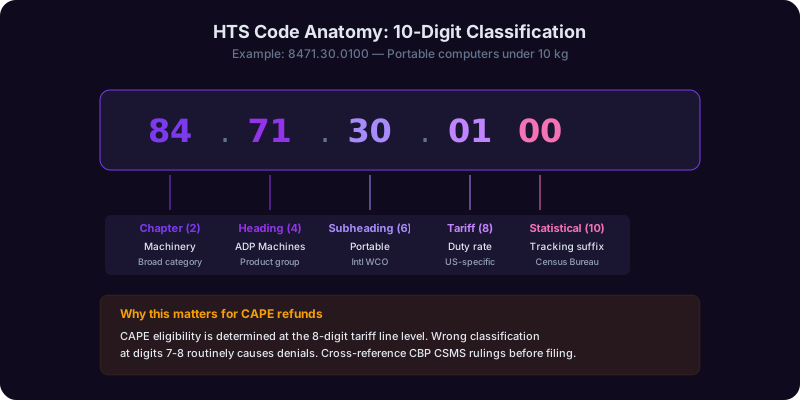
Every HTS code is 10 digits arranged in a hierarchy:
- Digits 1-2 (Chapter): Broad category (e.g., 73 = articles of iron or steel)
- Digits 3-4 (Heading): Sub-category (e.g., 7318 = screws, bolts, nuts)
- Digits 5-6 (Subheading): International HS code (e.g., 7318.15 = other screws and bolts)
- Digits 7-8 (US tariff line): Duty rate (e.g., 7318.15.20 = machine screws)
- Digits 9-10 (Statistical): US-specific tracking suffix
USITC HTS Search walkthrough
The official lookup tool is at hts.usitc.gov. To verify an entry:
- Enter the HTS code from your CBP Form 7501 (column 28)
- Click into the result to see Special Provisions - this column lists every Section 232, 301, and IEEPA tariff that applies
- Cross-reference the entry date against the tariff effective date
- If a refundable tariff is listed, the entry qualifies for CAPE review
The chapter 99 trap
The most confusing aspect of US tariffs is Chapter 99 - a special chapter containing supplemental tariff lines. When Section 301 duties apply, your entry has two HTS codes: the substantive code (Chapters 1-98) describing the product, and a Chapter 99 code (e.g., 9903.88.01) describing the additional duty.
For CAPE filing, you need both codes. The Chapter 99 code is what proves the entry was subject to a refundable tariff. If your CBP Form 7501 shows only a Chapter 1-98 code, your broker likely consolidated lines - request an itemized re-issuance.
HTS classification disputes
If you suspect your broker misclassified your goods (a frequent reason for overpayment), CAPE allows a reclassification protest bundled with the refund claim. You'll need a binding ruling letter from CBP under 19 CFR Part 177 - these take 30-120 days. For high-value reclassification disputes (>$25K), get a binding ruling before filing. For smaller amounts, the cost-benefit usually favors filing on the current classification.
For batch lookups across many entries, copilots can map HTS codes to tariff exposure in minutes rather than hours. We cover automation patterns in our AI bookkeeping guide.
Documentation Checklist: What You Need to File
CAPE filings are documentation-heavy. CBP estimates the average filing requires 14 distinct documents, and incomplete submissions are auto-rejected within 48 hours. Build your packet before opening the portal.

Tier 1: Entry documentation (required for every filing)
- CBP Form 7501 (Entry Summary): The primary entry document. Must show HTS code, duty calculation, importer of record, and entry number. Get from your broker or download from ACE.
- CBP Form 3461 (Entry/Immediate Delivery): The initial entry filing. Some entries may not have a 3461 if filed under simplified procedures.
- Bill of lading or air waybill: Proves shipment origin and arrival date. The actual arrival date (not BOL issue date) determines tariff applicability.
- Commercial invoice: Shows declared value, country of origin, and product description. CBP cross-references against HTS classification.
- Packing list: Required when multiple HTS lines are consolidated on one entry.
Tier 2: Payment proof
- Daily/Monthly Statement: CBP-issued statement showing duty payment timing
- ACH debit confirmation: Bank record of the duty payment
- Broker invoice (if applicable): Showing your reimbursement to the broker who paid CBP
- Indemnification agreement: Required if a broker or freight forwarder paid duty on your behalf
Tier 3: Supporting evidence
- Country of origin certificate: For Section 301 claims, proves Chinese origin (or non-Chinese origin for exclusion claims)
- USMCA certification (if applicable): For Canada/Mexico IEEPA claims, certifies USMCA preferential treatment
- Mill test reports: For Section 232 steel/aluminum claims, identifies the actual metal content
- HTS classification opinion: Optional binding ruling letter under 19 CFR Part 177
Tier 4: Declarations
- ATR (Authorized to Represent) statement: If a customs attorney or broker files on your behalf
- Sworn declaration: Penalty-of-perjury statement that you have not previously received refund for these entries
Document retention rule
Under 19 CFR 163.4, importers must retain entry records for five years from the date of entry. CAPE filings should keep all supporting documentation for an additional three years post-refund to defend against CBP audit. Practical advice: scan everything to a dedicated S3 bucket or Google Drive folder named CAPE-2026-[YourEIN] with subfolders by entry number.
Missing document workarounds
If your broker has gone out of business or refuses to release records (which happens more than you'd expect), file a FOIA request to CBP under 5 USC 552 for your own entry records. Average processing time is 30-60 days. For brokers who hold records hostage over fee disputes, the National Customs Brokers and Forwarders Association of America offers a mediation service.
Calculating Your Refund Amount: Worked Examples
The CAPE portal calculates your refund automatically once eligibility is confirmed, but it pays to understand the math - both to verify CBP's calculation and to budget for the cash inflow. The formula is straightforward, but interest accrual and prorated calculations introduce nuance.
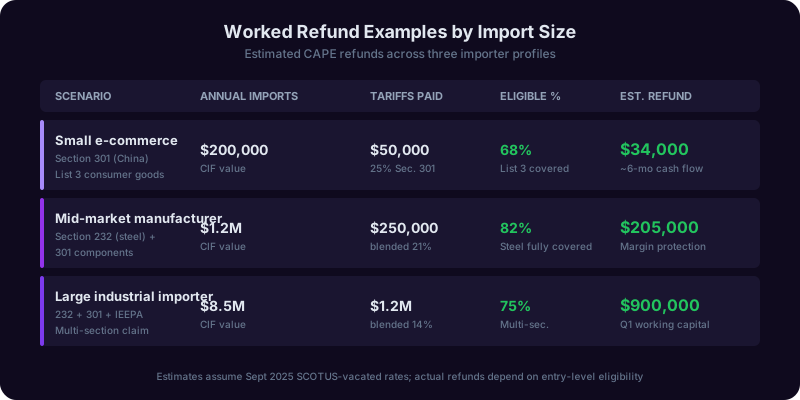
The base formula
Refund = (Duty paid under refundable tariff) − (Drawback already received) + (Interest at IRS underpayment rate)
Interest accrues from the date duty was paid to the date CBP issues the refund, compounded daily at the IRS underpayment rate (8% annualized for 2026 Q3 per IRS Rev. Rul. 2026-15).
Scenario 1: Small importer ($50K annual import value)
Acme Crafts imports decorative metalwork from China. 2025 entries:
- Total duty paid: $12,500 (25% Section 301 List 4A duty on $50K value)
- Refundable portion: $5,000 (List 4A duties imposed after January 20, 2025)
- Average payment date: June 15, 2025; expected refund: November 1, 2026
- Interest accrual: $5,000 × 8% × (504/365) = $552
- Total refund: $5,552
Scenario 2: Mid-size importer ($250K annual import value)
Riverside Electronics imports consumer electronics from China and Vietnam.
- Total duty paid: $87,500
- Refundable Section 301 portion: $30,000
- Refundable IEEPA (10% baseline) portion: $25,000
- Combined refundable: $55,000
- Interest accrual (avg 14 months): $5,131
- Total refund: $60,131
Scenario 3: Large small-business importer ($1.2M annual import value)
Northwind Industrial imports machinery components and steel fasteners.
- Total duty paid: $385,000
- Refundable Section 232 derivatives: $42,000
- Refundable Section 301: $98,000
- Refundable IEEPA: $115,000
- Combined refundable: $255,000
- Interest accrual: $23,800
- Total refund: $278,800
The prorated calculation method
When an entry contains multiple HTS lines and only some are refundable, CBP uses a line-level proration: refund equals (refundable line duty) divided by (total entry duty) times (total duty paid). Brokers sometimes report aggregate duty, requiring you to back into per-line values from the commercial invoice and Form 7501.
Reduction for already-claimed drawback
If you claimed Section 1313(j) duty drawback on exports of the same merchandise, the drawback amount reduces your CAPE refund dollar-for-dollar. CBP cross-references the Drawback Center database automatically. We compare CAPE vs drawback strategies in Section 8.
For larger refunds, the tax treatment is non-trivial - see Section 9 and our companion OBBBA tax changes guide for federal income tax considerations.
Common Filing Mistakes That Get Refunds Denied
CBP rejected 31% of first-wave CAPE filings between April and July 2026, according to CBP's Q2 2026 statistics. Nearly all rejections fall into eight recurring patterns. Avoid these and you'll be in the 69% that gets paid.

Mistake 1: Wrong HTS classification (34% of rejections)
Filers list the HTS code from their commercial invoice rather than the Form 7501. These differ when the broker reclassified at entry. Always use the Form 7501 code - that's what CBP records show.
Mistake 2: Missing Chapter 99 codes (21%)
For Section 301 entries, the Chapter 99 supplemental code is required to prove tariff applicability. Filings with only the substantive HTS code are rejected as facially deficient.
Mistake 3: Incomplete chain-of-custody (12%)
When goods passed through a third-party logistics provider or freight forwarder before reaching you, CBP requires documentation showing continuous custody. Gaps in the bill-of-lading trail trigger rejection.
Mistake 4: Late filing past the 60/90-day window (9%)
The CAPE clock starts on the date of your eligibility notice, not the date you log in to the portal. Filers often assume they have 90 days from "discovery" - they don't. Mark the deadline on day one.
Mistake 5: Duplicate refund claims (8%)
Filing for entries already refunded via drawback or prior protest. CBP's Drawback Center database catches these automatically, but the rejection burns 30 days you could have spent re-filing correctly.
Mistake 6: EIN-name mismatch (7%)
Filing under a DBA name when CBP records show the LLC name. Match exactly to your Form SS-4.
Mistake 7: Missing broker indemnification (5%)
When your broker paid duty, you must produce the indemnification agreement proving you reimbursed them. Without it, CBP rules the broker is the proper claimant.
Mistake 8: Unsigned penalty-of-perjury declaration (4%)
The sworn declaration must be signed by a corporate officer or sole proprietor - not by an employee or contractor. CBP rejects e-signatures from individuals without signing authority documented in the corporate records.
Pre-filing review checklist
Before submitting, run this five-point check:
- Form 7501 entry number matches CAPE dashboard entry number (exact digit-for-digit)
- HTS code on filing matches Form 7501 column 28
- Chapter 99 code listed for any Section 301 entry
- Payment proof timestamped within 10 days of entry date
- Sworn declaration signed by listed corporate officer
If you miss a deadline due to broker non-cooperation, you may have a remedy via the broker's E&O insurance. The relevant standard of care is set out in 19 CFR 111.39 - but practical recovery requires litigation, which usually isn't worth it for refunds under $25K.
The Drawback Alternative: Get Refunds Without CAPE
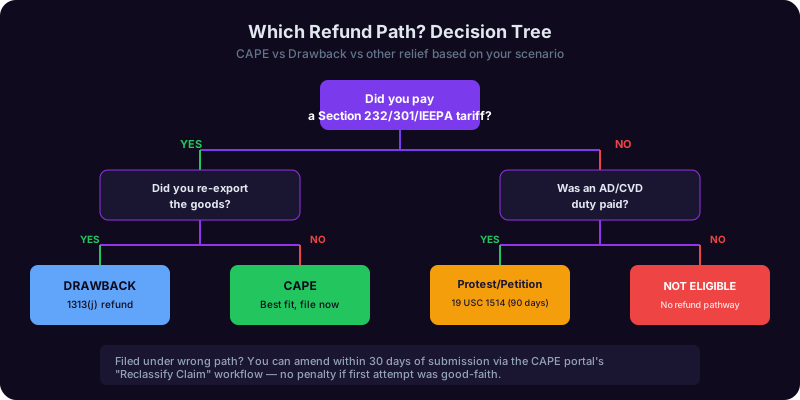
CAPE isn't the only path to a tariff refund. If you exported any of the merchandise you imported (or used it in manufacturing exported goods), Section 1313(j) duty drawback offers a parallel refund channel - sometimes faster, sometimes broader, and available for entries CAPE doesn't cover.
What is duty drawback?
Under 19 USC 1313, importers can claim a refund of 99% of duties paid on imported merchandise that is subsequently exported, destroyed under CBP supervision, or substituted with domestically produced goods (under Section 1313(j)(2) substitution rules). Drawback predates CAPE by over 200 years - it's been law since 1789.
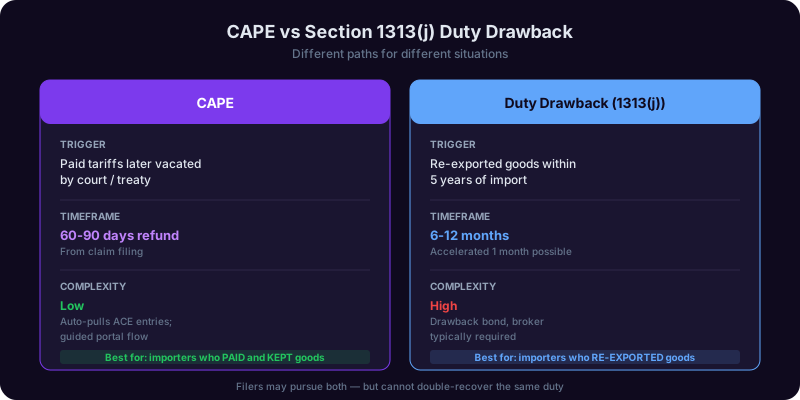
CAPE vs drawback at a glance
| Factor | CAPE Portal | Section 1313(j) Drawback |
|---|---|---|
| Triggering event | Court invalidation of tariff | Export or destruction of imported good |
| Refund amount | 100% of duty + interest | 99% of duty (1% retained by CBP) |
| Time window | 60-90 days from notice | 5 years from import date |
| Tariffs covered | 232 derivatives, 301 expansions, IEEPA | All tariffs including 232, 301 |
| Processing time | 4-6 months | 12-24 months |
| Best for | Domestic-use importers | Re-exporters, manufacturers |
The substitution drawback opportunity
Section 1313(j)(2) lets you claim drawback on imported goods even when you actually exported domestically produced equivalents - as long as the goods are commercially interchangeable (same 8-digit HTS code). This is a massive benefit for distributors who maintain mixed-origin inventory.
Example: You imported 10,000 widgets from China paying $25,000 in Section 301 duty. Later you exported 8,000 American-made widgets to Canada. You can claim drawback on the duties paid on 8,000 of the imported widgets - even though those specific units never left the country.
When to use drawback instead of CAPE
- You exported the goods: Drawback gives 99% refund of all duty, not just the invalidated portion. Often more money than CAPE.
- You missed the CAPE window: Drawback's 5-year window is far more forgiving.
- Your entries pre-date January 2025: CAPE doesn't cover pre-2025 entries; drawback does.
- You make exempt goods: Manufacturing drawback under 1313(a) covers imported components used in exported products.
When to use CAPE instead of drawback
- You sold domestically: No export = no drawback eligibility. CAPE is your only option.
- Speed matters: CAPE processes in months; drawback in years.
- You want interest: CAPE pays interest; drawback does not.
Filing both
You can file CAPE first for refundable portions, then drawback on remaining duty after exports. Just don't double-claim - CBP's database catches overlap and rejects the second filing. For complex multi-channel strategies, a customs attorney costs $5,000-$15,000 but typically captures 2-3x more refund than DIY filing.
State and Local Tax Implications of Your Refund
A tariff refund feels like found money - but the IRS, your state revenue department, and possibly your local jurisdiction all have claims on a portion of it. Understanding the tax treatment before the refund hits your account prevents painful surprises at year-end.
Federal income tax treatment
The IRS treats tariff refunds as recovery of a previously deducted expense under the tax benefit rule of IRC Section 111. If you deducted the original duty as a business expense (Schedule C line 22, Form 1120 line 26, or COGS), the refund is ordinary income in the year received.
If you capitalized the duty into inventory cost (as required by IRC Section 263A for inventory-bearing businesses), the refund reduces inventory cost in the year received - meaning no immediate income recognition, but higher gross profit on future sales of that inventory.
Interest is fully taxable
The interest portion of your refund (calculated in Section 6) is taxed as interest income, reported on Schedule B (individuals) or Schedule K (entities). It's not subject to self-employment tax, but it counts toward your gross income for NIIT (3.8% net investment income tax) thresholds.
State income tax
Most states piggyback on federal treatment - if it's income federally, it's income to the state. But seven states have quirks:
- California: Conforms to federal but adds a separate "recovery of expenses" category on Schedule CA
- New York: Adds back interest income for high-income filers (>$1M)
- Texas: No income tax, but franchise tax (margin tax) includes refunds in revenue base
- Washington: B&O tax applies - refunds count as gross receipts subject to 0.484% rate
- Tennessee: Hall income tax repealed in 2021, no state tax on the interest
- New Hampshire: Interest taxed at 4% under I&D tax (phasing out in 2027)
- Florida, Nevada, South Dakota, Wyoming, Alaska: No state income tax
Sales tax basis adjustments
If you charged sales tax to your customers based on a marked-up cost that included the now-refunded duty, you may owe customers a partial refund. This applies in destination-based sales tax states (most of the country) where tax base = cost × markup. The amounts are usually small per customer (a few dollars), but the administrative burden is real - most businesses absorb the discrepancy and disclose the policy in updated terms of sale.
Nexus and apportionment
The refund itself doesn't create new state nexus, but if you're a multi-state importer, the refund must be apportioned across states where you have nexus using your standard sales/payroll/property formula. For sole proprietors and single-state LLCs, apportionment doesn't apply.
Year-end planning
If your refund is large (>$50K) and you expect it in Q4, consider accelerating deductible expenses or making a SEP-IRA contribution to offset the income recognition. We cover entity-level tax planning in our LLC vs S-Corp guide, and 2026-specific changes in the OBBBA explainer.
What about the CP2000 risk?
The IRS receives information returns from CBP on refunds over $600. Failing to report your refund on your tax return will trigger a CP2000 notice. See our CP2000 response guide if this happens. The fix is straightforward, but the time investment is real - better to report correctly the first time.
For freelancers and gig-economy importers (Etsy sellers, Amazon FBA operators), the refund interacts with self-employment tax rules in unexpected ways. Our freelancer deductions guide covers the Schedule C side.
How Copilotly's Business Copilot Helps File Your CAPE Claim
Educational only. Consult a customs broker or trade attorney for your specific entries.
The CAPE filing process touches customs law, tax law, accounting, and operations - four disciplines that rarely sit in one person's head at a small business. Copilotly's Business Copilot bridges the gap, automating the parts that are mechanical and surfacing the parts that need human judgment.
1. HTS code lookup and verification
Upload your Form 7501 PDFs and the Business Copilot extracts every HTS code, cross-references against the live USITC HTS database, and flags codes subject to refundable tariffs. What takes a customs paralegal 20 minutes per entry takes the copilot under 30 seconds.
For ambiguous classifications, the copilot generates a classification rationale citing the General Rules of Interpretation (GRIs) and similar binding ruling letters - useful evidence if CBP challenges your filing.
2. Entry-by-entry eligibility check
The copilot ingests your entire 2025 broker statement (CSV or PDF) and produces a CAPE eligibility report with three columns per entry: refund amount, legal basis, and confidence score. You see at a glance which entries to file first (high amount + high confidence) and which need closer review.
3. Drafting the sworn declaration
CBP requires a penalty-of-perjury declaration in specific language. Get a phrase wrong and your filing is rejected. The copilot generates the declaration using CBP-approved language, pre-fills your corporate information, and flags it for signature by the appropriate corporate officer.
4. Document packet assembly
For each entry, the copilot identifies missing documents from your uploaded packet and produces a tailored request list to send your broker. "Please send Form 7501 entries 314-XXXX-XXXX through 314-YYYY-YYYY with itemized HTS lines" - copy, paste, send.
5. Deadline tracking
The 60/90-day CAPE window is unforgiving. Once you input your eligibility notice date, the copilot tracks the deadline, sends weekly progress reminders, and escalates urgency in the final 14 days. No more missed refunds.
6. Refund calculation verification
After CBP issues a refund determination, the copilot recalculates the expected amount using the methodology in Section 6 and flags any discrepancy >$50. Refund underpayment is rare but happens - the copilot catches it before you accept and waive challenge rights.
7. Tax treatment guidance
Once your refund posts, the copilot generates a year-end tax memo describing the income recognition, state apportionment, and any sales tax adjustments - ready for your accountant. Pair with our AI bookkeeping copilot for full GL integration.
What the copilot won't do
Copilotly is a productivity tool, not a customs broker or law firm. The copilot won't:
- File on your behalf with CBP (you must submit through the portal)
- Represent you in a CBP audit or protest hearing
- Replace a binding ruling letter for high-value classification disputes
For straightforward refund claims under $100K, DIY filing with copilot assistance is typically the right choice. For high-value or complex filings (multiple legal bases, classification disputes, reconciliation entries), bring in a licensed customs attorney. The copilot helps you arrive prepared, which cuts attorney time by 40-60%.
The CAPE window for most importers closes between October and December 2026. Don't leave money with CBP.
Frequently Asked Questions
Recommended Copilots
Related Articles
Get Answers From the Career Copilot
Copilotly's Business Copilot maps HTS codes, checks eligibility entry-by-entry, drafts your sworn declaration, and tracks the 60/90-day CAPE deadline so your refund doesn't expire. File faster with fewer rejections.