Why Every Contract Deserves a Careful Review (Even the Short Ones)
Contracts govern nearly every professional and personal transaction you enter into. Your apartment lease, your freelance agreement, your employment offer letter, your NDA with a new client -- each one is a binding legal document that defines your rights, obligations, and potential liabilities. Yet most people sign contracts without reading them thoroughly, let alone understanding the legal implications of every clause.
The consequences of signing a poorly understood contract can be severe. A non-compete clause buried in an employment agreement might prevent you from working in your industry for two years. An indemnification clause in a freelance contract could make you personally liable for a client's losses. An automatic renewal provision in a lease could lock you into another twelve months you did not plan for.
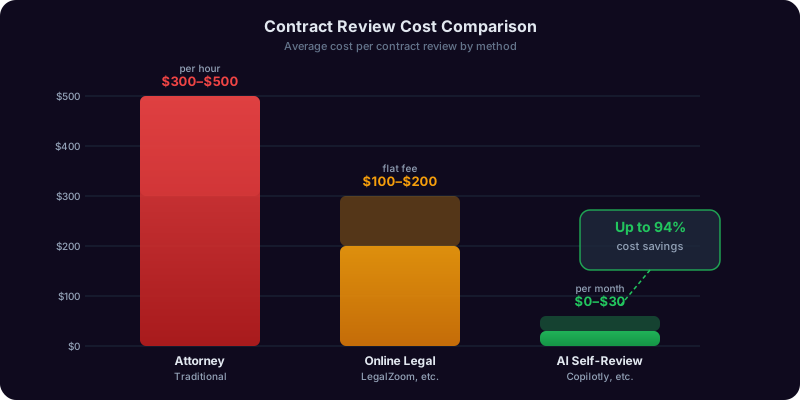
The traditional solution has always been simple: hire a lawyer. But at $300 to $500 per hour for a competent contracts attorney, the math does not work for most people reviewing routine documents. A freelancer earning $75,000 per year cannot justify spending $600 to have a lawyer review a $5,000 project contract. A first-time renter cannot afford $400 in legal fees to review a standard apartment lease.
This gap between "needs legal review" and "can afford legal review" has left millions of people exposed. According to the American Bar Association, approximately 80 percent of low- and moderate-income Americans do not get the legal help they need. Contract review is one of the most common unmet legal needs.
The landscape has changed dramatically in 2026. AI-powered contract review tools can now analyze standard agreements in seconds, flag unusual or risky clauses, explain legal terminology in plain language, and compare contract terms against industry standards. These tools do not replace lawyers for complex negotiations or high-stakes deals, but they fill the gap for the vast majority of routine contract reviews that most people skip entirely.
This guide walks you through a systematic approach to reviewing contracts yourself using AI assistance. You will learn what to look for in the most common contract types, how to identify red flags, when AI tools are sufficient, and when you genuinely need to involve a human attorney.
The Five Most Common Contracts You Will Encounter (and What to Check in Each)
Different contract types carry different risks. Here is what to scrutinize in each of the five contracts most people encounter.
1. Residential Lease Agreements
Leases are often your first binding contract and frequently favor the landlord. Check: termination and early exit clauses (penalty amounts, notice periods), security deposit terms (compare against your state's tenant protection laws), maintenance responsibilities (who pays for what and the dollar threshold), rent increase provisions (mid-term increases, notice requirements), and subletting and guest policies.
2. Freelance and Independent Contractor Agreements
These define your client relationship and can limit future opportunities. Watch for: scope of work (vague scope invites scope creep), payment terms (when, how, and late payment penalties), intellectual property assignment (does it capture pre-existing work?), non-compete and non-solicitation clauses, and kill fee or cancellation terms (compensation if the project is canceled midway).
3. Employment Contracts and Offer Letters
Go beyond salary and benefits. Review: at-will vs. for-cause termination language, non-compete agreements (duration, geographic scope, industry definition), invention assignment clauses (some employers claim ownership of personal projects and side businesses created during employment), and mandatory arbitration clauses that limit your legal options in disputes.
4. Non-Disclosure Agreements (NDAs)
Not all NDAs are equal. Evaluate: the definition of confidential information (narrow trade secrets vs. broadly "anything told to you"), duration (indefinite NDAs are a red flag), mutual vs. one-way protection, and standard exceptions (publicly available information, independently developed knowledge, prior knowledge).
5. Service Agreements and Terms of Service
These govern vendor and platform relationships. Check: liability limitations (caps often do not cover actual damages), data ownership and privacy (can the provider use your data for marketing or training?), and automatic renewal with price increases (note the cancellation window immediately).
For a deeper walkthrough of contract language and negotiation strategies, see our guide on how to read and negotiate any contract.
Universal Contract Red Flags: 12 Clauses That Should Always Raise Concern
Regardless of the contract type, certain provisions should trigger immediate scrutiny. These are not always deal-breakers, but they require you to understand exactly what you are agreeing to.
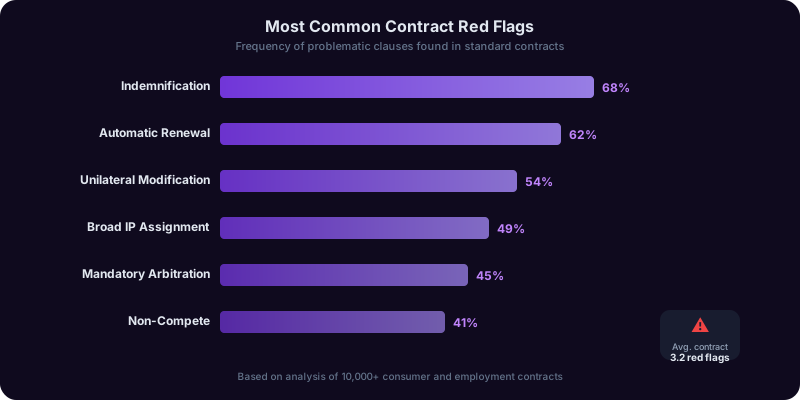
The Top Six Red Flags
- Unlimited indemnification: You could be liable for damages far exceeding the contract value. Look for "indemnify, defend, and hold harmless" with no cap. Negotiate for a cap tied to fees paid.
- Unilateral modification rights: Language like "Company reserves the right to modify these terms at any time" means you are signing a blank check. Require mutual written consent for changes.
- Broad IP assignment: Phrases like "all work created during the term" can capture personal projects and pre-existing work. Limit assignment to specific deliverables only.
- Non-compete clauses over 12 months: Overly broad definitions of "competing business," wide geographic scope, or excessive duration. Check your state bar's resources on enforceability.
- Mandatory binding arbitration: Eliminates your right to a jury trial and limits appeals. Class action waivers paired with arbitration are especially concerning.
- Automatic renewal with narrow opt-out windows: Contracts that renew unless you give written notice within 30-60 days can lock you into unwanted terms. Calendar the deadline immediately.
| Red Flag | Risk Level | Negotiable? | Recommended Action |
|---|---|---|---|
| Unlimited indemnification | High | Usually yes | Cap at total fees paid |
| Unilateral modification | High | Sometimes | Require mutual consent |
| Broad IP assignment | High | Usually yes | Limit to deliverables only |
| Non-compete over 12 months | Medium-High | Often yes | Narrow scope and duration |
| Mandatory arbitration | Medium | Rarely | Negotiate venue or court option |
| Auto-renewal | Medium | Sometimes | Request 90-day notice window |
| Liquidated damages | Medium-High | Usually yes | Ensure proportionate amount |
| No limitation of liability | High | Usually yes | Add mutual liability cap |
| Unfavorable choice of law/venue | Medium | Sometimes | Negotiate for your state |
| Assignment without consent | Medium | Usually yes | Require written approval |
If you encounter three or more of these red flags in a single contract, the deal may not be structured fairly. A high concentration of one-sided provisions suggests the other party is not negotiating in good faith, and you should consider whether to proceed at all.

Get Answers From the Legal Copilot
Upload any contract and get a plain-language breakdown of every clause, red flag alerts, and negotiation suggestions in minutes. Stop signing agreements you do not fully understand.
How AI Contract Review Actually Works in 2026
Modern AI contract review uses large language models trained on millions of legal documents to understand contract language in context -- not just match keywords. Here is what the technology can reliably do for you today.
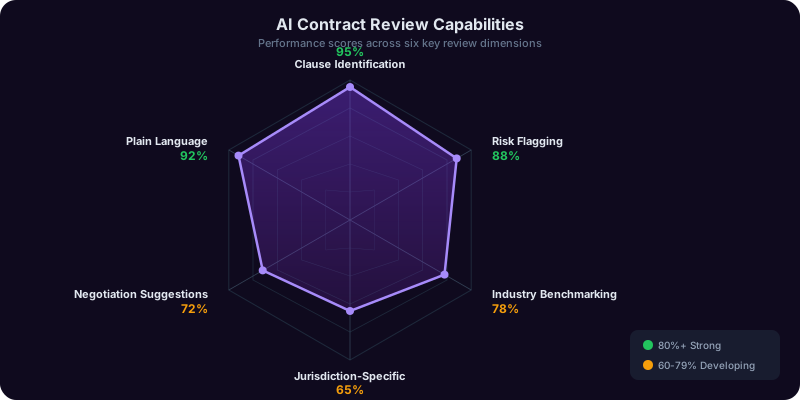
What AI Contract Review Tools Can Do
Clause identification and extraction: AI parses a contract and identifies every significant clause -- indemnification, termination, IP assignment, liability limitation, governing law, and dispute resolution. This ensures you do not miss a provision buried on page 23 of a 30-page agreement.
Risk assessment and flagging: AI evaluates clauses against a risk model, flagging provisions that are unusually aggressive or deviate from standard market terms. An indemnification clause without a liability cap gets flagged as "high risk." A non-compete gets flagged as "potentially unenforceable" based on the governing law.
Plain-language explanation: Instead of puzzling over "the Receiving Party shall indemnify, defend, and hold harmless the Disclosing Party from any and all claims, damages, losses, costs, and expenses," the AI tells you: "You must pay for the other party's legal costs if they get sued because of information you disclosed."
Industry benchmarking: Advanced tools compare your contract's terms against databases of standard provisions. If your freelance contract specifies net-90 payment, the AI flags that industry standard is net-30.
Missing clause detection: AI identifies important provisions that are absent. If a freelance agreement lacks a kill fee, or a lease does not address maintenance responsibilities, the gap is flagged.
How to Use AI for Contract Review
- Upload or paste the contract. Most tools accept PDF, Word, or plain text. Remove sensitive personal information if using a cloud-based tool.
- Request a full clause-by-clause analysis -- not just the risky ones.
- Ask specific questions: "What happens if I want to terminate early?" or "Does this prevent me from working with competitors?"
- Request a risk summary prioritized by severity.
- Ask for negotiation suggestions with alternative language for each flagged issue.
- Cross-reference with your jurisdiction. Ask how specific clauses interact with your state's laws.
Copilotly's Legal Copilot is designed specifically for this workflow -- walking you through a contract section by section, explaining each provision in plain language, flagging risks, and suggesting questions to ask before signing.
Your Complete Contract Review Checklist: The AI-Assisted Process
Follow this systematic five-phase process for thorough contract review, combining traditional best practices with AI-powered analysis.
Phase 1: Initial Read and Context Setting (15-20 minutes)
Read the entire contract from beginning to end without stopping to analyze individual clauses. Your goal is to understand the structure, the parties, and the general deal. Answer these questions:
- Who are the parties, and are they correctly identified?
- What is the basic deal -- what does each party give and get?
- What is the term (duration) of the agreement?
- What is the total financial commitment?
- Is anything obviously missing that you expected to see?
Phase 2: AI-Powered Deep Analysis (20-30 minutes)
Upload the contract and run these prompts:
- Full clause extraction: "Identify and categorize every significant clause, including section numbers and a brief summary of each."
- Risk assessment: "Flag clauses that are unusually aggressive, one-sided, or deviate from standard market terms."
- Missing provisions: "What important provisions are missing that are standard in similar agreements?"
- Plain language summary: "Summarize this contract in plain language, including key obligations, rights, and risks for each party."
Phase 3: Targeted Deep Dives (15-20 minutes)
For each flagged clause, ask: What is the worst-case scenario? Is it enforceable in my jurisdiction? What is the market standard? What alternative language could I propose?
Phase 4: Financial Impact Assessment (10-15 minutes)
Translate legal terms into real-world financial impact:
| Contract Element | Question to Ask | How AI Helps |
|---|---|---|
| Payment terms | When will I actually receive money? | Calculates cash flow impact of net-30/60/90 |
| Termination penalties | What does it cost to exit early? | Identifies all financial penalties |
| Liability exposure | What is my maximum financial risk? | Calculates worst-case liability |
| Non-compete impact | How does this limit future income? | Estimates income restriction impact |
| IP assignment value | What am I giving away? | Identifies long-term IP value at risk |
Phase 5: Decision and Documentation (10 minutes)
Categorize your findings into three buckets:
- Accept as-is: Clauses you understand and are comfortable with
- Negotiate: Clauses to modify, with specific alternative language prepared
- Deal-breakers: Clauses you cannot accept under any circumstances
If your negotiate or deal-breaker list is substantial, decide whether to involve a lawyer for the negotiation phase. For negotiation tactics, read our guide on how to negotiate contract terms effectively.
When You Genuinely Need a Lawyer (Do Not Skip This Section)
AI contract review is powerful, but it is not a substitute for a qualified attorney in every situation. Getting this decision wrong can cost far more than the attorney fees you were trying to save.
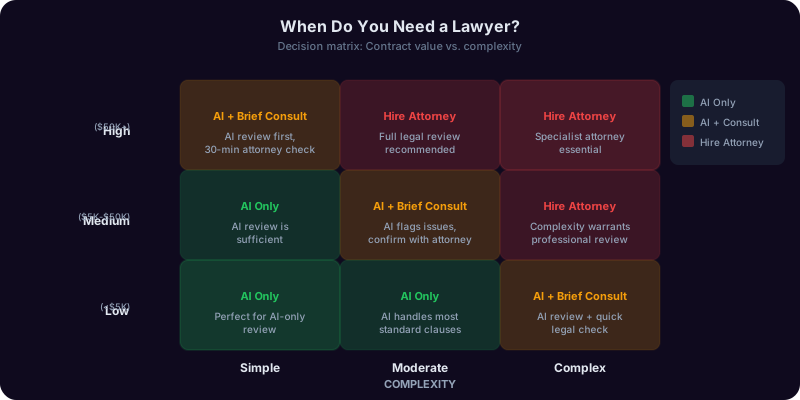
You Need a Lawyer When:
- High financial stakes: If the contract involves more than $25,000 in value or potential liability, a $500-$2,000 legal review is a reasonable insurance premium. This includes commercial leases, partnership agreements, large consulting engagements, executive employment contracts, and any deal involving equity or profit sharing.
- Complex legal structures: Multi-party agreements, cross-border contracts, regulated industries (healthcare, financial services), and IP licensing deals involve nuances that AI may not fully trace.
- Power imbalances: "Take it or leave it" employment contracts from large employers, franchise agreements, and vendor terms from major tech platforms benefit from professional advocacy.
- You are drafting, not reviewing: AI is better at analyzing existing contracts than creating new ones. Drafting a contract for an important business relationship requires a lawyer.
- Active disputes: If a dispute has already arisen, or you are considering terminating an agreement, the analysis shifts from "what does this mean" to "what are my rights" -- which requires professional judgment.
You Probably Do Not Need a Lawyer When:
Standard residential leases, routine NDAs, freelance agreements under $25,000, non-executive employment offer letters, basic service agreements, and simple vendor contracts can typically be handled with AI-assisted self-review.
Finding Affordable Legal Help
- Use AI first, then bring in the lawyer. Document your questions and bring a focused list. This cuts the lawyer's time on basic analysis and reduces your bill significantly.
- Ask for a flat fee. Expect $300-$800 for a standard review, $500-$1,500 for review plus negotiation help.
- Use your state bar's referral service. The ABA's lawyer referral directory connects you with attorneys offering reduced-rate consultations.
- Consider unbundled services. Some attorneys review and advise on specific clauses only, rather than the entire agreement, reducing cost substantially.
The bottom line: AI handles 80 percent of routine contract reviews effectively. For the remaining 20 percent -- high stakes, high complexity, or active disputes -- a lawyer is not an expense but an investment.
Real-World Scenarios: AI Contract Review in Action
Concrete examples make the process tangible. Here are four scenarios showing how AI-assisted contract review catches problems and saves money.
Scenario 1: Freelance Web Developer's Client Contract
Maria received a 12-page agreement for a $15,000 website project. AI analysis took under two minutes and caught: an IP assignment clause transferring ownership of "all work product, including pre-existing tools, libraries, and code frameworks" -- meaning she would lose her reusable code library built over five years; a payment structure withholding 40 percent until "final approval" with no definition of approval or deadline; and a non-compete preventing work with any online retail company for 18 months.
Outcome: Maria limited IP assignment to custom project work only, changed to milestone-based payments with approval deadlines, and removed the non-compete. Cost of AI review: $0. Estimated attorney cost: $600-$900.
Scenario 2: First-Time Renter's Lease
James ran his first apartment lease through AI review. It caught: a $500 tenant maintenance threshold (typical is $50-$100), a 90-day security deposit return timeline violating his state's 30-day requirement, and an automatic renewal requiring 90 days notice or locking him into another full year.
Outcome: James negotiated the maintenance threshold to $75, the landlord corrected the illegal deposit timeline, and the auto-renewal notice dropped to 60 days.
Scenario 3: Small Business Vendor Agreement
Priya's fulfillment vendor sent a 35-page standard agreement. AI caught: liability capped at "fees paid in the preceding 30 days" (roughly $1,200 -- inadequate for $50,000 in inventory), a data usage clause allowing customer data for "marketing purposes," and a 3-year minimum commitment with a termination penalty equal to the remaining contract value.
Outcome: Priya raised the liability cap to 12 months of fees, restricted data usage to service delivery, and reduced the commitment to 12 months. Estimated savings from avoided losses: over $40,000.
Scenario 4: Employee's Non-Compete Agreement
David's $95,000 job offer included a "standard" non-compete. AI flagged: "competing business" defined as any company offering "software products or services" (covering virtually every tech company), a 24-month worldwide restriction, and no garden leave pay during the restricted period.
Outcome: David narrowed the definition to his specific software niche, reduced duration to 12 months within the United States only, and secured six months of garden leave pay. The AI also noted the original terms were likely unenforceable in his state, giving him negotiation leverage. For more contract negotiation strategies, see our contract negotiation guide.
AI Contract Review Limitations, Best Practices, and Staying Protected
Using AI effectively means understanding its blind spots and following practices that maximize value while protecting you.
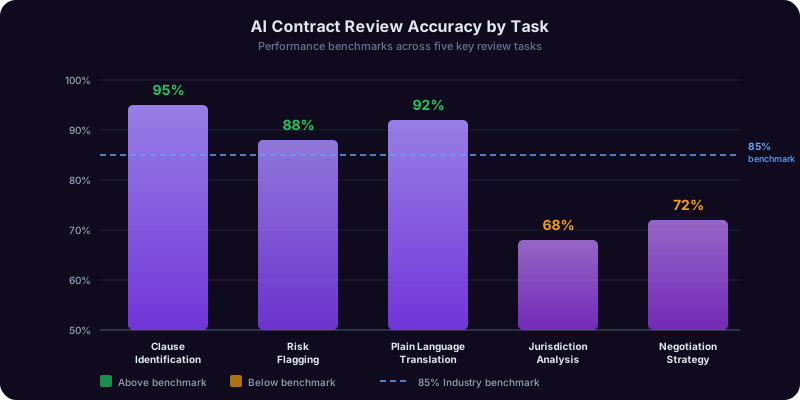
Known Limitations
Jurisdiction-specific analysis remains imperfect. Contract law varies by state and country. Non-compete enforceability differs dramatically between California (largely unenforceable) and Florida (generally enforceable), and nuances evolve constantly. Always cross-reference jurisdiction-specific findings with your state's actual statutes.
Business judgment is limited. AI can identify that a clause is one-sided, but it cannot weigh the value of the relationship, your negotiating position, or your risk tolerance. Those judgments remain yours.
Unusual contract formats may cause errors. AI tools are trained on standard forms. Highly customized agreements or non-standard drafting conventions may lead to missed or misinterpreted provisions.
AI cannot verify facts. If a contract states the other party holds a license or insurance policy, AI cannot confirm those claims. Verify factual representations independently.
Best Practices
Never rely solely on AI. Use it as a powerful first pass. Read flagged sections yourself to confirm you understand and agree with the interpretation.
Ask follow-up questions. Request simpler explanations, concrete examples of how clauses could be used against you, and worst-case scenarios. Specific questions yield more useful analysis.
Cross-reference with state laws. For tenant rights, employee rights, non-compete enforceability, and consumer protection, verify AI findings against your state's statutes. The CFPB and state attorney general websites are reliable free resources.
Document your review process. Keep records of your AI analysis, questions asked, and conclusions reached. This documentation demonstrates good faith if a dispute arises later.
Privacy and Data Security
Before uploading contracts to any AI tool, consider data sensitivity. Check whether the tool stores your data, uses it for training, offers encryption, and allows deletion. If the contract is subject to an NDA, uploading it to a third-party service might breach that agreement. Redact sensitive details or use tools with strong privacy guarantees.
Building Skills Over Time
Each AI-assisted review is a learning opportunity. Over time, you will recognize clause patterns, understand terminology without translation, and develop intuition for standard versus unusual terms. AI accelerates your learning curve -- each review makes you more capable for the next one. For ongoing guidance, explore our guide on getting a second opinion on professional decisions.
Frequently Asked Questions
Recommended Copilots
Recommended Copilots
Get clause-by-clause contract analysis, risk flagging, and plain-language explanations for any agreement
Try Free →Calculate the financial impact of contract terms like payment schedules, penalties, and liability exposure
Try Free →Evaluate employment contract terms including non-competes, equity, and compensation packages
Try Free →Related Articles
Get Answers From the Legal Copilot
Upload any contract and get a plain-language breakdown of every clause, red flag alerts, and negotiation suggestions in minutes. Stop signing agreements you do not fully understand.