
Legal & Rights
The 10 Contract Clauses That Cost People the Most Money (and How to Spot Them in 30 Minutes)
The average American signs over 1,500 contracts in a lifetime, mostly unread. Learn the 10 clauses that cost people the most money, a 30-minute reading method, and the negotiation scripts that get unfair terms changed before you sign.
Why Most People Sign Contracts They Don't Understand
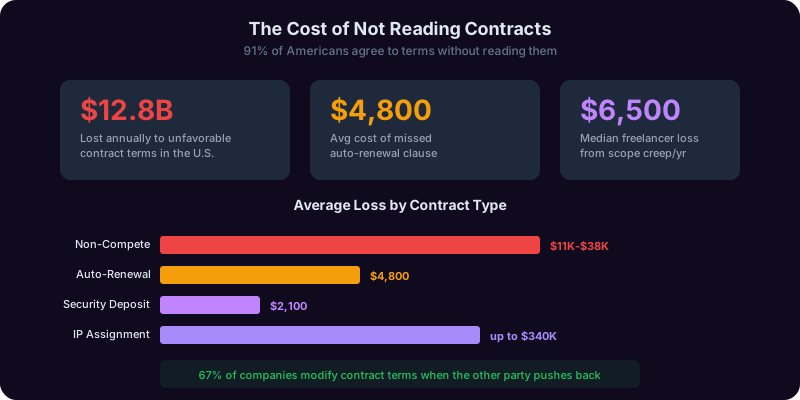
Here is a number that should alarm you: 91% of Americans agree to terms and conditions without reading them, according to a Deloitte study on consumer consent. And it is not just software terms of service. The same pattern holds for employment contracts, leases, freelance agreements, gym memberships, and car loans.
The consequences are not theoretical. They are measured in dollars:
- $4,800 - the average cost of an auto-renewal clause that a consumer did not notice, according to a 2025 Consumer Financial Protection Bureau report on subscription billing disputes
- $11,000 to $38,000 - the range of damages employees have paid after violating non-compete clauses they did not fully understand
- $2,100 - the average security deposit loss from tenants who did not understand their lease's move-out condition requirements
- $6,500 - the median amount freelancers lose annually to scope creep enabled by vague contract language
Why do people skip reading contracts? Three reasons dominate:
- Length and complexity. The average employment contract is 8-12 pages of dense legal language. Residential leases run 15-30 pages. A standard SaaS terms of service is over 7,000 words. The sheer volume is designed to overwhelm.
- Perceived powerlessness. Most people believe contracts are "take it or leave it" - that the terms are non-negotiable. This is frequently wrong. A 2024 survey by Contract Counsel found that 67% of companies modified at least one contract term when the other party pushed back.
- Social pressure. Sitting in an HR office on your first day, across from a leasing agent who is tapping their pen, or at a car dealership with your trade-in already processed - these situations create enormous pressure to sign quickly.
The result is predictable: Americans lose an estimated $12.8 billion annually to unfavorable contract terms they agreed to without understanding. Resources like Nolo's contract basics library and this guide exist to make sure you are not part of that statistic.
Disclaimer: This guide provides general educational information about contract literacy. It is not legal advice. For contracts involving significant amounts of money or complex legal rights, consult a licensed attorney.
The 10 Contract Clauses That Cost People the Most Money
Not every clause in a contract carries equal weight. These ten are the ones that drain the most money from the people who sign without understanding them.
1. Mandatory Arbitration Clauses
Arbitration is a form of private dispute resolution governed by the Federal Arbitration Act.
What it says: "Any disputes arising from this agreement shall be resolved through binding arbitration, not in court."
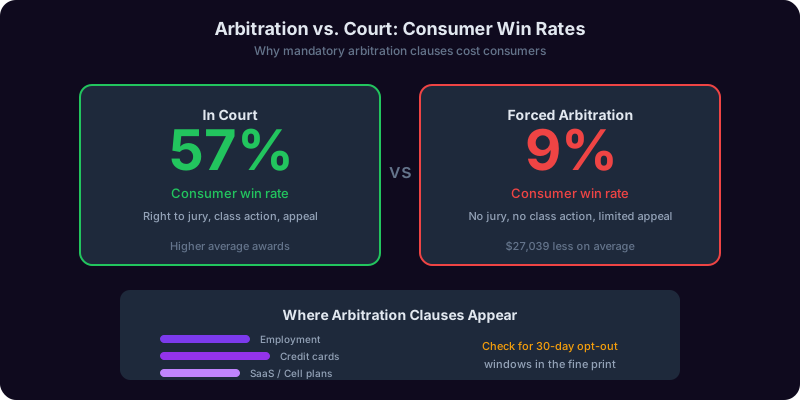
What it costs you: You give up your right to sue in court, join a class action, or have a jury hear your case. Arbitration heavily favors the company - the American Association for Justice found that consumers win just 9% of forced arbitration cases, compared to 57% in court. One study found that employees who were forced into arbitration received $27,039 less on average than those who went to court for similar claims.
Where you see it: Employment contracts, credit card agreements, SaaS terms, gym memberships, cell phone contracts.
2. Auto-Renewal and Evergreen Clauses
What it says: "This agreement shall automatically renew for successive one-year terms unless either party provides written notice of non-renewal at least 60 days prior to the renewal date."
What it costs you: You are locked in for another full term if you miss a narrow cancellation window. The FTC's Negative Option Rule addresses deceptive auto-renewal practices, and the agency received over 16,000 complaints about auto-renewal charges in 2025 alone. B2B SaaS contracts are particularly aggressive - average auto-renewal terms lock businesses into $14,000-$48,000 annual commitments with 60-90 day cancellation windows.
What to negotiate: Push for 30-day cancellation notice, month-to-month renewal instead of annual, and automatic email reminders before renewal dates.
3. Limitation of Liability Caps
What it says: "In no event shall Company's total liability exceed the amounts paid by Customer in the twelve months preceding the claim."
What it costs you: If the other party causes you $500,000 in damages but you paid them $10,000, you can only recover $10,000. This clause is standard in nearly every B2B contract and most consumer agreements. It effectively means the other party has no meaningful financial consequence for underperformance or negligence.
4. Indemnification Clauses
What it says: "You agree to indemnify, defend, and hold harmless Company from any claims, damages, losses, or expenses arising from your use of the Service."
What it costs you: You are agreeing to pay the other party's legal bills if someone sues them because of something related to your use of their product. This can be tens or hundreds of thousands of dollars. In freelance contracts, one-sided indemnification clauses mean the freelancer bears all legal risk even when the client's instructions caused the problem.
What to negotiate: Push for mutual indemnification (both parties protect each other) and a cap on indemnification obligations.
5. Non-Compete Agreements
What it says: "For a period of 24 months following termination, Employee shall not work for any competitor within 50 miles."
What it costs you: The median salary loss for workers bound by enforceable non-competes is $8,700 per year, according to the Economic Policy Institute. Even when unenforceable, non-competes chill job mobility - workers who believe their non-compete is enforceable are 35% less likely to change jobs. Note: The FTC's 2024 rule banning most non-competes was struck down by federal courts, so state law still governs. As of 2026, California, Minnesota, North Dakota, and Oklahoma ban most non-competes entirely, while many other states limit them. If you have been impacted by a non-compete, our wrongful termination guide covers related employment law protections.
6. Termination and Cancellation Penalties
What it says: "If Customer terminates this agreement prior to the end of the term, Customer shall pay an early termination fee equal to the remaining balance of the contract term."
What it costs you: You owe the full remaining contract value even if the product is terrible. A 3-year contract at $2,000/month with 2 years remaining means a $48,000 termination fee. Cell phone carriers, commercial leases, and B2B SaaS companies routinely enforce these penalties.
What to negotiate: Push for termination for cause (you can leave if they underperform), declining penalties (50% in year one, 25% in year two), or a maximum penalty cap.
7. Intellectual Property Assignment
What it says: "Employee hereby assigns to Company all right, title, and interest in any inventions, works, or ideas created during the term of employment."
What it costs you: Everything you create - even on nights and weekends, even if unrelated to your job - may belong to your employer. This is devastating for employees with side projects. One developer lost a side project worth an estimated $340,000 in revenue because his employment contract included a broad IP assignment clause that covered work done outside business hours.
What to negotiate: Push for an explicit carve-out for personal projects, limited scope to work "related to Company's business," and a schedule of pre-existing IP.
8. Confidentiality and Non-Disclosure Overkill
What it says: "All information disclosed during the course of this agreement shall be considered Confidential Information and shall not be disclosed for a period of five years."
What it costs you: Overly broad NDAs can prevent you from using general industry knowledge at future jobs, talking about your work experience in interviews, or even listing a client on your portfolio. Freelancers and consultants are particularly vulnerable - a broad NDA can effectively erase years of portfolio-building work.
9. Governing Law and Jurisdiction
What it says: "This agreement shall be governed by the laws of the State of Delaware, and any disputes shall be brought exclusively in the courts of New Castle County."
What it costs you: If a dispute arises, you may have to travel across the country and hire a lawyer in a different state. For small disputes, the travel and legal costs in a distant jurisdiction can exceed the amount at stake, effectively making it impossible for you to pursue your claim. Average cost of out-of-state litigation: $8,000-$25,000 in travel and local counsel fees alone.
10. Waiver of Jury Trial
What it says: "Each party waives its right to a trial by jury."
What it costs you: Juries tend to be more sympathetic to individuals in disputes with corporations. Bench trials (decided by a judge alone) statistically favor corporate defendants. This clause, which most people skip right over, quietly removes one of your most powerful legal protections.
If you want help identifying these clauses in a specific contract, the Contract Review Copilot can analyze your agreement and flag the terms that carry the highest financial risk.
How to Read Any Contract in 30 Minutes: A Step-by-Step Methodology
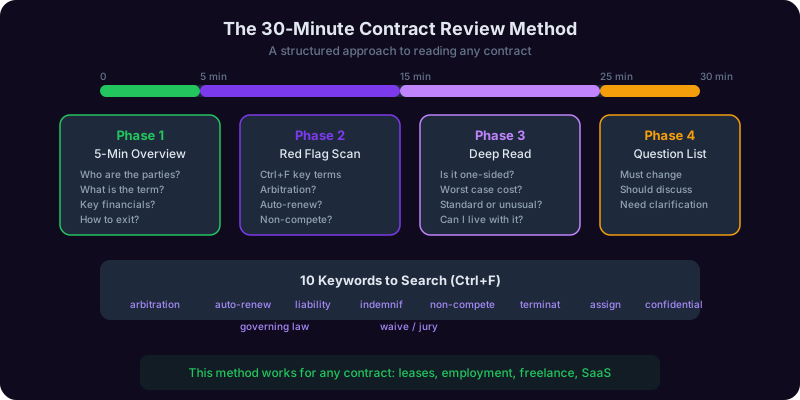
You do not need a law degree to understand a contract. You need a system. Here is a structured methodology that works for any contract type - from a 3-page freelance agreement to a 30-page commercial lease.
Phase 1: The 5-Minute Overview (Minutes 1-5)
Read the contract once, quickly, without trying to understand every word. You are looking for four things:
- Who are the parties? Confirm the correct legal names. Contracts with the wrong entity name can be unenforceable or enforceable against the wrong person.
- What is the term? How long does this last? When does it start and end? Does it auto-renew?
- What are the key financial terms? What do you pay, what do you receive, when are payments due?
- How do you get out? What does termination look like? What are the penalties?
After this first pass, you should be able to answer in one sentence: "I am agreeing to [do this] for [this long] in exchange for [this] and I can get out by [this method]."
Phase 2: The Red Flag Scan (Minutes 5-15)
Now go back through and specifically search for the 10 high-cost clauses from the previous section. Use Ctrl+F (or Command+F) on digital contracts to search for these keywords:
| Search Term | What You Are Looking For |
|---|---|
| "arbitration" | Mandatory arbitration clause |
| "auto-renew" or "automatically renew" | Auto-renewal terms and cancellation windows |
| "liability" or "limitation" | Liability caps that protect the other party |
| "indemnif" | Indemnification obligations (one-sided or mutual?) |
| "non-compete" or "compete" | Restrictions on your future work |
| "terminat" | Termination penalties and early exit fees |
| "intellectual property" or "assign" | IP ownership provisions |
| "confidential" | NDA scope and duration |
| "governing law" or "jurisdiction" | Where disputes would be heard |
| "waive" or "jury" | Jury trial waivers |
Highlight or note every clause you find. Do not evaluate yet - just identify.
Phase 3: The Deep Read (Minutes 15-25)
Now read the clauses you flagged carefully. For each one, ask:
- Is this one-sided? Does it protect only the other party, or both parties equally?
- What is the worst case? If everything goes wrong, what is my maximum financial exposure under this clause?
- Is this standard or unusual? Some clauses are boilerplate (limitation of liability in a SaaS contract). Others are aggressive (a gym membership that charges a $500 early termination fee).
- Can I live with this? If you cannot change it, can you accept the risk?
Phase 4: The Question List (Minutes 25-30)
Write down every term you do not fully understand and every clause you want to negotiate. Organize them into three categories:
- Must Change: Terms you will not sign with as written (deal-breakers)
- Should Discuss: Terms you would prefer to change but can accept if needed
- Want Clarification: Terms you do not fully understand and need explained
This list becomes your negotiation agenda. Having it written out transforms a vague "I have some concerns" into a specific, professional conversation.
For a faster analysis, try the Contract Review Copilot - paste your contract and get a structured breakdown of key terms, risk areas, and plain-English explanations of complex clauses in minutes.
Red Flags That Should Stop You From Signing
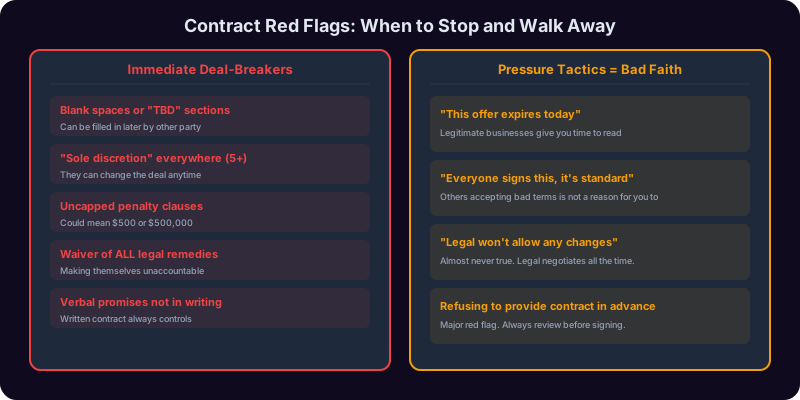
Some contract provisions are so one-sided or unusual that they should make you pause before signing. These are not just unfavorable terms - they are warning signs that the other party may be acting in bad faith or trying to exploit your lack of legal knowledge.
Immediate Deal-Breakers
- Blank spaces or "TBD" sections. Never sign a contract with blanks. Anything left blank can theoretically be filled in later by the other party. If terms are not finalized, they should not be in the contract.
- "Sole discretion" language everywhere. Phrases like "Company may, in its sole discretion, modify these terms at any time" mean they can change the deal whenever they want. One or two sole discretion clauses are normal. Five or more in a contract is a red flag.
- Penalty clauses with no cap. Any clause that imposes penalties without a maximum amount is dangerous. "Contractor shall be liable for all costs and damages resulting from breach" is open-ended - it could mean $500 or $500,000.
- Waiver of all legal remedies. If the contract asks you to waive your right to sue, to join class actions, AND to seek regulatory relief, the other party is trying to make themselves completely unaccountable.
- Verbal promises not in writing. If the salesperson said "do not worry, we never enforce that clause" but the clause is in the written contract, the written contract controls. Get every promise in writing or assume it does not exist.
Serious Warning Signs
- Asymmetric termination rights. They can cancel anytime with 30 days' notice, but you are locked in for 2 years. This means they bear no risk and you bear all of it.
- Extremely broad assignment clauses. "Company may assign this agreement to any third party without notice." This means a company you chose to do business with can transfer your contract to a company you have never heard of.
- Retroactive terms. Clauses that apply to work done before the contract was signed, or that change the terms for work already completed and paid for.
- Hidden fees in the definitions. Watch the definitions section at the top. Sometimes "Service Fee" is defined to include additional charges that were not discussed in the sales process.
- Unusual governing law. If you are in Texas and the contract specifies that disputes must be resolved under the laws of the Cayman Islands, something is wrong.
Pressure Tactics That Indicate Bad Faith
- "This offer expires today." Legitimate businesses give you time to read their contracts. Any company pressuring you to sign immediately does not want you to read the terms.
- "Everyone signs this, it's standard." The fact that other people accepted bad terms is not a reason for you to do the same.
- "Our legal department will not allow any changes." This is almost never true. Legal departments negotiate all the time - that is their job.
- Refusing to provide the contract in advance. If a company will not let you take the contract home to read before signing, that is a major red flag. Reputable landlords, employers, and service providers expect you to review documents.
If you encounter any of these red flags, you might want to understand your legal options before proceeding. And if the contract is related to renting, review the first-time renter checklist for lease-specific red flags.
How to Negotiate Contract Terms: Scripts and Templates
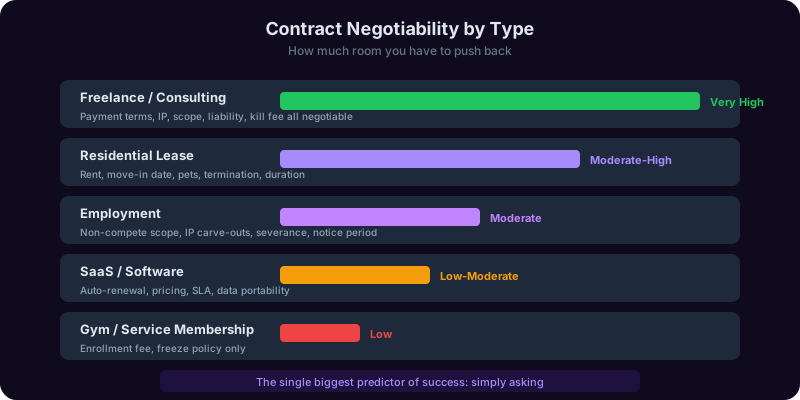
Most people assume contracts are non-negotiable. They are wrong. A Harvard Business School study found that the single biggest predictor of negotiation success is simply asking. Here is exactly how to do it.
The Mindset Shift
Contract negotiation is not adversarial. You are not "fighting" the other party. You are proposing terms that work for both sides. The person on the other side of the table wants to close this deal too. They have quotas, deadlines, and bosses asking why the contract has not been signed. Your leverage is that they want your business, your labor, or your tenancy.
What Is Usually Negotiable
| Contract Type | Commonly Negotiable Terms | Rarely Negotiable |
|---|---|---|
| Employment | Non-compete scope, IP assignment carve-outs, severance, notice period, remote work | Benefits plan structure, at-will status (in most states) |
| Residential Lease | Move-in date, pet deposits, painting/modifications, early termination, parking | Fair Housing terms, state-mandated disclosures |
| Freelance/Consulting | Payment terms, IP ownership, scope definition, liability caps, kill fee | Very little - these are highly negotiable |
| SaaS/Software | Auto-renewal terms, pricing, SLA guarantees, termination notice, data portability | Core product features, standard security terms |
| Gym/Service Membership | Enrollment fee, freeze policy, cancellation terms | Monthly rate (usually fixed), facility rules |
Script 1: The Initial Ask (Email Template)
Use this template when you have reviewed the contract and want to negotiate:
Subject: Contract Review - [Your Name] - A Few Items to Discuss
Hi [Name],
Thank you for sending over the agreement. I have reviewed it and am excited to move forward. Before I sign, I would like to discuss a few provisions:
1. [Specific clause, section number]: I understand the intent here, but I would like to propose [your modification]. This is important to me because [brief reason].
2. [Specific clause, section number]: Could you clarify what this means in practice? Specifically, [your question].
3. [Specific clause, section number]: I would be more comfortable if we could adjust this to [your proposal].
I am happy to discuss by phone if that is easier. I would like to finalize this by [reasonable date].
Best, [Your Name]
Script 2: Pushing Back on "It's Standard"
When the other party says "this is our standard contract":
"I understand this is your standard template, and I appreciate that it works well for most situations. However, [specific clause] does not work for my circumstances because [reason]. I am sure you have modified this provision for other clients/employees/tenants before. Here is what I would propose instead: [specific modification]."
Script 3: The Non-Compete Negotiation
Non-competes are one of the most negotiated employment terms. Try this approach:
"I am happy to agree to reasonable protections for the company's interests. However, the current non-compete is quite broad - it covers [X geographic area] for [Y years] across [Z industries]. Could we narrow this to [specific competitors only / 6 months instead of 24 / the specific metro area instead of the entire state]? I want to make sure I can continue to earn a living in my field if things do not work out."
Script 4: Negotiating Early Termination
"I understand the value of a long-term commitment for both of us. But I would be more comfortable signing a [2-year term] if we could include a termination clause that allows either party to exit with [60 days' notice] after the first [12 months]. Would you be open to adding a mutual termination provision?"
If your contract involves a lease, our guide to breaking a lease early provides lease-specific negotiation strategies. And for understanding what clauses in your lease can actually be changed, see the complete lease agreement guide.
The Golden Rules of Contract Negotiation
- Always negotiate before signing, never after. Your leverage disappears the moment you sign.
- Be specific. "I have some concerns" is weak. "I would like to change Section 4.2(b) to limit the non-compete to 12 months instead of 24" is strong.
- Propose solutions, not just problems. Do not just say "I do not like the termination clause." Say "I propose we change the termination clause to [specific alternative]."
- Get everything in writing. If they agree to a modification verbally, follow up with "Great, I will mark that change on the contract and send it back for your signature."
- Know your walk-away point. Decide before you negotiate which terms are deal-breakers and which you can accept. Do not let the heat of negotiation push you past your limits.
For help identifying which clauses to prioritize in your negotiation, the Contract Review Copilot can rank contract terms by risk level and suggest specific negotiation language.
Common Contract Types and What to Watch For
Different contracts have different danger zones. Here is a targeted guide for the six contract types most people encounter.
Employment Contracts
Average length: 8-15 pages
What most people focus on: Salary, title, start date
What actually matters more:
- Non-compete clause: Check the duration, geographic scope, and definition of "competitor." A non-compete that covers "any company in the technology industry" is far broader than one covering "direct competitors in enterprise SaaS."
- IP assignment: Does the company own everything you create, or just work product created during work hours using company resources? Demand a carve-out for personal projects.
- At-will language: In 49 out of 50 states (Montana is the exception), employment is at-will, meaning either party can end it at any time. Your contract may add conditions on top of this - severance packages, notice periods, or cause requirements. Read these carefully.
- Equity and vesting: If you receive stock options, understand the vesting schedule, the exercise window (typically 90 days after departure), and whether accelerated vesting applies upon acquisition.
If you believe your employment contract was violated during termination, see our wrongful termination guide. The Employment Law Copilot can help you understand the enforceability of specific employment contract terms in your state.
Residential Lease Agreements
Average length: 15-30 pages
Critical clauses to check:
- Security deposit terms: What can the landlord deduct for? When must they return it? Some states require deposits in interest-bearing accounts. The security deposit guide covers this in detail.
- Lease break penalties: Typical penalties range from 1-3 months' rent, but some leases require you to pay rent for the entire remaining term. See our guide to breaking a lease early for your options.
- Maintenance and repair responsibilities: Who handles plumbing, appliances, pest control? Many leases shift surprising responsibilities to the tenant.
- Subletting and assignment: If there is any chance you might need to leave early, check whether subletting is permitted.
For a deep dive into lease clauses, see our complete guide to reading lease agreements. The Tenant Rights Copilot can help you understand your lease in the context of your state's tenant protection laws.
Freelance and Consulting Agreements
Average length: 3-8 pages
Biggest traps:
- Scope creep enablers: Vague descriptions of deliverables like "and any other related tasks" or "such other services as Client may request." This language allows the client to pile on unlimited additional work without additional pay. Read our scope creep guide for how to handle this.
- Payment terms: "Net 60" means you wait 2 months after delivering work to get paid. Push for Net 15 or Net 30 with a 50% upfront deposit for new clients.
- Kill fee: What happens if the client cancels the project midway? Without a kill fee clause, you could do 80% of the work and receive nothing. Standard kill fees are 25-50% of the remaining contract value.
- IP ownership: In a work-for-hire arrangement, the client owns the output. Make sure you retain the right to use the work in your portfolio unless there are genuine confidentiality concerns.
SaaS and Software Subscriptions
Average length: 5,000-15,000 words
Hidden dangers:
- Auto-renewal with long cancellation windows: Enterprise SaaS contracts commonly auto-renew for a full year and require 60-90 days' written notice to cancel. Miss the window by one day and you are locked in for another year.
- Price increase provisions: "Company may increase prices upon renewal with 30 days' notice." Some SaaS companies have raised prices 40-60% at renewal, and the auto-renewal clause means you are stuck paying it.
- Data portability: What happens to your data if you cancel? Can you export it? In what format? How long do they retain it? Some companies hold customer data hostage to prevent cancellation.
- SLA penalties: Most SLAs promise 99.9% uptime but offer only service credits (not cash refunds) if they miss it. A "99.9% uptime SLA" sounds great until you realize the penalty for 24 hours of downtime is a $50 credit on your next bill.
Gym and Service Memberships
Average length: 2-5 pages
Most common traps:
- Annual commitment disguised as monthly billing. You are paying monthly, but the contract commits you for 12-24 months. Canceling early triggers a lump-sum early termination fee, often $100-$250.
- Automatic rate increases. "Monthly dues may increase by up to 10% annually." Your $39/month membership becomes $47/month in year two without your explicit approval.
- Freeze limitations. Can you freeze your membership during travel or injury? Some gyms charge $10-$15/month to "freeze" and limit freezes to 30-60 days per year.
Car Purchase and Financing Agreements
The CFPB's auto loan resources can help you understand financing terms before you walk into a dealership.
Average length: 4-10 pages
Critical areas:
- The "four square" game: Dealers negotiate trade-in value, purchase price, monthly payment, and down payment simultaneously to obscure the actual deal. Insist on negotiating the purchase price first, then the trade-in, then the financing terms.
- Arbitration clauses: Nearly universal in auto financing. Check if you can opt out - some agreements include a 30-day opt-out window buried in the fine print.
- Extended warranty and add-ons: These are often included in the contract and added to the financed amount. At a 6% interest rate, a $2,500 extended warranty actually costs you $3,150 over a 5-year loan.
When You Actually Need a Real Lawyer
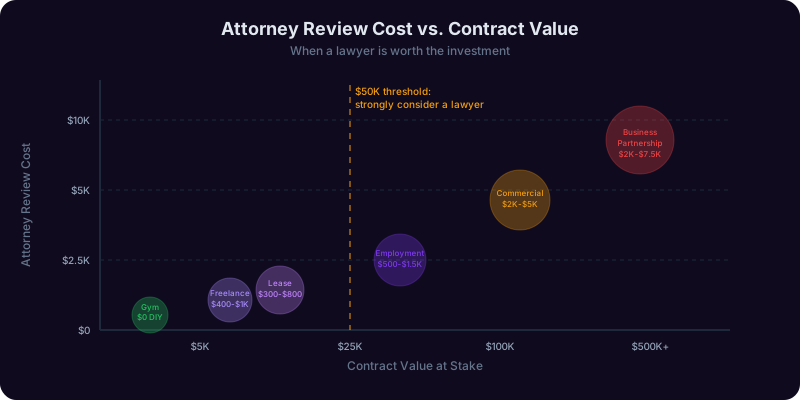
Self-review works for many contracts, but some situations demand professional legal help. Here is how to know the difference - and what it will cost.
You Need a Lawyer When:
- The contract value exceeds $50,000. At this level, the cost of a lawyer ($200-$500/hour for 2-4 hours of review, or $750-$2,500 flat fee) is a tiny fraction of the amount at stake. An attorney reviewing a $100,000 commercial lease for $1,500 is one of the highest-ROI investments you can make.
- Real estate is involved. Property transactions involve title issues, zoning, liens, easements, and other complexities that require specialized knowledge. Residential closings typically cost $500-$1,500 for attorney review; commercial transactions run $2,000-$10,000+.
- You are starting a business with partners. Operating agreements, partnership agreements, and shareholder agreements determine who controls the business, how profits are split, and what happens when someone leaves. Getting these wrong destroys businesses. Read the LLC vs. sole proprietorship comparison for context on entity structures, and then hire a lawyer for the actual agreements. The Business Formation Copilot can help you prepare questions and understand the basics before your consultation.
- The contract restricts your ability to work. Non-compete agreements, non-solicitation clauses, and exclusivity provisions can affect your income for years. A lawyer can advise on enforceability in your state. Typical cost for a non-compete review: $300-$800.
- You are licensing intellectual property. Licensing agreements determine who can use creative works, inventions, or trademarks, and how they are compensated. Royalty structures, exclusivity, and sub-licensing rights are nuanced areas where mistakes are expensive. The Intellectual Property Copilot can help you understand the basics before engaging an IP attorney.
- You are creating legal authority documents. Powers of attorney, healthcare directives, and similar documents require precision. Our power of attorney guide covers the basics, but an attorney ensures the documents are valid in your jurisdiction.
- International contracts or complex regulatory environments. Cross-border agreements involve multiple legal systems, tax implications, and compliance requirements. Do not attempt these without professional help.
Typical Attorney Costs for Contract Review
| Contract Type | Hourly Rate Range | Typical Flat Fee | Time Required |
|---|---|---|---|
| Employment contract | $200-$400/hr | $500-$1,500 | 1-3 hours |
| Residential lease | $200-$350/hr | $300-$800 | 1-2 hours |
| Commercial lease | $300-$500/hr | $2,000-$5,000 | 3-8 hours |
| Freelance agreement | $200-$350/hr | $400-$1,000 | 1-2 hours |
| Business partnership | $300-$500/hr | $2,000-$7,500 | 5-15 hours |
| IP licensing agreement | $350-$600/hr | $2,500-$10,000 | 5-20 hours |
How to Find the Right Lawyer
- Match specialization to contract type. An employment lawyer for employment contracts, a real estate attorney for property deals. General practitioners are fine for simple contracts.
- Ask for flat-fee quotes. Many attorneys offer flat fees for contract review, which eliminates the anxiety of an open-ended hourly bill.
- Check state bar associations. The ABA's lawyer referral directory links to every state bar. Every state bar has a referral service that matches you with attorneys in the relevant practice area.
- Consider legal aid if you qualify. If your income is below 200% of the federal poverty line, legal aid organizations may help with contract issues at no cost.
- Prepare before the meeting. Use the guide to preparing for a lawyer consultation to make the most of your time and reduce billable hours.
How AI Can Help You Review Contracts in 2026
The gap between "I cannot afford a lawyer" and "I will just sign it and hope for the best" used to be a chasm. AI has built a bridge across it.
What AI Contract Review Can Do Today
Modern AI tools can analyze a contract and provide:
- Plain-English explanations of every clause, translating legal jargon into language anyone can understand
- Risk identification - flagging one-sided terms, unusual clauses, and provisions that deviate from market standard
- Clause-by-clause comparison against industry benchmarks to show where a contract's terms fall relative to what is typical
- Negotiation suggestions with specific alternative language you can propose
- Missing clause detection - identifying important protections that should be in the contract but are not
What AI Cannot Replace
AI contract review is powerful, but it has clear limitations:
- Jurisdiction-specific advice. Contract enforceability varies dramatically by state and locality. AI can flag a non-compete clause, but determining whether it is enforceable in your specific state and county requires legal expertise.
- Strategic judgment. A lawyer does not just identify risks - they weigh those risks against your specific situation, your negotiating position, and the likely behavior of the other party.
- Court representation. If a contract dispute goes to litigation, you need a licensed attorney.
- Complex multi-party agreements. Contracts involving three or more parties, cross-references to other agreements, or intricate regulatory compliance still benefit from human legal review.
How to Use Copilotly's Contract Review Copilot
Copilotly's Contract Review Copilot is specifically designed for people who need to understand a contract but are not ready (or able) to hire a lawyer. Here is how to use it effectively:
- Paste the full contract text. The copilot works best with the complete contract, not selected sections, because it can identify how clauses interact with each other.
- Ask specific questions. "What are the riskiest clauses in this contract?" is a good start. "Can I be held liable if their product causes damage to my customer?" is even better because it focuses on a specific concern.
- Request negotiation language. Ask: "How would I modify Section 7 to make the indemnification mutual?" The copilot can suggest specific language.
- Compare to standards. Ask: "Is this non-compete clause standard for a software engineer in California?" The copilot can contextualize terms against common industry practices.
The Smart Approach: AI First, Lawyer When Needed
The most cost-effective approach to contract review in 2026 combines both tools:
- Use AI for first-pass review of every contract. It is fast, available 24/7, and costs a fraction of attorney fees. This catches the obvious issues and gives you a baseline understanding.
- Use AI to prepare for negotiation by generating specific modification language and alternative clauses.
- Bring a lawyer in for high-stakes contracts where the amount at risk justifies the fee, or where the AI review uncovered complex issues that require professional judgment.
This approach means you are never signing blind, and you are only paying attorney rates when the stakes genuinely demand it. For most contracts in daily life - gym memberships, freelance agreements, SaaS subscriptions, residential leases - an AI-assisted review is the smart middle ground between ignoring the contract and spending $500 on a lawyer. If you are dealing with a demand letter related to a contract dispute, start there before escalating to small claims court.
Ready to review a contract? Try the Contract Review Copilot to get a plain-English analysis of your next agreement. For employment-specific contracts, the Employment Law Copilot can provide additional context on workplace-related provisions. And if you are reviewing a rental agreement, the Tenant Rights Copilot specializes in lease analysis.
Frequently asked questions
Can I negotiate a contract even if the other party says it is non-negotiable?
Yes. In most cases, 'non-negotiable' is a negotiation tactic, not a legal reality. Studies show that 67% of companies modify contract terms when asked. The key is to be specific about what you want changed and why, and to propose alternative language rather than simply objecting. The only contracts that are truly non-negotiable are government-regulated forms (like standardized insurance policies) and mass consumer agreements (like Apple's Terms of Service). Everything else has room for discussion.
What happens if I sign a contract without reading it? Am I still bound by it?
Generally, yes. Courts have consistently ruled that signing a contract creates a binding obligation regardless of whether you read it. The legal principle is that you had the opportunity to read the terms and chose not to. There are narrow exceptions: if the contract was fraudulently misrepresented, if it contains unconscionable terms (so unfair that no reasonable person would agree), or if you were under duress. But these defenses are difficult to prove. The safest approach is always to read before signing.
How do I know if a non-compete clause is enforceable in my state?
Enforceability varies dramatically by state. As of 2026, California, Minnesota, North Dakota, and Oklahoma ban most non-competes entirely. Many other states enforce them only if they are reasonable in scope, duration, and geography. Courts generally view non-competes lasting more than 2 years or covering excessively large geographic areas as unenforceable. However, signing an unenforceable non-compete can still cause problems - you may need to hire a lawyer to challenge it, and some employers use them as intimidation tools even when they cannot legally enforce them.
What is the difference between a contract amendment and an addendum?
An amendment changes existing terms in the original contract - for example, modifying the payment schedule from Net 30 to Net 15. An addendum adds new terms that were not in the original agreement - for example, adding a new deliverable to a freelance contract. Both must be signed by all parties to be enforceable. The practical takeaway: if you negotiate changes, make sure the changes are documented as a formal amendment or addendum attached to the original contract, not just discussed verbally or confirmed over email (unless the contract specifically allows email modifications).
Can I get out of a contract I already signed if I find unfair terms?
It depends on the specific situation. There are several possible paths: (1) Some contracts include a cooling-off period, especially for door-to-door sales (the FTC's 3-day Cooling-Off Rule) and certain financial products. (2) If the other party materially misrepresented the terms, you may have grounds for rescission. (3) If a clause is unconscionable - meaning grossly unfair - a court may refuse to enforce it. (4) You can negotiate a termination or modification with the other party. (5) Some state consumer protection laws void specific types of unfair contract terms automatically. However, there is no general 'I did not read it' escape clause. Your best option is usually to negotiate directly with the other party.
Should I hire a lawyer for a standard residential lease?
For a standard lease in a well-regulated market, a thorough self-review using the methodology in this guide is usually sufficient. Most residential leases use templates that are largely governed by state law. However, you should consider a lawyer ($300-$800 for a lease review) if: the rent is above $3,000/month (meaning total commitment exceeds $36,000/year), the lease contains unusual clauses you do not understand, you are signing a commercial lease for a business, or you are in a state with weak tenant protection laws. The cost of a lease review is almost always less than the cost of a single month's rent lost to an unfavorable term.
What is the FTC's 3-day Cooling-Off Rule, and does it apply to all contracts?
The FTC's Cooling-Off Rule gives consumers the right to cancel certain contracts within 3 business days of signing, without penalty. However, it applies only to specific situations: sales made at your home or at a location that is not the seller's permanent place of business (such as hotel conference rooms, fairs, or temporary booths). It does not apply to purchases made at a store, online transactions, real estate contracts, insurance policies, securities, or motor vehicle purchases from a dealer. Some states have their own cooling-off laws that expand these protections. Always check both federal and state rules to see if your contract qualifies for a cancellation window.
How can I handle a contract dispute without going to court?
There are several alternative dispute resolution (ADR) methods available. Negotiation is always the first step - contact the other party directly and propose a resolution. If negotiation fails, mediation uses a neutral third party to help both sides reach an agreement voluntarily. Mediation typically costs $500-$3,000 and resolves faster than litigation. If your contract contains an arbitration clause, arbitration is a binding process where an arbitrator makes the decision. For disputes under $10,000, small claims court is another option - see our small claims court guide. You can also file a complaint with the CFPB for financial product disputes or the FTC for deceptive business practices. Sending a formal demand letter often resolves disputes before any formal process is needed.
Don't Sign Until You Understand Every Clause
Paste any contract into Copilotly's Contract Review Copilot for a plain-English breakdown of key terms, risk flags, and negotiation suggestions - in minutes, not billable hours.
Free plan, no card. Pro from $4.99/week for every copilot across all 20 domains - about what one hour with any single professional costs per year.
Not a law firmThis is legal information, not legal advice. Consult a licensed attorney for your specific situation.