
AI Tools
What Should You Bring to a Lawyer Consultation? An AI-Assisted Prep Checklist
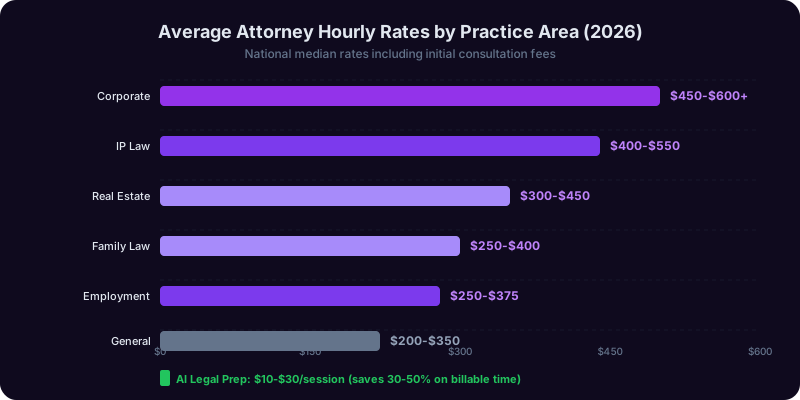
Lawyers bill $200-$500+ per hour, and unprepared clients burn half of the first meeting explaining basics. This checklist shows how to use AI to organize your documents by case type, draft sharp questions, and decode legal terminology before you walk in.
Why Preparation Saves You Real Money
Attorneys bill in increments, typically 6-minute blocks (one-tenth of an hour). At $350/hour, every 6 minutes costs you $35. If you spend 20 minutes of a one-hour consultation explaining your situation in a disorganized way while the attorney asks clarifying questions, you have just spent $117 on information transfer that could have been handled with a well-organized summary.
The math of preparation. A typical initial consultation is 30-60 minutes. Clients who come unprepared often need a second meeting just to cover the ground that a prepared client covers in one. At $350/hour, that second meeting costs $175-$350. In contrast, spending 1-2 hours organizing your case with an AI tool costs a fraction of that and can cut your total legal costs by 30-50% on the initial phase of your case.
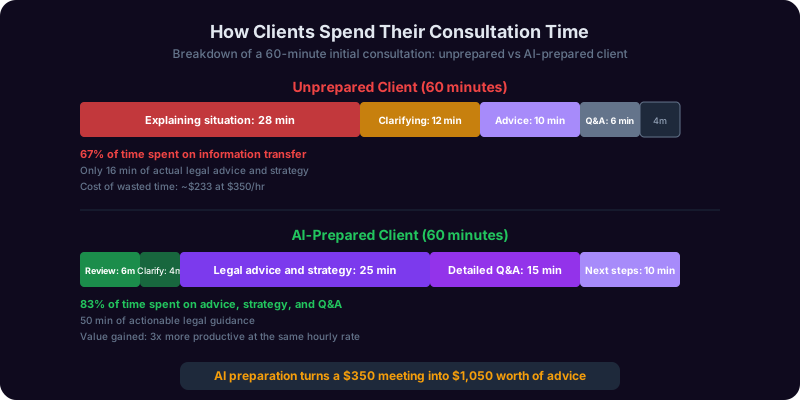
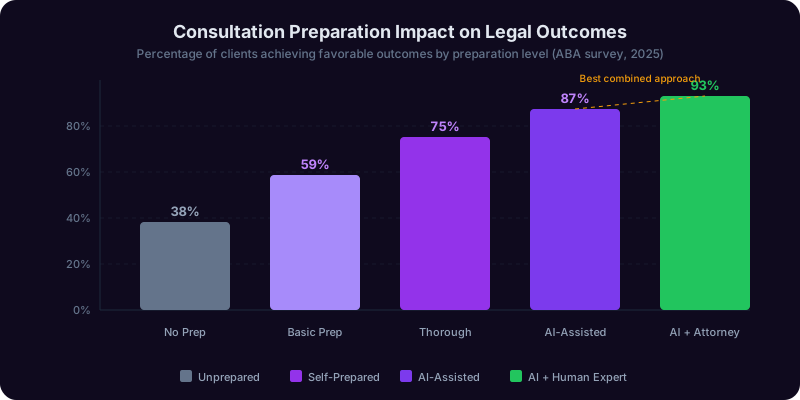
What attorneys wish their clients knew. Lawyers consistently report that their most efficient (and least expensive) clients share these traits: they arrive with a written summary of their situation, they bring organized documents in chronological order, they have specific questions written down, and they understand the basic terminology relevant to their issue. These clients get answers faster, make better decisions, and spend less on legal fees overall. A 2025 ABA Legal Technology Survey found that clients who bring organized documentation to their first meeting save an average of 40% on initial-phase legal costs.
What wastes attorney time (and your money):
- Telling your story out of chronological order, requiring the attorney to piece together a timeline
- Bringing a disorganized stack of papers and asking the attorney to sort through them
- Not knowing what you want to achieve ("I just want to know my options" without context)
- Asking the attorney to explain basic concepts that a 10-minute Google search or AI query could have covered
- Emotional venting (understandable, but expensive at $350/hour)
The Legal Copilot can help you organize your situation into a structured summary, identify the relevant legal concepts, and prepare specific questions, all before the meter starts running.
What to Do Before the Meeting
Your preparation should start at least 48 hours before your consultation. Here is a step-by-step checklist.
Step 1: Write a one-page summary of your situation (30-45 minutes). Include: who is involved (names and relationships), what happened (in chronological order), when key events occurred (specific dates), what you have done so far (complaints filed, letters sent, conversations had), and what outcome you want. Keep it to one page. Attorneys can absorb a written summary in 2-3 minutes that would take 15-20 minutes to explain verbally.
Step 2: Create a timeline (15-30 minutes). List every significant event with its date. This is the single most useful document you can bring. Example format:
- January 15, 2026: Signed lease for apartment at [address]
- March 3, 2026: Reported water damage to landlord via email
- March 10, 2026: Landlord acknowledged but no repair scheduled
- April 15, 2026: Mold discovered in bathroom
- April 16, 2026: Sent written notice to landlord (certified mail)
Step 3: Gather your documents (30-60 minutes). Collect everything relevant: contracts, emails, text messages (screenshots), letters, receipts, photographs, medical records, police reports, or government filings. Organize them chronologically and label them clearly. Digital copies on a USB drive or in a shared folder are ideal.
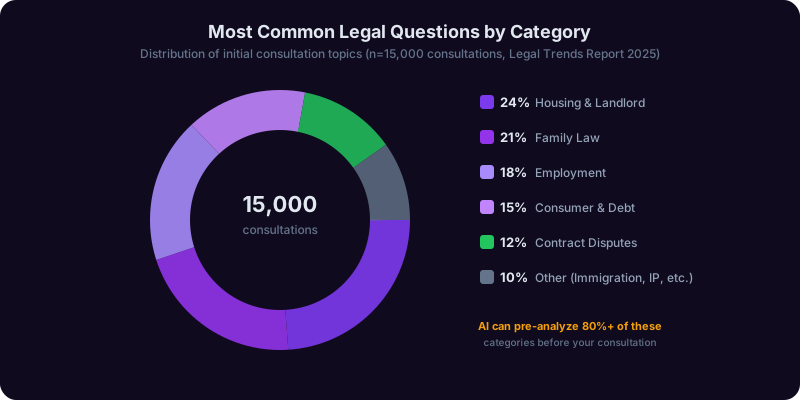
Step 4: Research the type of attorney you need (15 minutes). Not all lawyers handle all cases. You need a lawyer who specializes in your issue: family law (divorce, custody, adoption), employment law (wrongful termination, discrimination, wage disputes), personal injury (accidents, medical malpractice), real estate (lease disputes, property transactions), immigration, business law, or estate planning. Calling a general practice attorney for a specialized issue wastes both your time and money. The Martindale-Hubbell directory and your state bar association's referral service can help you find specialists.
Step 5: Confirm logistics. Bring a government-issued ID, your insurance information (if relevant), payment method for the consultation fee, and a notebook. Ask the office in advance what the consultation fee is, how long it will last, and whether there is anything specific you should bring.
See our real-world walkthrough: landlord keeping security deposit.
How AI Can Help Organize Your Case
AI tools are particularly powerful for the organizational and research aspects of legal preparation. Here is specifically how to use them.
Structuring your narrative. Most people tell their story emotionally, jumping between events and mixing facts with feelings. An AI copilot can take your unstructured explanation and reorganize it into a clear, chronological, fact-based summary. Describe your situation conversationally to the Legal Copilot, and it will produce a structured summary you can hand to your attorney.
Identifying the legal issues. You may know you have a problem, but you may not know what legal category it falls into. "My landlord will not fix my apartment" might involve habitability laws, constructive eviction, lease breach, or local housing codes. "My employer changed my job without asking" might involve breach of employment contract, constructive dismissal, or wage and hour violations. AI can identify the likely legal theories based on your facts, which helps you find the right type of attorney and ask informed questions.
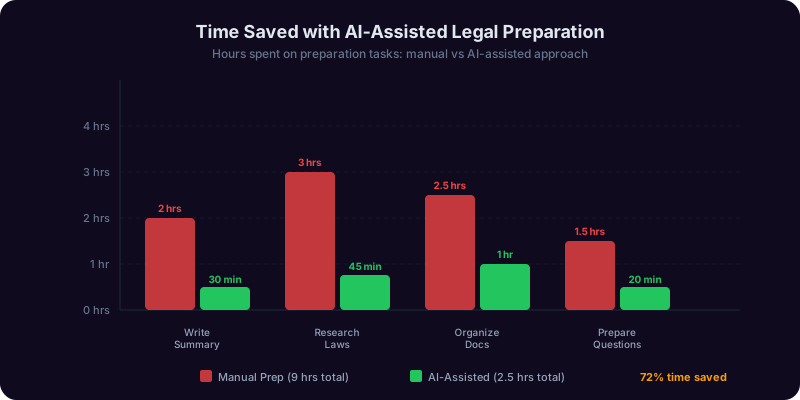
Analyzing contracts and documents. If your dispute involves a contract, lease, or agreement, upload it to the Contract Review Copilot before your meeting. The AI can identify the specific clauses relevant to your situation, explain what they mean in plain English, and flag areas where the contract may support or undermine your position. Handing your attorney a contract with flagged sections and questions about specific clauses is infinitely more efficient than handing them a 20-page document and saying "Is this fair?" For a deeper guide on contract analysis, see our article on how to read and negotiate any contract.
Researching relevant laws. AI can provide a general overview of the laws relevant to your situation, including state-specific statutes and their key provisions. For example, if your landlord is withholding your security deposit, AI can tell you your state's specific deadline for returning deposits (14-60 days depending on the state), the penalties for violations (often 2-3x the deposit amount), and the process for filing a claim. This background knowledge means you spend your attorney's time on strategy rather than basic legal education. Research from Pew Research Center shows that 62% of Americans who used AI for legal research reported feeling significantly more prepared for professional consultations.
Important limitation: AI provides general legal information, not legal advice for your specific situation. It cannot assess the strength of your case, predict outcomes, or represent you. Its role is to prepare you so your human attorney's time is maximized.
Questions to Prepare for Your Attorney
Walking in with a prepared list of questions ensures you cover everything and prevents the common post-meeting realization that you forgot to ask something important. Here are the essential questions organized by phase.
Understanding your case:
- Based on the facts I have described, what type of legal matter is this?
- What are my strongest arguments? What are the weaknesses in my position?
- What is the likely outcome if I pursue this? What is the range of possible outcomes?
- What evidence do I need to strengthen my case? Is there anything I should stop doing or start doing right now?
- Is there a statute of limitations I need to be aware of? How much time do I have?
Understanding the process:
- What are the steps involved in pursuing this? What is the typical timeline?
- Is this something that can be resolved through negotiation, or will it likely require litigation?
- Are there alternatives to going to court (mediation, arbitration, demand letter)?
- What would the other side's likely response be?
Understanding the costs:
- What is your fee structure (hourly, flat fee, contingency)?
- What is your estimate of the total cost to resolve this matter?
- Are there additional costs beyond your fees (filing fees, expert witnesses, process servers)?
- Do you require a retainer? How much, and how is it applied?
- If this is a contingency case, what percentage do you take, and does that change if the case goes to trial?
Understanding the attorney:
- How many cases like mine have you handled?
- What is your availability, and who will be my primary point of contact?
- How do you communicate with clients (email, phone, portal), and what is your typical response time?
The Legal Copilot can generate additional case-specific questions based on your situation. Having 8-12 targeted questions shows the attorney you are organized and serious, which often improves the quality of advice you receive. If your situation involves a demand letter, you might also want to review our complete guide to writing demand letters before your meeting.
Documents to Gather by Case Type
The documents you need depend on your legal issue. Here are comprehensive checklists for the most common consultation types.
Employment disputes (wrongful termination, discrimination, wage issues):
- Employment contract or offer letter
- Employee handbook or relevant company policies
- Pay stubs for the relevant period
- Performance reviews (all of them, not just recent ones)
- Written warnings or disciplinary actions
- Emails, texts, or messages related to the dispute
- Termination letter or documentation
- Any severance agreement offered
- Non-compete or non-disclosure agreements
- Records of complaints to HR (dates and outcomes)
Landlord-tenant disputes:
- Lease agreement (complete, including all addenda)
- Move-in and move-out inspection reports
- Photographs of the property (condition at move-in and current/move-out)
- All written communications with the landlord (emails, texts, letters)
- Rent payment records
- Repair request documentation
- Security deposit receipt
- Any notices received (to vacate, rent increase, lease violation)
Family law (divorce, custody):
- Marriage certificate
- Prenuptial or postnuptial agreements
- Financial documents: tax returns (3 years), bank statements, retirement account statements, mortgage documents, credit card statements, loan documents
- Property deeds and vehicle titles
- Documentation of domestic violence (police reports, protective orders, photographs)
- Children's school and medical records
- Communication logs relevant to custody
Contract disputes:
- The complete contract (all pages, signatures, amendments)
- All communications related to the contract (negotiation emails, modification requests)
- Evidence of performance or non-performance (deliverables, invoices, payments)
- Records of any verbal agreements or promises
- Damage calculations (what you lost or were overcharged)
For immigration matters, the Immigration Copilot can help you identify which specific documents you need based on your visa type and situation. For family law matters, the Family Law Copilot can help you organize financial disclosure documents. If you are considering handling your family law matter yourself, see our complete guide to filing for divorce.
Understanding Legal Terminology Before Your Meeting
You do not need a law degree, but knowing 20-30 key terms relevant to your case means you can follow your attorney's analysis without stopping every other sentence to ask "What does that mean?" According to a MIT Technology Review analysis, AI-powered legal literacy tools have helped reduce the knowledge gap between attorneys and their clients, leading to more productive consultations and better outcomes. Here are the most common terms by practice area.
General legal terms everyone should know:
| Term | Plain English Meaning |
| Statute of limitations | The deadline to file a lawsuit (varies by claim type and state, typically 1-6 years) |
| Liability | Legal responsibility for something (who is at fault) |
| Damages | The money you are seeking as compensation |
| Discovery | The phase where both sides exchange evidence before trial |
| Deposition | Sworn out-of-court testimony, recorded by a court reporter |
| Mediation | A voluntary settlement process with a neutral third party (non-binding) |
| Arbitration | A binding decision made by a private judge (often required by contracts) |
| Retainer | An upfront payment held in a trust account; attorney bills against it |
| Contingency fee | Attorney gets paid only if you win (typically 33-40% of the recovery) |
| Pro bono | Free legal work (usually for qualifying low-income clients) |
Employment law terms:
| Term | Plain English Meaning |
| At-will employment | Either party can end the employment at any time, for any legal reason |
| Constructive dismissal | Conditions made so bad you were forced to quit (treated like being fired) |
| Retaliation | Employer punishing you for exercising a legal right (filing a complaint, etc.) |
| Severance | Payment offered when employment ends (not legally required in most states) |
| Non-compete | Agreement restricting where you can work after leaving |
Landlord-tenant terms:
| Term | Plain English Meaning |
| Habitability | The legal standard requiring landlords to maintain livable conditions |
| Constructive eviction | Landlord's failure to maintain the property effectively forces you to leave |
| Quiet enjoyment | Your right to use the rental without unreasonable interference from the landlord |
| Security deposit | Money held as protection against damage; return deadlines vary by state (14-60 days) |
The Legal Copilot can explain any legal term in plain English and provide context for how it applies to your specific situation.
Making the Most of Your Billable Hour
Your consultation time is limited and expensive. Here is how to structure the meeting for maximum value.
The first 5 minutes: set the agenda. Hand your attorney the one-page summary and timeline you prepared. Say: "I have written a summary and timeline to save us time. I also have [number] specific questions. Can we start with your assessment of my situation and then go through my questions?" This signals that you are organized and respect the time, and it lets the attorney absorb the facts quickly rather than reconstructing them from a verbal account.
Minutes 5-20: listen to the assessment. After reviewing your summary, a good attorney will tell you: what type of legal issue you have, whether you have a viable case, what the likely process and timeline look like, and what the potential outcomes are. Take notes. If you do not understand something, ask. This is the most valuable part of the meeting because you are getting expert analysis of your specific facts.
Minutes 20-40: ask your prepared questions. Work through your question list in order of importance. If you run short on time, the most important questions to get answered are: What is the statute of limitations (your deadline)? What should I do or stop doing right now? And what is the estimated cost to resolve this? Write down the answers. Do not rely on memory.
Minutes 40-50: discuss next steps and costs. If you want to hire this attorney, discuss: fee structure, estimated total cost, retainer amount, and what happens next. If you are not sure, say: "Thank you, I would like to take a day to consider before proceeding. When is the latest I should let you know?" You are never obligated to hire the first attorney you consult.
Last 5 minutes: confirm action items. Summarize what you understand the next steps to be. Ask for anything in writing. Get a business card and the best method to reach them.
What to avoid during the meeting:
- Do not vent or tell irrelevant backstory (your attorney needs facts, not the full emotional narrative)
- Do not ask hypothetical questions ("What if they also did X?") unless X is real
- Do not argue with the attorney's assessment (you are paying for their honest opinion)
- Do not bring uninvolved family members who will talk over you or add unrelated information
After the Consultation: Next Steps
What you do in the 24-48 hours after your consultation is almost as important as the meeting itself. Here is how to maximize the value of what you learned.
Immediately after (within 1 hour):
- Review and expand your notes while the conversation is fresh. Fill in any gaps and clarify any shorthand you used.
- Write down your overall impression: Did the attorney seem knowledgeable about your type of case? Were they responsive to your questions? Did you feel heard? Did their assessment make sense?
- Note any follow-up documents or information the attorney requested.
Within 24 hours:
- Send a follow-up email thanking the attorney and confirming your understanding of the next steps. This creates a written record and ensures you are aligned.
- If you are considering hiring them, ask for a written engagement letter or fee agreement before proceeding. Read it carefully (use the Contract Review Copilot to review the engagement letter if needed).
- If you are getting a second legal opinion, schedule that consultation now while your case preparation is fresh. Our guide to professional second opinions explains when and how to get additional perspectives on legal matters.
Within 48 hours:
- Complete any action items the attorney identified (gathering additional documents, filing a complaint, sending a notice).
- If there is a statute of limitations issue, calendar the deadline with multiple reminders.
- If you decided to proceed, send the signed engagement letter and retainer payment.
Evaluating whether to hire this attorney. Consider: Do they have experience with your specific type of case? Is their communication style compatible with yours? Is the fee structure clear and reasonable? Did they give you a realistic assessment (attorneys who guarantee outcomes are a red flag)? Do you trust their judgment?
If you cannot afford an attorney. Options include: legal aid organizations (income-based, free services), law school clinics (supervised by licensed professors), bar association referral programs (often offer reduced-fee initial consultations), and unbundled legal services (attorney handles only specific tasks, like drafting a letter, rather than the entire case). The Legal Services Corporation maintains a directory of free legal aid providers by state. The Legal Copilot can help you identify free and low-cost legal resources in your area.
Continuing to use AI after the consultation. After your meeting, the Legal Copilot can help you: draft follow-up correspondence, organize the additional documents your attorney requested, track deadlines and action items, and prepare for subsequent meetings as your case progresses. The goal is the same as before: maximize the value of every dollar you spend on legal counsel by being consistently prepared.
For more on this topic, read our guide on How to Write a Demand Letter That Gets Results. If you are dealing with debt collection issues, our debt collector rights guide covers what to prepare before speaking with an attorney about collections cases.
Frequently asked questions
How much does an initial attorney consultation cost?
Can AI replace the need for a lawyer entirely?
What should I do if I cannot afford any attorney at all?
How do I know if I even need a lawyer or if I can handle this myself?
What information should I never share with an AI tool when preparing for a legal consultation?
How far in advance should I start preparing for my lawyer consultation?
Should I consult multiple attorneys before choosing one?
What is the difference between legal information and legal advice, and why does it matter?
Prepare for Your Lawyer Meeting and Save Hundreds
Use the Legal Copilot to organize your facts, understand legal terminology, and prepare your questions. Walk in prepared and make every billable minute count.
- Legal CopilotOrganize your legal situation and prepare key questions before meeting your lawyer
Free plan, no card. Pro from $4.99/week for every copilot across all 20 domains - about what one hour with any single professional costs per year.