
Legal & Rights
The 5 Types of Illegal Firing: Signs Your Termination Broke the Law and What to Do in 72 Hours
Not every unfair firing is illegal, but five categories are. Learn the signs your termination broke the law, the evidence to gather in the first 72 hours, whether to sign that severance agreement, and realistic settlement ranges before you decide to sue.
What Wrongful Termination Actually Means
Let us start with the hardest truth in employment law: being fired unfairly is not the same as being fired illegally. This distinction trips up nearly every employee who has just lost their job, and misunderstanding it leads to wasted time, money, and emotional energy pursuing claims that have no legal basis.
In the United States, the vast majority of employment is "at-will." At-will employment means that either you or your employer can end the employment relationship at any time, for any reason, or for no reason at all - with or without notice. Your boss can fire you because they do not like your shoes, because they had a bad day, because they want to give your job to their nephew, or because Mercury is in retrograde. Unfair? Absolutely. Illegal? No.
At-will employment is the default in every U.S. state except Montana (which requires "good cause" for termination after a probationary period). Even in Montana, the protections are more limited than most employees assume.
So What IS Wrongful Termination?
Wrongful termination occurs when an employer fires an employee for a reason that violates a specific law or legal principle. The key word is specific. There must be a statute, regulation, contract provision, or established legal doctrine that makes the reason for your firing illegal. General unfairness, bad management, or even dishonesty from your employer is not enough.
Wrongful termination claims generally fall into five categories, which we will cover in detail in the next section:
- Discrimination - fired because of a protected characteristic
- Retaliation - fired for exercising a legal right or reporting violations
- Breach of contract - fired in violation of an employment agreement
- Public policy violation - fired for refusing to do something illegal
- Statutory violation - fired in violation of specific employment laws (FMLA, WARN Act, etc.)
The Numbers
According to the Equal Employment Opportunity Commission (EEOC), approximately 73,000 workplace discrimination charges were filed in fiscal year 2025. Of those, roughly 35-40% involved termination. The EEOC found "reasonable cause" (meaning the claim had merit) in about 4.5% of cases. State agencies found merit at slightly higher rates, typically 8-12%.
This does not mean most wrongful termination claims are frivolous. It means the legal standard is high, the evidence requirements are specific, and many legitimate claims are difficult to prove. Understanding what does and does not qualify as wrongful termination is the first step toward deciding whether your situation warrants action.
Disclaimer: This guide provides general information about wrongful termination and employment law. It is not legal advice. Employment law varies significantly by state, and the specific facts of your situation determine your legal options. Consult with an employment attorney about your specific case.
See our real-world walkthrough: fired without warning.
The 5 Types of Illegal Termination
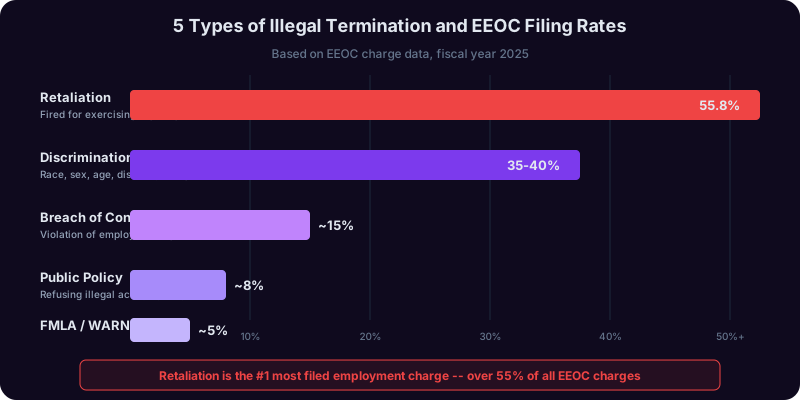
The chart below breaks down EEOC charge filing rates by type of wrongful termination claim, showing how frequently each category is pursued and the relative prevalence of each.
1. Discrimination
Federal law prohibits employers from firing employees based on certain protected characteristics. The major federal anti-discrimination statutes are:
| Law | Protected Characteristic | Applies To |
|---|---|---|
| Title VII of the Civil Rights Act (1964) | Race, color, religion, sex (including pregnancy, sexual orientation, gender identity), national origin | Employers with 15+ employees |
| Age Discrimination in Employment Act (ADEA) | Age (40 and older) | Employers with 20+ employees |
| Americans with Disabilities Act (ADA) | Disability (physical or mental) | Employers with 15+ employees |
| Genetic Information Nondiscrimination Act (GINA) | Genetic information, family medical history | Employers with 15+ employees |
| Pregnancy Discrimination Act (PDA) | Pregnancy, childbirth, related medical conditions | Employers with 15+ employees |
Example: A 58-year-old sales manager with consistently strong performance reviews is fired and replaced by a 31-year-old. The employer claims "restructuring," but the only position eliminated was the older employee's. This could be age discrimination under the ADEA.
Many states and cities add additional protected categories, including marital status, political affiliation, criminal history, military status, and others. Check your state's civil rights agency for a complete list.
2. Retaliation
Retaliation is the most commonly filed type of employment discrimination charge, accounting for over 55% of all EEOC charges in recent years. It is illegal for an employer to fire you for:
- Filing a discrimination complaint (with the EEOC, your HR department, or a state agency)
- Reporting safety violations to OSHA or internal safety committees
- Whistleblowing on fraud, waste, or illegal activity (protected under Sarbanes-Oxley for public companies, Dodd-Frank for financial industry, and various state whistleblower statutes)
- Filing a workers' compensation claim after a workplace injury
- Participating in an investigation as a witness in a co-worker's discrimination case
- Reporting wage violations to the Department of Labor or state labor board
- Engaging in union activity or collective bargaining (protected under the National Labor Relations Act)
Example: An employee reports to HR that their supervisor is making sexually explicit comments to female team members. Three weeks later, the employee is fired for "performance issues" that were never previously documented. This could be retaliation.
3. Breach of Contract
If you have an employment contract - either express (written/verbal) or implied - your employer may be required to follow specific termination procedures or may only fire you "for cause." Contract-based wrongful termination includes: Try our AI contract review tool for step-by-step help. If you need guidance understanding contract language, our complete guide to reading and negotiating contracts covers the key terms to look for.
- Express written contract: An employment agreement that specifies the term of employment, grounds for termination, or required notice period. Firing you without following those terms is a breach.
- Implied contract: Even without a written agreement, an employer's actions, policies, or statements can create an implied contract. Employee handbooks that outline progressive discipline procedures, verbal promises of continued employment, or long-standing company practices can create enforceable obligations.
- Collective bargaining agreement: Union employees are covered by negotiated contracts that typically require "just cause" for termination and mandate specific disciplinary procedures.
Example: Your employee handbook states that employees will receive a verbal warning, written warning, and performance improvement plan before termination. You receive no warnings and are fired without notice. The handbook may constitute an implied contract.
4. Public Policy Violation
Most states recognize a "public policy exception" to at-will employment. This means an employer cannot fire you for:
- Refusing to commit an illegal act (falsifying records, violating safety regulations, committing fraud)
- Exercising a legal right (voting, serving on a jury, filing a legal claim)
- Performing a public duty (reporting for military service, cooperating with a law enforcement investigation)
Example: A truck driver is fired for refusing to drive a vehicle that fails a DOT safety inspection. The employer wants the delivery completed on time regardless. This is a public policy violation because the employee was fired for refusing to violate federal safety regulations.
Note: A handful of states (Alabama, Georgia, Louisiana, Maine, Nebraska, New York, Rhode Island, and Florida) have limited or no recognition of the public policy exception. Check your state's specific case law.
5. FMLA, WARN Act, and Other Statutory Violations
Several specific federal and state statutes create additional protections against termination:
- Family and Medical Leave Act (FMLA): Employers with 50+ employees must allow eligible workers up to 12 weeks of unpaid leave for serious health conditions, family care, or new child bonding. Firing an employee for taking FMLA leave, or retaliating against them for requesting it, is illegal. See the DOL's FMLA overview for eligibility details.
- WARN Act (Worker Adjustment and Retraining Notification): Employers with 100+ employees must provide 60 days' advance notice before a mass layoff (50+ employees) or plant closing. Failure to provide notice entitles affected employees to 60 days' back pay and benefits.
- USERRA (Uniformed Services Employment and Reemployment Rights Act): Employers must reemploy returning service members and cannot fire them without cause for a period after their return (180 days for service of 31-180 days; one year for service of 181+ days).
- State mini-WARN acts: Many states have their own versions of the WARN Act with lower thresholds. For example, California's WARN Act applies to employers with 75+ employees, and New York's applies to 50+ employees.
Example: An employee takes 8 weeks of FMLA leave to recover from surgery. When they return, their position has been filled and they are told there is "no role available." This is likely an FMLA violation, as the law requires reinstatement to the same or an equivalent position.
For help understanding which category your termination may fall into, the Employment Law Copilot can analyze the facts of your situation and identify potential legal claims. If your employer also asked you to sign a non-compete agreement, understand your rights before assuming you are bound by it.
Signs Your Termination May Be Illegal
Proving wrongful termination rarely involves a smoking gun. Employers are advised by attorneys not to state the real reason for a discriminatory or retaliatory firing. Instead, you need to identify patterns and circumstantial evidence that, taken together, suggest the stated reason for your termination was pretextual - a cover story for an illegal motive.
Timing Patterns
Timing is often the strongest indicator of illegal termination. Watch for these patterns:
- Fired shortly after a protected activity: You filed a complaint, requested FMLA leave, reported a safety violation, or disclosed a disability - and were fired within days or weeks. Courts have found that termination within 1-3 months of a protected activity creates a strong inference of retaliation.
- Fired shortly after a triggering event: You announced a pregnancy, turned 40 (or another milestone age), got married to a same-sex partner, or disclosed a medical condition - and your employer's attitude toward you shifted immediately.
- Fired during or immediately after medical leave: Particularly suspicious if your position was "eliminated" while you were out.
Documented Evidence
- Positive performance reviews followed by sudden negative ones: If you had years of good reviews and then received a sudden poor review shortly before termination - especially if the review process or criteria changed - this suggests the negative review was manufactured to justify the firing.
- No prior warnings or progressive discipline: If company policy calls for verbal warning, written warning, PIP, then termination - but you went straight to termination - the employer may have bypassed its own procedures to fire you quickly.
- Written communications showing bias: Emails, texts, or Slack messages from supervisors or HR that reference your age, gender, disability, medical condition, complaints, or other protected characteristics. Save everything.
Comparative Treatment
- Disparate treatment: Other employees did the same thing you were fired for (attendance issues, performance problems, policy violations) but were not fired - and those employees are of a different race, age, gender, or other protected category than you.
- Your replacement: You were fired for "performance" and immediately replaced by someone younger, of a different race or gender, or someone who did not engage in protected activity. The more similar the replacement's qualifications to yours (or the more inferior), the stronger the inference.
Pretextual Reasons
- The stated reason does not match the evidence: You were fired for "poor performance" but your metrics show you were a top performer. You were fired for "tardiness" but no one else with similar attendance records was disciplined.
- Shifting explanations: The employer gives different reasons for the firing at different times - one reason in the termination meeting, a different reason in the unemployment response, and yet another in legal proceedings. Inconsistent explanations are a hallmark of pretext.
- The reason is vague or subjective: "Not a good culture fit," "we are going in a different direction," or "restructuring" without any documentation of the business need. These generic explanations can mask discriminatory intent.
Red Flags Checklist
| Indicator | Strength of Evidence | What It Suggests |
|---|---|---|
| Fired within 30 days of protected activity | Strong | Retaliation |
| No documented performance issues before termination | Moderate to Strong | Pretextual reason |
| Replaced by someone outside your protected class | Moderate to Strong | Discrimination |
| Company bypassed its own discipline policy | Moderate | Pretext / bad faith |
| Shifting or inconsistent reasons given | Strong | Pretext |
| Supervisor made comments about protected characteristic | Strong | Discriminatory intent |
| Others who did the same thing were not fired | Moderate to Strong | Disparate treatment |
| Sudden negative review after years of positive ones | Moderate | Manufactured justification |
No single indicator is conclusive. But when multiple indicators align, they form a pattern that employment attorneys and courts take seriously. Document everything you observe - the more specific your evidence, the stronger your position.
The Critical First 72 Hours After Being Fired
What you do in the first three days after being fired can make or break a potential wrongful termination claim. This is when evidence is freshest, deadlines start running, and critical decisions need to be made. Here is your action plan.
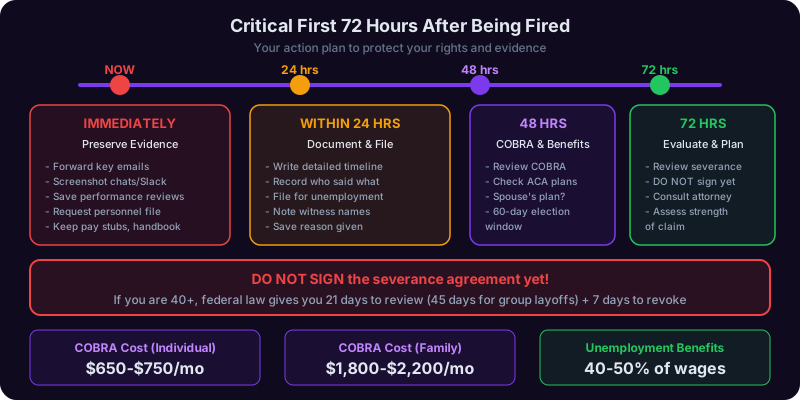
Immediately: Preserve Evidence
This is the single most important thing you can do. Once you lose access to your work email and systems, much of the evidence is gone forever.
- Forward key emails to your personal email - performance reviews, praise from supervisors, complaints you filed, HR correspondence, any communications referencing your protected activity or characteristics. Do this before your access is revoked. Note: Check your employer's policies on forwarding work emails. In some cases, taking company documents could complicate your case. When in doubt, take notes about what exists and where it is stored, rather than copying proprietary information.
- Screenshot text messages and chat logs (Slack, Teams, etc.) that are relevant to your termination, especially any that show bias, retaliation, or a timeline of events.
- Save your personnel file. You have a legal right to request a copy of your personnel file in most states. Send a written request immediately - some states require employers to provide it within 30 days.
- Preserve your own records - personal notes, calendar entries documenting meetings and conversations, pay stubs, offer letters, the employee handbook, and any written policies relevant to your termination.
Within 24 Hours: Document the Timeline
While the events are fresh in your mind, write a detailed chronological account of:
- When and how you were told you were being fired
- Who was present in the room
- Exactly what was said (use direct quotes where you can remember them)
- The reason given for your termination
- Any events in the preceding weeks or months that may be relevant (complaints you filed, medical leave you took, protected activity you engaged in)
- Names of co-workers who witnessed relevant events or can corroborate your account
Within 24 Hours: File for Unemployment
File for unemployment benefits immediately. Do not wait. Here is why:
- Benefits start from the date you file, not the date you were fired. Every day you delay is a day of benefits you lose.
- If your employer contests your unemployment claim, their stated reason for firing you becomes part of the record - and if it differs from what they told you, that inconsistency is evidence.
- In most states, you can file online in 20-30 minutes.
- Typical unemployment benefits replace 40-50% of your prior wages, up to your state's maximum (ranges from $235/week in Mississippi to $1,015/week in Massachusetts).
Within 48 Hours: Handle COBRA
Your employer is required to send you a COBRA (Consolidated Omnibus Budget Reconciliation Act) notice within 14 days. COBRA allows you to continue your employer-sponsored health insurance for up to 18 months, but you pay the full premium plus a 2% administrative fee. Typical COBRA costs:
| Coverage Type | Average Monthly COBRA Cost (2026) |
|---|---|
| Individual only | $650-$750 |
| Employee + spouse | $1,300-$1,500 |
| Family | $1,800-$2,200 |
You have 60 days to elect COBRA coverage, and the election is retroactive - meaning if you have a medical need during those 60 days, you can elect COBRA afterward and it will cover the expenses. This effectively gives you 60 days of free "insurance" to decide.
Alternatives to COBRA that may be cheaper: ACA marketplace plans (healthcare.gov - losing your job qualifies you for a Special Enrollment Period), Medicaid (if your income drops below the threshold), a spouse's employer plan, or short-term health insurance.
Within 72 Hours: DO NOT Sign the Severance Agreement
If your employer offered a severance package, do not sign it yet. Severance agreements almost always include a "release of claims" - meaning you give up your right to sue for wrongful termination in exchange for the severance payment. You need time to evaluate whether the severance is fair relative to what you might recover through a legal claim.
- Under the Older Workers Benefit Protection Act (OWBPA), employees over 40 must be given at least 21 days to consider a severance agreement (45 days in a group layoff), plus 7 days to revoke after signing.
- Even if you are under 40, you are under no obligation to sign immediately. Tell the employer you need time to review it. A reasonable request for 1-2 weeks to review is standard.
- Have an employment attorney review the agreement before signing. Many offer free consultations specifically for severance review.
If you need help writing a formal response to your employer during this period, our guide on how to write a demand letter walks through the process of crafting effective legal correspondence.
The Career Copilot can help you create a timeline of events and organize your documentation, while the Employment Law Copilot can help you understand the terms of any severance agreement you have been offered.
How to File a Wrongful Termination Complaint
If you believe your termination was illegal, you typically cannot go directly to court. Most employment discrimination and retaliation claims require you to first file a complaint (called a "charge") with a government agency. Here is how each process works.
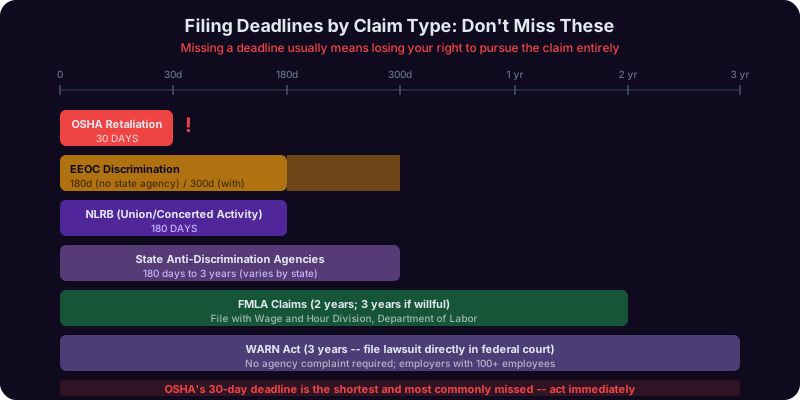
The chart below shows the filing deadlines for each type of claim. Note that OSHA's 30-day deadline is the shortest and most commonly missed.
EEOC (Equal Employment Opportunity Commission)
For discrimination and retaliation claims under federal law (Title VII, ADA, ADEA, GINA).
Filing deadlines:
- 180 days from the date of termination in states without a state anti-discrimination agency
- 300 days from the date of termination in states with a state agency (the majority of states) - this extended deadline applies because of "work-sharing" agreements between the EEOC and state agencies
- These deadlines are strict. If you miss them, you lose your right to pursue the claim. Do not wait.
How to file:
- Online: Go to publicportal.eeoc.gov and submit an inquiry. You will be contacted to schedule an intake interview.
- In person: Visit your nearest EEOC field office. Bring your documentation and timeline.
- By mail: Send a signed, detailed letter to your local EEOC office describing the discrimination.
What happens after you file:
- The EEOC notifies your employer within 10 days
- The EEOC may offer mediation (a voluntary process that resolves about 75% of participating cases)
- If mediation fails or is declined, the EEOC investigates (average timeline: 6-10 months)
- The EEOC issues a determination: "reasonable cause" (they found evidence of discrimination) or "no reasonable cause"
- If reasonable cause is found, the EEOC attempts conciliation (settlement). If that fails, the EEOC may file suit on your behalf (rare - this happens in less than 1% of cases)
- If no reasonable cause is found (or at any point), you can request a "Right to Sue" letter, which gives you 90 days to file a lawsuit in federal court
State Anti-Discrimination Agencies
Most states have their own civil rights agencies that handle employment discrimination claims. These often have advantages over the EEOC:
- Broader protections: Many states protect additional categories not covered by federal law
- Lower employer thresholds: Some state laws apply to employers with as few as 1-4 employees (vs. 15 for Title VII)
- Longer filing deadlines: Some states allow 1-3 years to file
- Faster processing: State agencies often investigate more quickly than the EEOC
Filing with either the EEOC or your state agency is usually sufficient - they cross-file with each other under work-sharing agreements.
OSHA (Occupational Safety and Health Administration)
For retaliation claims related to safety complaints or whistleblowing.
- Filing deadline: 30 days from the retaliatory action (this is extremely short - act immediately)
- How to file: Online at osha.gov, by phone at 1-800-321-OSHA, or at your local OSHA office
- OSHA investigates and can order reinstatement, back pay, and compensatory damages
NLRB (National Labor Relations Board)
For termination related to union activity, collective bargaining, or concerted activity (including non-union employees discussing wages or working conditions with co-workers).
- Filing deadline: 180 days from the unfair labor practice
- How to file: Online at nlrb.gov or at your nearest NLRB regional office
- The NLRB investigates and can issue a complaint leading to a hearing before an administrative law judge
Department of Labor
For FMLA violations, WARN Act violations, and wage-related retaliation.
- FMLA complaints: File with the Wage and Hour Division within 2 years (3 years for willful violations)
- WARN Act complaints: File a lawsuit in federal court (no agency complaint required) within 3 years
If your employer retaliates by sending you a threatening letter, our cease and desist letter guide can help you understand and respond to it.
For help determining which agency to file with and meeting the correct deadlines, the Legal Copilot can guide you through the filing process based on the type of claim you have.
Severance Negotiation When You Suspect Wrongful Termination
Here is something most employees do not realize: severance is almost always negotiable. There is no federal law requiring employers to offer severance at all. When they do, it is because they want something from you - typically a release of claims (your agreement not to sue). If you suspect your termination was wrongful, that release has significant value, and you should negotiate accordingly.
Typical Severance Packages
Standard severance ranges by situation:
| Scenario | Typical Severance | Notes |
|---|---|---|
| Standard layoff (no legal issues) | 1-2 weeks per year of service | Industry standard baseline |
| Layoff with potential age discrimination | 2-4 weeks per year of service | Employer knows ADEA claims are costly |
| Termination with potential retaliation claim | 3-6 months' salary | Retaliation cases have high success rates |
| Executive-level termination | 6-24 months' salary | Often negotiated in the employment agreement |
| Termination with strong discrimination evidence | 6-12+ months' salary | Reflects litigation risk to employer |
Leverage Analysis
Before negotiating, honestly assess your leverage:
- How strong is your legal claim? A well-documented retaliation claim filed two weeks after protected activity gives you strong leverage. A vague sense that things "were not right" does not.
- How expensive is your claim to the employer? Discrimination lawsuits are expensive to defend ($75,000-$250,000+ in legal fees alone), damaging to reputation, and time-consuming for management. Employers are often willing to pay significantly more in severance to avoid these costs.
- How public could this get? If your termination involves facts that would be embarrassing in a public filing or media report, the employer has additional incentive to settle quietly.
- What is your documentation? Emails, texts, performance reviews, and witness statements make your negotiating position much stronger than verbal recollections alone.
What to Negotiate Beyond Money
Severance is not just about the check. Consider negotiating for:
- Extended health insurance: Ask the employer to continue paying their share of your health insurance premiums for the severance period (saves you $500-$1,500+/month compared to COBRA)
- Neutral reference: A written agreement specifying exactly what the employer will say when contacted by future employers - typically confirming dates of employment and title, with no negative characterization
- Non-disparagement (mutual): Both parties agree not to speak negatively about each other. Make sure it is mutual - a one-sided clause that only restricts you is not balanced
- Outplacement services: Professional career coaching and job placement assistance, typically valued at $2,000-$10,000
- Unvested stock or bonuses: Acceleration of unvested equity or payment of prorated bonuses you would have earned
- Title and dates: Agreement on how your employment dates and final title will be reported
- Non-compete release: If you signed a non-compete agreement, negotiate its release or narrowing as part of the severance
Negotiation Script
"I appreciate the severance offer. Before I can sign the release of claims, I need to discuss the terms. Based on my [length of service / circumstances of termination / specific concerns], I believe a fair severance would include [your ask]. I would also like to discuss [non-monetary items - reference language, insurance continuation, non-compete release]. I am prepared to sign a reasonable release if we can reach fair terms, and I would prefer to resolve this amicably rather than pursue other options."
The phrase "pursue other options" is understood to mean legal action. You do not need to threaten explicitly - and you should not. Simply signaling that you are aware of your options is sufficient.
If you want to understand the full context of what you are entitled to when leaving a job, our guide on the differences between being fired and laid off covers the rights specific to each scenario.
Should You Sue? Realistic Expectations
Filing a wrongful termination lawsuit is a significant decision with real costs - financial, emotional, and professional. Before you decide, here is what you should realistically expect.
Settlement and Verdict Ranges
The vast majority of wrongful termination cases settle before trial. Here are realistic ranges based on case type and evidence strength:
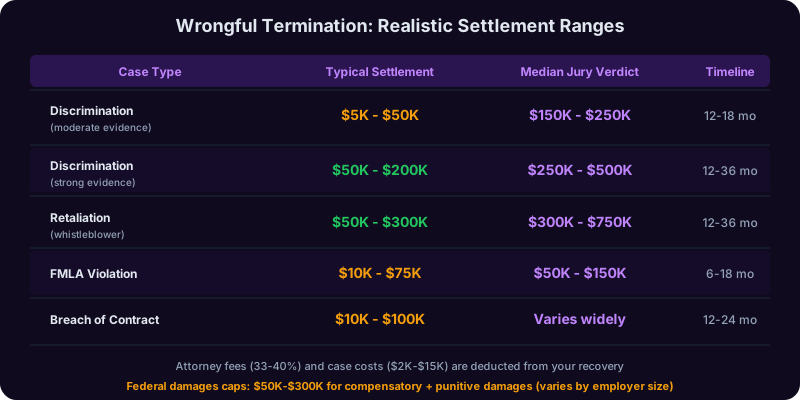
| Case Type | Typical Settlement Range | Median Jury Verdict (if it goes to trial) |
|---|---|---|
| Single-plaintiff discrimination (moderate evidence) | $5,000-$50,000 | $150,000-$250,000 |
| Single-plaintiff discrimination (strong evidence) | $50,000-$200,000 | $250,000-$500,000 |
| Retaliation (whistleblower) | $50,000-$300,000 | $300,000-$750,000 |
| FMLA violation | $10,000-$75,000 | $50,000-$150,000 |
| Breach of contract | $10,000-$100,000 | Varies widely by contract value |
| Class action / pattern discrimination | $500,000-$50M+ (total) | Highly variable |
Note: These are approximations based on published settlement data and jury verdict databases. Your case may fall outside these ranges depending on your salary, length of employment, strength of evidence, jurisdiction, and other factors.
Federal Damages Caps
For claims under Title VII and the ADA, federal law caps compensatory and punitive damages based on employer size:
| Employer Size | Maximum Combined Damages |
|---|---|
| 15-100 employees | $50,000 |
| 101-200 employees | $100,000 |
| 201-500 employees | $200,000 |
| 501+ employees | $300,000 |
These caps apply to compensatory and punitive damages only. Back pay (lost wages), front pay (future lost wages), and attorney fees are not capped. State law claims often have different or no caps, which is one reason many attorneys file under both federal and state law.
Timeline
Wrongful termination cases are not resolved quickly:
- EEOC investigation: 6-10 months (sometimes longer)
- Filing lawsuit to settlement: 12-18 months typical
- Filing lawsuit to trial: 2-3 years typical, sometimes longer
- Appeals: Add 1-2 years if either party appeals
Total timeline from termination to final resolution: 1-5 years is the realistic range.
Attorney Fees and Costs
Most employment attorneys work on contingency for plaintiff-side wrongful termination cases, meaning:
- Contingency fee: 33-40% of the settlement or verdict (33% if settled before trial, 40% if the case goes to trial)
- Costs: You may be responsible for case costs (filing fees, deposition transcripts, expert witnesses) regardless of outcome. These typically run $2,000-$15,000 for a case that settles, and $20,000-$50,000+ for a case that goes to trial.
- Hourly alternative: Some attorneys work hourly ($200-$500/hour), which makes sense only if your case has high damages potential and strong evidence.
Cost-Benefit Analysis Example
Consider this scenario: You have a moderate retaliation claim with decent evidence. Your attorney estimates a likely settlement of $60,000.
- Attorney fee (33%): $19,800
- Case costs: $5,000
- Your net recovery: $35,200
- Time investment: 12-18 months of depositions, document production, and emotional stress
Is $35,200 (before taxes - lawsuit settlements for emotional distress are taxable) worth 12-18 months of litigation? For some people, absolutely. For others, the emotional cost outweighs the financial recovery.
The Emotional Reality
This is the factor most guides do not mention. Pursuing a wrongful termination lawsuit means:
- Reliving the experience repeatedly during depositions and trial preparation
- Having your work history, performance, and personal life scrutinized by the employer's attorneys
- Uncertainty for months or years about the outcome
- Potential difficulty job searching (some employers are wary of candidates with pending employment lawsuits, though asking about them in interviews is risky for the employer)
- The emotional drain of an adversarial legal process
None of this means you should not pursue a legitimate claim. It means you should go in with clear eyes about what the process involves. The best candidates for a lawsuit are people with strong evidence, realistic expectations, and the emotional resilience to see it through.
If your situation does not warrant a full lawsuit, you may still be able to resolve it through small claims court for certain breach of contract claims, or by sending a well-crafted demand letter to negotiate a resolution.
For a deeper understanding of how workplace dynamics can gradually shift before a termination, our guide on scope creep covers the patterns that sometimes precede a pretextual firing.
How AI Can Help You Assess Your Situation
Evaluating a potential wrongful termination claim involves analyzing facts against legal standards, understanding filing deadlines, reviewing employment documents, and making strategic decisions about how to proceed. These are tasks where AI-powered legal tools can provide meaningful help - especially in the early stages when you are trying to determine whether you even have a case.
How Copilotly Can Help
Copilotly offers several AI copilots that address different aspects of a wrongful termination situation:
- Employment Law Copilot: This is your starting point. Describe the circumstances of your termination and the Employment Law Copilot can help you identify which type of wrongful termination claim (if any) may apply to your situation. It can explain the relevant federal and state laws, outline the filing deadlines you need to be aware of, and help you understand the evidence that would be needed to support your claim. It can also help you analyze a severance agreement to understand what rights you would be giving up by signing.
- Career Copilot: While you assess your legal options, you still need to find your next job. The Career Copilot can help you update your resume to address an employment gap, prepare for interview questions about why you left your previous employer, and develop a professional narrative about your departure that is truthful without being self-damaging.
- Legal Copilot: For understanding the broader legal process - how EEOC complaints work, what to expect in mediation, how to find an employment attorney in your area, and what questions to ask during a consultation. The Legal Copilot can help you prepare for your first meeting with an attorney so you use that time efficiently.
- Consumer Rights Copilot: If your termination is connected to a consumer issue (you were fired for reporting fraud, safety violations, or consumer harm), the Consumer Rights Copilot can help you understand the whistleblower protections that may apply and the reporting channels available to you.
- Resume Copilot: Getting back on your feet starts with a strong resume. The Resume Copilot can help you position your experience effectively, even when your most recent employment ended under difficult circumstances.
- Salary Copilot: When you do land your next position, the Salary Copilot can help you negotiate a compensation package that accounts for any financial losses from your termination - including lost bonuses, unvested equity, and the gap in employment.
What AI Can and Cannot Do
AI legal tools are valuable for:
- Identifying the type of legal claim that may apply to your facts
- Explaining complex employment laws in plain English
- Helping you organize your evidence and timeline
- Reviewing and explaining severance agreement terms
- Preparing you for consultations with attorneys
- Drafting initial complaint narratives and correspondence
AI legal tools are not a substitute for:
- An attorney's assessment of your specific case (which depends on jurisdiction-specific case law, the credibility of witnesses, and strategic judgment)
- Filing legal documents on your behalf
- Representing you in negotiations, mediation, or court proceedings
- Providing the attorney-client privilege that protects your communications from disclosure
The most effective approach is to use AI tools to educate yourself, organize your facts, and prepare your questions - then consult with an employment attorney who can provide case-specific legal advice. An informed client who arrives at a consultation with an organized timeline, relevant documents, and the right questions gets far more value from that meeting than someone who walks in cold.
If you received a cease and desist letter from your former employer (common when non-compete or NDA issues are involved), our separate guide covers how to evaluate and respond to those demands. You may also find our guide on the differences between being fired and laid off helpful for understanding your specific rights based on the circumstances of your departure.
Frequently asked questions
Can I sue for wrongful termination if I am an at-will employee?
How much does it cost to hire a wrongful termination lawyer?
What is the deadline to file a wrongful termination claim?
Should I sign the severance agreement my employer offered?
Can I collect unemployment if I was wrongfully terminated?
What evidence do I need to prove wrongful termination?
Can my employer retaliate against me for filing a wrongful termination claim?
What is the difference between wrongful termination and constructive dismissal?
How long does a wrongful termination lawsuit typically take?
Get AI-Powered Help Evaluating Your Wrongful Termination Claim
Describe your termination and get an instant assessment of potential legal claims, filing deadlines, and next steps - without the $400/hr employment attorney consultation fee.
- Career & Professional CopilotUpdate your resume, prepare for interviews, and develop a professional narrative after a difficult departure
- Legal CopilotUnderstand the EEOC complaint process, find an attorney, and prepare for legal consultations
Free plan, no card. Pro from $4.99/week for every copilot across all 20 domains - about what one hour with any single professional costs per year.
Not a law firmThis is legal information, not legal advice. Consult a licensed attorney for your specific situation.