

The State of AI Estate Planning in 2026: What Has Changed
Estate planning has long been one of the most avoided legal tasks in America. According to a 2025 Caring.com survey, 64 percent of American adults do not have a will or any estate planning documents. The reasons are familiar: it feels morbid, it seems expensive, and people assume they are too young or do not have enough assets to bother. But the emergence of AI-powered legal tools in 2025 and 2026 has fundamentally changed the accessibility equation.
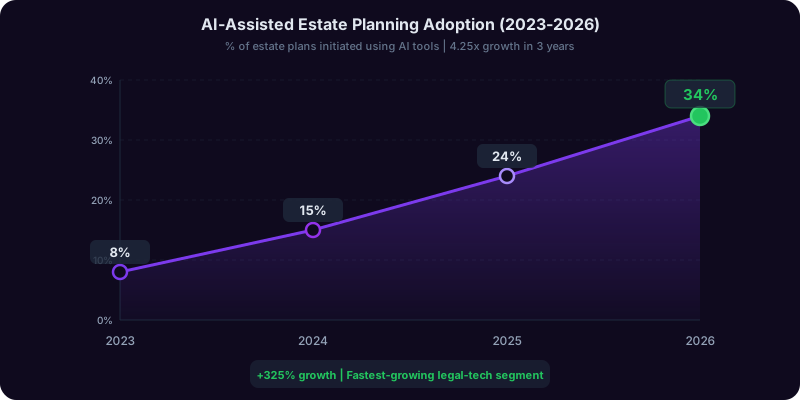
AI estate planning tools now do things that would have required a $300-per-hour attorney consultation just three years ago: they walk you through asset inventories with intelligent prompts, explain complex legal terminology in plain language, identify gaps in your planning, flag state-specific requirements, and generate initial drafts of estate planning documents. The technology has matured from novelty to genuinely useful assistance.
What AI Can Do for Estate Planning Today
Modern AI tools bring several concrete capabilities to the estate planning process:
- Asset organization and inventory. AI can guide you through a comprehensive asset inventory by asking structured questions about property, accounts, insurance policies, digital assets, and debts. It catches categories people commonly forget, like retirement account beneficiary designations, digital subscriptions with transferable value, and outstanding loans to family members.
- Terminology translation. Estate planning is dense with jargon: intestacy, per stirpes, testamentary trust, pour-over will, QTIP trust, elective share. AI translates these terms into plain language and explains how each concept applies to your specific situation.
- Initial document drafting. AI can generate preliminary frameworks for simple wills, power of attorney documents, and healthcare directives based on your inputs. These drafts serve as starting points, not finished legal documents.
- Beneficiary planning analysis. AI can model different distribution scenarios: what happens if you leave everything equally to three children versus creating a trust for the minor child while giving the adults their shares outright? What are the tax implications of each approach?
- State requirement identification. AI can flag the specific witness, notarization, and execution requirements for your state, reducing the risk of creating a document that fails on technicalities.
What AI Cannot Do (Yet)
Despite these advances, there are hard boundaries. AI cannot provide legal advice -- it provides legal information. That distinction matters in probate court. AI cannot execute documents (you still need witnesses and notaries). It cannot navigate complex tax optimization strategies with the judgment of a seasoned estate planning attorney. It cannot represent you in probate proceedings or defend a will contest. And it cannot account for the nuanced family dynamics that often drive the most important estate planning decisions.
The American Bar Association's estate planning resources remain the authoritative reference for understanding what constitutes legal advice versus legal information, and why the distinction matters for consumer protection.
This guide is about finding the practical middle ground: using AI to make estate planning accessible, affordable, and thorough while knowing exactly when human expertise is non-negotiable.
Disclaimer: This guide provides general legal information for educational purposes, not legal advice. Estate planning laws vary significantly by state. For situations involving substantial assets, blended families, business ownership, or special needs dependents, consult a licensed estate planning attorney in your state.
Five Things AI Does Well in Estate Planning (With Examples)
AI is not equally useful across all estate planning tasks. Understanding where it excels helps you leverage it effectively and avoid over-relying on it where human judgment matters more. Here are the five areas where AI provides the most practical value.

1. Building a Complete Asset Inventory
The foundation of any estate plan is knowing what you own and what you owe. This sounds simple but is consistently the step people do worst on their own. A typical person forgets three to five asset categories when doing it from memory. AI helps by asking structured, category-by-category questions that surface assets you would otherwise miss.
A thorough AI-guided inventory covers: real property and how title is held (sole ownership, joint tenancy, tenancy in common, community property), bank and savings accounts with payable-on-death designations, investment and brokerage accounts with transfer-on-death designations, retirement accounts (401k, IRA, Roth IRA, pension) and their beneficiary designations, life insurance policies and beneficiaries, vehicles and recreational vehicles, valuable personal property (jewelry, art, collectibles, firearms), business interests and intellectual property, digital assets (cryptocurrency wallets, domain names, online businesses, digital media libraries), debts (mortgage, auto loans, student loans, credit cards, personal loans), and money owed to you.
The critical insight AI catches that most people miss: beneficiary designations on retirement accounts and life insurance override your will. If your 401(k) names your ex-spouse as beneficiary and your will leaves everything to your current spouse, the ex-spouse gets the 401(k) regardless. AI tools flag these conflicts during the inventory process.
2. Explaining Complex Legal Concepts
Estate planning conversations are loaded with terminology that stops people cold. AI excels at translating legal jargon into decisions you can actually make. For example, instead of asking whether you want "per stirpes" or "per capita" distribution, an AI tool explains: "If your son passes away before you, should his share go to his children (your grandchildren), or should it be split among your surviving children only?" Same legal concept, expressed as a human decision.
This extends to explaining the differences between wills and trusts, revocable versus irrevocable trusts, the probate process and how to avoid it, community property versus common law property states, the federal estate tax exemption and how it applies to you, and the role of powers of attorney alongside a will. For a deeper exploration of wills specifically, our guide on how to write a will without a lawyer covers every element in detail.
3. Drafting Initial Document Frameworks
AI can produce first-draft frameworks for basic estate planning documents. These are not finished legal instruments, but they provide a structured starting point that covers standard provisions. For a simple will, an AI-generated framework includes: declaration of testamentary intent, revocation of prior wills, executor appointment with alternates, guardian designation for minor children, specific bequests, residuary clause, digital asset instructions, and signature blocks with witness provisions.
The quality of these drafts has improved significantly. In 2024, AI-generated will frameworks missed provisions roughly 30 percent of the time. By 2026, with better training data and structured prompting, that rate has dropped to around 10 percent for simple estates. However, 10 percent is not zero, which is why AI drafts should always be reviewed carefully before execution.
4. Modeling Beneficiary Distribution Scenarios
One of AI's strongest estate planning applications is scenario modeling. You can describe your family situation and assets, then ask questions like: "What happens if I leave everything equally to my three children but one of them has $200,000 in student debt?" or "If I leave the house to my spouse and split investment accounts among the children, what is the approximate value each person receives?" AI calculates distributions, identifies potential conflicts (like one child receiving a disproportionately large share because they are also named as life insurance beneficiary), and helps you see the full picture before committing to a plan.
5. Identifying State-Specific Requirements
Will execution requirements vary by state and are unforgiving -- a perfectly drafted will is worthless if it is not signed according to your state's formalities. AI tools can quickly identify whether your state requires two or three witnesses, whether notarization is mandatory or optional, whether self-proving affidavits are available, whether holographic wills are recognized, and what special rules apply to property distribution (community property versus common law states). This is pure information retrieval where AI saves hours of research and reduces the risk of a procedural error invalidating your entire plan.
Where AI Falls Short: When You Absolutely Need an Attorney
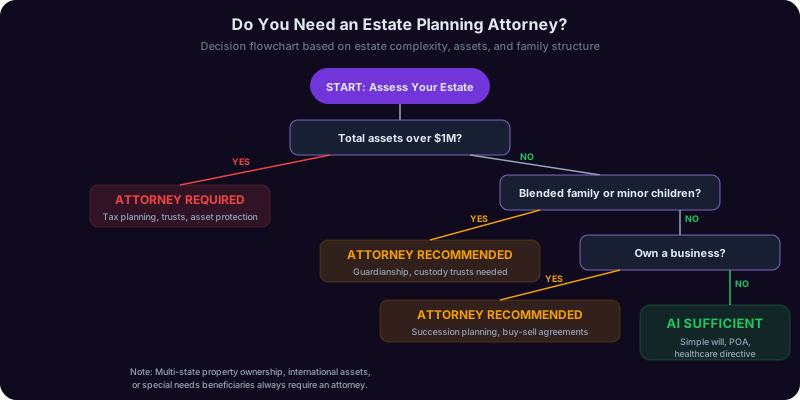
AI estate planning tools have a seductive completeness to them. They ask good questions, generate polished documents, and make the process feel finished. But there are situations where using AI without attorney oversight is not just suboptimal -- it is genuinely dangerous to your family's financial future. Recognizing these situations is the most important skill in AI-assisted estate planning.
Complex Trust Structures
If your estate plan requires anything beyond a basic revocable living trust, you need an attorney. This includes: irrevocable life insurance trusts (ILITs) that remove life insurance proceeds from your taxable estate, qualified personal residence trusts (QPRTs) that transfer your home at a reduced gift tax value, charitable remainder trusts (CRTs) that provide income during your lifetime and benefit a charity at your death, supplemental needs trusts for dependents with disabilities receiving government benefits, and generation-skipping trusts that pass assets to grandchildren while minimizing transfer taxes.
Each of these instruments has precise legal requirements. A supplemental needs trust with incorrect language can disqualify your disabled child from Medicaid and SSI benefits. An ILIT with retained incidents of ownership defeats its entire tax-avoidance purpose. AI can explain what these trusts do, but it cannot draft them with the precision required.
Tax Optimization for Larger Estates
In 2026, the federal estate tax exemption is approximately $7 million per individual (down from approximately $13 million, after the 2017 Tax Cuts and Jobs Act provisions sunset at the end of 2025). If your estate exceeds this threshold, you face a 40 percent federal estate tax on the excess. Several states impose their own estate or inheritance taxes at lower thresholds -- Oregon at $1 million, Massachusetts at $2 million, New York at approximately $7 million. The IRS estate tax information page provides current thresholds and filing requirements.
Tax optimization strategies -- annual gifting programs, family limited partnerships, grantor retained annuity trusts, strategic use of the marital deduction -- require an attorney who understands both federal tax law and your state's specific rules. A mistake in this area does not just cause inconvenience; it can cost your heirs hundreds of thousands of dollars in unnecessary taxes.
Blended Family Dynamics
If you have children from a previous relationship and a current spouse, your estate plan must balance competing interests that AI cannot fully navigate. The fundamental tension: you want to provide for your current spouse while ensuring your children from a prior relationship ultimately inherit. A simple will leaving everything to your spouse gives them complete control, and your children from a previous marriage may receive nothing if that spouse remarries, changes their will, or depletes the assets.
Attorneys solve this with structures like QTIP trusts that provide the surviving spouse with income during their lifetime while preserving principal for the children. These require careful drafting and coordination with existing prenuptial agreements, divorce decrees, and child support obligations. Our guide on power of attorney covers how these instruments interact with broader estate plans.
Business Succession Planning
Business owners face estate planning questions AI is not equipped to answer with sufficient precision: Who takes over management? How is the business valued for estate purposes? Does a buy-sell agreement need to be coordinated with the estate plan? Are there co-owners whose rights must be addressed? What about business debts and personal guarantees? Should the business be held in a separate trust? An attorney ensures your estate plan and business continuity plan work together rather than contradicting each other.
Property in Multiple States
Owning real estate in more than one state can trigger ancillary probate -- a separate probate proceeding in each state where you own property. An attorney can structure ownership (often through an LLC or trust) to minimize this problem. AI tools typically flag the issue but cannot implement the solution.
Anticipated Will Contests
If you expect a family member to challenge your estate plan, an attorney can build in protections that AI-generated documents cannot: formal capacity evaluations at the time of signing, video recordings of the execution ceremony, detailed written explanations for potentially controversial distributions, enforceable no-contest clauses tailored to your state's standards, and professional testimony about your intent and mental state. A contested will can cost $50,000 to $200,000 in litigation. Spending $3,000 to $5,000 on attorney-drafted contest protections is insurance.
The Practical Rule
If your estate involves any of the following, consult an attorney: assets exceeding $1 million (total, including real estate and retirement accounts), children from multiple relationships, business ownership, dependents with special needs, property in multiple states, anticipated family disputes, or significant charitable giving goals. For everything else, AI-assisted planning is a legitimate and cost-effective approach.

Get Answers From the Legal Copilot
Copilotly's Legal Copilot walks you through asset inventories, explains estate planning terminology in plain language, drafts document frameworks, and identifies when your situation needs a human attorney. Start organizing your estate plan in minutes, not months.
The Complete AI-Assisted Estate Planning Checklist
A comprehensive estate plan involves more than just a will. This checklist covers every document and decision you need to address, organized by priority. Use this as your master roadmap, whether you are working with AI tools, a lawyer, or both.
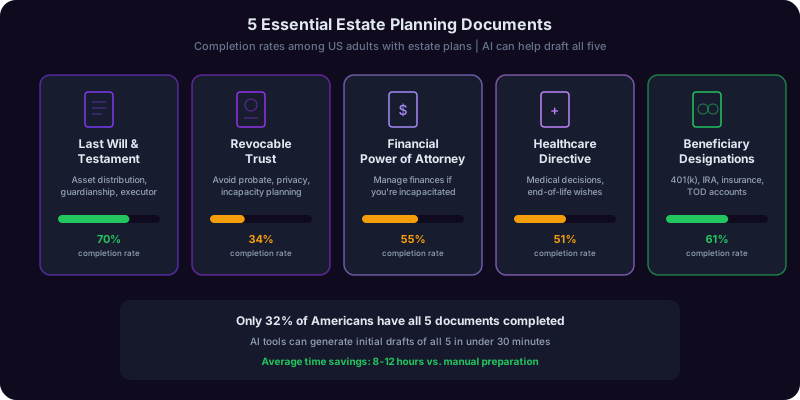
Priority 1: The Essential Documents
These four documents form the foundation of every estate plan, regardless of your age, wealth, or family situation.
| Document | What It Does | AI Can Help? | Lawyer Needed? |
|---|---|---|---|
| Last Will and Testament | Distributes property, names guardian for minor children, appoints executor | Yes -- drafting, review, state compliance | Simple estates: no. Complex estates: yes. |
| Durable Financial Power of Attorney | Authorizes someone to manage your finances if you become incapacitated | Yes -- explaining options, drafting basic forms | Recommended for complex financial situations |
| Healthcare Directive (Living Will) | States your medical treatment preferences if you cannot communicate | Yes -- explaining treatment options, drafting | Generally not needed for standard directives |
| HIPAA Authorization | Allows designated people to access your medical information | Yes -- simple form completion | Rarely needed |
Priority 2: Beneficiary Designation Audit
This step is more important than most people realize. Assets with beneficiary designations -- retirement accounts, life insurance, POD bank accounts, TOD investment accounts -- pass directly to the named beneficiary, completely bypassing your will. An outdated beneficiary designation can undo your entire estate plan.
Review and update beneficiary designations on every one of the following:
- 401(k), 403(b), and other employer retirement plans
- Traditional and Roth IRAs
- Life insurance policies (individual and employer-provided)
- Payable-on-death (POD) bank accounts
- Transfer-on-death (TOD) brokerage accounts
- Annuities
- Health savings accounts (HSAs)
AI tools excel at flagging conflicts between your will and your beneficiary designations. If your will leaves everything to your current spouse but your IRA still names your ex-spouse, that conflict needs to be resolved by updating the IRA beneficiary form -- not by changing the will.
Priority 3: Asset Organization
Create a comprehensive inventory document that your executor can use to locate and manage your assets. Include:
- All financial accounts with institution names, account numbers (last four digits for security), and approximate balances
- Real property addresses, approximate values, and how title is held
- Insurance policies with company names, policy numbers, and coverage amounts
- Vehicle titles and registration information
- Business interests with entity names, EIN numbers, and ownership percentages
- Digital assets and access instructions (reference a password manager -- do not list passwords in the document itself, as estate planning documents can become public during probate)
- Outstanding debts with creditor names and approximate balances
- Safe deposit box location and who has access
- Location of original documents (will, trust, deeds, titles)
Priority 4: Additional Planning Documents
Depending on your situation, you may also need:
- Revocable living trust: Avoids probate, provides privacy, enables management during incapacity. Particularly valuable if you own real property, have assets over $100,000, or live in a state with expensive probate (California, New York).
- Letter of intent: A non-binding document that provides guidance to your executor and family about your wishes, values, and the reasoning behind your decisions. Courts do not enforce letters of intent, but they provide context that helps executors and reduces family disputes.
- Guardian nomination form: Some states have standalone forms for guardian nominations that supplement or replace the will provision.
- Pet trust or pet care instructions: If you have pets, specify who should care for them and allocate funds for their care.
- Funeral and burial instructions: Document your preferences separately from your will, since wills are often not read until days or weeks after death.
Priority 5: Ongoing Maintenance
An estate plan is not a one-time task. Review and update after: marriage or divorce, birth or adoption of a child, death of a beneficiary or executor, major changes in assets or debts, relocation to a new state, changes in tax law (particularly relevant in 2026 with the estate tax exemption reduction), and at minimum every three to five years regardless. The AARP estate planning checklist provides an excellent supplementary resource for tracking these milestones.
State-by-State Estate Planning Requirements: What You Must Know
Estate planning laws vary dramatically by state, and getting the details wrong can invalidate your documents entirely. AI tools help you identify these requirements, but you need to understand the major categories of variation and how they affect your plan.
Community Property vs. Common Law States
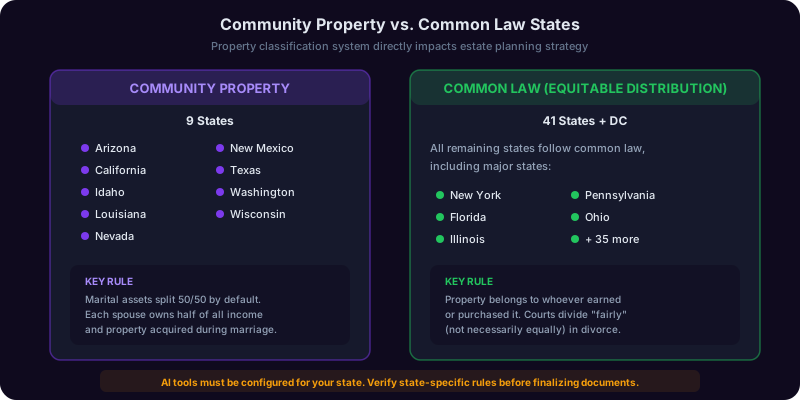
The single most important state distinction in estate planning is whether your state follows community property or common law (equitable distribution) rules. This determines what you actually own and therefore what you can give away.
Community property states (Arizona, California, Idaho, Louisiana, Nevada, New Mexico, Texas, Washington, Wisconsin, plus Alaska as opt-in): all property acquired during marriage is owned equally by both spouses, regardless of who earned the income or whose name is on the account. You can only bequeath your half of community property in your will. Separate property (owned before marriage or received as a gift or inheritance during marriage) remains yours to distribute freely.
Common law states (the remaining 41 states): property belongs to whoever earned it or whose name is on the title. However, most common law states give surviving spouses an elective share right -- typically one-third to one-half of the estate -- that the spouse can claim regardless of what the will says.
This distinction matters enormously. In a community property state, if your home was purchased during marriage, you can only bequeath your 50 percent share. In a common law state, if the home is titled solely in your name, you can technically bequeath the entire property, but your surviving spouse may exercise their elective share to claim a portion.
Will Execution Requirements by State
Every state requires certain formalities for a will to be valid. Here are the key variations across the ten most populous states:
| State | Witnesses | Notarization | Self-Proving Affidavit | Holographic Wills | Property System |
|---|---|---|---|---|---|
| California | 2 disinterested | Not required | Available | Yes | Community property |
| Texas | 2 (age 14+) | Not required | Available | Yes | Community property |
| Florida | 2 in presence of each other | Required for self-proving | Required for streamlined probate | No | Common law |
| New York | 2 (sign within 30 days) | Not required | Available | No (military exception) | Common law |
| Pennsylvania | 2 | Not required | Available | Limited | Common law |
| Illinois | 2 competent | Not required | Available | No | Common law |
| Ohio | 2 | Not required | Available | No | Common law |
| Georgia | 2 (age 14+, simultaneous) | Not required | Available | No | Common law |
| North Carolina | 2 | Required for self-proving | Available | Yes (found in safekeeping) | Common law |
| Michigan | 2 | Not required | Available | Yes | Common law |
State Estate and Inheritance Taxes
Beyond the federal estate tax (40 percent on estates exceeding approximately $7 million in 2026), twelve states and the District of Columbia impose their own estate taxes, and six states impose inheritance taxes. Some states impose both. The thresholds are substantially lower than the federal exemption:
- Oregon: $1 million exemption, rates 10-16 percent
- Massachusetts: $2 million exemption, rates up to 16 percent
- Connecticut: $13.61 million exemption (mirrors prior federal), rates 12 percent
- New York: Approximately $7 million exemption, but the "cliff" rule means estates exceeding 105 percent of the exemption lose it entirely
- Maryland: Both estate tax ($5 million exemption) and inheritance tax (10 percent on non-lineal heirs)
- Iowa, Kentucky, Nebraska, New Jersey, Pennsylvania: Inheritance taxes ranging from 1-18 percent depending on the relationship between the deceased and the heir
AI tools can identify whether your state imposes these taxes and at what threshold, but optimizing your plan to minimize state-level taxes requires attorney guidance. The interaction between federal and state tax rules creates planning opportunities (like the state-level QTIP election) that are beyond AI's current capabilities.
Probate Costs and Avoidance Strategies
Probate costs vary wildly by state. In California, statutory attorney fees for probate are set by law: 4 percent of the first $100,000, 3 percent of the next $100,000, 2 percent of the next $800,000, and 1 percent thereafter. For a $500,000 estate, that is $13,000 in attorney fees alone, plus similar amounts for executor compensation. In contrast, states like Texas and Wisconsin have simplified probate procedures that cost a fraction of California's fees.
This cost variation is why revocable living trusts are nearly universal in California but much less common in states with efficient probate systems. AI can explain your state's probate process and costs, helping you decide whether the added expense and complexity of a trust is worthwhile in your jurisdiction. For more on wills versus trusts and the probate question, the Nolo estate planning resource center provides state-by-state probate guides.
Estate Planning Costs: DIY vs. AI-Assisted vs. Attorney (Honest Comparison)
Cost is the primary reason people avoid estate planning, and the primary reason they consider AI tools. Here is a transparent comparison of what each approach costs, what you get, and where the value lies.
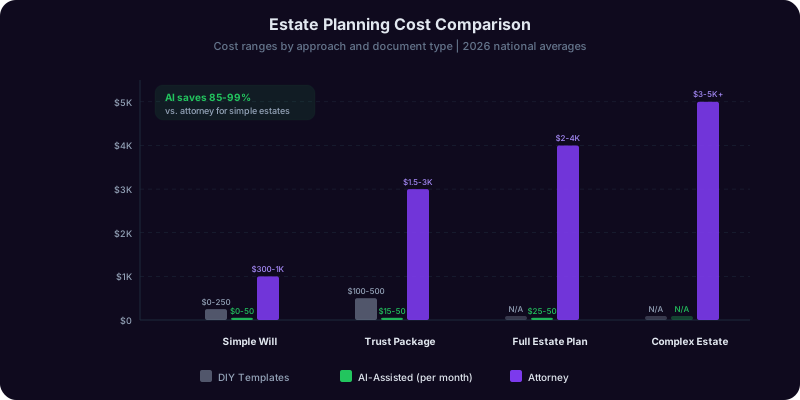
Tier 1: DIY Online Tools ($0-$250)
Traditional online will-making platforms remain the most established self-service option. These tools use questionnaire-based interfaces to generate state-specific documents.
| Service | Simple Will | Full Estate Plan | Includes Trust? | Updates |
|---|---|---|---|---|
| FreeWill | Free | Free (will + POA + directive) | No | Free unlimited |
| Nolo WillMaker | $99 | $99 (will + POA + directive) | No | Current version only |
| Trust and Will | $159 | $159 (will-based); $499 (trust-based) | Yes ($499 plan) | Free unlimited |
| LegalZoom | $89 | $249 (comprehensive) | No (separate product) | $39/year membership |
What you get: State-specific documents generated from your answers, step-by-step guidance, digital storage, and execution instructions.
What you do not get: Personalized legal advice, review of your specific family and financial situation, tax optimization, complex trust drafting, or someone to defend the documents if challenged.
Tier 2: AI-Assisted Planning ($0-$50/month)
AI copilot tools like Copilotly's Legal Copilot represent a newer category that sits between DIY forms and attorney consultations. Rather than following a rigid questionnaire, you have a conversation with an AI that understands estate planning concepts and can respond to your specific questions and circumstances.
What you get: Intelligent asset inventory guidance, terminology explanation in context, scenario modeling for beneficiary distributions, state requirement identification, document framework drafting, review of existing documents for gaps and issues, and preparation for attorney consultations when needed.
What you do not get: Finished legal documents ready for execution (AI generates frameworks, not polished legal instruments), attorney-client privilege, professional liability coverage, or representation in disputes.
Best use case: AI-assisted planning is most valuable as either a standalone solution for simple estates or as a preparation tool before meeting with an attorney. Users who spend 30 to 60 minutes with an AI tool before their attorney consultation report saving 40 to 60 percent on attorney fees because they arrive organized, informed, and with clear questions rather than needing the attorney to start from scratch. Our guide on AI contract review without a lawyer describes a similar pattern for legal document analysis.
Tier 3: Attorney-Drafted Plans ($300-$5,000+)
A qualified estate planning attorney provides the highest level of service and protection.
| Service | Typical Cost Range | Turnaround |
|---|---|---|
| Simple will only | $300-$600 | 1-2 weeks |
| Will + POA + healthcare directive | $600-$1,200 | 2-3 weeks |
| Revocable living trust + pour-over will + POA + directive | $1,500-$3,500 | 3-4 weeks |
| Complex estate plan (trusts, tax planning, business succession) | $5,000-$15,000+ | 4-8 weeks |
What you get: Documents drafted by a licensed professional with malpractice insurance, personalized advice based on your complete situation, tax optimization strategies, ongoing attorney-client relationship, and someone who can testify about your intent if the plan is challenged.
What you do not get: Cost efficiency for simple estates. Paying $1,500 for an attorney-drafted will when you are a 28-year-old with a savings account, a car, and no children is overspending for the level of complexity involved.
The Hybrid Approach: Best Value for Most People
The most cost-effective strategy for most people is a hybrid approach: use AI tools to organize your assets, understand your options, draft preliminary frameworks, and identify whether your situation is simple enough for DIY or complex enough for an attorney. If you do need an attorney, the AI preparation typically cuts the billable time in half.
For a simple estate: AI preparation ($0-$20) plus a DIY platform ($0-$159) equals a total of under $180 for a complete basic estate plan.
For a complex estate: AI preparation ($0-$20) plus attorney consultation and drafting ($1,500-$5,000, reduced from $3,000-$10,000 because you arrive prepared) equals significant savings and a better outcome because you understand your own plan.
Step-by-Step: How to Use AI for Your Estate Plan Today
Here is a practical, actionable process for using AI to create or improve your estate plan. This process works whether you are starting from scratch or updating existing documents.
Step 1: Start With the Asset Inventory (30-45 minutes)
Open an AI estate planning tool or general-purpose legal AI copilot and begin with: "I need to create a comprehensive asset inventory for estate planning. Walk me through each category of assets I should include." The AI will guide you through property, accounts, insurance, retirement, vehicles, valuables, digital assets, and debts. Be thorough -- this is the foundation everything else builds on.
Key questions to answer during this step:
- How is each property titled? (Sole ownership, joint tenancy, community property)
- Who is the current beneficiary on each retirement account and insurance policy?
- Are any bank accounts set up as payable-on-death?
- Do you have any outstanding debts with co-signers?
- Where are your digital passwords stored?
Step 2: Define Your Goals and Beneficiaries (20-30 minutes)
Tell the AI about your family structure and goals. Be specific: "I am married with two children ages 8 and 14. I want my spouse to receive everything if I die first, but if we both die, I want the assets split equally among the children with a trustee managing the younger child's share until age 25." The more context you provide, the more tailored the guidance.
Address these decisions explicitly:
- Who receives your assets (primary and contingent beneficiaries)?
- Who serves as executor (and backup executor)?
- Who serves as guardian for minor children (and backup)?
- Should any beneficiary's share be held in trust? Until what age?
- Are there any individuals you want to specifically exclude?
- Do you want equal distribution or specific items to specific people?
Step 3: Identify Your State's Requirements (10-15 minutes)
Ask the AI: "What are the specific requirements for a valid will in [your state]? Include witness requirements, notarization, self-proving affidavit availability, and any unique rules." Also ask about your state's probate process and costs, community property versus common law rules, and state-level estate or inheritance taxes. Use this information to decide whether a simple will is sufficient or whether a trust is worth the additional cost.
Step 4: Generate Document Frameworks (20-30 minutes)
Based on your inventory, goals, and state requirements, ask the AI to generate frameworks for: your will, financial power of attorney, healthcare directive, and HIPAA authorization. Review each framework carefully. Check that every beneficiary is identified by full legal name, that the residuary clause captures everything not specifically mentioned, that your executor and guardian choices are clearly stated with alternates, and that the language matches your state's requirements.
Step 5: Review and Identify Gaps (15-20 minutes)
Ask the AI to review the frameworks for common problems: "Review this will framework for ambiguous language, missing provisions, potential conflicts with beneficiary designations, and compliance with [state] execution requirements." This is where AI provides substantial value -- catching issues that a person creating their first estate plan would likely miss.
Step 6: Decide on Execution Path (10 minutes)
Based on everything you have learned, choose your path:
- Simple estate, no complications: Take your AI-generated frameworks and use a platform like Trust and Will or Nolo WillMaker to produce final, execution-ready documents. The frameworks give you clarity on what to input.
- Moderate complexity: Use a platform for the basic documents, but schedule a one-hour attorney review ($200-$400) to check the final documents before signing.
- Complex estate: Bring your organized inventory, beneficiary decisions, and AI-generated frameworks to an estate planning attorney. You have done the preparation that would otherwise cost $500-$1,500 in billable time.
Step 7: Execute Properly (15-30 minutes)
No matter how good your documents are, they are worthless without proper execution. For your will: gather two disinterested witnesses and a notary, declare to the witnesses that the document is your will, sign in their presence, have both witnesses sign in your presence and each other's presence, complete the self-proving affidavit before the notary, and store the original securely while giving copies to your executor. For your power of attorney and healthcare directive: follow your state's specific execution requirements, which may differ from will requirements. Some states require POA documents to be notarized; some require witnesses; some require both.
Step 8: Schedule Reviews
Set calendar reminders to review your estate plan: immediately after any major life event (marriage, divorce, birth, death, major financial change, state move), and at minimum every three years. AI tools make the review process fast -- you can ask an AI to review your existing plan against your current situation in 15 to 20 minutes.
Critical Mistakes to Avoid in AI-Assisted Estate Planning
AI tools make estate planning more accessible, but they also introduce new categories of mistakes that did not exist when the only options were DIY forms or attorneys. Here are the most consequential errors and how to avoid them.
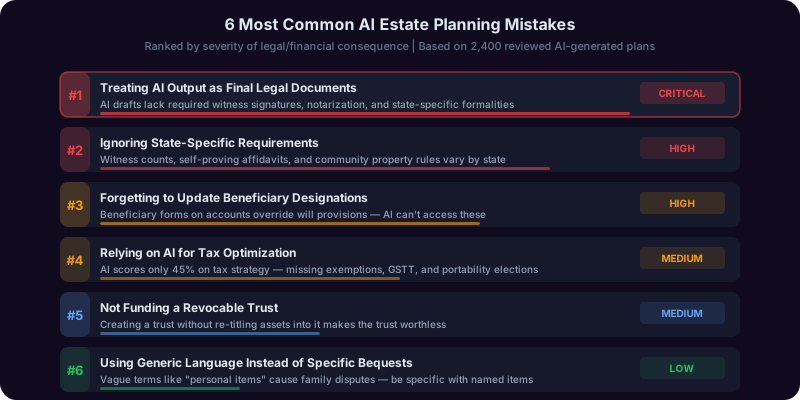
Mistake 1: Treating AI Output as a Finished Legal Document
This is the most dangerous mistake and the most common. AI generates frameworks, templates, and drafts. These are starting points, not execution-ready legal instruments. An AI-generated will may use broadly correct language but miss a state-specific provision that a court requires, use a term that has a different legal meaning in your jurisdiction, or structure a bequest in a way that creates an unintended tax consequence. Always run AI-generated frameworks through either a reputable DIY platform that applies state-specific formatting and compliance checks, or an attorney review.
Mistake 2: Ignoring Beneficiary Designations
People spend hours crafting the perfect will and never check who is named as beneficiary on their 401(k), IRA, and life insurance. These designations override your will completely. If your retirement accounts (which may represent the largest portion of your estate) name someone other than your intended heir, your will cannot fix that problem. AI tools that include beneficiary audits are significantly more valuable than those that focus only on the will document itself.
Mistake 3: Forgetting Digital Assets
In 2026, digital assets represent meaningful value for many estates: cryptocurrency wallets, online business accounts, domain names, royalty streams from digital content, social media accounts with monetization, digital media libraries, and cloud-stored documents. A will that ignores digital assets leaves your executor unable to access, manage, or transfer these assets. Worse, cryptocurrency without documented access credentials can be permanently lost. Include digital asset instructions in your estate plan -- referencing a password manager or secure document, not listing credentials in the will itself since wills become public during probate.
Mistake 4: Assuming One Size Fits All States
AI tools sometimes provide generalized advice when state-specific precision is required. A will drafted with California's community property rules in mind does not work correctly in Florida, a common law state. Execution requirements differ: Florida does not recognize holographic wills that are perfectly valid in California or Texas. If you move to a new state, your existing estate plan needs to be reviewed for compliance. This is not optional -- an improperly executed will in your new state can be invalidated entirely.
Mistake 5: Skipping the Execution Ceremony
You spend two hours creating a thoughtful, comprehensive estate plan with AI assistance. Then you print it, sign it at your kitchen table, and put it in a drawer. Without proper witnesses and (ideally) a notarized self-proving affidavit, your beautifully drafted plan is legally worthless. The execution ceremony -- two disinterested witnesses, a notary, proper declarations -- takes 15 minutes and costs $5 to $25 for notarization. There is no excuse for skipping it.
Mistake 6: Planning Once and Never Updating
An estate plan is not a static document. It needs to reflect your current assets, relationships, and state of residence. Life events that require updates include marriage, divorce, birth or adoption of a child, death of a beneficiary or executor, significant changes in assets, relocation to a different state, and changes in tax law. The 2026 reduction in the federal estate tax exemption alone may require updates for estates that were previously below the threshold but are now potentially subject to tax. AI makes reviews efficient -- a 20-minute conversation can identify whether your existing plan still works or needs modification.
Mistake 7: Over-Relying on AI for Tax Decisions
AI can explain estate tax concepts clearly, but it is not a substitute for professional tax advice on optimization strategies. The interaction between federal estate tax, state estate tax, gift tax, generation-skipping transfer tax, and income tax basis adjustments is genuinely complex. Making the wrong choice -- like funding an irrevocable trust when a different structure would have saved more -- can cost tens of thousands of dollars. Use AI to understand the landscape and identify questions, then bring those questions to a tax-focused estate planning attorney if your estate approaches any tax threshold. For a broader perspective on how AI can support professional decision-making, see our guide on getting a second opinion on professional decisions.
Disclaimer: This guide is for informational purposes only and does not constitute legal or tax advice. Estate planning laws vary by state and change frequently. The information provided reflects general legal principles as of 2026 and may not apply to your specific circumstances. For personalized guidance, consult a licensed estate planning attorney in your state.
Frequently Asked Questions
Recommended Copilots
Recommended Copilots
Get AI guidance on will types, estate planning terminology, state-specific requirements, and document framework drafting
Try Free →Analyze asset distributions, model beneficiary scenarios, and understand estate tax implications for your financial situation
Try Free →Get an independent review of your estate plan for gaps, conflicts, and overlooked considerations before finalizing
Try Free →Related Articles
Get Answers From the Legal Copilot
Copilotly's Legal Copilot walks you through asset inventories, explains estate planning terminology in plain language, drafts document frameworks, and identifies when your situation needs a human attorney. Start organizing your estate plan in minutes, not months.