
Your Rights Under the Fair Debt Collection Practices Act (FDCPA)
The Fair Debt Collection Practices Act (15 U.S.C. 1692 et seq.) is a federal law that strictly regulates how third-party debt collectors can interact with you. Enacted in 1977 and updated through Regulation F (effective November 2021), it gives you more protection than most people realize.
Here is what debt collectors cannot do:
Communication Restrictions
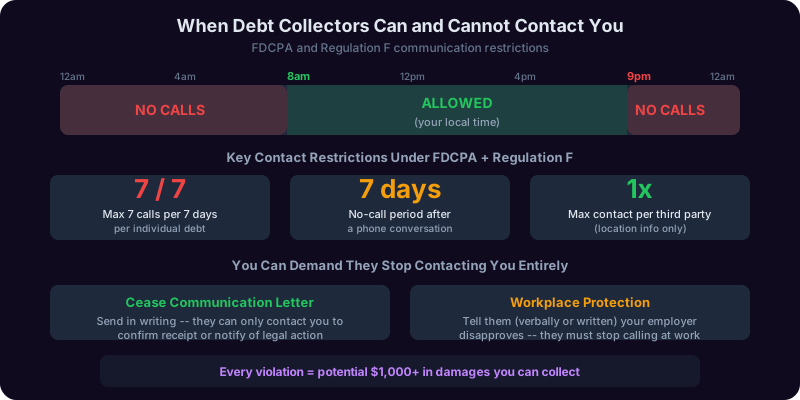
- Call before 8 AM or after 9 PM in your local time zone (15 U.S.C. 1692c(a)(1))
- Call you at work if you tell them (verbally or in writing) that your employer disapproves (15 U.S.C. 1692c(a)(3))
- Contact you directly if you have an attorney representing you on the debt (15 U.S.C. 1692c(a)(2))
- Call you more than 7 times within 7 days about a particular debt, or within 7 days after having a phone conversation with you about that debt (Regulation F, 12 CFR 1006.14(b))
- Contact your friends, family, or neighbors about your debt, except to obtain your contact information (one time only per person) (15 U.S.C. 1692c(b))
- Communicate via social media in a way that is visible to your connections or the public (Regulation F)
Prohibited Conduct
- Threaten violence or criminal prosecution. A debt is a civil matter. No collector can threaten to have you arrested. (15 U.S.C. 1692d)
- Use profane or abusive language. Collectors must maintain professional conduct at all times. (15 U.S.C. 1692d(2))
- Misrepresent the debt amount. They cannot add fees, interest, or charges not authorized by the original agreement or by law. (15 U.S.C. 1692e(2))
- Falsely claim to be attorneys or government officials. Impersonation of legal or governmental authority is a violation. (15 U.S.C. 1692e(1))
- Threaten actions they cannot or will not take. If they say "we will sue you" but have no intention of filing suit, that is a violation. (15 U.S.C. 1692e(5))
- Collect more than what is owed. Adding unauthorized fees or inflating the balance is illegal. (15 U.S.C. 1692f(1))
- Deposit a post-dated check early. (15 U.S.C. 1692f(2))
- Publish your name on a "bad debtor" list. (15 U.S.C. 1692d(3))
Your Affirmative Rights
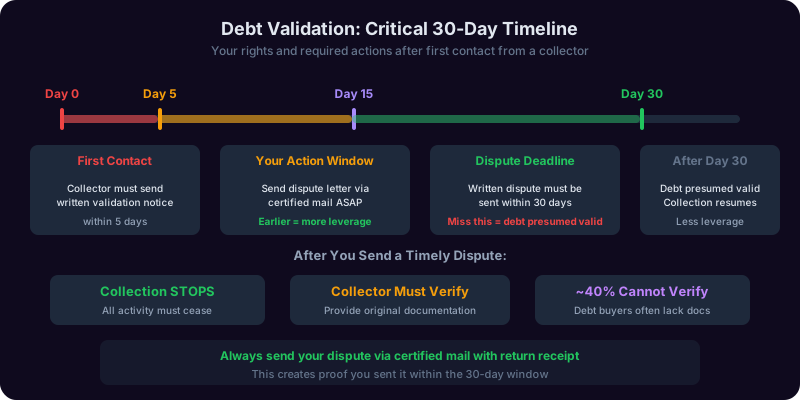
- Right to debt validation. Within 5 days of first contact, the collector must send you a written notice containing the amount of the debt, the name of the creditor, and a statement that you have 30 days to dispute it. (15 U.S.C. 1692g(a))
- Right to dispute. If you dispute the debt in writing within 30 days, the collector must stop all collection activity until they provide verification. (15 U.S.C. 1692g(b))
- Right to cease communication. You can send a written request that the collector stop contacting you entirely. After receiving it, they can only contact you to confirm they will stop or to notify you of a specific legal action. (15 U.S.C. 1692c(c))
- Right to sue. You can file a lawsuit against a collector who violates the FDCPA and recover up to $1,000 in statutory damages per case, plus actual damages, plus attorney fees. (15 U.S.C. 1692k)
Important limitation: The FDCPA applies to third-party debt collectors - companies that buy or are assigned debts to collect. Original creditors collecting their own debts are generally not covered by the FDCPA, though many state laws provide similar protections. Additionally, the CFPB's Regulation F extended some protections to debt buyers.
Disclaimer: This guide provides general information about federal debt collection laws. State laws may provide additional protections. This is not legal advice. If you believe your rights have been violated, consider consulting with a consumer rights attorney.
The First 30 Days After Contact: A Critical Timeline
The first 30 days after a debt collector contacts you are the most important period in the entire process. Here is exactly what to do and when.
Day 1-5: Initial Contact and Validation Notice
Within 5 days of their first communication, the collector must send you a written validation notice containing:
- The amount of the debt
- The name of the creditor to whom the debt is owed
- A statement that unless you dispute the debt within 30 days, it will be assumed valid
- A statement that if you dispute in writing, the collector will obtain verification
- A statement that you can request the name and address of the original creditor (if different from the current creditor)
What to do: When you receive this notice (or the first call), write down the date immediately. This starts your 30-day clock. Do not admit the debt is yours. Do not agree to any payment plan. Say only: "I am requesting that you send me written validation of this debt. Please send all communication in writing to [your address]."
Day 1-30: Your Dispute Window
You have 30 days from receiving the validation notice to dispute the debt in writing. This is a critical right. When you send a written dispute:
- All collection activity must stop until the collector provides verification (15 U.S.C. 1692g(b))
- The collector cannot report the debt to credit bureaus as "confirmed" while it is in dispute (FCRA requirements)
- The collector must provide you with actual documentation of the debt - not just a computer printout of what they say you owe
What to do: Send a debt validation letter via certified mail with return receipt requested. This creates proof that you sent the dispute within the 30-day window. Here is what your letter should include:
[Your Name]
[Your Address]
[Date]
[Collector Name]
[Collector Address]
Re: Account Number [number from their notice]
Dear [Collector Name],
I am writing in response to your communication dated [date]. I am exercising my right under the Fair Debt Collection Practices Act, 15 U.S.C. 1692g, to request validation of this alleged debt.
Please provide the following:
1. The amount of the alleged debt and how it was calculated, including an itemization of principal, interest, fees, and other charges
2. The name and address of the original creditor
3. A copy of the original signed agreement or contract creating this debt obligation
4. Proof that you are licensed to collect debts in [your state]
5. Proof that the statute of limitations has not expired on this debt
Until you provide this validation, please cease all collection activity and communication regarding this alleged debt, as required by federal law.
Sincerely,
[Your Name]
What Happens After You Dispute
The collector has three options:
- Provide proper validation - documentation proving the debt is yours and the amount is correct. If they do this, you know the debt is legitimate and can decide how to handle it.
- Fail to validate and stop collecting - this is surprisingly common. Many debt buyers purchase debts in bulk for pennies on the dollar and do not have the original documentation. If they cannot validate, they must stop collecting.
- Continue collecting without validating - this is a violation of the FDCPA. Document it and consult with a Consumer Rights Copilot about your options, which may include filing a complaint with the CFPB or suing the collector.
What Happens If You Miss the 30-Day Window
If you do not dispute within 30 days, the debt is presumed valid - but it is not proven valid. You can still dispute later, but the collector is no longer required to stop collection activity while they verify. You also lose some leverage in any subsequent negotiation. This is why the 30-day window is so critical - do not let it pass.
How to Verify the Debt Is Actually Yours
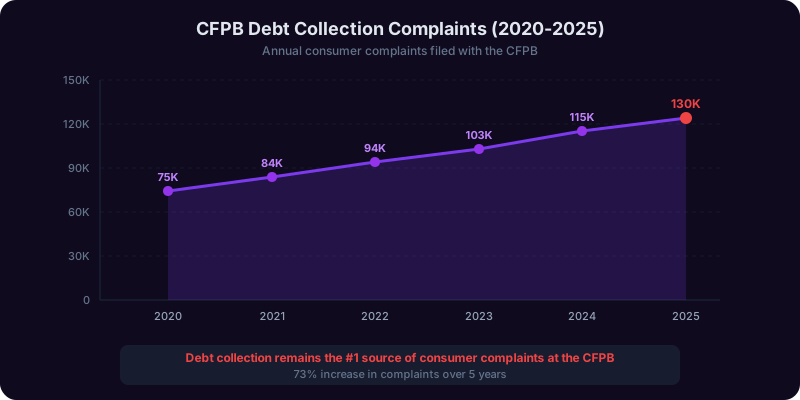
A shocking number of collection accounts are wrong. The FTC's own studies have found that one in four consumers identified errors on their credit reports that could affect their scores, and debt collection is the number one source of consumer complaints at the CFPB - over 130,000 complaints in 2025 alone. Here is how to determine if a debt is actually yours and actually correct.
Common Reasons Debts Are Wrong
- Mistaken identity. Someone with a similar name or a transposed Social Security number. The FTC estimates 20% of consumers have at least one error caused by mixed files.
- Zombie debt. Old debts past the statute of limitations that have been resold to aggressive collectors. The original debt may have been $300, but after years of fees and interest added by successive collectors, it is now $2,800. Some of these debts were already paid or discharged in bankruptcy.
- Inflated amounts. Collectors adding unauthorized fees, interest, or charges. The CFPB has found cases where the collected amount was 200-300% higher than the original debt due to improperly added charges.
- Medical billing errors. Medical debt is notoriously inaccurate. A 2025 Kaiser Family Foundation study found that 57% of medical bills contained at least one error. A $150 copay could appear as a $4,000 collection account due to coding errors or insurance processing failures.
- Identity theft. Debts opened fraudulently in your name. If you do not recognize the original creditor at all, this is a strong possibility.
Step-by-Step Verification Process
- Check the validation notice against your records. Do you recognize the original creditor? Does the amount seem right? Does the date of the debt match anything in your history?
- Pull your credit reports. Get free reports from AnnualCreditReport.com (you are entitled to one free report per week from each bureau). Check whether the debt appears and what details are listed.
- Request documentation from the collector. Your validation letter (see the previous section) should request the original signed agreement. If they cannot produce it, they may not be able to prove you owe the debt.
- Check for the original creditor's records. Contact the original creditor (not the collector) and ask if they still have records of the account. Sometimes the original creditor's records show the debt was paid or settled, even though the collector's records do not reflect this.
- Calculate the statute of limitations. Every state has a time limit for how long a creditor can sue you to collect a debt. If the statute of limitations has expired, the debt is "time-barred" - the collector cannot successfully sue you for it. See the full state-by-state table in the next section.
Red Flags That a Debt Is Not Yours
- You do not recognize the original creditor
- The amount is significantly different from what you remember owing
- The collector cannot provide the original signed agreement
- The debt is more than 7 years old (it should have fallen off your credit report)
- The debt was previously paid, settled, or discharged in bankruptcy
- You received medical services but your insurance was not billed first
- The collector is vague about the original creditor or dates
What to Do If the Debt Is Not Yours
If your investigation reveals the debt is not yours, wrong, or time-barred:
- Send a written dispute to the collector explaining specifically why you do not owe the debt, with supporting documentation
- File a dispute with all three credit bureaus (Equifax, Experian, TransUnion) to have the incorrect account removed from your reports
- File a complaint with the CFPB at consumerfinance.gov/complaint - the CFPB forwards complaints to the company and typically gets a response within 15 days
- If the collector continues after your dispute, consult with a consumer rights attorney about potential FDCPA violations
The Consumer Rights Copilot can help you analyze the validation documents, identify discrepancies, and draft dispute letters tailored to your specific situation.

Get Answers From the Consumer Rights Copilot
Copilotly's Consumer Rights Copilot can analyze debt collector communications, identify FDCPA violations, draft validation and dispute letters, and help you build a strategy - whether that means negotiating a settlement or fighting back.
When and How to Negotiate a Settlement
If the debt is legitimately yours and you cannot pay the full amount, negotiation is almost always possible. Debt collectors purchase debts for 4 to 7 cents on the dollar on average, according to the Federal Reserve Bank of Philadelphia. This means a collector who bought your $5,000 debt paid roughly $250-$350 for it. They have enormous room to negotiate.
Typical Settlement Ranges
| Debt Type | Typical Settlement Range | Average Settlement |
|---|---|---|
| Credit card debt | 30-60% of balance | 48% |
| Medical debt | 20-50% of balance | 35% |
| Personal loans | 30-50% of balance | 40% |
| Old/zombie debt (3+ years) | 10-30% of balance | 20% |
| Debt near statute of limitations | 10-25% of balance | 15% |
Example: If you owe $8,000 in credit card debt that has been sold to a collector, a reasonable opening offer is $2,400 (30%). The collector will counter. You might settle at $3,200-$4,000 (40-50%). On $8,000 in debt, that is $4,000-$4,800 in savings.
The Negotiation Process: Step by Step
Step 1: Know Your Number
Before calling, decide the maximum you can realistically pay as a lump sum. Lump-sum offers get better deals than payment plans because they eliminate the collector's risk that you will default on the plan.
Step 2: Start Low
Open at 15-25% of the balance. The collector will almost certainly reject this, but it anchors the negotiation lower. Your script:
"I have reviewed my financial situation and I can offer a one-time payment of $[amount] to settle this account in full. I understand this is less than the full balance, but it is the most I can pay. If this is not acceptable, I may need to explore other options."
Step 3: Let Them Counter
The collector will typically counter at 70-80% of the balance. Do not accept the first counter. Respond with:
"I appreciate the offer, but that is beyond what I can afford. I can go up to $[your next number, slightly above your opening]. Would that work to settle this completely?"
Step 4: Meet in the Middle
After 2-3 rounds, you will typically converge on a number between 30-50% of the original balance. The closer you are to the statute of limitations, the more leverage you have.
Step 5: Get It in Writing BEFORE Paying
This is the most important step. Never pay a settlement without a written agreement that specifies:
- The exact amount to be paid
- That payment constitutes settlement in full of the debt
- That the collector will report the account as "paid in full" or "settled" to credit bureaus (push hard for "paid in full")
- That the collector waives the right to collect any remaining balance
- The date by which payment must be made
If the collector will not put it in writing, do not pay. Verbal agreements are nearly impossible to enforce, and unscrupulous collectors have been known to accept a partial payment and then continue collecting the "remaining" balance.
Pay-for-Delete: The Best Possible Outcome
A "pay-for-delete" agreement means the collector agrees to completely remove the account from your credit report in exchange for payment. This is better than a settlement marked "settled" or even "paid in full" because the negative mark disappears entirely.
Not all collectors agree to pay-for-delete, and credit bureaus officially discourage the practice. But many smaller collection agencies will agree to it, especially for older debts. Your script:
"I am willing to settle this account, but only if you agree to request deletion of this account from all three credit bureaus within 30 days of receiving payment. Can you include that in the settlement agreement?"
Payment Methods: Protect Yourself
- Best: Cashier's check or money order. Creates a paper trail without giving the collector access to your bank account.
- Acceptable: One-time electronic payment through a verified portal.
- Never: Do not give a debt collector direct access to your bank account, your debit card number for recurring payments, or post-dated checks. Unscrupulous collectors have been known to withdraw more than the agreed amount.
The Finance Copilot can help you assess whether settlement makes financial sense for your situation, and the Budgeting Copilot can help you figure out the maximum lump sum you can afford without compromising other financial obligations.
How to Stop Debt Collector Harassment
If a debt collector is crossing legal lines, you have powerful tools to make them stop - and to make them pay for the violations.
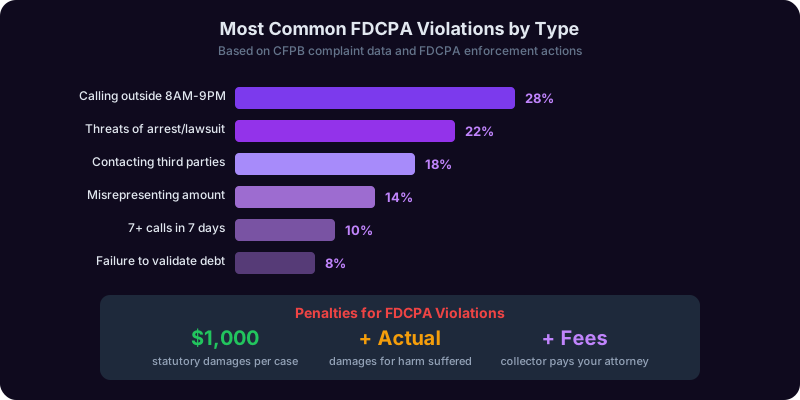
What Constitutes Harassment Under the FDCPA
- Calling more than 7 times in 7 days about a single debt
- Calling before 8 AM or after 9 PM
- Using threatening, profane, or abusive language
- Calling your workplace after you have told them to stop
- Contacting your family members, friends, or neighbors about your debt (beyond one-time location requests)
- Continuing to call after you have sent a written cease communication request
- Sending messages visible to others (such as postcards about your debt or social media messages visible to your connections)
- Leaving voicemails that reveal the debt to others who may hear them
Step 1: Document Everything
Start keeping a log immediately. For every contact, record:
- Date and time of the call or communication
- The name of the person who contacted you (ask for their full name and employee ID)
- The company name
- What was said - write down direct quotes as best you can
- Any witnesses (if the call was on speaker, or if a family member overheard)
Recording calls: Recording laws vary by state. In 11 states (California, Connecticut, Florida, Illinois, Maryland, Massachusetts, Michigan, Montana, New Hampshire, Pennsylvania, and Washington), all parties must consent to being recorded ("two-party consent"). In the remaining 39 states, only one party (you) needs to consent. If you are in a one-party consent state, record every call. If you are in a two-party consent state, you can say at the start of the call: "I am recording this call for my records. If you do not consent, please communicate with me only in writing." Most collectors will stay on the line.
Step 2: Send a Cease Communication Letter
Under 15 U.S.C. 1692c(c), you have the right to demand that a collector stop all communication. Send this via certified mail:
[Your Name]
[Your Address]
[Date]
[Collector Name]
[Collector Address]
Re: Account Number [number]
Dear [Collector Name],
Pursuant to my rights under the Fair Debt Collection Practices Act, 15 U.S.C. 1692c(c), I am requesting that you cease all communication with me regarding the above-referenced account.
You may contact me only to: (1) confirm that you will cease further communication, or (2) notify me that you or the creditor intend to invoke a specific legal remedy.
Any further communication beyond these two exceptions will be considered a violation of the FDCPA.
Sincerely,
[Your Name]
Important: A cease communication letter stops the calls but does not make the debt go away. The collector can still sue you. This strategy is best when the debt is near or past the statute of limitations, or when you are preparing to negotiate and want to stop the pressure first.
Step 3: File Formal Complaints
If the harassment continues after your cease communication letter, or if the collector committed specific violations, file complaints with:
- Consumer Financial Protection Bureau (CFPB): consumerfinance.gov/complaint - the CFPB is the primary federal enforcement agency for debt collection violations. Companies must respond to CFPB complaints within 15 days. Over 80% of complaints receive a timely response.
- Federal Trade Commission (FTC): ReportFraud.ftc.gov - the FTC tracks patterns of violations and brings enforcement actions against repeat offenders.
- Your State Attorney General: Every state AG has a consumer protection division. State-level complaints often get faster action than federal ones, especially for in-state collectors.
- Your State's Consumer Protection Agency: Some states have separate agencies that handle debt collection complaints (e.g., the New York Department of Financial Services, the California Department of Financial Protection and Innovation).
Step 4: Know the Penalties Collectors Face
FDCPA violations carry real financial consequences:
- $1,000 per lawsuit in statutory damages - you do not have to prove you were actually harmed (15 U.S.C. 1692k(a)(2))
- Actual damages for any harm you suffered - emotional distress, lost wages from workplace calls, medical bills from stress-related health issues
- Attorney fees and court costs - the collector pays your lawyer if you win
- Class action potential: Up to $500,000 or 1% of the collector's net worth in class action cases
- State law penalties: Many states impose additional penalties. For example, Texas allows up to $100 per violation under the Texas Debt Collection Act, and New York allows treble damages under its consumer protection statute.
These penalties mean that consumer rights attorneys often take FDCPA cases on contingency (no upfront cost to you) because the fee-shifting provision means the collector pays the attorney fees. If a collector has committed clear violations, you may actually come out financially ahead by suing them. For guidance on writing a formal demand to the collector, read our demand letter guide.
Statute of Limitations by State: When Debt Expires
Every state sets a time limit on how long a creditor can sue you to collect a debt. Once this period expires, the debt is "time-barred" - the collector can still ask you to pay, but they cannot successfully sue you. If they file a lawsuit on a time-barred debt and you raise the statute of limitations as a defense, the case will be dismissed.
Critical warning: In many states, making a payment on an old debt or even verbally acknowledging the debt can restart the statute of limitations clock. Never pay anything on an old debt or say "yes, I owe that" until you have confirmed the statute of limitations status.
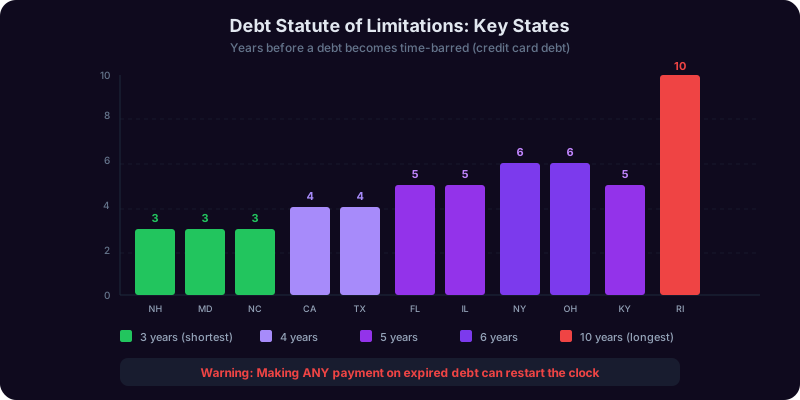
Statute of Limitations by State (in Years)
| State | Written Contracts | Oral Contracts | Credit Cards | Medical Debt |
|---|---|---|---|---|
| Alabama | 6 | 6 | 6 | 6 |
| Alaska | 3 | 3 | 3 | 3 |
| Arizona | 6 | 3 | 6 | 6 |
| Arkansas | 5 | 3 | 5 | 5 |
| California | 4 | 2 | 4 | 4 |
| Colorado | 6 | 6 | 6 | 6 |
| Connecticut | 6 | 3 | 6 | 6 |
| Delaware | 3 | 3 | 3 | 3 |
| Florida | 5 | 4 | 5 | 5 |
| Georgia | 6 | 4 | 6 | 6 |
| Hawaii | 6 | 6 | 6 | 6 |
| Idaho | 5 | 4 | 5 | 5 |
| Illinois | 10 | 5 | 5 | 5 |
| Indiana | 10 | 6 | 6 | 6 |
| Iowa | 10 | 5 | 5 | 5 |
| Kansas | 5 | 3 | 5 | 5 |
| Kentucky | 10 | 5 | 5 | 5 |
| Louisiana | 10 | 10 | 3 | 3 |
| Maine | 6 | 6 | 6 | 6 |
| Maryland | 3 | 3 | 3 | 3 |
| Massachusetts | 6 | 6 | 6 | 6 |
| Michigan | 6 | 6 | 6 | 6 |
| Minnesota | 6 | 6 | 6 | 6 |
| Mississippi | 3 | 3 | 3 | 3 |
| Missouri | 10 | 5 | 5 | 5 |
| Montana | 8 | 5 | 5 | 5 |
| Nebraska | 5 | 4 | 5 | 5 |
| Nevada | 6 | 4 | 6 | 6 |
| New Hampshire | 3 | 3 | 3 | 3 |
| New Jersey | 6 | 6 | 6 | 6 |
| New Mexico | 6 | 4 | 6 | 6 |
| New York | 6 | 6 | 6 | 6 |
| North Carolina | 3 | 3 | 3 | 3 |
| North Dakota | 6 | 6 | 6 | 6 |
| Ohio | 8 | 6 | 6 | 6 |
| Oklahoma | 5 | 3 | 5 | 5 |
| Oregon | 6 | 6 | 6 | 6 |
| Pennsylvania | 4 | 4 | 4 | 4 |
| Rhode Island | 10 | 10 | 10 | 10 |
| South Carolina | 3 | 3 | 3 | 3 |
| South Dakota | 6 | 6 | 6 | 6 |
| Tennessee | 6 | 6 | 6 | 6 |
| Texas | 4 | 4 | 4 | 4 |
| Utah | 6 | 4 | 6 | 6 |
| Vermont | 6 | 6 | 6 | 6 |
| Virginia | 5 | 3 | 5 | 5 |
| Washington | 6 | 3 | 6 | 6 |
| West Virginia | 10 | 5 | 5 | 5 |
| Wisconsin | 6 | 6 | 6 | 6 |
| Wyoming | 10 | 8 | 5 | 5 |
How to Determine When the Clock Started
The statute of limitations clock typically starts on the date of last activity on the account - usually the date of your last payment. Key points:
- The original delinquency date is what matters for credit reporting (the 7-year removal clock). The statute of limitations for lawsuits may be different.
- Selling the debt to a new collector does not restart the clock. The statute of limitations is based on the original account activity, not when a new company bought it.
- Moving to a different state can change which state's statute applies. Courts sometimes apply the shorter of the two states' statutes, but this varies by jurisdiction.
What Happens If a Collector Sues on Time-Barred Debt
It happens more often than you might think. If you are sued on a time-barred debt:
- Do not ignore the lawsuit. You must respond, or the court may enter a default judgment against you even though the debt is time-barred.
- Raise the statute of limitations as an affirmative defense in your answer to the lawsuit.
- The case should be dismissed. Many courts are cracking down on collectors who knowingly file lawsuits on time-barred debt, with some states (like Mississippi and New Mexico) making it a per se FDCPA violation.
If you need help determining whether a debt is time-barred in your state, the Consumer Rights Copilot can analyze the dates and applicable statutes. For debts where a lawsuit is possible, the small claims court guide covers what to expect if the matter goes to court.
Will This Affect My Credit? Timeline and Recovery
Debt in collections affects your credit score, but the impact is not permanent, and there are specific strategies to minimize and recover from the damage.
How Collections Appear on Your Credit Report
When a debt goes to collections, the collector may report it to the three major credit bureaus (Equifax, Experian, TransUnion) as a "collection account." This is separate from any late-payment history the original creditor already reported. Key rules:
- The 7-year rule: Collection accounts can remain on your credit report for 7 years from the date of original delinquency (the date you first fell behind on the original account). This date does not change when the debt is sold to a new collector.
- The 180-day reporting buffer: Original creditors must wait at least 180 days after delinquency before reporting the debt to collections. This gives you time to resolve the issue directly with the original creditor.
- Medical debt special rules (2026): As of 2023, the three credit bureaus agreed to remove paid medical collection debt from credit reports. Additionally, medical debt under $500 is no longer reported. The CFPB finalized a rule in 2024 to remove all medical debt from credit reports, though enforcement has faced legal challenges.
How Much Does a Collection Account Hurt Your Score?
| Starting Credit Score | Typical Score Drop from New Collection | Score Range After |
|---|---|---|
| 780+ (Excellent) | 100-150 points | 630-680 |
| 720-779 (Good) | 70-120 points | 600-710 |
| 660-719 (Fair) | 50-80 points | 580-670 |
| 600-659 (Poor) | 30-50 points | 550-630 |
| Below 600 | 10-30 points | Minimal additional impact |
The impact diminishes over time. A 3-year-old collection hurts significantly less than a new one, even at the same dollar amount.
Paid vs. Settled vs. Unpaid Collections
- Unpaid collection: Maximum negative impact. The account remains as an open, derogatory item.
- Settled ("settled for less than full amount"): Better than unpaid, but still negative. Shows you did not pay the full amount. FICO 9 and VantageScore 3.0+ ignore paid collections, but many lenders still use older scoring models.
- Paid in full: The best outcome short of deletion. Shows the debt was resolved completely. Under FICO 9 and VantageScore 3.0+, paid collections have zero impact on your score.
- Deleted (pay-for-delete): The ideal outcome. The collection account is completely removed from your credit report, as if it never existed. This has the most positive impact on your score.
How to Dispute a Collection on Your Credit Report
If a collection account is inaccurate, you have the right to dispute it under the Fair Credit Reporting Act (FCRA):
- File disputes with all three bureaus. You can dispute online (fastest), by phone, or by mail. Include your full name, address, the account number, and a clear explanation of why the information is incorrect.
- Provide supporting documentation. Attach proof of payment, identity theft reports, debt validation failures, or other evidence.
- The bureau has 30 days to investigate (45 days if you submit additional information during the investigation). They must contact the collector, verify the information, and notify you of the result.
- If the collector cannot verify, the bureau must remove the account. This is why proper debt validation (Section 2 of this guide) is so important - if the collector never validated the debt, they may be unable to verify it when the bureau investigates.
- If the dispute is denied, you can submit a 100-word consumer statement to be included with your credit report, file a CFPB complaint, or consult with an FCRA attorney about potential violations.
Credit Recovery Timeline
| Action | Score Impact Timeline |
|---|---|
| Collection account reported | Immediate drop of 50-150 points |
| 6 months after collection | Slight natural recovery begins |
| Collection settled or paid | 0-20 point increase immediately (varies by model) |
| 1-2 years after collection | Impact reduced by roughly 50% |
| 3-4 years after collection | Impact reduced by roughly 75% |
| Collection deleted (pay-for-delete) | Immediate improvement of 50-100+ points |
| 7 years after original delinquency | Collection removed automatically; full recovery |
For a deeper understanding of how collections fit into your overall credit picture, read the complete guide to understanding your credit score. The Finance Copilot can help you model how different resolution strategies (settlement vs. pay in full vs. dispute) would affect your score based on your specific credit profile.
When You Need a Consumer Rights Attorney
In many cases, you can handle debt collectors yourself using the strategies in this guide. But some situations call for professional legal help - and thanks to the FDCPA's fee-shifting provision, it may cost you nothing out of pocket.
When to Hire a Lawyer
- The collector has filed a lawsuit against you. If you have been served with court papers, you must respond within the deadline (typically 20-30 days depending on your state). Failing to respond results in a default judgment, which allows the collector to garnish your wages, freeze your bank accounts, and place liens on your property. An attorney can help you respond, raise defenses (including statute of limitations), and potentially get the case dismissed.
- The collector has committed clear FDCPA violations. If you have documented evidence of harassment (calls before 8 AM or after 9 PM, threats of arrest, continued contact after a cease communication letter, calls to your workplace after being told to stop), you may have a strong case worth pursuing. Remember: $1,000 in statutory damages plus actual damages plus attorney fees.
- The debt amount is above $10,000. At this level, the financial stakes justify professional representation. A lawyer can negotiate more effectively and protect you from legal maneuvers that might trip up a non-lawyer.
- You are being sued for a debt you do not owe. Identity theft, mistaken identity, zombie debt, or debts already discharged in bankruptcy all require proper legal defense to prevent an unjust judgment.
- The collector has obtained a judgment and is pursuing garnishment. If your wages are being garnished or your bank account has been frozen, a lawyer can help you claim exemptions (many states protect a portion of wages and certain bank account types) and potentially challenge the judgment.
- Multiple collectors are pursuing you for significant amounts. If you are overwhelmed with collections, a lawyer can advise on whether bankruptcy, debt management, or other structured approaches make sense.
How FDCPA Fee-Shifting Works in Your Favor
The FDCPA includes a provision that makes it financially accessible to sue debt collectors who violate the law. Under 15 U.S.C. 1692k(a)(3), if you win an FDCPA case, the collector must pay your attorney fees and court costs. This means:
- Many consumer rights attorneys take FDCPA cases on contingency - you pay nothing upfront and nothing if you lose
- The attorney is compensated by the collector, not by you
- You receive the $1,000 statutory damages and any actual damages awarded
- You can recover damages even if the debt itself is legitimate - the collector's violations are a separate legal matter from the underlying debt
Finding a Consumer Rights Attorney
- National Association of Consumer Advocates (NACA): naca.net has a searchable directory of consumer rights attorneys by state and practice area
- Your state bar association: Most state bars have lawyer referral services with consumer protection categories
- Legal aid organizations: If your income is below 200% of the federal poverty level (approximately $31,200 for a single person in 2026), you may qualify for free legal representation through Legal Services Corporation
- CFPB's legal resources: The CFPB provides information on finding legal help and understanding your rights
What to Bring to Your First Meeting
- All letters and notices from the collector
- Your call log with dates, times, and notes
- Any recordings you have made (where legal)
- Your credit reports showing the collection account
- Copies of your dispute letters and the return receipts
- Any documentation of the original debt (statements, contracts)
- The validation response (or lack of response) from the collector
Before meeting with an attorney, the Consumer Rights Copilot can help you organize your documentation, identify potential FDCPA violations in your interactions, and prepare specific questions to make the most of your consultation time. You can also review the demand letter guide if you want to send a formal demand to the collector before pursuing litigation. If the dispute may end up in court, our cease and desist guide covers how formal legal demands work.
Frequently Asked Questions
Recommended Copilots
Recommended Copilots
Identifies FDCPA violations, drafts dispute and validation letters, and analyzes collector communications
Try Free →Models how different debt resolution strategies affect your overall financial picture
Try Free →Helps determine the maximum lump sum you can afford for settlement negotiations
Try Free →Provides general legal guidance on debt-related disputes and court proceedings
Try Free →Assists with medical debt disputes involving insurance billing errors
Try Free →Related Articles
Get Answers From the Consumer Rights Copilot
Copilotly's Consumer Rights Copilot can analyze debt collector communications, identify FDCPA violations, draft validation and dispute letters, and help you build a strategy - whether that means negotiating a settlement or fighting back.