
The Health Literacy Crisis: Why 88% of Adults Struggle with Medical Information
The United States has a health literacy crisis that costs lives and money. According to research from the National Institutes of Health, only 12% of American adults have proficient health literacy. That means 88% of the adult population struggles to understand the health information they encounter in their daily lives, from prescription labels and insurance forms to discharge instructions and lab results.
This is not a problem of intelligence. The medical system communicates in a language that is fundamentally inaccessible to most people. A typical discharge summary uses vocabulary at a college reading level or higher, while the average American reads at an eighth-grade level. Explanation of Benefits statements from insurance companies are dense with codes, abbreviations, and cross-references that even well-educated professionals find confusing. And a single medical bill can contain charges from four or five different entities, each with its own billing department, coding system, and appeal process.
The consequences are severe and measurable. The World Health Organization identifies low health literacy as a stronger predictor of health outcomes than income, employment status, education level, or racial and ethnic group. People with limited health literacy are 1.5 to 3 times more likely to experience poor health outcomes. They are hospitalized more frequently, use emergency services more often, take medications incorrectly, and skip preventive care at higher rates.
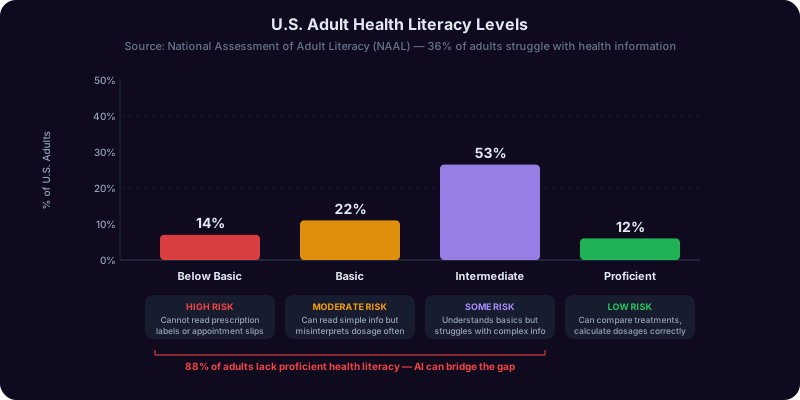
The financial toll is equally staggering. Low health literacy costs the U.S. healthcare system an estimated $236 billion annually in unnecessary emergency visits, medication errors, longer hospital stays, and missed preventive screenings. On an individual level, patients who do not understand their medical bills are far less likely to identify and dispute billing errors, which occur on an estimated 80% of medical bills according to industry audits.
AI tools are changing this equation in 2026. They cannot replace your doctor, and they should not try. But they can serve as a translation layer between the medical system and the patient, converting jargon into plain language, surfacing relevant questions you did not know to ask, and helping you spot errors in bills that would otherwise go unquestioned. The rest of this guide shows you exactly how to use these tools across every stage of your healthcare experience.
Important disclaimer: AI tools are informational aids, not medical devices. They do not diagnose conditions, prescribe treatments, or replace professional medical judgment. Always verify AI-generated health information with your healthcare provider before making medical decisions.
Using AI to Understand Your Diagnosis and Doctor's Notes
You leave the doctor's office with a diagnosis you have never heard of, a stack of printouts, and a head full of questions you did not think to ask during the 15-minute appointment. This is one of the most common and most stressful moments in healthcare, and it is where AI can make an immediate difference.
Translating medical terminology. A diagnosis of "bilateral plantar fasciitis with calcaneal enthesopathy" sounds alarming until you learn it means heel pain caused by inflammation where a tissue band connects to the heel bone, affecting both feet. AI tools excel at this kind of translation. You can paste your diagnosis, your doctor's notes (which you have a legal right to access under the 21st Century Cures Act), or your after-visit summary into an AI assistant and ask for a plain-language explanation.
The key is asking the right follow-up questions. After getting a basic explanation, go deeper:
- What causes this condition? Is it genetic, lifestyle-related, or both?
- Is this condition acute (short-term) or chronic (ongoing)?
- What is the typical progression if treated versus untreated?
- What specialists typically manage this condition?
- Are there different subtypes or stages I should understand?
Understanding your medical records. Since April 2021, hospitals and health systems are required to give patients access to their electronic health records, including clinical notes. These notes contain abbreviations and shorthand that are nearly impossible to decode without training. Common examples include "NAD" (no acute distress), "A&O x3" (alert and oriented to person, place, and time), "WNL" (within normal limits), and "RRR" (regular rate and rhythm, referring to heartbeat). AI can parse an entire clinical note and translate every abbreviation, assessment, and plan item into language you actually understand.
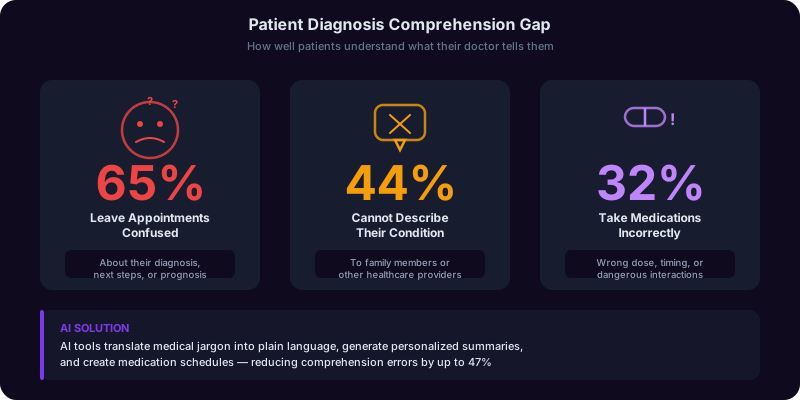
Researching your condition responsibly. AI can help you research a diagnosis more effectively than a raw internet search. Instead of falling into a spiral of worst-case scenarios, you can ask targeted questions about the most common causes, the typical treatment path, and expected outcomes. The Health Copilot can guide you through this process, helping you build a clear picture of your condition without the noise and anxiety of unfiltered search results.
However, there are boundaries you should respect. AI is useful for understanding what your doctor has already told you and for generating informed questions. It is not useful for self-diagnosis. Diagnosis requires physical examination, medical history, and clinical judgment that no AI tool can replicate.
A practical workflow: after every appointment, take 15 minutes to review your visit summary with an AI assistant. Paste in the clinical notes, ask for a plain-language translation, then generate a list of follow-up questions for your next visit. This single habit can transform your relationship with your healthcare.
AI health information is not a substitute for professional medical advice, diagnosis, or treatment. Use it to supplement, not replace, your doctor's guidance.
Researching Treatment Options with AI: Medications, Procedures, and Alternatives
Once you understand your diagnosis, the next step is understanding your treatment options. Your doctor may present a recommendation, but you have the right and the responsibility to understand what you are agreeing to, what the alternatives are, and what the evidence says about each option.
Evaluating medication options. When your doctor prescribes a medication, AI can help you understand far more than the pharmacy handout. You can research the mechanism of action, the most common side effects and their frequency, potential drug interactions with anything else you take, whether a generic version exists, and what clinical trial data shows about effectiveness. For a deeper look at interpreting lab work that often drives medication decisions, see our complete guide to reading blood test results.
For example, if your doctor prescribes a statin for high cholesterol, you might learn that statins reduce the risk of heart attack by 25-35% in people with elevated cardiovascular risk, that muscle pain occurs in about 5-10% of patients (lower than many believe), that there are seven different statins with different potency profiles, and that CoQ10 supplementation may help with muscle-related side effects.

Understanding procedures. If a surgery or procedure is recommended, AI can help you understand the specific technique being proposed, success rates and complication rates from published data, the typical recovery timeline, what questions to ask your surgeon, and whether less invasive alternatives exist. The Second Opinion Copilot is designed to help you evaluate whether a recommended procedure is supported by current evidence.
Exploring evidence-based alternatives. For many conditions, there are multiple valid treatment approaches. Physical therapy versus surgery for certain joint problems. Cognitive behavioral therapy versus medication for anxiety. Lifestyle modification versus pharmacological intervention for borderline hypertension. AI can help you understand the evidence behind each approach so you can have an informed conversation with your provider.
Understanding clinical trials. If you have a serious or rare condition, AI can help you search for and understand relevant clinical trials. The federal database at ClinicalTrials.gov lists over 470,000 studies. You can ask about eligibility criteria, what the experimental treatment involves, the phase of the trial, and what participation requires.
Red flags to watch for. Be skeptical of any AI output that presents a single treatment as the only option, dismisses your doctor's recommendation without evidence, promotes supplements without rigorous evidence, or downplays the seriousness of a condition. Good AI-assisted research always leads you back to a conversation with your healthcare provider, not away from one.
Treatment decisions should always be made in consultation with your healthcare provider, who understands your complete medical history.

Get Answers From the Health Copilot
Understand your diagnosis, decode medical bills, and prepare smarter questions for your doctor. Copilotly's AI assistants translate complex medical and billing information into plain language you can act on.
Decoding Medical Bills, EOBs, and Insurance Statements with AI
Medical billing in the United States is one of the most complex consumer-facing systems ever created, and it is riddled with errors. According to billing industry audits, approximately 80% of medical bills contain errors. The Centers for Medicare and Medicaid Services (CMS) has expanded consumer protections, but the burden of catching errors still falls primarily on patients.
Understanding your Explanation of Benefits (EOB). An EOB is not a bill. This is one of the most common points of confusion. Your insurance company sends you an EOB after processing a claim, and it shows what the provider charged, the negotiated rate, what insurance paid, and what you owe. Key terms:
- Billed amount: What the provider charged. This is almost always higher than what anyone actually pays.
- Allowed amount: The negotiated rate between your insurance and the provider.
- Deductible applied: The portion counting toward your annual deductible, paid out of pocket.
- Copay/Coinsurance: Your share after the deductible. A copay is a flat fee; coinsurance is a percentage.
- Patient responsibility: The total amount you actually owe.
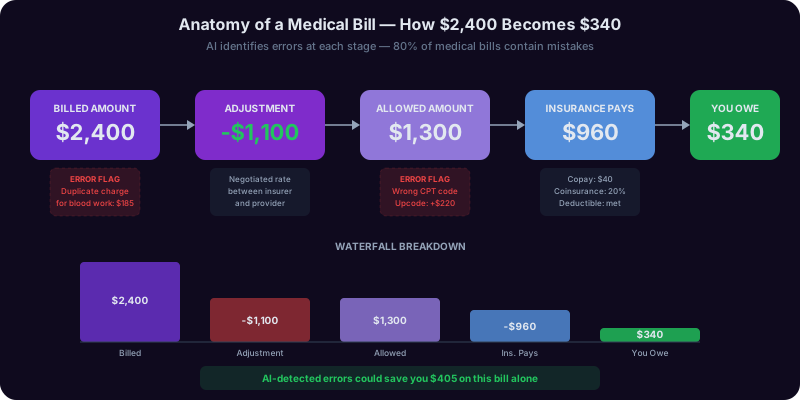
Common billing errors AI can help you catch. The most frequent errors include duplicate charges, unbundling (charging separately for services that should be billed as a package), upcoding (billing for a more expensive service than what was provided), incorrect patient information leading to claim denials, and charges for services not rendered.
To use AI for bill review, gather your itemized bill (you have the right to request one), your EOB, and any clinical notes. Ask the AI to identify charges that appear duplicated, CPT codes inconsistent with the services described, and charges that seem unusually high for your region. The Finance Copilot can walk you through this process and help you draft a dispute letter if errors are found.
Surprise billing protections. The No Surprises Act protects you from unexpected out-of-network charges in emergency situations and from out-of-network providers at in-network facilities. If you receive a surprise bill that violates these protections, AI can help you understand your rights and draft a complaint.
Negotiating medical debt. If you receive a bill you cannot afford, hospitals with 501(c)(3) status are legally required to offer financial assistance. Many providers offer prompt-pay discounts of 10-30%. Payment plans with zero interest are commonly available. AI can help you draft negotiation letters and identify financial assistance programs.
For a deeper look at navigating healthcare costs, see our guide on understanding health insurance.
This is general financial information, not legal or financial advice. For billing disputes involving large amounts, consider consulting a medical billing advocate.
Preparing Smarter Questions for Your Doctor Using AI
The average primary care appointment lasts 15-18 minutes. In that narrow window, you need to describe your symptoms, receive a diagnosis or update, discuss treatment, and cover other concerns. Most patients leave with unanswered questions, either because they forgot to ask, did not know what to ask, or felt rushed. AI can help you walk in prepared and walk out informed.
Pre-appointment preparation. Use AI to organize your symptoms into a structured format that gives your doctor the most useful information in the least time. The medical format includes:
- Onset: When did the symptom start? Sudden or gradual?
- Location: Where exactly do you feel it?
- Duration: How long does each episode last?
- Character: What does it feel like? (sharp, dull, burning, throbbing)
- Aggravating factors: What makes it worse?
- Relieving factors: What makes it better?
- Timing: Is there a pattern? Worse at certain times of day?
- Severity: On a scale of 1-10, how bad is it?
When you describe symptoms using this framework, you are speaking your doctor's language, which leads to more efficient and accurate communication.
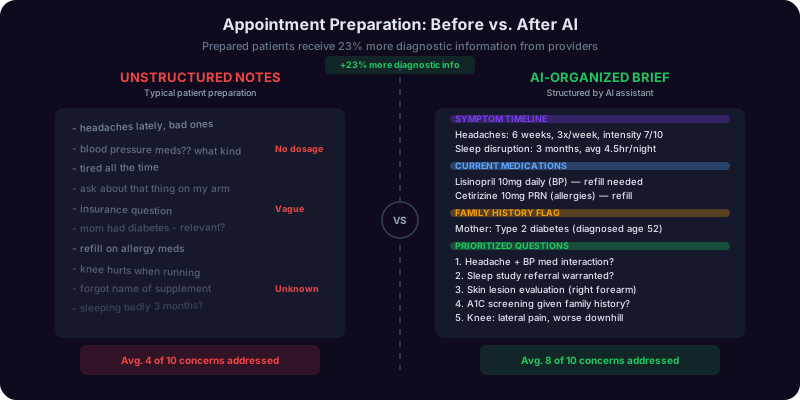
Generating condition-specific questions. Different appointment types call for different questions. For a new diagnosis, ask about prognosis, treatment timeline, and when to seek urgent care. For a medication review, ask about side effect management, drug interactions, and dose adjustments. AI can generate targeted question lists based on your specific situation.
Categories of questions patients commonly forget to ask:
- Differential diagnosis: What else could this be, and how are you ruling those out?
- Red flags: What symptoms should prompt me to come back sooner?
- Lifestyle modifications: Are there non-medication changes that could help?
- Cost considerations: Is there a less expensive alternative that would be equally effective?
- Monitoring: What should I track between now and my next visit?
Post-appointment review. After your visit, use AI to review your after-visit summary, translate any medical terminology, and identify gaps in understanding. Generate follow-up questions while the information is fresh. The Health Copilot can guide you through this entire workflow, from pre-appointment preparation to post-visit review.
Research published in the Journal of Patient Experience shows that patients who bring written questions to appointments are more satisfied with their care and have better treatment adherence. Preparation is not about challenging your doctor. It is about being a more effective partner in your own care.
Using AI to Understand Lab Results and Track Health Trends
Lab results are among the most actionable pieces of health information you receive, yet most patients look at them once, see that nothing is flagged in red, and file them away. AI transforms lab results from a confusing list of numbers into a personalized health narrative you can actually use.
Beyond normal versus abnormal. The "normal range" on your lab report represents a statistical range where 95% of healthy people fall. But a result within range does not always mean everything is fine, and a result slightly outside does not always mean something is wrong. Context matters enormously. A hemoglobin of 12.1 g/dL is technically normal for women but might be worth investigating if your previous three readings were 14.0, 13.5, and 12.8, showing a clear downward trend. AI can identify these trends when you input results from multiple time points.
For a detailed breakdown of every common lab marker, see our complete guide to reading blood test results.
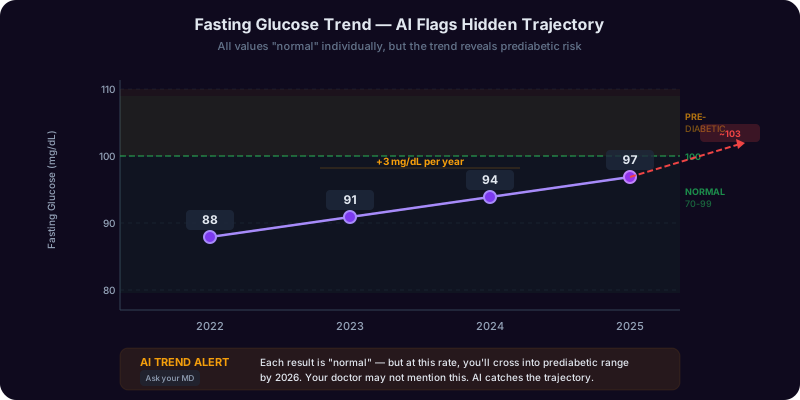
What to do with your lab results. When you receive results, follow this process with AI assistance:
- Get a plain-language summary. Ask for an explanation of what each marker measures and what your values indicate.
- Identify anything flagged. Ask the AI to explain high or low values, common causes, and recommended follow-up testing.
- Look for trends. Compare with previous results. Ask the AI to identify markers trending in a concerning direction, even if still within range.
- Generate questions. Create specific questions for your next appointment about borderline or unclear values.
- Understand the gaps. Ask what additional tests might be useful based on your age, sex, and health concerns. Tests like vitamin D, vitamin B12, thyroid antibodies, and inflammatory markers can provide valuable information but are not always included in routine panels.
Building a personal health baseline. One of the most powerful uses of AI in personal health management is building a longitudinal view of your lab results. By maintaining a record over years, you create a baseline far more informative than any single snapshot. AI can organize this data, spot patterns, and show how lifestyle changes correlate with lab value changes.
Understanding specialized tests. Beyond routine panels, you may encounter specialized tests that are harder to interpret. Thyroid panels with multiple markers have complex relationships. Hormone panels vary by time of day, menstrual cycle phase, and age. Genetic tests involve probability rather than simple categories. AI is particularly valuable for explaining these nuanced results.
The Health Copilot can help you interpret specific lab values and prepare informed questions for your doctor.
Lab result interpretation requires clinical context. AI explanations are educational, not diagnostic. Always discuss concerning results with your healthcare provider.
Comparing Healthcare Providers and Getting Second Opinions with AI
Choosing a healthcare provider is one of the most consequential decisions you make, yet most people put more research into buying a car than selecting a surgeon. AI tools can help you make more informed choices by organizing the information that matters most.
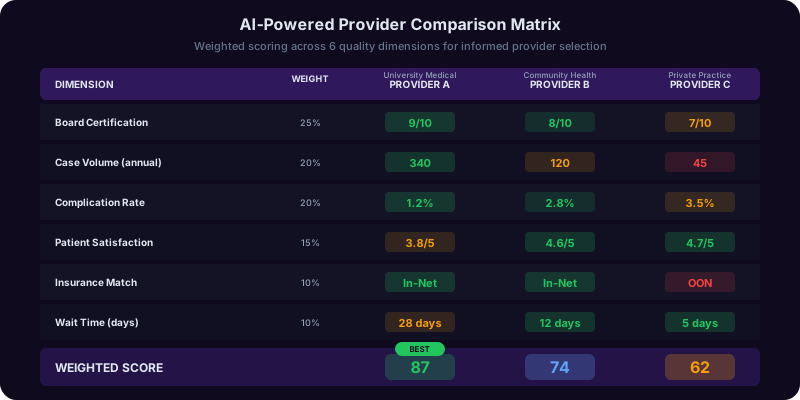
What to evaluate when choosing a provider. For any provider, especially specialists and surgeons, the key factors are:
- Board certification: Is the provider board-certified in the relevant specialty? Verify at the American Board of Medical Specialties website.
- Volume and experience: For surgical procedures, outcomes are strongly correlated with how many procedures the surgeon performs annually.
- Hospital quality: CMS publishes Hospital Compare data including complication rates, readmission rates, and patient satisfaction scores.
- Patient reviews: While individual reviews are unreliable, patterns across many reviews can be informative. AI can summarize large numbers of reviews to identify recurring themes.
- Insurance acceptance: Confirm the provider is in-network before scheduling. Out-of-network costs can be dramatically higher.
When to seek a second opinion. Consider a second opinion when you receive a diagnosis of a serious or rare condition, when surgery is recommended (especially elective or irreversible), when your condition is not improving with treatment, or when different providers have given conflicting information. Studies show second opinions change the diagnosis or treatment plan in 10-62% of cases, depending on the specialty.
AI can help you prepare for a second opinion by organizing your medical records, summarizing your current treatment plan, and generating specific questions. For a comprehensive guide, see our post on using AI for professional second opinions. The Second Opinion Copilot is designed specifically for this purpose.
Comparing costs across providers. The same procedure can cost dramatically different amounts at different facilities. A knee MRI might cost $400 at an independent imaging center and $2,500 at a hospital outpatient department. Since January 2021, hospitals have been required to publish prices under the Hospital Price Transparency Rule. AI can help you navigate price comparison tools and estimate out-of-pocket costs based on your insurance plan.
Telehealth versus in-person. Telehealth works well for follow-ups, medication management, mental health therapy, and reviewing test results. In-person visits are usually necessary for new symptoms requiring examination, procedures, and acute care. AI can help you determine which format is appropriate for your situation.
Provider selection is a personal decision. AI can organize information, but the final choice should reflect your individual needs and circumstances.
Building Your AI Patient Toolkit: A Practical Action Plan
Understanding the concepts in this guide is the first step. Putting them into practice requires building habits and systems. Here is a concrete action plan for becoming a more empowered, informed patient using AI tools available in 2026.
Step 1: Centralize your medical records. Request copies of your complete medical records from every provider you have seen in the past five years. Under HIPAA, providers must fulfill your request within 30 days. Store these records digitally in a secure location. Most health systems now offer patient portal access where you can download visit notes, lab results, and imaging reports.
Step 2: Build a medication inventory. Create a comprehensive list of everything you take: prescription medications with dosages, over-the-counter medications, vitamins, supplements, and herbal remedies. Use AI to check for interactions. Update it whenever anything changes, and bring it to every appointment.
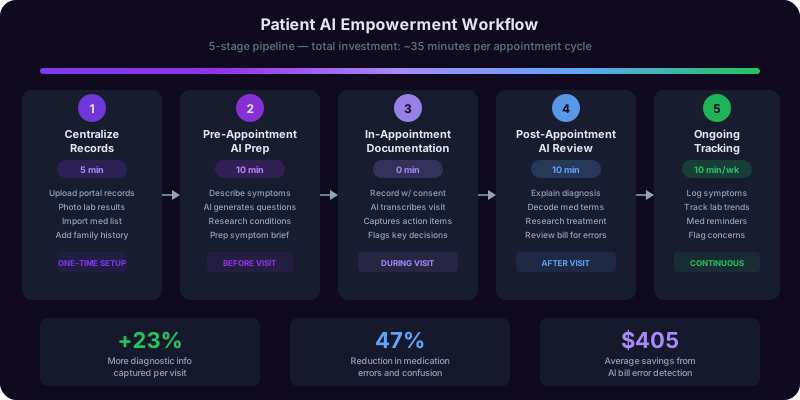
Step 3: Establish a pre-appointment routine. Before every medical appointment, spend 15-20 minutes with an AI assistant to organize your symptoms, review recent lab results, generate a prioritized question list, and note medications that need refilling. Print or save this document and bring it with you.
Step 4: Create a post-appointment review habit. After every appointment, spend 10-15 minutes using AI to translate your after-visit summary, clarify unfamiliar terms, research any new medications or tests ordered, and update your personal health record.
Step 5: Review every medical bill systematically. When you receive a medical bill, do not pay it immediately. Request an itemized bill, compare charges against your EOB and your recollection of services received, and use AI to check for common billing errors. The Finance Copilot can assist with review and help draft appeal letters if needed.
Step 6: Track your health data over time. Maintain a record of key lab values, vital signs, weight, and symptoms you are monitoring. Review this data quarterly with AI assistance to identify trends. This longitudinal view is far more valuable than any single data point.
Privacy considerations. When using AI tools with health information, avoid sharing identifying information alongside medical data. Paraphrase results rather than pasting entire documents when possible. Remove identifying headers from lab reports before sharing. Review the privacy policies of AI tools you use regularly.
The combination of accessible AI tools and your own engagement creates something new in healthcare: a patient who understands their diagnosis, knows their options, catches billing errors, and walks into every appointment prepared. Research consistently shows that engaged, informed patients receive better care, have better outcomes, and spend less money. The 15-20 minutes of AI-assisted preparation before each appointment may be the highest-return investment you can make in your own health.
This guide provides general health and financial information for educational purposes. It is not a substitute for professional medical advice, diagnosis, treatment, or financial counseling.
Frequently Asked Questions
Recommended Copilots
Recommended Copilots
Translates medical terminology, explains diagnoses in plain language, and helps you prepare informed questions for doctor appointments.
Try Free →Evaluates medical recommendations against published evidence and helps you prepare for productive second-opinion consultations.
Try Free →Reviews itemized medical bills for errors, explains EOB statements, and helps you draft dispute or negotiation letters for billing issues.
Try Free →Related Articles
Get Answers From the Health Copilot
Understand your diagnosis, decode medical bills, and prepare smarter questions for your doctor. Copilotly's AI assistants translate complex medical and billing information into plain language you can act on.