
Why Strength Training Matters
Strength training is not just for people who want bigger muscles. It is the single most impactful type of exercise for long-term health, and the research backing this claim is overwhelming. Try our AI workout planner for step-by-step help.
Muscle loss (sarcopenia) begins around age 30. Without resistance training, the average person loses 3-5% of their muscle mass per decade. By age 70, inactive adults have lost 30-40% of their muscle. This directly contributes to falls, fractures, loss of independence, and increased mortality. Strength training is the only intervention proven to reverse sarcopenia at any age, as confirmed by the National Institutes of Health.
Metabolic health improves dramatically with strength training. Muscle tissue is metabolically active, meaning it burns calories even at rest. Each pound of muscle burns approximately 6-7 calories per day at rest compared to 2 calories per pound of fat. Over time, this difference compounds. Strength training also improves insulin sensitivity, reducing the risk of type 2 diabetes by up to 34% according to a meta-analysis in the journal Diabetologia.
Bone density increases with resistance training. Weight-bearing exercises stimulate bone formation and slow bone loss, reducing the risk of osteoporosis. This is especially important for women, who lose bone density rapidly after menopause. Studies show that resistance training can increase bone mineral density by 1-3% annually, compared to losses of 1-2% per year in sedentary individuals.
Mental health benefits are significant and often overlooked. A 2018 meta-analysis in JAMA Psychiatry found that resistance training significantly reduces symptoms of depression, regardless of health status or training volume. The effect was comparable to antidepressant medication for mild to moderate depression. The CDC Physical Activity Guidelines recommend muscle-strengthening activities at least 2 days per week for all adults.
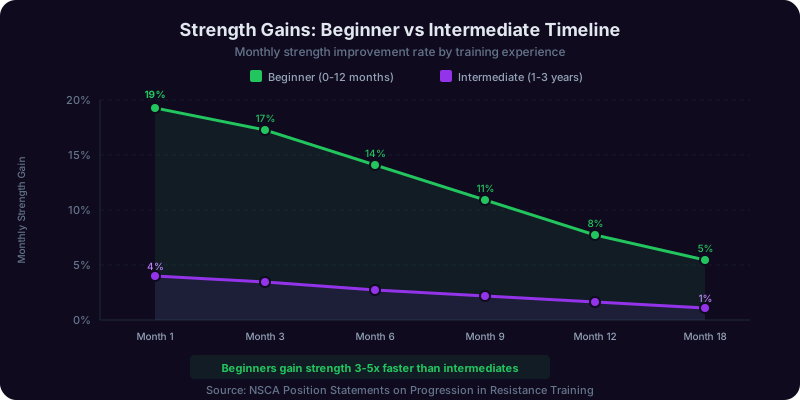
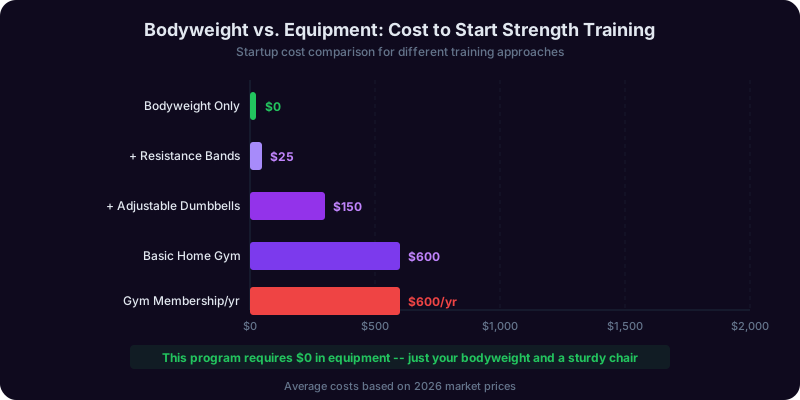
The best part: you do not need a gym. Bodyweight exercises provide sufficient resistance for beginners and intermediates to build meaningful strength, improve body composition, and achieve all the health benefits listed above. This program will prove it over the next 12 weeks.
For personalized guidance on matching your training to your health goals, the Fitness Copilot can adapt recommendations to your specific situation.
This is general health information, not medical advice. Consult a healthcare professional before starting any new exercise program, especially if you have existing health conditions.
Equipment-Free Exercise List
This program uses 15 core exercises. Master these movements and you can build impressive strength anywhere. Each exercise is listed with its primary muscle groups.
| Exercise | Primary Muscles | Difficulty |
| Wall Push-ups | Chest, shoulders, triceps | Beginner |
| Knee Push-ups | Chest, shoulders, triceps | Beginner |
| Standard Push-ups | Chest, shoulders, triceps | Intermediate |
| Bodyweight Squats | Quads, glutes, hamstrings | Beginner |
| Lunges | Quads, glutes, hamstrings | Beginner |
| Glute Bridges | Glutes, hamstrings, lower back | Beginner |
| Single-Leg Glute Bridge | Glutes, hamstrings | Intermediate |
| Plank (forearm) | Core, shoulders | Beginner |
| Side Plank | Obliques, shoulders | Intermediate |
| Dead Bug | Core, hip flexors | Beginner |
| Superman Hold | Lower back, glutes | Beginner |
| Step-ups (using a sturdy chair) | Quads, glutes | Intermediate |
| Pike Push-ups | Shoulders, triceps | Intermediate |
| Bulgarian Split Squat | Quads, glutes | Advanced |
| Pistol Squat (assisted) | Quads, glutes, balance | Advanced |
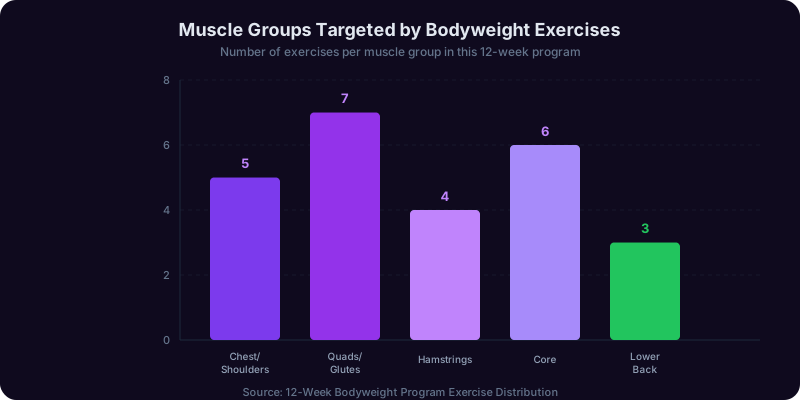
How to use this list: You do not need to learn all 15 exercises on day one. The program introduces them progressively. Weeks 1-4 use only the beginner exercises. Weeks 5-8 add intermediate movements. Weeks 9-12 introduce the advanced variations.
Each exercise should be performed with controlled tempo: 2 seconds down, 1 second pause, 2 seconds up. This maximizes time under tension and builds more strength than fast, sloppy reps. Quality always beats quantity.
Breathing: Exhale during the exertion phase (pushing up, standing up) and inhale during the lowering phase. Never hold your breath during strength exercises, as this can spike blood pressure dangerously.
Weeks 1-4: Foundation Phase
The goal of this phase is to build a foundation of movement quality, core stability, and muscular endurance. You will train 3 days per week with at least one rest day between sessions (for example, Monday/Wednesday/Friday).
Each session takes 25-30 minutes. Complete all exercises as a circuit. Rest 60 seconds between exercises. Complete the full circuit 2 times (2 rounds).
| Exercise | Week 1-2 | Week 3-4 |
| Wall Push-ups | 2 x 10 reps | 2 x 15 reps |
| Bodyweight Squats | 2 x 10 reps | 2 x 15 reps |
| Glute Bridges | 2 x 10 reps | 2 x 15 reps |
| Forearm Plank | 2 x 15 seconds | 2 x 25 seconds |
| Dead Bug | 2 x 6 each side | 2 x 10 each side |
| Superman Hold | 2 x 10 seconds | 2 x 20 seconds |
| Lunges | 2 x 6 each leg | 2 x 10 each leg |
Progression rules for Weeks 1-4:
- If you can complete all prescribed reps with good form and it feels easy, move to the Week 3-4 volume early.
- If an exercise is too difficult (for example, wall push-ups at 10 reps), reduce to as many reps as you can with perfect form and build up gradually.
- If bodyweight squats are difficult, use a chair or countertop for support. Sit back toward the chair but stand up before fully sitting.
- For planks, if 15 seconds is too long, do 2-3 sets of 8-10 seconds with short rest.
What to expect: The first week may feel easy. That is intentional. The goal is to learn the movements with perfect form before adding volume. By week 3-4, you should feel genuinely challenged during the last few reps of each set. If you are not, you are ready to progress faster.
Muscle soreness (DOMS) is normal during the first 1-2 weeks, especially in the quads and glutes. This diminishes significantly as your body adapts. Mild soreness is fine; sharp pain during an exercise means you should stop and check your form. Try our AI symptom checker for step-by-step help.

Get Answers From the Fitness Copilot
Tell the Fitness Copilot your current level, available equipment, and goals, and get a customized progressive program with nutrition guidance.
Weeks 5-8: Progression Phase
Now you start building real strength. This phase increases volume to 3 rounds, introduces intermediate exercises, and ups the training frequency to 3-4 days per week. Each session takes 35-40 minutes.
| Exercise | Week 5-6 | Week 7-8 |
| Knee Push-ups | 3 x 10 reps | 3 x 15 reps |
| Bodyweight Squats | 3 x 15 reps | 3 x 20 reps |
| Single-Leg Glute Bridge | 3 x 8 each leg | 3 x 12 each leg |
| Forearm Plank | 3 x 30 seconds | 3 x 45 seconds |
| Side Plank | 3 x 15 sec each side | 3 x 25 sec each side |
| Step-ups (chair) | 3 x 8 each leg | 3 x 12 each leg |
| Lunges | 3 x 10 each leg | 3 x 12 each leg |
| Pike Push-ups | 3 x 5 reps | 3 x 8 reps |
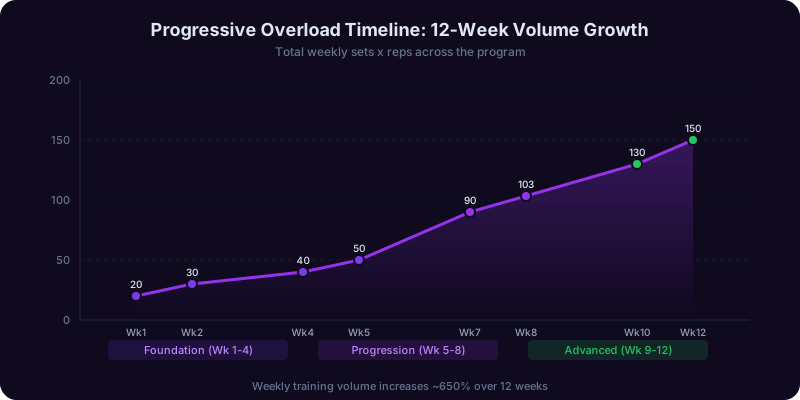
Key changes in this phase:
- Push-up progression: You graduate from wall push-ups to knee push-ups. If you can do 15 knee push-ups with good form by Week 8, you are ready for standard push-ups in Phase 3. The chest should touch the floor (or get within 2 inches) on every rep. Half-reps build half-strength.
- Single-leg work: The single-leg glute bridge and step-ups build unilateral strength, which corrects imbalances between your left and right sides. Most people have a dominant leg that does more work during squats. Single-leg exercises force each leg to carry its own weight.
- Core progression: Side planks challenge your obliques and lateral stability. If you cannot hold 15 seconds, start from your knees rather than your feet and work up. The goal is a straight line from head to feet with no hip sagging.
Optional 4th day: If you are recovering well (no persistent soreness, sleeping well, energy is good), add a 4th training day focused on mobility and active recovery: 10 minutes of stretching, 10 minutes of walking, and 2 rounds of dead bugs and glute bridges at reduced volume. This keeps you moving without adding fatigue.
By the end of Week 8, you should notice visible changes in muscle tone, particularly in your legs, glutes, and arms. Your endurance during daily activities (climbing stairs, carrying groceries) should be noticeably improved. Track your progress by recording your reps and comparing week over week. The Fitness Copilot can help you adjust the program if you are progressing faster or slower than expected.
Weeks 9-12: Advanced Phase
This is where beginners start feeling like athletes. You will perform 3-4 rounds of more challenging exercises, 4 days per week, with sessions lasting 40-45 minutes. Rest periods decrease to 45 seconds between exercises to increase cardiovascular demand.
| Exercise | Week 9-10 | Week 11-12 |
| Standard Push-ups | 3 x 8 reps | 4 x 10 reps |
| Bulgarian Split Squat | 3 x 6 each leg | 3 x 10 each leg |
| Pike Push-ups | 3 x 8 reps | 4 x 10 reps |
| Single-Leg Glute Bridge | 3 x 12 each leg | 4 x 12 each leg |
| Side Plank | 3 x 30 sec each side | 3 x 45 sec each side |
| Step-ups (chair) | 3 x 12 each leg | 4 x 12 each leg |
| Pistol Squat (assisted) | 3 x 3 each leg | 3 x 5 each leg |
| Plank to Push-up | 3 x 6 reps | 4 x 8 reps |
New exercises introduced:
- Bulgarian Split Squat: Place one foot behind you on a chair or couch. Lower your back knee toward the floor until your front thigh is parallel to the ground. This exercise loads your front leg significantly more than a standard lunge and is one of the best bodyweight leg exercises available. If balance is an issue, place a hand on a wall for support.
- Assisted Pistol Squat: Hold onto a doorframe, sturdy table, or TRX strap with one hand. Extend one leg forward and lower yourself on the standing leg until your hip crease is below your knee. Use your hand for balance, not to pull yourself up. This is a challenging exercise; even 3 reps per leg is excellent for beginners.
- Plank to Push-up: Start in a forearm plank. Press up to a full push-up position one arm at a time, then lower back to forearms. This trains core stability under dynamic conditions and builds serious arm and shoulder endurance.
By Week 12, target benchmarks:
- 10 consecutive standard push-ups with full range of motion
- 20 bodyweight squats without rest
- 45-second plank with no form breakdown
- 10 Bulgarian split squats per leg
- 3-5 assisted pistol squats per leg
Hitting these benchmarks means you have built a genuine foundation of strength that exceeds the average untrained adult. From here, you can progress to more advanced bodyweight skills, add resistance with dumbbells or bands, or transition to a gym program.
Nutrition Basics for Strength Training
Exercise is the stimulus. Nutrition is the fuel. Without adequate nutrition, your muscles will not recover or grow regardless of how perfectly you follow the program.
Protein is the most critical macronutrient for strength training. Your muscles need protein to repair and grow after each workout. The research-backed recommendation for people engaged in resistance training is 0.7-1.0 grams of protein per pound of bodyweight per day. For a 160-pound person, that is 112-160 grams of protein daily. The Mayo Clinic provides additional guidance on protein intake for active individuals.
Here is what that looks like in real food:
| Food | Protein | Serving Size |
| Chicken breast | 31g | 4 oz cooked |
| Eggs | 6g each | 1 large egg |
| Greek yogurt | 15-20g | 1 cup |
| Canned tuna | 20g | 3 oz can |
| Black beans | 15g | 1 cup cooked |
| Cottage cheese | 14g | 1/2 cup |
| Whey protein powder | 25g | 1 scoop |
| Tofu (firm) | 20g | 1/2 block |
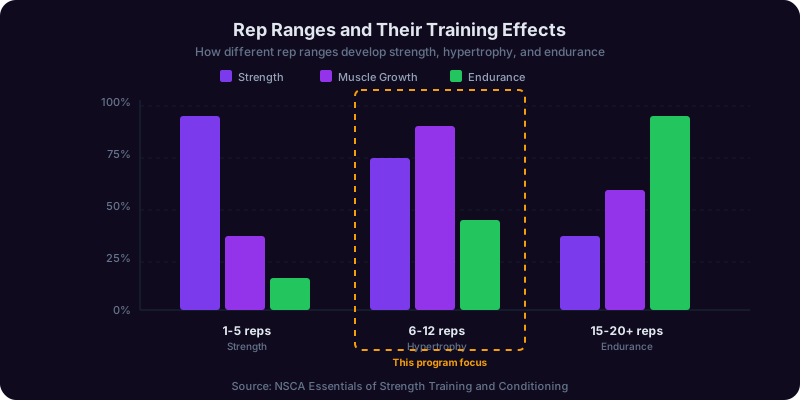
Calorie intake determines whether you gain or lose weight. To build muscle while losing fat (body recomposition), most beginners do well eating at maintenance calories or a slight deficit of 200-300 calories below maintenance. To find your approximate maintenance calories, multiply your bodyweight in pounds by 14-16 (lower end if sedentary outside workouts, higher if active).
Meal timing matters less than total daily intake, but consuming 20-40 grams of protein within 2 hours after your workout supports recovery. This does not need to be a protein shake. A meal containing chicken, fish, eggs, or dairy works equally well.
Hydration directly affects performance. Dehydration of just 2% of bodyweight reduces strength output by up to 20%. Aim for at least half your bodyweight in ounces of water daily, plus an additional 16-24 oz for each hour of exercise. If your urine is pale yellow, you are adequately hydrated. Dark yellow means you need more water.
For a personalized nutrition plan that matches your training goals, the Nutrition Copilot can calculate your specific calorie and macro targets based on your body composition and activity level.
Recovery and Rest Days
Muscles do not grow during your workout. They grow during recovery. Skipping rest days or under-sleeping will stall your progress faster than any programming mistake.
Sleep is the most powerful recovery tool available, and it is free. During deep sleep, your body releases growth hormone (GH), which drives muscle repair and growth. Adults who sleep fewer than 6 hours per night have significantly lower testosterone and growth hormone levels, both of which are critical for building strength. Aim for 7-9 hours per night. If you only optimize one recovery variable, make it sleep. For more on optimizing your sleep, read our guide on melatonin vs. magnesium for insomnia.
Rest days are built into the program for a reason. During Weeks 1-4, you train 3 days and rest 4. During Weeks 9-12, you train 4 days and rest 3. On rest days, avoid the temptation to "sneak in" extra workouts. Active recovery (walking, gentle stretching, yoga) is fine and even beneficial, but another strength session is counterproductive.
Delayed onset muscle soreness (DOMS) peaks 24-72 hours after a workout and is completely normal, especially in the first 2-3 weeks of the program. DOMS is caused by microscopic muscle fiber damage, which is actually the signal that triggers muscle growth. Light movement (walking, stretching) during DOMS increases blood flow and speeds recovery. Complete inactivity during soreness is not necessary and may actually prolong it.
Signs you need more recovery:
- Performance is declining (you can do fewer reps than last week)
- Persistent fatigue that does not improve with a good night's sleep
- Elevated resting heart rate (5-10 beats above your normal baseline)
- Joint pain (as opposed to muscle soreness)
- Loss of motivation or dread about training sessions
If you notice these signs, take an extra rest day or reduce your volume by 50% for a week (a "deload" week). This is not losing progress. It is allowing accumulated fatigue to dissipate so you can push harder in the following weeks.
Stretching and mobility: Spend 5-10 minutes after each workout stretching the muscles you trained. Focus on hip flexors, hamstrings, chest, and shoulders, as these are the areas that tighten most from both exercise and daily sitting. Hold each stretch for 30 seconds. Do not bounce. Consistent flexibility work prevents the stiffness that derails long-term training programs.
Common Form Mistakes to Avoid
Bad form reduces effectiveness and increases injury risk. These are the mistakes beginners make most often, along with how to fix them.
Push-ups: Sagging hips. When your core is not engaged, your lower back drops toward the floor, putting stress on your lumbar spine. The fix: before each rep, squeeze your glutes and brace your abs as if someone is about to poke your stomach. Your body should form a straight line from head to heels. If you cannot maintain this, regress to knee push-ups until you build sufficient core strength.
Push-ups: Flared elbows. Many beginners let their elbows point straight out to the sides at 90 degrees, which stresses the shoulder joint. Your elbows should track at about 45 degrees from your body, forming an arrow shape rather than a T shape. This protects the rotator cuff and actually engages more chest muscle.
Squats: Knees caving inward. This is called knee valgus and it is extremely common, especially in women. It stresses the ACL and meniscus. The fix: actively push your knees out over your pinky toes as you lower into the squat. Placing a light resistance band around your knees (just above the kneecap) is a great training tool to reinforce this pattern. If your knees still cave, reduce your depth until you can maintain proper alignment.
Squats: Rising on toes. If your heels lift off the ground during a squat, you likely have tight calves or limited ankle mobility. The temporary fix: place your heels on a book or small board (about 1 inch thick) while you work on ankle mobility. The long-term fix: spend 2 minutes daily stretching your calves with wall stretches and ankle circles.
Planks: Holding your breath. This is the most common plank mistake and it drives blood pressure dangerously high during a static hold. Breathe steadily throughout the entire plank. Count your breaths to stay focused: inhale for 3 seconds, exhale for 3 seconds.
Lunges: Front knee extending past toes excessively. A small amount of forward knee travel is natural and safe, but excessive forward lean usually means your step is too short. Take a longer stride so that at the bottom of the lunge, your front shin is roughly vertical and your front thigh is parallel to the floor.
Film yourself from the side during your workouts. Most form errors are invisible to the person doing the exercise but obvious on video. Review one exercise per session and make corrections the following workout. The Fitness Copilot can help you troubleshoot specific form issues and suggest corrective exercises for common weaknesses.
If you experience sharp pain (not muscle burn) during any exercise, stop immediately. Pain is your body telling you that something is wrong, either with your form or with a pre-existing issue that needs medical attention. The Weight Loss Copilot can also help you integrate this strength program with your broader fitness and body composition goals.
For more on this topic, read our guide on How to Read Your Blood Test Results: A Complete Plain-English Guide. If you are managing anxiety that affects your motivation to train, our guide on how to reduce anxiety naturally offers evidence-based strategies.
See our real-world walkthrough: reading your lab results.
Frequently Asked Questions
Recommended Copilots
Recommended Copilots
Get a personalized workout progression based on your fitness level and goals
Try Free →Build a meal plan that supports your strength training program
Try Free →Create a holistic health plan combining exercise, nutrition, and recovery
Try Free →Continue Exploring
For You
Related Articles
Get Answers From the Fitness Copilot
Tell the Fitness Copilot your current level, available equipment, and goals, and get a customized progressive program with nutrition guidance.