

Why 2026 Is the Best Year to Start a Side Hustle (The Numbers Make the Case)
The side hustle is no longer a fringe activity for restless millennials. It is a mainstream economic strategy used by over 45% of working Americans, according to a 2025 Bankrate survey. That is up from 39% in 2023 and 34% in 2020. The trend is not slowing. It is accelerating, and the forces driving it are structural, not temporary.
The Income Reality That Created the Side Hustle Economy
The math behind the side hustle boom is straightforward. Median household income in the United States reached approximately $82,000 in 2025, but inflation-adjusted wage growth has averaged just 1.1% annually over the past decade. Meanwhile, housing costs have increased 38% since 2019, childcare costs have risen 26%, and health insurance premiums are up 18%. The gap between what people earn and what life costs has widened every single year, and a single income stream no longer provides the financial margin it once did.
A 2026 McKinsey report found that 58% of side hustlers started not because they wanted extra spending money, but because they needed it to cover basic expenses their primary salary no longer fully supported. The remaining 42% cited goals like building savings (see our emergency fund guide), paying off debt faster, testing a business idea, or creating a path out of traditional employment entirely.
The Gig Economy Has Matured
The gig economy is no longer just driving for Uber or delivering groceries. It has evolved into a sophisticated ecosystem of platforms, tools, and opportunities that make it easier than ever to monetize skills. Consider the growth:
- Freelance platforms: Upwork, Fiverr, and Toptal processed over $18 billion in freelancer payments in 2025, up 24% year-over-year. The average hourly rate on Upwork reached $36/hour for skilled freelancers.
- Creator economy: Over 50 million people globally identify as content creators, and the creator economy is valued at $250 billion as of 2026. Platforms like YouTube, Substack, Patreon, and Gumroad make it possible to monetize audiences without a publisher, distributor, or venture capital.
- AI-powered productivity: The biggest shift in 2025-2026 is that AI tools have dramatically reduced the time and cost required to start and run a side hustle. Tasks that used to require hiring a designer, copywriter, or developer can now be handled by one person with the right AI tools. This means higher margins and faster launches for solo operators.
- Remote work infrastructure: With 35% of full-time workers still working remotely at least part-time, the infrastructure for digital work is fully built out. Payment processing, project management, video conferencing, and digital delivery are all commoditized and cheap.
What Side Hustlers Actually Earn
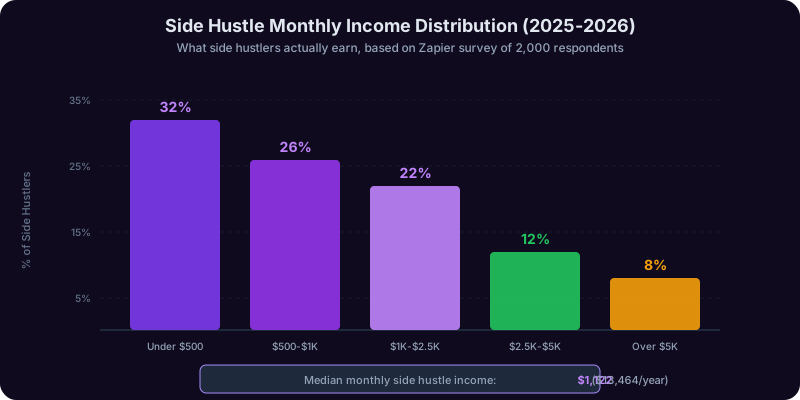
The earnings data is encouraging but realistic. According to a 2025 Zapier survey of 2,000 active side hustlers:
| Earning Range (Monthly) | Percentage of Side Hustlers |
|---|---|
| Under $500 | 32% |
| $500 - $1,000 | 26% |
| $1,000 - $2,500 | 22% |
| $2,500 - $5,000 | 12% |
| Over $5,000 | 8% |
The median monthly side hustle income is $1,122. That translates to $13,464 per year, which is enough to max out a Roth IRA, pay off $13,000 in student loan debt, or build a meaningful emergency fund. The top 20% of side hustlers earn over $2,500 per month, and they tend to share three characteristics: they chose a skill-based hustle (not a platform-based one), they treated it like a business from day one, and they reinvested their early earnings into growth.
The Psychological Case for a Side Hustle
Beyond the money, there is a well-documented psychological benefit to having a side hustle. A 2024 study published in the Journal of Vocational Behavior found that people with a side hustle reported 23% higher career satisfaction than those without one, even when controlling for total income. The researchers attributed this to three factors:
- Autonomy: Side hustles give you control over what you work on, who you work with, and how you deliver. This sense of agency is a fundamental human need that most corporate jobs constrain.
- Skill development: Running even a small side business forces you to learn marketing, sales, financial management, and client communication. These skills transfer directly to your primary career and make you more promotable.
- Identity diversification: When your entire professional identity is tied to one employer, a layoff feels existential. When you have a side hustle, losing your job is a financial setback, not an identity crisis. You are still a business owner, a freelancer, a creator.
The bottom line: starting a side hustle in 2026 is not a gamble. It is a calculated decision supported by favorable economics, mature infrastructure, and powerful AI tools that reduce the barriers to entry. The question is not whether you should start. It is which hustle to start and how to do it right. The Career Copilot can help you evaluate which side hustle opportunities align best with your existing skills and long-term career goals.
15 Side Hustle Ideas Ranked by Startup Cost and Earning Potential
Not all side hustles are created equal. Some require zero upfront investment and can generate income within a week. Others require significant capital or months of ramp-up time. The key is choosing a hustle that matches your available time, existing skills, and financial goals. Here are 15 proven options, ranked from lowest to highest startup cost, with realistic earning potential based on 2025-2026 market data. Try our AI business plan generator for step-by-step help.
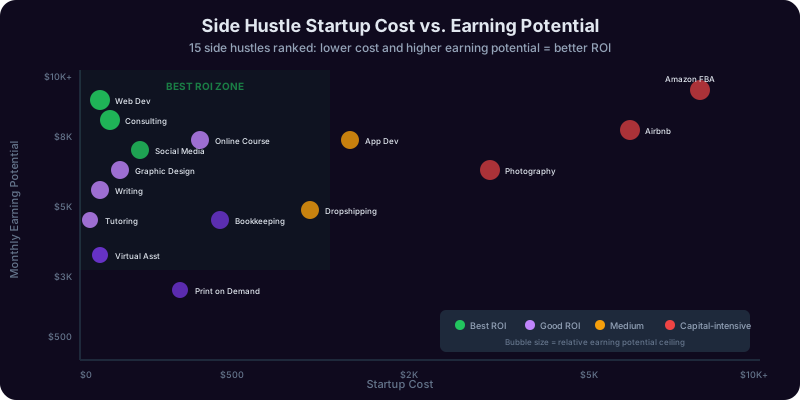
Comparison Table: All 15 Side Hustles at a Glance
| Side Hustle | Startup Cost | Monthly Earning Potential | Time to First Dollar | Skill Level |
|---|---|---|---|---|
| 1. Freelance Writing | $0 - $50 | $500 - $5,000+ | 1-2 weeks | Intermediate |
| 2. Virtual Assistant | $0 - $100 | $800 - $3,000 | 1-2 weeks | Beginner |
| 3. Online Tutoring | $0 - $50 | $500 - $4,000 | 1 week | Intermediate |
| 4. Social Media Management | $0 - $200 | $1,000 - $5,000 | 2-4 weeks | Intermediate |
| 5. Graphic Design (Freelance) | $0 - $300 | $1,000 - $6,000 | 2-3 weeks | Intermediate |
| 6. Web Development | $0 - $200 | $2,000 - $10,000+ | 2-4 weeks | Advanced |
| 7. Bookkeeping | $200 - $500 | $1,000 - $4,000 | 3-6 weeks | Intermediate |
| 8. Print on Demand | $0 - $100 | $200 - $3,000 | 2-6 weeks | Beginner |
| 9. Online Course Creation | $100 - $500 | $500 - $10,000+ | 1-3 months | Intermediate |
| 10. Consulting (Niche Expertise) | $0 - $300 | $2,000 - $15,000+ | 2-6 weeks | Advanced |
| 11. E-commerce (Dropshipping) | $200 - $1,000 | $500 - $5,000 | 1-3 months | Intermediate |
| 12. Photography/Videography | $1,000 - $5,000 | $1,000 - $6,000 | 2-4 weeks | Intermediate |
| 13. Rental Property (Airbnb) | $5,000 - $50,000+ | $1,000 - $8,000 | 1-3 months | Intermediate |
| 14. Mobile App Development | $100 - $1,000 | $500 - $10,000+ | 2-6 months | Advanced |
| 15. Amazon FBA / E-commerce (Inventory) | $2,000 - $10,000 | $1,000 - $20,000+ | 2-4 months | Intermediate |
Low-Cost, High-Skill Hustles (Best for Professionals)
1. Freelance Writing ($0-$50 startup): If you can write clearly and meet deadlines, the demand is enormous. Businesses need blog posts, email sequences, white papers, case studies, and website copy. The rates range from $0.10/word for commodity content to $1.00+/word for specialized B2B, finance, or technical writing. A writer producing 10,000 words per month at $0.30/word earns $3,000 monthly. Start on Upwork or Contently, build a portfolio of 5-10 samples, then move to direct client outreach within 3-6 months.
2. Virtual Assistant ($0-$100 startup): Small business owners and executives are drowning in administrative tasks. Virtual assistants handle email management, scheduling, data entry, customer service, social media posting, and bookkeeping. Rates start at $15-$20/hour for general VAs and climb to $35-$75/hour for specialized VAs who handle operations, project management, or tech stack administration. The fastest path: sign up on Belay, Time Etc, or Zirtual, or post directly on LinkedIn.
3. Online Tutoring ($0-$50 startup): The online tutoring market is valued at $19.6 billion in 2026 and growing at 14% annually. If you have expertise in math, science, test prep, coding, or languages, platforms like Wyzant, Tutor.com, and Varsity Tutors connect you with students immediately. Rates range from $25/hour for general subjects to $100+/hour for SAT/ACT prep, GMAT tutoring, or specialized technical subjects.
4. Social Media Management ($0-$200 startup): Small businesses know they need a social media presence but have neither the time nor expertise to maintain one. A social media manager handles content creation, scheduling, community engagement, and analytics for 3-5 clients simultaneously. Monthly retainers range from $500-$2,000 per client. With just three clients at $1,000/month, you are earning $3,000/month on approximately 15-20 hours of work per week.
5. Graphic Design ($0-$300 startup): Canva made basic design accessible to everyone, but businesses still need professional branding, packaging, marketing materials, and custom illustrations. Tools like Figma (free) and Affinity Designer ($70 one-time) keep costs low. Freelance designers on Upwork charge $50-$150/hour, and logo packages sell for $500-$5,000 depending on the scope. A strong portfolio of 8-10 pieces is your ticket to consistent work.
High-Earning, High-Skill Hustles (Best for Experienced Professionals)
6. Web Development ($0-$200 startup): Businesses will always need websites, web apps, and custom integrations. A freelance developer can charge $75-$200/hour depending on specialization. Building WordPress sites, Shopify stores, or custom React applications are all in high demand. With AI coding assistants accelerating development speed in 2026, solo developers can handle more projects than ever before, pushing monthly earnings above $10,000 for those who build a steady client pipeline.
7. Bookkeeping ($200-$500 startup): There are over 33 million small businesses in the United States, and most of them hate doing their books. A QuickBooks ProAdvisor certification costs $200-$400 and can be completed in 2-4 weeks. Bookkeepers charge $300-$800/month per small business client. Five clients at $500/month is $2,500/month for roughly 20 hours of work. This is one of the most underrated side hustles because demand far exceeds supply.
10. Consulting ($0-$300 startup): If you have 5+ years of deep expertise in a specific domain, consulting is the highest-leverage side hustle available. Strategy consultants, marketing consultants, HR consultants, and operations consultants charge $100-$500/hour depending on the niche and their track record. The key is positioning yourself as a specialist, not a generalist. "I help SaaS companies reduce churn" is a consulting business. "I help businesses with stuff" is a hobby.
Passive and Semi-Passive Income Hustles
8. Print on Demand ($0-$100 startup): Design t-shirts, mugs, phone cases, or posters, upload them to Printful, Redbubble, or Merch by Amazon, and earn royalties on every sale with zero inventory risk. Average earnings are modest ($200-$800/month for most sellers), but the top 10% of print-on-demand sellers earn $3,000-$10,000/month by focusing on niche audiences and high-volume design uploads. It takes time to build momentum, but the income becomes increasingly passive once designs are live.
9. Online Course Creation ($100-$500 startup): If you can teach something people want to learn, online courses offer exceptional leverage. Create once, sell indefinitely. Platforms like Teachable, Kajabi, and Udemy make it possible to launch a course in weeks. The range is enormous: Udemy courses average $10-$30 per sale (volume play), while self-hosted courses on Kajabi sell for $200-$2,000+ per enrollment. A well-marketed course in a specific niche can generate $2,000-$10,000/month in passive revenue after the initial launch effort.
The best side hustle for you depends on your existing skills, your available hours, and how much upfront investment you can afford. Do not chase what is trendy. Choose what matches your strengths and the time you realistically have. The Business Copilot can help you evaluate which of these options best fits your situation, and the Freelance Copilot can help you set competitive rates once you have chosen your hustle. For a deep dive on pricing your services, see our Freelance Rate Calculator Guide.
Validating Your Side Hustle Idea Before You Invest a Dollar
The number one reason side hustles fail is not a lack of effort. It is choosing an idea that nobody is willing to pay for. Validation is the process of confirming that real people will exchange real money for what you are offering before you invest significant time or capital. Skip this step and you risk spending months building something the market does not want. Try our AI salary negotiation guide for step-by-step help.
The 48-Hour Market Research Sprint
You do not need weeks of research to validate a side hustle idea. You need 48 focused hours. Here is the exact process:
Hour 1-4: Demand Research
- Google Trends: Search your side hustle category (e.g., "freelance bookkeeping," "online tutoring math") and check whether demand is growing, flat, or declining. You want stable or upward trends. A declining trend means you are swimming against the current.
- Keyword volume: Use free tools like Ubersuggest or Google Keyword Planner to check how many people search for your service each month. If "freelance bookkeeper near me" gets 12,000 monthly searches and "freelance hieroglyphics translator" gets 40, the market is telling you something.
- Platform supply check: Go to Upwork, Fiverr, or the relevant marketplace for your hustle. Search for your service. If there are hundreds of providers with strong reviews and full profiles, that is a good sign. It means there is demand. If the marketplace is empty, it might mean there is no demand, not that you found a gap.
Hour 5-12: Competitive Analysis
- Identify 10 competitors: Find 10 people or businesses doing what you want to do. Study their pricing, their positioning, their reviews, and their weaknesses. What do their clients complain about? Where are the gaps in their offerings?
- Price mapping: Create a simple spreadsheet with three columns: competitor name, price, and what is included. This gives you a clear picture of market rates and helps you position your offering. If everyone charges $500/month for social media management, you know the ballpark. If prices range from $200 to $3,000, the market is segmented and you need to decide which segment you are targeting.
- Differentiation test: Can you articulate in one sentence why someone would choose you over the existing options? If you cannot, you either need to find a niche within the market or choose a different hustle. "I am cheaper" is not a sustainable differentiation. "I specialize in social media for veterinary practices" is.
Hour 13-24: Talk to Real People
Online research tells you what the market looks like from the outside. Conversations tell you what it looks like from the inside. Reach out to 5-10 people who represent your target customer and ask them:
- "What is the biggest challenge you face with [the problem your hustle solves]?"
- "Have you tried to solve this before? What did you try? What worked and what did not?"
- "If someone offered you [your service], what would you need to see before you trusted them enough to pay?"
- "What would you expect to pay for this kind of help?"
Do not pitch. Just listen. You are not selling yet. You are learning whether the pain is real, whether people have budget for a solution, and what they actually need versus what you assume they need.
The Minimum Viable Side Hustle (MVSH)
Borrowing from the startup world's concept of a Minimum Viable Product, the Minimum Viable Side Hustle is the smallest version of your offering that you can deliver to a paying customer. The goal is to generate your first dollar as quickly as possible, because nothing validates an idea like someone handing you money.
Here is what an MVSH looks like for different hustles:
| Side Hustle | Full Version | MVSH (Start Here) |
|---|---|---|
| Social Media Management | Full-service: strategy, content creation, scheduling, analytics, ads | Manage Instagram only for 1 client, post 3x/week, monthly report |
| Freelance Writing | Blog posts, white papers, email sequences, case studies | Write 2 blog posts for 1 client at a discounted rate to build a portfolio sample |
| Online Course | 10-module video course with workbooks, community, and live Q&A | 90-minute live workshop delivered via Zoom, sold for $29-$49 |
| Consulting | Ongoing retainer with strategy, implementation, and reporting | Single 60-minute strategy session for $150-$300 |
| Bookkeeping | Monthly reconciliation, financial reports, payroll, tax prep | Offer to clean up 1 client's messy QuickBooks for a flat $200-$400 fee |
The MVSH approach eliminates two common failure modes: spending months building something nobody wants, and waiting until everything is "perfect" before launching. Perfection is the enemy of revenue. Get something out there, get feedback, get paid, then iterate.
The Three Green Lights for Proceeding
After your 48-hour sprint, you should have enough data to make a go/no-go decision. Proceed if you have at least two of these three green lights:
- Market demand is confirmed: People are actively searching for and paying for this service. Google Trends is stable or growing. Competitors exist and have clients.
- You have a differentiation angle: You can articulate in one sentence why you are not just another provider. This could be a niche specialization, a unique process, a specific credential, or a combination of skills that is rare.
- At least 2 out of 5 conversations produced genuine interest: The people you talked to said something like "I would pay for that" or "Do you know anyone who does this?" Polite interest ("That sounds cool") does not count. Financial interest ("How much would that cost?" or "When can you start?") does.
If you hit zero or one green light, do not force it. Go back to the list of 15 ideas in the previous section and run the same validation process on your second-choice option. It is better to spend another 48 hours validating than to spend 6 months building the wrong thing. The Business Copilot can help you structure your market research, identify competitors, and refine your differentiation positioning during this validation phase.

Get Answers From the Business Copilot
From choosing the right idea to landing your first clients to managing taxes, the Copilotly AI assistants guide you through every step of building a profitable side hustle. Get personalized advice on business strategy, pricing, legal setup, and financial planning so you can focus on doing the work.
Legal Setup: Protecting Yourself and Your Side Hustle
Most side hustlers skip the legal setup because it feels intimidating and bureaucratic. That is a mistake that can cost you thousands of dollars in personal liability, tax penalties, or compliance fines. The good news is that the basic legal setup for a side hustle takes less than a day and costs under $500 in most states. Here is exactly what you need.
Sole Proprietorship vs. LLC: The Decision That Matters
When you earn money outside of an employer, you are automatically operating as a sole proprietorship unless you choose a different structure. This means there is no legal separation between you and your business. Your personal assets (savings, home, car) are exposed if someone sues your business or if you take on business debt you cannot repay.
An LLC (Limited Liability Company) creates a legal wall between your personal assets and your business obligations. Here is a direct comparison:
| Feature | Sole Proprietorship | LLC |
|---|---|---|
| Formation Cost | $0 (automatic) | $50 - $500 (varies by state) |
| Personal Liability Protection | None | Yes (if properly maintained) |
| Tax Complexity | Low (Schedule C on personal return) | Low-Moderate (same as sole prop by default, option for S-corp election) |
| Credibility with Clients | Lower | Higher (looks more professional) |
| Bank Account | Can use personal (but should not) | Requires separate business account |
| Annual Maintenance | None | $0 - $800/year (varies by state) |
| Best For | Testing an idea, low-risk services | Any hustle earning $1,000+/month or with client-facing liability |
The recommendation: Start as a sole proprietor while you validate your idea. Once you are consistently earning $1,000+/month or your side hustle involves any client-facing work that could result in a claim (consulting, services, physical products), form an LLC. The cost is minimal and the protection is substantial. For a deep dive on this decision, see our LLC vs. Sole Proprietorship Complete Comparison. If you are also considering leaving your day job eventually, our guide to quitting your job professionally covers the financial and logistical planning involved.
Getting an EIN (Employer Identification Number)
An EIN is essentially a Social Security number for your business. You need one if you form an LLC, hire employees, or want to open a business bank account (which you should). Getting an EIN is:
- Free: Apply directly on the IRS website. It takes about 10 minutes.
- Instant: If you apply online during business hours, you receive your EIN immediately.
- Permanent: Your EIN never expires and never changes, even if you change business names or structures.
Do not pay a third-party service $50-$200 to get an EIN for you. They are literally filling out the same free IRS form and charging you for it.
Business Licenses and Permits
Licensing requirements vary dramatically by location and industry. Here is a general framework:
- Home-based business license: Many cities and counties require a general business license or home occupation permit, even for online businesses. Costs range from $25-$150 annually. Check your city clerk's website.
- Professional licenses: Some side hustles require specific licenses. Bookkeeping generally does not (though a CPA license does). Real estate requires a license. Tax preparation requires a PTIN from the IRS. Hair styling requires a cosmetology license. Research your specific field.
- Sales tax permit: If you sell physical products (e-commerce, print on demand), you likely need a sales tax permit in your state. This is typically free but requires you to collect and remit sales tax on applicable transactions.
- DBA (Doing Business As): If you operate under any name other than your legal name (or your LLC's registered name), you may need to file a DBA with your county. This costs $10-$50 in most jurisdictions.
Insurance: What You Actually Need
Insurance sounds like overkill for a side hustle, but a single client lawsuit or accident can wipe out everything you have built, including your personal savings. Here is what to consider:
- General liability insurance: Covers claims of bodily injury, property damage, or personal injury related to your business. Costs $300-$600/year for most solo service businesses. Essential if you ever work on client premises, hold in-person meetings, or sell physical products.
- Professional liability (errors and omissions): Covers claims that your professional advice or service caused a client financial harm. Critical for consultants, bookkeepers, financial advisors, and anyone whose recommendations clients rely on to make business decisions. Costs $500-$1,500/year.
- Cyber liability: If you handle client data (which you almost certainly do), cyber liability insurance covers data breaches and associated costs. Increasingly important in 2026 as data privacy regulations tighten. Costs $500-$1,000/year for small businesses.
Do not skip insurance because you think your side hustle is too small to get sued. The threshold for a lawsuit is not the size of your business. It is the size of the perceived harm. A bookkeeping error that costs a client $50,000 in tax penalties does not care that you only charge $500/month.
Contracts: Your First Line of Defense
Every client engagement should be governed by a written contract. At minimum, your contract should include:
- Scope of work: Exactly what you will deliver, in specific terms. Vague scope leads to scope creep and disputes. For more on managing scope expectations, see our scope creep at work guide.
- Payment terms: How much, when it is due, and what happens if the client does not pay. Include late fees (1.5%/month is standard) and specify whether you require a deposit before starting work.
- Revision and change order process: How many rounds of revision are included, and what additional revisions cost.
- Termination clause: How either party can end the relationship, with what notice, and what payments are owed upon termination.
- Limitation of liability: A clause that caps your financial liability to the amount the client has paid you. This is not bulletproof, but it is a standard and effective protection.
- Intellectual property: Who owns the work product after delivery and payment. For most services, you assign full rights to the client upon payment.
You do not need a $3,000 lawyer to draft your first contract. Services like LegalZoom, Rocket Lawyer, and even free templates from the Freelancers Union provide solid starting points. However, if your side hustle involves significant client assets, financial advice, or intellectual property, invest in a one-time legal review ($300-$800) to ensure your contract actually protects you. The Freelance Copilot can help you understand common contract terms and identify gaps in your client agreements, and the Business Copilot can walk you through the formation process for your specific state.
Getting Your First 5 Clients: 5 Strategies That Work Immediately
The legal setup is done. Your idea is validated. Now comes the part that makes or breaks most side hustles: getting paying clients. Your first five clients are the hardest to land, but they are also the most important. They provide revenue, testimonials, case studies, and the confidence that this business is real. Here are five strategies ranked by speed and effectiveness.
Strategy 1: The Warm Outreach Method (Fastest: 1-7 Days)
Your first clients almost always come from people who already know and trust you. This is not networking in the slimy, transactional sense. It is telling the people in your life what you are doing and asking for introductions.
The exact script:
"Hey [Name], I wanted to let you know I have started offering [service] for [target client type]. I am building my client base right now and looking for [specific type of client or project]. Do you know anyone who might need this? I would really appreciate an introduction, and I would take great care of anyone you send my way."
Send this to 30-50 people in your network: friends, former colleagues, LinkedIn connections, alumni contacts. You are not asking them to buy. You are asking them to connect you with someone who might. The math works in your favor: if 50 people each know 200 people, you have access to 10,000 potential clients through introductions alone. Even a 1% hit rate gives you 5 warm leads.
Common objection: "But I do not want to bother people." You are not bothering them. You are giving them the opportunity to help someone they know (the potential client) solve a real problem. People love making helpful introductions. It makes them feel valuable and connected. The only way this feels "bothersome" is if you ask for a favor without being specific about what you need.
Strategy 2: The Platform Launch (Fast: 1-2 Weeks)
Freelance platforms like Upwork, Fiverr, Toptal, and industry-specific marketplaces have millions of clients actively looking for service providers right now. The advantage is that the clients are already there, already have budget, and already want to buy. The disadvantage is competition.
Here is how to stand out on a platform in 2026:
- Niche your profile ruthlessly. "I am a freelance writer" gets lost in a sea of 500,000 other freelance writers. "I write conversion-focused landing page copy for SaaS companies" stands out because it speaks to a specific buyer with a specific need.
- Lead with results, not credentials. "I have a degree in marketing" is less compelling than "My last three landing pages averaged a 4.2% conversion rate." Clients pay for outcomes, not diplomas.
- Price strategically for your first 3-5 projects. Your first priority on a platform is building reviews, not maximizing revenue. Offer your first few projects at 20-30% below your target rate in exchange for detailed reviews. Once you have 5+ five-star reviews, raise your rate. Reviews are the currency of trust on platforms, and they compound. A profile with 20 five-star reviews can charge 2-3x what a new profile charges.
- Apply with custom proposals. Do not use templates. Read the client's job posting carefully, reference specific details from their project, and explain how you would approach their specific problem. Generic proposals get ignored. Personalized proposals get responses.
Strategy 3: The Content Authority Play (Medium: 2-6 Weeks)
If you want clients who come to you instead of you chasing them, content marketing is the path. This is a slower strategy but creates a compounding asset that generates leads for months and years after the initial effort.
The approach: create 5-10 pieces of genuinely helpful content related to your side hustle. This can be LinkedIn posts, blog articles, YouTube videos, or a newsletter. The content should answer the exact questions your target clients are asking.
Examples:
- A bookkeeper writes a LinkedIn post titled "5 QuickBooks Mistakes That Are Costing Your Small Business Thousands" and ends with a soft CTA: "If you are not sure your books are right, I am offering free 15-minute audits this month."
- A web developer publishes a blog post ranking the top 5 website builders for small restaurants, with honest pros and cons for each, and includes a note: "If you want a custom solution that does not have the limitations of these builders, here is what I offer."
- A social media manager creates a TikTok series showing before/after transformations of small business Instagram profiles, ending each video with: "Want me to do this for your business? Link in bio."
Content authority works because it demonstrates your expertise before the client ever talks to you. By the time someone reaches out, they already trust your knowledge. The sales conversation is easier because you are not starting from zero credibility.
Strategy 4: The Direct Outreach Method (Medium: 2-4 Weeks)
Cold outreach has a bad reputation because most people do it badly. They send generic, self-centered pitches that scream "I want your money." Effective outreach is the opposite: it is research-driven, specific, and leads with value.
The framework:
- Identify 50 potential clients who clearly need what you offer. For social media management, look for small businesses with active but poorly managed social accounts. For web development, look for businesses with outdated websites. For bookkeeping, look for new business registrations in your state.
- Research each one for 5-10 minutes. Find something specific about their business that connects to your service. A social media manager might notice that a local bakery posts great food photos but never uses hashtags, has no call to action, and posts inconsistently.
- Send a personalized outreach message that leads with an observation about their business, offers a specific suggestion for free, and proposes a conversation. Not a pitch. A conversation.
"Hi [Name], I came across [Business Name] and love what you are doing with [specific thing]. I noticed your Instagram posts get great engagement on the photos, but the captions are not driving traffic to your website. I put together a quick analysis with three specific changes that could increase your click-through rate. Would you be open to a 15-minute call? No strings attached. I am building my portfolio in the food and restaurant space and would love to help."
The response rate for personalized outreach like this is typically 10-20%, compared to 1-2% for generic cold emails. Twenty messages with a 15% response rate gives you 3 conversations, and at least one of those will likely convert to a paying client.
Strategy 5: The Partnership and Referral Network (Ongoing)
The most sustainable client acquisition strategy is building referral relationships with complementary service providers. A web developer partners with a graphic designer. A bookkeeper partners with a tax preparer. A social media manager partners with a photographer. Each person refers clients to the other because it makes them look good and adds value to their own client relationships.
To build a referral network: identify 10 complementary service providers in your niche, reach out to them, offer to refer clients their way first (generosity creates reciprocity), and formalize the relationship by agreeing to a referral fee (10-15% is standard) or a mutual introduction arrangement. One strong referral partner who sends you 2-3 clients per month is worth more than any amount of cold outreach.
For help crafting your outreach messages, proposals, and content strategy, the Marketing Copilot can generate personalized pitches and content ideas tailored to your specific side hustle niche. To understand how to price your proposals competitively, see our Freelance Rate Calculator Guide.
Managing a Side Hustle While Working a Full-Time Job
The biggest constraint for side hustlers is not money, skill, or ideas. It is time. You have 168 hours in a week. Your full-time job takes 40-50. Sleep takes 49-56. Commuting, meals, hygiene, and basic life maintenance take another 20-30. That leaves 32-59 hours, and most of those are fragmented, low-energy, or committed to family and personal obligations. Building a side hustle means extracting maximum value from 10-15 hours per week without burning out or tanking your primary job performance.
The Time Audit: Finding Your 10-15 Hours
Before you plan your side hustle schedule, you need to know where your time actually goes. Track every 30-minute block of your time for one full week. Do not change your behavior. Just observe. Most people discover 8-12 hours per week of time they did not realize they had, hidden in three categories:
- Screen time: The average American spends 4 hours and 37 minutes per day on their phone outside of work. Even reclaiming 1 hour per day gives you 7 hours per week.
- Low-value commitments: Weekly obligations you continue out of habit rather than value. The committee you volunteered for two years ago. The standing dinner with acquaintances you do not particularly enjoy. The Netflix series you are watching out of inertia rather than interest.
- Transition gaps: The 30 minutes between getting home and dinner. The 45 minutes in the morning before the kids wake up. The lunch break you spend scrolling social media. These gaps are too short for deep work but perfect for administrative tasks, emails, and planning.
The Ideal Side Hustle Schedule
Based on data from a 2025 Side Hustle Nation survey of 3,000 side hustlers who work full-time, the most common and effective schedule patterns are:
| Schedule Pattern | Hours/Week | Best For | Burnout Risk |
|---|---|---|---|
| Early Morning (5-7am, weekdays) | 10 | Deep work: writing, design, coding | Low-Medium |
| Evening Block (7-10pm, 3x/week) | 9 | Client calls, content creation, admin | Medium |
| Weekend Intensive (Sat 8am-2pm) | 6 | Project-based work, batch content creation | Low |
| Hybrid (mornings + 1 weekend block) | 12-15 | Scaling phase, multiple clients | Medium-High |
The golden rule: Protect at least one full day per week where you do zero side hustle work. This is non-negotiable. Without regular recovery, your productivity in both your job and your hustle will decline, your relationships will suffer, and you will burn out within 3-6 months. The side hustlers who sustain for years are the ones who build in rest, not the ones who grind 7 days a week.
The 3-Block System
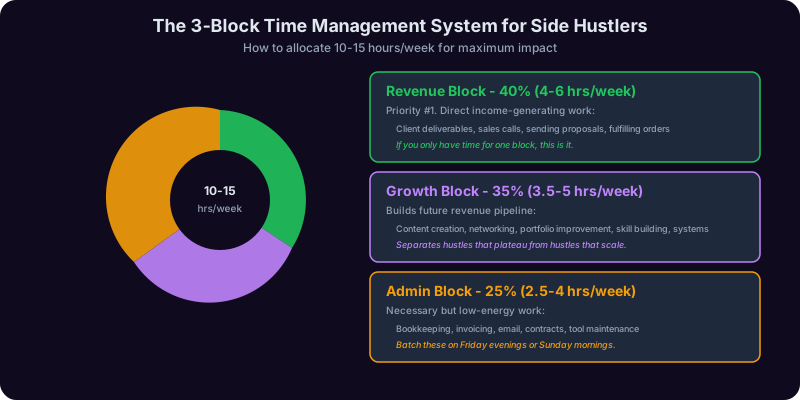
When you only have 10-15 hours per week, you cannot afford to waste any of them deciding what to work on. The 3-Block System eliminates decision fatigue by pre-assigning your side hustle time into three categories:
- Revenue Block (40% of your time): This is the work that directly generates income. Client deliverables, sales calls, sending proposals, and fulfilling orders. This always gets priority. If you only have time for one block in a given week, it should be this one.
- Growth Block (35% of your time): This is the work that builds future revenue. Content creation, networking, improving your portfolio, learning new skills, and building systems that make your hustle more efficient. This block is what separates hustles that plateau from hustles that scale.
- Admin Block (25% of your time): Bookkeeping, invoicing, email, contract management, tool maintenance. Batch these tasks together and handle them in your lowest-energy time slots. Friday evening or Sunday morning are common choices.
Protecting Your Full-Time Job
Your full-time job is paying your bills and funding your side hustle's growth. Torpedoing it is not an option. Here are the specific boundaries you need:
- Never use company equipment for side hustle work. This includes your work laptop, work phone, company email, or company software licenses. Many employment agreements explicitly state that work created on company equipment belongs to the company. Use your own devices, on your own time.
- Review your employment agreement. Look for non-compete clauses, moonlighting restrictions, and intellectual property assignment clauses. Our non-compete agreement guide can help you understand common clauses. Some employers prohibit side businesses in competing industries. Others require you to disclose outside work. A few claim ownership of anything you create while employed. Know what you signed. If you are unsure, consult a lawyer. A one-time $300 legal review is cheaper than a lawsuit.
- Never work on your side hustle during work hours. This seems obvious, but the temptation is real when a client emails during the workday or you have a "quick" task that would only take 10 minutes. Resist. Your employer is paying for your full attention. Stealing their time to build your business is both unethical and risky. If you get caught, you lose your income, your benefits, and your professional reputation.
- Manage your energy, not just your time. If your side hustle consistently leaves you exhausted at your day job, something needs to change. Either reduce your side hustle hours, shift to less intensive work during the week, or improve your sleep and recovery. Showing up to your full-time job visibly drained will attract attention you do not want.
When to Tell Your Employer
This depends on your employment agreement and your company culture. If your agreement requires disclosure, disclose. If it does not, the decision is yours. General guidance:
- Do tell if your agreement requires it, if your side hustle is in an adjacent industry, or if it could be perceived as a conflict of interest.
- Do not tell preemptively if there is no requirement and your hustle is completely unrelated to your employer's business. Some managers view side hustles positively (entrepreneurial, ambitious). Others view them negatively (distracted, flight risk). Know your audience before volunteering information.
For help evaluating your employment agreement's restrictions, the Career Copilot can help you understand common clauses and their implications. If you are concerned about non-compete restrictions specifically, check the career resources section for guidance on navigating workplace limitations.
Financial Management: Separate Accounts, Quarterly Taxes, and Deductions
Side hustle income is real business income, and the IRS treats it accordingly. The penalty for treating it like a hobby is not just disorganized finances. It is unexpected tax bills, missed deductions, and in the worst case, IRS audits with penalties and interest. Getting your financial house in order from day one takes less than 2 hours of setup and saves you thousands of dollars over the life of your side hustle.
Step 1: Separate Your Money Immediately
Open a dedicated business checking account. This is the single most important financial step you can take, and it is non-negotiable. Here is why:
- Legal protection: If you have an LLC, commingling personal and business funds can "pierce the corporate veil," which means a court could ignore your LLC's liability protection and hold you personally responsible for business debts. Keeping separate accounts preserves the legal wall between you and your business.
- Tax preparation: When tax time comes, you need to identify every business expense and every dollar of business income. If your business and personal transactions are mixed in one account, you (or your accountant, at $150-$300/hour) will spend hours sorting through them. A dedicated account means every transaction in it is business-related. Done.
- Financial clarity: Knowing exactly how much your side hustle earns and spends each month is impossible when the money flows through the same account as your groceries, rent, and subscriptions. Separate accounts give you a clear, real-time view of your business's financial health.
Recommended setup:
- Business checking account: Relay, Mercury, or Novo all offer free business checking with no minimums. Open one with your EIN and business name.
- Business savings account: Open a high-yield business savings account and automatically transfer 25-30% of every payment you receive into it. This is your tax reserve. Do not touch it for anything other than quarterly tax payments.
- Business credit card: Use a dedicated business credit card for all business expenses. This creates a second paper trail and often earns rewards on business spending. Chase Ink, Capital One Spark, and American Express Blue Business are strong options for side hustlers.
Step 2: Understand Quarterly Estimated Taxes
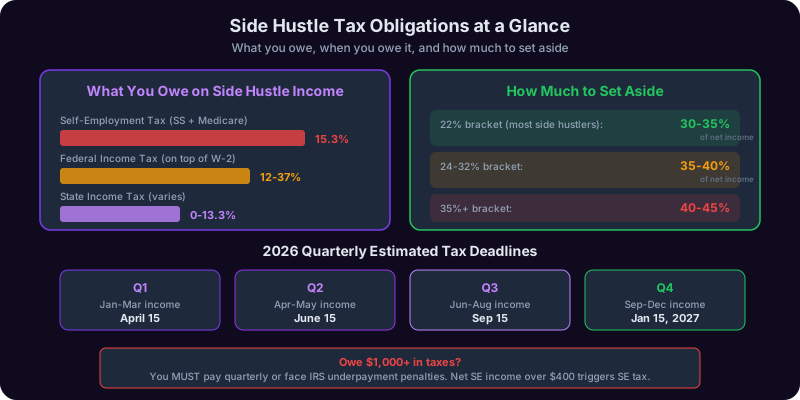
When you earn money as an employee, your employer withholds income tax and FICA taxes from every paycheck. When you earn money from a side hustle, nobody withholds anything. The IRS expects you to pay taxes on this income quarterly, not annually. If you wait until April to settle up, you will owe the tax plus underpayment penalties.
The quarterly estimated tax deadlines for 2026 are:
| Quarter | Income Period | Payment Due Date |
|---|---|---|
| Q1 | January 1 - March 31 | April 15, 2026 |
| Q2 | April 1 - May 31 | June 15, 2026 |
| Q3 | June 1 - August 31 | September 15, 2026 |
| Q4 | September 1 - December 31 | January 15, 2027 |
How much to set aside: As a side hustler, you owe both income tax and self-employment tax (Social Security + Medicare) on your net business income. The self-employment tax rate is 15.3% (12.4% Social Security + 2.9% Medicare). This is on top of your regular income tax rate. Use the IRS estimated tax guide for Form 1040-ES instructions and worksheets.
A simple rule of thumb:
- If your combined income (job + side hustle) puts you in the 22% tax bracket: Set aside 30-35% of your net side hustle income for taxes (22% income tax + 15.3% SE tax, minus the SE tax deduction).
- If your combined income puts you in the 24-32% bracket: Set aside 35-40%.
- If your combined income puts you in the 35%+ bracket: Set aside 40-45%.
Yes, these percentages feel painful. But the alternative is a $5,000+ surprise tax bill in April, plus underpayment penalties. Automate the transfer to your tax savings account on the day you receive each payment and you will never feel the pinch.
Step 3: Track Every Deduction (They Add Up Fast)
Side hustle expenses reduce your taxable income dollar for dollar. A $1,000 deduction saves you $300-$400 in taxes at typical side hustler tax rates. The problem is that most side hustlers miss deductions because they do not track them consistently. Here are the deductions you are most likely eligible for:
| Deduction Category | Examples | Estimated Annual Savings |
|---|---|---|
| Home Office | Dedicated space used exclusively for business (simplified method: $5/sq ft up to 300 sq ft = $1,500 max) | $300 - $600 |
| Software & Tools | Canva, QuickBooks, Zoom, hosting, project management, AI tools | $200 - $1,500 |
| Internet & Phone | Business percentage of your home internet and cell phone bill | $300 - $800 |
| Education & Training | Courses, certifications, books, conferences related to your business | $200 - $2,000 |
| Marketing & Advertising | Website costs, social media ads, business cards, domain names | $100 - $3,000 |
| Professional Services | Accountant, lawyer, business coaching | $200 - $2,000 |
| Equipment | Computer, camera, microphone, desk, chair (business-use portion) | $200 - $3,000 |
| Travel & Meals | Business travel, mileage (67 cents/mile in 2026), client meals (50%) | $100 - $5,000 |
| Health Insurance | Self-employed health insurance deduction (if applicable) | $2,000 - $10,000 |
Tracking method: Use QuickBooks Self-Employed ($15/month) or Wave (free) to categorize transactions automatically. Take photos of receipts with your phone and attach them to transactions. The IRS requires you to keep records for at least 3 years (7 years for certain items), and digital records are fully accepted.
For a comprehensive list of every deduction available to side hustlers and freelancers, see our Freelancer Tax Deductions Complete List. For a full walkthrough of side hustle tax obligations, quarterly payments, and filing strategies, read our Side Hustle Taxes Complete Guide. The Tax Copilot can help you estimate your quarterly payments, identify deductions you might be missing, and prepare for tax filing season without the panic.
Scaling from Side Hustle to Full Business: When and How to Make the Leap
Not every side hustle needs to become a full-time business. Some are perfectly valuable as supplemental income streams that run on 10 hours a week indefinitely. But if your side hustle is growing and you are starting to wonder whether you could do this full-time, here is the framework for making that decision intelligently rather than emotionally.
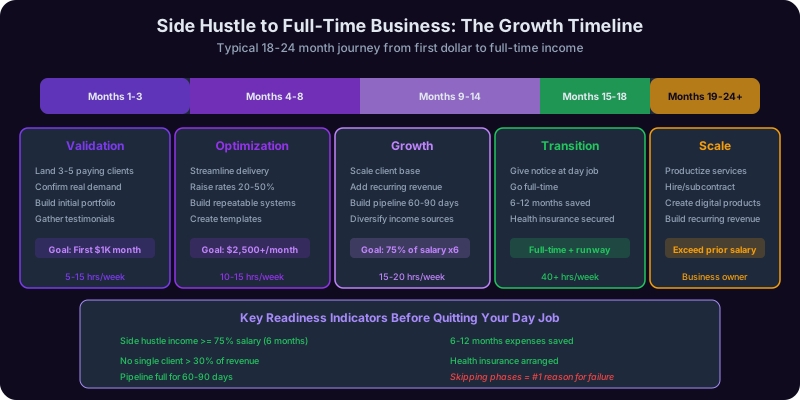
The Financial Readiness Checklist
Quitting your job to go full-time on your side hustle is one of the highest-stakes financial decisions you will ever make. Doing it prematurely is the number one reason side-hustle-turned-businesses fail within the first year. Here is the checklist that separates smart leaps from reckless ones:
- Your side hustle income has matched or exceeded 75% of your full-time salary for at least 6 consecutive months. One good month is not a pattern. Two good months is not a pattern. Six months demonstrates sustainable demand. The 75% threshold (rather than 100%) accounts for the fact that going full-time will give you more hours to grow revenue. But anything below 75% means you are gambling on growth that has not materialized yet.
- You have 6-12 months of personal living expenses saved. Not business expenses. Personal. Rent, food, insurance, debt payments, everything. This is your runway. It is the money that keeps you alive while your business finds its full-time footing. Without it, you will make desperate decisions (accepting bad clients, underpricing, skipping marketing) because you cannot afford to be strategic.
- You have health insurance figured out. In the United States, this is a major factor. COBRA is expensive ($600-$2,000/month for an individual or family). Marketplace plans vary widely. Your spouse's plan might be an option. Figure this out before you resign, not after. For a detailed walkthrough, see our professional resignation guide which covers health insurance transitions in depth.
- Your business has diversified revenue. If 80% of your income comes from one client, you do not have a business. You have a freelance job with one employer. Before going full-time, aim to have at least 3-5 clients or revenue sources so that losing any single one does not sink you. The rule of thumb: no single client should represent more than 30% of your total revenue.
- Your pipeline is full for the next 60-90 days. You need confirmed work or strong leads extending at least 2-3 months into the future. Going full-time with no pipeline means your first month is spent frantically finding work rather than doing it.
The Growth Levers: From Solo to Scalable
There is a ceiling on what one person can earn trading time for money. Even at $200/hour, a solo consultant working 40 billable hours per week maxes out around $400,000/year, and that assumes 50 weeks of fully booked capacity, which is unrealistic. To build a business that earns beyond your personal capacity, you need at least one of these growth levers:
Lever 1: Productize Your Service
Turn your custom service into a standardized package with a fixed scope, fixed price, and repeatable delivery process. A graphic designer who offers "Custom Logo Package: 3 concepts, 2 rounds of revisions, final files in all formats, delivered in 10 business days for $1,500" can deliver twice as many logos per month as one who does custom scoping for every project. Productizing reduces sales friction (clients know exactly what they are getting), increases efficiency (you refine the process with each delivery), and enables you to eventually delegate the work.
Lever 2: Build Recurring Revenue
One-time projects create a revenue roller coaster. You finish a project, income drops to zero, you scramble to find the next one. Recurring revenue (monthly retainers, subscriptions, maintenance contracts) creates a stable income floor that covers your base expenses while you pursue growth. Examples:
- A social media manager charges $1,200/month per client on a 6-month contract. Five clients = $6,000/month in predictable revenue.
- A web developer offers a $200/month website maintenance and hosting package. Twenty clients = $4,000/month in recurring revenue with minimal time investment.
- A bookkeeper charges $600/month per client for ongoing monthly reconciliation. Eight clients = $4,800/month.
Lever 3: Hire or Subcontract
The first hire does not need to be a full-time employee. Start by subcontracting overflow work to a trusted freelancer. If you are a web developer earning $150/hour and you can subcontract some work to a junior developer at $50/hour, you earn $100/hour on work you do not personally do. This is the fundamental transition from self-employed to business owner: making money from other people's labor, not just your own.
Key considerations for your first subcontractor:
- Start with project-based contracts, not ongoing commitments
- Choose someone whose skills complement yours, not duplicate them
- Create clear quality standards and review every deliverable before it reaches the client
- Pay fairly. Squeezing subcontractors on rates leads to turnover and poor quality
Lever 4: Create Digital Products
Digital products (courses, templates, guides, software tools) are the ultimate leverage play because they decouple your income from your time. You create the product once and sell it indefinitely. A marketing consultant who creates a $297 course on "Social Media Strategy for Restaurants" and sells 20 copies per month earns $5,940/month from work completed in the past. The marginal cost of each additional sale is essentially zero.
The Transition Timeline
The healthiest side-hustle-to-business transitions follow a predictable timeline:
| Phase | Timeline | Focus | Key Milestone |
|---|---|---|---|
| Validation | Months 1-3 | Land first 3-5 paying clients, confirm demand | First $1,000 month |
| Optimization | Months 4-8 | Streamline delivery, raise rates, build systems | Consistent $2,500+/month |
| Growth | Months 9-14 | Scale client base, add recurring revenue, build pipeline | Revenue matches 75% of salary for 6 months |
| Transition | Months 15-18 | Give notice, go full-time, accelerate growth | Full-time with 6-month runway saved |
| Scale | Months 19-24+ | Productize, hire, create digital products | Revenue exceeds previous salary by 50%+ |
This is not a rigid timeline. Some hustles move faster (consulting, web development) and some move slower (e-commerce, digital products). The point is that each phase has a clear focus and a clear milestone. Do not skip phases. The hustlers who jump from Validation to Transition (quitting their job after 3 months of income) are the ones who end up back in full-time employment within a year. According to the U.S. Small Business Administration, proper business planning and structure selection significantly increase the odds of long-term survival.
The Emotional Readiness Factor
Financial readiness is necessary but not sufficient. You also need to be emotionally prepared for the reality of full-time self-employment:
- Income volatility: Your income will fluctuate month to month, sometimes dramatically. A $10,000 month followed by a $3,000 month is normal. If inconsistent income causes you severe anxiety, build a larger financial buffer (12+ months) or consider keeping your side hustle as a side hustle indefinitely.
- Isolation: Working alone is harder than most people expect. The casual social interactions of an office, the daily rhythm of meetings and collaboration, and the sense of being part of something larger all disappear. Plan for this by joining coworking spaces, attending industry meetups, or scheduling regular video calls with other business owners.
- Decision fatigue: Every decision is yours. Pricing, marketing, operations, taxes, tools, clients, subcontractors. The volume of decisions in a solo business is relentless. Build systems and processes that automate or eliminate as many routine decisions as possible.
- Identity shift: Going from "I work at [Company]" to "I run my own business" is a deeper psychological shift than most people anticipate. Your professional identity, your social circle, and your daily structure all change simultaneously. Give yourself time to adjust.
The Business Copilot can help you build your business plan, create financial projections, and stress-test your readiness for the full-time transition. The Career Copilot can help you evaluate whether going full-time is the right move for your long-term career trajectory or whether keeping the side hustle as supplemental income serves your goals better. For ongoing help with financial planning after the transition, the Tax Copilot can keep you on track with quarterly payments and deduction tracking. Explore more business and freelance scenarios at the scenarios library.
Frequently Asked Questions
Recommended Copilots
Recommended Copilots
Evaluate which side hustle opportunities align with your existing skills and long-term career goals
Try Free →Build your business plan, validate your idea, and plan the transition from side hustle to full-time business
Try Free →Set competitive rates, manage client relationships, and build a sustainable freelance practice
Try Free →Estimate quarterly tax payments, track deductions, and stay compliant with IRS requirements
Try Free →Create client outreach strategies, content marketing plans, and promotional materials for your side hustle
Try Free →Related Articles
Get Answers From the Business Copilot
From choosing the right idea to landing your first clients to managing taxes, the Copilotly AI assistants guide you through every step of building a profitable side hustle. Get personalized advice on business strategy, pricing, legal setup, and financial planning so you can focus on doing the work.