

Credit Score Ranges Explained: From Poor to Exceptional
A credit score is a three-digit number that lenders use to evaluate how likely you are to repay borrowed money. The two most widely used scoring models are FICO (used by 90% of top lenders) and VantageScore. Both use a 300-850 scale, but they categorize the ranges slightly differently.
Here is how FICO breaks down its score ranges as of 2026:
| Score Range | Rating | % of Americans |
| 800 - 850 | Exceptional | 21% |
| 740 - 799 | Very Good | 25% |
| 670 - 739 | Good | 21% |
| 580 - 669 | Fair | 17% |
| 300 - 579 | Poor | 16% |
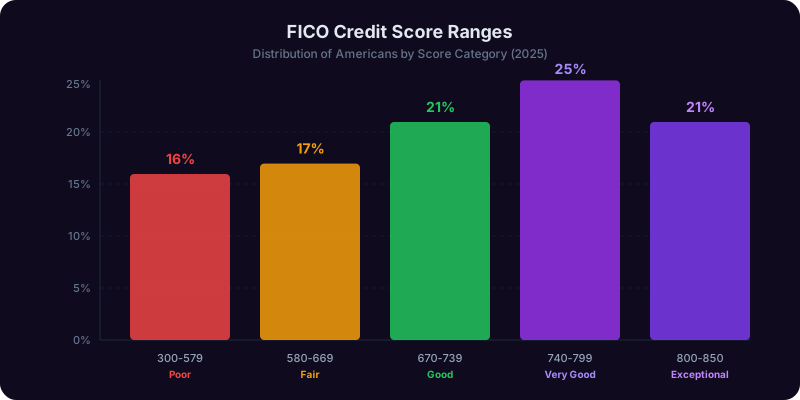
A score of 670 or above is generally considered "good" by most lenders. However, the score you actually need depends entirely on what you are applying for. A mortgage typically requires at least 620 for an FHA loan and 740 or higher to get the best interest rates on a conventional loan. An auto loan might approve you at 580, but you will pay significantly more in interest compared to someone with a 750+ score. Credit card issuers offering the best rewards cards usually require 740 or higher.
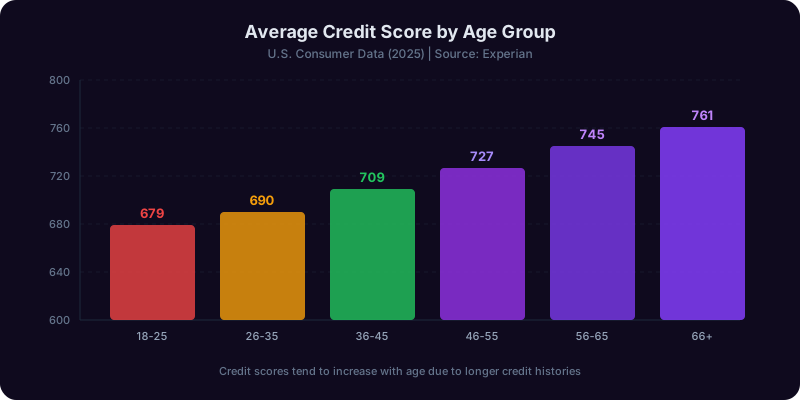
The average FICO score in the United States reached 718 in 2025, according to Experian's annual consumer credit review, up from 714 in 2023. This means the typical American falls in the "Good" range. If your score is below average, you have significant room for improvement, and the strategies in this guide can help. The Finance Copilot can analyze your specific financial situation and create a personalized plan to raise your score.
One important distinction: you do not have a single credit score. You have dozens of scores across different models and versions. Your FICO 8 score (the most commonly used) may differ from your FICO 9, FICO 10, or VantageScore 3.0. Lenders also pull from three different credit bureaus (Equifax, Experian, and TransUnion), and each bureau may have slightly different information, leading to different scores. A 20-40 point difference between bureaus is completely normal. For a deeper understanding of how these scoring models work, read our complete guide to understanding credit scores.
What Credit Score Do You Actually Need? Thresholds by Loan Type
The "good" score threshold varies dramatically depending on what you are trying to do. Here are the minimum and ideal scores for the most common financial products in 2026:
| Product | Minimum Score | Best Rates Score |
| Conventional Mortgage | 620 | 740+ |
| FHA Mortgage (3.5% down) | 580 | 680+ |
| VA Mortgage | No official minimum (most lenders want 620+) | 720+ |
| Auto Loan (new car) | 500 (subprime) | 720+ |
| Auto Loan (used car) | 500 | 700+ |
| Premium Rewards Credit Card | 700 | 750+ |
| Personal Loan | 580 | 720+ |
| Apartment Rental | 620 (varies by landlord) | 700+ |
| Private Student Loan | 650 | 750+ |
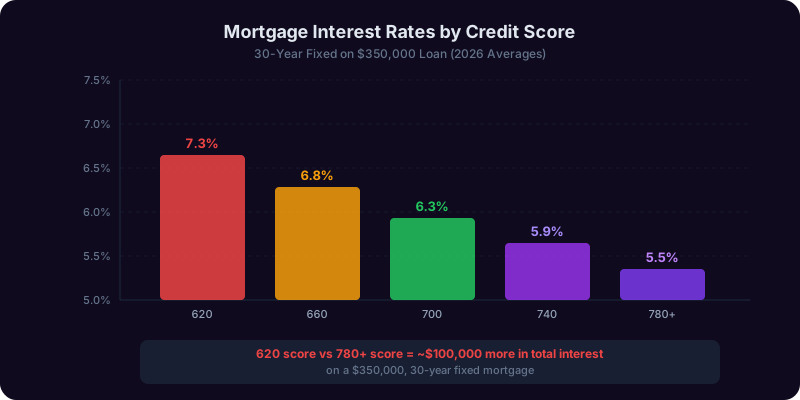
The financial impact of your score is staggering. On a $350,000 30-year fixed mortgage in 2026, the difference between a 680 score and a 760 score can mean 0.5 to 1.0 percentage points in interest rate. That translates to roughly $50,000 to $100,000 more in total interest paid over the life of the loan. According to the Consumer Financial Protection Bureau's rate explorer tool, even small score differences can meaningfully change the rates you are offered. On an auto loan for $35,000 over 60 months, a borrower with a 620 score might pay an interest rate of 11%, while someone with a 760 score pays 5.5%. That difference costs the lower-score borrower approximately $5,200 more over the loan term.
Beyond loans, your credit score affects insurance premiums in most states (auto and homeowners insurers use credit-based insurance scores), security deposit requirements for utilities and apartments, and even employment decisions in some industries. About 29% of employers run credit checks as part of the hiring process, particularly for positions involving financial responsibilities.
If you are planning a major purchase and want to understand exactly where your score needs to be, the Finance Copilot can walk you through the requirements for your specific goal and help you create a timeline to reach your target score. For first-time buyers, our budget planning tool can help you model monthly payments at different interest rate tiers. You can also check out our guide to first-time home buyer mistakes if a mortgage is your goal.
How Credit Scores Are Calculated: The 5 Factors That Determine Your Number
Understanding how your score is calculated gives you the power to improve it strategically. FICO uses five weighted factors, each contributing a specific percentage to your overall score:
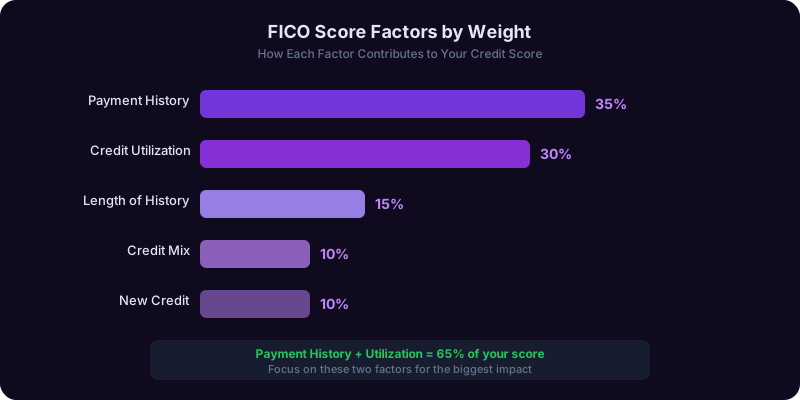
1. Payment History (35% of your score)
This is the single largest factor. It tracks whether you have paid your bills on time across all credit accounts. A single 30-day late payment can drop your score by 60-110 points depending on how high your score was before the delinquency. The higher your starting score, the harder you fall. A 90-day late payment is worse than 30-day, and accounts sent to collections are worse still. The good news is that the impact of late payments fades over time. A single late payment from 3+ years ago has minimal effect on your current score. Bankruptcy remains on your report for 7-10 years but its impact diminishes significantly after 2 years.
2. Credit Utilization (30% of your score)
This measures how much of your available credit you are using. It is calculated both per-card and across all cards combined. If you have a credit card with a $10,000 limit and a $3,000 balance, your utilization on that card is 30%. The commonly cited rule is to keep utilization below 30%, but data from FICO shows that people with scores above 800 typically keep utilization below 7%. Utilization has no memory: it only reflects your current balances. If you pay down your balances today, your utilization-based score improvement can appear within 30 days when your issuer reports to the bureaus.
3. Length of Credit History (15% of your score)
This includes the age of your oldest account, the age of your newest account, and the average age of all accounts. Longer history is better. This is why closing your oldest credit card can hurt your score even if you never use it. The average age of accounts for consumers with exceptional credit is 11+ years.
4. Credit Mix (10% of your score)
FICO rewards having a variety of credit types: credit cards (revolving credit), auto loans, mortgages, student loans (installment credit), and retail accounts. You do not need one of each, but having only credit cards and no installment loans will slightly limit your score ceiling.
5. New Credit Inquiries (10% of your score)
Each hard inquiry (when a lender pulls your credit for a lending decision) can reduce your score by 5-10 points. The impact lasts about 12 months. However, FICO groups multiple inquiries of the same type (mortgage, auto, or student loan shopping) within a 45-day window as a single inquiry, so rate shopping does not penalize you. Checking your own credit is a soft inquiry and does not affect your score at all. The myFICO education center provides additional details on how each factor is weighted in different FICO model versions.
The Budgeting Copilot can help you monitor these factors and prioritize which ones to address first based on your current credit profile. The biggest bang for your buck almost always comes from fixing payment history issues and reducing utilization.

Get Answers From the Finance Copilot
Use the Finance Copilot to analyze your credit profile, identify the fastest ways to raise your score, and create a personalized improvement plan. The Budgeting Copilot can help you manage debt payoff and payment schedules.
How to Check Your Credit Score for Free (Without Hurting It)
You can check your credit score without paying a dime and without any impact on your score. Here are the legitimate free options available in 2026:
AnnualCreditReport.com: This is the only federally authorized source for free credit reports from all three bureaus, as mandated by the Fair Credit Reporting Act (FCRA). As of 2026, you can access your reports weekly for free (this was originally a pandemic-era policy that was made permanent in 2023). The reports show your full credit history but do not include your actual score number.
Your bank or credit card issuer: Most major banks and credit card companies now provide free FICO or VantageScore access through their apps or online banking. Chase, Bank of America, Capital One, Discover, American Express, and Wells Fargo all offer this feature to cardholders. This is one of the easiest ways to monitor your score regularly.
Credit Karma: Provides free VantageScore 3.0 scores from TransUnion and Equifax, updated weekly. The scores may differ from your FICO score by 20-40 points in either direction because VantageScore and FICO weigh factors slightly differently. Credit Karma makes money through targeted financial product recommendations, not by selling your data.
Experian: Offers a free FICO 8 score based on your Experian credit report through its website and app. This is particularly useful because FICO 8 is the most widely used scoring model among lenders.
A critical point: checking your own credit is always a soft inquiry and never affects your score. The myth that checking your credit hurts it persists but is completely false for self-checks. Only hard inquiries from lender applications affect your score.
You should check your credit reports (not just your score) at least once per quarter to look for errors. A Federal Trade Commission study found that 1 in 4 consumers had errors on their credit reports that could affect their scores. Common errors include accounts that do not belong to you (possible identity theft or mixed files), incorrect late payment reports, closed accounts listed as open, and wrong credit limits (which distort your utilization ratio). If you suspect identity theft, consider freezing your credit at all three bureaus immediately.
If you find an error, you can dispute it directly with the credit bureau online. By law, the bureau must investigate within 30 days. If the error is verified, your score adjustment can happen within one reporting cycle. The Finance Copilot can help you review your credit report, identify potential errors, and guide you through the dispute process step by step.
How to Improve Your Credit Score Fast: Strategies That Work in 30 to 90 Days
If you need to boost your score quickly, focus on the strategies that produce the fastest results. Here is a prioritized action plan ranked by speed and impact:
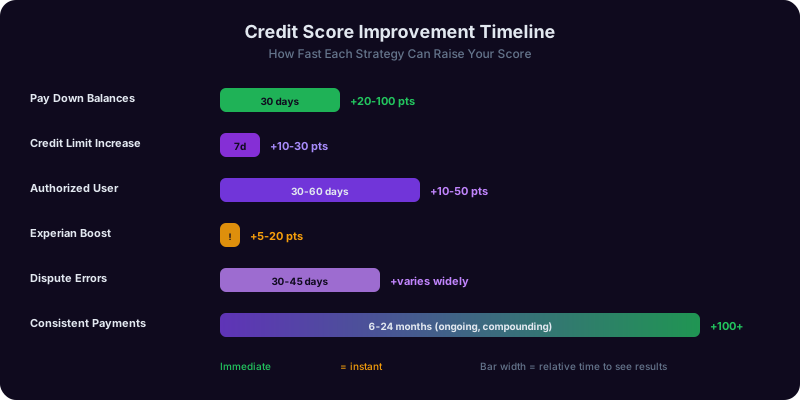
1. Pay down credit card balances (impact: 20-100+ points, timeline: 30 days)
Reducing your credit utilization is the fastest way to raise your score because utilization has no memory. Your score only reflects your most recently reported balances. If you have $5,000 in credit card debt across $10,000 in total limits (50% utilization), paying it down to $500 (5% utilization) can boost your score by 50-100 points within a single billing cycle. If you cannot pay down the balance, consider making a payment a few days before your statement closing date so a lower balance gets reported to the bureaus.
2. Request a credit limit increase (impact: 10-30 points, timeline: 1-7 days)
If you cannot pay down balances, increasing your credit limits achieves the same utilization reduction mathematically. Many issuers allow you to request increases online or by phone. Some perform a soft pull (no score impact); others do a hard pull (small temporary dip). Ask your issuer which type they use before requesting. If you have a $5,000 limit with a $2,500 balance (50% utilization), getting a limit increase to $10,000 drops your utilization to 25% without paying a cent.
3. Become an authorized user (impact: 10-50 points, timeline: 30-60 days)
If a family member or close friend has a credit card with a long history, low utilization, and perfect payment record, being added as an authorized user on that account can boost your score. The entire positive history of that account gets added to your credit report. You do not even need to use or possess the physical card. This strategy is particularly effective for people with thin credit files or short credit histories.
4. Use Experian Boost or UltraFICO (impact: 5-20 points, timeline: immediate)
Experian Boost allows you to add utility, phone, and streaming service payment history to your Experian credit file. UltraFICO factors in your checking and savings account history. Both are free and can provide an immediate score bump, particularly for people with thin credit files. The average Experian Boost user sees a 13-point increase.
5. Dispute credit report errors (impact: varies widely, timeline: 30-45 days)
If your report contains inaccurate negative information (a late payment you actually made on time, an account that is not yours, or an incorrect balance), disputing it can produce significant score improvements. A removed late payment alone can boost your score by 60-110 points.
The Budgeting Copilot can help you build a debt payoff plan that strategically targets the cards where reducing balances will have the largest impact on your utilization ratio. For a broader financial plan, try the budget planning tool to see how debt payments fit into your monthly cash flow.
Long-Term Credit Building: Habits That Keep Your Score Above 750
Quick fixes get you started, but sustained excellent credit requires consistent habits. People with scores above 750 share these behaviors:
They never miss payments. Set up autopay for at least the minimum payment on every account. A single missed payment can undo months of progress. If you are worried about overdrafts from autopay, set a calendar reminder 5 days before each due date and pay manually. The Budgeting Copilot can send you reminders and help you schedule payments across all your accounts.
They keep utilization consistently low. People with 800+ scores carry an average utilization of just 5-7%. This does not mean you need to avoid using credit cards. Instead, pay your balance in full each month, or even make mid-cycle payments to keep reported balances low. Some credit-savvy consumers pay their balance right before the statement closing date so the reported utilization is near zero.
They keep old accounts open. Even if you no longer use your oldest credit card, keeping it open preserves your credit history length and your total available credit (which helps utilization). If the card has an annual fee, call the issuer and ask to downgrade to a no-fee version of the card rather than closing it.
They apply for new credit sparingly. Each hard inquiry causes a small, temporary dip. More importantly, each new account lowers your average account age. Opening 3-4 new credit cards in a short period can drop your score by 30-50 points. Space new applications at least 6 months apart unless you are rate-shopping for a mortgage or auto loan within a 45-day window.
They maintain a healthy credit mix. Over time, having both revolving accounts (credit cards) and installment accounts (auto loan, mortgage, student loan, or credit builder loan) strengthens your profile. You should never take on debt just for credit mix purposes, but if you are making a purchase anyway, financing it can diversify your credit types.
They monitor their credit regularly. Checking your score monthly and reviewing your full credit reports quarterly catches errors early and helps you spot identity theft before it causes serious damage. Set a recurring quarterly reminder to pull reports from AnnualCreditReport.com.
Building excellent credit is a marathon. Most people who reach 800+ have been managing credit responsibly for 10 or more years. But you can reach the "Very Good" range (740+) within 1-3 years of disciplined behavior, even if you are starting from a fair score. If you are starting from zero, see our guide on how to build credit from nothing for a month-by-month roadmap. The Finance Copilot can help you set milestones and track your progress toward your target score over time.
Credit Score Myths That Cost You Points
Misinformation about credit scores is everywhere. Here are the most common myths that lead people to make decisions that actually hurt their scores:
Myth: Checking your own credit lowers your score. This is false. Self-checks are soft inquiries with zero score impact. You can check your score daily without any penalty. Only hard inquiries from lender applications affect your score, and even those have a small, temporary impact of 5-10 points.
Myth: You need to carry a balance to build credit. This is one of the most expensive myths in personal finance. Carrying a balance and paying interest does nothing to improve your score. In fact, carrying a higher balance increases your utilization ratio and can lower your score. Pay your statement balance in full every month. Your on-time payment is reported to the bureaus whether you carry a balance or not.
Myth: Closing a credit card improves your score. Closing a card reduces your total available credit (increasing utilization) and eventually removes that account's history from your report. Both effects lower your score. Keep cards open even if you rarely use them. Put a small recurring charge on unused cards (like a streaming subscription) so the issuer does not close them for inactivity.
Myth: Income affects your credit score. Your income, employment status, and bank balances are not factored into your FICO or VantageScore. A person earning $30,000 per year with perfect payment history and low utilization can have a higher score than someone earning $300,000 who misses payments and maxes out cards. Income matters for loan approval amounts but not for your credit score itself.
Myth: Paying off a collection account removes it from your report. A paid collection still appears on your report for 7 years from the original delinquency date. However, newer FICO models (FICO 9 and FICO 10) ignore paid collection accounts entirely, and VantageScore 3.0 and 4.0 also ignore paid collections. Ask your lender which scoring model they use. Additionally, you may be able to negotiate a "pay for delete" agreement where the collector agrees to remove the account from your report in exchange for payment, though not all collectors will agree to this.
Myth: All debt is bad for your credit. Responsibly managed debt actually builds your score. A mortgage with on-time payments, a car loan paid as agreed, and credit cards paid in full each month all contribute positively to your payment history, credit mix, and credit age. The key is keeping balances manageable relative to your limits and never missing payments.
If you are unsure whether a financial decision will help or hurt your credit, ask the Finance Copilot before you act. Small mistakes like closing your oldest card or paying off the wrong debt first can set your progress back by months.
Special Situations: Rebuilding After Bankruptcy, Divorce, or Identity Theft
Certain life events can devastate your credit score. Here is how to recover from the most common ones:
After Bankruptcy: A Chapter 7 bankruptcy stays on your report for 10 years and a Chapter 13 for 7 years. The initial score impact is severe: most people see a drop of 130-240 points. However, rebuilding can begin immediately. Within 6-12 months of discharge, you can typically qualify for a secured credit card. Use it responsibly (small purchases, paid in full monthly), and your score will begin climbing. Many people who file bankruptcy can reach a 700+ score within 3-4 years by consistently adding positive credit history. The bankruptcy's impact on your score diminishes substantially after 2 years, even though it remains visible on your report longer.
After Divorce: Divorce itself does not appear on your credit report, but its financial consequences often damage credit. Joint accounts where your ex stops paying, increased debt from legal fees, and reduced household income can all cause problems. The first step is to separate all joint accounts. Close joint credit cards (or remove yourself as an authorized user) and refinance joint loans into one person's name. Monitor your credit closely during and after divorce proceedings. If your ex fails to pay a joint account, you are equally responsible, and the late payment hits both of your credit reports.
After Identity Theft: If someone opens fraudulent accounts in your name, your score can drop precipitously. The recovery process involves filing a police report, placing a fraud alert or credit freeze with all three bureaus, and disputing every fraudulent account. The bureaus are required to investigate within 30 days. Once fraudulent accounts are removed, your score typically recovers within 1-2 billing cycles. A credit freeze (different from a fraud alert) prevents anyone from opening new accounts in your name and is free to place and lift at all three bureaus. For step-by-step instructions, see our complete guide to freezing your credit. Consider a permanent freeze if you are not actively applying for credit.
For young adults or immigrants with no credit history: You do not have a "zero" score. Instead, you are "credit invisible," meaning the bureaus do not have enough data to generate a score. Building from scratch is covered in our detailed guide on how to build credit from nothing. The fastest path is typically a secured credit card combined with becoming an authorized user on a family member's established account. You may also benefit from our guide on building credit from scratch, which includes strategies for students and immigrants.
No matter what situation damaged your credit, the path forward involves the same fundamentals: on-time payments, low utilization, patience, and monitoring. The Finance Copilot can help you create a customized rebuilding plan based on your specific circumstances, and the Budgeting Copilot can help you manage cash flow during the recovery period.
Frequently Asked Questions
Recommended Copilots
Recommended Copilots
Get personalized advice on improving your credit score and planning major financial decisions
Try Free →Create a debt payoff plan and manage monthly payments to keep your credit utilization low
Try Free →Understand how your credit score affects insurance premiums and find better rates
Try Free →Related Articles
Get Answers From the Finance Copilot
Use the Finance Copilot to analyze your credit profile, identify the fastest ways to raise your score, and create a personalized improvement plan. The Budgeting Copilot can help you manage debt payoff and payment schedules.