
Why Credit Matters: The Real Cost of Having No Credit History
If you have never borrowed money, you do not have bad credit. You have no credit, and in many ways that is just as limiting. Lenders, landlords, insurers, and even employers use your credit history to make decisions. Without one, you are invisible to the systems that control access to housing, transportation, and financial products.
Here is what having no credit actually costs you in 2026:
Housing
Landlords in competitive rental markets routinely run credit checks. With no credit history, you face three common outcomes: outright rejection, a requirement to pay 2-3 months of rent upfront as a security deposit instead of the standard one month, or the need for a cosigner. In cities like New York, San Francisco, and Austin, a missing credit report can cost you $2,000-$5,000 in extra deposits before you even move in.
Auto Insurance
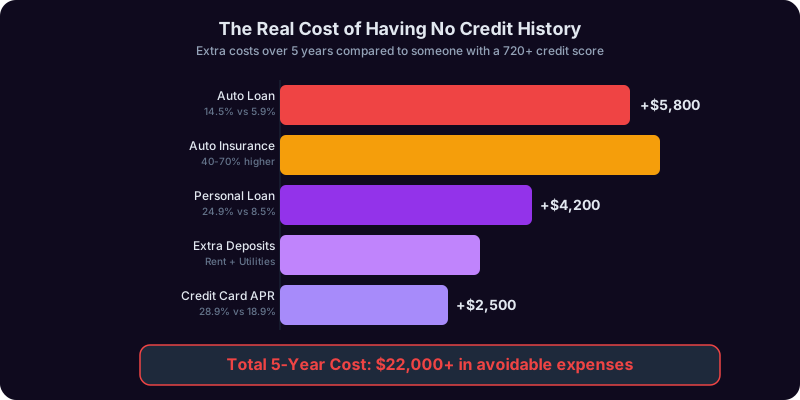
In 48 states (all except California and Massachusetts), auto insurers use credit-based insurance scores to set your premiums. According to a 2025 Consumer Federation of America study, drivers with no credit history pay 40-70% more for the same coverage compared to drivers with good credit. On a policy that costs $1,800/year for someone with a 750 score, you could be paying $2,500-$3,000 annually. That is $700-$1,200 per year in avoidable costs.
Employment
Roughly 29% of employers check credit reports as part of the hiring process, according to the National Association of Professional Background Screeners. This is most common in financial services, government, and positions involving money handling. They cannot see your score, but they can see whether you have any credit history at all, and an empty report raises questions.
Utilities and Cell Phones
Electric, gas, water, and cell phone providers check credit before establishing service. Without a credit history, expect to pay $100-$500 in security deposits per utility account. A cell phone carrier may deny you a postpaid plan entirely, limiting you to prepaid options that cost more per month and do not include device financing.
The Interest Rate Penalty
When you eventually do get approved for credit products, having a thin or nonexistent file means you pay the highest available rates:
| Credit Product | Good Credit Rate (720+) | No/Thin Credit Rate | Extra Cost Over 5 Years |
|---|---|---|---|
| Auto Loan ($25,000) | 5.9% APR | 14.5% APR | $5,800+ |
| Credit Card | 18.9% APR | 28.9% APR (if approved) | Varies with balance |
| Personal Loan ($10,000) | 8.5% APR | 24.9% APR | $4,200+ |
| Mortgage ($300,000) | 6.2% APR | Not available | Cannot qualify |
The total lifetime cost of having no credit, factoring in higher deposits, insurance premiums, and interest rates, can easily exceed $100,000 over a decade. Building credit is not optional financial optimization. It is a fundamental money skill that affects nearly every financial transaction you will make.
The Finance Copilot can help you calculate the specific costs you are facing right now due to limited credit history and create a prioritized plan to address the most expensive gaps first.
This guide provides general financial information for educational purposes. It is not financial advice. Credit products, rates, and terms vary by issuer and applicant. Consult a qualified financial advisor for personalized recommendations.
See our real-world walkthrough: landlord keeping security deposit.
Understanding Credit Scores: FICO vs. VantageScore and the 5 Factors
Before you start building credit, you need to understand what you are building toward. A credit score is a three-digit number between 300 and 850 that predicts your likelihood of repaying borrowed money. There are two major scoring models, and they treat new credit builders slightly differently.

FICO Score
Used in approximately 90% of lending decisions, the FICO score requires at least one credit account open for 6 months and at least one creditor reporting activity within the last 6 months to generate a score. This means you will be "unscoreable" for roughly the first 6 months of your credit journey. Learn more about FICO scoring models at myFICO.com.
VantageScore
Created by the three credit bureaus (Equifax, Experian, TransUnion), VantageScore can generate a score with as little as one month of history and one account. This is why Credit Karma (which uses VantageScore 3.0) may show you a score before your bank does.
Score Ranges and What They Mean
| Score Range | Rating | What It Gets You |
|---|---|---|
| 800-850 | Exceptional | Best rates on everything, instant approvals |
| 740-799 | Very Good | Near-best rates, most premium cards |
| 670-739 | Good | Solid rates, mainstream credit products |
| 580-669 | Fair | Subprime rates, limited options |
| 300-579 | Poor | Very limited options, high deposits |
The 5 FICO Factors and Their Weights
Every action you take with credit affects one or more of these five factors:
| Factor | FICO Weight | What New Builders Should Know |
|---|---|---|
| Payment History | 35% | One missed payment in your first year is devastating. Autopay is non-negotiable. |
| Credit Utilization | 30% | With a $200 limit on a secured card, spending $60 puts you at 30%. Keep it under $20. |
| Length of History | 15% | You cannot speed this up. Every month your account ages helps. Never close your first card. |
| New Credit | 10% | Each application causes a hard inquiry. Space applications 6+ months apart when starting out. |
| Credit Mix | 10% | Having both revolving (credit card) and installment (credit builder loan) helps, but do not take on debt just for mix. |
For someone building from nothing, the math simplifies dramatically: payment history (35%) + utilization (30%) = 65% of your score. If you pay on time every single month and keep your balances extremely low relative to your limits, you are controlling nearly two-thirds of the equation. The rest follows with time.
For a deeper dive into each factor with specific strategies, read our complete credit score guide. The Finance Copilot can also explain how each factor applies to your specific credit profile as it develops.
Secured Credit Cards: The Best First Step for Most People
A secured credit card is the single most reliable way to start building credit from zero. It works exactly like a regular credit card, except you provide a refundable security deposit that typically equals your credit limit. If you deposit $200, your credit limit is $200. The issuer holds the deposit as collateral, which is why they can approve you with no credit history.
How Secured Cards Build Credit
Every month, the card issuer reports your balance, payment status, and credit limit to the three major credit bureaus (Equifax, Experian, TransUnion). This is identical to what happens with an unsecured card. The bureaus and scoring models do not distinguish between secured and unsecured cards on your report. As far as your credit score is concerned, a secured card is a credit card.
The process: you charge a small amount each month (a subscription, gas, groceries), the statement closes and reports a balance, you pay the full statement balance by the due date, and the on-time payment is recorded. Repeat for 6-12 months, and you have a credit score.
Best Secured Credit Cards for Building Credit in 2026
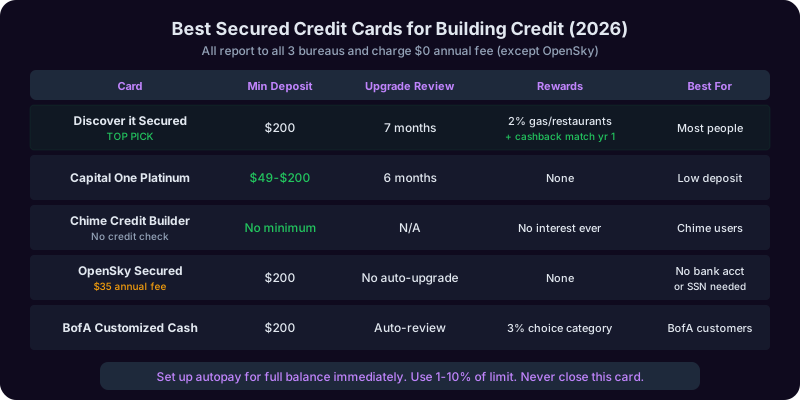
| Card | Annual Fee | Minimum Deposit | Reports to All 3 Bureaus | Upgrade Path | Standout Feature |
|---|---|---|---|---|---|
| Discover it Secured | $0 | $200 | Yes | Auto-review at 7 months | 2% cash back at gas/restaurants (up to $1,000/quarter), 1% everywhere else. Cashback match first year. |
| Capital One Platinum Secured | $0 | $49-$200 | Yes | Auto-review at 6 months | Deposit as low as $49 for a $200 limit. Automatic credit line reviews. |
| Chime Secured Credit Builder Card | $0 | No minimum | Yes | N/A (different model) | No credit check to apply. Spend from your Chime account balance. No interest charges ever. |
| OpenSky Secured Visa | $35 | $200 | Yes | No auto-upgrade | No credit check, no bank account required. Good for people who cannot open a bank account. |
| Bank of America Customized Cash Secured | $0 | $200 | Yes | Auto-review for upgrade | Choose your 3% cash back category. Strong upgrade path to BofA unsecured cards. |
How to Use a Secured Card the Right Way
- Set up autopay for the full statement balance immediately. Not the minimum payment. The full balance. This ensures you never pay interest and never miss a payment. These two things alone control 65% of your score.
- Use 1-10% of your credit limit each month. On a $200 limit card, charge $5-$20 per month. A single streaming subscription ($15.99) is perfect. Do not use the card for large purchases that push you above 10% utilization.
- Do not carry a balance. The myth that carrying a balance builds credit faster is false. It only costs you interest. Pay in full every month.
- Let the statement close before paying. If you pay before the statement closes, the reported balance may be $0, which some scoring models treat slightly less favorably than a small balance. Charge, wait for the statement, then pay in full by the due date.
- Never close this card. Your first credit card will eventually become your oldest account. Even after you graduate to better cards, keep this one open with a small recurring charge. The age of your oldest account matters for years to come.
When to Expect Your Deposit Back
Most issuers review your account after 6-12 months of responsible use. If you qualify, they upgrade you to an unsecured card and refund your deposit. Discover typically reviews at 7 months. Capital One reviews at 6 months. If you are not auto-upgraded, call the issuer and request a review after 12 months of perfect payments.
The Budgeting Copilot can help you set up a monthly spending plan that keeps your secured card utilization in the optimal range while you build your credit foundation.

Get Answers From the Finance Copilot
Tell the Finance Copilot your starting point - no credit, thin file, or rebuilding - and get a step-by-step plan with specific product recommendations, monthly targets, and timeline estimates tailored to your situation.
Credit Builder Loans: Adding an Installment Account to Your Mix
A credit builder loan (CBL) works in reverse compared to a traditional loan. Instead of receiving money upfront and paying it back, you make fixed monthly payments into a savings account or certificate of deposit, and the lender releases the funds to you after you finish paying. The lender reports your payments to the credit bureaus, building your payment history with an installment account.
Why Credit Builder Loans Matter
If you only have a secured credit card, your credit file shows one revolving account. Adding a credit builder loan gives you an installment account, which improves your credit mix (10% of your FICO score). More importantly, it doubles the number of accounts reporting on-time payments. Studies by the Consumer Financial Protection Bureau found that people who used a credit builder loan alongside a credit card saw the largest score improvements, averaging 25-40 points more than those using either product alone.
How Credit Builder Loans Work
- You apply (most require no credit check or accept thin files)
- The lender sets aside $300-$1,000 in a locked savings account or CD
- You make fixed monthly payments (typically $25-$50/month for 12-24 months)
- Each payment is reported to the credit bureaus as an on-time installment payment
- When the loan term ends, you receive the saved funds minus fees and interest
The net cost is usually $20-$60 in total interest and fees for a 12-month loan. Think of it as paying $20-$60 to build 12 months of installment payment history.
Best Credit Builder Loan Options in 2026
| Provider | Type | Loan Amount | Monthly Cost | Term | Reports To | Key Feature |
|---|---|---|---|---|---|---|
| Self (formerly Self Lender) | Fintech | $520-$1,700 | $25-$150 | 12-24 months | All 3 bureaus | Most popular CBL. Also offers a secured Visa card that uses your CBL savings as deposit. |
| MoneyLion | Fintech | $500-$1,000 | Varies | 12 months | All 3 bureaus | No hard credit check. Free with MoneyLion membership. |
| SeedFi (Intuit) | Fintech | $500 | As low as $10 | Varies | All 3 bureaus | Very low monthly minimums. Backed by Intuit (TurboTax parent). |
| Local Credit Unions | Traditional | $500-$2,000 | Varies | 6-24 months | Varies (ask) | Often lower interest rates. May offer additional banking relationship benefits. |
| Possible Finance | Fintech | $200-$500 | Varies | 8 months | All 3 bureaus | Shorter term option. App-based. Available in 29 states. |
The Optimal Strategy: Secured Card + Credit Builder Loan Together
The most effective credit-building combination for someone starting from zero is:
- Month 1: Open a secured credit card (Discover it Secured or Capital One Platinum Secured)
- Month 1-2: Open a credit builder loan (Self $520 plan at $48/month for 12 months)
- Monthly: Charge $10-$20 on the secured card, pay in full. Make CBL payment on time.
This gives you two accounts reporting positive payment history from the start, a credit mix of revolving + installment, and accelerates your score generation. The total monthly cost is approximately $48 (CBL payment, which you get back) plus whatever you charge on the card (which you pay in full).
Important Considerations
- Only take a CBL you can comfortably afford. A missed payment defeats the entire purpose and damages your score. Use the Budgeting Copilot to confirm the monthly payment fits your budget.
- Check that the lender reports to all three bureaus. Some only report to one or two, which limits the benefit.
- Compare the total cost. Calculate total interest + fees to understand what you are paying for the credit-building benefit. If a CBL costs more than $60-$80 in total interest and fees for a 12-month term, look for a cheaper option.
Building Credit as a Student, Immigrant, or Young Adult
The standard advice assumes you are a U.S. citizen with a bank account and a stable address. Real life is more complicated. Here are tailored strategies for specific situations.
College Students (Ages 18-22)
Students have a unique advantage: the CARD Act of 2009 restricts marketing of credit cards to people under 21, but it also created student-specific credit card products with lower requirements.
Best path for students:
- Start with a student credit card. The Discover it Student Cash Back and Capital One Journey Student Rewards are designed for first-time credit users. They require no credit history (but you must be enrolled in a qualifying school). These are unsecured cards, meaning no deposit required.
- If denied a student card, get a secured card. Use the Discover it Secured and treat it identically. You will likely graduate to an unsecured card within 6-8 months.
- Report your rent with Experian Boost. If you are paying rent for off-campus housing, add it to your Experian file for free. This can add 10-25 points.
- Use student loans to your advantage. Federal student loans appear on your credit report. If you are making payments (or on an income-driven plan that counts as current), these add to your payment history and credit mix. See our credit score breakdown for more on how credit mix impacts your score.
The Student Loans Copilot can help you understand how your student loan repayment plan interacts with credit building, and whether adjusting your plan could improve your credit profile. If you are managing student loans alongside credit building, our student loan repayment strategies guide covers the best approaches.
Recent Immigrants and ITIN Holders
If you recently moved to the United States, your credit history from your home country does not transfer. You start from zero, even if you had excellent credit abroad. However, several programs now help bridge this gap.
Pathways for immigrants:
- ITIN credit cards: You do not need a Social Security Number to build credit. Several banks accept Individual Taxpayer Identification Numbers (ITINs). Self Financial and some credit unions offer secured cards to ITIN holders.
- Global credit transfer programs: Nova Credit partners with American Express to import credit data from select countries (India, Mexico, Brazil, South Korea, Philippines, and others). If you had a credit card in one of these countries, you may be able to use that history to qualify for an Amex card in the U.S.
- Secured cards with no SSN requirement: The OpenSky Secured Visa does not require a Social Security Number or a bank account. The annual fee is $35, but it is one of the most accessible entry points.
- Credit unions: Many community credit unions serve immigrant populations and offer credit-building products with flexible documentation requirements. Look for CDFIs (Community Development Financial Institutions) in your area.
Young Adults (Ages 18-25, Non-Students)
If you are not in school and have no credit history, your best options are secured cards and credit builder loans as described in the previous sections. Additional strategies:
- Experian Boost: Add your utility payments, phone bill, rent, and streaming subscriptions to your Experian credit file. This is free and can generate a score faster.
- UltraFICO: This program lets you link your bank account to show responsible banking behavior (consistent savings, no overdrafts). It can help if your credit file is thin.
- Payroll-linked cards: Some fintech companies (like Cred.ai and TomoCredit) use your income and banking behavior instead of credit scores to approve you for credit cards that report to all three bureaus.
People Rebuilding After Financial Hardship
If you had credit that was damaged by collections, bankruptcy, or charge-offs, the strategy is similar to building from nothing but with one key difference: the negative marks on your report will continue to weigh down your score for up to 7 years (10 for bankruptcy). You need to build positive history alongside the aging negative marks.
- Start with a secured card immediately. Do not wait for negative marks to fall off. New positive history can coexist with old negative marks and gradually outweigh them.
- Consider a credit-builder loan simultaneously. Two accounts reporting positive payments accelerate recovery.
- Do not apply for products you will be denied for. Each hard inquiry without an approval wastes a pull. The Finance Copilot can help you assess which products you are likely to be approved for based on your current profile.
Building an emergency fund alongside your credit is critical. Without savings, a single unexpected expense can cause a missed payment that undoes months of progress. You should also freeze your credit at all three bureaus to prevent identity theft from further damaging your thin file. The Budgeting Copilot can help you balance credit-building costs with savings goals.
Timeline Expectations: Month-by-Month from 0 to 700+
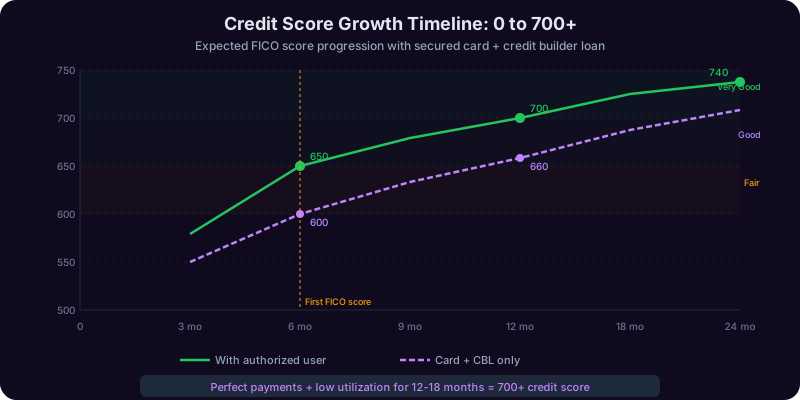
One of the most frustrating parts of building credit from nothing is not knowing when results will appear. Here is a realistic month-by-month timeline based on data from credit bureaus and financial institutions. This assumes you follow the combined strategy: secured credit card + credit builder loan + optional authorized user status.
The Credit-Building Timeline
| Month | Action | Expected Score | What Is Happening |
|---|---|---|---|
| Month 0 | Open secured card. Apply for credit builder loan. Become authorized user (if possible). | No score (FICO). Possibly VantageScore within weeks if AU. | Accounts are opened but have no payment history yet. Bureau files are created. |
| Month 1 | First charge on secured card. First CBL payment. Statement closes. | VantageScore may appear: 550-620 | First data points are reported. VantageScore can generate a score with minimal history. |
| Month 2-3 | Continue on-time payments. Keep utilization under 10%. | VantageScore: 600-650 | Consistency is being established. Each on-time payment strengthens the pattern. |
| Month 4-5 | Continue perfect payments. Do not apply for any new credit. | VantageScore: 630-670 | Your thin file is thickening. Payment history is becoming established. |
| Month 6 | FICO score is generated (minimum 6 months of history required). Review for secured card upgrade. | FICO: 630-680. VantageScore: 650-690. | Milestone moment. You now have a FICO score. Capital One may auto-upgrade your secured card. |
| Month 7-9 | Request credit limit increase on secured card (or upgrade to unsecured). Continue CBL payments. | FICO: 650-700. VantageScore: 670-710. | Score is climbing. History length is building. You may qualify for entry-level unsecured cards. |
| Month 10-12 | CBL term may end (funds released). Consider applying for first unsecured card. | FICO: 670-720. VantageScore: 690-730. | One year of perfect payments. You are transitioning from "thin file" to "established." |
| Month 13-18 | Maintain all accounts. Use new unsecured card responsibly. Old secured card stays open. | FICO: 700-740. VantageScore: 710-740. | "Good" credit territory. Most mainstream credit products are available to you. |
| Month 18-24 | Credit age is building. Consider a second unsecured card only if needed. | FICO: 710-750. VantageScore: 720-750. | "Very Good" range is within reach. Auto loans at competitive rates. Rental applications are easy. |
Important Caveats
- These ranges assume zero negative marks. One missed payment, one collection account, or one charge-off resets the timeline significantly. A single 30-day late payment in month 3 could keep you below 650 for another year.
- Authorized user impact varies. If you are added to a 15-year-old card with a $20,000 limit, your starting score will be higher than someone with only a new secured card. Authorized user accounts can add 30-80 points depending on the card's profile.
- Your credit limit matters. A $200 secured card limit means spending $20 puts you at 10% utilization. If you accidentally spend $100, you are at 50% utilization, which will significantly lower your reported score that month. The lower your limit, the more carefully you must manage every charge.
- Scores fluctuate monthly. Do not panic if your score drops 10-20 points from one month to the next. Normal variation due to reporting timing, utilization changes, and scoring model updates is common. Focus on the trend over 3-6 months, not any single number.
Accelerators That Can Speed Up the Timeline
- Experian Boost: Adding rent, utilities, phone, and streaming payments can add 10-30 points to your Experian FICO 8 score immediately.
- UltraFICO: Linking your bank account can add points if you maintain a positive balance, avoid overdrafts, and have account history.
- Multiple accounts reporting: Two accounts (secured card + CBL) reporting on-time payments builds score faster than one.
- Authorized user on an aged account: Instantly adds history depth that takes years to build on your own.
The Finance Copilot can track your credit-building progress against this timeline and alert you when you are on track for milestone upgrades like your first unsecured card approval or qualifying for better insurance rates.
8 Mistakes That Destroy New Credit (and How to Avoid Them)
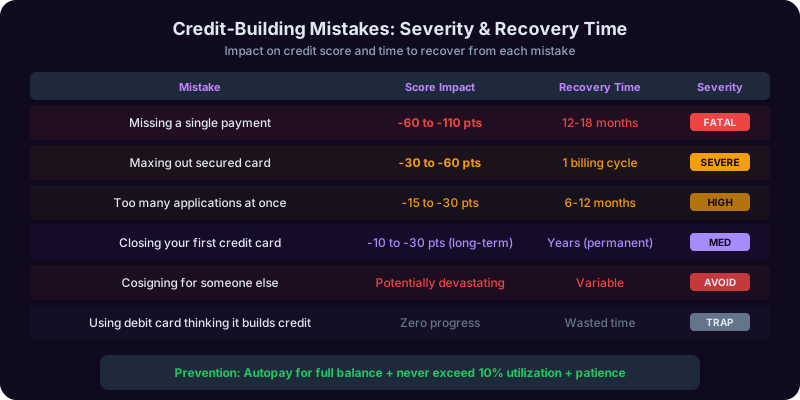
Building credit takes months of consistent behavior. Destroying it takes one bad decision. Here are the most common mistakes that set new credit builders back, ranked by severity.
Mistake 1: Missing a Single Payment
Damage: Catastrophic (60-110 point drop). A single payment that is 30+ days late is reported to the credit bureaus and stays on your report for 7 years. For someone with a thin file and a 660 score, this can drop you to 550-600. The fix takes 12-18 months of perfect payments to partially recover.
How to avoid it: Set up autopay for the full balance on every credit card and autopay for the minimum on loans (then pay extra manually). Set backup calendar reminders 5 days before each due date. Use the Budgeting Copilot to build a bill-tracking system.
Mistake 2: Maxing Out Your Secured Card
Damage: Severe (30-60 point drop, but recoverable in one billing cycle). With a $200 credit limit, spending $180 puts you at 90% utilization. Even if you pay it off by the due date, if the statement closes while the balance is high, that 90% utilization is what gets reported. Unlike payment history, utilization resets each month, but the damage to your score lasts until the next low-utilization report.
How to avoid it: Set a personal spending limit of $20 per month on a $200 limit card (10% utilization). If you need to make a larger purchase, pay it off before the statement closing date, not just the due date.
Mistake 3: Applying for Too Many Cards at Once
Damage: Moderate (5-10 points per hard inquiry, cumulative). Three credit card applications in a month generates three hard inquiries. On a thin file, this can drop your score 15-30 points and signals to lenders that you are desperate for credit. Worse, the denials themselves are not reported, but the inquiries without corresponding new accounts look bad.
How to avoid it: Apply for one secured card to start. Wait at least 6 months before applying for anything else. When you do apply for a second card, research approval requirements first.
Mistake 4: Closing Your First Credit Card
Damage: Long-term (reduces average account age, increases utilization). Your first credit card becomes your oldest account. Closing it removes that age anchor from your credit file (after it ages off the report in about 10 years) and reduces your total available credit. Some new builders close their secured card as soon as they get an unsecured one. This is a mistake.
How to avoid it: Keep your first card open forever. If it has an annual fee, ask the issuer to downgrade it to a no-fee version. Put one small recurring charge on it (a $5 subscription) to keep it active.
Mistake 5: Cosigning for Someone Else
Damage: Potentially devastating. When you cosign a loan or credit card, you are 100% responsible for the debt if the other person does not pay. Their missed payments appear on your credit report. Their maxed-out card becomes your high utilization. New credit builders should never cosign for anyone until they have established credit of their own for several years.
How to avoid it: Say no. Point the other person to the strategies in this guide to build their own credit independently.
Mistake 6: Ignoring Fraudulent Activity
Damage: Variable, but potentially severe. Identity theft can result in fraudulent accounts, unauthorized inquiries, and collection accounts on your report. New credit builders often do not monitor their credit because they assume there is nothing to steal. But a thin file is actually more vulnerable because there is less data to contradict the fraud.
How to avoid it: Set up free credit monitoring through Credit Karma, your bank, or Experian. Review your credit report at AnnualCreditReport.com every 4 months. Freeze your credit at all three bureaus (Equifax, Experian, TransUnion) and temporarily unfreeze only when you are applying for credit.
Mistake 7: Using a Debit Card Thinking It Builds Credit
Damage: Zero credit progress. Debit cards do not report to credit bureaus. No matter how responsibly you use your debit card, it does nothing for your credit score. Many young people use debit cards exclusively for years, thinking they are building a financial track record. They are not.
How to avoid it: Use a credit card for small purchases you would otherwise put on debit, and pay the credit card balance in full from your checking account. You get credit-building benefits, purchase protections, and sometimes rewards.
Mistake 8: Falling for Credit Repair Scams
Damage: Financial loss + no improvement. Companies that promise to "fix" your credit for $500-$2,000 are almost always scams. They cannot do anything you cannot do yourself for free (dispute inaccurate information, negotiate with creditors). Under the Credit Repair Organizations Act, it is illegal for these companies to charge you before services are performed, yet many do.
How to avoid it: Dispute inaccurate information yourself (free) through AnnualCreditReport.com. If you need help, contact a HUD-approved credit counseling agency (free or low-cost). Never pay upfront for credit repair. The Finance Copilot can walk you through the dispute process step by step.
Building credit is a marathon, not a sprint. The strategies in this guide, combined with patience and consistency, will get you from invisible to 700+ within 12-18 months. The Finance domain resources on Copilotly provide additional tools for managing your complete financial picture as your credit grows. And when you are ready to start putting that new credit score to work, explore our guides on getting started with investing and building an emergency fund.
This guide provides general financial information for educational purposes. It is not financial advice. Credit products, terms, and availability change frequently. Always read the terms and conditions of any financial product before applying. Consult a qualified financial advisor or HUD-approved credit counselor for guidance specific to your situation.
Frequently Asked Questions
Recommended Copilots
Recommended Copilots
Get a personalized credit-building plan based on your current situation and goals
Try Free →Set up a spending system that keeps credit utilization low while building savings
Try Free →Start investing once your credit foundation is established and emergency fund is built
Try Free →Understand how student loan payments interact with your credit-building strategy
Try Free →Continue Exploring
Related Articles
Get Answers From the Finance Copilot
Tell the Finance Copilot your starting point - no credit, thin file, or rebuilding - and get a step-by-step plan with specific product recommendations, monthly targets, and timeline estimates tailored to your situation.